
InspectAPedia® FREE Encyclopedia of Building & Environmental Construction, Diagnosis, Maintenance & Repair |
Question? Just ask us! InspectAPedia
|
 Pascal Calculations & Building Air Infiltration Rate Variation
- POST a QUESTION or COMMENT about pascal calculations, building air infiltration rate, building air exchange rate, ACH or air changes per hour rates
Pascal calculations to express building pressure & air infiltration rates:
This article explains methods of measuring building air infiltration rates and the related calculations of pascals. This website discusses how to inspect, diagnose problems in, and install or repair building insulation & ventilation systems including air leaks, air infiltration, heating cost, heat loss, moisture, & interior stains.
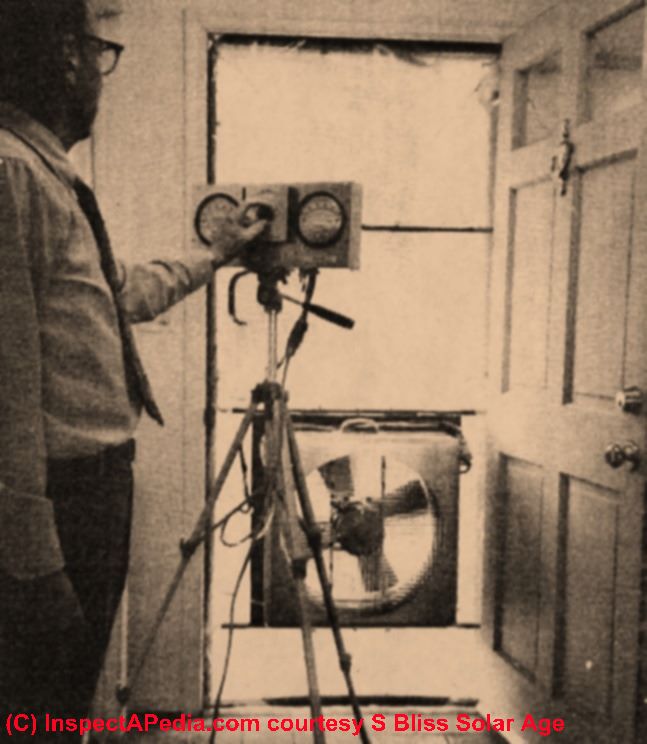
Our page top photo, courtesy of Steven Bliss, shows an Infiltec blower door test being performed at a home. Accompanying text is reprinted/adapted/excerpted with permission from Solar Age Magazine - editor Steven Bliss.
InspectAPedia tolerates no conflicts of interest. We have no relationship with advertisers, products, or services discussed at this website.
Building Air Infiltration Rates & How to Calculate Pascals
- Q&A on use of Pascal Calculation - original text. Use your browser's back button to return to this page
The question-and-answer article about Pascals and using rules of thumb to estimate building air infiltration rates based on blower door tests found just below paraphrases, quotes-from, updates, and comments an original article from Solar Age Magazine and written by Steven Bliss.
Pascal-Calculations
I am confused by a slight lack of consistency in magazine articles about air leakage rates. Solar Age Magazine February 1984 p. 47 said that to get the normal air leakage you divide the building air changes per hour (ACH) at 50 Pascals [of pressure, e.g. by blower door testing] by 7.
But the May 1984 issue of the same magazine said 10 ACH at 50 Pascals equals roughly 0.5 natural ACH (dividing by 20). Which one is correct? -- Joe Bockelman, Dayton OH
Answer: Building air infiltration rate rules of thumb
Definition of Pascals (Pa): Pascals is a unit of measurement of pressure or an SI derived unit of pressure or stress. Pascal measurements are used in evaluating building air infiltration rates, often using blower door tests, where relatively small absolute pressure differences become important, so we need a sensitive unit of measurement.
One Pascal or Pa equals one newton per square meter; one bar of pressure equals 100,000 Pa, one atmosphere equals 101,325 Pa, and one psi equals 6.894 x 10³ Pa.
A widely accepted rule of thumb for estimating the natural winter air infiltration rate in a building is to divide the ACH at 50 Pascals by 20.
This is most appropriate for a single-story detached house with no unusual wind loads.
This rough rule of thumb on air infiltration rates works pretty well for averages of large samples of homes, yet for a single home, it is not very reliable.
For example, the average air infiltration rate at 50 Pascals of 35 passive solar homes monitored by SERI was 11.1 ACH. The average natural infiltration rate of this sample (as measured by tracer gas) was 0.5.
So dividing by 20 would have worked well for the average.
Variation in Individual Building Air Infiltration Rates
However, for individual homes in this sample, the correct divisor ranged from 10 to 40. The wind speed, shape of the house, location of the cracks and air leaks, temperature differences, and use of combustion equipment all play a role.
A given number tends to work pretty well for a given type of house under similar conditions. The natural ACH in a single house, though, may change by as much as a factor of 10 depending on the time of year and weather variables.
See AIR SEALING STRATEGIES and also AIR LEAK DETECTION TOOLS for details about sealing air leaks in buildings.
See BRICK VENEER WALL INSULATION for a discussion of leaks at brick veneer walls insulated with foam board.
Here we include solar energy, solar heating, solar hot water, and related building energy efficiency improvement articles reprinted/adapted/excerpted with permission from Solar Age Magazine - editor Steven Bliss.
Readers should also see AIR LEAK DETECTION TOOLS (including an example of use of the blower door test to measure building air changes per hour)
...
Continue reading at AIR FLOW MEASUREMENT CFM, how to make air flow measurements, where to buy air flow measurement equipment. or select a topic from the closely-related articles below, or see the complete ARTICLE INDEX.
Or see these
Recommended Articles
- BLOWER DOORS & AIR INFILTRATION - testing building air change (ACH) rates
- AIR MOVEMENT in BUILDINGS - When, where, how & why air moves in buildings.
Suggested citation for this web page
PASCAL CALCULATIONS at InspectApedia.com - online encyclopedia of building & environmental inspection, testing, diagnosis, repair, & problem prevention advice.
Or see this
INDEX to RELATED ARTICLES: ARTICLE INDEX to BUILDING ENERGY SAVINGS
Or use the SEARCH BOX found below to Ask a Question or Search InspectApedia
Ask a Question or Search InspectApedia
Try the search box just below, or if you prefer, post a question or comment in the Comments box below and we will respond promptly.
Search the InspectApedia website
Note: appearance of your Comment below may be delayed: if your comment contains an image, photograph, web link, or text that looks to the software as if it might be a web link, your posting will appear after it has been approved by a moderator. Apologies for the delay.
Only one image can be added per comment but you can post as many comments, and therefore images, as you like.
You will not receive a notification when a response to your question has been posted.
Please bookmark this page to make it easy for you to check back for our response.
Our Comment Box is provided by Countable Web Productions countable.ca
Citations & References
In addition to any citations in the article above, a full list is available on request.
- "Enter the Blower Door", Steve Bliss, Solar Age, February 1984, p. 46-47 -- Adapted with permission, from original material to form this web page article.
- Sources of blower doors and more blower door test information:
- Princeton University's Center for Energy and Environmental Studies, http://www.princeton.edu/pei/energy/
- Retrotec Blower Door Sources: www.retrotecblowerdoor.com/ Minneapolis Blower Door Source Information
- Infiltec Blower Door Sources: Lightweight blower door and instrumentation are available from Infiltec - see their online catalog at www.infiltec.com/inf-catb.htm
- The Energy Conservatory Blower Door Source: - www.energyconservatory.com/products/products4.htm
- Best Practices Guide to Residential Construction, by Steven Bliss. John Wiley & Sons, 2006. ISBN-10: 0471648361, ISBN-13: 978-0471648369, Hardcover: 320 pages, available from Amazon.com and also Wiley.com. See our book review of this publication.
- Decks and Porches, the JLC Guide to, Best Practices for Outdoor Spaces, Steve Bliss (Editor), The Journal of Light Construction, Williston VT, 2010 ISBN 10: 1-928580-42-4, ISBN 13: 978-1-928580-42-3, available from Amazon.com
- In addition to citations & references found in this article, see the research citations given at the end of the related articles found at our suggested
CONTINUE READING or RECOMMENDED ARTICLES.
- Carson, Dunlop & Associates Ltd., 120 Carlton Street Suite 407, Toronto ON M5A 4K2. Tel: (416) 964-9415 1-800-268-7070 Email: info@carsondunlop.com. Alan Carson is a past president of ASHI, the American Society of Home Inspectors.
Thanks to Alan Carson and Bob Dunlop, for permission for InspectAPedia to use text excerpts from The HOME REFERENCE BOOK - the Encyclopedia of Homes and to use illustrations from The ILLUSTRATED HOME .
Carson Dunlop Associates provides extensive home inspection education and report writing material. In gratitude we provide links to tsome Carson Dunlop Associates products and services.
 | HOME | ABOUT | ASK a QUESTION | CONTACT | CONTENT USE POLICY | DESCRIPTION | POLICIES | PRIVACY | |
| © 2024 - 1985 Publisher InspectApedia.com - Daniel Friedman | |||||||||