
InspectAPedia® FREE Encyclopedia of Building & Environmental Construction, Diagnosis, Maintenance & Repair |
Question? Just ask us! InspectAPedia
|
 High R-Value Building Insulation Choices Described
- POST a QUESTION or COMMENT about High R-value insulation products & choices
Building insulation choices & properties:
This article discusses the properties of various building insulation materials: fiberglass insulation, expanded polystyrene insulation, foil-faced polyisocyanurate insulation, and extruded polystyrene.
InspectAPedia tolerates no conflicts of interest. We have no relationship with advertisers, products, or services discussed at this website.
Building insulation properties of fiberglass insulation, expanded polystyrene insulation, foil-faced polyisocyanurate insulation, and extruded polystyrene
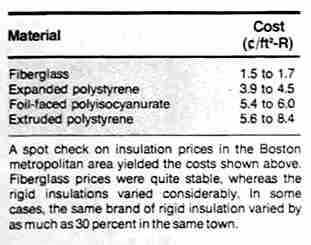
 The table of insulation properties at page top and accompanying text are reprinted/adapted/excerpted with permission from Solar Age Magazine - editor Steven Bliss.
"Insulation Options, a few facts to help you choose among foams and fibers":
This article explains the insulating properties and relative costs of common building insulating materials including fiberglass insulation, expanded polystyrene insulation, foil-faced polyisocyanurate insulation, and extruded polystyrene.
The insulation figure of merit, "cost of insulation per square foot R-value, is explained as a means of comparing insulating materials. While the insulation cost data in the original article dates back to November 1983, the concept of using an R-value normalized cost to evaluate insulation is useful today.
For superinsulated buildings the article concludes that a double-stud wall with fiberglass batts provided the greatest insulating value per dollar. However other insulating products may be a better choice depending on other construction details and space limitations.
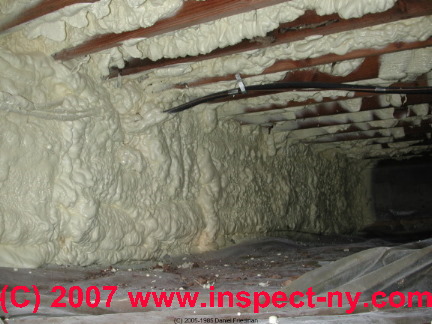
Our photograph (left) shows an insulation retrofit in a crawl space where icynene foam spray was applied to the crawl space wall and between the floor joists overhead.
The article also discusses the question of air permeability of fiberglass insulation and its impact on the actual insulating value of the material compared with impermeable (to air) foam insulation products. The impact of moisture on the R-value of fiberglass insulation is also discussed (it's low). Fiberglass both gains and loses moisture more rapidly than some other insulating products.
Foil-faced polyisocyanurate insulation such as the Thermax® and Hi-R® brands are discussed - these products give the highest R-value per inch among insulating materials. Also, as we tested in the 1970's, the use of these products combined with a 3/4" air space permits achieving an additional R 2.7 provided that the foil is clean and the gap or air space is uniform.
See POLYISOCYANURATE FOAM and IAQ for details about polyisocyanurate insulation use.
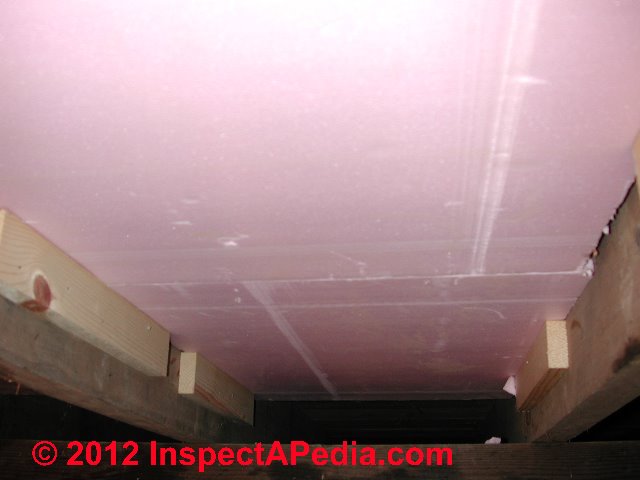
The polystyrene family of insulations are discussed and are recommended particularly for insulation below grade using expanded polystyrene (EPS or beadboard) and extruded polystyrene (such as Styrofoam® - photo at below left, or Foamular®).
 The article pointed out that in the 1980's there were more than 150 different manufacturers of EPS/beadboard and only three or four of extruded polystyrene.
Claims (perhaps by competitors) that EPS absorbs water are dismissed as nonsense - the material is used to float docks. The article also discusses the use of polystyrene insulation as a non-structural building sheathing (permitting insulating over building band joists and headers) and as an added control of air infiltration.
Problems reported with use of polystyrene as non-structural sheathing where horizontal wood siding is installed included loose clapboards, cupping or cracked clapboards, and nail pulling due to thermal movement of the foam.
The article concludes:
The wood problems are attributed to the tendency of these relatively impervious insulations to aggravate thermal and moisture cycling in the siding, since they soak up little heat and moisture themselves.
One solution may be to strap out the siding, though this reduces the savings obtained by eliminating the sheathing in the first place.
See POLYSTYRENE FOAM INSULATION for details about polystyrene foam board insulation use.
Here we include solar energy, solar heating, solar hot water, and related building energy efficiency improvement articles reprinted/adapted/excerpted with permission from Solar Age Magazine - editor Steven Bliss.
Current High-R Building Insulation Products for Super Insulated Buildings
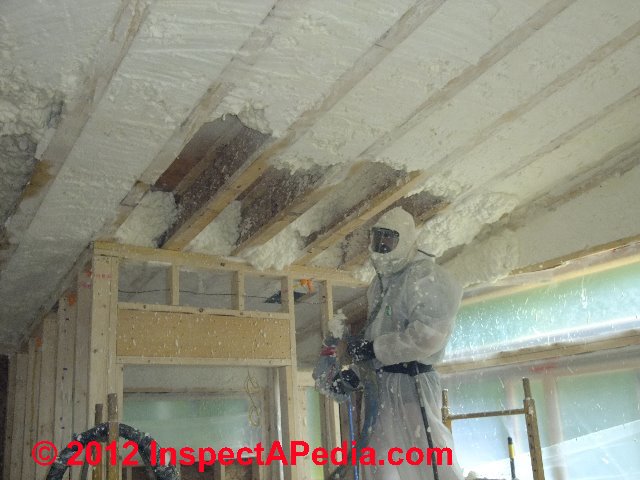 The high-R insulating panel building products currently in most common use are
and POLYISOCYANURATE FOAM and IAQ panels and
also polyurethane spray foam
URETHANE FOAM Deterioration, Outgassing
These materials have a typical R-value of about R-5 to R-6 per inch, though when installed with a radiant surface (that might help) and a 3/4" air gap, the R-value is increased substantially - as we detail below. Fiberglass batts, which are still most-widely used in residential construction, are about R-3 per inch.
Here are some currently-available high-R building insulation products as well as some specialty very high-R insulation materials:
- Aerogel has an R-value of about R-10 per inch, is 99% air and insulates up to 37 times higher R-value than fiberglass. The material is costly, and fragile, factors that have limited its use in residential construction. Work is in process to produce a less costly version.
- Barrier Ultra-R super high-R building panels, produced by Glacier Bay, use Aerogel and are rated up to R-30 per inch, or in Barrier Ultra-r™ panels, R-50 per inch.
The Ultra-R™ R-50 insulating panel is a rigid polypropylene-encased vacuum insulation panel that is custom made to the client's specified dimensions. The panels are also available with a fiberglass coating on one or both sides. (Used in refrigeration applications.)
The company also produces acoustic panels that are Ultra-db resistant and lightweight. Unlike the appliance insulation panels discussed in the original Q&A above on miracle insulation, these Aerogel based panels will continue to retain some, though reduced insulating value if punctured, performing at perhaps R-9 per inch.
The product is used in marine refrigerators, but in the future may be available as a residential construction product. The company is researching specialized products in medical, transportation, and aerospace applications.
Also see POLYPROPYLENE INSULATION - CERAMIC INSULATION- version of high temperature
treated PERLITE INSULATION - Eco-Panel polyurethane foam core structural insulated panels (SIPs)
are produced by Eco-Panels Corporation. The 3-inch thick panels include structural elements and panel locking devices.
The company offers a super-insulated 8.5-inch thick structural insulated panel and also produces roof panels. The 2.5 pound polyurethane foam used in these panels provides about R-7 per inch; 4-inch panels are rated at R-26, 6 1/2inch panels at R-40. - Hightherm R-24, Supertherm R30, and Superthermal R60 wall panels
are produced by Supertherm. Wallpanel® uses 18 gauge steel studs spaced 16" on center, staggered to support 24" o.c. roof trusses, combined with high-density (two pound) polystyrene foam insulation.
The higher density polystyrene foam insulation permits achieving an R-30 wall panel that is 6" thick (rather than 7" with lower density foam). The panels are finished with an insulating ceramic coating and are warranted for 25 years. - Low-E Housewrap Insulation™,
is a patented insulation consisting of a closed micro-cell foam core that is heat laminated to foil or polyethylene facings. This foam board insulating product is thin, provided in rolls, intended as a thermal break wrap that is moisture, rodent, and insect resistant.
The Low-E Manufacturer states that it outperforms 3-4" of fiberglass insulation. As the product literature points out, "All of these components are referred to as a system R-Value. A 3/4" air space facing the aluminum is ideal because convection currents cannot begin to move in an air space this small.
The aluminum actually increases the R-Value of the air space it faces. Low-E is manufactured using a 1/4" polyethylene foam core with scrim reinforced double-sided aluminum facings.
It can be used in all facets of the building industry where conventional insulations are used. It can be used alone or in conjunction with mass insulations for high R-systems. " The product is also advertised by some distributors for insulation retrofit products, attics, basements, under-slab insulation, etc. - Precision Panel R28 (R-4 to R-7 per inch) Laminated EPS foam core Structural Insulating Panels (SIPs)
are produced by Precision Panel Co. located in Idaho, ships insulating panels world wide. The 4-inch thick EPS foam core panels are laminated with exterior sheathing (OSB) and an interior sheathing (OSB or ?).
The foam core panels are prepared with window and door rough openings and accept edge splines or top and bottom plates for construction. They include wire chases and are cut to customer specifications. - STRAW BALE CONSTRUCTION has been considered a high-R building method for a long time and is discussed
at STRAW BALE CONSTRUCTION - STYROFOAM™ Brand Spray
Polyurethane Foam
R 6.1 per inch, (CM Series) produced by DOW Chemical is a "two-component, spray-applied polyurethane foam that creates a seamless, monolithic barrier for protection against water vapor and air on the interior of steel stud walls.
This closed-cell, 2-pcf spray foam successfully incorporates the Enovate 3000 blowing agent from Honeywell. This product is designed as a filler for the Thermax Wall System discussed below. - Super Therm® insulating ceramic coatings produced by Superior Solar Barrier ,
are used on buildings as well as freezers and refrigerators, intended as an impenetrable exterior coating. The coating uses a vacuumed microceramic hollow particle (ceramic bubbles) containing a gas,and providing minimal heat conductivity. The particles are distributed in a coating vehicle. - Thermax™ Wall System,
DOW Chemical, "addresses design considerations for commercial steel stud applications and is not relevant for most residential applications.
THERMAX™ Exterior Insulation
R6.5 per inch, consists of a glass-fiber-reinforced polyisocyanurate foam core faced with nominal 4 mil embossed BLUE™ acrylic-coated aluminum on one side and 1.25 mil embossed aluminum on the other. - Tuff-R™ and Super Tuff-R™,
Dow Building Solutions, have an R-value of R 6.5 per inch. Note that the R-value of this insulating board is increased to R-9.3 per inch if construction includes a 3/4" air space. These are closed-cell polyisocyanurate insulating foam core board products.
The foam core is sandwiched between a choice of exterior faces including aluminum foil, tri-plex aluminum foil, or polyester kraft paper combined with reinforced aluminum foil. One board side is blue, the other is radiant aluminum foil. These products must be covered with a minimum of 1/2" drywall or equivalent thermal barrier in building applications.
See POLYISOCYANURATE FOAM and IAQ.
Also see Q&A on use of Rigid Foam Insulating Board - [PDF]
Also see the Dow Product Literature for Tuff-R insulating board - [PDF] - Vacuum Super-Insulated R-28 Panels from RParts are sold as an alternative to aerogel products. The panels are produced by a third party manufacturer using DOW INstill foam cores sealed at high vacuum in a special multi-layer gas impermeable barrier membrane film.
Original Solar Age Magazine Article on High R Insulation Choices
Links to the original article in PDF form immediately below are preceded by the expanded/updated online version of this article above.
- Insulation_Options - PDF form, use your browser's back button to return to this page
- Insulation_Options - PDF form, part 2
...
Continue reading at INSULATION INSPECTION & IMPROVEMENT or select a topic from the closely-related articles below, or see the complete ARTICLE INDEX.
Or see these
Recommended Articles
- INSULATION FACT SHEET [PDF] OSTI (1997) advice on insulating your home
- INSULATION IDENTIFICATION GUIDE
- INSULATION R-VALUES & PROPERTIES
- PIPE INSULATION CHOICES, MATERIALS, TYPES
Suggested citation for this web page
INSULATION CHOICES & PROPERTIES at InspectApedia.com - online encyclopedia of building & environmental inspection, testing, diagnosis, repair, & problem prevention advice.
Or see this
INDEX to RELATED ARTICLES: ARTICLE INDEX to BUILDING INSULATION
Or use the SEARCH BOX found below to Ask a Question or Search InspectApedia
Ask a Question or Search InspectApedia
Questions & answers or comments about finding, using, diagnosing, repairing, or replacing water pressure gauges on private well systems.
Try the search box just below, or if you prefer, post a question or comment in the Comments box below and we will respond promptly.
Search the InspectApedia website
Note: appearance of your Comment below may be delayed: if your comment contains an image, photograph, web link, or text that looks to the software as if it might be a web link, your posting will appear after it has been approved by a moderator. Apologies for the delay.
Only one image can be added per comment but you can post as many comments, and therefore images, as you like.
You will not receive a notification when a response to your question has been posted.
Please bookmark this page to make it easy for you to check back for our response.
Our Comment Box is provided by Countable Web Productions countable.ca
Citations & References
In addition to any citations in the article above, a full list is available on request.
- Solar Age Magazine was the official publication of the American Solar Energy Society. The contemporary solar energy magazine associated with the Society is Solar Today. "Established in 1954, the nonprofit American Solar Energy Society (ASES) is the nation's leading association of solar professionals & advocates. Our mission is to inspire an era of energy innovation and speed the transition to a sustainable energy economy. We advance education, research and policy. Leading for more than 50 years. ASES leads national efforts to increase the use of solar energy, energy efficiency and other sustainable technologies in the U.S. We publish the award-winning SOLAR TODAY magazine, organize and present the ASES National Solar Conference and lead the ASES National Solar Tour – the largest grassroots solar event in the world."
- Steve Bliss's Building Advisor at buildingadvisor.com helps homeowners & contractors plan & complete successful building & remodeling projects: buying land, site work, building design, cost estimating, materials & components, & project management through complete construction. Email: info@buildingadvisor.com
Steven Bliss served as editorial director and co-publisher of The Journal of Light Construction for 16 years and previously as building technology editor for Progressive Builder and Solar Age magazines. He worked in the building trades as a carpenter and design/build contractor for more than ten years and holds a masters degree from the Harvard Graduate School of Education. Excerpts from his recent book, Best Practices Guide to Residential Construction, Wiley (November 18, 2005) ISBN-10: 0471648361, ISBN-13: 978-0471648369, appear throughout this website, with permission and courtesy of Wiley & Sons. Best Practices Guide is available from the publisher, J. Wiley & Sons, and also at Amazon.com - In addition to citations & references found in this article, see the research citations given at the end of the related articles found at our suggested
CONTINUE READING or RECOMMENDED ARTICLES.
- Carson, Dunlop & Associates Ltd., 120 Carlton Street Suite 407, Toronto ON M5A 4K2. Tel: (416) 964-9415 1-800-268-7070 Email: info@carsondunlop.com. Alan Carson is a past president of ASHI, the American Society of Home Inspectors.
Thanks to Alan Carson and Bob Dunlop, for permission for InspectAPedia to use text excerpts from The HOME REFERENCE BOOK - the Encyclopedia of Homes and to use illustrations from The ILLUSTRATED HOME .
Carson Dunlop Associates provides extensive home inspection education and report writing material. In gratitude we provide links to tsome Carson Dunlop Associates products and services.
 | HOME | ABOUT | ASK a QUESTION | CONTACT | CONTENT USE POLICY | DESCRIPTION | POLICIES | PRIVACY | |
| © 2024 - 1985 Publisher InspectApedia.com - Daniel Friedman | |||||||||