
InspectAPedia® FREE Encyclopedia of Building & Environmental Construction, Diagnosis, Maintenance & Repair |
Question? Just ask us! InspectAPedia
|
 Guide to Selecting & Installing, Solid Vinyl Windows
- POST a QUESTION or COMMENT about solid vinyl windows & vinyl clad windows: choices, installation, troubleshooting, repair
Solid vinyl windows, guide:
This article explains the properties of solid vinyl windows, vinyl window choices, and how to install and maintain vinyl windows.
In this article series we discuss the selection and installation of solid vinyl windows and doors, following best construction and design practices for building lighting and ventilation, with attention to the impact on building heating and cooling costs, indoor air quality, and comfort of occupants.
We review the proper installation details for windows and doors, and we compare the durability of different window and door materials and types.
InspectAPedia tolerates no conflicts of interest. We have no relationship with advertisers, products, or services discussed at this website.
- Daniel Friedman, Publisher/Editor/Author - See WHO ARE WE?
Guide to Buying & Installing Solid Vinyl Windows
This article includes excerpts or adaptations from Best Practices Guide to Residential Construction (Steve Bliss, J Wiley & Sons) , by Steven Bliss, courtesy of Wiley & Sons.
Article Contents
Solid vinyl windows can attribute their surge in popularity over the past decade to the fact that they have delivered a high-quality, maintenance-free product for about a third less cost than a clad window of comparable quality.
Contractors like the fact that the interior window sashes do not need painting, and homeowners like the notion that the frame and sill cannot rot (although vinyl windows do not live forever).
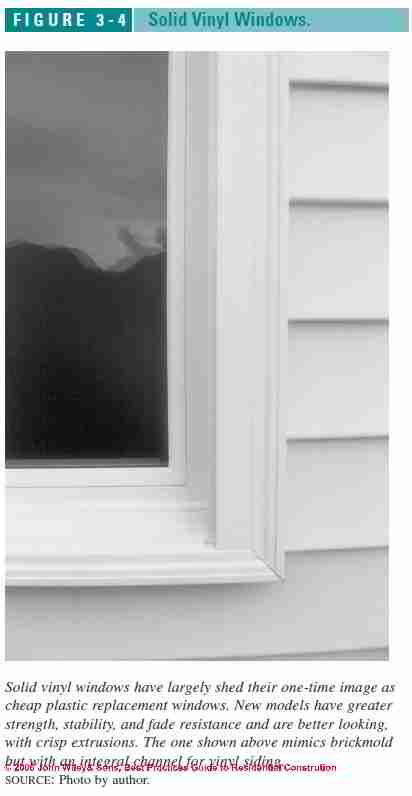
Solid vinyl windows have shed their image as cheap plastic replacement windows by continually improving to the point where premium quality vinyl windows are stronger and more dimensionally stable, more fade resistant, and better looking with crisper extrusions and better hardware (Figure 3-4).
As an added benefit, vinyl window manufacturers claim that their products can match the energy performance of wood windows.
While improvements in extrusions have made vinyl windows less bulky looking, they still do not have the crisp lines of a wood window, particularly on the interior, and vinyl window sash are unmistakably white plastic.
Still, vinyl windows have shed their stigma as a low-end product and are finding their way into more and more new homes across the spectrum from spec to upper-end custom.
Construction of Solid Vinyl Windows
Vinyl window quality starts with the chemistry.
A number of additives are blended into the raw vinyl to make it more dimensionally stable and more resistant to UV radiation, which otherwise can cause the vinyl to fade, chalk, and become brittle over time.
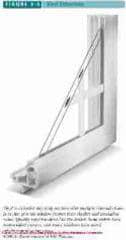
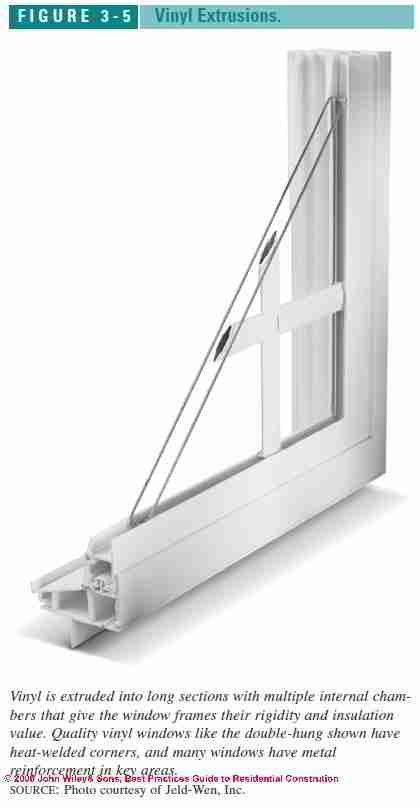
The vinyl is then extruded into long sections with multiple internal chambers that give the material its rigidity and insulation value from the trapped air (see Figure 3-5 at left).
The thin-walled plastic ranges in thickness from about .065 to .085 inch. All other things being equal, the thicker the plastic, the stronger the window component. However, extrusions can gain strength from having a well-engineered profile, as well (many European windows use much heavier .125-inch plastic, but U.S. manufacturers feel this would make them less competitive).
The extrusions are then cut and joined to create frames and sash. Nowadays, most corners are heat-welded, producing the strongest joints, although some corners are still mechanically fastened. Some manufacturers add steel or aluminum reinforcing, particularly to larger windows, to stiffen them and help them meet structural load requirements.
Typical places for reinforcing are sills, which have a tendency to sag in hot weather, lock rails, and mullions between mulled units.
Vinyl Window Options
 All vinyl windows have an integral nailing
flange, simplifying watertight installations
All vinyl windows have an integral nailing
flange, simplifying watertight installations
(see Window Flashing & Sealing Guide).
All standard window types, including tilt-turn, are available in solid vinyl today. All glazing types, except for true divided lites, are also available.
For the look of divided lites, the options are either snap-in grilles or between-the-glass grills.
Typical exterior trims include brickmold or nominal 4-inch flat casings with either an integral or snap-on J-channel to receive the ends of wood, vinyl, or fiber cement siding.
Window trims designed for stucco are widely available in the western states and Florida.
Colors are generally limited to white and beige, since dark colors absorb heat and raise vinyl temperatures to near 165°F, where it begins to soften and sag.
On the interior, most vinyl windows will accept either wood extension jambs or drywall returns.
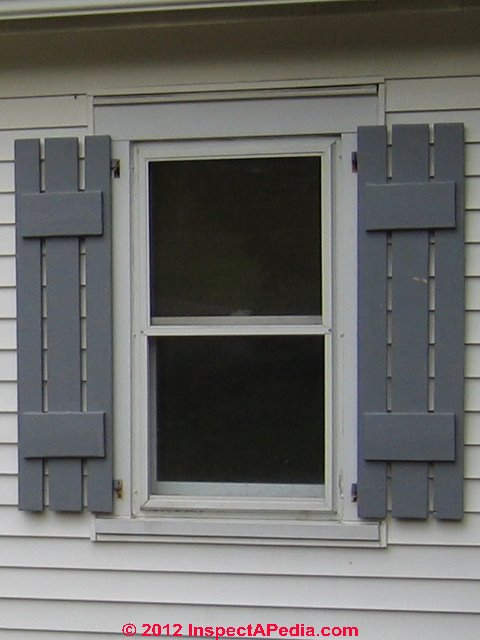
A solid vinyl replacement window may not be so easy to spot during a building survey, as our photo (above left) illustrates.
The replacement window is coverd by an aluminum storm and screen window, aluminum covered trim, etc.
Quality Issues with Vinyl Windows
 As with any building products, not all
vinyl windows are created equal. Many early models were
poorly made and subject to excessive thermal movement,
often opening at corners, fading prematurely, and losing
structural integrity from UV exposure, particularly in hot
climates.
As with any building products, not all
vinyl windows are created equal. Many early models were
poorly made and subject to excessive thermal movement,
often opening at corners, fading prematurely, and losing
structural integrity from UV exposure, particularly in hot
climates.
Warping was a complaint for some PVC vinyl windows, as we discuss
at VINYL / PVC WINDOW WARPING.
Most window manufacturers today have overcome these problems with better vinyl formulations, improved extrusion design, and heat welding at corners. Many also use metal reinforcing at strategic points, such as meeting rails, sills of large units, and between mulled units.
Since the chemistry, extrusion design, metal reinforcing, and other determinants of quality are hidden from view, however, the best approach is to stick with an established manufacturer and to look for a certification label from the American Architectural Manufacturers Association (AAMA).
AAMA established a separate standard for vinyl windows in 1997, which includes tests for strength, dimensional stability, strength of corner welds, heat and impact resistance, and weathering. The main features to look for include:
- Heat-welded corners
- Metal reinforcing, particularly on larger units
- Solid, heavy extrusions with little obvious flex
- Good quality hardware
Installation Procedure for Vinyl Windows
As reported in Best Practices Guide to Residential Construction (Steve Bliss, J Wiley & Sons) Chapter 3, BEST PRACTICES GUIDE: WINDOWS & DOORS:
High Rate of Thermal Expansion in Vinyl Windows, allow for
In general, vinyl windows install the same as other flange-type windows, although the installer must take into account vinyl’s high rate of thermal expansion.
A 6-foot-wide window can expand as much as 5/16 inch from 0°F to 100°F. To prevent problems, It is best to leave a 1/8 - to 1/4 -inch gap between the window and siding or wood trim (more in cold weather, less in hot). Good detailing of this joint is especially important with stucco, which can crack if set too tightly against the window or leak if the caulk joint fails.
Thermal expansion can also cause window sash to bind in hot weather if the rough opening is too small to accommodate the movement. And in very cold weather, some vinyl windows can bow inward due to temperature differences on either side of the window.
Sturdy extrusion profiles with metal reinforcing can help prevent this. A related concern is sagging of the sill during hot weather— vinyl starts to soften and distort at about 165°F, a temperature easily reached on the surface of a dark building in direct sun. To prevent sagging, some manufacturers reinforce the sill, and all recommend specific shim spacing under the sill.
Some vinyl window installations require continuous support along the length of the sill, which is easiest to achieve by using a double 2x sill with leveling shims in between.
Vinyl Window Installation Nailing Recommendations
Nailing recommendations for vinyl windows also vary among manufacturers. Some recommend driving nails tight; some suggest leaving the nail heads proud. Some recommend against nailing the head flange or corners; others require it. To avoid warranty problems, it is always best to closely follow the manufacturer’s instructions regarding the rough opening, shimming, nailing, and other installation details. Other general recommendations that apply to all windows include:
- In hot weather, do not store vinyl windows in a container, such as a trailer, or lean them against a wall, as they can permanently deform.
- Seal around openings with flexible flashing before
installing the window
(see Window Flashing & Sealing Guide). - Set the nailing fin in a bead of high-quality caulking.
- Before nailing, make sure the side jambs are plumb and do not bow in or out in the center. Some installers use a wood spacer to hold the two side jambs parallel.
- Do not puncture the nailing fin when installing trim or siding.
- Do not use expanding foam to seal around the window frame on the interior.
Also see WINDOW TYPES - Photo Guide.
Industry Associations for Windows & Doors
American Architectural Manufacturers Association (AAMA) www.aamanet.org
Efficient Windows Collaborative www.efficientwindows.org
National Fenestration Rating Council (NFRC) www.nfrc.org Sustainable by Design www.susdesign.com
Shareware calculators for sun angles, solar heat gain, and shading
Window and Door Manufacturers Association (WDMA) www.wdma.com
-- Adapted and paraphrased, edited, and supplemented, with permission from Best Practices Guide to Residential Construction (Steve Bliss, J Wiley & Sons) .
...
Reader Comments, Questions & Answers About The Article Above
Below you will find questions and answers previously posted on this page at its page bottom reader comment box.
Reader Q&A - also see RECOMMENDED ARTICLES & FAQs
Question:
(Sept 5, 2014) Anonymous said:
how do I put j channel back around a window that had built in j channel when replacing it?
Reply:
You'll need to buy j channel, cut to length, and nail it on place, possibly lifting existing siding to do so.
...
Continue reading at VINYL / PVC WINDOW WARPING or select a topic from the closely-related articles below, or see the complete ARTICLE INDEX.
Or see
VINYL SIDING or WINDOW PLASTIC ODORS
WINDOWS & DOORS - home
WINDOW & DOOR FLASHING TAPE DETAILS
Suggested citation for this web page
VINYL WINDOWS at InspectApedia.com - online encyclopedia of building & environmental inspection, testing, diagnosis, repair, & problem prevention advice.
Or see this
INDEX to RELATED ARTICLES: ARTICLE INDEX to DOORS & WINDOWS
Or use the SEARCH BOX found below to Ask a Question or Search InspectApedia
Ask a Question or Search InspectApedia
Try the search box just below, or if you prefer, post a question or comment in the Comments box below and we will respond promptly.
Search the InspectApedia website
Note: appearance of your Comment below may be delayed: if your comment contains an image, photograph, web link, or text that looks to the software as if it might be a web link, your posting will appear after it has been approved by a moderator. Apologies for the delay.
Only one image can be added per comment but you can post as many comments, and therefore images, as you like.
You will not receive a notification when a response to your question has been posted.
Please bookmark this page to make it easy for you to check back for our response.
IF above you see "Comment Form is loading comments..." then COMMENT BOX - countable.ca / bawkbox.com IS NOT WORKING.
In any case you are welcome to send an email directly to us at InspectApedia.com at editor@inspectApedia.com
We'll reply to you directly. Please help us help you by noting, in your email, the URL of the InspectApedia page where you wanted to comment.
Citations & References
In addition to any citations in the article above, a full list is available on request.
- Basic Housing Inspection, US DHEW, S 352.75 U48, p.144, out of print, but is available in most state libraries; New York State version, ca 1955, source of our window parts and window repair sketches.
- Best Practices Guide to Residential Construction, by Steven Bliss. John Wiley & Sons, 2006. ISBN-10: 0471648361, ISBN-13: 978-0471648369, Hardcover: 320 pages, available from Amazon.com and also Wiley.com. See our book review of this publication.
- Our recommended books about building & mechanical systems design, inspection, problem diagnosis, and repair, and about indoor environment and IAQ testing, diagnosis, and cleanup are at the InspectAPedia Bookstore. Also see our Book Reviews - InspectAPedia.
- In addition to citations & references found in this article, see the research citations given at the end of the related articles found at our suggested
CONTINUE READING or RECOMMENDED ARTICLES.
- Carson, Dunlop & Associates Ltd., 120 Carlton Street Suite 407, Toronto ON M5A 4K2. Tel: (416) 964-9415 1-800-268-7070 Email: info@carsondunlop.com. Alan Carson is a past president of ASHI, the American Society of Home Inspectors.
Thanks to Alan Carson and Bob Dunlop, for permission for InspectAPedia to use text excerpts from The HOME REFERENCE BOOK - the Encyclopedia of Homes and to use illustrations from The ILLUSTRATED HOME .
Carson Dunlop Associates provides extensive home inspection education and report writing material. In gratitude we provide links to tsome Carson Dunlop Associates products and services.
 | HOME | ABOUT | ASK a QUESTION | CONTACT | CONTENT USE POLICY | DESCRIPTION | POLICIES | PRIVACY | |
| © 2025 - 1985 Publisher InspectApedia.com - Daniel Friedman | |||||||||