
InspectAPedia® FREE Encyclopedia of Building & Environmental Construction, Diagnosis, Maintenance & Repair |
Question? Just ask us! InspectAPedia
|
 Best Practices Guide to Lighting for Building Interiors
- POST a QUESTION or COMMENT about interior lighting choices, design, installation, specifications & requirements or codes
Guide to buying, installing, & troubleshooting interior building lighting.
This article series details guidelines for selecting and installing interior lighting to meet the requirements for different building areas.
InspectAPedia tolerates no conflicts of interest. We have no relationship with advertisers, products, or services discussed at this website.
Choosing & Installing Interior Lighting: Best Practices Guide
With the exception of purely decorative lighting fixtures, all lighting fits into one of three main categories: ambient, task, and accent. Most rooms use a mixture of lighting types to create visual interest and to meet the functional needs of the space.
[Click to enlarge any image]
A space lit only by indirect light sources can seem visually flat, while a space lit only by directed light from spots and floods can seem harsh and cast dark shadows.
Similarly, a space lit only by accent lighting can look like an art museum and leave people in the dark. A balanced combination of strategies works best.
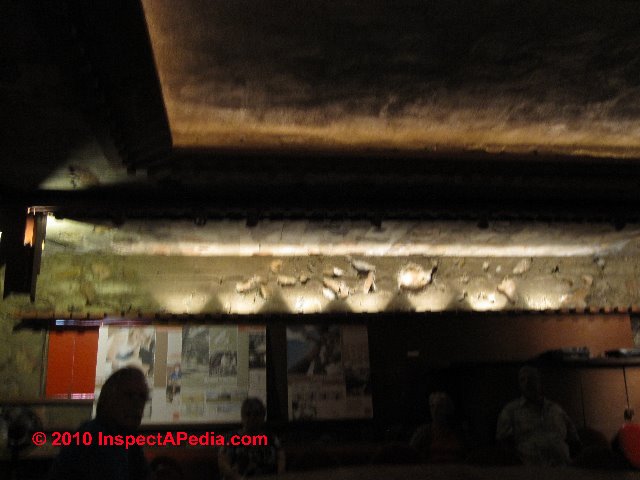
Our page to photo (Taliesin West, Scottsdale, AZ, D Friedman) illustrates two of several indoor lighting methods used by Frank Lloyd Wright in "the bunker", originally a storage room, currently used for meetings, and built with no windows.
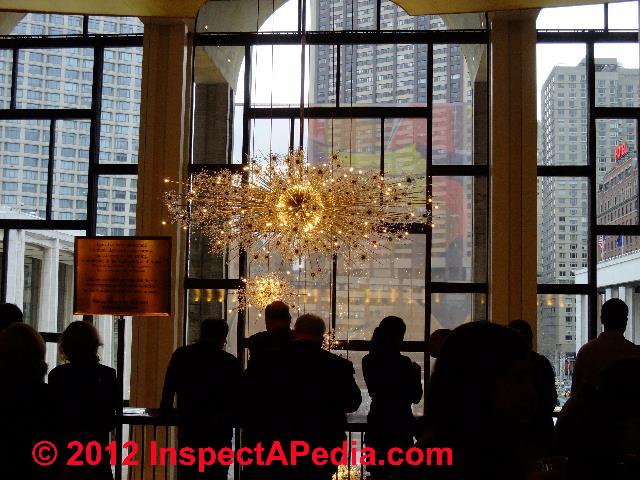
Our photo (above left) illustrates lighting in the lobby of the New York Metropolitan Opera building in New York City.
This article includes excerpts or adaptations from Best Practices Guide to Residential Construction (Steve Bliss, J Wiley & Sons) , by Steven Bliss, courtesy of Wiley & Sons.
Definition of Ambient Lighting
 Ambient lighting is the general background illumination
that is bright enough to allow people to move about
safely and perform simple tasks. Ambient lighting can be
achieved by directly lighting the lower part of the room
(direct lighting), or by reflecting light off the ceiling and
upper half of the room (indirect lighting).
Ambient lighting is the general background illumination
that is bright enough to allow people to move about
safely and perform simple tasks. Ambient lighting can be
achieved by directly lighting the lower part of the room
(direct lighting), or by reflecting light off the ceiling and
upper half of the room (indirect lighting).
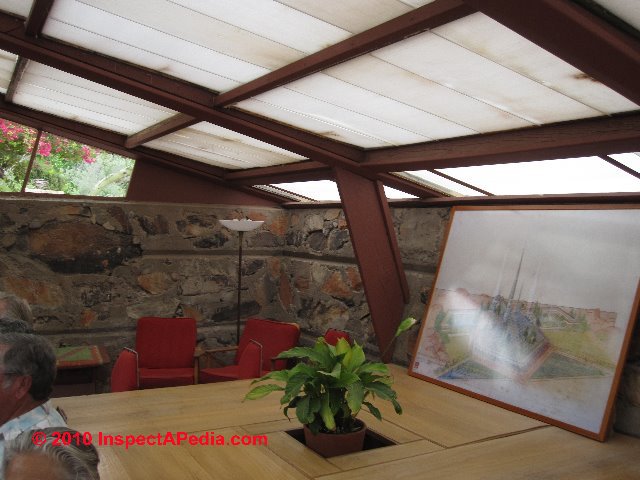
Our photo (left) shows how Frank Lloyd Wright took advantage of natural lighting thorough a translucent roof at Taliesin West in Scottsdale, AZ. The original roof was white canvas.
Reflecting light upward off the ceiling and upper walls tends to give a room a spacious feeling and soften shadows on objects and faces. It can be achieved with built-in coves, wall sconces, and pendants that direct light upward, or freestanding torchiere-style floor lamps.
Lighting just the lower part of the room can create a more intimate feeling. Options include recessed lights and wall and ceiling fixtures that direct light downward
. Fixtures with diffusers will help prevent glare. Evenly illuminating a wall with downlights called “wall washers” is another way to provide soft ambient light and also makes a room feel larger. Many surface-mounted and hanging luminaires project light in more than one direction, providing both uplighting and direct lighting in a single fixture.
Definition of Task Lighting
For details see TASK LIGHTING, DEFINITION, USES. Excerpts are below.
Task lighting is bright light directed to a specific surface, like a countertop or desk, to illuminate activities such as reading, homework, meal preparation, or laundry. For reading and desk work, task lighting should be bright and well diffused and come from the side or from over the shoulders.
Overhead light often casts shadows from a person’s head and body onto the work surface.
Also, light from directly overhead or in front of a person is prone to cause glare (veiling reflection) on shiny work surfaces, such as a glossy magazine. Light coming from one or both sides of the work reduces glare. For example, a table or floor lamp on the side is effective for reading or desk work.
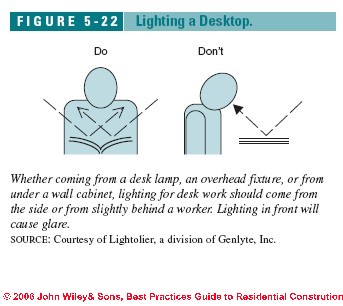
Under cabinet lighting can also be effective for desk work if placed toward the front of the cabinet on either side of the occupant (see Figure 5-22).
Where a computer screen is used, avoid bright sources of overhead light that reflect off the screen. Also keep the screen at right angles to windows if possible to avoid glare.
For kitchen work, laundry, or hobbies, concentrated light from above can be effective as long as the fixtures are placed so the occupants do not shade the work surface.
Under cabinet lighting is another effective strategy for placing bright task lighting on a kitchen counter or workbench.
Explanation & Uses of Accent Lighting
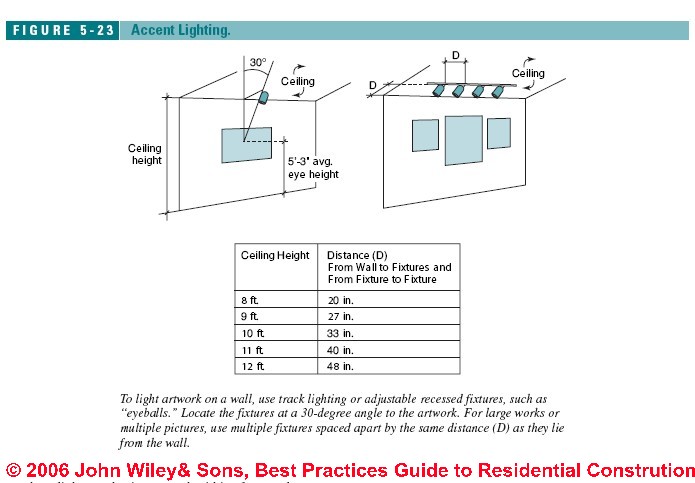
Accent lighting, sometimes called “object lighting,” directs light to specific objects, such as artwork, furniture, plants, or architectural features.
When lighting a single object or work of art, use a directional source, such as a PAR (parabolic aluminized reflector) or BR (bulged reflector) lamp in a track, or an adjustable recessed fixture, such as an “eyeball.” Position the fixture so the light strikes the wall at a 30-degree angle from the vertical.
When lighting a large picture or grouping of pictures,
it is often best to illuminate the entire wall section with a
wash of light from multiple track lights or adjustable recessed
fixtures.
For consistent lighting across the wall without a “scalloping” pattern, use special “wall washer” fixtures or non directional lamps (A-bulbs or compact fluorescent's) to diffuse the light beams (Figure 5-23).
Definition & Uses of Decorative Lighting
Decorative lighting includes candlestick chandeliers and sconces, decorative table lamps, and other fixtures whose main function is to provide luminous “sparkle” to a room.
Definitions & Glossary of of Common Lighting Terms
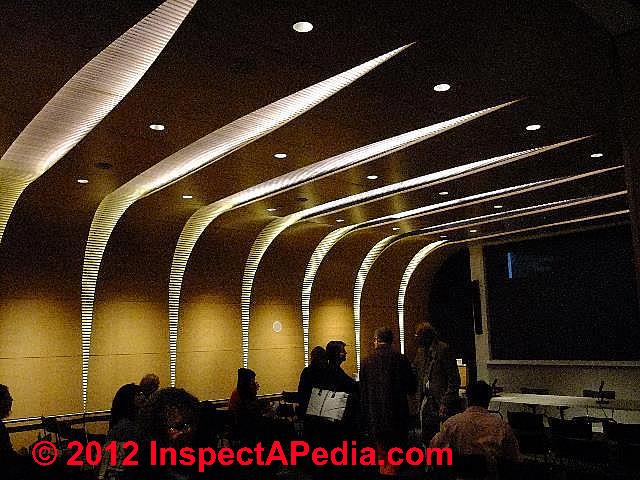
Our photo illustrates interesting recessed lighting in the Bard Center, New York City.
- Ballast: A device that regulates the flow of electricity to start and operate fluorescent and other discharge type lamps.
- Beam angle: The angle of the central cone of light (the beam spread) cast by a reflector-type lamp, beyond which the beam intensity is less than 50% of the maximum. Generally, a lamp with a beam angle of less than 25 degrees is considered a spot; with an angle greater than 25 degrees, a flood.
- Diffused light: Light that is dispersed in a wide pattern with no directional quality, similar to outside conditions on an overcast day. Glare is reduced, but such light may tend to wash out and flatten objects.
- Diffuser: A glass or plastic lens over a lamp that scatters light in all directions. In fluorescent downlights, a plastic or metal grid is often used to block glare and direct the light downward. Deep-cell parabolic louvers are the most efficient grid configuration.
- Efficacy: The light output of a lamp per electricity consumed, expressed as lumens per watt. Fluorescent's are three to five times more efficient than standard “A” lamp incandescent's.
- Footcandles: A measure of the total light falling on a surface. One foot candle (fc) is equal to one lumen per square foot, originally based on the illumination of one candle held one foot from a surface.
- Lamp: A light bulb or fluorescent tube. Types of lamps are explained
at Lamp & Bulb Abbreviations & Type and at Lamp & Bulb Types, Indoor - Lumens: A measure of the light output of a lamp (light bulb) or other light source. A candle provides about 12 lumens, a 60-watt soft light bulb about 850 lumens. Details are at Lumens, Definition, comparisons.
- Luminaire: Any lighting fixture or built-in lighting system, such as a cove or valence.
- Wattage: A measure of the energy consumption of a lamp or other electrical device. More efficient lamps produce more lumens for the same wattage consumed.
Guide to Recommended Lighting Levels Indoors
For details see GUIDE TO RECOMMENDED LIGHTING LEVELS FOR INDOOR AREAS, TABLES & RULES OF THUMB FOR INTERIOR LIGHTING
Excerpts are below.
Many factors affect the illumination needed for a specific task. An often overlooked factor is the age of the occupants. At 60 years old, we need two to three times the light we needed at age 20, and also more shielding and diffusers since older eyes are more sensitive to glare. T
he other main factors in determining lighting requirements are how detailed the work is and the level of contrast and reflectance of the work surface.
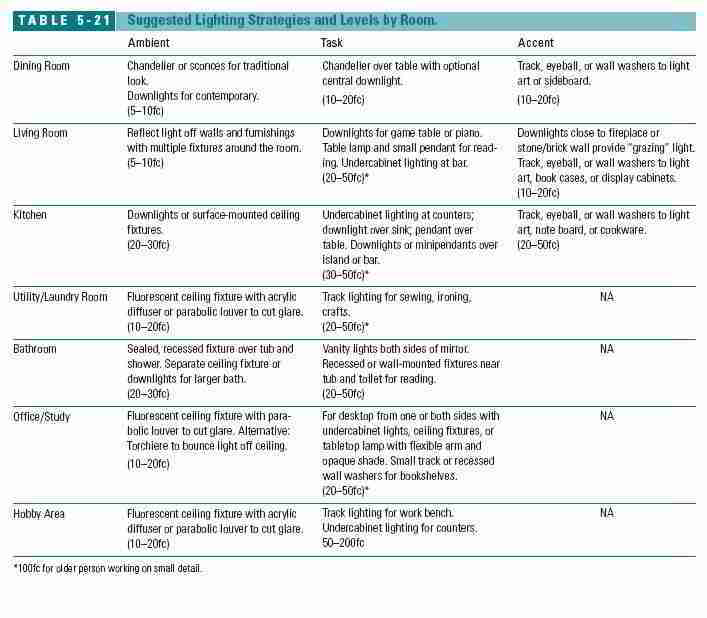
Table 5-21 below shows the recommended lighting along with common strategies for each type of room. For task lighting, the low numbers in each range represent the light needed for simple tasks with high contrast (reading large black type on white paper). T
he high number is for tasks with more detail or lower contrast (reading the newspaper). For very detailed, low-contrast work or for older persons, light levels of 100 footcandles are often needed.
Interior Lighting Rules of Thumb
Also see GUIDE TO RECOMMENDED LIGHTING LEVELS FOR INDOOR AREAS, TABLES & RULES OF THUMB FOR INTERIOR LIGHTINGThe illumination level on a surface depends on many factors, including the colors of the room and furnishings and the type of lamp and fixture. High ceilings, dark colors, and diffusers on fixtures all reduce light levels.
The commonly used black baffles in recessed lights reduce output by up to 40%. Tightly focused spots produce much higher light levels than wide floods. The distance from the light source is also critical. Doubling the distance to a lamp reduces the lighting level by a factor of four. So moving the light closer to the task is often the simplest way to provide a big boost in lighting levels.
As a starting point for design in kitchens, baths, home offices, and other brightly lit spaces, provide at least 2 watts of incandescent light or 3/4-watt of fluorescent light per square foot of floor area.
In larger spaces, using multiple fixtures will provide more even lighting and reduce glare. Also, since lighting needs change throughout the day with changes in daylight and usage, it is good to provide flexibility by separately switching groups of lights and adding dimmers. Increase these minimums by 50 to 100% for:
- Valences or other indirect lighting schemes
- Rooms with dark surfaces
- Lighting placed in cathedral ceilings or other high ceilings
- Recessed lighting with diffusers, black baffles, or
other light-blocking trim. (also see recessed lighting use outdoors, discussed
at LIGHTING, EXTERIOR GUIDE)
Lamp Types & Types of Bulbs for Indoor Lighting
For details see LAMP & BULBS TYPES, INDOOR
Excerpts:
There is a vast array of choices in light bulbs, known in the lighting industry as “lamps.” For residential lighting, the main choices are incandescent, halogen, low-voltage, tubular fluorescent, and compact fluorescent.
Which lamp to choose for a given application will depend upon the amount of light needed (lumens), color of light desired, type of fixture (luminaire), and whether the application calls for a directed beam or a diffused light source.
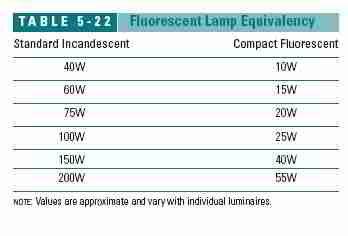
Table Comparing Fluorescent bulb Light Output to Standard Incandescent Light Bulb Output
[Click to enlarge any image]
Also, some lamps are more energy-efficient, providing more lumens for the same amount of electricity consumed.
Fluorescent's are the most efficient, using up to 70% less energy than an equivalent incandescent bulb (see Table 5-22).
Incandescent Light Bulbs
Incandescent light bulbs include the familiar non directional “A” lamps, as well as a variety of directional flood and spot lamps designated by an “R” or “BR.” Incandescent's. have a low color temperature of around 2700 K, which produces a warm light with lots of red and yellow tones that make skin, natural wood, and other warm colors look good.
To some extent, things look good to us under incandescent light because it is what we are most accustomed to. Incandescent lamps are inexpensive and are easy to dim, but they are also the least efficient type of bulb and the shortest lived.
Halogen Lights for Use Indoors
Halogen bulbs, also known as tungsten-halogen, is actually a kind of incandescent with more blue and less red light (3000 K), giving it a whiter appearance than standard incandescent lamps. Halogen lamps provide good color rendition and good light for reading and fine detail work. When dimmed, however, halogen light becomes more yellow, like standard incandescent lighting.
Also, dimming can cause a halogen lamp to darken due to tungsten evaporation. Turning the lamp to full illumination for about 10 minutes will restore its full power.
Halogen lamps tend to be smaller, produce 10 to 15% more lumens per watt than standard incandescent's., and last about twice as long. They come in a wide range of beam spreads and wattages. However, since halogen lights burn very hot, they must be shielded from contact with other materials or they can create a fire hazard.
Also, the bulbs should not be touched without wearing a glove (since the oil from your skin can create a weak spot on the bulb), and should be cleaned with alcohol. Halogen PAR (parabolic aluminized reflector) lamps are enclosed in a protective glass casing, which allows them to be handled like ordinary bulbs.
Low-Voltage lamps are tungsten-halogen, incandescent, or the newer xenon lamps, operating at 12 volts DC. Their small size makes them ideal for under cabinet lighting, and their very precise beam control makes them well-suited to accent lighting of artwork. Many low-voltage fixtures allow the lamps to rotate within the housing to precisely aim the beam.
Low-voltage Lighting Guide for Building Interiors
Low voltage lights use a step-down transformer to convert 120V line voltage to 12 volts DC. Most newer fixtures use solid-state electronics, which are more energy efficient and longer lasting than the older magnetic type. Transformers are either attached to the fixtures or installed remotely.
Since the transformers, as well as the lamps and dimmers, emit a slight hum, remote location can be an advantage. However, locating the transformer too far from the fixtures can result in a loss of power and dimming of the lamps. When using dimmers with low-voltage lighting, make sure they are specifically designed for low voltage systems and for the specific type of transformer.
Fluorescent Lighting Guide for Indoors
Fluorescent bulbs or lamps produce light by energizing the phosphor coating on the inside of a glass envelope. A device called the ballast regulates the power needed to start the lamp and keep it going. Older magnetic ballasts caused humming and flickering, but new electronic or solid-state ballasts have eliminated these problems.
Fluorescent's produce three to five times the output as incandescent lamps [per watt of energy used], last about ten times as long, and stay very cool. Because they reduce lighting bills by as much as 75%, and reduce cooling loads as well, they are heavily promoted by model energy codes and mandated in some areas. For example, the California Energy Code requires that the main lighting in kitchens and baths be fluorescent.
The downside of fluorescent's has always been their poor color rendering. Standard fluorescent's emphasize the blue range of the spectrum, giving skin an unflattering, pale appearance. Manufacturers have worked hard over the years to improve the light quality. So-called “deluxe” fluorescent's offer CRI (color rendering index) values in the 85 to 90 range but with a 25% loss of efficiency. To achieve CRIs in the high 90s without sacrificing energy efficiency, manufacturers use more expensive rare earth phosphors, creating triphosphor and quad-phosphor lamps.
Fluorescent lamps with high CRIs, and color temperatures within the range of 2700 to 3500K, create pleasing light for skin tones and natural wood and can blend in with incandescent lighting. In applications where color accuracy is important, such as laundry areas, lighting artwork, and certain hobbies, full-spectrum daylight lamps may be preferred. These lamps, which produce light similar to natural daylight, include General Electric’s Chroma 50 and Chroma 75.
Dimming also used to be a challenge with fluorescent's However, using solid-state dimming ballasts and special dimmers designed for fluorescent's can eliminate any humming sounds. These also allow a single dimmer switch to dim groups of fixtures with different length tubes.
Guide to Using Compact Fluorescent Lights
Compact fluorescent lights have created a lot more flexibility, allowing fluorescent's to be used in recessed downlights, wall sconces, pendants, and just about any type of luminaire. Early compact fluorescent's were noisy, slow to start, and had a limited selection of color temperatures.
Newer products, however, are quiet and typically have rapid-start ballasts. Dimmable ballasts are also available for compact fluorescent's, but are costly. As with tube fluorescent's, look for high CRIs and lower (warmer) color temperatures from 2700 to 3500K to blend in with incandescent and halogen lighting. All compact fluorescent's have a minimum 80 CRI.
While some compact fluorescent's have been introduced that mimic R and PAR-type reflector bulbs, directional lighting is best achieved with incandescent or halogen lamps. Fluorescent's are better used for ambient lighting, indirect lighting, and lighting of closets and storage areas. Although they cost $5 to $20 per bulb, depending on the wattage and configuration, they generally pay for themselves within two to three years in both energy savings and longevity of the bulbs.
Definitions of Common Lamp (Light Bulb) Abbreviations & Types
For details see LAMP (LIGHT BULB) ABBREVIATIONS & TYPES - Excerpts:
There are literally thousands of lamps to choose from, but the most common in residential lighting are standard incandescent A lamps, 120-volt BR and PAR directional lamps, and low-voltage PAR and MR lamps, along with a variety of tubular and compact fluorescent's.
While different lamp manufacturers use different codes and abbreviations to label their lamps, most list the wattage first, followed by the bulb shape, width of the bulb (in eighths of an inch), and additional information about the shape and beam angle. For example, a 50PAR36/H/NSP8° is a 50-watt PAR lamp, 36/8 (4 1/2) inches across, halogen with an 8-degree narrow spot beam. Common abbreviations include the following:
- A: General incandescent, Standard Household/Arbitrary bulbs. A19 is the standard light bulb size.
Excerpting from gelighting.com cited in detail below:
Type A Light Bulbs: A15, A19, A21, A25 Bulbs within the A group are widely used when it comes to household lighting.
They’re typically compatible with medium screw bases (E26 and E27) or the candelabra base (E12).
- B & C: candle flame shaped chandelier & decorative lighting.
Excerpting from gelighting.com cited in detail below:
Type B and C Light Bulbs: B10, C7, C9, C15, CA10 B and C group bulbs all resemble the shape of candle flames and may be referred to as candle bulbs. ...
Their most common base types are the E26 and E27 medium screw in bases, the E12 candelabra base, as well as the E17 base. - BR: Incandescent, bulged reflector lamps, which replaced
the older “R” lamps. These produce up to twice
the light in footcandles on the subject as A lamps. Common in outdoor floodlights and in indoor recessed floods or ceiling lights.
Excerpting from gelighting.com cited in detail below:
Type BR Light Bulbs: BR20/R20, BR30, BR40 Bulbs in the R and BR group include reflectors and bulged reflectors, respectively. ...
Most common are the BR30 and R20 bulbs, and they typically connect with the E26 or E27 bases. - F: Fluorescent.
- G: Globe, incandescent lamp.
The following details are courtesy of gelighting.com cited in detail below on this page - excerpting:
Type G Light Bulbs: G11, G14, G16/G50, G60, G25, G80, G30
G group, or globe lights, are commonly used for aesthetic purposes such as in bathroom vanities.
They re identified by an antique-looking filament in the center and can add flair to any fixture.
G group lights most commonly connect with E26 and E27 medium screw bases and E12 candelabra bases. - H: Halogen.
- IF: Inside frost.
- LFL: Linear flouorescent bulbs (long tubes)
- MR-16: Multifaceted reflectors or Quartz Reflector Lamp – low-voltage halogen
lamp with faceted mirrors that provide superior beam
control. Available in numerous beam widths.
Again from GE:
Type MR Light Bulbs: MR11, MR16 In the MR group, bulbs emit a concentrated beam of directionally focused light and can come in wide varieties of colors. Because of this, multifaceted reflectors are popularly used in track lights, recessed lights, desks, and display cases.
They usually use low voltage wiring systems, making them an excellent choice for landscaping applications like path and driveway lighting, gazebo lights, and paver lights.
The most common base types for MR bulbs within low-voltage AC/DC systems is the GX5.3 bi-pin or GZ4 bi-pin, and the GU10 bi-pin for 120-volt systems. - NSP: Narrow spot.
- PAR20, 30, 38: Parabolic Aluminized Reflector—A
halogen lamp protected by a heavy glass lens.
PAR lamps provide excellent beam control and
produce up to four times the light on the subject as
A lamps.
Excerpting from our GE reference cited below:
Type PAR Light Bulbs: PAR16, PAR20, PAR30, PAR36, PAR38 PAR group bulbs are typically used as outdoor lighting, like BR lights.
PAR, parabolic aluminized reflector, are typically higher wattage bulbs which can provide a lot of light.
The major difference between PAR and BR lights lies in their focus—BR lights provide a wider wash, while PAR lights can offer more focused beams.
The most common base types include the E26 and E27, as well as the G53 screw pin base. - PAR36: Low-voltage halogen lamp with superior beam control over longer distances.
- R: Reflector.
- SB: Silver bowl, which indicates that the bottom of the lamp is opaque and reflects the light upward.
- T: Tubular lamps, often long fluorescent, but "T" shaped lights may include other bulb types including LED, incandescent and halogen bulbs that are also tubular in shape. Here is what GE Lighting says:
Type LFL and T Light Bulbs: T: T7, T8, T10, T12, T14; LFL: T5, T8, T12
T and LFL group lights, referring to tubular and linear fluorescent lights, respectively, include specialty and vintage lights. You’re also likely to see the T8 or T12 in a laundry room, kitchen, or garage.
They commonly have magnetic or electronic ballasts which help limit the amount of current in an electrical circuit. Typically, these are fluorescent and use very little energy, offering optimal brightness with a crisp, white glow lasting up to 20,000 hours.
... hybrid LED light bulb replacements have recently become more popular due to their increased efficiency.
T group lights most commonly connect with E26 and E27 medium screw bases, E12 candelabra bases, E17 bases, BA15D bayonet bases, or the G13 bi-pin base. - VWFL: Very wide flood.
- WSP: Wide spot.
- WFL: Wide flood.
Explanation of Color Temperature and CRI for Indoor Lights & Bulbs
Also see COLOR TEMPERATURE AND CRI FOR INDOOR LIGHTS - color codes
and see COLOR TEMPERATURE BULB COMPARISONS
Color temperature and color rendering index (CRI) are two different ways to characterize how colors appear under a light source. Color Temperature is expressed in degrees Kelvin, and for incandescent lights equals the temperature of the metal filament. For fluorescent's and other bulbs without filaments, it is the theoretical equivalent temperature.
Lower color temperatures indicate “warmer” light with more yellow and red tones, which complement skin and natural wood finishes. Higher color temperatures indicate “cooler” light with more blue and green tones, which renders faces harshly and tends to make skin look pale (Table 5-23).
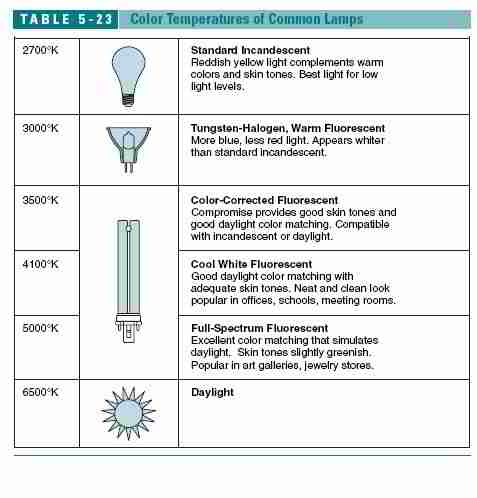
Skin tones look best under lamps rated from 2700K (standard A-bulb) to 3500K and with a CRI over 80. Residential lamps range as high as 7500K for continuous spectrum fluorescents, such as GE’s Chroma 50 or 75. These simulate daylight and are good for detailed work where color accuracy is critical, but they give skin an unflattering greenish tone.
Definition of CRI Scale Rates Accuracy of Lighting from Various Bulb Types
CRI is a rating on a scale of 1 to 100 of how accurately a lamp shows colored objects. The higher the CRI, the closer the colors look to a standard reference. For incandescent lamps and all others with a color temperature of 5000K or less, the reference is an incandescent or halogen bulb, which are both assigned CRIs of 100.
For lamps with a color temperature of over 5000K, the reference is natural daylight, which also has a CRI of 100.
CRI numbers are best used to compare lamps with color temperatures within about 300K of each other. Colors will look very different under a 3000K lamp and a 6000K lamp with the same CRI.
Definition & Use of Luminaires
Also see LUMINAIRES, DEFINITION, USES
While there are thousands of different luminaires on the market, they all fall into a few basic categories. Many mix more than one lighting strategy within a single fixture. All luminaires can be categorized as either direct lights, downlights, accent lights, or indirect lights.
Many luminaires combine two or more of these strategies. For example, many dining room chandeliers include a downlight that provides accent or task lighting to the table top in addition to the fixture’s ambient lighting. Common fixture types and placement are covered below.
Catalog of Types of Direct Lights
These include most surface-mounted fixtures on walls and ceilings, often with a diffusing globe or lens to reduce glare.
In general, these are very efficient sources of light, but may also produce a lot of glare.
Common types include surface-mounted ceiling fixtures, pendants, chandeliers, and sconces.
- Surface-mounted ceiling lights. Either incandescent or fluorescent fixtures mounted directly on the ceiling are a very efficient source for ambient lighting. Some, such as fluorescent “clouds,” use rounded diffusers that cast light on the ceiling as well as downward.
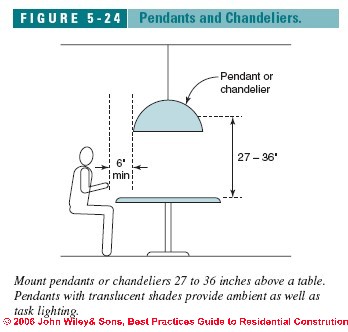
- Pendant ceiling lights. Pendant fixtures are often used to provide task lighting above kitchen tables or eating counters and may also project light sideways and upward to the ceiling. Select a fixture at least 12 inches less in diameter than the table’s smallest dimension and mount the fixture 27 to 36 inches above the table or counter (see Figure 5-24 above). Mini-pendants with halogen spots are often used to accent breakfast bars and kitchen islands.
- Chandeliers. When used over dining room tables, select a fixture at least 12 inches less than the width of the table and locate them 27 to 36 inches above the table, as in Figure 5-24 above). Some fixtures contain a central downlight to provide task lighting to the table.
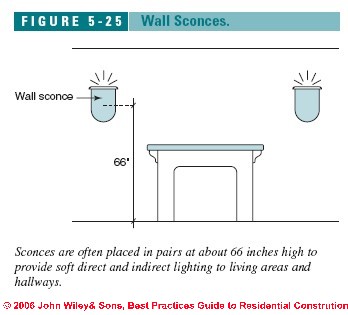
- Sconces. Wall sconces provide soft lighting in living and dining areas and hallways. Most provide some direct lighting as well as an indirect “wash” of light upward onto walls and ceilings. Often placed in pairs, they are typically located about 66 inches from the floor to the center of the sconce (Figure 5-25 shown below). Our photo of wall sconces is from the dinner theatre at Taliesin West - D Friedman.
What are Downlights & How are they Used?
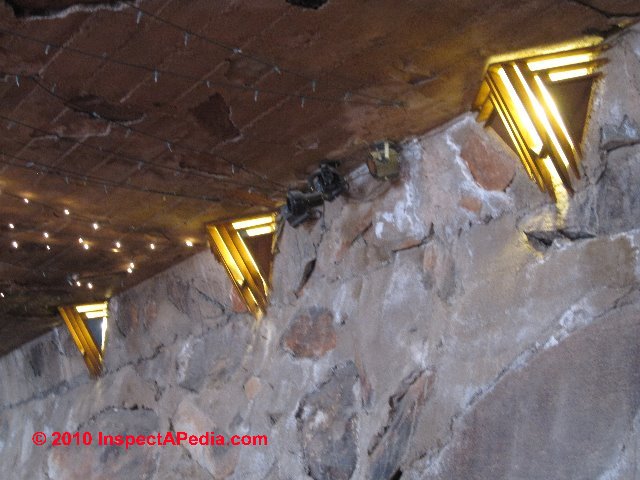
These are predominantly recessed ceiling lights that create a dramatic effect by casting pools of bright light on floors and work surfaces while leaving the ceiling in shadow.
Used with A lamps, floods, or compact fluorescents, and spaced properly, downlights can create even general lighting.
With more focused spot bulbs and special trims, downlights can function as task lighting, accent lighting, or wall washers.
What are Accent Lights?

When lighting a picture or single object, use a directional spot lamp in a shielded fixture.
These are often track-mounted or adjustable recessed fixtures, such as “eyeballs.”
Our photos above show how Frank Lloyd Wright used accent lights in the corners of "the bunker" at Taliesin West as part of a compendium of different lighting methods all demonstrated in this space: direct, indirect, accent, and track lighting all are installed and create different effects in this structure that has no exterior windows (and was originally used for storage).
To create even lighting over a large picture or group of pictures, it is best to use special “wallwasher” fixtures, or non directional lamps such as A-bulbs or compact fluorescents (Figure 5-23 below)
What are Indirect Lights & how is Indirect Lighting Best Used?

[Click to enlarge any image]
Bouncing light off light-colored walls and ceilings creates a soft and diffused illumination with little glare and gives a room a feeling of spaciousness.
Examples include upward directed floor lamps and wall sconces, as well as site-built coves and valences, which can make use of cost-effective fluorescent tubes.
Coves reflect light off the upper walls and ceiling and dramatize a high or cathedral ceiling. Brackets provide down lighting as well to emphasize wall surfaces or artwork.

Typical cove and bracket details are shown in Figure 5-26 (above) and Figure 5-27 (below).
The shield should be designed to protect the bulbs from view within the room.
Best Uses of Recessed and Track Lighting
Recessed lighting can provide either ambient, task, or accent lighting, depending on the lamp type, its beam spread, and the type of reflector and trim used. Where recessed fixtures are used for ambient lighting, they should be spaced to provide even lighting without dark spots.
Track lighting follows the same design principles as recessed, but is best used for accent or task lighting in certain situations. It is particularly well-suited to situations where flexibility is required since fixtures may be easily moved as lighting needs change.
Guide to Lamps (Bulbs) Used with Recessed & Track Lights
Also see GUIDE TO RECESSED & TRACK LIGHT BULBS
Beam spreads for directional lights vary depending on the lamp and fixture. For general lighting, choose a wide flood with a beam spread of at least 50 degrees. BR lamps are the most economical directional lamp and provide good enough beam control for general lighting. Standard A lamps with Alzak trim or compact fluorescents also provide good general lighting.
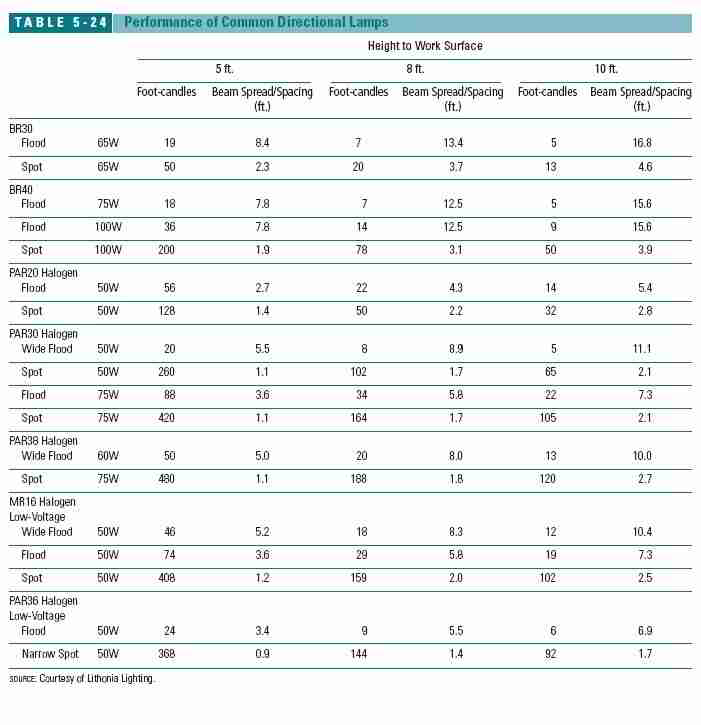
Halogen PAR lamps offer more precise beam control suitable for task or accent lighting. Low-voltage M-16 and PAR36 lamps offer very precise beam control, making them well-suited to accent lighting. Because of their narrow focus, spots produce higher illumination levels than floods but over a smaller area. Beam spreads and lighting levels for common directional lamps are shown in Table 5-24.
Guide to Recessed Light Housings
Typical residential recessed lights come in 4- to 7-inch diameters and can take a variety of different trims that significantly affect light output and glare.
For general lighting, a 5- to 7-inch diameter housing is commonly used. For accent lights, smaller 4-inch housings are available for both line-voltage and low-voltage figures. Special recessed housings are also available for compact fluorescents, sloped ceilings, and retrofit installations.
Standard recessed housings must be left un insulated above. For insulated ceilings, use a can rated IC for “insulation contact.” Also make sure the housing is rated “airtight,” which is not true of all IC units. Air leaks through recessed lights can be a significant source of heat loss and moisture problems in cathedral ceilings.
Recessed Lighting Fixture Trims
[Click to enlarge any image]
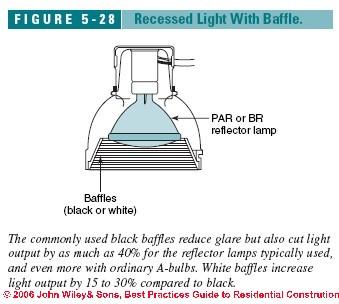
The common black or white
step baffles are designed for use with a PAR or BR lamp, although
homeowners often put in the less expensive A19
bulbs. Baffles reduce glare, but also cut light output by 50%
or more for A lamps and up to 40% for directional lamps.
Black baffles cut light output significantly more than white
(Figure 5-28).
For maximum light output from a recessed lighting fixture, use a clear or gold specular reflector, also known as Alzak trim.
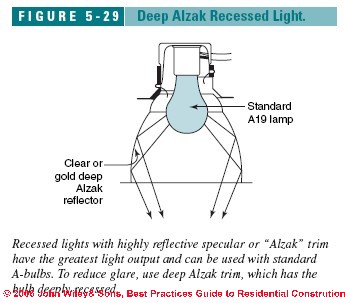
To reduce glare, which
can be a problem with these highly efficient reflectors, it is
best to use a deep-profile Alzak trim, offered by most recessed
lighting manufacturers. These work well with standard
A19 bulbs as well as BR lamps (Figure 5-29). Gold
Alzak is about 10% less efficient than the clear style.
For accent lighting, eyeballs and similar adjustable trims allow the homeowner to direct the light to the artwork or architectural feature being lit (Figure 5-30).

[Click to enlarge any image]
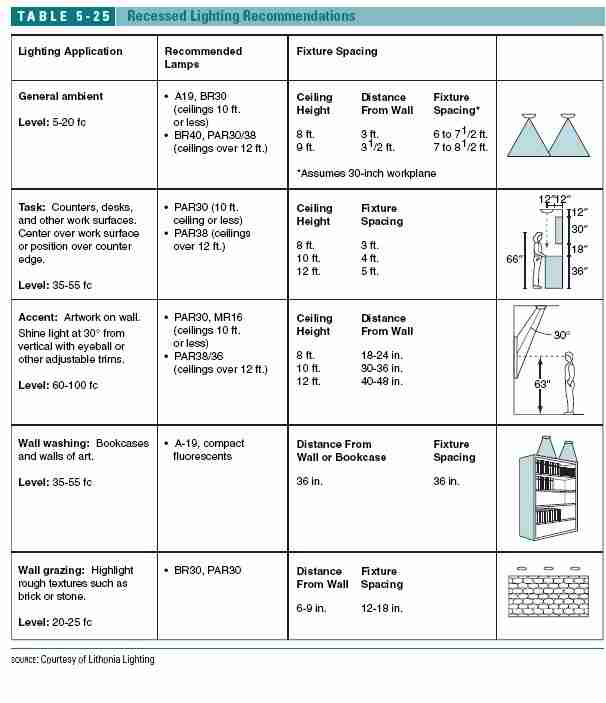
These are typically used with a narrow spot to provide bright focused light on a small area. Slotted wall wash trim is used to splash diffused light on broad areas of wall or bookcases. Nondirectional A lamps or compact fluorescents work well in this application. General recommendations for recessed lighting bulb wattage or bulb type and fixture spacing are given in Table 5-25.
Spacing Guidelines for Light Fixtures
Also see LIGHT FIXTURE SPACING
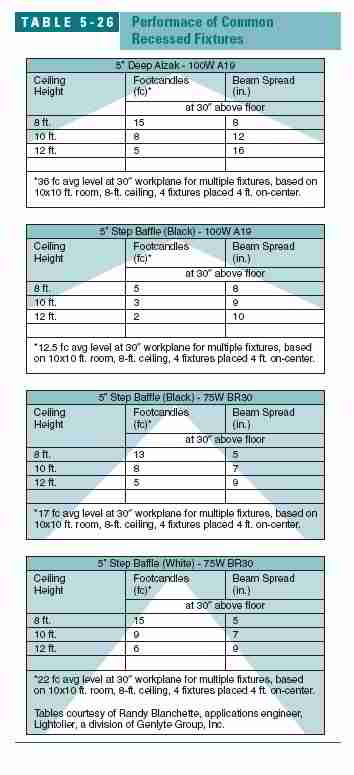
The general rule for ambient or task lighting is to space recessed ceiling fixtures approximately the same distance apart as the beam spread at the work height, typically assumed to be 30 inches above the floor (36 inches for kitchen counters). The beam spread is the central cone of light, where the beam is at least 50% of the brightness at the center of the beam.
Most manufacturers publish beam spread data for their recessed lights with different trim options. Beam spreads and lighting levels for some common fixtures and lamps are shown in Table 5-26.
For ambient lighting, choose a compact fluorescent, A lamp, or wide flood with a beam angle of at least 50 degrees. Typical spacing for ambient lighting with recessed lights is 6 to 7 1/2 feet for an 8-foot ceiling, or 7 to 8 1/2 feet for a 9-foot ceiling. Spacing from the first row of lights to the wall is half this distance.
For accent lighting, space recessed or track fixtures so
their light hits the wall at about 30 degrees. For lighting a
large wall area, the distance between fixtures should be
equal to or less than their distance from the wall (see Figure 5-23).
Closet Lighting Selection & Installation - Fire Safety Clearances
Due to risk of fire, the International Building Code and the National Electrical Code require that all fixtures installed in closets must be either surface-mounted or recessed and must completely enclose the bulb. Only incandescent or fluorescent lamps are allowed.
In addition, the fixture must be installed either in the wall above the door or on the ceiling and have the following clearances:
- For surface-mounted incandescent fixtures: 12 inches to the nearest point of clothing or storage space.
- For surface-mounted fluorescent fixtures: 6 inches to the nearest point of clothing or storage space.
- For recessed fluorescent or incandescent fixtures (with a completely enclosed lamp): 6 inches to the nearest point of clothing or storage space.
Also see CLOSET LIGHTING FIRE SAFETY
Kitchen Lighting Requirements
See details at
- KITCHEN LIGHTING REQUIREMENTS - specifications & details
- AMBIENT KITCHEN LIGHTING SPECIFICATIONS
- KITCHEN LIGHTING COUNTERS, SINKS, COOKTOPS
- TABLE TOP LIGHTING SPECIFICATIONS
Kitchens require general ambient lighting as well as task lighting on sinks, ranges, counters, and eating areas. Given the high lighting needs of a kitchen, the energy savings from fluorescent lights can be substantial. Look for fluorescent bulbs with a CRI over 80 and a color temperature near 2800K to match standard incandescent lights, or 3500K to match halogen lights.
Ambient Kitchen Lighting Specifications
For efficient general lighting, use one or more enclosed ceiling fixtures with a white diffuser that illuminates the ceiling as well as the space below. In a very small kitchen, placing the ceiling fixture near the sink and counter can provide effective task lighting as well.
For a softer glow in a kitchen, indirect lighting can also work nicely with lights placed in coves and above the cabinets to illuminate the ceiling.
Although not the most energy-efficient, recessed lighting has become a popular choice for kitchen lighting because of its sleek appearance and dramatic effect. For even
lighting, use fixtures and lamps with wide beam spreads and spacing based on a 36-inch work plane (Figure 5-23).
Also see the discussion on “Spacing,” page 202.
As a rough guide, the American Lighting Association suggests the following minimum lighting levels:
- Small kitchens of under 75 square feet: 150 watts of direct incandescent lighting from up to three bulbs, or about 60 watts of fluorescent.
- Kitchens up to 125 square feet: 200 watts of incandescent from up to four bulbs, or about 80 watts of fluorescent.
- Kitchens over 120 square feet: two watts of incandescent lighting or 34 watts of fluorescent per square foot of floor area.
These numbers should be increased by 50 to 100% for indirect lighting, dark surfaces, lighting placed high in cathedral ceilings, or use of recessed lights with diffusers, baffles, or other light blocking trim.
Kitchen Task Lighting Guidelines for Counters, Sinks, Cooktops
Work counters, sinks, and cooktops all need high lighting levels. Where wall cabinets are present, under cabinet lighting provides excellent illumination for counters. Place lights as close as possible to the front of the cabinets to avoid glare reflecting off the work surface (Figure 5-23 shown above).
Low-voltage xenon “festoon” lamps provide bright, even light similar to halogen but without the high temperatures and pressures, eliminating the safety concerns associated with halogen. Also, xenon lamps can be touched with bare skin and provide 10,000 hours of service.
An alternative for lighting at counters is to place a row of recessed fixtures directly over the outer edge of the counter. If used for task lighting, place fixtures about 36 inches apart for 8-foot ceilings or 48 inches apart for 10-foot ceilings (see Task Lighting in Table 5-25).
Sinks, cooktops, islands, and counters without cabinets above can be lit by small recessed downlights or track lighting. Mini-pendants with 12-volt halogen bulbs offer an attractive and functional way to illuminate islands, peninsulas, and eating counters (Figure 5-23).
Table Top Lighting Specifications
Choose a pendant at least 12 inches less in diameter than the table’s smallest dimension and mount the fixture 27 to 36 inches above the table.
A 120-watt incandescent or 40- to 50-watt fluorescent fixture will generally provide sufficient illumination
(see Figure 5-24).
Bathroom Lighting Guidelines
Also see BATHROOM LIGHTING GUIDELINES
Bathroom Mirror Lighting Recommendations
Good lighting is critical at the bathroom mirror for shaving, makeup, and other tasks of personal hygiene. For optimal lighting, place strip lights or globe type light bars at least 16 inches long on each side of the mirror centered at 61 to 64 inches (about the average eye height).
Wall sconces on either side are also an option for
smaller mirrors. These provide even cross lighting without
shadows or glare (see Figure 5-23).
For small mirrors under 30 inches wide, use about 75 watts of incandescent lighting or 20 watts of warm-white fluorescent on each side. For larger mirrors, use up to 150 watts of incandescent or 40 watts of fluorescent on each side.
Additional lights across the top of larger mirrors are also helpful. If using fluorescents, select lamps with high CRIs and warm color temperatures in the 2700K to 3000K range.
Lighting from above the mirror only using globe-type light bars, a pair of recessed downlights, or a lighting soffit is acceptable as long as the vanity top is a light color. Otherwise, areas under the eyes, nose, and chin will be in shadow. If recessed fixtures are used, choose an A lamp, flood, or compact fluorescent for a diffused beam.
General Lighting. As a rule of thumb, provide one watt of incandescent or 1/3 to 1/2 watt of fluorescent light per square foot of floor space. Increase this by 50 to 100% for recessed lights, indirect lighting, or a room with dark surfaces. In a small bathroom, the mirror lights can also provide the ambient light.
For larger baths, a separate ceiling fixture mounted near the tub and toilet can be useful for ambient light and reading. Finally, in a room with a high ceiling, indirect lighting with coves or uplights can create a feeling of spaciousness in a bathroom, along with a pleasing, soft glow.
Guidelines for Lighting Over Tub and Shower
A recessed light with a white diffuser mounted over the tub or shower will be appreciated by bathers. Electrical codes require that these fixtures be totally enclosed and rated for use in a damp location (tub area) or wet location (shower). Most require GFCI protection for their UL rating. In addition, fixtures must be at least 6 feet above the water line and switches must be a minimum of 5 feet from the edge of the bathtub or shower.
Watch out: Check with local code officials in your own jurisdiction for specific lighting and electrical safety requirements.
Industry & Trade Association for Building Lighting
- American Lighting Association www.americanlightingassoc.com
- Adapted with permission from Best Practices Guide to Residential Construction (Steve Bliss, J Wiley & Sons) .
References & Resources
- GE, GUIDE to LIGHT BULB SIZES, SHAPES & COLORS [PDF] General Electric Co., GE Lighting, retrieved 2023/04/30, original source: https://www.gelighting.com/inform/guide-light-bulb-sizes-shapes-and-codes
- See also the page bottomReferences or Citations
- Steve Bliss's Building Advisor at buildingadvisor.com helps homeowners & contractors plan & complete successful building & remodeling projects: buying land, site work, building design, cost estimating, materials & components, & project management through complete construction. Email: info@buildingadvisor.com
Steven Bliss served as editorial director and co-publisher of The Journal of Light Construction for 16 years and previously as building technology editor for Progressive Builder and Solar Age magazines.
He worked in the building trades as a carpenter and design/build contractor for more than ten years and holds a masters degree from the Harvard Graduate School of Education.
Excerpts from his recent book, Best Practices Guide to Residential Construction, Wiley (November 18, 2005) ISBN-10: 0471648361, ISBN-13: 978-0471648369, appear throughout this website, with permission and courtesy of Wiley & Sons. Best Practices Guide is available from the publisher, J. Wiley & Sons, and also at Amazon.com
Reader Comments, Questions & Answers About The Article Above
Below you will find questions and answers previously posted on this page at its page bottom reader comment box.
Reader Q&A - also see RECOMMENDED ARTICLES & FAQs
Question/comment:
(Mar 3, 2012) Hakens said: Is good to b here.
(Jan 6, 2013) Anonymous said: very nice guide lines
(Apr 27, 2014) Anonymous said: Good explanation.Very useful
Reply:
Thank you; we also welcome content critique, corrections, suggestions.
Question:
(Apr 7, 2013) spacing, quantity, no. of fixtur said:
energy reduction calculation per year
attaining 150 kWh/m2 per year
Question: What about LED?
(May 16, 2014) John U. said:
Good overview of subject and helpful. What about LED?
Reply:
Thanks John.
I'm a big fan of LED lighting and have been installing it in both the U.S. and Mexico for some time. Advantages include more light at lower wattage and generally cooler operation as well as of course very long life.
Bulbs in hard to reach areas are great candidates as they'll probably not need to be changed again in my lifetime, as are bulbs in areas where I want more light but where wattage or heat tolerance are limited. Fluorescents offer still lower prices, but generally also not so long a life.
See LED BULB & LIGHTING TYPES for a discussion of types of LED bulbs, prices, applications, opinions.
Daniel
Question: translating LED bulb wattage into equivalent LED Watts
(June 10, 2014) seth s said:
I figure you can translate any bulb into LED watts by finding the lumens. I have 7' ceiling for which I want ambient light in a living room. I need to know whether 4" lights will be too small and how close together I can place them. thoughts?
Reply:
I too look at lumens to get in the right total illumination ballpark when converting from incandescent or florescent bulbs to LEDs, but as different designs achieve different efficiencies you'll see that equal lumens are not always equal in watts consumed. Even lumens can be a tricky comparison as how you see light also is affected by color temperature of the light source.
Question:
Moe: I want to light a very small narrow range from a high ceiling
Reply:
Mo, you have a very clear specification. I'd look through a lamp catalog at mini spots or just give the manufacturer or distributor a call. I agree that the pinhole approach won't be very satisfactory.
Reader follow-up:
Thanks, I am definately on the search!
Question: We use 60w bulbs and they are burning out within 1 week
7/29/14 (1 days ago) Donna said:
I work in a medical office and one of our waiting rooms has flood lights in the ceiling. We use 60w bulbs and they are burning out within 1 week or so. Could it be the lighting fixture itself or do we need to use a smaller watt? It is not just one particular one we have about 8 to 10.
Reply:
Donna,
Someone who knows ladder safety needs to look into the ceiling light fixtures at the stickers found therein - that's where I'd expect to see what kinds of bulbs, at what wattages, the fixture manufacturer thinks can be used safely.
Other causes of overheating and bulb failure could be present such as improper insulation or voltage fluctuations.
In some cases where fixtures were running very hot I've had good results by changing to a more expensive but much cooler-running and longer-lived LED bulb or Florescent bulb of equivalent light output - those bulbs run at lower actual wattage.
...
Continue reading at KITCHEN LIGHTING REQUIREMENTS or select a topic from the closely-related articles below, or see the complete ARTICLE INDEX.
Or see these
Interior Lighting Articles
- LIGHTING, INTERIOR GUIDE - home - you are on this page
- BATHROOM LIGHTING GUIDELINES
- BAYONET BASE BULB TYPES
- BULB & LAMP ABBREVIATIONS & CODES
- BULB & LAMP TYPES GUIDE - home
- BULB COLOR TEMPERATURE COMPRARISONS
- BULB & FIXTURE TYPES for SOFFIT
- CLOSET LIGHTING FIRE SAFETY
- ELECTRIC POWER LOSS / FLICKERING LIGHTS
- FLUORESCENT LIGHT REPAIRS
- KITCHEN LIGHTING REQUIREMENTS
- LED BULB & LIGHTING TYPES
- LIGHTING LEVELS INDOORS, RECOMMENDED
- LUMENS DEFINITION COMPARISON
- RECESSED LIGHT CLEARANCES
- RECESSED LIGHT HOUSINGS GUIDE
- RECESSED & TRACK LIGHT USES
- RECESSED & TRACK LIGHT BULB GUIDE
- RECESSED LIGHT FIXTURE TRIM
- RECESSED SOFFIT or ROOF OVERHANG
- SPACING GUIDE for LIGHT FIXTURES
- TABLE TOP LIGHTING
- TASK LIGHTING
- LIGHTING OVER STAIRS & AT EXITS
Suggested citation for this web page
INTERIOR LIGHTING GUIDE at InspectApedia.com - online encyclopedia of building & environmental inspection, testing, diagnosis, repair, & problem prevention advice.
Or see this
INDEX to RELATED ARTICLES: ARTICLE INDEX to BUILDING LIGHTING
Or use the SEARCH BOX found below to Ask a Question or Search InspectApedia
Ask a Question or Search InspectApedia
Try the search box just below, or if you prefer, post a question or comment in the Comments box below and we will respond promptly.
Search the InspectApedia website
Note: appearance of your Comment below may be delayed: if your comment contains an image, photograph, web link, or text that looks to the software as if it might be a web link, your posting will appear after it has been approved by a moderator. Apologies for the delay.
Only one image can be added per comment but you can post as many comments, and therefore images, as you like.
You will not receive a notification when a response to your question has been posted.
Please bookmark this page to make it easy for you to check back for our response.
Our Comment Box is provided by Countable Web Productions countable.ca
Citations & References
In addition to any citations in the article above, a full list is available on request.
- .../li>
- Our recommended books about building & mechanical systems design, inspection, problem diagnosis, and repair, and about indoor environment and IAQ testing, diagnosis, and cleanup are at the InspectAPedia Bookstore. Also see our Book Reviews - InspectAPedia.
- "Simplified Electrical Wiring," Sears, Roebuck and Co., 15705 (F5428) Rev. 4-77 1977 [Lots of sketches of older-type service panels.]
- "How to plan and install electric wiring for homes, farms, garages, shops," Montgomery Ward Co., 83-850.
- "Electrical System Inspection Basics," Richard C. Wolcott, ASHI 8th Annual Education Conference, Boston 1985.
- "Simplified Electrical Wiring," Sears, Roebuck and Co., 15705 (F5428) Rev. 4-77 1977 [Lots of sketches of older-type service panels.]
- "How to plan and install electric wiring for homes, farms, garages, shops," Montgomery Ward Co., 83-850.
- "Home Wiring Inspection," Roswell W. Ard, Rodale's New Shelter, July/August, 1985 p. 35-40.
- "Evaluating Wiring in Older Minnesota Homes," Agricultural Extension Service, University of Minnesota, St. Paul, Minnesota 55108.
- "Electrical Systems," A Training Manual for Home Inspectors, Alfred L. Alk, American Society of Home Inspectors (ASHI), 1987, available from ASHI. [DF NOTE: I do NOT recommend this obsolete publication, though it was cited in the original Journal article as it contains unsafe inaccuracies]
- "Basic Housing Inspection," US DHEW, S352.75 U48, p.144, out of print, but is available in most state libraries.
- In addition to citations & references found in this article, see the research citations given at the end of the related articles found at our suggested
CONTINUE READING or RECOMMENDED ARTICLES.
- Carson, Dunlop & Associates Ltd., 120 Carlton Street Suite 407, Toronto ON M5A 4K2. Tel: (416) 964-9415 1-800-268-7070 Email: info@carsondunlop.com. Alan Carson is a past president of ASHI, the American Society of Home Inspectors.
Thanks to Alan Carson and Bob Dunlop, for permission for InspectAPedia to use text excerpts from The HOME REFERENCE BOOK - the Encyclopedia of Homes and to use illustrations from The ILLUSTRATED HOME .
Carson Dunlop Associates provides extensive home inspection education and report writing material. In gratitude we provide links to tsome Carson Dunlop Associates products and services.
 | HOME | ABOUT | ASK a QUESTION | CONTACT | CONTENT USE POLICY | DESCRIPTION | POLICIES | PRIVACY | |
| © 2024 - 1985 Publisher InspectApedia.com - Daniel Friedman | |||||||||