
InspectAPedia® FREE Encyclopedia of Building & Environmental Construction, Diagnosis, Maintenance & Repair |
Question? Just ask us! InspectAPedia
|
 Carpenter Ants
Identify carpenter ants, inspect for ant infestation, structural damage prevention & cure
- POST a QUESTION or COMMENT about carpenter ants: what they look like, how to find carpenter ant damage, how to get rid of carpenter ants, how to prevent carpenter ant infestations
Carpenter ant infestation photo guide:
This article describes carpenter ants and how to inspect a building for carpenter ant damage.
We explain and illustrate how to identify carpenter ants - what carpenter ants look like, why and where they attack buildings, and how to cure a carpenter ant infestation using pesticides or other methods.
We describe and include photographs of building details that increase the risk of carpenter ant attack - which tells you where to look for ant damage as well as how to prevent carpenter ant infestations in buildings without reliance on pesticides.
We also describe how to distinguish carpenter ants from termites and how to tell a carpenter ant from other ants. We include many photo-examples of building damage caused by carpenter ants. And we provide citations to authoritative sources for more carpenter ant identification & control information.
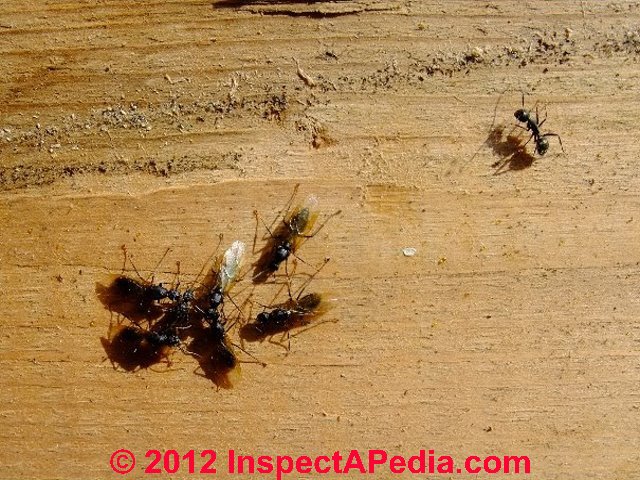
Our photo at page top illustrates a closer to actual size view of carpenter ants found during demolition in an area where the evidence of carpenter ant activity and damage justified tearing some building surfaces apart. .
InspectAPedia tolerates no conflicts of interest. We have no relationship with advertisers, products, or services discussed at this website.
Carpenter Ants Guide
What carpenter ants look like, how to find carpenter ant damage, how to get rid of carpenter ants, how to prevent carpenter ant infestations.
Carpenter ants (Camponotus pennsylvanicus) attacking a wood structure, if not discovered and evicted (or treated), can cause substantial structural damage to the building.
The black carpenter ant (Camponotus pennsylvanicus) is the most common carpenter ant member of the species found in wood structures in North America, though there are about 1000 members of the group.
[Click to enlarge any image]
Both black and red carpenter ants are found further north including some areas of Quebec.[4]
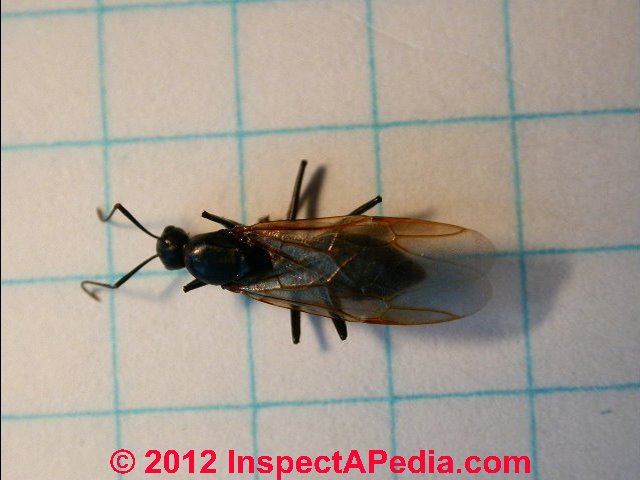
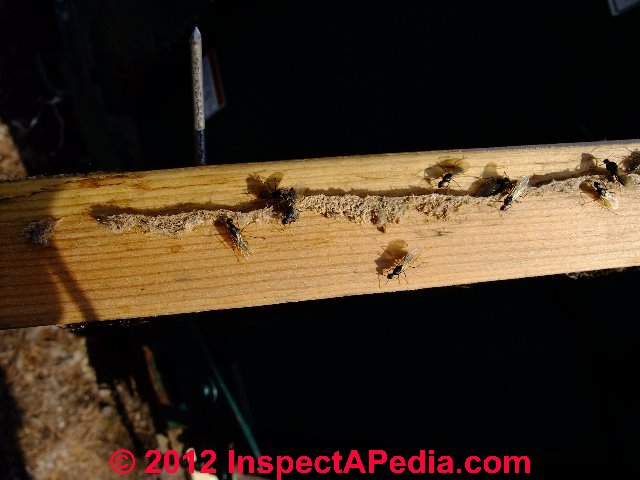
Carpenter ants may be winged (shown enlarged to about 5 x life size in our photo at left) if the colony is swarming, but more often you'll find them wingless.
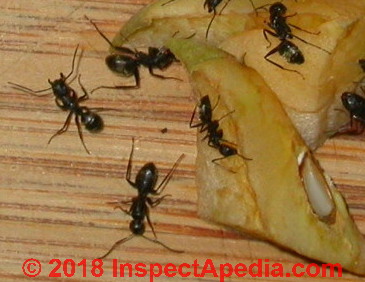
Our wingless carpenter ant picture just below illustrates that carpenter ants might be baited to come out into the open with a bit of apple core.
Throughout this article we'll include a variety of photos of carpenter ants giving their sizes, shapes, identifying characteristics and personalities.
Article Contents
Distinguish Between a Carpenter Ant and Swarming Termites
 ...
... 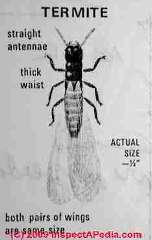
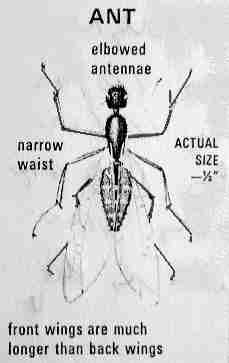
Our sketches show the difference in appearance between a winged carpenter ant (first image) and winged termite (swarming) (second image). [Click to enlarge any image]
Carpenter ants are about 1/2" long, are generally black, have long angled antennae, a segmented body, and a really narrow waist. Below are some photos of carpenter ants under the microscope. Their narrow waste and segmented body are quite evident.
Swarming carpenter ants have wings but otherwise they don't. The swarming carpenter ant's front wings are much longer than its back wings. Throughout this article you'll find more photos of both winged and wingless carpenter ants.
If your "flying ant" has an un-segmented body (second illustration above) it's probably a termite not a carpenter ant, and you should
see TERMITE IDENTIFICATION & CONTROL.
Enlarged Ant Photos Help Identify Carpenter Ants
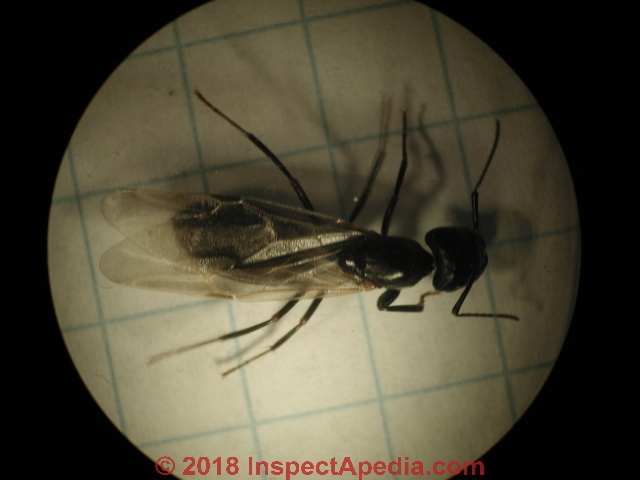
Above: the upper or winged side and the under-side of a winged queen carpenter ant. You can see that compared to worker carpenter ants the queen ant is huge.
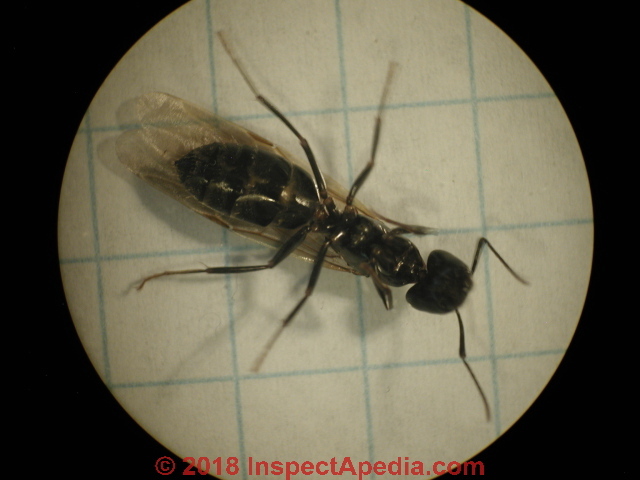
Each grid square is 1/4" (6.35 mm) - from nose to wing-tips this queen is nearly 3/4" (19 mm) in length.
Below is a photo on the same scale showing the size of a minor worker - the smallest carpenter ant, and a major worker or soldier carpenter ant.
The minor worker is the smallest, but even the major workers are much smaller, roughly half the size of their queen, about 1/4" (6.35 mm) to 3/8" (9.53 mm) in length - and as they're not swarming in these photos they're wingless.
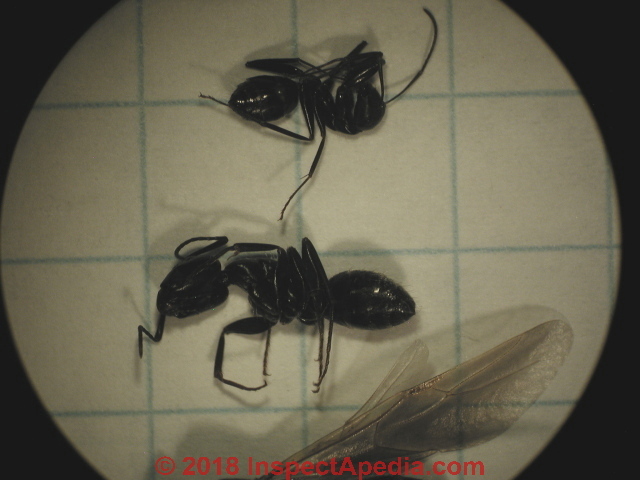
In my carpenter ant photo above you can see the queen's wing in the lower right portion of the image.
Below I provide a view of the queen carpenter ant's head under the stereo microscope. [Click to enlarge any image]
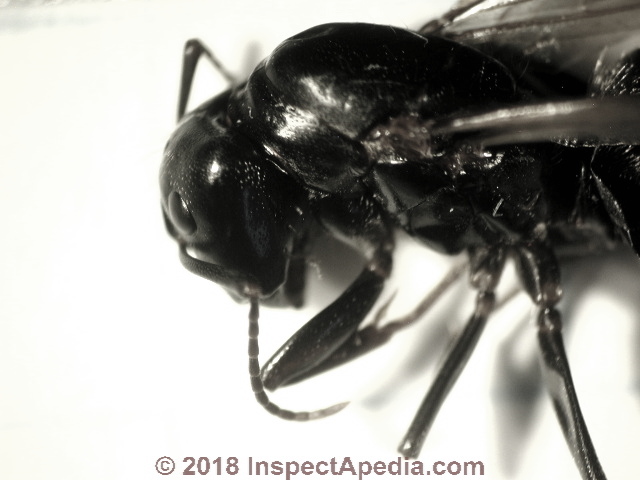 ...
... 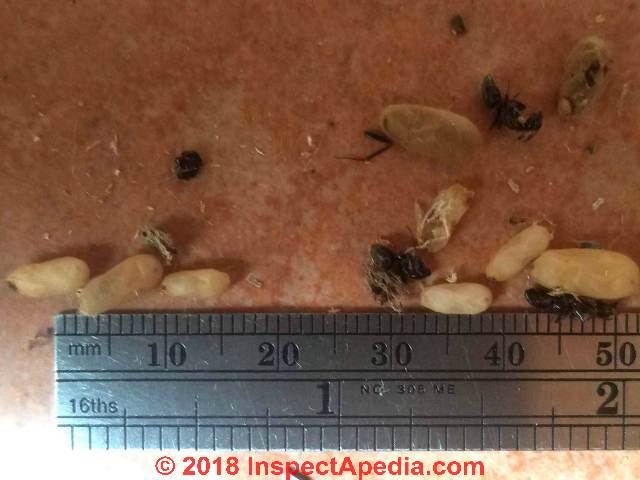
My second photo above shows carpenter ant eggs (soon to hatch as larvae) that the ants brought out of the building roof and walls in response to an ant poison spray. The larval/egg is up to about 1/2" or a bit over 1 cm.
Where to Look for Carpenter Ant Activity on buildings
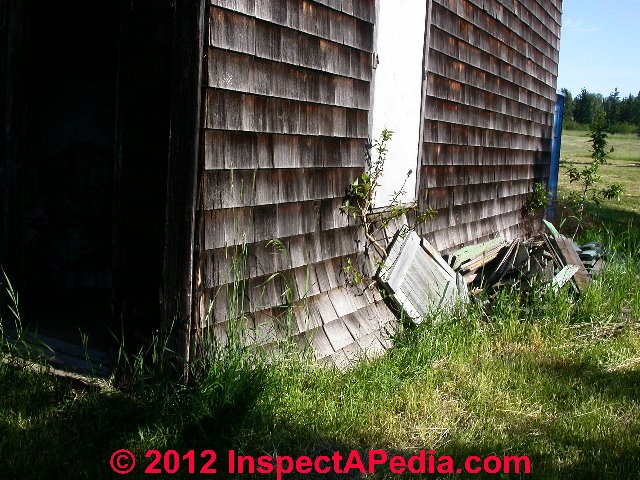 Here are the principal approaches to inspecting a building for carpenter ant activity & damage:
- Look for frequent appearance of carpenter ants themselves
on the building exterior or interior; in spring in some climates it's common to find one or two ants exploring indoors; but if you keep seeing ants in a particular building or location it's time to watch them more closely for frequency, population level, and directions of travel. - Look for past or current building leaks.
Because carpenter ants prefer to tunnel (for carpenter ant nest building purposes) in damp rather than dry wood, building leaks are a common trigger for ant infestation.
Roof leaks, leaks at building flashing junctures of chimneys, leaks around windows and doors and into walls, and plumbing leaks in a building all make conditions inviting for carpenter ants. - Look for wood close to or in contact with the ground.
Wood less than 8-inches from soil is an invitation to carpenter ant (or termite) infestation. - Look for a combination of wood close to ground combined with water
(from roof spillage, surface runoff, plumbing leaks, or any other source. The combination of wood close to ground and wet conditions is a red letter invitation to carpenter ants. - Look for a combination of wood close to ground, water or wet conditions, and a difficult-to-access
or inaccessible area (such as a very tight crawl space) - these conditions are a platinum invitation to carpenter ants to attack the building.
- Look for carpenter ant frass or sawdust
in areas of recent or current ant activity, typically below and/or around exit holes. - Look for carpenter ants themselves or for carpenter ant bodies:
If you see carpenter ants inside your home, particularly if you keep seeing them in the same area and in increasing quantity, there is probably a carpenter ant nest nearby and further investigation is warranted.
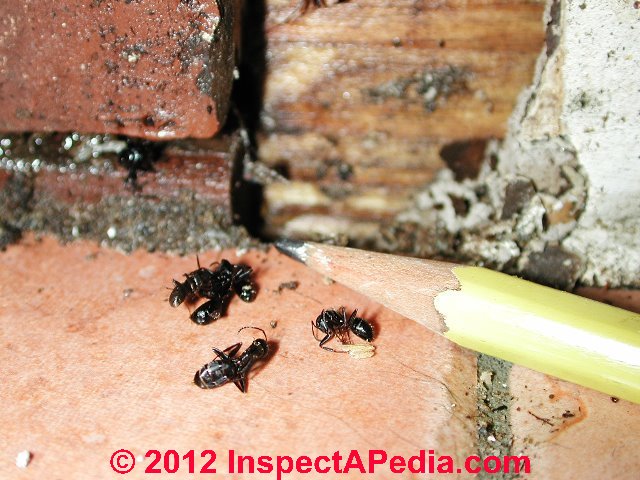
You may also see carpenter ant bodies either because the ants have walked through carpenter ant poison you spread nearby or because the living carpenter ants have tossed out of the nest their dead family members.
These inspection points for finding carpenter ants and carpenter ant damage also tell us how to avoid their company: avoid wood in contact with or within 8" of soil, and fix and prevent water leaks into the building structure.
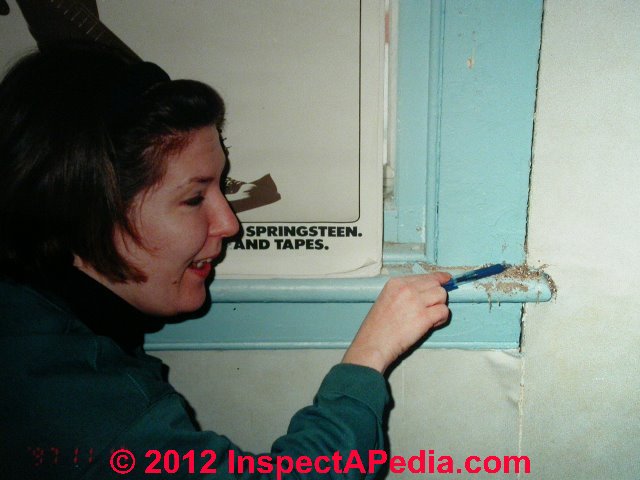
Our first photo below provides an example of discovering carpenter ant frass right in the living area - in this case our client points out this "sawdust" on the light blue window window sill.
Often water leaks due to sealing or flashing areas around a window or door will send water into the wall, attracting wood destroying insects (WDI).
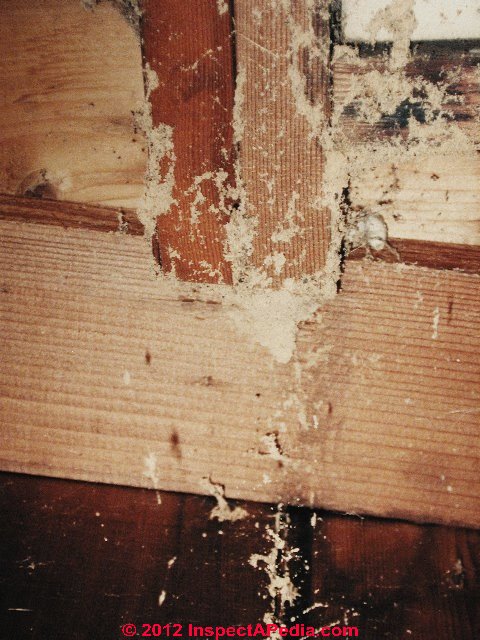
Below, our second photo shows a significant amount of carpenter ant frass at a wood framing juncture. You might find carpenter ant frass on the floor below an area of damage like this before you look "up" to see the actual area of activity.
- Look for signs of structural damage
such as sagging, bending, bowing of wood framed floors, walls, ceilings, roofs.
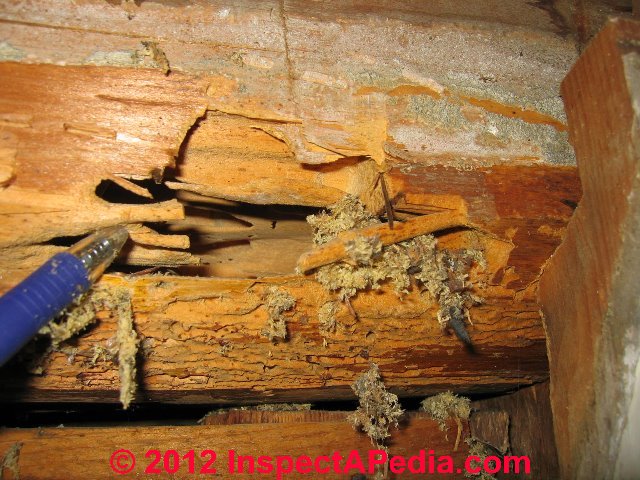
Our carpenter ant damage photo shown below illustrates mature but still active carpenter ant nesting. This structural member is practically hollow - the carpenter ants like to leave the more dense latewood or winter wood when cutting their galleys.
The photo shows both the carpenter ant galleys (the hollow areas pointed to by my pen) and carpenter ant frass or "wood dust" at right and in the lower areas of the image.
The extensive structural damage to the wood floor in the building shown below occurred in a wood framed structure over an inaccessible crawl space in a New York cottage built in the 1920's along Wappingers Creek.
Wood framing was at ground level, in ground contact, and wet from roof leaks as well as surface runoff.
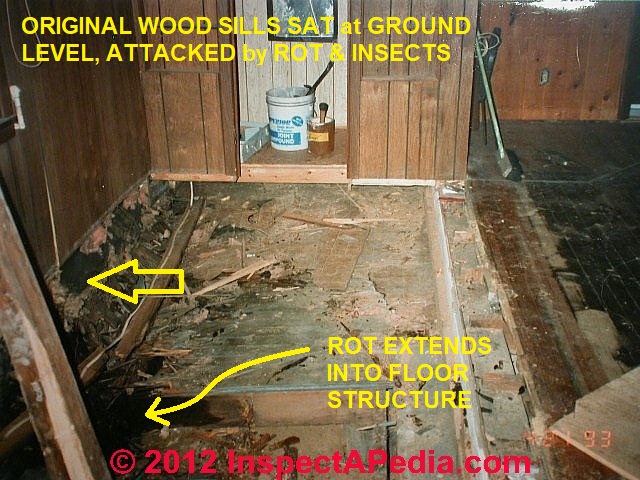
We demolished the original structure (Willowbrook Hgts., Poughkeepsie NY), rebuilt the floor and sills using pressure-treated wood, we raised the foundation height to above ground level, and we corrected the water and leak problems.
Carpenter ant infestation can be higher in a building, even in the building roof.
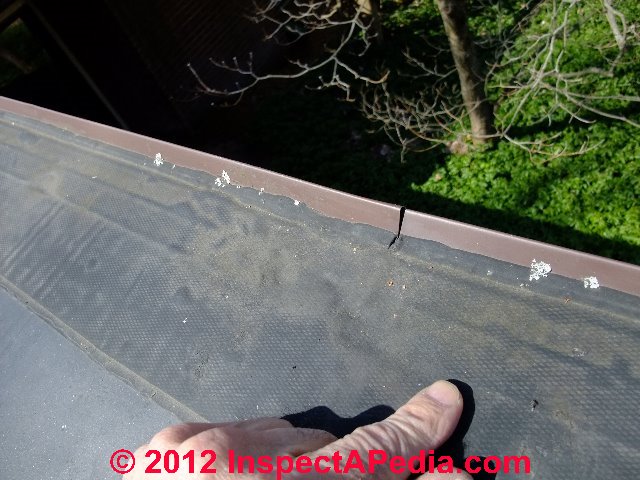 Don't restrict your carpenter ant inspection to ground level.
Overhanging tree branches provide an easy path onto a building roof.
Leaks into a wood framed roof structure (often around a chimney) are an inviting condition for carpenter ants - they don't have to go downstairs to get a drink.
Our photo illustrates just how subtle a leak can be in a flat or low slope roofed structure.
That small area of ponding combined with improper type of drip edge (Gravel stop on an EPDM roof) directed water into the roof structure. That was enough invitation to start a carpenter ant colony.
Details of what we found are below at EXPLORING BUILDING FRAMING FOR CARPENTER ANT DAMAGE
Common roof leak areas such as around chimney flashing and at leaky eaves (or at areas of ice damming) are common sites for carpenter ant infestation.
Signs of Carpenter Ant Activity: Exploring Building Framing for Carpenter Ant Damage
- Look for dead carpenter ant bodies
in an area where you have applied an ant spray or pesticide. The carpenter ant colony will toss out their dead members. - Look for live carpenter ants in number and carpenter ants that are swarming
(and winged) carpenter ants in the spring. When an ant colony has grown large enough it may send out a new branch - you may see hundreds of carpenter ants milling about, including winged ants.
Pest control experts sometimes use a chemical spray that when injected into a building cavity will cause the ants to come streaming out - as a means of finding the carpenter ant nest. It's very exciting.
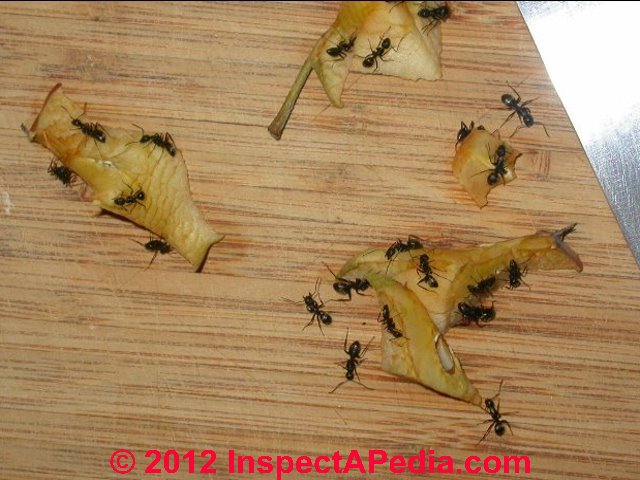
Our photo illustrates how easy it is to entice carpenter ants into the open if they are already nearby.
We left these apple cores on a kitchen cutting board in early spring - a time of peak carpenter ant exploring activity.
In less than an hour our local carpenter ants had found and were enjoying fresh apple juice.
- Look for live carpenter ants at nearby sources of food and water.
Carpenter ants don't eat the wood they are tearing into, so you can count on local food and water to attract carpenter ants out of their wooden galleys. - Look for carpenter ant frass or "sawdust" -
if you find fresh, light-colored carpenter ant frass there is carpenter ant activity nearby.
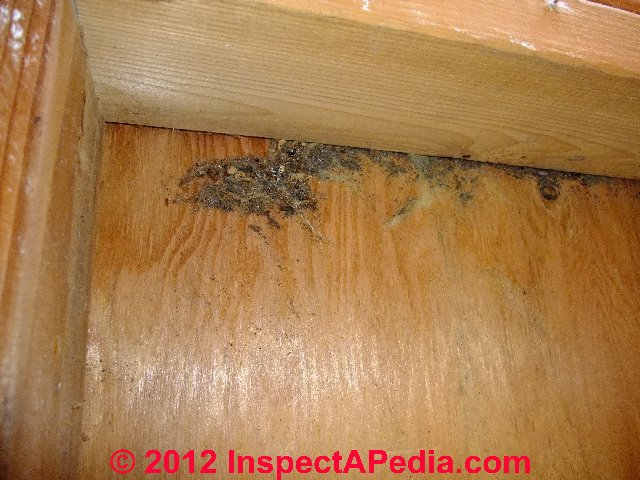 Here is a photo of carpenter ant frass or "sawdust" beneath an area of carpenter ant infestation in a building.
Below at CARPENTER ANT FRASS we show what this "sawdust" looks like in a home.
Carpenter ants don't "eat" wood, but they rip out passages through wood to form their nest. Typically the ants remove the softer summer wood, resulting in the long galleys you find in carpenter-ant damaged wood.
Unlike wood destroying termites, carpenter ants aren't "eating" the wood but rather tunneling through wood members to make space for their colony.
As a result, where there is fresh, current carpenter ant activity you will often find fresh, light colored sawdust (carpenter ant frass) below or at the area of entry or exit of the ant infestation.
Notice a second relevant clue to carpenter ant attack: the water stain on the plywood wall sheathing at the upper right corner of the photo. This stain and carpenter ant frass were found beneath a flat roof over a garage.
Without opening this wall and removing the insulation one would not be likely to see this carpenter ant colony nor any damage the ants are making to the structure until conditions were much more severe.
Below we illustrate further investigation of the carpenter ant attack whose clues were just above. At below left you can see much more compelling evidence of carpenter ant activity on the sill plate atop the same wall - a place no one might have looked without the first clue.
At below right you can see our disclosure of active carpenter ant activity and a sawdust trail (carpenter ant frass trail) that was located between the plywood roof deck and the wall top framing.
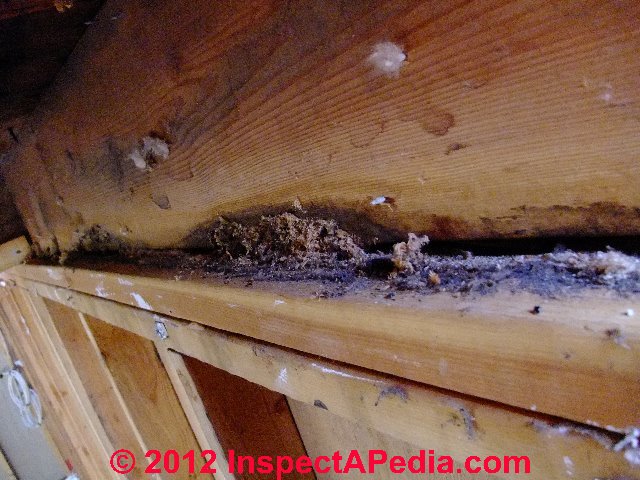 ...
...
 <
<
Signs of Carpenter Ant Activity: Exploring for Carpenter Ants at an Interior Wall at Floor Baseboard Trim
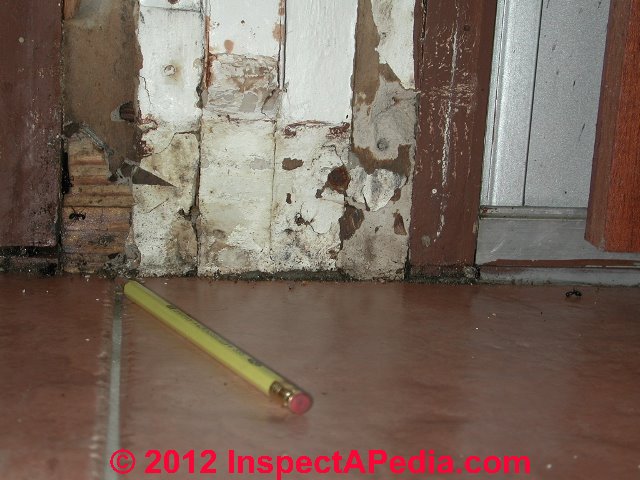
Our carpenter ant activity photos below illustrate the results of deciding to investigate further for ant activity and damage at the ground floor of a slab-on grade structure. After observing frequent carpenter ant traffic on the floor in this area we watched the ants to see where they seemed to be most busy (coming and going) at the wall bottom.
That led to a spot between two sliding exterior doors and an area where there had been some leakage into the wall cavity. Pulling off a small section of floor baseboard trim (below left) we found the main entry/exit point for our carpenter ants (below right).
Probing into the wood post bottom in this location did not discover significant damage. We decided to address this carpenter ant problem by two simple DIY steps:
- We used a simple carpenter ant killing spray on the exposed surfaces inside and outside this immediate area combined with
- We repaired the exterior leak that was sending water into the wall at this post bottom.
Signs of Carpenter Ants: Frass or "sawdust" - Explore further for Carpenter Ants
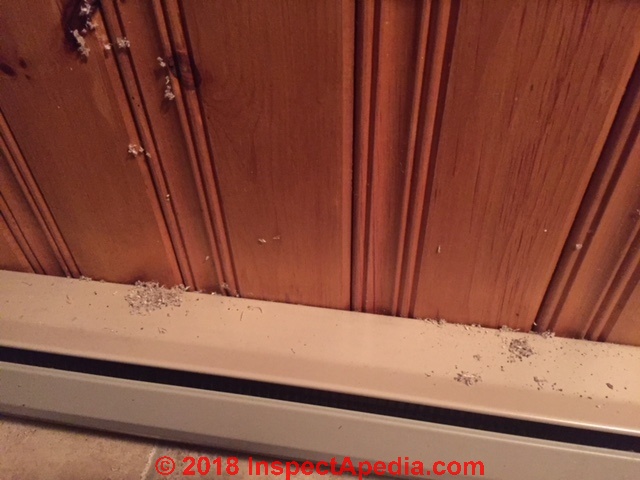
We’re wondering what these droppings could be that have been appearing for some time now and we just vacuum them up?
This is in a porch that is part of our house in Oakville, Ontario, but we tend to keep temperatures cooler say 50F during the winter. - Anonymous by private email 2018/04/09
Reply: fresh carpenter ant frass means find and fix the ant infestation
To me that looks like carpenter ant frass - a fancy word for the sawdust made when carpenter ants are ripping their way through wood in a structure. I'd do some careful probing and some inspection for leaks - it's often water in wood framed walls that invites ants into the structure.
Is there a basement below this area, or a crawl space where you could take a look? Or is this part of your home built on a slab.
Outside is there wood close to soil?
And as spring comes we might watch for swarming carpenter ants.
Don't panic. If we catch them in time we won't have to rebuild the porch - ok that's an editorial "we" as it's you and your porch but I didn't want you to feel abandoned.
Around Burlington, Oakville, and also Hamilton, Ontario carpenter ants are one of the more-common insect pests. I speculate that proximity to Lake Ontario moderates the climate a bit so we see more carpenter ants in southern Ontario than further north. I'd give a call to one of your local pest control companies.
Reader follow-up: here is what we found during exploration of the carpenter ant sawdust or wood frass
The porch was more of an add-
on with its own crawl space but its not really accessible as it only has an opening size of a couple cement blocks to get a heating duct out there.
However we should be able to shine a light out there from a crawl space under our house to see what’s going on. Theirs no wood outside just a concrete patio.
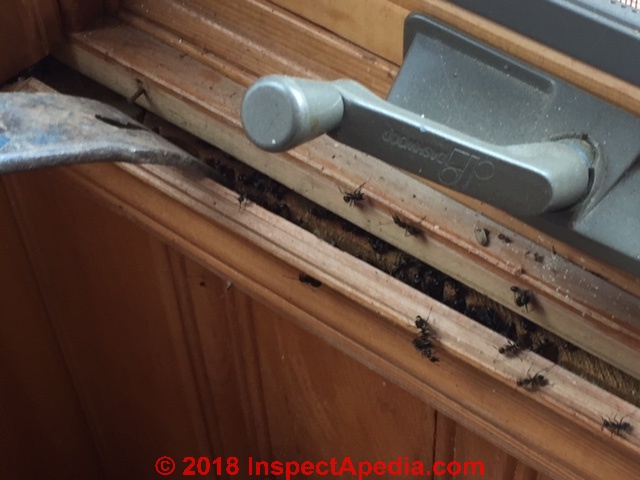
Above: on prying open the wood trim below a porch window, the carpenter ants ran amok.
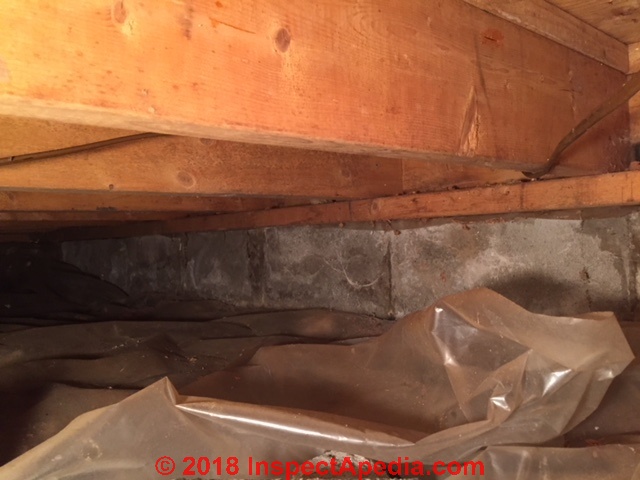
Above: access to the crawl area below this porch is very limited but where we could look we don't see obvious damage to the structure ... yet.
The porch sits on cement blocks however with a dirt floor. It has plastic sheet on the dirt similar to the larger crawl space under our addition that butts up to the porch.
Moderator follow-up:
That crawl space is a hard-to-access area. Look in there as much as you can for signs of so much ant damage that the sill bottom edges or sill plate top edge are crushing.
If you don't see such damage there and if you don't see signs of structural movement above the ant-infested area, then I'm doubtful that heroic demolition and repair would be justified.
Instead focus on
1. finding and fixing leaks into the crawl or into the wall cavity
2. have the area treated for carpenter ants - by a licensed PCO.
3. then vacuum up the ants (they hate that) and their frass in the finished area. That'll help you notice future activity.
Examples of Ants that are Not Carpenter Ants & that do not attack wood structures
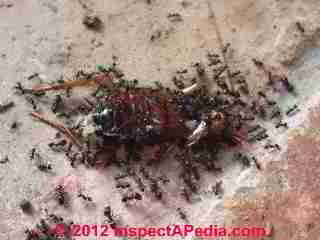
Here we illustrate ant activity that is not carpenter ants.
These little ants appeared within a few hours of our leaving a dead insect on a brick walkway.
These ants are not carpenter ants and are of no risk to the structure itself.
In addition to noticing where we found them (not attacking wood) one can observe that they are about 1/3 the size of a carpenter ant (shown at page top).
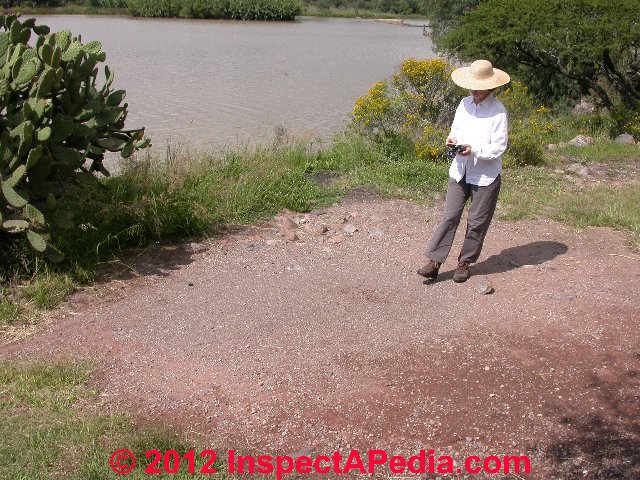
Below our first photo illustrates a large area free of grass and other plant growth - this is a large red ant colony typical of what one might find in the Southwestern U.S. or in Mexico.
This large ant colony was found along the edge of EL Charco del Ingenio in San Miguel de Allende, Guanajuato, Mexico.
Localizado a unos minutos de San Miguel de Allende, El Charco del Ingenio es un Jardín Botánico y una Reserva Natural extraordinaria. Posee una extensa colección de cactáceas y otras plantas suculentas de México, muchas de ellas raras, amenazadas o en peligro de extinción. - http://www.elcharco.org.mx/
These ants do not attack wood structures.
Watch out: these biting red ants are capable of a painful bite injecting a good dose of formic acid.
If you are hiking in an are where these ant colonies are found, don't stand idly around atop the ant colony or you'll find yourself invaded and attacked.
 ...
... 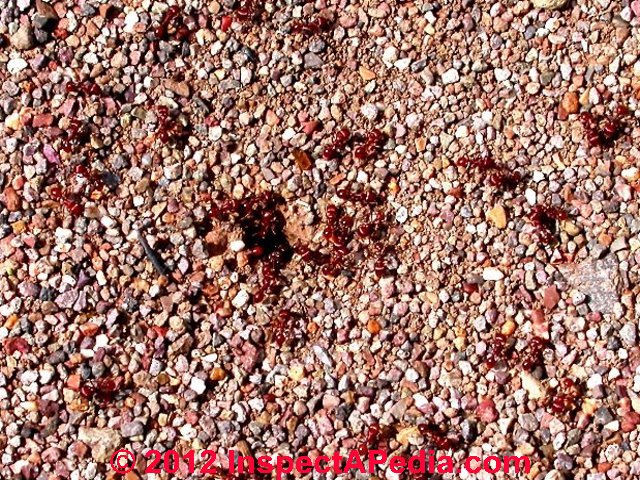
Our second photo above provides a closeup of these people-biting ants.
Carpenter Ant Research
Including: Odor detection of ants, other insects, mold
- Brandstaetter, Andreas Simon, and Christoph Johannes Kleineidam. "Distributed representation of social odors indicates parallel processing in the antennal lobe of ants." Journal of neurophysiology 106, no. 5 (2011): 2437-2449.
- Brooks, Shawn E., Faith M. Oi, and Philip G. Koehler. "Ability of canine termite detectors to locate live termites and discriminate them from non-termite material." Journal of Economic Entomology 96, no. 4 (2003): 1259-1266.
Abstract:
Dogs were trained to detect Eastern subterranean termites, Reticulitermes flavipes (Kollar), using the United States Customs method of scent detection dog training modified with a food reward.
Dogs were tested with various numbers of Eastern subterranean termites placed in vented PVC containers. Trained dogs were 95.93% accurate in finding ≥40 Eastern subterranean termite workers (positive indications) and incorrectly indicated the presence of termites in 2.69% of the containers without termites. Multiple species of termites [dark southern subterranean, R. virginicus (Banks); Formosan subterranean, Coptotermes formosanus Shiraki; powderpost, Cryptotermes cavifrons Banks; and southeastern drywood termites, Incisitermes snyderi (Light)], were similarly evaluated.
Dogs trained to locate Eastern subterranean termites were also 100% accurate in finding dark southern subterranean termites, 98.89% accurate in finding Formosan subterranean termites, 97.33% accurate in finding powderpost termites, and 88.89% accurate in finding southeastern drywood termites. Dogs were able to discriminate live termites from non-termite material.
Trained dogs’ false response rate was 25.33% to Eastern subterranean termite–damaged wood, 6.67% to American cockroaches, Periplaneta americana (L.), and 2.67% to Florida carpenter ants, Camponotus floridanus Buckley. - MOLD PRODUCTS, INEFFECTIVE - mold dogs?
- Rossi, Natacha, David Baracchi, Martin Giurfa, and Patrizia d’Ettorre. "Pheromone-induced accuracy of nestmate recognition in carpenter ants: simultaneous decrease in type I and type II errors." The American Naturalist 193, no. 2 (2019): 267-278.
- Zube, Christina, Christoph Johannes Kleineidam, Sebastian Kirschner, Jakob Neef, and Wolfgang Rössler. "Organization of the olfactory pathway and odor processing in the antennal lobe of the ant Camponotus floridanus." Journal of Comparative Neurology 506, no. 3 (2008): 425-441.
- UNIVERSITY OF KENTUCKY EXTENSION FACT SHEET
- OHIO STATE UNIVERSITY EXTENSION FACT SHEET
- CARPENTER ANT FACT SHEET from the National Pest Management Association with information on habits, habitat and prevention - http://en.wikipedia.org/wiki/National_Pest_Management_Association
Reader Comments, Questions & Answers About The Article Above
Below you will find questions and answers previously posted on this page at its page bottom reader comment box.
Reader Q&A - also see RECOMMENDED ARTICLES & FAQs
On 2023-04-12 by InspectApedia Publisher
@Chuck,
Thanks. I'd like to see the exterior as well as what else you find.
Is there wood close to ground?
[Ed. this reader exchange was originally posted at INSECT DAMAGE]
On 2023-04-12 by Chuck
@InspectApedia Publisher,
Thanks for the quick reply. The location is Boise, Idaho. It is a detached garage with painted wood on the outside. Thanks for your help!
On 2023-04-12 by InspectApedia Publisher
@Chuck,
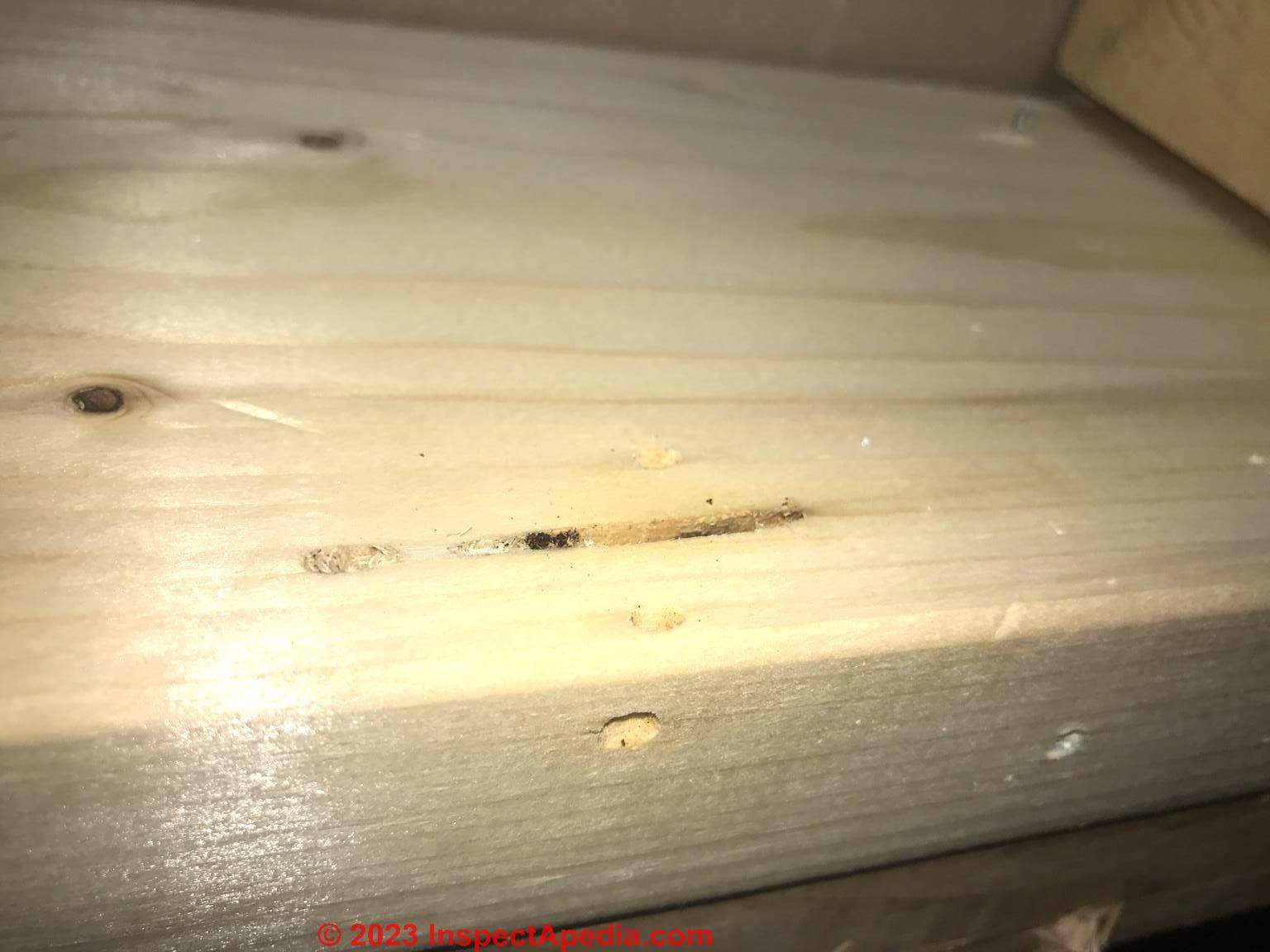
Could the oval things be insect eggs?
On 2023-04-12 by InspectApedia Publisher - size of holes indicate carpenter ants
@Chuck,
From. The size of those openings in the wood it could be carpenter ants. I would look for black ant bodies.
Where is the property and what are the building age and type of concert. construction?
On 2023-04-12 by Chuck
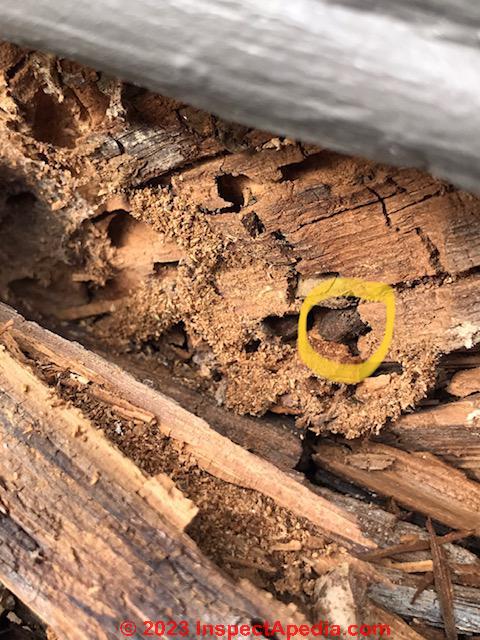
Hello, I inspected a detached garage today that had visible wood damage from the outside. The owner let me open the damaged area by pushing it in (and it easily crumbled) to see if any insects were visible inside.
When I opened the area I saw the damaged wood (see attached picture) with a number of these little round oval dark brown to blackish things inside (see circled area on picture). I saw no visible pests but a number of these oval things. You can tell some sort of wood destroying insect has been damaging the wood.
The owner said he started noticing the damaged wood for approx 6 months but just now decided to have it looked at. He said the damage has grown significantly in that time and is continuing to grow. I ruled out subterranean termites due to the holes being too large. Any help identifying appreciated.
On 2023-04-06 by InspectApedia Publisher
@Beth,
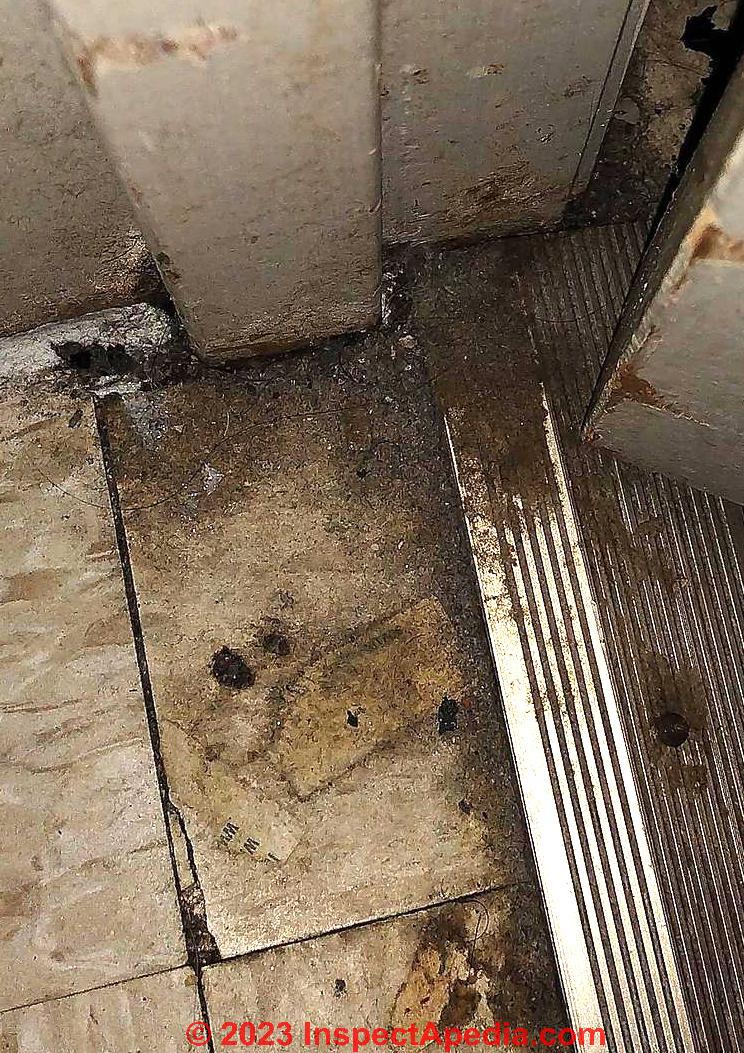
The photo is too dark for me to see much but I think that's just a dirty place.
Carpenter ant frass from an active investigation will be light in color and look like little bits of sawdust.
If you look at the page that I recommended you will see photographs of carpenter and frass.
[Ed. this reader exchange was originally posted at INSECT DAMAGE]
On 2023-04-05 by Beth
@InspectApedia Publisher,
Can you tell me if this looks like the carpenter ants sawdust or just a dirty place ?
On 2023-04-05 by InspectApedia Publisher
@Beth,
Did you take a look at the page that I suggested where you could see other photos of carpenter ants? Then look at your aunt through a magnifying glass and compare it. I think you will see it's the same.
If you are not finding sawdust or insect frass or any other signs of ant damage In a thorough inspection of the building,. Then there's no ant repellent activity that you need to deal with 1 lr 2 carpenter ants.
But if you start to see them frequently in numbers of 6, or 8 ants in a building area, then there is an infestation that you need to find and eradicate.
On 2023-04-05 by Beth
@InspectApedia Publisher,
Thanks for answering my question. We are not seeing any other sign that is saying about carpenter ants. What other can of ant could it be ? Any ideas on how to get rid of and keep them out of the house ?
On 2023-04-05 by InspectApedia Publisher
@Beth,
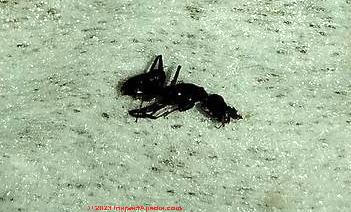
It sure looks to me like a carpenter ant. A bit worse for wear.
Compare yours with ours above on this page.
On 2023-04-05 by Beth
Can you tell me what kind of ant this is ? We mostly see the ants in our living room but sometimes they come in bathroom, kitchen, or bedroom.
On 2022-10-15 by InspectApedia (Editor)
@oboy,
Check the photos on this page - they're real, mine, from field work - and not "stock" from somewhere else. You'll see that typical old house borer or powder post beetle holes are very small and produce ultra-fine frass.
Bigger holes like in your wood are something else.
[Ed. this reader exchange was originally posted at INSECT DAMAGE]
On 2022-10-15 by oboy
Thanks, I wasn't sure if it was some kind of beetle. Some sites use stock photos for bug damage examples and some have a similarity depending on what stage of damage.. I was thinking this was too large for beetle type insect.
On 2022-10-15 by InspectApedia (Editor)
@oboy,
Looks like carpenter ant damage (or another insect) probably from before the wood was milled.
On 2022-10-15 by oboy
What Does this looks like? Bug ID
On 2022-07-23 by InspectApedia-911 (mod)
@Sbothra,
when we see moisture between panes of insulated glass, we know that the glass has lost its seal and there is a small opening somewhere that is letting humid air if not actual water into the glass space.
If there are leaks into the wall around the window the increase in moisture in that area could indeed contribute to the fogging of the glass.
On 2022-07-23 by Sbothra
@InspectApedia-911, Thank you for your response. I often see moisture in between the double glass wall of the window (i don't know how it gets there since there is no way to access that, it's supposed to be sealed) and the metal in that part of the window looks like it's rusted. But i will do what you suggested and keep you posted.
On 2022-07-16 by InspectApedia-911 (mod) - little bits of wood debris suggests nearby carpenter ant activity
@S Bothra,
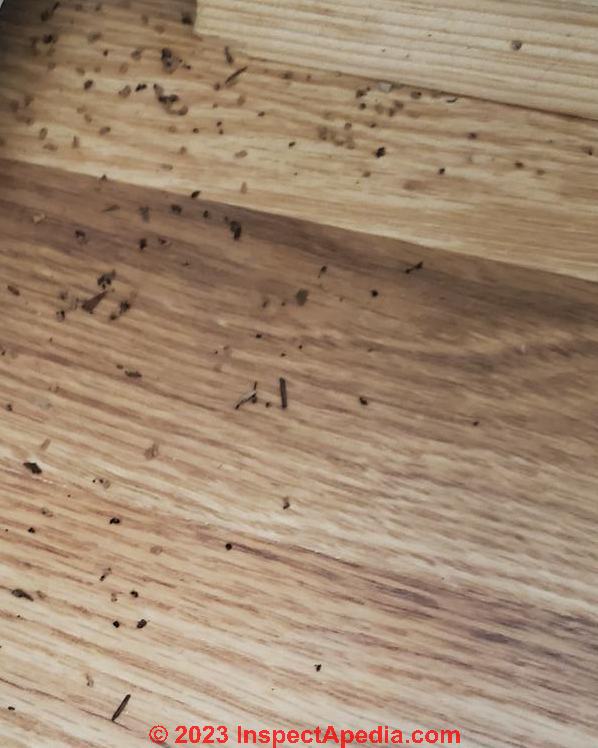
Thank you for the photo and the question. I don't know for certain but I have often seen little bits of wood debris like that when there is nearby carpenter ant activity.
I would inspect the condition of the building outside near and above this area for leaks, rot, insect activity. You might try a carpenter ant spray approved for indoor use,.
Vacuum up the debris, spray the ant poison along the edge of the floor / wall juncture and watch for some dead carpenter ants to appear as their survivors toss their bodies out in your direction.
Keep you posted.
On 2022-07-16 by S Bothra
I keep seeing these shavings under my window sill every few days. There is no sawdust, just these shavings. What could this be
On 2021-05-16 by danjoefriedman (mod) - follow carpenter ant poison directions carefully
@Amara,
We don't normally treat the ground automatically in new construction when carpenter ants are a concern.
What we do is keep wood 8 to 12 inches or more above ground level. Or use treated lumber at risk points.
Carpenter ants don't stay in your building, they go in and out. Their poison kills them either by getting on their bodies when they walk through a chemical spray on a surface, or ant poison in the form of small granules that the ants accept as food and carry back into the nest as a gift to everyone else.
Some of these are available to the public. Be sure to read the directions and follow them with care. Some of these products are toxic to wildlife and so must be applied in accordance with the manufacturer's instructions.
On 2021-05-15 by Amara
@danjoefriedman, Thank you so much for replying. I am just wondering though if the ants are in the walls, how would putting poison around the outside perimeters help? Would it be an attractant? How would I know if there is serious damage, since I can't see any?
As for what brought them in the first place, well I think since this is an older neighborhood, the contractor who put the addition to our house didn't treat the ground first?
On 2021-05-15 by danjoefriedman (mod) - light colored sawdust may indicate carpenter ants
@Amara,
If you are seeing light colored sawdust that looks like the frass photos above on this page, then it's quite possible that you have a carpenter ant infestation.
And there are three questions.
One is having the house treated which typically involves a spray or poison that's put around the house to kill the carpenter acts.
The second question is whether or not there is sufficient damage to the house that repairs are needed.
Third question is where are the leaks or structural conditions such as would cause the ground that have invited ant (or other wood destroying insect) attack on the building in the first place.
Each of these needs to be addressed, but you will probably find that the pest control inspector can address #1 and 3 but question two may require a separate inspection by a home inspector or contractor who is familiar with insect damage.
On 2021-05-15 by Amara
I've been sweeping the tile floor of an addition to our house for the past 10 years or so and have seen this saw dust like shavings about a handful amount once a week. My husband said it was just disintegrating varnish falling off from the baseboards; however, all varnish looks after all these years but I am still sweeping up a handful of saw dust looking stuff every week.
I have been keeping an infestation of ants out of the living area by keeping the baseboards sprayed with bug killer. If I call a pro, what could they do to check for damage and treat it, since we can't get inside the walls? Please give me some advice before I call a pro and pay a lot of money for incompetent work. By the way, there is no water leaking or mold in these walls.
On 2020-12-23 by Matt
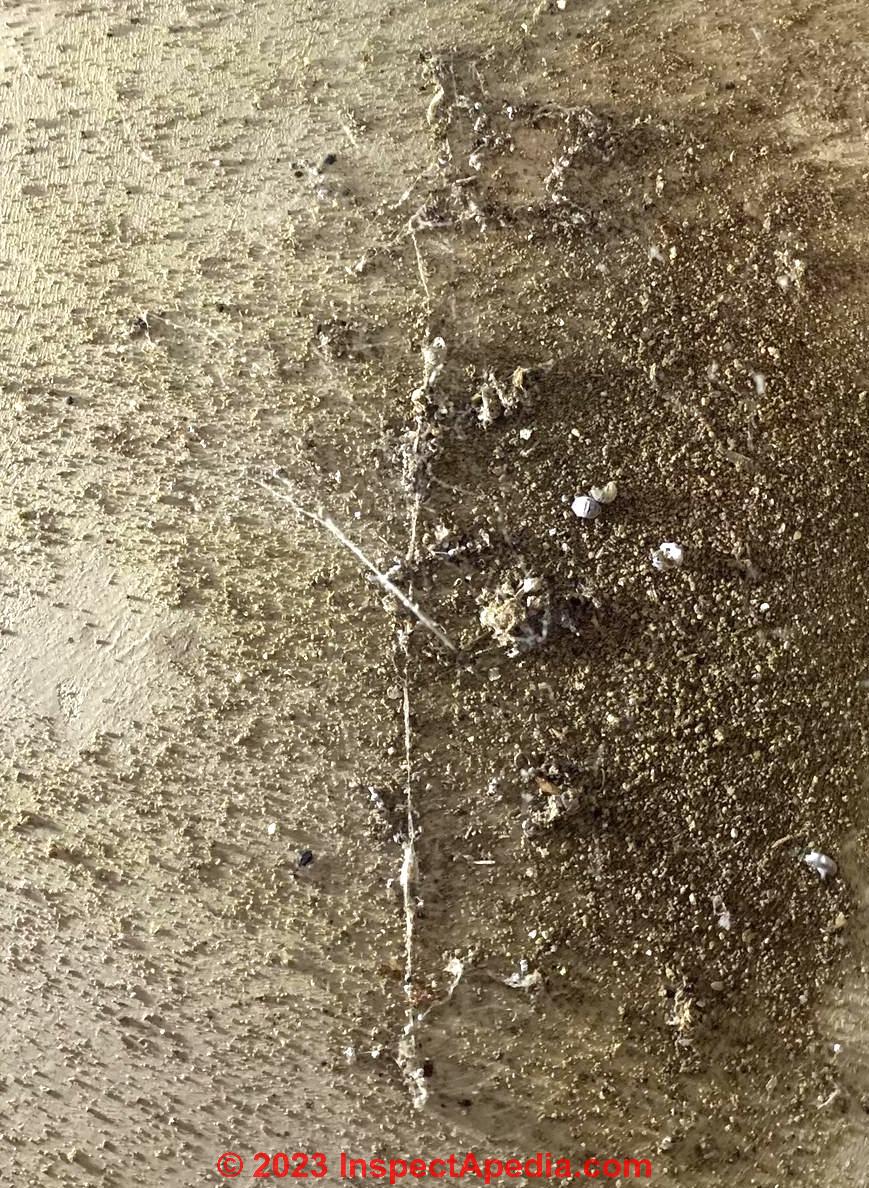
I found this in my basement when getting out Xmas decorations. Any idea what this Is from? I’m thinking carpenter ants. Only bugs I found in basement though were spiders. What do you think? If ants what’s the best bait to use. Thanks.
On 2020-11-07 by (mod) - Odor or Smell Detection of Carpenter Ants or Other Insect Pests
James; thank you for a helpful question about detection of carpenter ant activity by smell.
I've found no research indicating that a human can smell carpenter ants.
However the conditions that invite carpenter ants to attack the wood in a building generally involve water: leaks somewhere that are wetting wood or cellulose materials (including fiberboard insulation, wood framing, wood flooring etc.)
And where water has leaked into a building there is a good risk of mold contamination in those building cavities.
Some, not all, molds under some conditions, produce MVOCs that have a distinctive "moldy" or "musty" smell that many if not most people will recognize.
There has been research supporting the ability to train some dogs to recognize other insect damage in buildings, such as termite sniffing dogs and mold detecting dogs - a cute but silly idea that is too limited to be of much value. See those details
at MOLD PRODUCTS, INEFFECTIVE
This answer does *not* mean that carpenter ants live an odor-free life. Quite the contrary, the ants themselves are very highly sensitive to and are able to detect very low levels of pheromones that in fact they use to navigate ant trails and to convey other information.
A few examples are given by this research on carpenter ant odor detection and also termite sniffing dogs who, in fact can be trained to recognize a great variety of odors (Brooks 2003) above on this page.
On 2020-11-07 by James B
Is this possible to smell carpenter ants if it’s a heavy infestation?
On 2020-09-27 - by (mod) - is carpenter ant dust harmful to breathe?
Donna
Generally no, as I'll explain.
But any answer to the respiratory harm from carpenter and dust is wildly speculative as we haven't a shred of information about your case.
It sounds a bit glib but it's true that for just about every substance, even water,
the dose makes the poison.
That means that a high level of exposure to many airborne dusts, even those comprised primarily of saw dust can still be harmful.
Also unknown is whether or not the dusted you are breathing was previously sprayed with pesticides, and toxins that could be particularly harmful if inhaled.
All of that warning arm-waving complete, in my OPINION, in most situations the volume of carpenter ant frass or "sawdust" a homeowner would normally encounter is likely to be so small as to be trivial and not particularly risky. I'd be more concerned for workers performing demolition and repair of extensive insect damage on a building that may have also been treated especially long ago with various pesticides.
Watch out: however, breathing ant dust or other dust or fine particulates in an area where pesticides have been sprayed might be hazardous as you may be breathing in pesticide.
On 2020-09-27 by Donna Long
Can breathing dust from carpenter ants in air ducts cause respiratory or allergic symptoms
On 2020-09-05 - by (mod) -
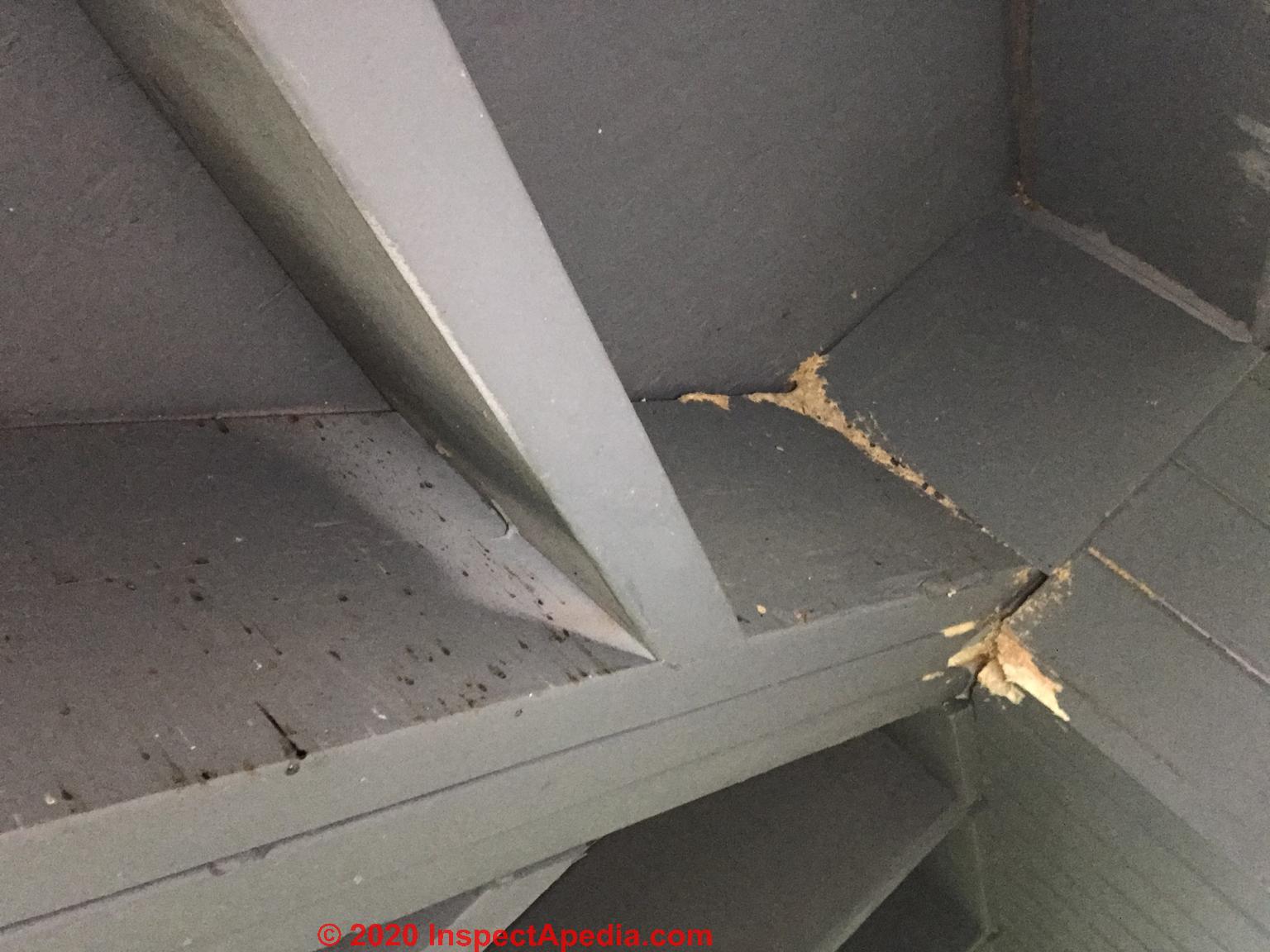
That certainly looks like insect damage, perhaps carpenter ants, though I've also seen similar chipping from woodpeckers.
If you see large splinters on the ground below that wood roof damage I'd figure it's woodpeckers.
If you see granular sawdust it's probably carpenter ants.
If you see very fine dust and round holes into the wood in the area of damage it's probably carpenter bees.
If you see mud tubes in or around the wood I'd suspect termites.
On 2020-09-04 by Bill2
Pile of frass at base of siding. Can't see anything on the outside of the siding high up (about 30 feet) It's an extension Built in 2014. Ants? termites?
It's a west facing corner but quite damp because of tree cover. Boston area. can anyone identify? thank you
On 2020-09-04 by Bill
Mystery pest under overhang. Staining and frass. Can anyone identify this? There's often a woodpecker there but it's so high up- about 45 feet- that I can't get up there.
The can lights in the room next to this area have some dead insects (Flies/ ants) Boston area. At the base of the siding about 30 feet from here is a pile of frass. Will try to post a pix under Bill2
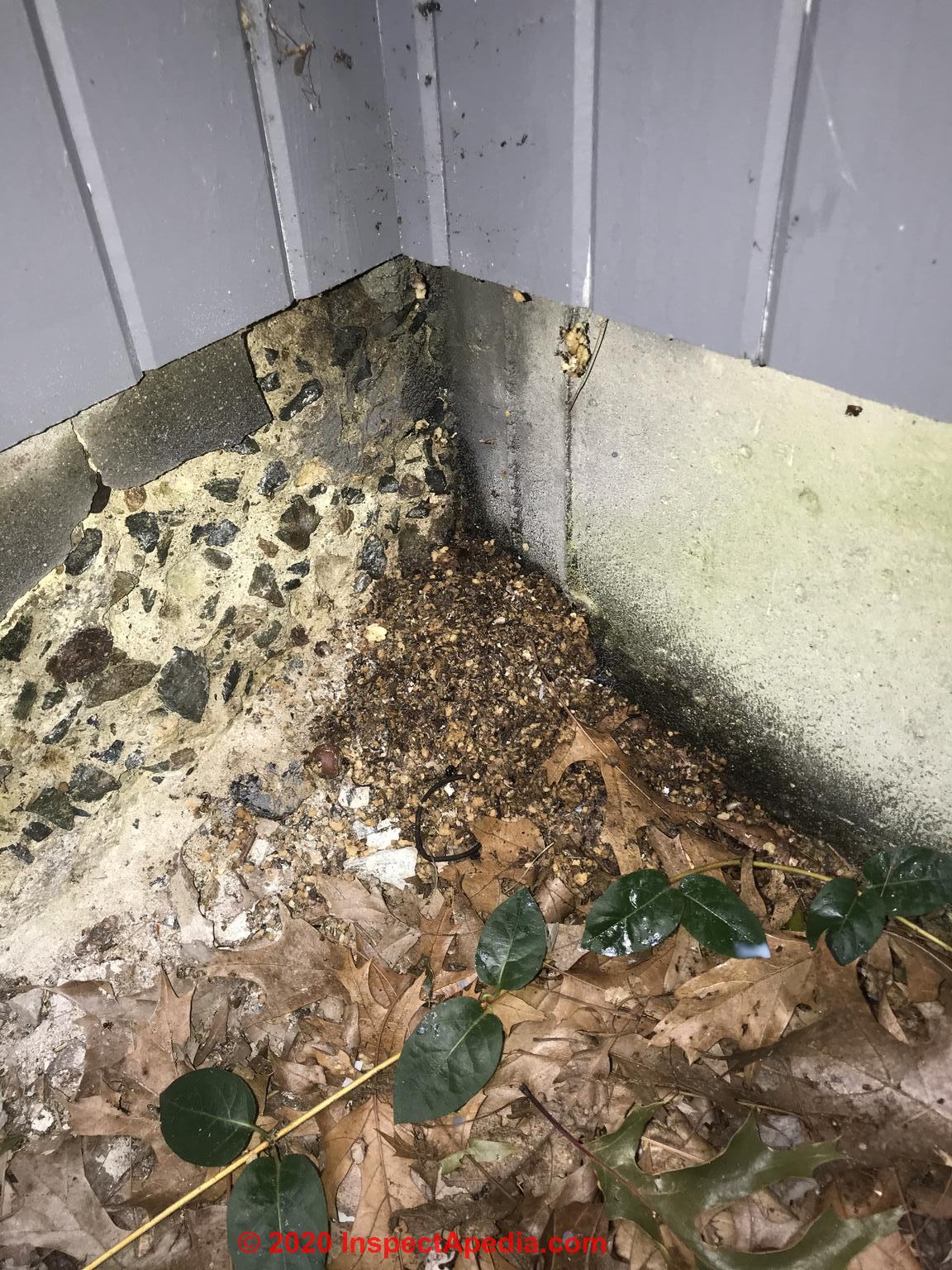
On 2020-05-19 by (mod) - carpenter ants versus termites versus rodents
If you see actual mud it's probably termites
but from the mix of what looks like coarse sawdust and insulation I'd suspect carpenter ants
but from those dark things that look like rodent droppings there may be mice or some little animal as well - photo isn't so sharp that I can say for sure
On 2020-05-19 by Jasmine
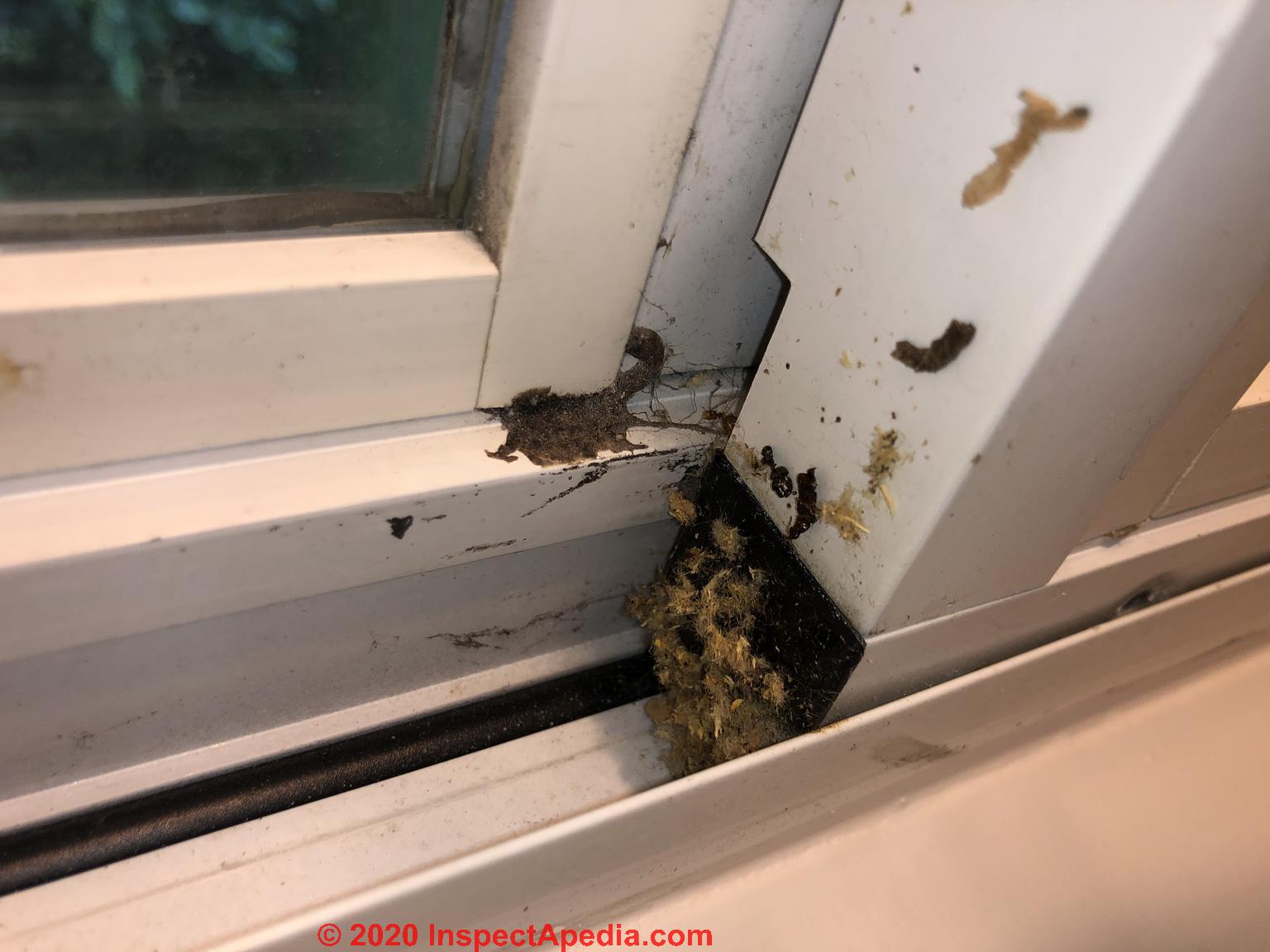
Wondering if this is from Carpenter Ants?
On 2018-03-07 - by (mod) -
Gia
It's pretty likely that the pest control gal hit a nest or hit very close to one.
On 2018-03-07 y Gia
Extraordinarily informative articles - thank you! (incidentally, love how you characterize the streaming of carpenter ants upon pesticide application as 'exciting'; made me laugh.) Does it alway mean when they stream out in an exciting manner like that - that the pest control guy hit a nest, absolutely for sure?
On 2013-02-26 by (mod) where to buy carpenter ant spray
MJ: any hardware store, building supplier, garden supplier as well as online vendors sell a variety of treatments for carpenter ants including both sprays and granular crystals that can be safely sprinkled in some areas.
Watch out: just about every pesticide also comes with serious environmental, contamination, safety & health warnings from the manufacturer: follow the manufacturer's application instructions when using any pesticide.
On 2013-02-26 by MJ
Where do you get this special carpenter ant spray?
...
Continue reading at TERMITE DAMAGE PROBING or select a topic from the closely-related articles below, or see the complete ARTICLE INDEX.
Or see these
Recommended Articles
- INSECT INFESTATION / DAMAGE - home
- STRUCTURAL DAMAGE PROBING
- TERMITE DAMAGE PROBING
- WOOD DESTROYING INSECTS carpenter ants, powder post beetles, & other wood destroying organisms
- WOOD STRUCTURE ASSESSMENT - damage inspection & testing
Suggested citation for this web page
CARPENTER ANTS at InspectApedia.com - online encyclopedia of building & environmental inspection, testing, diagnosis, repair, & problem prevention advice.
Or see this
INDEX to RELATED ARTICLES: ARTICLE INDEX to INSECT DAMAGE
Or use the SEARCH BOX found below to Ask a Question or Search InspectApedia
Ask a Question or Search InspectApedia
Try the search box just below, or if you prefer, post a question or comment in the Comments box below and we will respond promptly.
Search the InspectApedia website
Note: appearance of your Comment below may be delayed: if your comment contains an image, photograph, web link, or text that looks to the software as if it might be a web link, your posting will appear after it has been approved by a moderator. Apologies for the delay.
Only one image can be added per comment but you can post as many comments, and therefore images, as you like.
You will not receive a notification when a response to your question has been posted.
Please bookmark this page to make it easy for you to check back for our response.
Our Comment Box is provided by Countable Web Productions countable.ca
Citations & References
In addition to any citations in the article above, a full list is available on request.
- [3] Jeffrey Hahn, Colleen Cannon, and Mark Ascerno, "Carpenter Ants", University of Minnesota Extension, retrieved 9/19/2012, original source: http://www.extension.umn.edu/distribution/housingandclothing/dk1015.html, copy on file as [Carpenter_Ants_UMinn.pdf]
- [4] Wikipedia Web: https://www.wikipedia.org/ provided background information about some topics discussed at this website provided this citation is also found in the same article along with a " retrieved on" date. NOTE: because Wikipedia entries are fluid and can be amended in real time, we cite the retrieval date of Wikipedia citations and we do not assert that the information found there is necessarily authoritative.
Carpenter ants, retrieved 9/21/12, original source http://en.wikipedia.org/wiki/Carpenter_ant
Following citations from that article: - In addition to citations & references found in this article, see the research citations given at the end of the related articles found at our suggested
CONTINUE READING or RECOMMENDED ARTICLES.
- Carson, Dunlop & Associates Ltd., 120 Carlton Street Suite 407, Toronto ON M5A 4K2. Tel: (416) 964-9415 1-800-268-7070 Email: info@carsondunlop.com. Alan Carson is a past president of ASHI, the American Society of Home Inspectors.
Thanks to Alan Carson and Bob Dunlop, for permission for InspectAPedia to use text excerpts from The HOME REFERENCE BOOK - the Encyclopedia of Homes and to use illustrations from The ILLUSTRATED HOME .
Carson Dunlop Associates provides extensive home inspection education and report writing material. In gratitude we provide links to tsome Carson Dunlop Associates products and services.
 | HOME | ABOUT | ASK a QUESTION | CONTACT | CONTENT USE POLICY | DESCRIPTION | POLICIES | PRIVACY | |
| © 2024 - 1985 Publisher InspectApedia.com - Daniel Friedman | |||||||||