
InspectAPedia® FREE Encyclopedia of Building & Environmental Construction, Diagnosis, Maintenance & Repair |
Question? Just ask us! InspectAPedia
|
 Septic System Life Expectancy
& Maintenance
Septic System Life Expectancy
& Maintenance
10 Key Determinants of Septic Life
- POST a QUESTION or COMMENT about the typical life expectancy of septic system components
Septic system life expectancy:
This document describes the typical life expectancy of septic systems and various common septic system components.
The life expectancy of a septic tank depends largely on its materials, while the life of septic system piping depends largely on the risk of damage from vehicle traffic, clogging by roots, or flooding by groundwater.
The life expectancy of a drainfield varies widely by installation type (conventional soil absorption system versus a sand bed filter, for example), by soil conditions (clay or rock or sand), and importantly, by the frequency of maintenance and cleaning which has been performed on the septic system.
InspectAPedia tolerates no conflicts of interest. We have no relationship with advertisers, products, or services discussed at this website.
Septic System Component Life Expectancy
 Understanding the proper procedures for septic tank care, septic tank cleaning frequency, and other septic tank maintenance chores,
will permit the owner of a home with an onsite septic system to maximize the life of the system and to assure that it is
working properly.
Understanding the proper procedures for septic tank care, septic tank cleaning frequency, and other septic tank maintenance chores,
will permit the owner of a home with an onsite septic system to maximize the life of the system and to assure that it is
working properly.
How Quickly Does A Septic System Fail? How long will a septic tank, D-box, or absorption bed last?
Watch out: the most important step that a homeowner can do take maximize the life of a private (onsite) septic system is to pump the septic tank on a regular schedule based on number of building occupants, tank size, wastewater usage.
Readers should also see SEPTIC LIFE MAXIMIZING STEPS,
and see SEPTIC TANK PUMPING PROCEDURE for a detailed step by step photo-illustrated guide to find, pump and clean a septic tank.
The life of the entire septic septic system depends on the following factors:
- Septic Tank Pumping Frequency:
providing you are starting with a functional and reasonably-designed septic system, the most significant step you can take to extend the septic system life is to have the septic tank cleaned or "pumped" on schedule.
See TANK PUMPING SCHEDULE for a table that determines how often a particular septic tank needs this service.
Similarly, while a septic filter at the tank can extend the drainfield life, failure to maintain the septic tank filter can result in a sewage backup in the building or damage to the drainfield.
See FILTERS SEPTIC & GREYWATER - How the Septic System is Used:
including the wastewater usage level and what materials are flushed down the septic system drains.
Using the septic system at levels beyond its design capacity will lead to septic system failiure.
Conserving water reduces the load on the absorption field. Avoiding flushing chemicals or items that don't biodegrade reduces the solid build-up rate in the septic tank.
See "DON'T FLUSH INTO THE TOILET these things into a septic system" for a list of what's ok and what's not ok to put into septic tanks and building drains. - Soil Conditions
such as the soil percolation rate and the amount and level of ground water or surface water that affect the soil absorption area or drain field. - Septic Tank Materials:
a steel septic tank rusts away, first losing its baffles (which lead to drain field clogging) and eventually rusting at its bottom or sides. The rate of rust depends on the soil conditions and soil acidity and other factors.
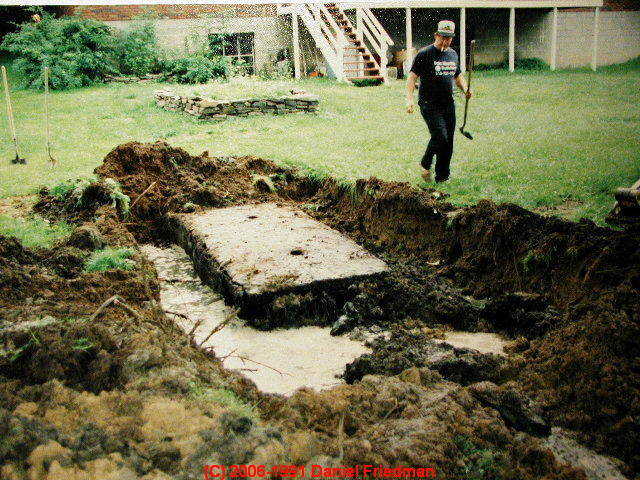
A concrete septic tank can have a very long life, in excess of 40 years, except for cases of poorly-mixed concrete or possibly acidic soils which may reduce that span.
Plastic or fiberglass septic tanks can expect to have a similar life unless they are mechanically damaged. - Septic Tank Tees or Baffles:
The septic tank baffles or tees provided at the septic tank inlet and outlet are key components that prevent sewage backups into the building (the septic tank inlet tee) and that prevent solids from flowing out into the septic absorption system (drainfield, soakaway, leachfield, mound, sand bed, etc.,)>
If the outlet baffle or tee is damaged or lost, the subsequent flow of solid waste material into the septic absorption system will significantly reduce the remaining life of the system. So be sure to check the condition of these key components whenever the septic tank is serviced or cleaned. - Life of Special Components
such as effluent pumps or septic grinder pumps, septic filters, septic media, and sand bed filter systems often determines the need for repair of alternate-design septic systems that use these components. - Nearby trees or plants
whose roots invade system components. - Water & wet sites:
sending surface or roof runoff into a drainfield area or locating a septic soakaway bed in wet soils, near a high water table, near creeks or streams prone to flooding all mean short life as well as maybe an improper or illegal installation. - Water usage in the building:
The level of water usage in a building also affects the drainfield and unusual or abnormal levels of water usage, such as constantly running toilets
See TOILET RUNS CONTINUOUSLY - or a water softener stuck in "backwash" cycle, can saturate a septic drainfield and cause it to fail.
Similarly, a water softener that is stuck in regeneration cycle and keeps running can flood the septic fields
or a water conditioner that is improperly adjusted can put too much salt into the water is also harmful to the drainfield.
See HOW SOFTENERS WORK for details about how water softeners work.
See WATER SOFTENER ADJUSTMENT & CONTROLS for advice on how to set the water softener timer and salt dose. - Events or actions that damage the septic system:
such as driving vehicles or heavy equpiment over a drainfield can damage the field, compact the soil, or even break buried piping, leading to early septic system failure, as can planting or allowing growth of trees or deep-rooted plants over the drainfield.
See DRIVING OVER SEPTIC SYSTEMS
and PLANTS & TREES OVER SEPTIC SYSTEMS
How Quickly Will the Septic System Fail if We Have One or More of the Problems Listed Above?
Septic systems (tank and absorption system, or onsite wastewater disposal systems) will not fail immediately if they are not pumped. However, an un-maintained septic tank is no longer protecting the soil absorption field from solids.
Continued neglect shortens the drain field life and may result in system failure and even require complete replacement of the soil absorption field. In some cases, site limitations may make replacement of the absorption field impossible - at least impossible using a conventional drainfield design.
Alternative designs are available to solve these problems.
So provided you've addressed these factors in septic system life, how long can you expect a septic system to last before costly repairs to the septic tank or septic drain field are required?
How Long do Individual Septic System Components like Tanks, Piping, D-Boxes, Filters or Pumps Last?
A steel septic tank will rust out on a schedule affected by soil acidity and tank steel quality and coating integrity. A steel septic tank more than 15 or 20 years old is likely to have already rusted to the point of having lost its baffles and perhaps having a rusted-out bottom - conditions that can be recognized during septic tank cleaning and inspection. A steel septic tank cover lasts until some fool drives over it or it rusts out.
A concrete septic tank can last 40 years to nearly indefinitely, though poor quality concrete or acidic ground water may result in deteriorated baffles or tank components.
A conventional septic drain field has a varying life as a function of the soil percolation rate, drainfield size, and usage level.
I've seen a septic drainfield, a large one in good soil with a well maintained septic tank, last for more than 50 years. I've seen a conventional septic drainfield fail within 24 hours of first use on a new system when piping was poorly installed.
There is therefore a very wide range of life for this component. Experience of neighbors who have similar soils and similar systems can be helpful if you ask. In general, if I know nothing but that there is a conventional septic drainfield or a raised bed system and it's 20 years old, I consider its forward life not predictable and advise owners to budget for its replacement at any time.
The septic tank is only one part of an on-site wastewater system. It is designed to remove solids prior to the effluent entering the soil absorption field, provide for the filtration, digestion of a portion of those solids, and storage of the remaining solids.
Taking care of the septic tank will, however, extend the life of the costly second half of the onsite wastewater treatment system - the absorption system, leach field, or drainfield.
What to Do if you have just moved into a home with a septic system
If you've just moved into a home with a septic tank you may not know the size of the septic tank, its maintenance history, or even where the septic tank is. In this case, you should have the tank pumped and inspected. The company pumping the tank will tell you its size, age, and condition.
Reader Comments, Questions & Answers About The Article Above
Below you will find questions and answers previously posted on this page at its page bottom reader comment box.
Reader Q&A - also see RECOMMENDED ARTICLES & FAQs
On 2020-06-06 - by (mod) - I need to move a 1000 gal. septic tank
Pete
If your excavator digs sufficient clearance around the concrete septic tank and the tank is not damaged it ought to be possible to lift and relocate it.
On 2020-06-05 by pete
Due to construction I need to move a 1000 gal. septic tank. My concern is the age of the tank's integrity. It's 40 yrs old and seems in good condition; the baffles are showing relatively little deterioration. I can't see the sides or bottom without pumping. If the baffles look good so I believe that would indicate a tank sound enough to move. Agreed? Also the baffles and concrete of the distribution box look good as well ( I do realize this is a separate entity).
The field was cleaned and tested and took as much water as we could put into it, so replacing the system seems unnecessary. All comments please.
Thank you all
On 2020-05-28 - by (mod) - "Code" compliance for a septic system that's 40 years old?
"Code" compliance is of course an arguable item; nobody buying a 40 year old home can expect that all of the home's features will meet current building codes nor that the owners can be required to update every item to current codes whose coverage is extensive, ranging among structure, mechanicals, etc. even to lot line setbacks and clearances.
(Just ask our neighbor Mr. Krause who could have been required to move his house twenty feet to the left).
Having a larger septic tank will extend the life of any drainfield - IN GENERAL - but, forgive me but 50+ years of experience in this field makes me warn that it would be foolish to have any expectation of a 40-year-old septic drainfield.
Having "survived" for 40 years with a very small septic tank would itself be a warning that the field is likely to be near, at or even past its useful life. It's all too common that new people move into a property, perhaps with a younger or larger family, run more water, and quickly discover a failed drainfield.
Therefore it would be prudent to have, in your financial plan, an understanding that you may need to replace the septic fields at any time.
On 2020-05-28 by LonnyGB
We had an inspection on a 40 year old house with the original septic system. The inspection passed, but they said that the septic tank is only 500 gal and for it to be at code it would need to be a 1500 gal. I am working with our realtor to see if the home owners would replace it with a new 1500 gal tank. Will that also possibly extend the life of the drain field if properly maintained?
On 2020-05-09 - by (mod) -
Greg
If there is room on the site to install the new drainfield the contractor leaves everything of the old field alone and intact, digging new drainfield trenches either in another area or in parallel between the old trenches.
Trenches are usually 5 ft. apart. If there's not that much room then the whole field design is questionable and needs review by a septic engineer who will take into account soil perc rates, space, etc.
If it's an old septic tank that's being abandoned, if it's steel it's often crushed flat and put in the bottom of the hole or alongside the hole so that the new septic tank can be set in about the same place.
Beyond that general advice I'm unclear what about your site requires digging up and moving old lines but I suspect it's a lack of space for the fields.
On 2020-05-09 1 by Anonymous
Thank you very much for the info and quick response. I'm just concerned of the size of an additional hole dug on my property to accommodate all of the stone, sand, and what ever other materials come with it.
Do the laterals get buried as well and does this need to be 100 feet from our well? Thanks again. Greg
On 2020-05-09 - by (mod) -
It's common practice to crush old steel septic tanks into Barry other septic components that are no longer in use rather than to haul them away. You might ask just how much excavation and disturbance is going to be necessary
On 2020-05-09 by Greg
Wow! Thank you for your quick response. I had another contractor tell me he would replace the field with a Conventional system like I have and that he doesnt install the chamber system. . The thing Im not sure about with this is that he said all of the material of the failed field would be buried in another spot in my yard. Is this common practice? Or should I request the material to be hauled off? which Im sure will increase the cost. Thanks again.
On 2020-05-08 - by (mod) -
Greg
Your contractor is proposing a two-septic-field design. You switch between them every so many years, letting the one that's "off" rest for some years i hopes that the natural bio-mat that forms around the drain trenches will thin and thus reduce the chances of clogging and failure, while it rests.
It's an accepted design, though if I were the contractor I'd not promise anything tied to an exact number of years. The success of the rest period in "restoring" the "off" drainfield depends on a number of variables such as: soil type, porosity, makeup, original percolation rate, usage levels, septic tank pumping history (avoiding pushing solids into the drainfield).
See SEPTIC LIFE MAXIMIZING STEPS
On 2020-05-08 by Greg
Hello Sirs, My conventional drain field is at the end of its life of 23 yrs. I had a Septic contractor come to my house. His recommendation is to construct a new chamber field and put valve in to switch from field to field. This is what Im not sure about.....He said my conventional system will restore itself after about 7 yrs and will operate without issues. Is this true? Thank you for your time. Greg. gregt4586@gmail.com
On 2019-12-08 - by (mod) -
Rita
From what you describe a reasonable planning estimate is that you will need to
1. install a new septic tank
2. install a drainfield (or at the very least scope every drainfield line and dig up a couple of sample cross-sections to see how the field was constructed, amount of gravel, biomat condition)
3. remove the tree and its roots or else move the drainfield to a sufficient distance (In the ARTICLE INDEX you'll find an article on planting over or near the septic and the required distances)
On 2019-12-08 by Rita
Also, what about the drain field?
What about a system installed in 1978 but had very little use. The premises unoccupied for the past 15 years? The last inspection 20 years ago a tree root had split the cement tank in half so they cut the tree root and put in root killer however the tree is huge and still nearby. We want to resurrect the property but not sure of the system after so many years of unuse.
On 2019-08-05 - by (mod) -
Hi Mike
We discussed this system at
https://inspectapedia.com/septic/Residential_Sewage_Treatment_Systems.php
Where you'll see that I posed the number of questions that might help give a better idea of the condition of the system..
I also think it's important to make a distinction between having to repair or replace individual components such as a pump or filter and having to reconstruct an effluent absorption field or drain field.
On 2019-08-04 by Mike Staniforth
We have a 30 year old steel clargester which manages the waste for 9 houses. It has been regularly serviced. How many more years is it likely to be before it has to be replaced
On 2019-05-22 - by (mod) - drainfield restorers ?
Ron
There are services and systems claiming to restore drainfields, some supported by (not what I consider independent un-biased) "White papers"
but I have not found any of those that is reported by our readers or by independent research as effective and adding meaningful life to a septic field when the failure is due to soil clogging from a mature biomat.
I wish there were such a product that worked and that didn't contaminate the environment as do some harsh chemicals people try.
No.
On 2019-05-22 by Ron Whitney
my fifteen year old title five septic field appears to be failing. Is there any way to break up the field?
...
Continue reading at SEPTIC DRAINFIELD LIFE or select a topic from the closely-related articles below, or see the complete ARTICLE INDEX.
Or see SEPTIC LIFE EXPECTANCY FAQs - questions and answers posted originally at the end of this article
Or see these
Recommended Articles
- DISHWASHERS vs SEPTICS
- NO ROCK SEPTIC SYSTEM LIFE
- SEPTIC LIFE EXPECTANCY
- SEPTIC LIFE MAXIMIZING STEPS
Suggested citation for this web page
SEPTIC LIFE EXPECTANCY at InspectApedia.com - online encyclopedia of building & environmental inspection, testing, diagnosis, repair, & problem prevention advice.
Or see this
INDEX to RELATED ARTICLES: ARTICLE INDEX to SEPTIC SYSTEMS
Or use the SEARCH BOX found below to Ask a Question or Search InspectApedia
Ask a Question or Search InspectApedia
Try the search box just below, or if you prefer, post a question or comment in the Comments box below and we will respond promptly.
Search the InspectApedia website
Note: appearance of your Comment below may be delayed: if your comment contains an image, photograph, web link, or text that looks to the software as if it might be a web link, your posting will appear after it has been approved by a moderator. Apologies for the delay.
Only one image can be added per comment but you can post as many comments, and therefore images, as you like.
You will not receive a notification when a response to your question has been posted.
Please bookmark this page to make it easy for you to check back for our response.
Our Comment Box is provided by Countable Web Productions countable.ca
Citations & References
In addition to any citations in the article above, a full list is available on request.
- In addition to citations & references found in this article, see the research citations given at the end of the related articles found at our suggested
CONTINUE READING or RECOMMENDED ARTICLES.
- Carson, Dunlop & Associates Ltd., 120 Carlton Street Suite 407, Toronto ON M5A 4K2. Tel: (416) 964-9415 1-800-268-7070 Email: info@carsondunlop.com. Alan Carson is a past president of ASHI, the American Society of Home Inspectors.
Thanks to Alan Carson and Bob Dunlop, for permission for InspectAPedia to use text excerpts from The HOME REFERENCE BOOK - the Encyclopedia of Homes and to use illustrations from The ILLUSTRATED HOME .
Carson Dunlop Associates provides extensive home inspection education and report writing material. In gratitude we provide links to tsome Carson Dunlop Associates products and services.
 | HOME | ABOUT | ASK a QUESTION | CONTACT | CONTENT USE POLICY | DESCRIPTION | POLICIES | PRIVACY | |
| © 2024 - 1985 Publisher InspectApedia.com - Daniel Friedman | |||||||||