
InspectAPedia® FREE Encyclopedia of Building & Environmental Construction, Diagnosis, Maintenance & Repair |
Question? Just ask us! InspectAPedia
|
 Find Out if a Building is Connected to a Septic Tank or a Municipal Sewer
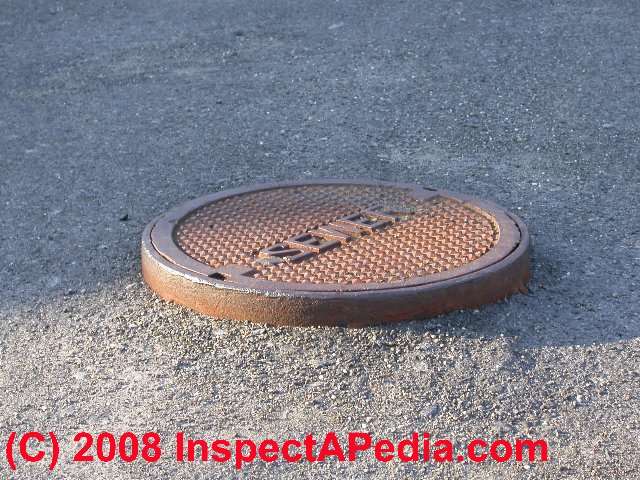
- POST a QUESTION or COMMENT about how to figure out if a home is connected to public sewer or private septic
How to determine if a building is connected to sewer or septic system:
This article discusses what a property buyer can do to determine whether a home or other building she is buying is connected to a public sewer line or to a private septic system.
A reader asked, "How do I know if the house I am purchasing has a septic tank?"
Often the answer to this question is well known, documented, and everyone is confident of the facts.
But in older communities, especially if the age of a building is greater than the age of the community sewer system, even if a sewer is installed right in the street in front of a building, that building may never have been connected to the sewer line.
InspectAPedia tolerates no conflicts of interest. We have no relationship with advertisers, products, or services discussed at this website.
- Daniel Friedman, Publisher/Editor/Author - See WHO ARE WE?
How to Determine If a Building Is Connected to a Private Septic Tank or a Public Community Sewer System
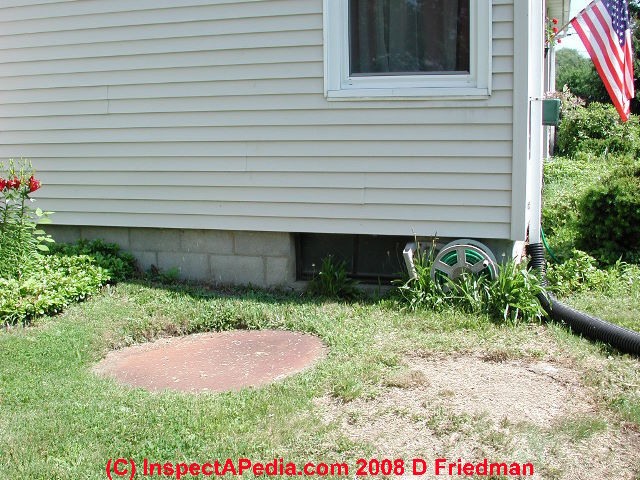
Failure to connect an older building to a sewer line can lead to some ugly surprises, including unanticipated expense to repair an old septic system, expense to connect the building to the new sewer line, and even serious life safety hazards if an old septic tank is at risk of collapse.
Our friend Steve Vermilye, an inspector and contractor in New Paltz, New York, discovered that an office building that everyone thought had been connected to the New Paltz sewer system for decades was in fact connected to an old cesspool in the back yard of the property.
That condition was discovered during new construction, happily before someone fell into the cesspool.
Article Series Contents
- SEPTIC or SEWER CONNECTION?
- WHAT TO ASK ABOUT SEWERS or SEPTICS
- CLUES INDICATING A SEWER LINE is PRESENT
- CLUES INDICATING CONNECTED to SEWER
- GUIDE for BUILDINGS CONNECTED to PUBLIC SEWER
- GUIDE for BUILDINGS PRE-DATING SEWER INSTALLATION
- GUIDE for BUILDINGS CONNECTED to PRIVATE SEPTIC
- WHAT TO DO IF NO ONE KNOWS - if the connection is to sewer or septic
- SEPTIC VIDEOS show how to walk the site for possible septic tank & drainfield locations
- SEWER / SEPTIC PIPE CAMERAS explore the sewer line from inside, tracing its condition, length, direction to a terminal point: a public sewer, septic tank, cesspool, seepage pit.
Septic tanks or other private onsite waste disposal systems are used to handle sewage and wastewater in neighborhoods that are not served by a municipal or community sewer system.
Sewer systems include large sewer main drains that are routed through neighborhoods they serve, often in the street but sometimes through an easement across multiple properties. These drains carry sewage and wastewater to a community or municipal sewage treatment plant, sometimes by way of one or more pumping stations if the terrain is hilly.
What Questions to Ask About Public Sewers or Private Septic Systems When Buying a Home, Building, or Property
The realtor or seller of a home or other property should be able to tell a buyer answers to the following questions, but if s/he cannot, we have lots of advice on how to find these important answers anyway:
- Is there a municipal sewer system in the neighborhood and on your particular street?
We discuss how to find the answer to this question
at CLUES INDICATING A SEWER LINE is PRESENT - Is the building connected to the public sewer or does it use a private septic system? Don't assume that every home on a street is connected to the public sewer main that runs nearby.
We discuss how to find the answer to this question
at CLUES INDICATING CONNECTED to SEWER.
Five possible outcomes to these questions about sinks, toilets, sewers, and septic tanks:
- If no one seems to know if the building is connected to a public sewer or a private septic tank and drainfield system, don't give up, we can still find out what you need to know.
We discuss this case
at WHAT TO DO IF NO ONE KNOWS if its Sewer or Septic? - If the building is connected to a private septic system, lots of other important detailed questions need to be asked.
See our detailed advice
at SEPTIC SYSTEM, HOME BUYERS GUIDE which discusses the inspections and tests that should be performed, introduces the need for septic system maintenance, and describes how to find septic tanks, distribution boxes, and drainfields. - If you are told that the building is for sure connected to a public sewer system, there are still a few questions to ask, and if the home is an older one that could have been built before the sewer system was put in place, there are some important questions to resolve about safety, older septic systems that may still be in place, and more.
We discuss these
at GUIDE for BUILDINGS CONNECTED to PUBLIC SEWER where we handle the cases of both newer homes and older homes which have different concerns about connecting to a public sewer. - A building may be connected to both public sewer and private onsite septic systems. It sounds odd but some older buildings that have been connected to a public sewer may still have old laundry sinks running to a drywell or even a bathroom still connected to a septic tank or cesspool.
We tell you how to figure this out
at GUIDE for BUILDINGS PRE-DATING SEWER INSTALLATION - A building may have no waste piping, or almost no waste piping system whatsoever. If we exclude buildings that are immediately obvious as having no plumbing whatsoever, there remain a smaller number of cases in which a building has self-contained or waterless systems for washing or toilets.
You'll probably notice this as soon as someone needs to use a toilet or even wash a dish. But it's not as odd as you may imagine.
Some buildings may use self-contained very limited-capacity waterless or low-water toilets, for example, and some may use graywater systems that recycle and re-use much of their wastewater. We discuss these systems
at SEPTIC DESIGN ALTERNATIVES.
What Does It Mean If No Public Sewer Line is Available at a Property?
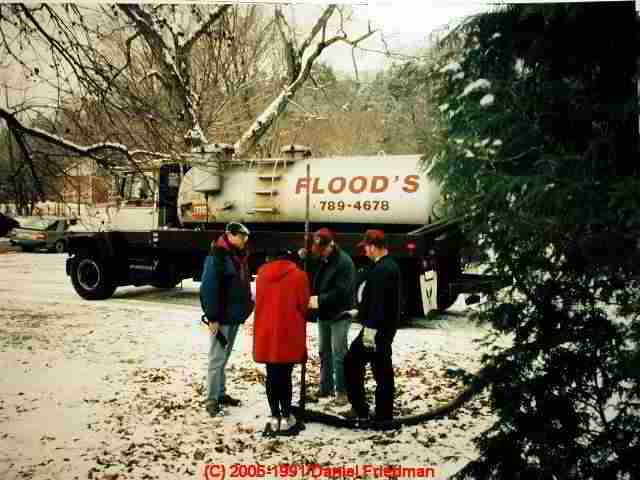
If there is no sewer system present the home cannot be attached to one and a local septic system is or should be present.
But don't worry, it's possible to treat building sewage and wastewater onsite safely and with good sanitation.
Millions of private homes in the U.S. and in many other countries are served by private onsite septic and wastewater treatment systems.
See some basic comments about buying a home with a septic tank at
GUIDE for BUILDINGS CONNECTED to PRIVATE SEPTIC
then see the critical advice on how to proceed which we describe at
SEPTIC SYSTEM, HOME BUYERS GUIDE
which discusses the inspections and tests that should be performed, introduces the need for septic system maintenance, and describes how to find septic tanks, distribution boxes, and drainfields.
Citation of this article by reference to this website and brief quotation for the sole purpose of review are permitted. Use of this information at other websites, in books or pamphlets for sale is reserved to the author. Technical reviewers are welcome and are listed at "References."
...
Reader Comments, Questions & Answers About The Article Above
Below you will find questions and answers previously posted on this page at its page bottom reader comment box.
Reader Q&A - also see RECOMMENDED ARTICLES & FAQs
On 2020-08-16 by (mod) - What does it mean if a house has a Public Septic?
Sandy:
Either someone is speaking without taking great care of word choice, and they're referring to a building connected to a public sewer system,
or
In some developments such as small clusters of housing a local private onsite septic system may be installed - also referred to as a shared septic system.
In either case, sewage and other wastewater leaves your house for treatment and disposal at a public or community septic system or sewage treatment system.
Homeowners connected to a community sewage or septic system may expect to be periodically assessed for the cost of operation and maintenance of the community septic.
On 2020-08-16 by Sandy
What does it mean if a house has a Public Septic?
On 2018-12-12
by (mod)
- how to find out if there is a septic tank or public sewer system
On 2017-12-27 by Anonymous
Michael, Nikki and Clive:
The steps are given in the SEPTIC or SEWER CONNECTION? article above - please take a look and then let me know if any of that information leaves you with questions.
Also see CLUES INDICATING A SEWER LINE is PRESENT
On 2018-08-28 by Michael O'Keefe
3725 Longview Carlsbad, Ca. Is it connected to city sewer system?
On 2018-12-11 by Clive Nada
How do I found out if I have a septic tank or soakaway
On 2017-12-26 by Nikki Ingle
Does 3 cline drive Granite Falls NC 28630 have a septic tank?
On 2017-02-07 by Greg
Who is responsible to move sewer line from old sewer main to the new main
On 2016-11-03 by Steph
My toilet won't stop backing up I need to find out why
On 2015-06-30 by Anonymous
Thanks, I mowed today to where I could see into the lagoon, and the water looks clear, but there is a lot of duckweed on top. There is a 4 inch white pvc pipe sticking upright out of the water, and the top of a t post. I have someone set up to come out to look at the well, I will have to see if he canlook at the lagoon, or knows someone. Thank you for your response.
On 2015-06-29 - by (mod) -
Linda
From the test you describe I would by no means assume that the onsite septic system is working nor that it is safe. For example a floor drain may simply drain to daylight or to a drywell.
Septic lagoons require maintenance and cleaning - search InspectApedia.com for SEPTIC LAGOON to see details.
I suggest an onsite inspection by a local expert.
On 2015-06-29 by Linda
Hi, we bought a property that was a gas station and motor court along historic rt 66 back in the day. It has been empty for years, but we are wanting to put a mobile home on it. The neighbors have told us the location of a mobile home that was there about 7 years ago. There is a lagoon, and there is a well. We ran the well into a drain in the floor of the old garage for overnight, and it did not back up. I am wondering of that means the lagoon is functional, and we could install a new pipe from the proposed mobile home to the lagoon. I also wonder, but no one knows, if there may have been a septic close to the previously placed trailer. Would it likely still be functional? Should we bother looking for it? How deep would the old lines be buried, if we wanted to dig some parallel trenches to look for them ( parallel to the back of where the trailer was). There are some areas where the grass won't grow well., should I dig gently there? And if I find something, call a stic person?
...
Continue reading at CLUES INDICATING A SEWER LINE is PRESENT or select a topic from the closely-related articles below, or see the complete ARTICLE INDEX.
Or see these
Recommended Articles
- CLOGGED DRAIN DIAGNOSIS
- SEPTIC TANK, HOW TO FIND - how to get the location of the septic tank, if there is one
- SEPTIC or SEWER CONNECTION? - topic home
- WHAT TO ASK ABOUT SEWERS or SEPTICS
- CLUES INDICATING A SEWER LINE is PRESENT
- CLUES INDICATING CONNECTED to SEWER
- GUIDE for BUILDINGS CONNECTED to PUBLIC SEWER
- GUIDE for BUILDINGS PRE-DATING SEWER INSTALLATION
- GUIDE for BUILDINGS CONNECTED to PRIVATE SEPTIC
- WHAT TO DO IF NO ONE KNOWS - if the connection is to sewer or septic
- SEPTIC VIDEOS show how to walk the site for possible septic tank & drainfield locations
- SEWER / SEPTIC PIPE CAMERAS
Suggested citation for this web page
SEPTIC or SEWER CONNECTION? at InspectApedia.com - online encyclopedia of building & environmental inspection, testing, diagnosis, repair, & problem prevention advice.
Or see this
INDEX to RELATED ARTICLES: ARTICLE INDEX to SEPTIC SYSTEMS
Or use the SEARCH BOX found below to Ask a Question or Search InspectApedia
Ask a Question or Search InspectApedia
Try the search box just below, or if you prefer, post a question or comment in the Comments box below and we will respond promptly.
Search the InspectApedia website
Note: appearance of your Comment below may be delayed: if your comment contains an image, photograph, web link, or text that looks to the software as if it might be a web link, your posting will appear after it has been approved by a moderator. Apologies for the delay.
Only one image can be added per comment but you can post as many comments, and therefore images, as you like.
You will not receive a notification when a response to your question has been posted.
Please bookmark this page to make it easy for you to check back for our response.
IF above you see "Comment Form is loading comments..." then COMMENT BOX - countable.ca / bawkbox.com IS NOT WORKING.
In any case you are welcome to send an email directly to us at InspectApedia.com at editor@inspectApedia.com
We'll reply to you directly. Please help us help you by noting, in your email, the URL of the InspectApedia page where you wanted to comment.
Citations & References
In addition to any citations in the article above, a full list is available on request.
- New York State Department of Health, APPENDIX 75-A WASTEWATER TREATMENT STANDARDS - INDIVIDUAL HOUSEHOLD SYSTEMS , [PDF] New York State Department of Health, 3 February 2010, retrieved 3/1/2010, original source: https://www.health.ny.gov/regulations/nycrr/title_10/part_75/appendix_75-a.htm
- SEPTIC TANK/SOIL-ABSORPTION SYSTEMS: HOW TO OPERATE & MAINTAIN [PDF] - , Equipment Tips, U.S. Department of Agriculture, 8271 1302, 7100 Engineering, 2300 Recreation, September 1982, web search 08/28/2010, original source: http://www.fs.fed.us/t-d/pubs/pdfimage/82711302.pdf.
- Pennsylvania State Wastewater Treatment Fact Sheet SW-161, Septic System Failure: Diagnosis and Treatment
- Pennsylvania State Wastewater Treatment Fact Sheet SW-162, The Soil Media and the Percolation Test
- Pennsylvania State Wastewater Treatment Fact Sheet SW-l64, Mound Systems for Wastewater Treatment
- Pennsylvania State Wastewater Treatment Fact Sheet SW-165, Septic Tank-Soil Absorption Systems
- Document Sources used for this web page include but are not limited to: Agricultural Fact Sheet #SW-161 "Septic Tank Pumping," by Paul D. Robillard and Kelli S. Martin. Penn State College of Agriculture - Cooperative Extension, edited and annotated by Dan Friedman (Thanks: to Bob Mackey for proofreading the original source material.)
- Advanced Onsite Wastewater Systems Technologies, Anish R. Jantrania, Mark A. Gross. Anish Jantrania, Ph.D., P.E., M.B.A., is a Consulting Engineer, in Mechanicsville VA, 804-550-0389 (2006). Outstanding technical reference especially on alternative septic system design alternatives. Written for designers and engineers, this book is not at all easy going for homeowners but is a text I recommend for professionals--DF.
- Builder's Guide to Wells and Septic Systems, Woodson, R. Dodge: $ 24.95; MCGRAW HILL B; TP; Quoting from Amazon's description: For the homebuilder, one mistake in estimating or installing wells and septic systems can cost thousands of dollars. This comprehensive guide filled with case studies can prevent that. Master plumber R. Dodge Woodson packs this reader-friendly guide with guidance and information, including details on new techniques and materials that can economize and expedite jobs and advice on how to avoid mistakes in both estimating and construction. Chapters cover virtually every aspect of wells and septic systems, including on-site evaluations; site limitations; bidding; soil studies, septic designs, and code-related issues; drilled and dug wells, gravel and pipe, chamber-type, and gravity septic systems; pump stations; common problems with well installation; and remedies for poor septic situations. Woodson also discusses ways to increase profits by avoiding cost overruns.
- In addition to citations & references found in this article, see the research citations given at the end of the related articles found at our suggested
CONTINUE READING or RECOMMENDED ARTICLES.
- Carson, Dunlop & Associates Ltd., 120 Carlton Street Suite 407, Toronto ON M5A 4K2. Tel: (416) 964-9415 1-800-268-7070 Email: info@carsondunlop.com. Alan Carson is a past president of ASHI, the American Society of Home Inspectors.
Thanks to Alan Carson and Bob Dunlop, for permission for InspectAPedia to use text excerpts from The HOME REFERENCE BOOK - the Encyclopedia of Homes and to use illustrations from The ILLUSTRATED HOME .
Carson Dunlop Associates provides extensive home inspection education and report writing material. In gratitude we provide links to tsome Carson Dunlop Associates products and services.
 | HOME | ABOUT | ASK a QUESTION | CONTACT | CONTENT USE POLICY | DESCRIPTION | POLICIES | PRIVACY | |
| © 2025 - 1985 Publisher InspectApedia.com - Daniel Friedman | |||||||||