
InspectAPedia® FREE Encyclopedia of Building & Environmental Construction, Diagnosis, Maintenance & Repair |
Question? Just ask us! InspectAPedia
|
 Reverse Osmosis Water System Waste Impact on Septic Systems - Septic Tank Maintenance
- POST a QUESTION or COMMENT about using a reverse osmosis water purifier in a home with a septic system
Reverse Osmosis water purifier effects on a septic system:
Does a home reverse osmosis water treatment system damage the septic system by the disposal of its concentrate water into the septic tank?
InspectAPedia tolerates no conflicts of interest. We have no relationship with advertisers, products, or services discussed at this website.
Reverse Osmosis Water Treatment Systems Impact on Septic Tank and Drainfield
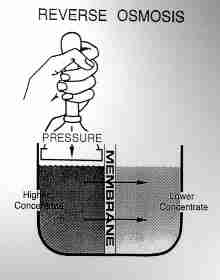
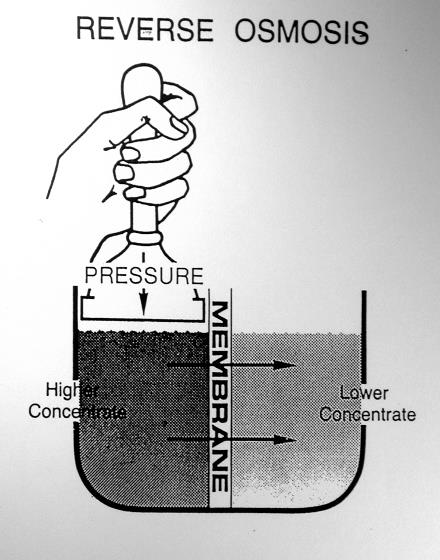
The good news is that reverse osmosis for water purification does not rely on chemicals that may be toxic when released in the environment. Reverse osmosis or RO water treatment systems work by passing water through a membrane that keeps contaminants on one side.
The down-side risk of high levels of reverse osmosis use in a property served by a septic tank and drainfield is that the system might be releasing an un-wanted quantity of additional water into the drainfield.
Reverse osmosis or R.O. water purifiers waste about four gallons of water for every gallon of purified water that they produce.
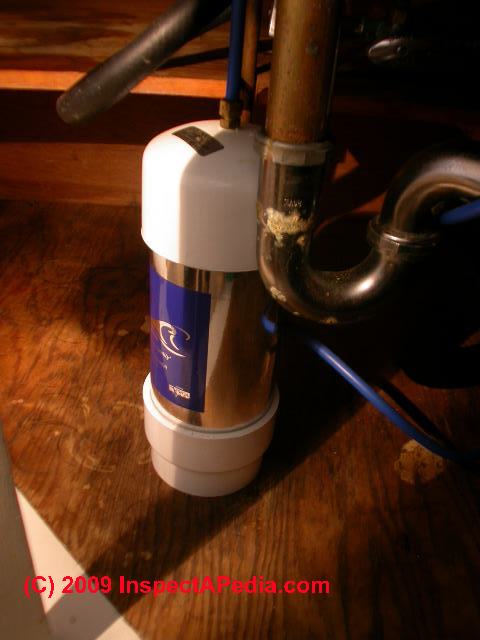
In normal use with a small point-of-use (POU) RO system (photo at left) such as one providing just a few gallons of purified water per day at a kitchen sink, the impact on a septic system is negligible.
But a large RO system may be a problem if the effluent absorbing capacity of the drainfield is limited.
Some designers or water treatment equipment providers such as Watts suggest routing the waste water produced by a reverse osmosis system back to the building plumbing system as gray water used for washing, bathing, or flushing toilets.
If you take this approach you can reduce the water waste from your R.O. system, possibly to zero.
If you plan to purchase a system that recycles wastewater from an RO water purifier, make sure that your system meets local plumbing codes - some systems, especially ones that do not further filter or treat the wastewater before it is recycled do not meet plumbing codes in some areas.
More information about Reverse Osmosis for water treatment and purification can be found at Reverse Osmosis.Reverse Osmosis Systems - Impact on Septic Systems and Water Quantity Usage
What about water volume from reverse osmosis water treatment systems? These can vary by manufacturer with a range of 3:1 to 10:1 of waste to product efficiency.
"Typically" for every gallon produced with a top of the line system, 3 to 5 gallons goes into the septic tank. Less efficient systems (regardless of shutoffs) can dump up to 10 gallons to waste for every gallon that goes into the storage tank. Don't despair...the membranes of ten years ago dumped up to twenty five gallons per gallon of product.
Ask the manufacturer of your reverse osmosis water treatment system for their efficiency, platform statement, and percent recovery data.
An excellent resource for membrane information is the National Sanitation Foundation. We are not confident about the generalized water quantity usage information obtained via EPA publications, Small Flows, etc.
If you ask reputable reverse osmosis treatment system manufacturers, you should be able to get reliable water usage and water flow information. -- Larry Newcomb Encinitas Learning Center
[Thanks to Larry Newcomb Encinitas Learning Center, jayhawk@cts.com, for the above opinion--DJF]
...
Continue reading at RV HOLDING TANK DUMP INTO SEPTIC TANK? or select a topic from the closely-related articles below, or see the complete ARTICLE INDEX.
Or see these
Recommended Articles
Suggested citation for this web page
REVERSE OSMOSIS CONCENTRATE DISPOSAL at InspectApedia.com - online encyclopedia of building & environmental inspection, testing, diagnosis, repair, & problem prevention advice.
Or see this
INDEX to RELATED ARTICLES: ARTICLE INDEX to SEPTIC SYSTEMS
Or use the SEARCH BOX found below to Ask a Question or Search InspectApedia
Ask a Question or Search InspectApedia
Try the search box just below, or if you prefer, post a question or comment in the Comments box below and we will respond promptly.
Search the InspectApedia website
Note: appearance of your Comment below may be delayed: if your comment contains an image, photograph, web link, or text that looks to the software as if it might be a web link, your posting will appear after it has been approved by a moderator. Apologies for the delay.
Only one image can be added per comment but you can post as many comments, and therefore images, as you like.
You will not receive a notification when a response to your question has been posted.
Please bookmark this page to make it easy for you to check back for our response.
Our Comment Box is provided by Countable Web Productions countable.ca
Citations & References
In addition to any citations in the article above, a full list is available on request.
- New York State Department of Health, APPENDIX 75-A WASTEWATER TREATMENT STANDARDS - INDIVIDUAL HOUSEHOLD SYSTEMS , [PDF] New York State Department of Health, 3 February 2010, retrieved 3/1/2010, original source: https://www.health.ny.gov/regulations/nycrr/title_10/part_75/appendix_75-a.htm
- Watts Industries of North Andover, Mass., provides its ZRO-4 under counter system intended to target the independent water dealer market.
- Ohio State University article on the concentration of chlorine necessary to act as an effective disinfectant, and the effects of the water's pH and temperature: See http://ohioline.osu.edu/b795/b795_7.html for details.
- Mark Cramer Inspection Services Mark Cramer, Tampa Florida, Mr. Cramer is a past president of ASHI, the American Society of Home Inspectors and is a Florida home inspector and home inspection educator. Mr. Cramer serves on the ASHI Home Inspection Standards. Contact Mark Cramer at: 727-595-4211 mark@BestTampaInspector.com
- John Cranor [Website: /www.house-whisperer.com ] is an ASHI member and a home inspector (The House Whisperer) is located in Glen Allen, VA 23060. He is also a contributor to InspectApedia.com in several technical areas such as plumbing and appliances (dryer vents). Contact Mr. Cranor at 804-873-8534 or by Email: johncranor@verizon.net
- Thanks to Larry Newcomb Encinitas Learning Center, jayhawk@cts.com, for the above opinion concerning reverse osmosis treatment system water consumption rate
- SEPTIC TANK CAPACITY VS USAGE in Daily Gallons of Wastewater Flow, calculating required septic tank size, calculating septic tank volume from size measurements
- SEPTIC TANK/SOIL-ABSORPTION SYSTEMS: HOW TO OPERATE & MAINTAIN [PDF] - , Equipment Tips, U.S. Department of Agriculture, 8271 1302, 7100 Engineering, 2300 Recreation, September 1982, web search 08/28/2010, original source: http://www.fs.fed.us/t-d/pubs/pdfimage/82711302.pdf.
- Septic System Drainfield Absorption System Biomat Formation - what leads to drain field clogging and expensive drainfield repairs
- Ten Steps to Keeping a Septic System Working, suggestions from the U.S. EPA, edits and additions by DJF
- Pennsylvania State Wastewater Treatment Fact Sheet SW-161, Septic System Failure: Diagnosis and Treatment
- Pennsylvania State Wastewater Treatment Fact Sheet SW-162, The Soil Media and the Percolation Test
- Pennsylvania State Wastewater Treatment Fact Sheet SW-l64, Mound Systems for Wastewater Treatment
- Pennsylvania State Wastewater Treatment Fact Sheet SW-165, Septic Tank-Soil Absorption Systems
- Document Sources used for this web page include but are not limited to: Agricultural Fact Sheet #SW-161 "Septic Tank Pumping," by Paul D. Robillard and Kelli S. Martin. Penn State College of Agriculture - Cooperative Extension, edited and annotated by Dan Friedman (Thanks: to Bob Mackey for proofreading the original source material.)
- Our recommended books about building & mechanical systems design, inspection, problem diagnosis, and repair, and about indoor environment and IAQ testing, diagnosis, and cleanup are at the InspectAPedia Bookstore. Also see our Book Reviews - InspectAPedia.
- In addition to citations & references found in this article, see the research citations given at the end of the related articles found at our suggested
CONTINUE READING or RECOMMENDED ARTICLES.
- Carson, Dunlop & Associates Ltd., 120 Carlton Street Suite 407, Toronto ON M5A 4K2. Tel: (416) 964-9415 1-800-268-7070 Email: info@carsondunlop.com. Alan Carson is a past president of ASHI, the American Society of Home Inspectors.
Thanks to Alan Carson and Bob Dunlop, for permission for InspectAPedia to use text excerpts from The HOME REFERENCE BOOK - the Encyclopedia of Homes and to use illustrations from The ILLUSTRATED HOME .
Carson Dunlop Associates provides extensive home inspection education and report writing material. In gratitude we provide links to tsome Carson Dunlop Associates products and services.
 | HOME | ABOUT | ASK a QUESTION | CONTACT | CONTENT USE POLICY | DESCRIPTION | POLICIES | PRIVACY | |
| © 2024 - 1985 Publisher InspectApedia.com - Daniel Friedman | |||||||||