
InspectAPedia® FREE Encyclopedia of Building & Environmental Construction, Diagnosis, Maintenance & Repair |
Question? Just ask us! InspectAPedia
|
 Floating Oil Tanks & Septic Tanks
Causes & Prevention
- POST a QUESTION or COMMENT about why oil storage tanks & some septic tanks may float up out of the ground and how to prevent the problem
Floating oil storage tanks & floating septic tanks:
This article explains why some buried oil tanks or septic tanks float up out of the ground, what that event means to the property owner, and how to prevent oil tank or septic tank flotation. Oil tank anchors may be required to prevent empty tanks from floating up out of the ground.
InspectAPedia tolerates no conflicts of interest. We have no relationship with advertisers, products, or services discussed at this website.
- Daniel Friedman, Publisher/Editor/Author - See WHO ARE WE?
Why Buried Tanks Float Up out of the ground or up inside buildings during heavy rains or flooding
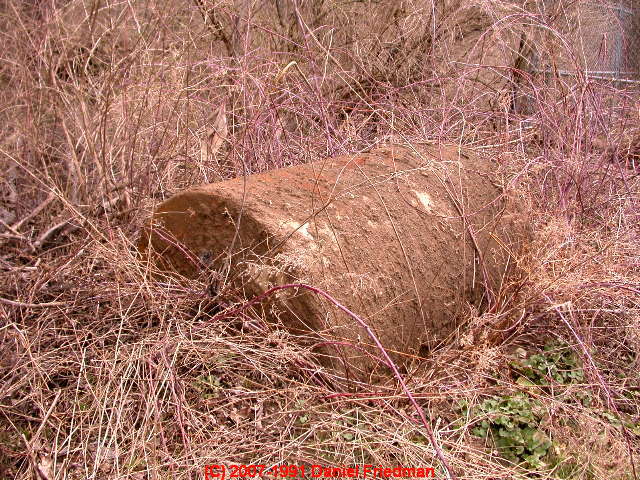
The photograph at the top of this page and this close up show an old abandoned oil tank which has burst up out of its grave in a thicket along a creek in New York.
Recent rains and area flooding brought water level above the top of the ground in which this empty and buried tank had rested for decades.
As water levels rose the buoyancy of the empty tank caused it to lift right out of its burial spot where it had been hidden.
A prior owner had even unscrewed the tank fill and vent valves so that there was no evidence of its presence along this creek.
Oil is lighter than water to begin with, but an oil tank or septic tank which is in use and full is unlikely to rise out of flooded ground even so.
But an empty steel, plastic, or fiberglass tank used for oil storage, such as heating oil, or for a septic tank, is very buoyant. Even a modest increase in ground water can be enough to push the tank up through the ground.
When a buried oil tank or septic tank is lifted by rising water or flooding, any piping connections to the building it serves are likely to be severed, leading to an oil spill or a sewage spill.
The tank shown in these photos should not have been installed by a creek in the first place, which may explain why it was later emptied and "abandoned" in place. Had the tank been properly abandoned it would have been cut open, cleaned, and filled with clean sand.
The fill should have prevented the buried oil tank from rising to the surface despite later rising ground water or floodwaters.
A buried oil tank or a buried steel, plastic, or fiberglass septic tank can be prevented from dislocation caused by rising water or flooding if it is either kept full or is physically anchored to the site using cables or other means.
Risk of Sewage Backup into Building After Septic Tank has Floated-Up from its Burial Site
Floating up septic tank needs to have been anchored - reply to reader questions
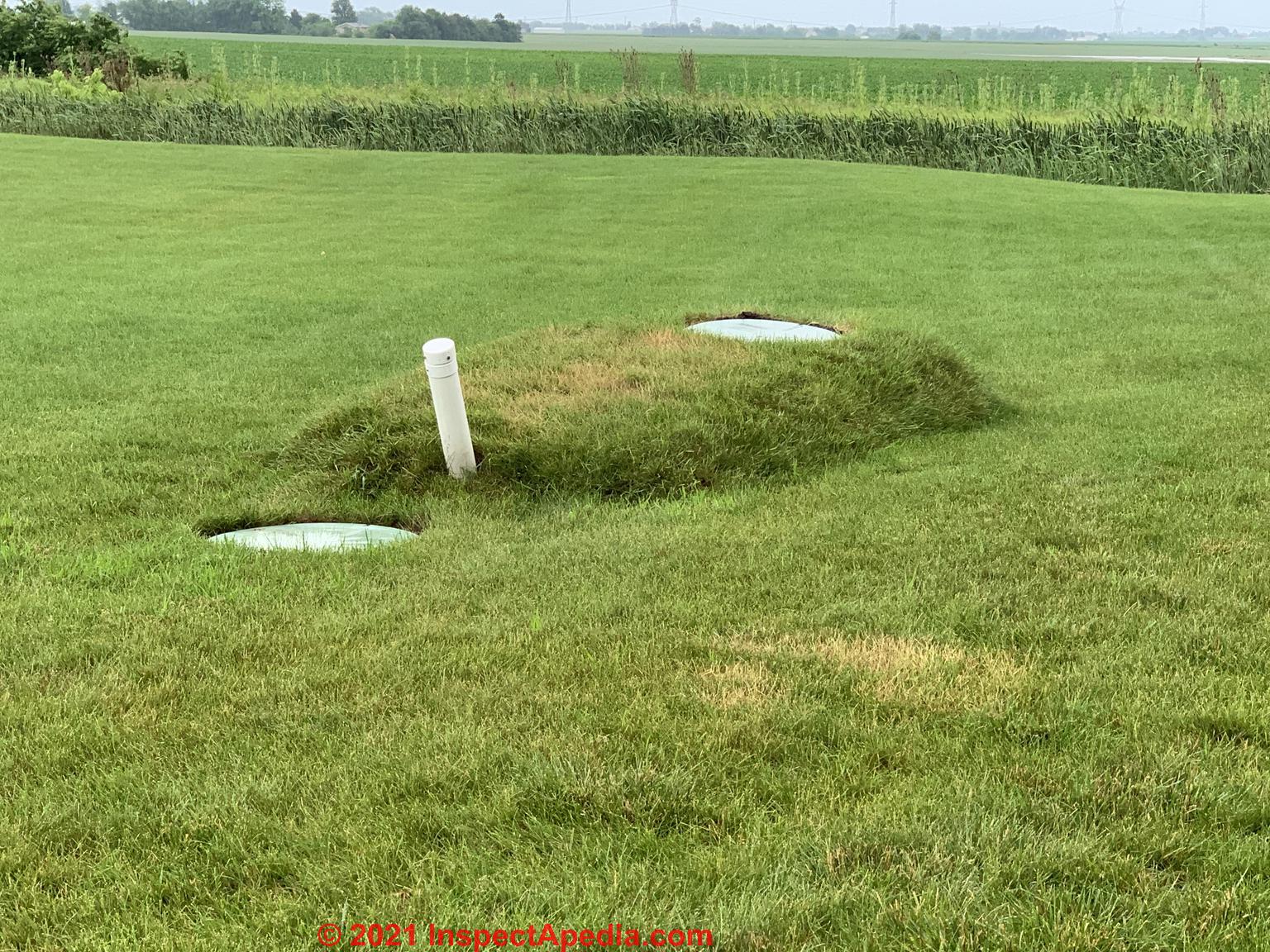 @Roger S,
Thanks and condolences for the question and the problem of your floating septic tank.
It is normal for a septic tank to be left empty after pumping, and in fact it's correct; else you may be paying the pumper to do nothing useful (as when they "return the effluent" OR you may be wasting water to fill the tank with fresh water.
Instead, what we have is an improper septic tank original installation: Plastic or fiberglass septic tanks are so light that unlike their concrete older sisters, they will float up out of wet soils in times of wet or flooding weather.
Watch out: because a septic tank that "floats up" like the one in your photo is also likely to have damaged or broken its piping connections, the immediate hazard from a floating-up septic tank is a sewage backup into the building or a failure that spills sewage improperly into the local environment, waterways, or water wells.
The installer of such a tank, at sites where that event is likely, are supposed to anchor the tank to soil using a combination of strapping and driven or buried anchors.
Anchors are required for lightweight buried tanks (oil tanks or septic tanks or water storage tanks) in typical government and model regulations and codes, of which we include examples and citations just below.
"Tank shall be properly supported by a proper foundation or, as applicable, its tie bolts, foundation anchors, or other supporting structure(s)." from the New York DEC guide at https://www.dec.ny.gov/regulations/38102.html
OPINION: I would not blame the septic pumping company for the rising septic tank; the pumper is dealing with a buried tank; she can't see whether or not the tank is strapped down or anchored, and wouldn't know that status unless the pumping company was also the original tank installer.
As to who's responsible for fixing such a problem, probably you, the property owner; and for and who pays, that's an argument about which to ask your lawyer.
Watch out: Some of these float-ups can be quite dangerous, such as the explosion hazard that might accrue if a buried LP tank floats-up from having been inadequately-anchored.
For other readers, the bottom line is that pretty much ALL types of tanks of plastic, fiberglass, or steel that might float up out of the ground under wet or flood conditions require some type of approved and safe anchoring system.
Examples of Codes, Standards Requiring Anchors for Fiberglass, Plastic, Steel Tanks Underground
The installer of a buried fiberglass, plastic or steel tank, at locations where flooding and risk of tank floating-up are likely, are supposed to anchor the tank to soil using a combination of strapping and driven or buried anchors or anchors to a concrete slab..
Some lightweight buried tank anchoring requirements, codes, standards are given below:
-
NFPA 31 "API Standard 650, Specifications for Welded Steel Tanks for Oil Storage", American Petroleum Institute, for guidance on SEISMIC protection for installation of above-ground tanks.
It also addresses wind load on tanks, and raises awareness of "sloshing" and resulting "uplift" of supports, which could result in shifting and collapse.
- NY DEC, "Tank shall be properly supported by a proper foundation or, as applicable, its tie bolts, foundation anchors, or other supporting structure(s)." from the New York DEC guide at https://www.dec.ny.gov/regulations/38102.html
[Buried Lightweight Septic Tank Anchors] (10) Septic tanks - may be forced toward the ground surface during cleaning or dewatering operations if they have been installed within the ground water zone.
- This is caused by the buoyancy effect
of the displaced volume of the tank. Septic tanks installed in groundwater should be anchored to
prevent “floating”.
Septic tanks installed in groundwater and not properly anchored should not be completely dewatered.
Tanks constructed of fiberglass, plastic, or steel are more likely to float than reinforced concrete tanks because of their lighter weight per given volume; however, many lighter weight tanks have developed effective anchoring systems.
All tanks should be installed in accordance with the manufacturer’s recommendations.
- source: New York Department of Health, RESIDENTIAL ONSITE WASTEWATER DESIGN HANDBOOK [PDF] (2012) retrieved 2021/06/27, original source: https://www.health.ny.gov/environmental water/drinking/wastewater_treatment_systems/ docs/design_handbook.pdf
[Buried Oil Tank Anchors] "b. Foundations & Supports
Only properly graded and leveled surfaces having adequate physical characteristics shall be used for foundations. Tank anchors should be installed to allow for the tank expansion/flexure; improperly installed anchors may initiate cracks in the tank. Flat bottomed tanks should only be installed on a smooth, flat base.
Manufacturers typically specify a deviation from nominal level depending on the tank size. Care must be taken to ensure that the base is free of debris. All installations shall follow manufacturer's specifications where available. Where wind-loading calculations require the use of tie-down bolts, these must be correctly installed using the brackets or steel girdle attached to the tank.
All of the requirements of 6 NYCRR section 598.3 must be followed when tanks are installed within a flood plain."
- source: PLASTIC OIL TANKS 5-YEAR INSPECTION PLAN NYS DEC [PDF] (2007), NYS DEC, Five-Year Inspection of Plastic Tanks (DER-16), DEC Program Policy [PDF] (2007) New York State Department of Environmental Conservation, retrieved 2021/06/27 original source: https://www.dec.ny.gov/regulations/38102.html - U.S. EPA, OIL TANK INSPECTION PROCEDURES - EPA [PDF] (2014) SPCC Guidance for Regional Inspectors, December 16, 2013, Chapter 7, Inspection, Evaluation, and Testing
- retrieved 2021/06/27 original source: U.S. EPA, www.epa.gov/sites/production/files/2014-04/documents/7_inspectionsevaluation_testing_2014.pdf This source includes the inspection of tank anchoring systems. - U.S. EPA, SPILL PREVENTION, CONTROL AND COUNTERMEASURE PLAN (SPCC) PROGRAM BULK STORAGE CONTAINER INSPECTION FACT SHEET [PDF] U.S. EPA
, that in turn is the EPA's advice concerning this U.S. federal regulation: §§112.8(c)(6), 112.12(c)(6)(i) - U.S. EPA, retrieved 2021/06/27 original source: https://www.epa.gov/sites/production/files/2014-05/documents/bulk_storage_container_integrity-testing-factsheet.pdf
Septic tanks floated up after being pumped out, in wet rainy weather
 Hi, i just had my septic tanks pumped out 3 day’s ago, i have 2 -500 gallon plastic tanks, with air pump, now we had 5 inches of rain and the second tank has floated out of the ground because no water was in it.
The first tank was fine, because it was full of water, we’ve had more rain than this a few times before with no problems, system only 5 years old.
They never told me to fill with water after pumping , I didn’t even know this was possible! Who is responsible for this ? I'm not an expert in septic they are!
No dig caps on tanks my hose was 10 ft away, easy prevention if i would have known this was possible even ? Any feedback, thanks On 2021-06-27 by Roger S -
Can you fix a floating-up abandoned septic tank yourself?
In general, there is nothing technically difficult about exposing the top of an old tank, cutting an opening if one is not provided, and filling the tank with stone rubble and sand, perhaps breaking a drainage hole in the tank bottom first.
Watch out: But there are life-safety hazards that may be present: falling into a tank, especially if it contains sewage, is a quick, nasty death. Never work alone. Hire expert help as needed.
Meanwhile keep everyone away as a buried tank of unknown condition is a safety hazard.
Should I fill up my empty septic tank using water to prevent a septic tank from floating up o?
If your septic tank is concrete there is never a reason to fill it after pumping.
If your septic tank is thin steel or lightweight plastic or fiberglass,
AND if the septic tank was not mechanically anchored to the ground when it was installed,
AND if the soil is wet and the area is flooded
THEN the septic tank could float up out of the ground.
And indeed some lightweights septic tank installers might suggest partly-filling the new septic tank with water immediately after installation to prevent a floating upwards septic tank before the septic tank is weighed down by sewage as it will be in normal use.
Really? This is in our view an improper approach. If the septic tank might float up because it's empty when new, it can perfectly as well float up in the future when it has been in use and has been pumped out as part of normal, regular septic tank maintenance.
The right installation, and the right floating septic tank repair is to install the necessary anchoring, not to re-fill the septic tank with water.
Risks of Structural or Mechanical Damage or Fuel Leak Contamination due to Floating-up Fuel Storage Tanks During Flooding At or In Buildings
Outdoors or inside as well, heating oil storage tanks that are full or nearly full are less likely to float up out of the ground or to move off of their moorings during area flooding.
During installation of plastic or fiberglass storage tanks for fuel or as septic tanks, the installer can include anchors to help protect these light storage vessels from movement during flooding. But generally installers of heavier steel storage tanks omit tank anchoring systems from their installation.
Outdoors buried steel oil tanks are simply placed into an excavation and connected to fuel fill, vent, and supply piping. And above-ground oil storage tanks both outdoors and indoors are typically installed relying on little more than gravity to hold the tank in place top its legs.
If exposed to flood waters, and depending on the volume of oil that they contain, oil storage tanks of any material, steel, fiberglass, or plastic, may float off of their support or moorings. Even if the tank itself is not damaged, an oil spill is likely as this movement will rupture oil supply piping lines and connections.
And movement can also damage the oil storage tank itself or the movement of the tank may damage other building components & mechanicals.
Julie Satow reported in the New York Times (January 2013), during flooding caused by Hurricane Sandy (New York, 2012),
The development 88 Greenwich ... incurred basement flooding. The water dislodged an oil tank, which hit a ceiling beam and cracked open, necessitating a major cleanup. [14]
...
Reader Comments, Questions & Answers About The Article Above
Below you will find questions and answers previously posted on this page at its page bottom reader comment box.
Reader Q&A - also see RECOMMENDED ARTICLES & FAQs
Our septic tanks were not tied down and now they have floated because of \rising water table during rain
Our septic tanks were being installed. They were not tied down and not filled with water and now they have floated because of the water table rising from the rain.
What should be done? Does the whole system need to be removed and reinstalled? Would the installer have to wait until better weather or he water table drops? On 2016-10-31 by Claire -
This question and answer were posted originally
at SEPTIC TANK PUMPING MISTAKES
Reply by (mod) - septic tanks floated up out of the ground
Claire:
This is a more annoying problem than meets the eye - as we discuss above on this page where we describe floating-up septic tanks or oil tanks.
I think that the septic tanks (presumably fiberglass or plastic) are not correctly installed.The installer probably figured that once the tank filled up with wastewater it'd never float out of the ground during rising ground water. But that's not a safe guess since septic tanks must be pumped out (emptied) regularly as part of normal maintenance.
So a proper installation for a tank that might float up and out of the ground would be to anchor it to the ground using straps and concrete or steel anchors.
Now the worry is that the tank movement will certainly have broken plumbing connections. So at the very minimum those connections need to be inspected and repaired or you risk a sewage backup in the building.Properly the oil storage tank is going to need to be anchored lest the problem simply happen again in wet weather.
But yes, the installer may not be able to replace the tank if the destination hole is filled with water.
Watch out: Meanwhile let's worry about where your wastewater is going and about sewage backups.If the septic tank has floated at all it has probably damaged if not completely broken waste piping near the tank. In turn that means that flushing toilets and running plumbing fixtures in the building risk causing a nasty sewage backup into the structure.
...
Continue reading at OIL TANK, BURIED, ADVICE or select a topic from the closely-related articles below, or see the complete ARTICLE INDEX.
Or see these
Recommended Articles
- OIL STORAGE TANKS - home
- SEPTIC TANK PUMPING MISTAKES
- SEPTIC TANK PUMPING PROCEDURE
- SOIL PROPERTIES & BUILDING FAILURES
Suggested citation for this web page
OIL or SEPTIC TANKS FLOATING UP at InspectApedia.com - online encyclopedia of building & environmental inspection, testing, diagnosis, repair, & problem prevention advice.
Or see this
INDEX to RELATED ARTICLES: ARTICLE INDEX to HEATING OIL, OIL BURNERS, OIL FIRED HEATERS, OIL TANKS
Or use the SEARCH BOX found below to Ask a Question or Search InspectApedia
Ask a Question or Search InspectApedia
Try the search box just below, or if you prefer, post a question or comment in the Comments box below and we will respond promptly.
Search the InspectApedia website
Note: appearance of your Comment below may be delayed: if your comment contains an image, photograph, web link, or text that looks to the software as if it might be a web link, your posting will appear after it has been approved by a moderator. Apologies for the delay.
Only one image can be added per comment but you can post as many comments, and therefore images, as you like.
You will not receive a notification when a response to your question has been posted.
Please bookmark this page to make it easy for you to check back for our response.
IF above you see "Comment Form is loading comments..." then COMMENT BOX - countable.ca / bawkbox.com IS NOT WORKING.
In any case you are welcome to send an email directly to us at InspectApedia.com at editor@inspectApedia.com
We'll reply to you directly. Please help us help you by noting, in your email, the URL of the InspectApedia page where you wanted to comment.
Citations & References
In addition to any citations in the article above, a full list is available on request.
- National Association of Oil Heat Service Managers, PO Box 380, Elmwood Park, NJ 07407
- "Homeowners Guide to Fuel Storage," Agway Energy Products, Verbank, NY, November 1990
- [14] Julie Satow, "Machine of the Moment", The New York Times, Real Estate, p.1, 13 January 2013
- Our recommended books about building & mechanical systems design, inspection, problem diagnosis, and repair, and about indoor environment and IAQ testing, diagnosis, and cleanup are at the InspectAPedia Bookstore. Also see our Book Reviews - InspectAPedia.
- In addition to citations & references found in this article, see the research citations given at the end of the related articles found at our suggested
CONTINUE READING or RECOMMENDED ARTICLES.
- Carson, Dunlop & Associates Ltd., 120 Carlton Street Suite 407, Toronto ON M5A 4K2. Tel: (416) 964-9415 1-800-268-7070 Email: info@carsondunlop.com. Alan Carson is a past president of ASHI, the American Society of Home Inspectors.
Thanks to Alan Carson and Bob Dunlop, for permission for InspectAPedia to use text excerpts from The HOME REFERENCE BOOK - the Encyclopedia of Homes and to use illustrations from The ILLUSTRATED HOME .
Carson Dunlop Associates provides extensive home inspection education and report writing material. In gratitude we provide links to tsome Carson Dunlop Associates products and services.
 | HOME | ABOUT | ASK a QUESTION | CONTACT | CONTENT USE POLICY | DESCRIPTION | POLICIES | PRIVACY | |
| © 2024 - 1985 Publisher InspectApedia.com - Daniel Friedman | |||||||||