
InspectAPedia® FREE Encyclopedia of Building & Environmental Construction, Diagnosis, Maintenance & Repair |
Question? Just ask us! InspectAPedia
|
 Abandonment, Closure, or Removal of Heating Oil Tanks (on conversion to natural gas) in New Jersey
1993 update
- POST a QUESTION or COMMENT about this article topic.
This article describes underground oil storage tank regulations in New Jersey and provides a 1993 update to the oil storage tank closure or removal regulations:
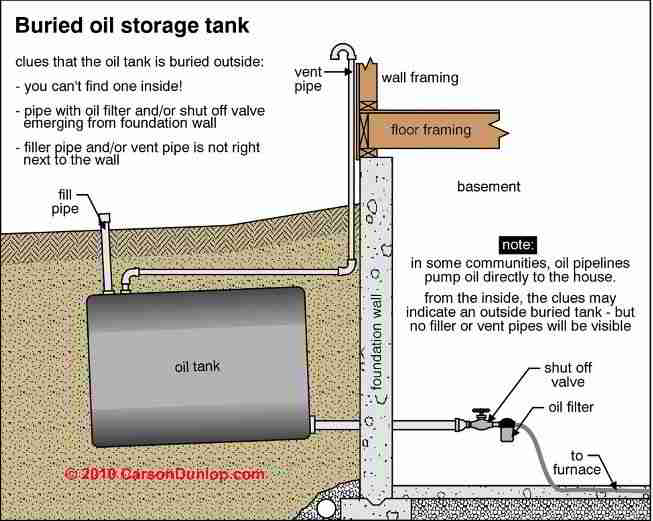
It has recently come to the Department's attention that them have been several accidental discharges of fuel oil resulting from oil tanks that have been placed out of service. These incidents commonly occur when home-owners convert from oil to natural gas for their heating needs. The problems have centered around tanks that have not been removed and have been "forgotten about" and subsequently leaked due to corrosion.
InspectAPedia tolerates no conflicts of interest. We have no relationship with advertisers, products, or services discussed at this website.
- Daniel Friedman, Publisher/Editor/Author - See WHO ARE WE?
New Jersey Regulations update following accidental discharge of fuel oil from tanks during conversion to natural gas
State of New Jersey
Department of Community Affairs
Division of Codes and Standards
Construction Code Element
CN816
Trenton, NJ  08625-0816
609-530-8820

Date: April 1, 1993

Subject: Abandonment-Heating Oil Tanks less than 2,001 gallons

Reference: N.J.A.C. 5:23-3.14
  Building Subcode
  Bulletins 88-3 and 91-4
  BFPC/90 F-2806.11


 [... excerpted first paragraph above ]


In other cases the tank has been removed
but the fill pipe has been left in place. Fuel oil deliveries made to an
incorrect address in these cases have resulted in fuel oil being pumped into the
basement of the home.

Previously in Bulletin 88-3, we indicated that abandoned oil tanks that had
become unsafe were to be removed. In addition, section P-2906.11 requires any
tank that has not been used for 90 days to be safeguarded.

Although F-2906.11 allows 90 days to elapse before action in taken, in cases
where conversions are performed it is clear that the abandonment is better performed
during the conversion to ensure that safeguarding the tank will not be forgotten.

Therefore, either the permit for the conversion, or a separate permit issued as
a prerequisite to the permit for the conversion shall include safeguarding of
the tank itself (see Bulletin 91-4 for proper abandonment procedures) and
removing or permanently capping all and vent pipes associated with the tank.

It may be noted that all work covered under the permit will be inspected upon
completion without regard to the 90 days referenced in F-2806.11 for
abandonment.

The only exception to this would be where the home-owner can demonstrate that
there will be a legitimate continued use of the tank after the conversion to
natural gas or other fuel is completed. Such legitimate use would be the use of
the tank to supply an oil appliance (i.e. oil fired hot water heater, oil
burner to heat a garage, etc.), or the use of heating equipment that can use
either fuel.

In the case of [oil] tanks which will remain in place it should be noted
that the fill caps on oil tanks am required to be painted green unless the fill
pipe is fitted with fill-tightness systems and clearly marked with the words
"FUEL OIL." Any tanks to remain in service shall meet these requirements in
order to avoid accidental pouring of fuel oil into storm drains, sanitary
drains, etc.

    #########
...
Continue reading at OIL TANK LEAK REPORTING, NEW JERSEY or select a topic from the closely-related articles below, or see the complete ARTICLE INDEX.
Or see these
Recommended Articles
Suggested citation for this web page
OIL TANK ABANDONMENT or LEAK REGS - 1993 at InspectApedia.com - online encyclopedia of building & environmental inspection, testing, diagnosis, repair, & problem prevention advice.
Or see this
INDEX to RELATED ARTICLES: ARTICLE INDEX to HEATING OIL, OIL BURNERS, OIL FIRED HEATERS, OIL TANKS
Or use the SEARCH BOX found below to Ask a Question or Search InspectApedia
Ask a Question or Search InspectApedia
Try the search box just below, or if you prefer, post a question or comment in the Comments box below and we will respond promptly.
Search the InspectApedia website
Note: appearance of your Comment below may be delayed: if your comment contains an image, photograph, web link, or text that looks to the software as if it might be a web link, your posting will appear after it has been approved by a moderator. Apologies for the delay.
Only one image can be added per comment but you can post as many comments, and therefore images, as you like.
You will not receive a notification when a response to your question has been posted.
Please bookmark this page to make it easy for you to check back for our response.
Our Comment Box is provided by Countable Web Productions countable.ca
Citations & References
In addition to any citations in the article above, a full list is available on request.
- Mark Cramer Inspection Services Mark Cramer, Tampa Florida, Mr. Cramer is a past president of ASHI, the American Society of Home Inspectors and is a Florida home inspector and home inspection educator. Mr. Cramer serves on the ASHI Home Inspection Standards. Contact Mark Cramer at: 727-595-4211 mark@BestTampaInspector.com
- NFPA - the National Fire Protection Association can be found online at www.nfpa.org
- In addition to citations & references found in this article, see the research citations given at the end of the related articles found at our suggested
CONTINUE READING or RECOMMENDED ARTICLES.
- Carson, Dunlop & Associates Ltd., 120 Carlton Street Suite 407, Toronto ON M5A 4K2. Tel: (416) 964-9415 1-800-268-7070 Email: info@carsondunlop.com. Alan Carson is a past president of ASHI, the American Society of Home Inspectors.
Thanks to Alan Carson and Bob Dunlop, for permission for InspectAPedia to use text excerpts from The HOME REFERENCE BOOK - the Encyclopedia of Homes and to use illustrations from The ILLUSTRATED HOME .
Carson Dunlop Associates provides extensive home inspection education and report writing material. In gratitude we provide links to tsome Carson Dunlop Associates products and services.
 | HOME | ABOUT | ASK a QUESTION | CONTACT | CONTENT USE POLICY | DESCRIPTION | POLICIES | PRIVACY | |
| © 2024 - 1985 Publisher InspectApedia.com - Daniel Friedman | |||||||||