
InspectAPedia® FREE Encyclopedia of Building & Environmental Construction, Diagnosis, Maintenance & Repair |
Question? Just ask us! InspectAPedia
|
 Carpet Padding Asbestos, Mold, Odors, IAQ
Modern carpet padding materials
Antique carpet padding & underlayment
Identify & Cure These Carpet Worries
- POST a QUESTION or COMMENT about carpet padding asbestos, mold, or smell problems,
Carpet padding types, properties, uses: this article explains carpet padding, cushions, and underlayment as well as antique carpet liners, and we address questions about carpet asbestos or mold hazards.
This article includes excerpts or adaptations from Best Practices Guide to Residential Construction (Steve Bliss, J Wiley & Sons) , by Steven Bliss, courtesy of Wiley & Sons.
The author is retired a mold/indoor air quality investigator, forensic microscopist, and home inspector who continues to work as journalist in Poughkeepsie, New York. He is a member of ASHRAE, and was of AHIA, the American Industrial Hygiene Association and was Standards, Exam & Technical Committee chair of ASHI, the American Society of Home Inspectors.
InspectAPedia tolerates no conflicts of interest. We have no relationship with advertisers, products, or services discussed at this website.
- Daniel Friedman, Publisher/Editor/Author - See WHO ARE WE?
Asbestos or Mold Hazards in Rug or Carpet Padding?
Carpet padding, carpet cushions, and carpet underlayments, used to improve carpet durability, prevent carpet movement, and for other purposes, can also be a source of hidden mold or other building contaminants, particularly if the carpet has been wet or exposed to spills..
Article Contents
- DOES CARPET PADDING CONTAIN ASBESTOS? - short answer: no, with an exception in Australia
- MODERN CARPET PADDING MATERIALS
- ANTIQUE CARPET PADDING & UNDERLAYMENTS
- MOLD CONTAMINATION of CARPET PADDING
- CARPET PADDING HAZARD RESEARCH
...
Does Carpet Padding Contain Asbestos?
Some readers ask if carpet padding is likely to be an asbestos hazard in buildings, as we discuss and illustrate here.
Example: "Does asbestos flooring or carpeting underlayment resemble foam? Is it a paper like product?" - reader question from D.G.
Answer:
Bottom line: residential carpet padding does not contain asbestos. With rare exceptions cited below, we have not found reports of foam carpet padding deliberately made of asbestos nor paper.
However asphalt impregnated felt sometimes used as carpet underlay or underlayment may contain asbestos if it was manufactured before your country banned or stopped that usage. (Overbury 1925 et als).
Details:
Some carpet padding looks like and may actually use forms of spongy foam products - that's not an asbestos material.
Other carpet padding may use natural fibers such as jute or may be felt.
But as you phrased it, "Asbestos flooring underlayment or carpet underlayment" No, that is not a residential carpeting product.
Watch out: Some other flooring products used for an underlay or as a backer an asphalt impregnated felt ("paper") that may, depending on when and where it was manufactured, contain asbestos, as did some flooring adhesive mastics.
Felt underlay or underlayment is not, in my OPINON actual carpet padding but it may indeed be found beneath carpeting in some buildings. (UK HSE 2012).
Case Report of Asbestos-Contaminated Carpet Padding in Australia
Watch out: in older homes in Australia, carpet padding may have been produced by recycled bags used by James Hardie corporation to transport asbestos fibers, creating an unexpected potential asbestos hazard in those homes.
Also in Australia, both driveways and garage floors of some homes built in the 1970's may have contained asbestos waste from James Hardie.[1]
There were however many other that used asbestos paper such as HVAC duct wrap and asbestos backing on sheet flooring.
Please keep in mind that no one can assure by email that your property has no asbestos present.
If the property age or other conditions raise an asbestos concern, you should have a professional inspection and tests performed before demolishing or disturbing any asbestos-suspect material.
See our articles on asbestos products in buildings including
ASBESTOS IDENTIFICATION IN BUILDINGS
ASPHALT ROOF MATERIAL ASBESTOS
and see
Details about Asbestos in Australian Carpet Padding
An exception of asbestos-contaminated carpet padding has been reported in Australia, creating a public stir, but a subsequent investigation by Jim Dodd, Director of Environmental Health, reported that the possibility of asbestos fibres being in carpet underlay was very low. [1][2][3][4]
People most at risk were those working in the bag recycling industry[4] when hessian (burlap or jute) bags used to transport asbestos material were recycled. Western Australians concerned about possible asbestos in their carpet underlay should first identify the type of carpet padding used: for example if it is a foam product it was not made from recycled bags.
Quoting from ASBESTOS in CARPET UNDERLAY [PDF] (2009), from the Western Australia DOH,
There is a slight possibility that some older hair felt-style underlay manufactured and installed prior to the early 1970s may have incorporated material sourced from hessian bags that were used to transport raw asbestos from mine sites to processing plants.
... believed to have been installed prior to 1970 ... in Perth homes. ... Of the 12 homes tested, one has proved positive for asbestos. ... Of the 12 homes tested, one has proved positive for asbestos.
It has been ascertained that the carpet and underlay in the affected home was installed in the early 1950’s. Further testing of underlay, carpet and dust from rooms in the home in which the affected underlay was situated indicates that the asbestos fibres remained within the underlay.
It therefore appears that the risk of fibres becoming airborne and presenting a health risk is very low provided the carpet and underlay remain undisturbed.
The DOH offered this good advice for removing old carpeting and carpet padding or underlay:
... it is advisable to wear a Class P1 or P2 disposable facemask (available at most hardware outlets) and disposable overalls if you are intending to remove old carpet with hair felt underlay (pre 1970).
This will provide protection against inhaling dust and other allergens as well as any asbestos fibres in the unlikely event they are present.
The carpet and underlay should be carefully, removed to minimise release of dust and particulates. It is advisable to lightly wet down the underside of the carpet and underlay prior to and during removal. This will help to suppress dust.
Owners concerned about possible asbestos in their fiber-based carpet underlay should contact an accredited asbestos testing laboratory.
...
List of Carpet Padding Materials
Normally carpet padding is constructed of man made or natural fibers, rubber, or urethane foam products.
Unlike the backer on some resilient flooring products or sheet flooring, carpet padding would not normally contain asbestos.
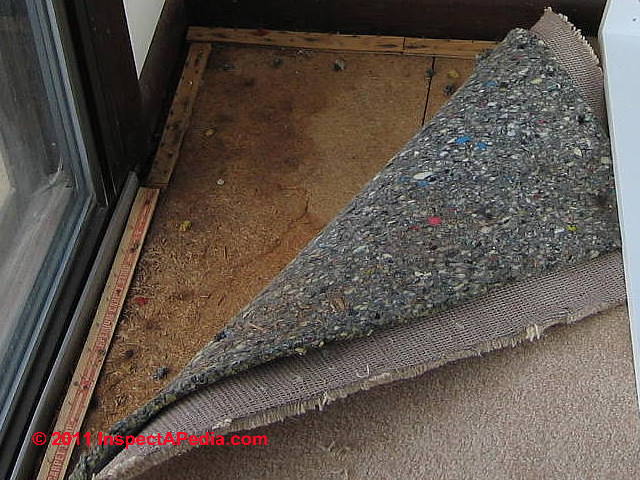
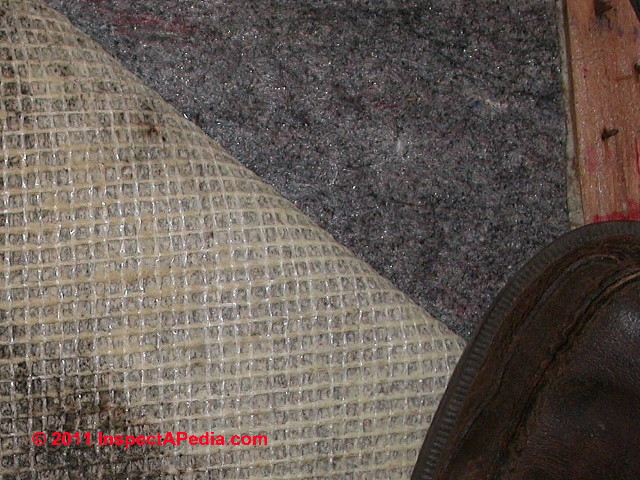
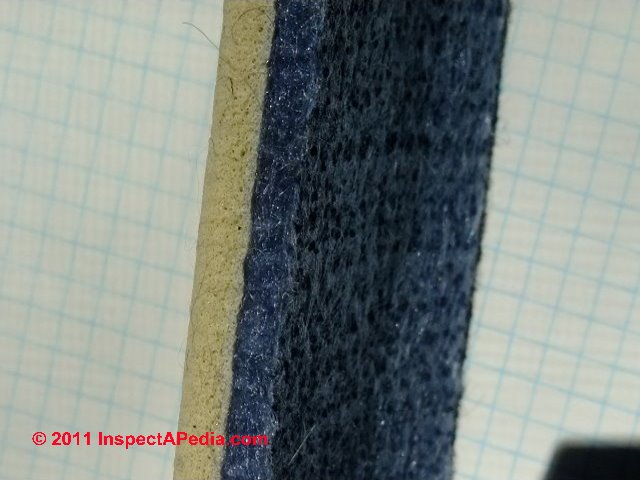
Carpet padding materials are typically felt carpet padding (photos above), foam carpet padding (photos below), or synthetic fabric bonded to a foam underlayment.
Fiber carpet cushions or pads
Fiber type carpet padding (above) may be made from natural fibers (such as jute, felt, or even horsehair), synthetic fibers (acrylic fibers, nylon fibers, polyesters, propylene fibers), or recycled textile fibers that may be a mix of natural and synthetic materials.
Bonded Synthetic Fabric & Foam Carpet Padding
Our photos below illustrate a durable carpet cushion that combines a dense synethetic fabric with a urethane foam cushion.
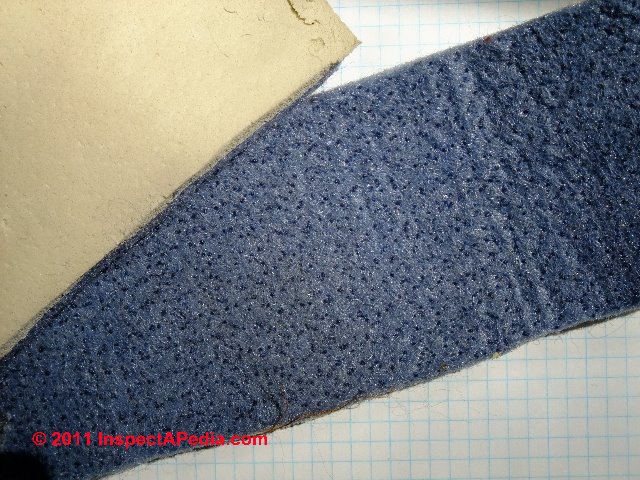
While this material is sold for use under wall-to-wall carpeting, we also use this padding cut to size for placement under area rugs where we want a firm walking surface and an anti-slip property to prevent the rug from moving.
Bonded Urethane Foam "Rebond" Carpet Padding
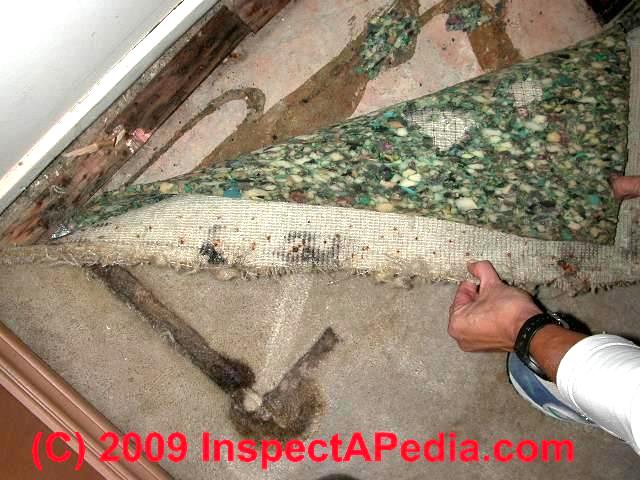
The carpet padding photographs below show a bonded urethane foam product also referred to as "rebond" because it is made of chopped or shredded foam that has been re-bonded together to form a sheet.
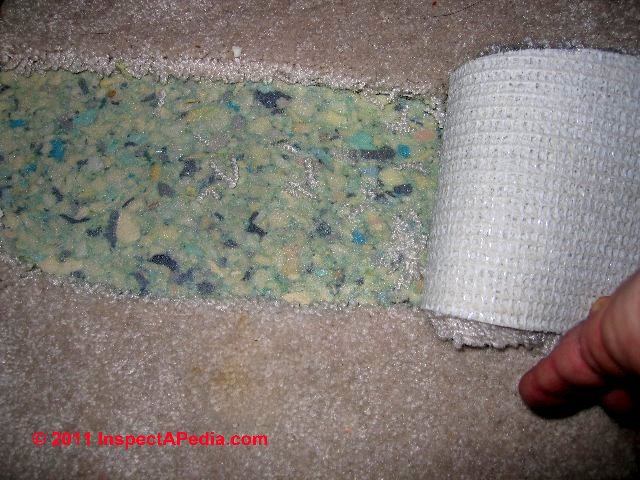
Above you can also see the bonded coated backing of the carpeting itself - the white-coated carpet bottom at the right side of the photo.
Our second rebond padding photo (below) shows us exposing the subfloor below the padding in an area where the homeowner had already made carpet and padding cuts to inspect for water leakage.
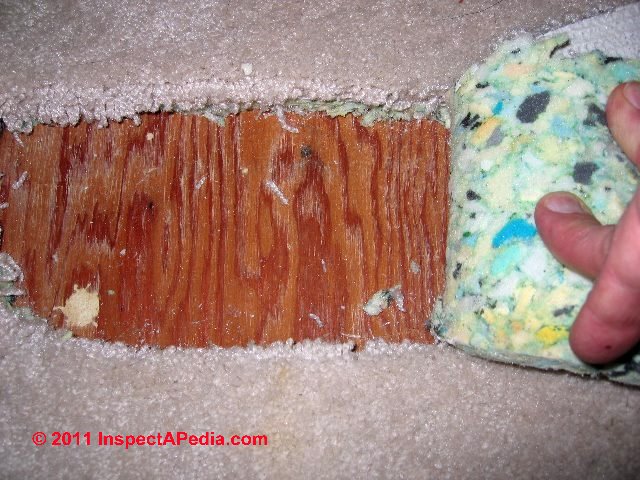
Here you can see that the rebond carpet padding is also reinforced with synthetic fibers.
Because some rebond, especially made in the U.S. before 1985, may contain butylated hydroxytoluene (BHT), this padding type can cause yellowing of olefin and some nylon carpets and is not recommended below those products.
Two other foam carpet padding materials are prime urethane foam and mechanically-frothed urethane foam.
Rubber carpet padding materials are typically seen in one of two forms: waffled sponge rubber and a more firm flat sponge rubber. Flat sponge rubber is used below commercial and berber carpets.
...
Antique & Historic Carpet Underlayment, Lining, Padding
Wanamaker's Sanitary Carpet Lining
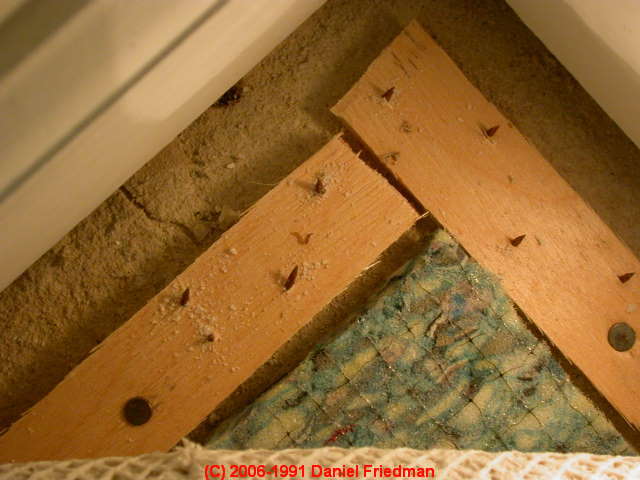
In older homes and some historic properties where very old carpeting remains, you may find paper-based Sanitary Carpet Lining that was sold by The Wanamaker Store (photographs below).
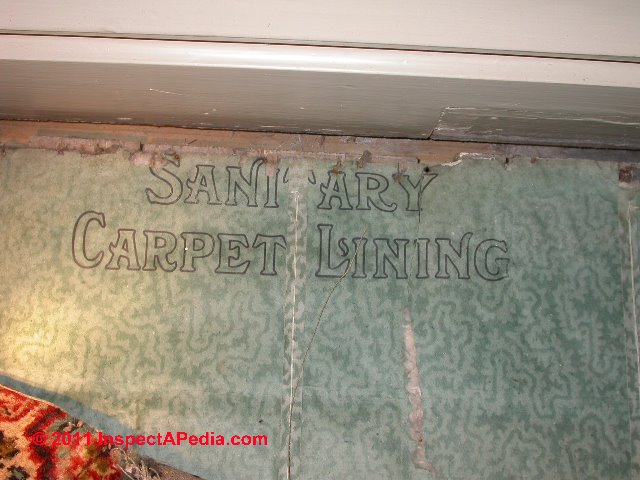
We are uncertain of the composition of this material, but you are highly unlikely to encounter it except in an antique building. Wanamakers, a Philadelphia PA store, began 1880, selling carpets and carpet liners in 1880.[2]
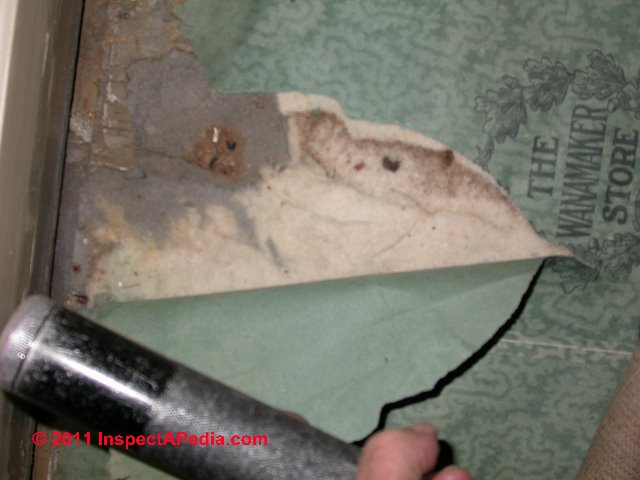
Note: The John Wanamaker Store in King of Prussia, PA. has been cited by some asbestos-exposure and mesothelioma websites as a source of asbestos exposure to workers. We have not [yet] located a description of how that exposure occurred or what products were involved.
...
Moldy or Smelly Carpeting & Carpet Padding Odors
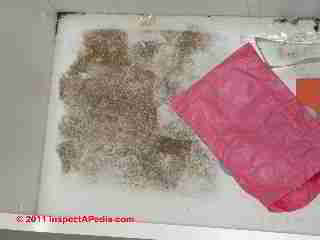
If you trace a moldy odor or smell to the carpeting or its padding beneath, chances are that it is or was moldy.
Wet carpeting and carpet padding can become moldy in just 48 hours or so, depending on building temperatures and extent of water intrusion so it's difficult to salvage wet wall to wall carpets or carpet padding even if only part of the carpet got wet.
Watch out: Carpeting that has been wet usually is removed along with its carpet padding and disposed of, though we have found a few cases in which carpet that was reported to have been wet was dry, un-stained, and clean at the time of our inspection.
There are other reasons to remove padding below moldy or wet carpets, particularly the need to inspect the floor and floor-wall trim for signs of water, mold, damage and to permit additional cleaning.
It's generally the case that a soaked carpet will also leave water marks on the subfloor below. But if water has entered the building wall cavities further investigation is warranted, lest we leave a mold reservoir in building walls.
Watch out: don't try to fix moldy, smelly or previously-wet carpet padding by spraying with a disinfectant or sanitizer nor by using an ozone generator. Those treatments are not reliable and in some cases can make mattes worse.
Details are at CARPET OZONE MOLD / ODOR TREATMENT WARNINGS
If your carpets look clean and you don't know of any history of wet carpeting, and so if you're not sure if a mold or other odor is coming from the carpet or carpet padding or from somewhere else,
see SMELL PATCH TEST to FIND ODOR SOURCE
Carpets or Carpet Padding & VOCs or MVOCs
As we discuss at CARPET MOLD / ODOR TESTS, mold may be visible on the surface of carpeting or mold may be hidden in carpeting or in the padding or carpet cushion below.
Carpets may not actually be mold contaminated but can smell moldy if the carpeting or padding have absorbed Mold-related volatile organic compounds or MVOCs. In this case we suspected that the visible carpet mold was the "tip of an iceberg" of hidden mold below.
More about dealing with wet or moldy carpeting is in articles listed at
- CARPET STAIN DIAGNOSIS - home
- CARPETING & INDOOR AIR QUALITY - home
...
Research on Asbestos in Carpet or Carpet Underlayment
- [1] "James Hardie's Mesothelioma and Asbestos Legacy Continues, 2009", web search 03/01/2011, www.survivingmesothelioma.com
- [2] "The Business Biography of John Wanamaker Founder and Builder, America's Merchant Pioneer from 1861 to 1922", web search 03/02/2011, original source: http://www.archive.org/stream/businessbiograph011556mbp/businessbiograph011556mbp_djvu.txt
- [3]"Western Australia Health Department Warns on Asbestos in Carpet Pad", Perth Now, Australian Broadcasting Company, 24 March 2006
- [4]"Old Carpet Underlay Unlikely Asbestos Risk", 11 July 2006, see http://www.health.wa.gov.au
- ASBESTOS in CARPET UNDERLAY [PDF] (2009) Department of Health, Government of Western Australia, Rev. 3 December 2009, web search 03/03/2011, original source: http://www.public.health.wa.gov.au/cproot/2463/2/Carpet%20Underlay%20Update_2_.pdf
Excerpt:
In response to the original concerns in 2006, the Department of Health’s (DOH) Environmental Health Directorate (EHD) had several samples of carpet underlay tested to try and obtain actual evidence of asbestos fibres in underlay of homes.
The intention was to obtain samples of underlay that had been installed before 1970, but ideally, ‘original’ underlay.
Although only a relatively small number of samples were able to be obtained, all were found to be free of asbestos. - Asbestos in Carpet Underlay, Frequently Asked Questions, , Department of Health, Government of Western Australia, Rev. 3 December 2009, web search 03/03/2011, original source:
http://www.public.health.wa.gov.au/cproot/2462/2/Carpet%20Underlay%20FAQ%20Update%20_2_.pdf - Carpet fibers and padding, Kathryn A. Hairle, [may be unavailable], University of Wisconsin Cooperative Extension, 1975
- Handbook of Fiber Finishing Technology, Philip E. Slade, 1997, [Quoting Amazon.com]
Gathering hard-to-obtain data from different fiber and fabric manufacturers and suppliers into a single, convenient volume, this practical handbook supplies detailed information on hundreds of textile finish components;including their structural formulae, physical properties, CAS numbers, and effects on various fibers.
Promoting a deeper understanding of finish technology, the Handbook of Fiber Finish Technology covers the fundamentals of fiber finish science, such as theories of friction laboratory testing of formulations from preliminary component evaluation to analyses for material characterization the influence of wetting, emulsification, and finish distribution on coatings soil- and stain-resistant chemicals and their applications in carpet protection the degradation of chemicals in the environment, including methods for predicting waste degeneration and more!
Complemented with bibliographic citations and nearly 500 tables, equations, and drawings, this expertly written handbook is invaluable for polymer, fiber, and textile chemists, scientists, and engineers; physical, surface, and colloid chemists; textile and fiber manufacturers; and graduate-level students in these disciplines. - Overbury, Frederick C. "Process of making roofing felt or like material." U.S. Patent 1,558,495, issued October 27, 1925.
Abstract excerpts
What I claim is The herein described method of producing-a flexible composite sheet of fibrous material, consisting in bringing into face contact two layers of wet pulpy felted fiber and asbestos fiber, causing the said fibers of said layers to interlock, and then drying the sheet thus formed.
- Rug and carpet fibers: Selection and Care, Shirley M. Niemeyer
- Rugs and Carpets - Padding, Patsy Keller, [may be unavailable],
- Rug pulled out from recycling: carpet padding recycling is taking a big hit ...(polybrominated diphenyl ethers presence, Ed Thornhill, Construction & Demolition Recycling (Magazine/Journal), 2005
- Tufted Carpet: Textile Fibers, Dyes, Finishes, and Processes, Von Moody, Howard L. Haber, [Quoting from Amazon]
This book combines Von Moody's original work and research in the carpet industry with the well respected 1986 textile source book, Textile Fibers, Dyes, Finishes, and Processes: A Concise Guide, by Howard L. Needles to produce a unique practical guide on all aspects of the preparation, manufacture, and performance of carpet.
It addresses the structure and properties of fiber, carpet construction, coatings, dyes, finishes, performance, and recycling, among other topics. This volume is an indispensable reference for all practitioners in the carpet industry. - U.K. Council, Balranald Shire. Asbestos Policy [PDF] (2018).
Excerpt: Asbestos can be found in carpet underlay p. 32 - U.K. HSE, Books, H. S. E. ASBESTEOS, THE SURVEY GUIDE [PDF] (2012). ISBN 978 0 7176 6502 0 U.K. Health & Safety Executive, HSE, - retrieved 2024/08/01, copy on file as Asbestos-Surveys-HSE-2012.pdf - This is a free-to-download, web-friendly version of HSG264 (Second edition, published 2012). This version has been adapted for online use from HSE’s current printed version. You can buy the book at www.hsebooks.co.uk. ISBN 978 0 7176 6502 0 Price £17.50
Excerpt:
Flooring products 15 Polyvinyl chloride (PVC or vinyl) tiles were manufactured with added asbestos to meet a British Standard and often contain a few per cent (5–7%) of very fine chrysotile. Black and brown thermoplastic tiles containing larger amounts and often visible clumps of chrysotile were also produced.
Sheet floor coverings were sometimes backed with a thin layer of chrysotile paper (eg ‘Novilon’, a vinyl flooring, which was more common in Europe).
Some underfelts for carpets and linoleum were also manufactured containing asbestos.
The mastics which were used to bond the floor covering to the surface could also contain asbestos. Some hardwearing composite floors (eg magnesium oxychloride) also contain about 2% of mineral fibres which could be asbestos.
...
Reader Comments, Questions & Answers About The Article Above
Below you will find questions and answers previously posted on this page at its page bottom reader comment box.
Reader Q&A - also see RECOMMENDED ARTICLES & FAQs
On 2024-08-01 by Anonymous - Was asbestos an accidential contaminant in carpeting?
So was the carpet not intended to contain asbestos, but some material used could be contaminated?
Reply by InspectApedia Publisher (mod) - right, in a rare case in Western Australia
@Anonymous,
Normally residential carpet padding does not contain asbestos.
In Western Australia there is a slight possibility that some older hair felt-style underlay manufactured and installed prior to the early 1970s may have incorporated material sourced from hessian bags that were used to transport raw asbestos from mine sites to processing plants.
The risk is very small.
On 2023-07-09 by Cat - Pulling up old cat-peed-on carpet: crumbling padding - is it foam? asbstos?

Hi, I was removing very old cat urine soaked carpet, I’m unsure the year it was installed, but definitely before 1970.. Underneath, I found green underlay, hard, brittle, parts crumbling into dust. What would this be? Is it toxic like asbestos?
I was wearing a KN95 mask when removing.
And for the most part, had wet it down first with water for removal. Really wanting to know if this could contain asbestos?
I want to finish the project, but unsure if it is safe to do so. I don’t know what the white thin stuff is on top, if that is some sort of fabric or what. I don’t know if that could contain asbestos?
That white fabric stuff was not on top all the sections of the green crumbly stuff.
Might be part of the carpet backing, unsure. Thank you.
Below: earlier post same day:

Pulled up very old carpet that was peed on by cats for years. The underlay is green, hard, brittle, crumbling into dust some areas. Would this be foam?
Could it contain asbestos? From what I read here, seems that is unlikely? I was waiting it down with water and removing with a chisel tool, but stopped when I wondered if maybe it could be asbestos.
Reply by InspectApedia Publisher (mod)
@Cat,
That looks to me like a deteriorated rubber carpet pad that's quite old and crumbly.
That sort of material is not likely to contain asbestos but you certainly wouldn't want to be breathing dust particles contaminated by cat urine and possibly other pathogens as well.
On 2023-01-07 by Karen Teixeira : Cooling pillows from Walmart stuffed with shredded carpet padding smell andm ake me sick

I bought Cooling pillows from Walmart.
They are stuffed with shredded carpet padding.
I'm feeling very sick.
Smells like petroleum.
Reply by InspectApedia Publisher (mod) - Memory Foam is not carpet padding
@Karen Teixeira,
Memory foam is not carpet padding, it's a type of foam that remains compressed in the shape pressed onto it - in the case of a pillow, that'd probably be your head.But if the pillows smell and make you sick, it sounds as if you should return them or toss those pillows in the trash.
Really, I'm a surprised. Walmart offers a blizzard of bedpillows and a search of their website returns nearly 600 items - far too many to read through, but at least some of those are described as "hypoallergenic".
Others say that they are stuffed with shredded memory foam. That would not be carpet padding. (See the image above, from Walmart online shopping.)
On 2022-11-12 by dave - Are you still moderating this website?
Hi- Are you still answering on this site? I could send photos of my carpet padding. Thanks.
Reply by InspectApedia (Editor) (mod) - yes
@dave,
Yes. For 25 years we've managed to keep the inspectApedia.com website active and growing.Your questions and photos are always welcome.
You can post one photo per comment but as many comments and therefore photos as you need.
On 2022-06-11 by Anonymous : Help, what's this stuff under my carpet?

Reply by InspectApedia-911 (mod)
@Anonymous,
Could be debris + mold. I see a foam carpet pad and carpet folded back and a narrow strip oak hardwood floor covered with black debris and also wood fragments. I'd be looking also for insect damage or some other explanation for all those wood chips.
Prior leaks? Look for water stains on the floor below the padding and on that floor trim along the bottom of the wall.
On 2021-03-21 by Jim - is asbestos in the carpet backing in my 2003 Toyota?
I have a 2003 Toyota Sienna Minivan. There was a leak in the back window, causing rain water to get all over the carpets. I removed the carpet and under padding to dry it out, but then realized that asbestos was used in carpet backing of cars. Does anyone know about this model of car or if it was used in the carpets after the 1980s?
Reply bydanjoefriedman (mod): No.
@Jim, you would not expect to find asbestos in carpet nor padding of a vehicle made in 2003.
On 2021-01-07 by Aimee

I know asbestos is not very common in carpet, but this
Looks suspect. The backing and glue is
Black. House was built in the mid sixties
Or so.
Reply by (mod): black foam carpet backing will not be asbestos
That looks like foam to me.
Take a look at DOES CARPET PADDING CONTAIN ASBESTOS? - short answer: no, with an exception in Australia
On 2020-08-16 by Theresa - can very old carpet padding decay to dust?
Can real old padding decay over time come thru carpet when vacuuming I keep getting this heat dust after I vacuum if I vacuum again and again it keeps coming out what is it
Someone told me it's the old padding. Please reply my landlord has to change the carpet before I take him to court
Reply by (mod) - yes
Yes certainly, some old carpet padding material or carpet backer that was actually adhered to the carpet iteslf can deteriorate and crumble to dust, particulary some old foam carpet pads or carpet backer.
You can answer the question for sure by lifting the carpet to inspect the condition of its padding.
On 2020-07-08 by LS - Was Asbestos Ever Used in Carpet Underlay (in the U.K.)
I wondered if you know if asbestos was ever used in carpet underlay? In our previous house (uk) there was a underlay which had become quite powdery.
It was a layer of like a sort of paper with the what was now a powdery foamy material inside with another papery layer on top. - LS by private email 2020 07 07 Re-posting from private email:
Reply by (mod): Please see our discussion of asbestos in carpet padding at https://inspectapedia.com/interiors/Carpet-Padding-IAQ.php
Reader follow-up: Thank you very much. I have had a look and i think it is basically saying that asbestos was NOT used for carpet padding - only the contaminated stuff in australia. Is that correct?
Moderator reply: Asbestos was Optional in Some Paddings per these Patent Disclosures: None were carpet padding
I cannot of course say a thing with absolute certainty but that article was all I could find on the question. So probably ... that's right.Asbestos was Optional in Some Paddings, None called Carpet Padding
Google Scholar research on asbestos in carpet padding shows where asbestos was at least included as an optional ingredient in various padding products - none of which explicitly names carpet padding.
- Carroll, Emil J. "Padding." U.S. Patent 1,608,975, issued November 30, 1926.
- Landers, Robert E., and Indyke Paul. "Padding for garment pressing machines, home ironers, mangles or the like." U.S. Patent 2,835,056, issued May 20, 1958.
- Sunbury, Herbert E., and Walter C. Hitchcock. "Asbestos-nylon cover cloth." U.S. Patent 2,542,297, issued February 20, 1951.
- Simpson, Donald C. "Method of producing combined asbestos and glass fiber yarns." U.S. Patent 2,230,271, issued February 4, 1941.
- Significant for discussion of occurrence of asbestos in fiberglass products
Does my 1960s carpet glue or underlay have asbestos?
i pulled a old carpet from the 60s i wandering if the glue or underlay has asbestos ? - On 2018-08-20 by joe -
Reply by (mod) - carpet padding (underlay) - generally no, but some carpet glues or mastic adhesives contained asbestos
No. See DOES CARPET PADDING CONTAIN ASBESTOS? - short answer: no, with an exception in Australia
Some mastic adhesives contained asbestos.
See ASBESTOS-CONTAINING ADHESIVES
for details
Was I harmed by pulling up old carpeting? Did I inhale asbestos?
We pulled up carpet and padding in our house. In one of the rooms, there is a lot of glue and also some type of white substance, kind of like an underlayment or fibrous filter material. Could this be asbestos?
We have been removing old carpet that had 2 kinds of padding underneath.
One was solid foam, the other must have been about 40 years old and is made of what looks like glued together foam particles that had turned to heaps of dust in some areas. I did not think to wear a mask and am coughing like mad now. Did I inhale asbestos? - On 2017-08-22 by Pam
Reply by (mod) - Inhaling asbestos from pulling up carpet: unlikely
Pam
I cannot make a reliable answer from just the information in your message but if you read -CARPET PADDING ASBESTOS, MOLD, ODORS
you'll see that the short answer about asbestos is generally NO, with some rare exceptions.
Watch out: however: breathing demolition dust in any building project can be a respiratory irritant or may contain other harmful particles such as dust from old lead paint, insect or rodent pests, etc.
Floor mastic adhesive is generally not friable - not easy to make it into airborned ust. In genearl, I'd consider the age of the home, possible age of flooring, appearance of the adhesive - and also I'd look for other sources of white "substance" under a carpet such as efflorescence from water leaks or powdery debris from a deteriorated carpet padding.
Finally, be sure to review your health worries with your doctor.
Are there any carpet products that are likely to contain asbestos?
Are there any carpet products likely to contain asbestos? - On 2014-05-31 by anon -
Reply by (mod) - Not likely in general, a few exceptions
See DOES CARPET PADDING CONTAIN ASBESTOS? - short answer: no, with an exception in Australia
Followup by Anon
Ok, so it is not likely to be in an old throw rug that does not have a backing then?
It was mostly just in the backings and not in the fabric itself?
ok, so it is not likely within the actual carpet fibres but in the backing? We have an old throw rug but it does not have any backing.
Reply by (mod) - Clean or toss your throw rug
Not likely in a throw rug; the worry is a greater health hazard here than your throw rug. Certainly you could have it cleaned, or just toss it out.
Did my mom's carpet contain asbestos?
I began removing a carpet from my mothers apartment and found that the padding was in a powder form with a yellow orange color. Could this powder contain asbestos.
Today I am coughing. I did wear a mask but it was a this nurses mask. - On 2013-03-28 by Lorraine
Reply by (mod) - not likely but if you're coughing you may have breathed irritating dust
Lorraine,
No one but should pretend s/he could tell you by email if a product contains asbestos or not.
But if the carpet padding or backing is itself a yellowish foam it would be no surprise if deteriorated foam was producing a yellow powder that would be irritating.Foam isn't asbestos. But pulling up any old carpet or padding can raise dust full of insect allergens, rodent feces and debris, etc., potentially irritating or harmful dust.
Check with your doctor.
Old asbestos bags woven into carpet pads?
Pretty interesting stuff. Glad to hear there is not much asbestos around in the carpet padding area.
Old asbestos bags woven into carpet pads in some areas though? That's pretty wild. Great research here. I have refurbished homes for years and you really never do know what you'll find lurking around an old house that might produce harm to humans. - On 2011-06-18 by Joan Patton -
Reply by (mod) - not that we've found
Joan
see DOES CARPET PADDING CONTAIN ASBESTOS? - short answer: no, with an exception in Australia
Why is some carpet padding missing in a house I just bought?
Hi- I just purchased a house, and found that in the basement bedroom, some of the carpet padding is missing- any idea what might have caused this? It is missing in small sections- a few square inches each. I have a picture, but can't figure out how to post it here. No mouse droppings around. Thanks for your help! - On 2014-08-02 by Amy
Reply by (mod) -
Amy,
Use the email found at our CONTACT link at page bottom to send me some photos and I will comment further.
If padding that's missing has straight-cut edges it was most likely cut-out, perhaps as soiled, damaged, moldy, peed-on.
If carpet padding that's missing is in irregularly shaped tears, perhaps the carpet and padding was previously pulled-up from the floor in a condition in which some padding segments were stuck to the floor - also from one of the problems or conditions just cited.
...
Continue reading at CARPET STAIN DIAGNOSIS - home, or select a topic from the closely-related articles below, or see the complete ARTICLE INDEX.
Or see these
Recommended Articles
- CARPET STAIN DIAGNOSIS - home
- CARPETING & INDOOR AIR QUALITY - home
- ASBESTOS in CARPETING, PADDING
- CARPET DUST IDENTIFICATION
- CARPET FUNGICIDAL SPRAY
- CARPET MOLD / ODOR TESTS
- CARPET PADDING ASBESTOS, MOLD, ODORS
- CARPET STAIN DIAGNOSIS
- CARPET STAINS by AIR LEAKS
- CARPET STAIN ID TESTS
- CARPET TACK STRIPS & FLOODS
- CARPET AIR LEAK STAINS at WALLS
- CARPET CONTAMINATION TEST PROCEDURE
- OZONE MOLD / ODOR TREATMENT WARNINGS
- CARPETING, SELECTION & INSTALLATION - home
- ODORS GASES SMELLS, DIAGNOSIS & CURE - home
Suggested citation for this web page
CARPET PADDING ASBESTOS, MOLD, ODORS at InspectApedia.com - online encyclopedia of building & environmental inspection, testing, diagnosis, repair, & problem prevention advice.
Or see this
INDEX to RELATED ARTICLES: ARTICLE INDEX to BUILDING INDOOR AIR QUALITY IAQ
Or use the SEARCH BOX found below to Ask a Question or Search InspectApedia
Ask a Question or Search InspectApedia
Questions & answers or comments about carpet padding & asbestos, mold, or smell problems, causes, solutions.
Try the search box just below, or if you prefer, post a question or comment in the Comments box below and we will respond promptly.
Search the InspectApedia website
Note: appearance of your Comment below may be delayed: if your comment contains an image, photograph, web link, or text that looks to the software as if it might be a web link, your posting will appear after it has been approved by a moderator. Apologies for the delay.
Only one image can be added per comment but you can post as many comments, and therefore images, as you like.
You will not receive a notification when a response to your question has been posted.
Please bookmark this page to make it easy for you to check back for our response.
IF above you see "Comment Form is loading comments..." then COMMENT BOX - countable.ca / bawkbox.com IS NOT WORKING.
In any case you are welcome to send an email directly to us at InspectApedia.com at editor@inspectApedia.com
We'll reply to you directly. Please help us help you by noting, in your email, the URL of the InspectApedia page where you wanted to comment.
Citations & References
In addition to any citations in the article above, a full list is available on request.
- In addition to citations & references found in this article, see the research citations given at the end of the related articles found at our suggested
CONTINUE READING or RECOMMENDED ARTICLES.
- Carson, Dunlop & Associates Ltd., 120 Carlton Street Suite 407, Toronto ON M5A 4K2. Tel: (416) 964-9415 1-800-268-7070 Email: info@carsondunlop.com. Alan Carson is a past president of ASHI, the American Society of Home Inspectors.
Thanks to Alan Carson and Bob Dunlop, for permission for InspectAPedia to use text excerpts from The HOME REFERENCE BOOK - the Encyclopedia of Homes and to use illustrations from The ILLUSTRATED HOME .
Carson Dunlop Associates provides extensive home inspection education and report writing material. In gratitude we provide links to tsome Carson Dunlop Associates products and services.
 | HOME | ABOUT | ASK a QUESTION | CONTACT | CONTENT USE POLICY | DESCRIPTION | POLICIES | PRIVACY | |
| © 2025 - 1985 Publisher InspectApedia.com - Daniel Friedman | |||||||||