
InspectAPedia® FREE Encyclopedia of Building & Environmental Construction, Diagnosis, Maintenance & Repair |
Question? Just ask us! InspectAPedia
|
 HVAC Dust Study:
Investigate Dust Debris Blamed on HVAC Finds Carpet Dust
- POST a QUESTION or COMMENT about what is commonly found in house dust
What is in house dust?
This article discusses analysis of building dust or house dust to trace its origins and to sort out whether or not dust problems are caused by the building HVAC system. A client called about an ongoing dispute with an HVAC contractor who had recently installed new heating and air conditioning equipment and duct work in her home.
Mysterious thick "blue dust" was appearing throughout the home, reappearing soon even after vacuuming and cleaning.
InspectAPedia tolerates no conflicts of interest. We have no relationship with advertisers, products, or services discussed at this website.
Killer house dust? a case history: Mystery dust identified as cotton, ending dispute with contractor
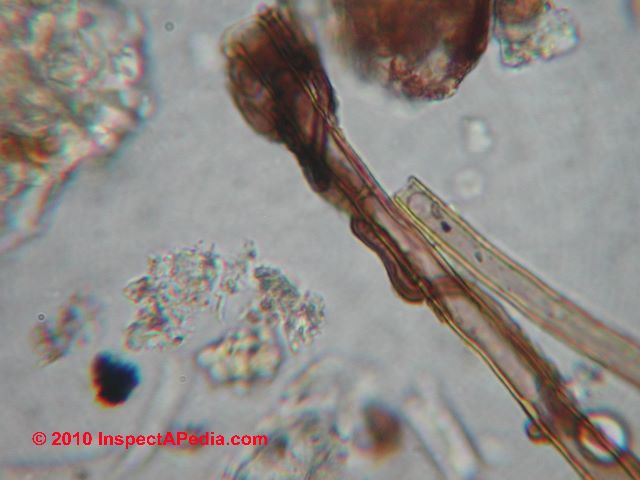
Our photo illustrates a common finding in house dust, an occasional fungal hyphal fragment along with mostly non-fungal granular debris such as road dust particles.
Usual components of house dust include skin cells and fabric fibers. Individual occurrences or infrequent occurrences of individual spores in air or dust samples are usually, but not always, insignificant.
Significance may depend on the context of the investigation.
For example we may find low levels of a not-normally-airborne spore such as Stachybotrys chartarum in a building after demolition and remediation during a mold cleanup job - probably not a concern.
Finding the same particles in a home that has not been properly cleaned might indicate a need for a more careful investigation.
While there were no serious health complaints nor people at unusual medical risk, the occupants were concerned, and believed that something in the ducts or air handlers was causing a problem.
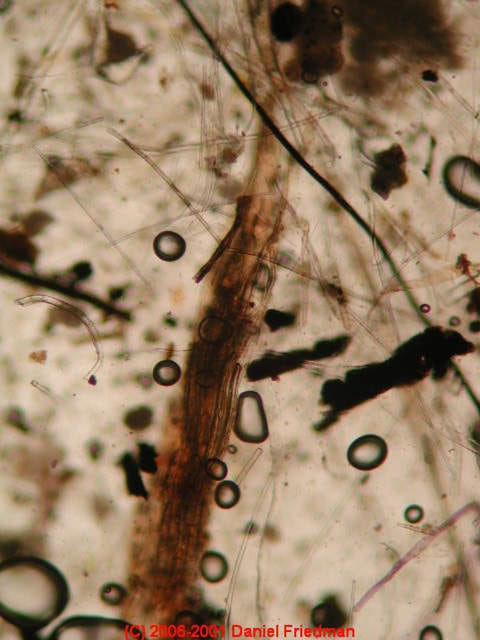
In contrast, at left we include one of our photographs of analysis of dust from the World Trade Center collapse - not from the building discussed in this article.
Details are at WORLD TRADE CENTER 9-11 DUST PHOTOS.
Now about our client's dust concern, while the dispute had been going on for months, at the time of this call no one had performed a forensic examination of the dust itself. The client mailed me a representative sample of surface dust from the home.
Here's one way surface dust can be easily collected and mailed:
TAPE TEST FOR SETTLED DUST ANALYSIS
We'd be concerned about finding high levels of problematic mold spores, and I'd not like to find a lot of fiberglass in the sample either, both because it may be a health concern and because it'd argue for sloppy work by the contractor.
House dust from an occupied home contains lots of stuff, usually dominated by skin cells and fibers from clothing and upholstery or carpets. Animal dander, particularly from dogs, cats, or mice, may be present at high levels too. In inner-city apartments I find lots of insect fragments as well, possibly cockroach allergens.
And everybody's dust can be expected to have traces of dust mites, usually their fecal pellets. By examining the pellets I can often determine what the mites are eating, for example mold spores.
Forensic Microscopy Basics for Particle & Fiber Identification
The dust sample was examined for homogeneity and then prepared for a look at high magnification in my lab, using both ordinary and polarized light, along with special microscope light wavelength filters, and combination of an index of refractive index mounting liquids combined Becke line analysis to measure the refractive index of particles.
These methods can quickly separate out synthetic fibers such as Orlon or Nylon, as well as distinguishing typical road grit and fiberglass.
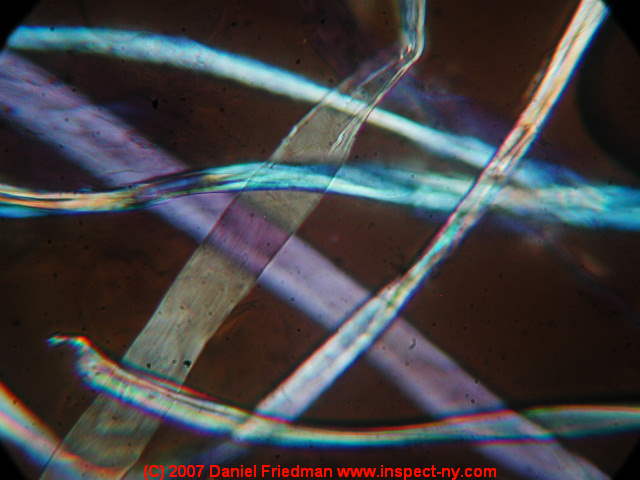
Remarkably the dust sample from this West coast home was unusually clean. The sample was 90% cotton fibers, mostly blue with a few red ones included. There were incidental (not statistically significant) wool fibers present too. Skin cells were another 8% of the sample, and typical drywall dust and road dust made up the rest.
The sample contained no mold spores, no fiberglass, no heating fuel combustion products, no ash, no paint droplets, in other words, it was cotton from a mostly blue fiber source.
This dust source was certainly not from the heating system components.
Without making a site inspection we can still offer some useful speculation:
Look for something new in the home, carpets, drapes, upholstery, bedding,
We would guess that mechanical disturbance like foot traffic, vacuuming, or other activity was combining with air movement from the HVAC system to spread dust around.
Naturally, an investigator is a lot smarter when on-site than when speculating by telephone or email. But in any case, this was the end of arguing with the HVAC contractor who was clearly not at fault.
See CARPETING & INDOOR AIR QUALITY for a broad discussion of indoor air quality concerns regarding carpeting, including chemicals, adhesives, odors, and VOCs associated with carpeting.
Also
See CARPET MOLD / ODOR TESTS
Reader Comments, Questions & Answers About The Article Above
Below you will find questions and answers previously posted on this page at its page bottom reader comment box.
Reader Q&A - also see RECOMMENDED ARTICLES & FAQs
On 2020-10-05 - by (mod) -
Sorry, but we cannot provide lab services.
After decades of field investigation and forensic lab work, with exception of a few pro-bono or research assignments, I have retired from field work and also from forensic laboratory analysis work to concentrate full time on pure research and writing for InspectApedia.com.
InspectAPedia.com provides building and environmental diagnostic and repair information. In order to absolutely assure our readers that we write and report without bias we do not sell any products nor do we have any business or financial relationships that could create such conflicts of interest. InspectAPedia is an independent publisher of building, environmental, and forensic inspection, diagnosis, and repair information for the public - we have no business nor financial connection with any manufacturer or service provider discussed at our website. We very much welcome critique, questions, or content suggestions for our web articles. Website content contributors, even if it's just a small correction, are cited, quoted, and linked-to from the appropriate additional web pages and articles - which benefits us both. Working together and exchanging information makes us better informed than any individual can be working alone.
We are dedicated to making our information as accurate, complete, useful, and unbiased as possible: we very much welcome critique, questions, or content suggestions for our web articles. Contributors, even if it's just a small correction, are cited, quoted, and linked-to from the appropriate additional web pages and articles - which benefits us both. Working together and exchanging information makes us better informed than any individual can be working alone.
At CONSULTANTS & EXPERTS DIRECTORIES - https://inspectapedia.com/Expert-Consultants-Directory.php you may find a suitable onsite expert - you can't diagnose nor fix the issues you describe by email nor general internet correspondence as a competent expert on site will pretty much always find things worth noting that were not obvious to a normal homeowner.
On 2020-10-05 by Jerrell Chesney
who can I send a sample to? I live in Kansas City.
On 2018-07-03 - by (mod) -
I can't say, Sharon, but probably from a fiber source that is itself blue, such as carpeting.
On 2018-07-02 by Sharon
Where does the blue lint in my house come from
On 2018-01-31 5 - by (mod) -
Phillip
Using the EXPERTS DIRECTORY link found at the top of any InspectApedia page (or the drop down menu if you're on a smartphone) finds
ENVIRONMENTAL INSPECTORS & TESTING SERVICES at https://inspectapedia.com/Environment/Environmental_Testing_Services.php
As your test lab to tell you the dominant particles in the dust. If the material is fiberglass it's often the case that the color of the binding resin can help trace that material to a source (such as mechanically-damaged fiberglass HVAC duct liner).
On 2018-01-31 by Phillip
My parents have white powder all over their house, we think it might be rug but the installation in the attic is also white. Where can I get the dust tested to determine it's origin by mail?
On 2015-04-26 - by (mod) -
Joe,
I agree that determining what the white dust is will be most helpful in determining if it is hazardous and also usually in determining its source. To avoid a conflict of interest we do not accept environmental samples for paid analysis. But you can use virtually any forensic microscopy lab who performs particle analysis.
Do keep me posted, and if specific question arise don't hesitate to ask.
On 2015-04-26 by Joe Stein
Our house is approx. 3 years old and was built brand new. With the exception of occasional cracking and creaking we continue to find "white dust" covering the furniture on a regular basis.
No sooner do we dust with a swifter or damp cloth within a 1/2 hour the dust reappears. My wife has mild asthma so we are concerned as to what this could be and is it dangerous. How do I get a sample to you and what are the costs involved
On 2015-03-05 - by (mod) -
Tavi,
A forensic analyst who knows about the building history and use of materials can often relate specific dust samples to probable particle sources.
But our forensic lab is not available for the analysis you request.
You may find an acceptable lab from the sources listed in our EXPERTS DIRECTORIES found at page top links.
On 2015-03-05 by tavi
I have to analyse some dust samples from an HVAC system from an hospital building. Is it possible for you to determine inside the dust sample the difference between construction-building dust (old dust) and hospital dust/particulate (new dust). If yes could you please send me an email octavianmoga@hotmail.com
On 2015-02-02 - by (mod) -
Brad
Fiberglass insulation in my experience is odorless unless it has been contaminated by some other substance.
I'd look for a leak, or a sealant or something else as the odor source.
On 2015-02-02 by Brad
I had my basement remodeled and added a hi-efficiency, variable speed furnace. I also added insulation for sound-proofing in the home theater. Since then, there is a slight odor that smells like fiberglass insulation. Is this dangerous? My suspicion is that insulation was packed around the pre-existing sheet metal HVAC duct in the theater and that air (especially with the new higher pressure furnace) is leaking from joints in the metal duct, through the insulation and into the house. I see no health symptoms ... but am concerned about long term exposure.
On 2014-02-09 - by (mod) -
Hi Debnose,
Unclear how electric baseboard heat would be blowing - are you saying that your system includes fans?
If not, air movement is simply by convection - warm air rises, pulling cool air in at the baseboard bottom.
Perhaps some information about the heater name, brand, model, & photos would allow a more helpful comment. You can use the CONTACT link at page top or bottom to send photos if you like.
Daniel
On 2014-02-09 by Debnose
I have electric baseboard heat in this tiny apartment I'm renting and I am seeing black dust everywhere as soon as it's been on and blowing! What could this be? Could the heater be oil-filled yet run on electric and needing a damn good cleaning the landlord neglected to do before I moved in here and turned it on? I know he was doing construction in here and painting, could this be debris burning off in those fins?
...
Continue reading at HOUSE DUST COMPONENTS or select a topic from the closely-related articles below, or see the complete ARTICLE INDEX.
Or see these
Indoor Dust & IAQ Articles
- AIR HANDLER DUST CONTAMINATION - drywall dust in furnace or air conditioner air handlers
- DUST SAMPLING PROCEDURE for help in collecting house dust or building dust samples for further analysis.
- CARPET AIR LEAK STAINS at WALLS
- CARPET CONTAMINATION TEST PROCEDURE
- CARPETING & INDOOR AIR QUALITY
- HOUSE DUST ANALYSIS
- HOUSE DUST COMPONENTS
- TAPE & BULK SAMPLING & TESTS for MOLD - also see DUST SAMPLING PROCEDURE
- HVAC DUST CONTAMINATION STUDY
Suggested citation for this web page
HVAC DUST CONTAMINATION STUDY at InspectApedia.com - online encyclopedia of building & environmental inspection, testing, diagnosis, repair, & problem prevention advice.
Or see this
INDEX to RELATED ARTICLES: ARTICLE INDEX to BUILDING ENVIRONMENT
Or use the SEARCH BOX found below to Ask a Question or Search InspectApedia
Or see
INDEX to RELATED ARTICLES: ARTICLE INDEX to BUILDING INDOOR AIR QUALITY IAQ
Or use the SEARCH BOX found below to Ask a Question or Search InspectApedia
Ask a Question or Search InspectApedia
Questions & answers or comments about what is commonly found in house dust
Try the search box just below, or if you prefer, post a question or comment in the Comments box below and we will respond promptly.
Search the InspectApedia website
Note: appearance of your Comment below may be delayed: if your comment contains an image, photograph, web link, or text that looks to the software as if it might be a web link, your posting will appear after it has been approved by a moderator. Apologies for the delay.
Only one image can be added per comment but you can post as many comments, and therefore images, as you like.
You will not receive a notification when a response to your question has been posted.
Please bookmark this page to make it easy for you to check back for our response.
Our Comment Box is provided by Countable Web Productions countable.ca
Citations & References
In addition to any citations in the article above, a full list is available on request.
- Domestic and Commercial Oil Burners, Charles H. Burkhardt, McGraw Hill Book Company, New York 3rd Ed 1969.
- National Fuel Gas Code (Z223.1) $16.00 and National Fuel Gas Code Handbook (Z223.2) $47.00 American Gas Association (A.G.A.), 1515 Wilson Boulevard, Arlington, VA 22209 also available from National Fire Protection Association, Batterymarch Park, Quincy, MA 02269. Fundamentals of Gas Appliance Venting and Ventilation, 1985, American Gas Association Laboratories, Engineering Services Department. American Gas Association, 1515 Wilson Boulevard, Arlington, VA 22209. Catalog #XHO585. Reprinted 1989.
- The Steam Book, 1984, Training and Education Department, Fluid Handling Division, ITT [probably out of print, possibly available from several home inspection supply companies] Fuel Oil and Oil Heat Magazine, October 1990, offers an update,
- Principles of Steam Heating, $13.25 includes postage. Fuel oil & Oil Heat Magazine, 389 Passaic Ave., Fairfield, NJ 07004.
- The Lost Art of Steam Heating, Dan Holohan, 516-579-3046 FAX
- Principles of Steam Heating, Dan Holohan, technical editor of Fuel Oil and Oil Heat magazine, 389 Passaic Ave., Fairfield, NJ 07004 ($12.+1.25 postage/handling).
- "Residential Steam Heating Systems", Instructional Technologies Institute, Inc., 145 "D" Grassy Plain St., Bethel, CT 06801 800/227-1663 [home inspection training material] 1987
- "Residential Hydronic (circulating hot water) Heating Systems", Instructional Technologies Institute, Inc., 145 "D" Grassy Plain St., Bethel, CT 06801 800/227-1663 [home inspection training material] 1987
- "Warm Air Heating Systems". Instructional Technologies Institute, Inc., 145 "D" Grassy Plain St., Bethel, CT 06801 800/227-1663 [home inspection training material] 1987
- Heating, Ventilating, and Air Conditioning Volume I, Heating Fundamentals,
- Boilers, Boiler Conversions, James E. Brumbaugh, ISBN 0-672-23389-4 (v. 1) Volume II, Oil, Gas, and Coal Burners, Controls, Ducts, Piping, Valves, James E. Brumbaugh, ISBN 0-672-23390-7 (v. 2) Volume III, Radiant Heating, Water Heaters, Ventilation, Air Conditioning, Heat Pumps, Air Cleaners, James E. Brumbaugh, ISBN 0-672-23383-5 (v. 3) or ISBN 0-672-23380-0 (set) Special Sales Director, Macmillan Publishing Co., 866 Third Ave., New York, NY 10022. Macmillan Publishing Co., NY
- Installation Guide for Residential Hydronic Heating Systems
- Installation Guide #200, The Hydronics Institute, 35 Russo Place, Berkeley Heights, NJ 07922
- The ABC's of Retention Head Oil Burners, National Association of Oil Heat Service Managers, TM 115, National Old Timers' Association of the Energy Industry, PO Box 168, Mineola, NY 11501. (Excellent tips on spotting problems on oil-fired heating equipment. Booklet.)
- In addition to citations & references found in this article, see the research citations given at the end of the related articles found at our suggested
CONTINUE READING or RECOMMENDED ARTICLES.
- Carson, Dunlop & Associates Ltd., 120 Carlton Street Suite 407, Toronto ON M5A 4K2. Tel: (416) 964-9415 1-800-268-7070 Email: info@carsondunlop.com. Alan Carson is a past president of ASHI, the American Society of Home Inspectors.
Thanks to Alan Carson and Bob Dunlop, for permission for InspectAPedia to use text excerpts from The HOME REFERENCE BOOK - the Encyclopedia of Homes and to use illustrations from The ILLUSTRATED HOME .
Carson Dunlop Associates provides extensive home inspection education and report writing material. In gratitude we provide links to tsome Carson Dunlop Associates products and services.
 | HOME | ABOUT | ASK a QUESTION | CONTACT | CONTENT USE POLICY | DESCRIPTION | POLICIES | PRIVACY | |
| © 2024 - 1985 Publisher InspectApedia.com - Daniel Friedman | |||||||||