
InspectAPedia® FREE Encyclopedia of Building & Environmental Construction, Diagnosis, Maintenance & Repair |
Question? Just ask us! InspectAPedia
|
 Guide to No. 2 Heating Oil Waxing, Gelling, or Clouding
- POST a QUESTION or COMMENT about the gelling, clouding, or waxing properties of No. 2 home heating oil
Waxing or jelling heating oil: Here we define and explain heating oil waxing, gelling, or pour point problems which can lead to loss of heat when oil tanks are located outdoors in freezing climates.
InspectAPedia tolerates no conflicts of interest. We have no relationship with advertisers, products, or services discussed at this website.
- Daniel Friedman, Publisher/Editor/Author - See WHO ARE WE?
Heating Oil Waxing, Gelling, or Clouding: a cause of oil piping or filter clogs and loss of heat - diagnosis and prevention of heating oil problems
 When heating oil does begin to gel, and before it has become actually too viscous to flow at all in the heating system oil piping, wax particles (wax platelets or little spheres of wax or in some articles, alkane "wax crystals") have already begun to form in the fuel.
The wax platelets form first from the long hydrocarbon chains which are a component in the heating oil (or diesel fuel). It is these waxy particles that can clog an oil line or even a oil fired heating boiler, furnace, or water heater.
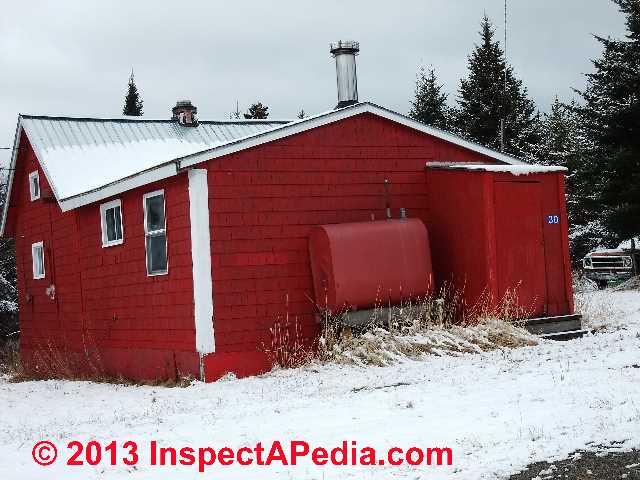
Our photo (above left) shows an outdoor heating oil storage tank at a Maine home - certainly in an area where heating oil waxing in an outdoor tank would be a real risk.
This article series answers most questions about all types of heating systems and gives important inspection, safety, and repair advice. Criticism and content suggestions are invited from heating service technicians, home inspectors, and home owners.
At what temperature point does home heating oil or No. 2 heating oil begin to cloud, wax or gel?
A Definition of the Pour Point for Home Heating Oil - No. 2 Heating Oil?
The pour point for heating oil is the lowest temperature at which the oil or fuel will continue to flow, that is it's viscosity has not increased or it has not become clogged with waxy particles.
Products sold as additives for home heating oil are called "pour point depressants" because they push the pour point temperature lower - that is, you can continue to use the treated heating oil or diesel fuel down to lower temperatures than otherwise.
An alternative to using pour point depressants is to purchase a cold-weather mix of fuel such as a mix of No. 2 diesel combined with less viscous Kerosene, or one can purchase a fuel or heating oil which has already been treated.
A Definition of The Cloud Point for Home Heating Oil - No. 2 heating oil:
Heating oil or diesel fuel waxing or clouding or gelling begins to occur at about -9 degC or about 16 °F.
The cloud point for heating oil is defined as the temperature at which a cloud of wax crystals first appears in a fuel sample that is cooled following the procedure in ASTM Standard D2500. In more practical words, home heating oil will probably flow through the oil piping, filter, and oil burner without an operating problem down to about -9 degrees Centigrade or 16 degrees Fahrenheit.
A Definition of the Wax Point or Gel Point for Home Heating Oil - No. 2 Heating Oil (or diesel fuels)
The gel point for home heating oil (No. 2 Heating Oil or Diesel Fuel) refers to the fuel or heating oil becoming so viscous that it "gels" and will no longer flow at all by gravity nor by pumping through the oil lines or heating equipment.
What we call the gel point or wax point of home heating oil is either a temperature lower than the cloud point for heating oil, or it may occur at a higher temperature if the oil is exposed to that temperature long enough.
The wax point or gel point of heating oil means that there has been sufficient formation of wax platelets or crystals that heating oil piping lines or oil filters will become clogged.
Here are the gel point temperatures for heating oil or diesel fuel: Heating oil or diesel fuel gelling or waxing to the point at which the fuel will no longer flow is 5? to 10?F below the cloud point.
The pour point, cloud point, gel point or wax point temperatures given for No. 2 home heating oil, which is similar to diesel fuel used in vehicles, are estimates.
The actual gelling or waxing of home heating oil will occur as a function of not only the temperature to which the heating oil (and oil tank) are exposed, but the duration of that exposure. That is to say, if temperature dips below freezing for a few hours and then rises, you may not see any troublesome waxing or gelling.
We have observed that an outdoor home heating oil storage tank exposed to about 10 degrees F for several hours or more may produce gelling or waxing in the heating oil which can stop the heating system from working.
Where in the oil tank, storage, piping, and filter does waxing or gelling first occur and how does this lead to a loss of heat in a building?
The clouding and then waxing of the heating oil will occur where the oil has the least thermal mass and is most exposed to cold conditions.
Often this is at the oil piping line exiting at the bottom of an outdoor heating oil tank since this small diameter pipe has much less volume and mass than the larger and perhaps mostly full tank of heating oil.
All petroleum distillate products contain waxy materials, which, at low temperatures, can crystallize and plug fuel filters. So a heating system may go out of service because it's filter has become clogged with waxy particles even though there was still oil flow in the heating oil lines.
At longer exposure to cold temperatures or exposure to lower temperatures the amount of wax forming inside the heating oil in the oil tank can prevent heating oil from flowing out of the tank. Some writers refer to the observation that waxes settle to the bottom of the oil storage tank.
How oil line piping design affects cold weather operation of outdoor heating oil storage tanks
If the oil piping is connected to the bottom of the oil tank it will certainly be blocked by oil waxes settling at the tank bottom. The oil piping in this location is also easily blocked by sludge in the oil tank -
see OIL TANK SLUDGE.
If oil piping is taken off of a tapping at the top of the oil tank,
as is good practice with outdoor installations in freezing climates, the piping may still include a "low loop" or bend down towards the tank bottom, depending on where the heating equipment is located with respect to the oil tank position and elevation.
A low loop in the oil line may accumulate waxes pulled out of the heating oil tank.
Alternatively, oil in the oil piping may gel and cause a blockage because of the line's exposure to very cold conditions because the oil piping has less thermal mass than the oil tank itself.
Wax settlement in heating oil tanks:
Even if the oil line itself is not fully blocked by waxed or gelled heating oil, if enough wax sphericules or platelets flow into the heating oil filter the filter may become blocked by waxes and thus starve the oil burner for oil until it goes off on reset.
This can be a tricky problem to diagnose since with the heat off for a while but with the oil filter canister sitting indoors in a location that is still much warmer than outdoor temperatures, it's possible that the service technician will arrive and successfully simply re-start the oil burner since the waxes in the filter canister may have returned to their liquid state.
Waxing causes change in heating fuel BTU's:
Waxing of fuels in an oil storage tank (or in a vehicle fuel tank) also causes an operating difference in the boiler, furnace, water heater, or vehicle, since the chemistry and thus the energy capacity of the remaining liquid fuel will have been changed by loss of the longer hydrocarbon molecules which have left it to form settled wax spheres.
How does Biodiesel differ from Petroleum Based Fuel with respect to gelling and waxing?
Biodeisels have a higher gel point than petroleum-based diesel because they contain molecules that form large spheres or crystals of wax at temperatures below 40 °F.
Anti-gel additives (also called pour point depressants) have not been shown to be effective with biodiesel fuel.
Therefore oil companies in areas where biodiesel is sold recommend that biodiesel (B100) should not be used at temperatures below 40 Deg. For that a blend of B100 biodiesel and 50% petroleum-based diesel be used in the vehicle's fuel tank.
Portions of this article paraphrase a biodiesel article at http://www.staroilco.net/BIODIESEL_07.html]
How pour point depressants work:
How pour point depressant and anti wax-settling additives work is not clear, but some writers including in patent applications for pour point depressant and anti-waxing heating oil and diesel fuel additives have argued that they work by matching alkanes in the heating oil or vehicle fuel fuel to alkyl or alkylene chains in the pour point depressant additive in order to affect the formation of wax particles.
[Paraphrasing patent description for a pour point depressant at http://www.freepatentsonline.com/5906663.html
What are the Different Petroleum-based Fuels and What are their Characteristics?
The differences among these fuels, arranged in our list from "lightest" to "heaviest" are in the types of hydrocarbon chains that are distilled out of the crude oil during refining (and also that some of these fuels may contain other additives.
- Jet Fuel type A basically Kerosene, or filtered #1 oil cleaned up to higher specifications including very fine filtering (through diatomaceous earth) and a water removal step.
- Kerosene is #1 oil which has been filtered to clean it up. Sold at ridiculously higher prices in stores as "lamp oil" this material may have deodorants or fragrances added.
- #1 fuel oil is more refined than #2 oil, has a lower pour point (or gel point or waxing point), is less viscous, has a higher septane rating and contains fewer BTU's per gallon than #2 heating oil.
- Diesel fuel used in diesel powered vehicles and some other engines, is basically #2 home heating oil but with dye added in order to assure that highway taxes are paid by the users of this fuel and to distinguish it from un-taxed or lower-taxed fuel used for heating purposes.
In an emergency if you're out of home heating oil you can drive to the "gas" station to purchase diesel fuel (but you'll pay more since it's taxed). - Diesel fuel Winter Blend combines Diesel fuel with about 10% to 20% #1 oil to avoid waxing or gelling of the fuel.
The septane rating of winter blend will usually be below regular diesel fuel unless a septane-booster additive has been included. - Home Heating Oil inter Blend combines #2 heating oil with #1 oil (often called a "kerosene mix" by the heating oil distributor) for use at homes with outdoor oil tanks in freezing climates. Kerosene mix is usually 10 - 20% #1 with #2 similar to the Winter Blend Diesel described above.
- Home Heating Oil also referred to as #2 Fuel Oil or by some writers as Regular Fuel Oil. One gallon of No. 2 home heating oil will provide about 138,500 BTUs per gallon.
How flammable is home heating oil?: it's not that easy to set on fire. If you were to toss a match into a bucket of No.2 home heating oil the match will just go out.
Watch out: DO NOT TRY THIS AT HOME
An oil burner uses a high voltage spark to ignite heating oil after the oil has been pressurized to 100 to 120 psi and then atomized by passing through the oil burner nozzle. - #4 fuel oil (bunker oil) is used in large stationary engines, power plants, and very large commercial boilers
- RM oil is used as fuel by diesel locomotives and is a mix of #4 and #2 oils with some other refining differences
- #6 oil is used to make asphalt for paving
What this all means is that the heavier petroleum based fuels (higher numbers) have longer hydrocarbon chains than the lower number fuels, they have more BTUs per gallon, they will be more viscous (and often dirtier or will contain more contaminants including environment-polluting sulphur).
It is not helpful to order and burn Kerosene #1 over #2 fuel oil except in outdoor aboveground oil tanks in areas subject to temperatures below 16 °F.
[From the following reference, edited: http://www.impalassforum.com/vBulletin/showthread.php?t=184909]
Problems With Heating System Reliability When Heating Oil Additives are Used or Low-Level Oil Tanks are Filled
When we serviced and installed heating equipment we often recommended use of heating oil additives to remove small amounts of water or sludge in oil storage tanks, or to act as a pour point depressant for outdoor aboveground oil storage tanks.
But while these are good products, things didn't always go well.
See details at OIL TANK SLUDGE
We have seen problems with rapid clogging of heating oil filters and thus loss of heat from sludge that was brought out of an old oil tank and into the filter when we added a pour point depressant to our heating oil.
The product also claimed to break up sludge - which sounds good if the oil lines are old and perhaps partly blocked with sludge.
But in this case the combination of use of a heating oil additive with a "de-sludger" combined with the sludge agitation up from the bottom of the oil tank during filling of a nearly empty oil tank led to loss of heat from filter clogging.
Oil companies may recommend that if you have to fill an old maybe sludgy oil tank that was nearly empty, turn off the boiler or furnace for a few hours to let the sludge return to the bottom of the tank (and be sure your heating equipment is fed fuel from the tank top tappings not from the tank bottom tapping.
In emergency when no home heating oil is available, one can use diesel fuel or kerosene to run the boiler or furnace.
An example of an oil additive to prevent gelling is at http://www.ezoil.com/Products/Hot_Shot.html
OR you can purchase a kerosene/heating oil mix (more costly) to lower the waxing temperature of your heating oil.
...
Reader Comments, Questions & Answers About The Article Above
Below you will find questions and answers previously posted on this page at its page bottom reader comment box.
Reader Q&A - also see RECOMMENDED ARTICLES & FAQs
Question: OK to put kerosene in an oil storage tank?
I came across an oil tank at a property, town house in the catskills area of NY, The tank was empty (hollow sound and gauge was at the bottom). There was electric baseboard heating and the dryer was heated by a propane tank.
Thus, the tank is not providing fuel to the home.
Realtor pointed out that there was never oil heat for the development and the tank must have held kerosene as there used to be a kerosene burner for the main floor. Right now there was no other heating element for the home other than electrical baseboards.
As I haven't much experience with kerosene fuel, I was wondering if it is fine to have kerosene on an oil tank? - 2020/09/07
- Dov Ber Kahn, a home inspector in Rockland County, NY has contributed photographs of various building features. Mr. Kahn is a licensed home inspector in New York and New Jersey, and can be reached at Website: Kahnbhomeinspectors, Tel: 845-445-8234, Email: kdovber@googlemail.com
Moderator reply: Yes
Tes, Kerosene is in essence a lighter-weight fuel oil.
It's often added to heating oil in outdoor tanks to reduce the pour point and thus avoid waxing or gelling that can cause loss of heat.
Keep in mind, however that a professional inspector ought not rely on a seller's or realtor's representation of a property; a realtor's representation of a property is not always reliable, there is an innate conflict of interest, and that real estate agents are protected by law from being held accountable for the accuracy of their statements.
On 2017-01-13 - by (mod) - Can anything be done after #2 heating oil gels in outside tank ?
Well that's a good question, Mike.
You could
- enclose the tank and add a modest heat source - even a small electric heater or even incandescent lights - though you want to watch for fire clearances and fire hazards.
- add a pour point depressant additive like the ones discussed above - though that won't find its way into an oil line that's already blocked by waxing until things warm up
- wait for a warm day, then add the pour point depressant
On 2017-01-13 by Mike
Can anything be done after #2 heating oil gels in outside tank
On 2015-12-19 - by (mod) -
Perhaps, but the quantities and costs would be questionable
On 2015-12-19 by lawrence
can you use diesel antigel agents in #2 heating oil?
Question: My furnace has been cutting out and each time the service techs replaced the filters and nozzle.
Interesting information. My furnace has been cutting out and each time the service techs replaced the filters and nozzle. The filters came out of the canister looking like balls of wax.
My tank is inside the basement and doesn't get that cold. Could there be a problem in the supply chain? - Jay 2/11/12
Reply:
Waxy stuff in the oil filter canister may be telling us that your oil tank has a sludge problem. I agree that an indoor oil storage tank ought not to be seeing actual heating oil waxing.
Question: sludge in bottom of oil tank
I have an indoor ( basement ) Oil tank. It is about 30 years old and I'm getting a lot of sludge in bottom of filter canister. Can I use diesel fuel watger remover additives without harming my burners and nozzle? - Charles Lucas 1/2/13
Reply:
Charles Lucas,
Oil companies sell both pour point depressants and water remover additives that will help remove SMALL amounts of water contamination in a heating oil storage tank. Automotive type additives are not likely to hurt the burner but may be inadequate.
Over at OIL TANK SLUDGE we discuss other options for avoiding water and sludge in oil tanks and piping, including making use of the Scully Snorkel that avoids picking up both sludge and water in an oil tank. That's the article you want to read.
Question: we installed Scully Snorkels but keep having air bubbles and loss of prime in the oil tank piping
We replaced our two 275 gal oil tanks with new scully snorkels because we had been loosing the prime,kept getting air bubbles, so our service guy replaced them. Run good for a few days and last night same problem. I might add i did add an additive before getting oil last week.
I primed about a 1/4 of a gallon and it ran until reaching temperature but when it came time to ignite again same problem. Primed about another quart and it seems to be running. I might add the temperature did go down to the 20s vs, the 30s when it ran fine. Any suggestions. Thanks your articles are great.
John
Reply:
John,
A Scully MagneLink Snorkel Gauge is an oil tank gauge that includes a float feature to assure that heating oil is picked up from just one-inch below the fuel oil level in the tank. This design avoids picking up water or sludge that are found at the bottom of older oil tanks.
So you did not replace the oil tanks themselves, right? Just the gauge and fuel pick-up?
Losing prime and seeing air bubbles is a different problem and not one that the Snorkel Gauge is designed to prevent.
Losing prime on an oil piping system means that there is a problem in the system piping - an air leak - or perhaps a defective fuel unit (oil pump) at the burner, or mis-routed oil piping that involves more lift than the fuel unit can handle (in a one-pipe, no-return oil pipe setup).
Your heating service tech will use a vacuum gauge to test the oil piping system for air leaks.
Details about the Scully Snorkel and company contact information are
at OIL TANK SLUDGE.
Question: How could we prevent or reduce fuel gelling?
(Feb 17, 2015) joey said:
How could we prevent or reduce fuel gelling?
Reply:
Use a pour point depressant additive at each oil tank fill up or ask your oil company to deliver an outdoor winter mix containing kerosene.
Question: domestic heating oil waxing in England
(July 17, 2015) Anonymous said:
in the east of england, at what temperature would domestic heating oil be expected to start waxing?
Reply:
Anon, unless where you live - East of England - heating oil has been treated with a pour point depressant or an addition of kerosene, then it is standard No. 2 home heating oil. For that product, waxing or clouding or gelling begins to occur at about -9 degC or about 16 °F.
...
Continue reading at OIL TANK TREATMENTS, ADDITIVES or select a topic from the closely-related articles below, or see the complete ARTICLE INDEX.
Or see these
Recommended Articles
- HEATING OIL CLOUD WAX GEL POINT
- HEATING OIL TYPES & PROPERTIES
- OIL TANK SLUDGE
- OIL TANK REPLACE due to SLUDGE?
- OIL TANK TREATMENTS, ADDITIVES
- OIL TANK WATER REMOVAL
- SCULLY SNORKEL® or OIL PIPING CHANGES to AVOID SLUDGE
- STEAM CLEANING OIL TANKS & OIL PIPING
Suggested citation for this web page
HEATING OIL CLOUD WAX GEL POINT at InspectApedia.com - online encyclopedia of building & environmental inspection, testing, diagnosis, repair, & problem prevention advice.
Or see this
INDEX to RELATED ARTICLES: ARTICLE INDEX to HEATING OIL, OIL BURNERS, OIL FIRED HEATERS, OIL TANKS
Or use the SEARCH BOX found below to Ask a Question or Search InspectApedia
Ask a Question or Search InspectApedia
Try the search box just below, or if you prefer, post a question or comment in the Comments box below and we will respond promptly.
Search the InspectApedia website
Note: appearance of your Comment below may be delayed: if your comment contains an image, photograph, web link, or text that looks to the software as if it might be a web link, your posting will appear after it has been approved by a moderator. Apologies for the delay.
Only one image can be added per comment but you can post as many comments, and therefore images, as you like.
You will not receive a notification when a response to your question has been posted.
Please bookmark this page to make it easy for you to check back for our response.
IF above you see "Comment Form is loading comments..." then COMMENT BOX - countable.ca / bawkbox.com IS NOT WORKING.
In any case you are welcome to send an email directly to us at InspectApedia.com at editor@inspectApedia.com
We'll reply to you directly. Please help us help you by noting, in your email, the URL of the InspectApedia page where you wanted to comment.
Citations & References
In addition to any citations in the article above, a full list is available on request.
- Domestic and Commercial Oil Burners, Charles H. Burkhardt, McGraw Hill Book Company, New York 3rd Ed 1969.
- In addition to citations & references found in this article, see the research citations given at the end of the related articles found at our suggested
CONTINUE READING or RECOMMENDED ARTICLES.
- Carson, Dunlop & Associates Ltd., 120 Carlton Street Suite 407, Toronto ON M5A 4K2. Tel: (416) 964-9415 1-800-268-7070 Email: info@carsondunlop.com. Alan Carson is a past president of ASHI, the American Society of Home Inspectors.
Thanks to Alan Carson and Bob Dunlop, for permission for InspectAPedia to use text excerpts from The HOME REFERENCE BOOK - the Encyclopedia of Homes and to use illustrations from The ILLUSTRATED HOME .
Carson Dunlop Associates provides extensive home inspection education and report writing material. In gratitude we provide links to tsome Carson Dunlop Associates products and services.
 | HOME | ABOUT | ASK a QUESTION | CONTACT | CONTENT USE POLICY | DESCRIPTION | POLICIES | PRIVACY | |
| © 2025 - 1985 Publisher InspectApedia.com - Daniel Friedman | |||||||||