
InspectAPedia® FREE Encyclopedia of Building & Environmental Construction, Diagnosis, Maintenance & Repair |
Question? Just ask us! InspectAPedia
|
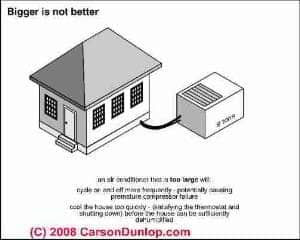 Dehumidification of Indoor Air
Central A/C Not Dehumidifying - Diagnosis & Repair

- POST a QUESTION or COMMENT about how to diagnose and cure inadequate building dehumidification - excessive indoor humidity levels
Diagnosis of inadequate dehumidification in buildings:
Tthis article discusses the causes of inadequate indoor air dehumidification when you are running a central air conditioner or heat pump system. If your central air conditioning system cools the building air but the indoor humidity remains too high, the system may be over-sized, as we explain here.
We also consider other sources of excessive water in central air systems, air handlers, and ductwork.
Page top sketch provided courtesy of Carson Dunlop Associates, a Toronto home inspection, education, & report writing tool company.
InspectAPedia tolerates no conflicts of interest. We have no relationship with advertisers, products, or services discussed at this website.
Air Conditioning System Dehumidification Problem Diagnosis & Cures
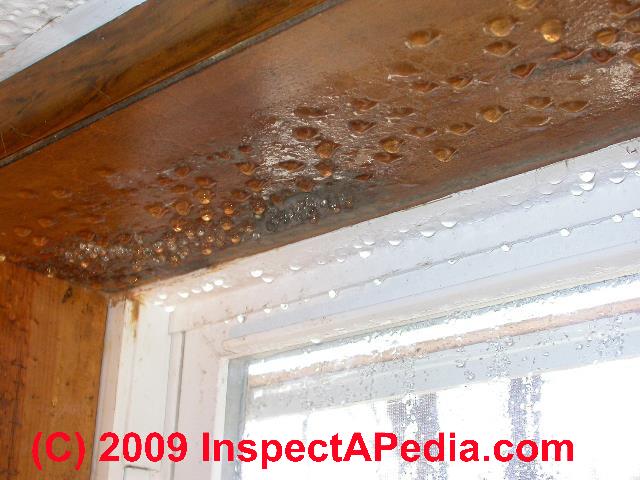 Air Conditioning Dehumidification Problems: air conditioning system cools but does not dehumidify the room.
The most common cause of inadequate dehumidification by an air conditioning system is the installation of a cooling unit which has too much capacity, or is "over-sized" for the space it is being used to cool.
[Click to enlarge any image]
If an air conditioning compressor unit is oversized (too many BTUH of cooling capacity) what happens is it cools the room so quickly that the system does not move enough total volume of air across the cooling coil to remove much moisture before the room temperature has dropped to the A/C cut-off point.
In other words, an air conditioner needs to run longer, and move more total volume of air through itself to drop room humidity than it does to just cool the air.
So "bigger" cooling capacity or higher BTU capacity for an air conditioning system is not necessarily better, and it can actually be a problem.
Key Air Conditioning Inadequate Dehumidification Symptom: If your cooling system is otherwise working normally, and it cools the room temperature quickly but the room humidity stays high, an over-sized unit is likely to be the problem.
Higher cooling coil temperatures may also reduce the dehumidification rate: a second explanation of why an air conditioner may not dehumidify properly was offered by reader Bar who noted that newer HVAC systems, in order to meet energy efficiency requirements, may operate at a lower cooling coil temperature. Here is what he noted [with minor editing]:
... I'll interject some of my expertise from my HVAC career.
Dehumidification while often is an over sizing issue, it is not always the case especially in the replacement of systems.
Dehumidification in AC systems is a combination of coil temperature vs the temperature [and relative humidity or moisture content] of air moving across the coil as Delta-T and time.
What is not commonly told is that new systems mandated by [U.S.] federal, state and local energy codes have a higher efficiency designs which tend to raise the indoor coil temps and reduce the Delta-T.
This causes a reduction in moisture removal as air travels across the cooling coil. So in effect, what can happen is the air is cooled somewhat more slowly on right-sized systems yet moisture removal is not as good as an older less efficient AC system.
This is where reducing the size of the system does not change how it dehumidifies and infac could make the situation worse because the coil temp is actually warmer.
Sometimes a simple solution (if the system is not over sized) is to reduce the fan speed if the system allows the wiring to be reconfigured.
On some newer and more elite systems technology is applied which adjusts compressor and fan speeds to compensate for cooling load on warmer or cooler days, and humidity levels.
All of this is more complicated than this brief description but hopefully this adds some understanding to the thread. - Bar 9 August 2015
Cures for inadequate dehumidification by an air conditioner
- First make sure that the equipment is operating properly: is it cooling - check that temperatures are dropping normally when the system is running.
- Check that there is not an abnormal moisture source such as leaks into the building or its wall or ceiling cavities from any other source. Check to see if the condensate drain from the air conditioner is producing water.
If you see lots of A/C condensate dripping out of the system condensate drain but room humidity is still high, we suspect that there may be an abnormal humidity source.
At the end of this list we discuss adding additional dehumidification capacity. - Adjust the A/C unit controls to increase dehumidification: discuss with your HVAC service technician whether there are technical changes that might be made to fan speed or other controls that might improve A/C unit dehumidification. We're doubtful there is much mileage in this but it's worth asking.
See BLOWER FAN SPEED SETTINGS - how to set the air handler fan speed - Increase the cooling load on the installed air conditioner by making it cool a larger area - like maybe leaving the doors open to other rooms - which we doubt is suitable in most cases.
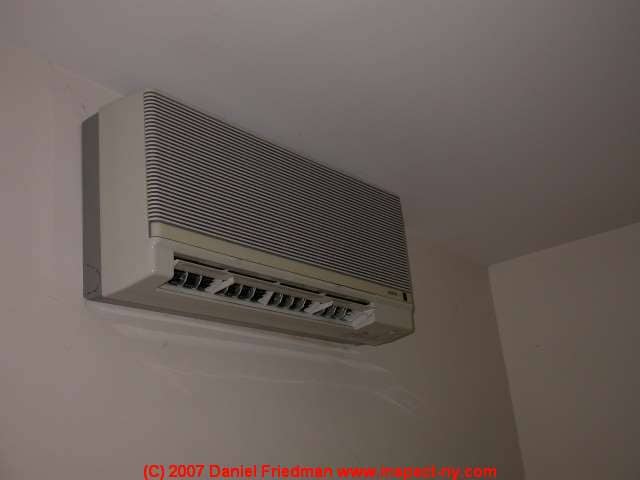
Our photo above shows a wall mounted air handler from a Sanyo™ split system air conditioner that was not adequately dehumidifying the bedroom where it was installed, even though the room was cold enough to hang meat.
The occupants experimented with leaving the bedroom door opened, as the rest of their home did not have air conditioning. That proved just enough to cause the system to dehumidify beautifully. - Adjust the building HVAC system ductwork: if a non-dehumidfying central air conditioning system (as opposed to a window unit or a wall-mounted split system unit) is otherwise working well, it may be possible to adjust its load and thus improve its dehumidification by making changes in the duct system, such as increasing the return air to the air handler from additional building areas.
- Replace the oversized air conditioner: Unfortunately the most likely fix for an A/C system that is not dehumidifying may be an ugly one - either replace the unit with one that is properly matched to the size of the area to be cooled
- Select an A/C unit of the proper size.
See AIR CONDITIONER BTU CHART for the data useful to do this. Whoever selected and installed the air conditioning unit needed to relate the room size to the AC capacity. Also
see COOLING RULES OF THUMB to guesstimate how many tons or BTUs of cooling a building needs
and
see RATED COOLING CAPACITY to determine the cooling capacity of existing air conditioning equipment. - Check that high indoor moisture levels are not due to a building water entry or leak problem. There could be a source of indoor moisture that just exceeds the ability of the air conditioning system to handle.
See MOISTURE PROBLEMS: CAUSE & CURE - Check that the air conditioning system condensate capture and drainage systems are working properly. Condensate in the air handler that is not being adequately captured and drained out of the blower compartment can wet nearby ductwork causing rust and sometimes air conditioning system duct mold.
- Add supplemental dehumidification. For wet conditions that exceed the capacity of the air conditioner itself, or when you require both unusually low temperatures and further dehumidification (such as a seed storage facility described by one of our readers), it may be necessary to add a separate free-standing or portable dehumidifier to the system to reach the temperature and humidity targets you need.
In an area of our forensic laboratory we use a Sears® dehumidifier, model 580.54501 - 50 pint (also available as 580.54701 - 70 Pint Low Temp) (cost about $200.).
The Sears portable dehumidifier instruction manual (Part# 3828A20803B) confirms on p.7 that the humidity control can be set anywhere between 35% and 70%. You can also adjust the fan speed (low / high) and also set an on-off cycle period of 3 hrs or 6 hrs.
Operating a dehumidifier (which uses the same technology as an air conditioner) will have a side effect of pumping a little heat into the dehumidified area - the output side of the dehumidifier produces air that is warmer than its input side. Depending on the size of the area being conditioned, that added heat might help compensate for an air conditioner that was a little oversized for the space.
See LOST COOLING CAPACITY if not enough cool air is provided by your air conditioner, or if the air temperature is not cool enough, or if you just can't get your A/C unit running, this article helps diagnose and correct the problem with step by step things to check and links to more detailed explanation when you need it. We provide links to other air conditioning system diagnostic articles too.
Troubleshooting High Indoor Humidity Levels
Reader Question: 11/30/2014 Glen de Valk said:
Last May we replaced our central air unit in our 2400 sq.ft. home in Sarasota, FL. It was replaced with the same size unit that had been in place for over 20 years (3.5 tons) and cooled and dehumidified very well. However, the new unit does not dehumidify the air regardless where temp. is set and keeps the humidity level no lower than 60% and as high as 72% when we raise the thermostat to our comfort level around 75 degrees.
We had an independent inspection of the system done and detected that the air humidity at the registers was 83-85% when the unit was running; when the compressor shuts off and the fan runs for a pre-set 90 seconds more, the humidity level goes to 100%.
The installer cancelled the 90 second period of running but the humidity level still stays at 82-85% coming out of the registers and around 60 to 65 % at the returns. The house was also thoroughly tested for plumbing leaks, etc. and there are none.
The A/C contractor thought the 3.5 ton unit was too big and replaced it with a 3 ton unit so it would run longer cycles. That made absolutely no difference in dehumidification. The contractor seems to be at a loss to cure it. Please advise. Thanks.
Reply:
Glen, usually when an air conditioner is not adequately dehumidifying the indoor air it is because its cooling capacity is too great - the air cools and shuts off the cooling system before the humidity has dropped.
- Continuing to run the fan after the cooling cycle stops will not reduce humidity at all - that only occurs when the cooling coil is in operation.
- Though you indicate that the capacity of the new unit was the same as the one it replaced, perhaps it was more efficient, cools faster, or was using a different air velocity, or a different sized cooling/evaporator coil. Moving to a smaller capacity unit sounds sensible to me.
- But as that did not work I'd want to look more closely at the air handling system: duct sizes, air flow rates, cooling coil size, return to supply air balance, etc.
- Also check for cooling coil icing - if the coil is partly blocked that might be a factor.
- Also ask yourself: what else was changed in the home: occupancy patterns, cooking patterns, doors kept open or shut, windows open or shut, house air leakiness, sun exposure, etc.
- Take a look at Simonson (2002) and also at Zhang (2003), cited below, for some techincal research on problems with decoupled cooling and humidity in humid climates (such as yours in Florida) that may be helpful
- Finally it would be smart to also survey the home carefully for unusual moisture sources that might not have been noticed.
Reader Question: Is there a Way to Scale Down Oversized Air Conditioner Units?
Some years ago now, I had 2 ACs installed in my home. It cost me about $10k and now I am told they “overinstalled” with 7 tons of cooling when I needed 4.5 tons. Problems keep coming, of course and the only fix I hear is to install new ones with less tonnage.
Seems to me, there ought to be some way to scale down the ones I have to fit my home.
Utility cost is out of sight, of course. I am told the savings to reduce the AC capacity would be significant. Is there some way I can scale down the volume of the units I have? Seems like a better fix for me. What say you? - W.S.
Reply: We are doubtful that you can squeeze down an oversized A/C system
A competent onsite inspection by an expert, especially if you employ an experienced HVAC designer or engineer usually finds additional clues that help accurately diagnose a problem. That said, here are some things to consider:
- I am sorry to joint the naysayers, but the problem is this: if the cooling capacity is significantly oversized the system won't properly handle humidity and may have other operating problems.
We discuss the air conditioning system sizing problem
at AIR CONDITIONER BTU CHART and while details are found
at DEHUMIDIFICATION PROBLEMS,
we also introduce the oversized air conditioner problem at LOST COOLING CAPACITY.
at ADDING A/C: RETROFIT SIZING we discuss home cooling system sizing mis-match on retrofit jobs. - The problem is with the run cycle of the too-powerful air conditioning system, both the air/handler cooling-coil evaporator unit and the compressor condenser unit that was sized to match it.
- Just trying to slow down air flow creates other problems - like coil frost and blockage - so there is no easy magic solution that I know of. That's why selling oversized equipment is actually illegal in some jurisdictions.
- Check with a very experienced HVAC tech or engineer for some suggestions - onsite inspection is needed; for example, I wonder if you can just not run one of the units and reroute duct work and improve fan capacity in the other, so you use one unit to cool the larger area?
- You could ask the tech if there is any use in installing a multi-speed air handler blower fan that might run at a lower rather than the higher speed. But I'm afraid that if there is too much of an air conditioner size mis-match, the result might be evaporator coil icing.
- I'd be reluctant to try modifying the cooling units themselves, as doing so voids warranty and probably would cost almost as much as buying a new unit.
- Also see COOLING RULES OF THUMB to guesstimate how many tons or BTUs of cooling a building needs and
see RATED COOLING CAPACITY to determine the cooling capacity of existing air conditioning equipment.
Research on Reducing Indoor Humidity Levels
- Also see theReferences or Citations of this article
- Arens, Edward A., and A. Baughman. "Indoor humidity and human health: part II--buildings and their systems." Center for the Built Environment (1996).
- Baughman, A., and Edward A. Arens. "Indoor Humidity and Human Health--Part I: Literature Review of Health Effects of Humidity-Influenced Indoor Pollutants." Center for the Built Environment (1996).
- Dharmage, S., M. Bailey, J. Raven, T. Mitakakis, F. Thien, A. Forbes, D. Guest, M. Abramson, and E. H. Walters. "Prevalence and residential determinants of fungi within homes in Melbourne, Australia." Clinical and Experimental Allergy 29 (1999): 1481-1489.
- Fletcher, A. M., C. A. C. Pickering, A. Custovic, J. Simpson, J. Kennaugh, and A. Woodcock. "Reduction in humidity as a method of controlling mites and mite allergens: the use of mechanical ventilation in British domestic dwellings." Clinical & Experimental Allergy 26, no. 9 (1996): 1051-1056.
- Garrett, M. H., P. R. Rayment, M. A. Hooper, M. J. Abramson, and B. M. Hooper. "Indoor airborne fungal spores, house dampness and associations with environmental factors and respiratory health in children." Clinical and Experimental Allergy 28, no. 4 (1998): 459-467.
- Padfield, Tim. "The role of absorbent building materials in moderating changes of relative humidity." Department of Structural Engineering and Materials, Lyngby, Technical University of Denmark 150 (1998). [Ph.D. Thesis] Excerpt:
This thesis is about controlling the relative humidity inside buildings by using the water absorption properties of porous materials. - Peat, Jennifer K., J. Dickerson, and J. Li. "Effects of damp and mould in the home on respiratory health: a review of the literature." Allergy 53, no. 2 (1998): 120-128.
- Simonson, C. J., M. Salonvaara, and T. Ojanen. "The effect of structures on indoor humidity–possibility to improve comfort and perceived air quality." Indoor Air 12, no. 4 (2002): 243-251. Excerpt from the article abstract:
... moisture transfer between indoor air and hygroscopic building structures can generally improe indoor humidity conditions. ... - Zhang, L. Z., and J. L. Niu. "Indoor humidity behaviors associated with decoupled cooling in hot and humid climates." Building and Environment 38, no. 1 (2003): 99-107.
Abstract
Radiant cooling with independent air dehumidification/ventilation is a complementary cooling and ventilation technology that has the potential to provide better thermal comfort, air quality and energy consumption than conventional all-air systems. However, in hot and humid regions, fears for the risk of condensation on ceiling panels limit its market penetration.
To address this problem, in this paper, indoor humidity behaviors associated with decoupled cooling in hot and humid climates are investigated.
Room mean temperature, mean humidity, maximum RH on the ceiling panel surfaces, annual condensation hours and annual primary energy consumptions are predicted with systems combining chilled ceiling with various air dehumidification and ventilation strategies, using a building energy simulation code ACCURACY.
The effects of night air infiltration rates and the ratios of air flow rates of return air to those of fresh air on the indoor humidity performance and annual condensation hours are discussed.
The results indicate that dehumidification and ventilation prior to cooling panels operation is required to reduce condensation risks in hot and humid climates. It is also revealed that a in advance dehumidification/ventilation in summer could completely eliminate the condensation problems.
How to Diagnose an air conditioning system that is not working
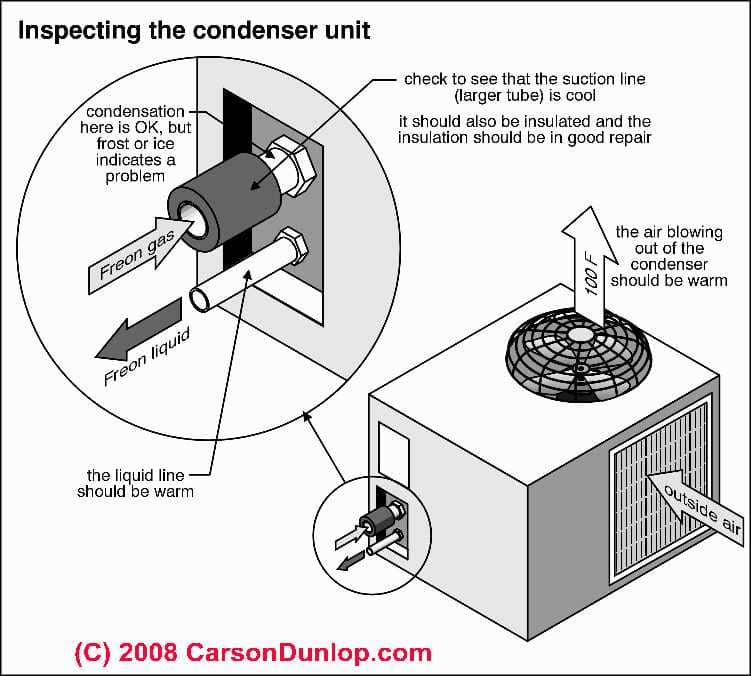 If your air conditioning system won't work, follow our diagnostic guides
- at LOST COOLING CAPACITY, our focus is on the case in which the air conditioning system seems to be "running" but not enough cool air, or no cool air at all is being delivered to the occupied space.
Sketch is provided courtesy of Carson Dunlop Associates, a Toronto home inspection, education & report writing tool company [ carsondunlop.com ]. [Click to enlarge any image]
- at OPERATING DEFECTS we take you through the major air conditioning problem symptoms and how to get the air conditioning system working again.
- at A/C - HEAT PUMP CONTROLS & SWITCHES we explain the many electrical switches and controls that control an air conditioner or heat pump system. You'll need to check these if your air conditioner won't start.
See our complete list of air conditioning system diagnostic and repair guide articles just below.
Sketch courtesy of Carson Dunlop Associates, a Toronto home inspection, education & report writing tool company [ carsondunlop.com ]..
Since the failure of an air conditioner to turn on, loss of air conditioner cooling capacity, reduced air conditioning output temperatures, loss of cool air supply, or even loss of air flow entirely can be due to a variety of problems with one or more components of an air conditioner or air conditioning system,
after reviewing the lost air conditioner cooling diagnosis procedures described in this article,
be sure to also review the diagnostic procedures at each of the individual air conditioning diagnosis and repair major topics listed just below.
...
Continue reading at AIR CONDITIONER BTU CHART - where we discuss the air conditioning system sizing problem or select a topic from the closely-related articles below, or see the complete ARTICLE INDEX.
Or see DEHUMIDIFICATION FAQs for diagnostic questions & answers about building air dehumidification posted originally at this page
Or see these
A/C & De-Humidification Articles
- AIR CONDITIONER BTU CHART - where we discuss the air conditioning system sizing problem
- AIR CONDITIONING & HEAT PUMP SYSTEMS - home
- BLOWER FAN SPEED SETTINGS - set the right speed for effective dehumidification
- COOLING RULES OF THUMB to guesstimate how many tons or BTUs of cooling a building needs
- DEHUMIDIFICATION BASICS
- DEHUMIDIFICATION PROBLEMS
- HUMIDITY CONTROL INDOORS
- HUMIDITY LEVEL TARGET
- MOISTURE PROBLEMS: CAUSE & CURE
- RATED COOLING CAPACITY to determine the cooling capacity of existing air conditioning equipment.
Suggested citation for this web page
DEHUMIDIFICATION PROBLEMS at InspectApedia.com - online encyclopedia of building & environmental inspection, testing, diagnosis, repair, & problem prevention advice.
Or see this
INDEX to RELATED ARTICLES: ARTICLE INDEX to AIR CONDITIONING & HEAT PUMPS
Or use the SEARCH BOX found below to Ask a Question or Search InspectApedia
Ask a Question or Search InspectApedia
Questions & answers or comments about how to diagnose and cure inadequate building dehumidification - excessive indoor humidity levels.
Try the search box just below, or if you prefer, post a question or comment in the Comments box below and we will respond promptly.
Search the InspectApedia website
Note: appearance of your Comment below may be delayed: if your comment contains an image, photograph, web link, or text that looks to the software as if it might be a web link, your posting will appear after it has been approved by a moderator. Apologies for the delay.
Only one image can be added per comment but you can post as many comments, and therefore images, as you like.
You will not receive a notification when a response to your question has been posted.
Please bookmark this page to make it easy for you to check back for our response.
Our Comment Box is provided by Countable Web Productions countable.ca
Citations & References
In addition to any citations in the article above, a full list is available on request.
- Thanks to Areader and research scientist Cyril Roberts, Barbados, for technical discussion and investigation of air conditioning system dehumidification problems (April 2009).
- Thanks to readers Beth & Dennis for asking about how to improve an inadequate air conditioning system supplying cool air through crawl space ducts and floor registers. (May 2010).
- Thanks to reader William Smith for discussing cooling coil leaks and lost cooling capacity diagnosis - June 2010
- Thanks to reader Jacob Behrends, FL for discussing how a clogged condensate drain line can overflow condensate into a condensate pan that in turn may contain a safety switch that shuts down the whole air conditioning system. August 2010.
- In addition to citations & references found in this article, see the research citations given at the end of the related articles found at our suggested
CONTINUE READING or RECOMMENDED ARTICLES.
- Carson, Dunlop & Associates Ltd., 120 Carlton Street Suite 407, Toronto ON M5A 4K2. Tel: (416) 964-9415 1-800-268-7070 Email: info@carsondunlop.com. Alan Carson is a past president of ASHI, the American Society of Home Inspectors.
Thanks to Alan Carson and Bob Dunlop, for permission for InspectAPedia to use text excerpts from The HOME REFERENCE BOOK - the Encyclopedia of Homes and to use illustrations from The ILLUSTRATED HOME .
Carson Dunlop Associates provides extensive home inspection education and report writing material. In gratitude we provide links to tsome Carson Dunlop Associates products and services.
 | HOME | ABOUT | ASK a QUESTION | CONTACT | CONTENT USE POLICY | DESCRIPTION | POLICIES | PRIVACY | |
| © 2024 - 1985 Publisher InspectApedia.com - Daniel Friedman | |||||||||