
InspectAPedia® FREE Encyclopedia of Building & Environmental Construction, Diagnosis, Maintenance & Repair |
Question? Just ask us! InspectAPedia
|
 Sizing Retrofit Conditioning Air Handlers
- POST a QUESTION or COMMENT about how to properly size & install retrofit or add-on air conditioning to an existing warm air furnace
Retrofit or add-on air conditioning specifications: this air conditioning repair article discusses the Sizing of Retrofit Conditioning Air Handlers: How to Add Air Conditioning to Hot Air Heating Systems.
We describe the central air conditioner operating problems that occur if an add-on air conditioning component (to an existing hot air heating system) is not properly sized for the building or if it is not properly matched to the pre-existing blower or air handler system that was used for central heating.
There may also be a need for an air handler blower fan capable of operating at different speeds for heating versus cooling.
InspectAPedia tolerates no conflicts of interest. We have no relationship with advertisers, products, or services discussed at this website.
- Daniel Friedman, Publisher/Editor/Author - See WHO ARE WE?
Retrofit Errors When Adding Air Conditioning to an Existing Hot Air Heating System
 Improper Air Conditioning Cooling Coil Size
The typical indoor half of an air conditioning system is comprised of a blower fan which moves building air (through return ducts) across an evaporator coil (which cools and dehumidifies the building air) and then through supply ducts to various building rooms.
Liquid refrigerant is metered into the evaporator coil where it evaporates or changes state from a liquid to a gas.
[Click to enlarge any image]
This state change from liquid to gas absorbs heat and thus cools the evaporator coil.
As air is cooled by moving across the evaporator coil, moisture is removed from the air (cool air holds less moisture than warm air). The condensate is moved to an acceptable disposal point, perhaps by a condensate pump to a building drain.
But a larger evaporator coil does not necessarily mean we'll see an equivalent improvement in the cooling capacity of the air conditioning system. In fact if the cooling coil is too large for the air handler or "blower unit" the air conditioning system will not work properly.
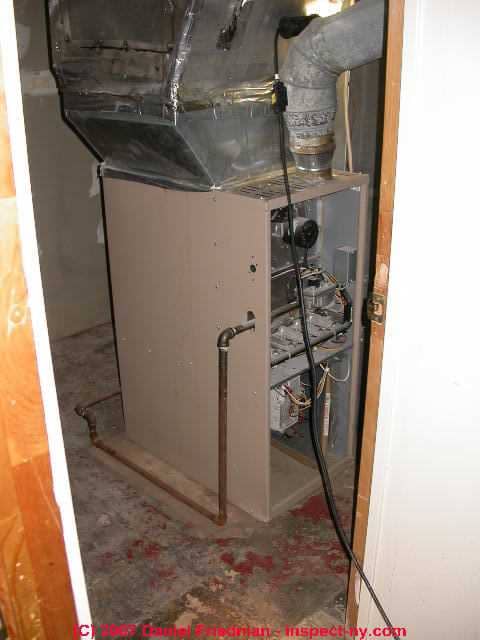
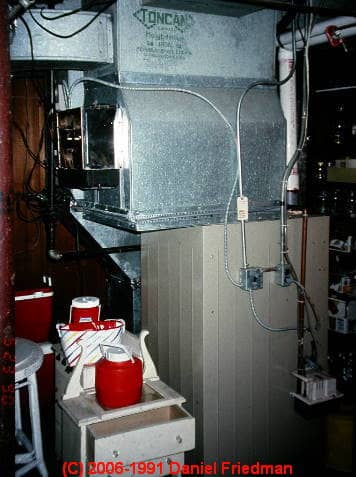
The photo shows that an evaporator coil has been added atop an existing heating furnace.
Using the existing blower and duct work and simply adding an evaporator coil atop the unit is a common way to add air conditioning to an existing furnace and duct system, and such air conditioning retrofits can work quite well by taking advantage of an existing duct system and air handler.
But to work properly the evaporator coil (or cooling coil) should not be too large for the air movement capacity of the existing air handling system.
Otherwise the air handler won't be able to move enough air across the evaporator coil to prevent freeze-ups and the net result may be less cooling capacity rather than more.
In other words, when the new evaporator coil for an add-on air conditioning system is too large, the blower will not move enough air across the coil, probably leading to the evaporator coil becoming blocked by ice.
Similarly, the air movement capability of the blower assembly, including the speed of the fan of an existing furnace needs to be matched to the evaporator coil's needs. The speed of air flow through ductwork and its delivery into a building are different for heating than for cooling a building.
Some contemporary combination units which provide both heating and cooling air to a building make use of a dual speed or variable speed fan.
If when inspecting a "retrofit" air conditioning system (like the one in this photograph) you see that the evaporator coil is much larger than the furnace blower atop which it sits, the system is probably not properly designed and it may not work correctly.
An expert air conditioning service technician or design specialist should evaluate the system when you see this condition.
Air conditioning added to existing furnace, not working right? Is it an air filter problem?
Recently have added air conditioning to a existing furnace. The air conditioning does not cool the house properly. The heating has been affected. The AC coil opening is 188 square inches and the furnace duct opening is 285 square inches.
The furnace in the heating mode recycles often and after a heat run will shut down and then after 2 minutes just the blower comes on and runs for a minute or so.
My heat costs are up about ten percent and I am concerned that the frequent recycling will damage the furnace and also that it may cause a fire. (Jan 10, 2013) John Callahan
Reply:
John,
Sometimes the plenum used to contain the A-coil in a retrofit air conditioner add-on to an existing warm air system is built smaller than the original plenum opening; if that's the case for your system it is under-sized and will constrict airflow by its size alone, even before considering the added restriction due to the obstruction of the cooling coil itself.
As a result the heating or cooling system will need to run longer to satisfy the thermostat, thus increasing operating costs.
The risk of fire is something about which I can't form an opinion from just the information in your question.
Why not ask your HVAC company to send an experienced technician or designer to take a look at the system to recommend some improvements or corrections. If you handle the question with care so that the installer doesn't feel in danger, they may cooperate.
We discuss the air conditioning system sizing problem at AIR CONDITIONER BTU CHART and while details are found at DEHUMIDIFICATION PROBLEMS, we also introduce the oversized air conditioner problem at LOST COOLING CAPACITY.
OK to add and run air conditioning through the existing duct work?
I have a mobil home as a camp, I would like to run air conditioning through the existing duct work that is meant for my Becket forced hot air system.
Can this be done and done at a reasonable price?
Reply:
In theory certainly the answer is yes. The practical stumbling blocks and actual costs depend on the details: I suggest an on-site inspection and advice from an experienced HVAC installer. (Feb 18, 2012) Bob
Thank you to our readers for their generous comments
Good info, just what I needed to know. Thanks (July 2, 2011) rhino
Perfect; Learned a lot; Will listen to my tech first and then ask questions.
The discussions about the possibility of repairs/replacement vs the practicality of repair most valuable. (July 10, 2011) jim
...
...
Continue reading at AIR CONDITIONER BTU CHART or select a topic from the closely-related articles below, or see the complete ARTICLE INDEX.
Or see these
Recommended Articles
- COOLING RULES OF THUMB
- RATED COOLING CAPACITY - determine the cooling capacity of existing air conditioning equipment
Suggested citation for this web page
RETROFIT SIZING for A/C or HEAT PUMPS at InspectApedia.com - online encyclopedia of building & environmental inspection, testing, diagnosis, repair, & problem prevention advice.
Or see this
INDEX to RELATED ARTICLES: ARTICLE INDEX to AIR CONDITIONING & HEAT PUMPS
Or use the SEARCH BOX found below to Ask a Question or Search InspectApedia
Ask a Question or Search InspectApedia
Try the search box just below, or if you prefer, post a question or comment in the Comments box below and we will respond promptly.
Search the InspectApedia website
Note: appearance of your Comment below may be delayed: if your comment contains an image, photograph, web link, or text that looks to the software as if it might be a web link, your posting will appear after it has been approved by a moderator. Apologies for the delay.
Only one image can be added per comment but you can post as many comments, and therefore images, as you like.
You will not receive a notification when a response to your question has been posted.
Please bookmark this page to make it easy for you to check back for our response.
IF above you see "Comment Form is loading comments..." then COMMENT BOX - countable.ca / bawkbox.com IS NOT WORKING.
In any case you are welcome to send an email directly to us at InspectApedia.com at editor@inspectApedia.com
We'll reply to you directly. Please help us help you by noting, in your email, the URL of the InspectApedia page where you wanted to comment.
Citations & References
In addition to any citations in the article above, a full list is available on request.
- In addition to citations & references found in this article, see the research citations given at the end of the related articles found at our suggested
CONTINUE READING or RECOMMENDED ARTICLES.
- Carson, Dunlop & Associates Ltd., 120 Carlton Street Suite 407, Toronto ON M5A 4K2. Tel: (416) 964-9415 1-800-268-7070 Email: info@carsondunlop.com. Alan Carson is a past president of ASHI, the American Society of Home Inspectors.
Thanks to Alan Carson and Bob Dunlop, for permission for InspectAPedia to use text excerpts from The HOME REFERENCE BOOK - the Encyclopedia of Homes and to use illustrations from The ILLUSTRATED HOME .
Carson Dunlop Associates provides extensive home inspection education and report writing material. In gratitude we provide links to tsome Carson Dunlop Associates products and services.
 | HOME | ABOUT | ASK a QUESTION | CONTACT | CONTENT USE POLICY | DESCRIPTION | POLICIES | PRIVACY | |
| © 2025 - 1985 Publisher InspectApedia.com - Daniel Friedman | |||||||||