
InspectAPedia® FREE Encyclopedia of Building & Environmental Construction, Diagnosis, Maintenance & Repair |
Question? Just ask us! InspectAPedia
|
 Thermal Mass Design Advice for Building Heating, Cooling, Insulation
- POST a QUESTION or COMMENT about using thermal mass for energy savings in building heating and cooling systems
Thermal mass in buildings:
This article, an update to Remember Thermal Mass?, discusses thermal mass in buildings, its effects in buildings, how to use thermal mass for passive solar houses, and using thermal mass for both heating and cooling as well as for insulation.
References to texts and guidelines for sizing thermal mass and using thermal mass are included. Here we explain what thermal mass is, how thermal mass works in buildings, reviews a number of thermal mass claims, thermal mass "rules of thumb", and it discusses use of thermal mass in passive solar homes, use of thermal mass for heating and cooling, and the effects of thermal mass as "insulation" in buildings.
InspectAPedia tolerates no conflicts of interest. We have no relationship with advertisers, products, or services discussed at this website.
How to Understand Thermal Mass in buildings
What is thermal mass? How does thermal mass really work in buildings? Rules of thumb for sizing and using thermal mass for heating, cooling, insulation. Use of thermal mass in passive solar homes and other energy efficient buildings. Solar Age Magazine Articles on Renewable Energy, Energy Savings, Construction Practices.
This material is reprinted/adapted/excerpted with permission from Solar Age Magazine - editor Steven Bliss. The text below paraphrases, quotes-from, updates, and comments an original article, "Remember Thermal Mass?" (see links just above) from Solar Age Magazine and written by Steven Bliss.
What is Thermal Mass?
Here are a number of thermal mass claims that I have heard over the years and tried to evaluate:
- You can't have too much thermal mass
- Thermal mass should be in direct sunlight
- Spread thermal mass throughout the building
- Thermal mass should be light colored
- Thermal mass should be dark colored
- Thermal mass is good in high arid climates
- Thermal mass is good in Florida
- Thermal mass can replace insulation
- Thermal mass has no insulation value
Thermal mass isn't easy to understand, and its effects are difficult to measure and predict. No wonder builders resist adding thermal mass to their buildings except where high-mass materials are standard. For the most part, it's just as well.
Thermal Mass in the Mind - Simple Analogies Explain Thermal Mass
Because the dynamics of thermal mass are pretty complex, I find it helpful to think about simple analogies. My favorites are the beer cooler, King Tut's tomb, and the refrigerator. The beer cooler has a low-R shell (1/2" Styrofoam) with a high mass interior (cold beer) that keeps the contents cool for several hours. Once it warms up, though, the mass does you no good -- unless you drink it.
In King Tut's tomb, on the other hand, the thermal mass is on the tomb exterior. Because there's so much of it, it will stifle almost all thermal swings on the interior of the structure, keeping it close to the annual average temperature. The un crowded pyramids, I'm told, are cool and comfortable. But those with big crowds (causing high internal heat gains) are hot, smelly, and stuffy.
The refrigerator combines a fairly high-R shell with a low- or high-mass interior,depending on the refrigerator's contents.
Question: Does a full refrigerator use less energy than an empty one, as is sometimes claimed?
Answer: The empty refrigerator will cycle on and off more often, because air cannot store much heat (or coolness). But no one I spoke with could tell me whether this saves energy. [It may consume more energy to cycle any compressor motor on and off frequently than to have a compressor run with longer on cycles because of extra energy that is used to start the motor --DF] Like the cooler, the full refrigerator will stay cold longer in a power outage.
What Does Thermal Mass Actually Do in a Building?
In a building, as in a refrigerator, mass really does only one thing. It delays the flow of heat. Delaying the flow of heat (say from indoors to outside, or from outside to indoors) can save fuel (and energy) in two ways. It can store energy in the form of heat (or "coolness") that you've bought cheaply (solar energy source or off-peak electricity, for example) for use when that same energy is more expensive.
In climates where daily temperatures swing above and below the human comfort zone, thermal mass can save energy by applying the day's heat (gained during warm hours) against the night's coolness. Thermal mass also improves the comfort of building occupants, particularly in solar homes, by reducing the range of temperature swings.
Thermal Mass for Passive Solar buildings
There's no argument that in passive solar houses you need to add thermal mass when the glazing area exceeds 6 or 7 percent of the floor area. There is less agreement, though, on where and how to place the thermal mass in the building.
The More Thermal Mass the Better
Many early passive solar houses were under massed, said solar pioneer Doug Balcomb. "You can't have too much mass in a direct-gain house." Balcomb said in a Solar Age Magazine interview [10/1985]. In a well-insulated shell, he said, the more mass there is, the more stable temperatures will be - and this, he emphasized, increases comfort.
A Thermal Mass Example from Mexico
This is exactly our experience [DJF] of living part time in a masonry structure in the mountains of central Mexico. Outdoor temperatures range from the upper 40's F on the chilliest nights to the high 80's on the warmest days.
Because the building's walls and roof are constructed of thick adobe or concrete, the building's thermal mass keeps indoor temperatures much more even, typically ranging between 64 degF. and 72 degF. if we do nothing particular to affect temperature. The home is located in a high (6200 ft) arid area where days are hot and sunny and nights are clear and chilly.
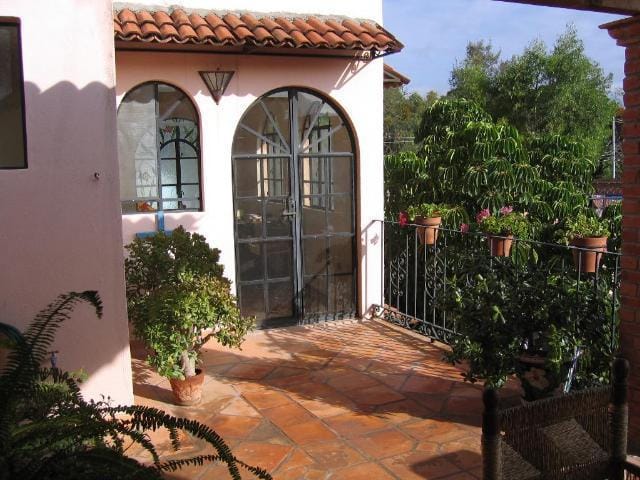
If we open windows in the cool morning to further cool down the building interior, closing them by mid-day, the home stays another 5-8 degF. cooler during the hottest part of the afternoon, a period typically between 1PM and 4PM daily.
Strategic placement of short sun-shades over windows receiving the most afternoon sun (photo at left) made a palpable difference in the comfort of those indoor spaces by reducing the time period over which direct sun shines against those windows. Only a small shade roof was necessary as we're simply reducing the amount of direct sunlight shining in those windows for a few hours during the hottest part of the afternoon.
In our photo you can see the shade just beginning to cover the upper part of the windows and doors of this room as the angle of the sun is shifting.
This Mexican home has no central heating and relies on gas-fireplaces (not a great idea) and small electric heaters for supplemental heat only on the very coldest mornings. At no time have we ever had to run these heaters throughout the day.
Also see ADOBE CONSTRUCTION
Diminishing Returns of Thermal Mass
Beyond some point, though, adding more thermal mass won't help performance. Once you put in enough thermal mass to prevent solar overheating, piling a few tons of brick in the living room won't reduce heating bills any further. It can even be a liability if night time thermostat temperature setbacks are planned.
So it becomes the designer's job to decide on the right amount of thermal mass for a building.
Thermal Mass Rule of Thumb
Mass surface area 6-7 x South-Facing Glass area
Balcomb's simplest rule of thumb is that a direct-gain space should have a heavy mass surface six or seven times the area of the south facing glass (windows and doors), or 15 times that area for drywall construction. This is for mass in the direct-gain space. This so-called radiatively coupled thermal mass is any mass in the line of sight of the mass where the sun first strikes.
The thicker the better for solar mass.
Insightful passive solar designers recognized early on that only the first 3 or 5 inches of thermal mass did any good. Nonetheless, many passive solar house designs still feature huge fireplaces or accent walls as the home's thermal mass.
Solar mass design thinking (as of the mid 1980's) is that, pound for pound, thin mass works better than thick mass. The reason, said Balcomb is simply that heat moves into and out of thin mass more readily. There is more surface area.
Thickening the thermal mass, though, is still an effective strategy up to a point. A dense material like concrete performs better up to 4-inches.
The walls of the Mexican home discussed above range from 17 cm to 20 cm (the age of various parts of the home vary and the materials vary among cement-stucco covered adobe and poured concrete). The indoor temperatures of the home do not vary significantly from the indoor temperatures of a 300-year old stone structure nearby even though the older building has much thicker walls. -DJF
A not-so-dense material like drywall probably levels off at a couple of inches. So doubling the drywall or plaster thickness is a good way to gain thermal mass. It tends to double the thermal benefit of the drywall. This thin-mass approach has won converts such as California architect David Wright, who has used an extra-thick finish of high-density plaster.
Thermal mass has to be in direct sun?
Early texts on solar energy and thermal mass said that thermal mass had to be in direct sunlight. Studies have shown, said Balcomb, that thermal mass alone is about 30-percent more effective in direct sun than in reflected sunlight. But it's still more important, he added, to spread the mass around the occupied space.
How about convectively coupled mass - materials in rooms not exposed to solar gains, but heated by airflow? Heavy mass that is convectively coupled, said Balcomb, is about one quarter as effective as mass in south-facing rooms. But thin thermal mass, such as drywall or plaster up to about an inch thick, is equally effective whether it's convectively or radiatively coupled.
With a south-facing room, the floor and back wall are good thermal mass locations. But the ceiling too, is an excellent spot that is often overlooked. The ceiling gets reflected light and reradiated heat off the floor and walls.
The darker the thermal mass the better?
The darker thermal mass is another area where solar gospel has been updated. Early solar designers called for dark massive materials. Current thinking, said Balcomb, is that only floors should be dark. The object here is to keep heat close to the floor to counteract stratification. Walls and ceilings, he said, should be light colored to bounce the light around and get maximum use of a broad surface area of thermal mass.
Another reason for light colored interior walls and ceilings is their daylighting value, particularly with clerestories. Dark colors placed against bright spaces cause uncomfortable contrast glare and bring less light into the building's interior.
Using Thermal Mass for Building Cooling
Thermal mass can store coolness. This is helpful when coolness can be obtained for little or nothing during part of the day and used when it is scarce or less expensive. Our Mexican home example above described simply opening windows to admit cool outside air in the early morning to provide additional coolness inside to "prepare" the home for the hot afternoon temperatures. Night flushing and photovoltaic-powered cooling are two additional ways to take advantage of this strategy.
Thermal mass can also delay and reduce peak cooling loads. For example, a west wall in Florida gets brutal sun on a summer afternoon. A high-mass wall will absorb that heat and delay its transfer indoors until the evening, when electricity is cheaper. If nights are cool, those peaks will be reduced as well as delayed.
Using Thermal Mass for Building Insulation
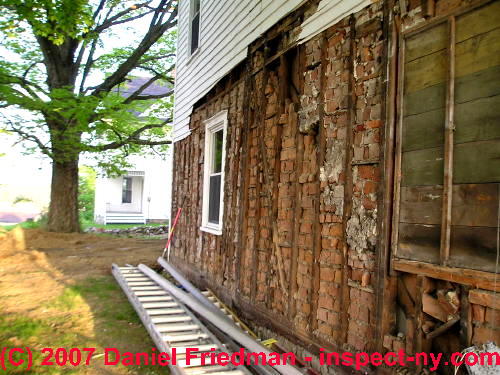
Promoters of envelope thermal mass as insulation have fought an uphill battle, but this is by no means a new idea. Brick-lined walls in pre-1900 homes used brick and mortar both to stop through-wall drafts and to provide enormous thermal mass in buildings.
See BRICK LINED WALLS for details. The efforts of promoters of envelope thermal mass to assign R-values or correction factors to thermal mass have been largely unsuccessful. Their main problem is that the effects of thermal mass depend on too many factors, such as its location in the wall (inside the insulation is generally considered best) and the climate.
In general, thermal mass in exterior walls only helps when outside temperatures swing daily above and below the comfort zone. Thermal mass as building insulation has the biggest effect where the swing is great and equally balanced above and below the house's temperature setpoint. High, arid areas in the Southwest and our Mexican home example above (also in a high, arid area) are a good example: days are hot and sunny; nights are clear and cold.
Under these conditions, thermal mass can reduce the overall heating/cooling load, theoretically to zero if daytime gains equal night time losses, and if the mass is thick enough and sufficient in total quantity to provide a half-day lag for the building interior.
In very mild climates, or in swing seasons, this thermal mass effect also works. But although percentage savings may be great in these periods, overall savings will be small since there's not much energy to save.
During periods when the temperature is always too high or too low, however, envelope mass has no demonstrated effect on heating or cooling loads.
Original Thermal Building Mass Article in PDF form
"Remember Thermal Mass? The tools for understanding thermal mass may lie in the beer cooler, King Tut's tomb, and the refrigerator" - this article is provided in original form (the PDF links below) and in expanded, updated text in the web article that is just below the links to the original version in PDF form.
- Understanding Thermal Mass - [PDF] use your browser's back button to return to this page
- Understanding Thermal Mass - part 2 - [PDF]
- Understanding Thermal Mass - part 3 - [PDF]
Here we include solar energy, solar heating, solar hot water, and related building energy efficiency improvement articles reprinted/adapted/excerpted with permission from Solar Age Magazine - editor Steven Bliss.
Readers should also see the passive solar design articles organized at SOLAR ENERGY SYSTEMS.
Thermal Properties & Thermal Mass Articles
- FLOOR COVERING for OVER THERMAL MASS SLABS
- THERMAL EXPANSION CRACKS in BRICK
- THERMAL EXPANSION of HOT WATER
- THERMAL EXPANSION TPR VALVE LEAKS
- THERMAL EXPANSION of MATERIALS
- THERMAL IMAGING, THERMOGRAPHY
- THERMAL IMAGING MOLD SCANS
- THERMAL MASS in BUILDINGS - home
- THERMAL MASS FLOOR SLABS
- THERMAL MASS in HOMES - STUDY
- THERMAL MASS in UPSTAIRS
- THERMAL MASS WALL DESIGN
- THERMAL TRACKING & HEAT LOSS
...
Continue reading at THERMAL MASS FLOOR SLABS or select a topic from the closely-related articles below, or see the complete ARTICLE INDEX.
Suggested citation for this web page
THERMAL MASS in BUILDINGS at InspectApedia.com - online encyclopedia of building & environmental inspection, testing, diagnosis, repair, & problem prevention advice.
Or see this
INDEX to RELATED ARTICLES: ARTICLE INDEX to BUILDING ENERGY SAVINGS
Or use the SEARCH BOX found below to Ask a Question or Search InspectApedia
Ask a Question or Search InspectApedia
Try the search box just below, or if you prefer, post a question or comment in the Comments box below and we will respond promptly.
Search the InspectApedia website
Note: appearance of your Comment below may be delayed: if your comment contains an image, photograph, web link, or text that looks to the software as if it might be a web link, your posting will appear after it has been approved by a moderator. Apologies for the delay.
Only one image can be added per comment but you can post as many comments, and therefore images, as you like.
You will not receive a notification when a response to your question has been posted.
Please bookmark this page to make it easy for you to check back for our response.
Our Comment Box is provided by Countable Web Productions countable.ca
Citations & References
In addition to any citations in the article above, a full list is available on request.
- Solar Age Magazine was the official publication of the American Solar Energy Society. The contemporary solar energy magazine associated with the Society is Solar Today. "Established in 1954, the nonprofit American Solar Energy Society (ASES) is the nation's leading association of solar professionals & advocates. Our mission is to inspire an era of energy innovation and speed the transition to a sustainable energy economy. We advance education, research and policy. Leading for more than 50 years. ASES leads national efforts to increase the use of solar energy, energy efficiency and other sustainable technologies in the U.S. We publish the award-winning SOLAR TODAY magazine, organize and present the ASES National Solar Conference and lead the ASES National Solar Tour – the largest grassroots solar event in the world."
- Steve Bliss's Building Advisor at buildingadvisor.com helps homeowners & contractors plan & complete successful building & remodeling projects: buying land, site work, building design, cost estimating, materials & components, & project management through complete construction. Email: info@buildingadvisor.com
Steven Bliss served as editorial director and co-publisher of The Journal of Light Construction for 16 years and previously as building technology editor for Progressive Builder and Solar Age magazines. He worked in the building trades as a carpenter and design/build contractor for more than ten years and holds a masters degree from the Harvard Graduate School of Education. Excerpts from his recent book, Best Practices Guide to Residential Construction, Wiley (November 18, 2005) ISBN-10: 0471648361, ISBN-13: 978-0471648369, appear throughout this website, with permission and courtesy of Wiley & Sons. Best Practices Guide is available from the publisher, J. Wiley & Sons, and also at Amazon.com - Thermal Mass Pattern Book, Total Environmental Action, Solar Age Magazine, April 1981 (out of print).
- PASSIVE SOLAR DESIGN HANDBOOK VOLUME II [PDF], the Passive Solar Handbook Comprehensive Planning Guide, in a version used by the U.S. Air Force - online version available at this link and from the USAF also at wbdg.org/ccb/AF/AFH/pshbk_v2.pdf [This is a large PDF file that can take a while to load]
- PASSIVE SOLAR HANDBOOK VOLUME III [PDF], the Passive Solar Handbook Programming Guide, in a version used by the U.S. Air Force - online version available at this link and from the USAF also at wbdg.org/ccb/AF/AFH/pshbk_v3.pdf
- The Passive Solar Design and Construction Handbook, Steven Winter Associates (Author), Michael J. Crosbie (Editor), Wiley & Sons, ISBN 978-047118382 or 0471183083
- "PASSIVE SOLAR HOME DESIGN [PDF] ", U.S. Department of Energy, describes using a home's windows, walls, and floors to collect and store solar energy for winter heating and also rejecting solar heat in warm weather.
- SOLAR WATER HEATERS [PDF] , U.S. Department of Energy article on solar domestic water heaters to generate domestic hot water in buildings, explains how solar water heaters work. Solar heat for swimming pools is also discussed.
- HEAT EXCHANGERS for SOLAR WATER HEATING SYSTEMS [PDF], U.S. DOE describes the types of solar water heater heat exchange methods between the sun and the building's hot water supply
- HEAT-TRANSFER FLUIDS for SOLAR WATER HEATING SYSTEMS [PDF] , U.S. DOE, describes the types of fluids selected to transfer heat between the solar collector and the hot water in storage tanks in a building. These include air, water, water with glycol antifreeze mixtures (needed when using solar hot water systems in freezing climates), hydrocarbon oils, and refrigerants or silicones for heat transfer.
- SOLAR WATER HEATING SYSTEM MAINTENANCE & REPAIR [PDF] , U.S. DOE
- SOLAR WATER HEATING SYSTEM FREEZE PROTECTION [PDF] , U.S. DOE,using antifreeze mixture in solar water heaters (or other freeze-resistant heat transfer fluids), as well as piping to permit draining the solar collector and piping system.
- "Scaling and Corrosion in Solar Water Heating Systems", U.S. DOE
- www.energysavers.gov/your_home/water_heating/index.cfm/mytopic=12850 is the base U.S. DOE website for these articles
- ACTIVE SOLAR HEATING SYSTEMS [PDF] , U.S. Department of Energy, including
- "Radiant Heating Systems" U.S. DOE
- ABSORPTION HEAT PUMPS & COOLERS [PDF] , U.S. DOE
- SOLAR AIR HEATING [PDF] U.S. DOE also referred to as "Ventilation Preheating" in which solar systems use air for absorbing and transferring solar energy or heat to a building
- SOLAR LIQUID HEATING [PDF] U.S. DOE, systems using liquid (typically water) in flat plate solar collectors to collect solar energy in the form of heat for transfer into a building for space heating or hot water heating. The term "solar liquid" is used for accuracy, rather than "solar water" because the water may contain an antifreeze or other chemicals.
- In addition to citations & references found in this article, see the research citations given at the end of the related articles found at our suggested
CONTINUE READING or RECOMMENDED ARTICLES.
- Carson, Dunlop & Associates Ltd., 120 Carlton Street Suite 407, Toronto ON M5A 4K2. Tel: (416) 964-9415 1-800-268-7070 Email: info@carsondunlop.com. Alan Carson is a past president of ASHI, the American Society of Home Inspectors.
Thanks to Alan Carson and Bob Dunlop, for permission for InspectAPedia to use text excerpts from The HOME REFERENCE BOOK - the Encyclopedia of Homes and to use illustrations from The ILLUSTRATED HOME .
Carson Dunlop Associates provides extensive home inspection education and report writing material. In gratitude we provide links to tsome Carson Dunlop Associates products and services.
 | HOME | ABOUT | ASK a QUESTION | CONTACT | CONTENT USE POLICY | DESCRIPTION | POLICIES | PRIVACY | |
| © 2024 - 1985 Publisher InspectApedia.com - Daniel Friedman | |||||||||