
InspectAPedia® FREE Encyclopedia of Building & Environmental Construction, Diagnosis, Maintenance & Repair |
Question? Just ask us! InspectAPedia
|
 Polyurethane & Urethane Foam Insulation Outgassing & Properties
- POST a QUESTION or COMMENT about polyurethane and urethane foam outgassing
This article discusses polyurethane foam insulation outgassing, the initial degradation in the R-value of foam insulation, and other properties.
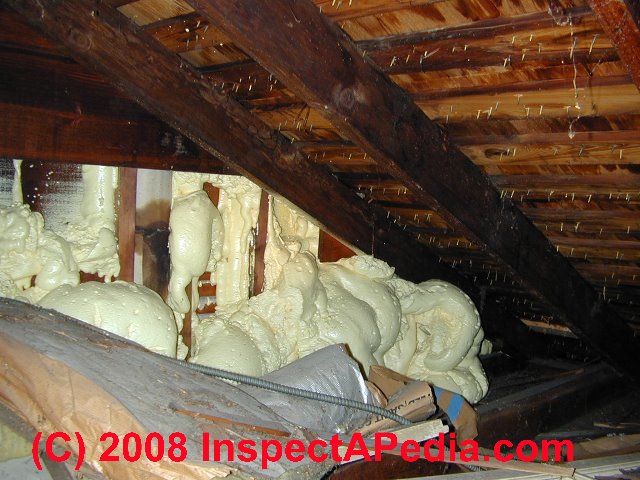
Our photo (page top) shows icynene foam insulation that oozed into an attic space after being blown onto the building gable-end wall.
InspectAPedia tolerates no conflicts of interest. We have no relationship with advertisers, products, or services discussed at this website.
- Daniel Friedman, Publisher/Editor/Author - See WHO ARE WE?
Rate of Outgassing of Foam Insulation
Relationship between thermal performance of foam insulation and time degradation
The question-and-answer article below paraphrases, quotes-from, updates, and comments an original article from Solar Age Magazine and written by Steven Bliss.
Polyurethane Foam R-Value Loss Mechanisms
Question: need accurate information about out gassing in foam building insulation
Thank you for an excellent article on building insulation materials (Solar Age, "Building it Right", 11/83)
Of all the areas in the field of energy-efficient materials and construction, none is so fraught with misinformation as insulation.
After many inquiries to manufacturers and extruders of rigid foam insulation products I have been unable to find accurate information as to the rate of outgassing in foam building insulation, or the relationship between thermal performance of foam insulation and time.
Have you found any better information than I have? -- Michael Luttrell, Napa CA
Expert's reply:
Polyurethane foams lose R-value by two mechanisms: air infiltrating the foam and fluorocarbon gas diffusing out of the foam insulation.
Immediately after manufacture, polyurethane foam increases in conductivity quite rapidly. The rate of increase in foam insulating board conductivity (which is equivalent to a loss in the foam insulating board's R-value) ultimately stabilizes at a plateau level, which can remain unchanged after more than 10 years.
Since most of the change in foam insulating board R-value occurs in the first two to two-and-a-half years, manufacturers of residential foam insulating products are required to publish a two-year aged R-value.
The rate and degree of R-value drift in foam insulating board depends on many factors such as foam cell size, closed cell foam content, foam board material thickness, and foam board density.
The main factors, though, are the permeance of the foam board facing and how well it is bonded to the foam itself. Metal foam insulating board facings bonded to the wet foam at the time of manufacture (generally aluminum foil) appear to yield the highest R-values.
Through extensive testing at independent laboratories, Celotex Corp. has established that its foil-faced Thermax™ foam board insulation remains stable at about R-7.2 per inch at 75 degF mean temperature for at least five years of aging.
In its bulletin U108, the Urethane Division of the Society of the Plastics Industry lists the stabilized R-value for unfaced foam insulating board or those with gas-permeable facings at R5.6 to R 6.2 per inch of thickness. Consult with the manufacturers for information on specific foam insulating board products.
More Details about Polyurethane, Urethane, and Icynene Foam Insulation Products
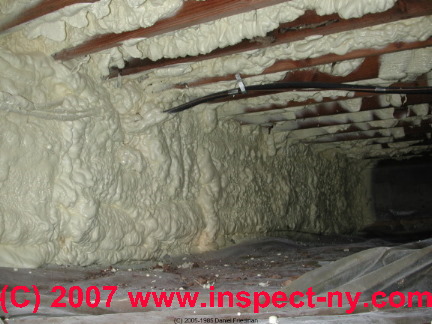
From our detailed article at ICYNENE FOAM SPRAY INSULATION:
Icynene ® foam insulation (and similar products) is a spray-in-place, injected through openings, or pour-in expanding-foam insulation product. Other water borne foam spray insulation products, including some latex-foams, are available.
- Wind leakage resistance:
both open cell foams and closed cell foam insulation products lose less of their R-value when exposed to wind than do some other in
sulating products such as fiberglass batts.
Spray Foam Systems asserts that the R-value of urethane foam (this is not an Icynene® product) drops from R 19 to R 18 while fiberglass batt insulating drops from R19 to R7 (presuming these are both applied in a 6" thickness).
U.S. Department of Energy studies cite air infiltration in buildings as responsible for 40% of the energy lost in homes (surely varying depending on tightness of construction, house age, etc.) - Dimensional stability:
this product does not shrink or settle
also see CELLULOSE LOOSE FILL INSULATION
and UREA FORMALDEHYDE FOAM INSULATION, UFFI)
- Icynene® foam and other water-borne foam insulation systems use a water-based solvent,
not formaldehyde, or other chemicals associated with prior problem-foam products such as CFCs and HCFCs. Initial foam curing occurs in minutes. When these foams have fully cured (about a month) no VOCs should be detected associated with these foam products.
See UREA FORMALDEHYDE FOAM INSULATION, UFFI for an example of an earlier set of problems with UFFI. - Fire safety protection:
foam insulation products can be hazardous in a building fire and in general must be protected from direct exposure in occupied spaces (such as covering with drywall) in order to assure that potentially dangerous gases are not released into the living area during a fire.
See the industry's fire safety guidelines for details, an example of which is provided in
this POLYURETHANE FIRE SAFETY BULLETIN [PDF] from the polyurethanes industry
The link to the original Q&A article in PDF form immediately below is preceded by an expanded/updated online version of this article.
- URETHANKE OUTGASSING [PDF] Q&A article, Solar Age, April 1984 - PDF version, Use your browser's back button to return to this page
...
Continue reading at FOAM SPRAY INSULATION TYPES or select a topic from the closely-related articles below, or see the complete ARTICLE INDEX.
Or see these
Recommended Articles
- CRAWL SPACE INSULATION RETROFIT
- FOAM SPRAY INSULATION TYPES - How to Make a Sure Distinction Among UFFI, Icynene, and Latex Foam Insulations we demonstrate a compression test of this material to show its elasticity.
- FORMALDEHYDE HAZARDS
- INSULATION INSPECTION & IMPROVEMENT
- UREA FORMALDEHYDE FOAM INSULATION, UFFI - example of an earlier set of problems with UFFI.
Suggested citation for this web page
URETHANE FOAM INSULATION at InspectApedia.com - online encyclopedia of building & environmental inspection, testing, diagnosis, repair, & problem prevention advice.
Or see this
INDEX to RELATED ARTICLES: ARTICLE INDEX to BUILDING INSULATION
Or use the SEARCH BOX found below to Ask a Question or Search InspectApedia
Ask a Question or Search InspectApedia
Try the search box just below, or if you prefer, post a question or comment in the Comments box below and we will respond promptly.
Search the InspectApedia website
Note: appearance of your Comment below may be delayed: if your comment contains an image, photograph, web link, or text that looks to the software as if it might be a web link, your posting will appear after it has been approved by a moderator. Apologies for the delay.
Only one image can be added per comment but you can post as many comments, and therefore images, as you like.
You will not receive a notification when a response to your question has been posted.
Please bookmark this page to make it easy for you to check back for our response.
IF above you see "Comment Form is loading comments..." then COMMENT BOX - countable.ca / bawkbox.com IS NOT WORKING.
In any case you are welcome to send an email directly to us at InspectApedia.com at editor@inspectApedia.com
We'll reply to you directly. Please help us help you by noting, in your email, the URL of the InspectApedia page where you wanted to comment.
Citations & References
In addition to any citations in the article above, a full list is available on request.
- Steve Bliss's Building Advisor at buildingadvisor.com helps homeowners & contractors plan & complete successful building & remodeling projects: buying land, site work, building design, cost estimating, materials & components, & project management through complete construction. Email: info@buildingadvisor.com
Steven Bliss served as editorial director and co-publisher of The Journal of Light Construction for 16 years and previously as building technology editor for Progressive Builder and Solar Age magazines. He worked in the building trades as a carpenter and design/build contractor for more than ten years and holds a masters degree from the Harvard Graduate School of Education. Excerpts from his recent book, Best Practices Guide to Residential Construction, Wiley (November 18, 2005) ISBN-10: 0471648361, ISBN-13: 978-0471648369, appear throughout this website, with permission and courtesy of Wiley & Sons. Best Practices Guide is available from the publisher, J. Wiley & Sons, and also at Amazon.com - Icynene Corporation maintains a website with information about Icynene® foam insulation products, applications, etc. and is located in Mississauga, Ontario, Canada Tel: 905.363.4040 Toll Free: 800.758.7325
- Icynene Foam Insulation Spray MSDS
- Icynene Foam Insulation Pour formula MSDS
- Spray Foam Systems (urethane foam insulation products)
- API Alliance for the Polyurethanes Industry Fire Safety Guidelines for Use of Rigid Polyurethane and Polyisocyanurate foam Insulation in building Construction (.pdf file)
- ENVIRO-SCARE Electric Power Lines, Electromagnetic Fields, Cancer Risk, & "Enviro-Scare" - The Normal Curve Cycle of Public Fear of Environmental Issues
- In addition to citations & references found in this article, see the research citations given at the end of the related articles found at our suggested
CONTINUE READING or RECOMMENDED ARTICLES.
- Carson, Dunlop & Associates Ltd., 120 Carlton Street Suite 407, Toronto ON M5A 4K2. Tel: (416) 964-9415 1-800-268-7070 Email: info@carsondunlop.com. Alan Carson is a past president of ASHI, the American Society of Home Inspectors.
Thanks to Alan Carson and Bob Dunlop, for permission for InspectAPedia to use text excerpts from The HOME REFERENCE BOOK - the Encyclopedia of Homes and to use illustrations from The ILLUSTRATED HOME .
Carson Dunlop Associates provides extensive home inspection education and report writing material. In gratitude we provide links to tsome Carson Dunlop Associates products and services.
 | HOME | ABOUT | ASK a QUESTION | CONTACT | CONTENT USE POLICY | DESCRIPTION | POLICIES | PRIVACY | |
| © 2025 - 1985 Publisher InspectApedia.com - Daniel Friedman | |||||||||