
InspectAPedia® FREE Encyclopedia of Building & Environmental Construction, Diagnosis, Maintenance & Repair |
Question? Just ask us! InspectAPedia
|
 Double Wall Framing Details
- POST a QUESTION or COMMENT about double wall framing for super-insulated buildings
This article discusses the question of exactly where to locate the outer edge of a wood-framed double wall for super-insulated building construction.
Added details discuss structural load capability of an offset wood framed wall, and insulation and vapor barrier placement on a wood framed wall.
Sketch at page top and accompanying text are reprinted/adapted/excerpted with permission from Solar Age Magazine - editor Steven Bliss.
InspectAPedia tolerates no conflicts of interest. We have no relationship with advertisers, products, or services discussed at this website.
- Daniel Friedman, Publisher/Editor/Author - See WHO ARE WE?
Double-Wall Houses: Framing Details
The text below paraphrases, quotes-from, updates, and comments an original article from Solar Age Magazine and written by Steven Bliss.
Four Detailed Questions & Answers About Double Wall Framing
- What is the exact placement of the double wood framed exterior wall with respect to the ends of the floor joists?
- How does the offset in a double-wall framed exterior wall affect the load bearing capabilities of the joists?
- What thickness foundation wall is used for double-wall wood framed buildings?
- What changes are needed to double-wall framed houses when a brick exterior veneer wall is used?
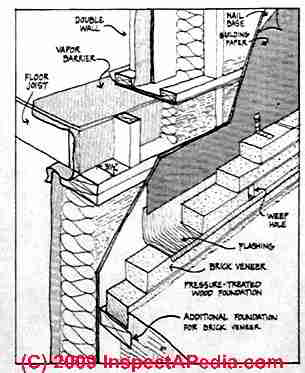
The questions above referred to "Double-Wall Houses," in Solar Age Magazine, December 1982 and were answered the next April. The questions and the detailed answers by Steven Bliss remain current today. Readers should also refer to the wood framed double wall details in the sketch below.
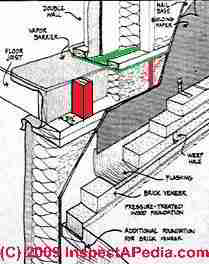
 In the Hughes double-wall wood frame structure design, the double wall overhangs the floor platform, bringing the outside surface of the exterior wall sheathing in line with the outside of the building's foundation wall below. (See sketch at left.)
The floor framing is set back from the outer edge of the foundation wall by 3 1/2 to 4 inches. The overhanging section of the double wall is supported by short 2x4's (red in the sketch) toenailed between the top of the foundation sill plate and the bottom of the plywood plate (green in the sketch).
Setting the load-bearing (inner wall) back from the band joist (rim joist) a few inches will, in most cases, not affect the sizing (nor load bearing ability) of the joists (and structure).
Hughes uses a treated-wood foundation system, ordinarily framing with 2x6 lumber for one story and 2x8 lumber for two-story construction.
A brick veneer would need to be supported by an additional thickness of foundation, whether the wall itself is wood or masonry. This section of the building foundation is often offset so that the brick wythe veneer can be carried down to or below grade.
(Don't forget termite shields where appropriate and don't forget to provide weep openings in the veneer wall).
This double wall framing system allows the air/vapor barrier to run continuously between floors - around band joists and sill plates, reducing building air leakage and simplifying building sealing. The spaces outside the band joists are filled with insulation, keeping the vapor barrier towards the warm side of the insulation.
Here we include solar energy, solar heating, solar hot water, and related building energy efficiency improvement articles reprinted/adapted/excerpted with permission from Solar Age Magazine - editor Steven Bliss.
Original article:
- Double Wall Details: Double Wall House Framing Details Q&A - PDF version, use your browser's back button to return to this page (original article - also see text below)
...
Continue reading at ENERGY SAVINGS MAXIMIZE RETURNS ON or select a topic from the closely-related articles below, or see the complete ARTICLE INDEX.
Or see these
Recommended Articles
- ENERGY SAVINGS in BUILDINGS - home
- ENERGY SAVINGS MAXIMIZE RETURNS ON
- FRAMING DETAILS for BETTER INSULATION
- FRAMING DAMAGE, INSPECTION, REPAIR - home
Suggested citation for this web page
FRAMING DETAILS for DOUBLE WALL HOUSES at InspectApedia.com - online encyclopedia of building & environmental inspection, testing, diagnosis, repair, & problem prevention advice.
Or see this
INDEX to RELATED ARTICLES: ARTICLE INDEX to BUILDING ENERGY SAVINGS
Or use the SEARCH BOX found below to Ask a Question or Search InspectApedia
Ask a Question or Search InspectApedia
Try the search box just below, or if you prefer, post a question or comment in the Comments box below and we will respond promptly.
Search the InspectApedia website
Note: appearance of your Comment below may be delayed: if your comment contains an image, photograph, web link, or text that looks to the software as if it might be a web link, your posting will appear after it has been approved by a moderator. Apologies for the delay.
Only one image can be added per comment but you can post as many comments, and therefore images, as you like.
You will not receive a notification when a response to your question has been posted.
Please bookmark this page to make it easy for you to check back for our response.
IF above you see "Comment Form is loading comments..." then COMMENT BOX - countable.ca / bawkbox.com IS NOT WORKING.
In any case you are welcome to send an email directly to us at InspectApedia.com at editor@inspectApedia.com
We'll reply to you directly. Please help us help you by noting, in your email, the URL of the InspectApedia page where you wanted to comment.
Citations & References
In addition to any citations in the article above, a full list is available on request.
- Solar Age Magazine was the official publication of the American Solar Energy Society. The contemporary solar energy magazine associated with the Society is Solar Today. "Established in 1954, the nonprofit American Solar Energy Society (ASES) is the nation's leading association of solar professionals & advocates. Our mission is to inspire an era of energy innovation and speed the transition to a sustainable energy economy. We advance education, research and policy. Leading for more than 50 years. ASES leads national efforts to increase the use of solar energy, energy efficiency and other sustainable technologies in the U.S. We publish the award-winning SOLAR TODAY magazine, organize and present the ASES National Solar Conference and lead the ASES National Solar Tour – the largest grassroots solar event in the world."
- Steve Bliss's Building Advisor at buildingadvisor.com helps homeowners & contractors plan & complete successful building & remodeling projects: buying land, site work, building design, cost estimating, materials & components, & project management through complete construction. Email: info@buildingadvisor.com
Steven Bliss served as editorial director and co-publisher of The Journal of Light Construction for 16 years and previously as building technology editor for Progressive Builder and Solar Age magazines. He worked in the building trades as a carpenter and design/build contractor for more than ten years and holds a masters degree from the Harvard Graduate School of Education. Excerpts from his recent book, Best Practices Guide to Residential Construction, Wiley (November 18, 2005) ISBN-10: 0471648361, ISBN-13: 978-0471648369, appear throughout this website, with permission and courtesy of Wiley & Sons. Best Practices Guide is available from the publisher, J. Wiley & Sons, and also at Amazon.com - Our recommended books about building & mechanical systems design, inspection, problem diagnosis, and repair, and about indoor environment and IAQ testing, diagnosis, and cleanup are at the InspectAPedia Bookstore. Also see our Book Reviews - InspectAPedia.
- Best Practices Guide to Residential Construction, Wiley (November 18, 2005) ISBN-10: 0471648361, ISBN-13: 978-0471648369, appear throughout this website, with permission and courtesy of Wiley & Sons. Best Practices Guide is available from the publisher, J. Wiley & Sons, and also at Amazon.com.
- In addition to citations & references found in this article, see the research citations given at the end of the related articles found at our suggested
CONTINUE READING or RECOMMENDED ARTICLES.
- Carson, Dunlop & Associates Ltd., 120 Carlton Street Suite 407, Toronto ON M5A 4K2. Tel: (416) 964-9415 1-800-268-7070 Email: info@carsondunlop.com. Alan Carson is a past president of ASHI, the American Society of Home Inspectors.
Thanks to Alan Carson and Bob Dunlop, for permission for InspectAPedia to use text excerpts from The HOME REFERENCE BOOK - the Encyclopedia of Homes and to use illustrations from The ILLUSTRATED HOME .
Carson Dunlop Associates provides extensive home inspection education and report writing material. In gratitude we provide links to tsome Carson Dunlop Associates products and services.
 | HOME | ABOUT | ASK a QUESTION | CONTACT | CONTENT USE POLICY | DESCRIPTION | POLICIES | PRIVACY | |
| © 2025 - 1985 Publisher InspectApedia.com - Daniel Friedman | |||||||||