
InspectAPedia® FREE Encyclopedia of Building & Environmental Construction, Diagnosis, Maintenance & Repair |
Question? Just ask us! InspectAPedia
|
 Air Filter Effectiveness Table & Guide
Air purifiers & air filters: what do they remove from indoor air
- POST a QUESTION or COMMENT about the effectiveness & efficiency of different types of air filters used in HVAC systems or air cleaners, furnaces or air conditioners
Effectiveness of air filters: Here we summarize the key measures of air filter effectiveness and we discuss the real world effectiveness of filters for improving indoor air quality in homes.
InspectAPedia tolerates no conflicts of interest. We have no relationship with advertisers, products, or services discussed at this website.
Measuring Air Filter Effectiveness
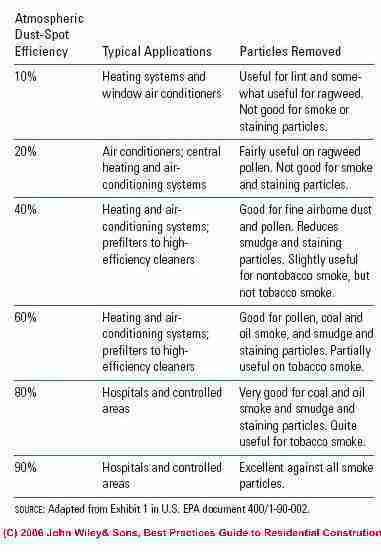 As discussed in Best Practices Guide to Residential Construction (available atReferences or Citations ):
Different types of air cleaners use different rating systems. It is important to know what is being measured, since a “90% efficient filter” may actually capture 0% of respirable particles.
[Click to enlarge any image or table]
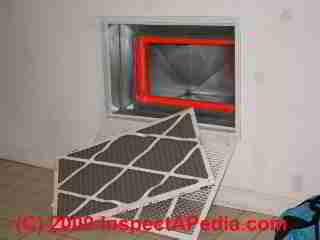
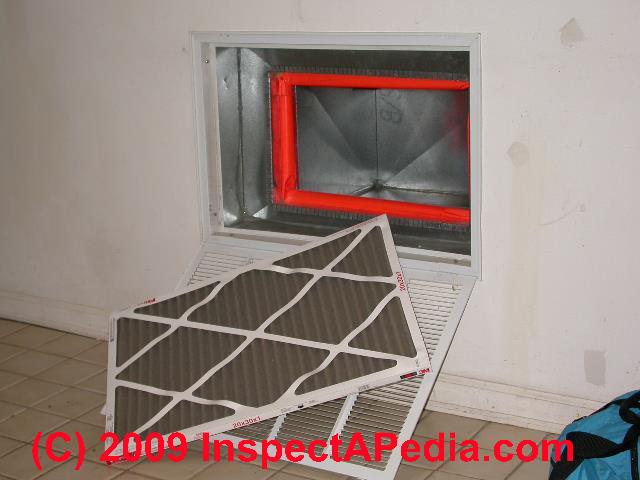
Our page top photo shows the first level of filtration in the cascade or in-series filter system discussed
at HOW to CASCADE AIR FILTERS.
In-Duct Filters. Under ASHRAE Standard 52-89, low-efficiency HVAC filters are evaluated for “arrestance” efficiency and medium- and high-efficiency filters are rated for “dust spot” efficiency. HEPA filters have their own measure as follows:
- Arrestance efficiency: This measures how well a filter captures large, heavy particles and is generally used only for the low-efficiency filters typically found in residential HVAC systems.
- Dust-spot efficiency: This measures how well a filter captures a mixture of fine particles ranging from 0.3 to 6.0 microns, and it is a good guide to how well a filter handles many respirable particles. However, it does not accurately predict the filtering of particles less than 1.0 micron. Also, two filters with the same dust-spot efficiency may perform very differently depending on the size of the particles being captured (see Table 7-3 at left)
- DOP: Based on Military Standard 2823, this uses a fine aerosol of the chemical dioctylphthalate (DOP) to rate high-efficiency filters and requires removal of 99.97% of 0.3-micron particles. Filters meeting this standard are often called “true HEPA” filters. High- efficiency filters that do not meet the standard may still have very good performance and may be called “near HEPA” or similar terms.
- MERV: The Minimum Efficiency Reporting Value is
based on ASHRAE Standard 52.2 1999. This new rating system evaluates a filter at a particular air velocity over 12 particle sizes ranging from 0.3 to 10 microns. MERV values range from 1 to 16. A higher MERV indicates that a filter is more efficient and more effective against smaller particles. Filter manufacturers are beginning to report MERV values.
See AIR FILTER EFFICIENCY for details.
Portable air cleaner units units. While tabletop units are generally ineffective, larger console-style filters can be effective when operating in a limited space provided that the rooms are kept closed and that there is not a large problem particle reservoir such as mold contamination. These units may contain one or more of the filter types described above. No portable air cleaner can remove a problem particle reservoir in the building. Many include HEPA filters and some also use adsorbents to capture odors and gases.
The Association of Home Appliance Manufacturers (AHAM) has developed an ANSI-approved standard for portable air cleaners called “Clean Air Delivery Rate” (CADR), which measures how quickly the filter removes dust, smoke, and pollen particles. The CADR is a function of both filter efficiency and airflow rate and assumes the filters are new and clean. To calculate how large a space a unit can effectively handle, AHAM recommends using the formula:
Square footage of room = Smoke CADR x 1.55
So, for example, a unit with a CADR of 100 can service a 155-square-foot room. The formula is based on the requirement that the filter remove 80% of the smoke particles on a continuous basis.
Readers who are concerned about fiberglass release from air filters should
see FIBERGLASS & AIR FILTERS.
Real-World Effectiveness of Air Cleaners & Filters
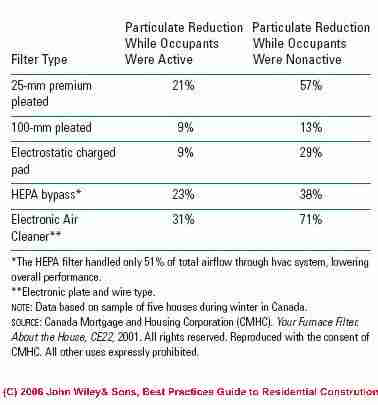
While air cleaners work efficiently in laboratory tests, their effectiveness in the typical household is less clear. Research conducted by the Canada Mortgage and Housing Corporation (CMHC) found that upgrading the HVAC systems to use medium and high-efficiency filters had only a modest effect on personal exposures to particulates in homes.
During peak activity periods, the best performing filter in the study, an electronic air cleaner, reduced particulate levels in the duct- work by 95%, but cut household levels by only 31%.
In nonactive times, like the middle of the night, the filter reduced particulate levels by over 70%, but levels were already so low that the Reduction had little impact on the occupants’ personal exposure or health (see Table 7-4 at left).
Researchers attributed the modest effect of the filters to two key facts: First, the filters only worked while the furnace fans were operating, about 20% of the time on average. Second, personal exposures to high levels of particulates were almost always caused by the occupants themselves, who in their daily tasks of cooking, vacuuming, or just walking on the carpet stirred up small clouds of surrounding dust.
Once the activity ended, the particles tended to rapidly settle out on their own before the filter, far away down a duct, could have much of an impact. If furnace fans were run continuously or the filters were part of a continuously operating ventilation system, their impact might have been greater.
Also, many of the larger, heavier particles linked to allergies, such as pollen, house dust, animal dander, and some molds, are more likely to be found settled on surfaces than in the air. A high-efficiency vacuum is needed for these, not an air cleaner.
- - Adapted with permission from Best Practices Guide to Residential Construction (Steve Bliss, J Wiley & Sons) .
Conclusions About Air Purifiers, Air Filtering Cost, Effectiveness, and Indoor Air Quality
Air purifiers or home air filtration systems including portable and central systems vary in their effectiveness in removing particles and other pollutants from air and their effectiveness in improving indoor air quality for different types of occupants, for example people suffering from allergies versus people suffering from asthma also varies.
Watch out: In our opinion, while the best air filtering systems may reduce the overall level of airborne particles or pollutants, no air filtration or air cleaning system can remove a significant indoor air quality hazard whose source is inside the building.
For example, if a building suffers from significant mold contamination (more than 30 sq.ft. of contiguous allergenic, pathogenic, or toxic mold whose spores are capable of being airborne or of releasing mycotoxins in MVOCs), it is essential to find and remove the source of contamination as well as to correct its original cause so that it does not recur.
See MOLD CLEANUP - MISTAKES to AVOID
In listening to a report on tests of an air cleaner effectiveness reported by Burge at a PAAA conference we [DF] saw a graph demonstrating that the air cleaner produced a significant drop in the airborne particle level during its test. But the air cleaner was tested in a sealed chamber into which a known quantity of particles of a known size and type was introduced. At best this test represents the use of an air cleaner in an enclosed space within which the actual particle source is not present. The test provided useful data on the air filter's abiltiy to remove particles from air but it did not accurately describe a "real world" case of a home with a persistent contaminant source.
Approaches that rely on filtering to remove airborne mold spores or similar contaminants cannot remove the problem source any more than you can vacuum dust bunnies from under the couch by standing two rooms away in the kitchen, waving your shop vacuum wand in the air. - OPINION, Daniel Friedman, based on more than 30 years of forensic building & indoor environment field & lab investigation & testing
Kurutz, who performed his own test on six air purifiers (using HEPA filters, UV_C light, ionic filtration, hydroxyl radical molecule generation) and reporting for the New York Times, found his own initial experience inconclusive. He further noted that
"Purifiers are somehow more than electronic gadgets, yet they aren't considered medical devices, so are not regulated by the Food and Drug Administration. ...
Over the years, the Federal Trade Commission has taken action against several makers of air purifiers, including brands like [Alpine], Honeywell and Oreck, for unsubstantiated allergy-relief claims or for advertising that their devices removed virtually all impurities from the indoor air people breathed. ... several articles in Consumer Reports suggesteing that some air purifiers were not very good at performing the latter function, [and that ] that most people don't need one." - Kurutz, Steven, "Eat My Dust: A veteran sneezer challenges several air purifiers to live up to their promimses of eliminating pollen, mold and even pet odors", The New York Times, 16 May 2013, p. D1, D6.
Kurutz also noted an important difference in the type of building occupant who may or may not be helped by the use of air filtration systems: asthma sufferers are more likely to benefit from indoor air filtration than people suffering from allergies. - op. cit.
Watch out: Similarly, relying on "kill it" approaches to try to "remove" hazardous biological materials such as mold spores risk leaving still-harmful particles in the air. Some mold spores that contain mycotoxins remain toxic even if the spore is no longer viable. For this reason, do not rely on ozone generators to correct indoor air quality issues, and beware of ion generators that may be adjusted to produce high levels of indoor ozone.
See OZONE AIR PURIFIER WARNINGS
The conclusion drawn by most air-quality experts is that filtering the air is costly and the effects are modest unless a high-efficiency filter is used, maintained well, and run frequently. A properly sized console unit can be effective at limiting personal exposure to pollutants, at least for the time spent in the room with the device.
First costs for whole-house systems, typically in the hundreds and sometimes thousands of dollars, plus maintenance costs, may be a justifiable expense for individuals with special health problems—but probably not for the average homeowner.
Anyone intent on keeping their household air clean should focus first on keeping pollutants out of the house in the first place (see “Source Control,” page 268 in Best Practices Guide to Residential Construction (Steve Bliss, J Wiley & Sons) ), along with regular vacuuming with a HEPA vacuum or central vacuum exhausted to the exterior. That, along with filtering any outdoor air brought into the home’s ventilation system, will go a long way toward providing wholesome indoor air.
Reader Comments, Questions & Answers About The Article Above
Below you will find questions and answers previously posted on this page at its page bottom reader comment box.
Reader Q&A - also see RECOMMENDED ARTICLES & FAQs
On 2019-08-04 by (mod) -
In sum you need to find and remove the IAQ problem source. As your question includes a reference to building energy efficiency and thus perhaps building insulation and ventilation improvements, it is vry important that you identify and correct any mold problems first; you don't want to insulate over mold nor leave moldy insulation or other building products un-addressed, lest you have to do your energy or insulation or ventilation improvements over again.
On 2019-08-04 by (mod) - Enviroklenz Versus Molekule Air Purifier: Your Thoughts/Feedback/Input
Anonymous wrote:
Please provide your thoughts on my purchase of Air Purifier Research: Enviroklenz Versus Molekule Air Purifier: Your Thoughts/Feedback/Input
Enviroklenz Versus Molekule Air Purifier: Your Thoughts/Feedback/Input
Musty Basement until I have the money to address all seepage and issues of an unfinished yet energy audit finding changes that I addressed and/ fixed in the short-term until I can afford longer-term costs.
Thank you, in advance, for you time and response, - anon
Moderator reply - opinion: no "air purifier" of any kind can ever correct an indoor mold problem
Sorry that the truth may seem to you bad news, but no "air purifier" of any kind can ever correct an indoor mold problem any more than standing in your garage, waving a vacuum cleaner wand in the air can remove dust bunnies from beneath the living room couch.
In the article above you'll read that in an enclosed space within which the actual mold or other problematic indoor air quality does not itself reside, any small-particle air filtration device can reduce the level of airborne particles and thus may make one more comfortable. Keep in mind that besides particles there may be gases or chemical contaminants in any environment.
...
Continue reading at AIR FILTER for HVAC SYSTEMS or select a topic from the closely-related articles below, or see the complete ARTICLE INDEX.
Or see these
Allergy & Allergen Articles
- AIR CLEANER PURIFIER TYPES
- AIR FILTER CLEANER EFFECTIVENESS
- AIR FILTER EFFICIENCY Analysis of the Effectiveness of Air Filters on HVAC Systems - HEPA & MERV Ratings.
- AIR FILTER MATERIAL RE-PURPOSED for FACE MASKS
- AIR FILTER OPTIMUM INDOOR
- AIR POLLUTANTS, COMMON INDOOR
- AIR POLLUTANTS, HEALTH EFFECTS
- AIRBORNE PARTICLE SIZE DEFINITIONS & TYPES
- AIRBORNE PARTICLE SIZE TABLE
- ALLERGEN TESTS for BUILDINGS
- ALLERGY & MOLD IAQ PRODUCTS
- BIOLOGICAL POLLUTANTS
- INDOOR AIR QUALITY IMPROVEMENT GUIDE - home
- OZONE GENERATOR EFFECTIVENESS for INDOOR AIR POLLUTION
Suggested citation for this web page
AIR FILTER CLEANER EFFECTIVENESS at InspectApedia.com - online encyclopedia of building & environmental inspection, testing, diagnosis, repair, & problem prevention advice.
Or see this
INDEX to RELATED ARTICLES: ARTICLE INDEX to BUILDING INDOOR AIR QUALITY IAQ
Or use the SEARCH BOX found below to Ask a Question or Search InspectApedia
Ask a Question or Search InspectApedia
.Questions & answers about the effectiveness & efficiency of different types of air filters used in HVAC systems or air cleaners, furnaces or air conditioners
Try the search box just below, or if you prefer, post a question or comment in the Comments box below and we will respond promptly.
Search the InspectApedia website
Note: appearance of your Comment below may be delayed: if your comment contains an image, photograph, web link, or text that looks to the software as if it might be a web link, your posting will appear after it has been approved by a moderator. Apologies for the delay.
Only one image can be added per comment but you can post as many comments, and therefore images, as you like.
You will not receive a notification when a response to your question has been posted.
Please bookmark this page to make it easy for you to check back for our response.
Our Comment Box is provided by Countable Web Productions countable.ca
Citations & References
In addition to any citations in the article above, a full list is available on request.
- Best Practices Guide to Residential Construction, by Steven Bliss. John Wiley & Sons, 2006. ISBN-10: 0471648361, ISBN-13: 978-0471648369, Hardcover: 320 pages, available from Amazon.com and also Wiley.com. See our book review of this publication.
- Our recommended books about building & mechanical systems design, inspection, problem diagnosis, and repair, and about indoor environment and IAQ testing, diagnosis, and cleanup are at the InspectAPedia Bookstore. Also see our Book Reviews - InspectAPedia.
- Decks and Porches, the JLC Guide to, Best Practices for Outdoor Spaces, Steve Bliss (Editor), The Journal of Light Construction, Williston VT, 2010 ISBN 10: 1-928580-42-4, ISBN 13: 978-1-928580-42-3, available from Amazon.com
- In addition to citations & references found in this article, see the research citations given at the end of the related articles found at our suggested
CONTINUE READING or RECOMMENDED ARTICLES.
- Carson, Dunlop & Associates Ltd., 120 Carlton Street Suite 407, Toronto ON M5A 4K2. Tel: (416) 964-9415 1-800-268-7070 Email: info@carsondunlop.com. Alan Carson is a past president of ASHI, the American Society of Home Inspectors.
Thanks to Alan Carson and Bob Dunlop, for permission for InspectAPedia to use text excerpts from The HOME REFERENCE BOOK - the Encyclopedia of Homes and to use illustrations from The ILLUSTRATED HOME .
Carson Dunlop Associates provides extensive home inspection education and report writing material. In gratitude we provide links to tsome Carson Dunlop Associates products and services.
 | HOME | ABOUT | ASK a QUESTION | CONTACT | CONTENT USE POLICY | DESCRIPTION | POLICIES | PRIVACY | |
| © 2024 - 1985 Publisher InspectApedia.com - Daniel Friedman | |||||||||