
InspectAPedia® FREE Encyclopedia of Building & Environmental Construction, Diagnosis, Maintenance & Repair |
Question? Just ask us! InspectAPedia
|
 Large Capacity Water Storage Tanks, Selection & Usage Guide
- POST a QUESTION or COMMENT about when, why, & how large water storage tanks are used
Large water storage tanks: why & when should you install extra water storage capacity at your building? What does the presence of a large water storage tank tell us about the flow rate or yield of a private well?
This article describes the use of extra or large water tanks to store additional water at properties with intermittent or limited water supply from a low-flow-rate well or intermittent municipal water supply.
InspectAPedia tolerates no conflicts of interest. We have no relationship with advertisers, products, or services discussed at this website.
Large Water Storage Tanks, Why They Are Used, What They Imply about Well Recovery Rate or Well Yield
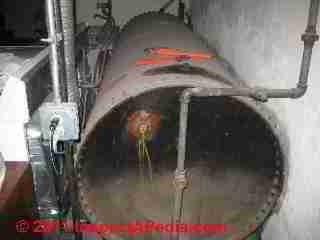
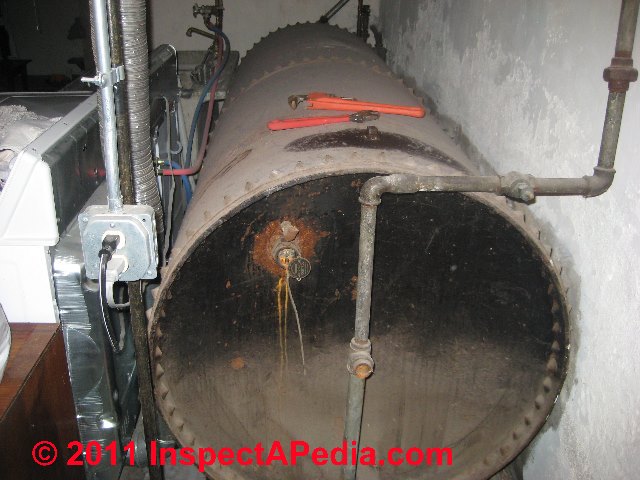
 The large indoor water storage tank shown at page top was contributed by reader Craig Revill and was found in a home that was 80-100 years old. We calculated the water tank volume at about 450 gallons.
What does it mean if you see a huge water storage tank at a property?
Can we use additional water storage tanks to overcome a well that has a very slow recovery rate or a poor well flow rate? Yes we can, with some warnings.
[Click to enlarge any image]
At left we illustrate a huge liquid storage tank observed in Dutchess County, New York. This tank was used for apple juice storage: New York's Hudson Vall
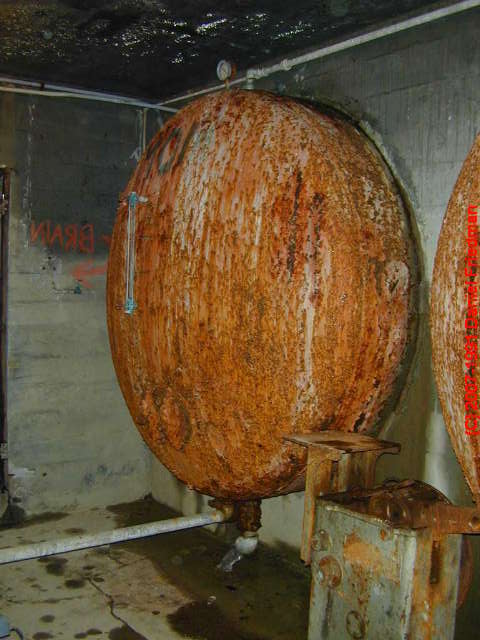
Very large water storage tanks, such as the one whose end is visible in the two photographs below are from two different properties, and are likely to indicate that the flow rate of the well serving the property is very slow, even inadequate by contemporary standards.
We've found these old steel tanks at older properties in the Northeastern U.S. in situations where the well flow rate, the rate in gallons per minute at which the well can give water over a sustained period, to be very low, perhaps around one gallon per minute or less.
Very low well flow or well water delivery rates in the 2.5 gpm range or below, simply can't keep up with the rate of water usage in a building during normal occupancy.
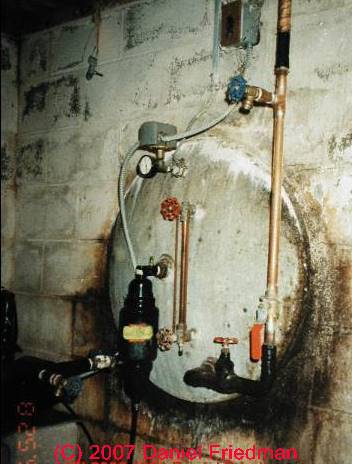
Large water tanks may indicate that the well flow rate can't keep up with demand
Worse, if we have only a typical water tank installed, say a 30 or 40-gallon unit, that tank is designed to smooth the flow of delivery of water to the building as the pump is turned on and off.
A small water tank is not sized to actually store a reservoir of water for the building. So if our well flow rate is very low, the building will simply run out of water and occupants will have to wait, perhaps hours, for the pump to re-fill the water tank.
Multiple smaller water tanks may also mean that the well flow rate is poor
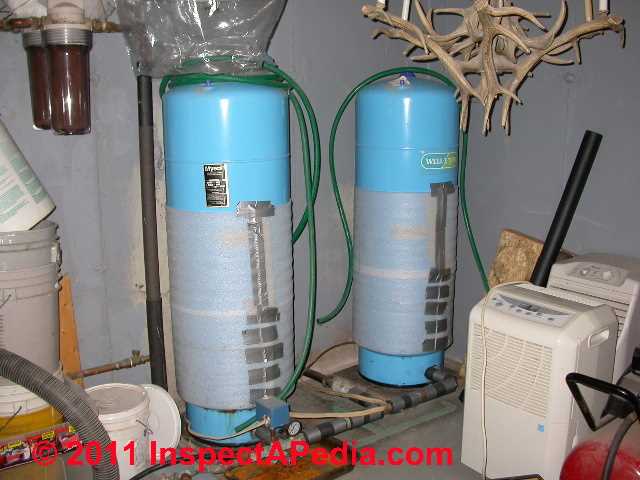 A more modern solution to poor well flow rate is to install a cascade of two or more individual water pressure tanks in order to provide a larger volume of water stored at a property.
A low flow rate well and pump may rely on "recovery" overnight or over many hours
So a common solution for a low-flow-rate well is the installation of a very large water reservoir.
At older properties the single water tank may have been 1000 gallons or even more.
With a large water tank or multiple water tanks installed to provide this water storage reservoir, the well flow rate can be terrible but the building occupants won't see its effect since they're working off of the water storage tank.
At a low-flow-rate well installation the pump will be designed to run at a slow pumping rate so that the well water flow-rate can keep up with the pump as the pump sends water to the water storage tank.
The building occupants use water out of the tank and the tank and well and pump recover their water slowly, perhaps overnight.
Low flow rate wells or slow recovery rate wells at modern properties use a cascade of water tanks
At newer properties this same approach may be taken to "solve" a low-flow well but instead of a single huge steel tank such as the one in this photograph, the plumber will install a series or cascade of from two to perhaps four or five smaller water storage tanks of perhaps 50 gallons each.
If you are looking at a property and see that it has five new shiny blue and pretty big water tanks lined up in the basement you can guess that the well is marginal in its delivery capacity.
Low flow rate slow recovery rate wells have a questionable future life expectancy
A final warning about low-flow rate wells: because in many areas water is flowing into the well through cracks in rock below the surface, and because we're starting with an already low recovery rate well, the future ability of the well to give water at all must be questioned.
If local water is heavy in minerals, for example, the minerals tend to clog up those rock cracks over time, gradually reducing the water flow-rate into the well still further, until eventually it just stops working.
So a very large water storage capacity at a property is an indicator of both a low-flow-rate
well (poor well recovery rate means the same thing), and an indicator that the future usability of the well at all must be questioned. We explain how people determine the necessary water tank size and volume
OPEN WATER TANKS - gravity fed water systems or pump-up rooftop systems with and without pressure-boosting pumps and water tanks
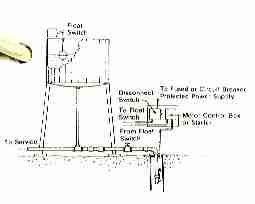 Still More Water Storage Capacity: Rooftop Water Tanks or Free-standing Water Storage Tanks at Ground Level offer increased water storage to mask the effects of an intermittent or slow-recovery water source.
Rooftop water tanks in urban areas such as New York City may be used to supply water at high pressure to the building below.
Water is pumped to the rooftop tank from its municipal source, then redistributed at good pressure to the points of use in the building below.
When passing through New York City, look at rooftops and you'll often see these tanks still in use. This sketch shows how a rooftop tank might be constructed, though this particular sketch has the tank next to a well.
Details about rooftop & tower - mounted water tanks are
Also see related details at CISTERNS, WATER STORAGE.
Reader Comments & Q&A
On 2018-09-11 - by (mod) -
I think that plastic or fiberglass are durable and avoid long-term rust and corrosion problems but of course need to be anchored and supported.
Any large tank needs to be able to be emptied, cleaned, disinfected. The tank manufacturers typically advise annual or semi-annual cleaning - a step that in my experience almost nobody follows - until they have a problem.
At ROOFTOP WATER TANKS - WATER TANK CLEANING REQUIREMENTS https://inspectapedia.com/water/Rooftop_Water_Tanks.php#TankCleaning you'll see that cleaning is required by local and model codes.
In that article you'll find live links in this text:
Roortop Water Tank Cleaning: rooftop water tanks require periodic cleaning and disinfection.
See ROOFTOP WATER TANK CONSTRUCTION STANDARDS & REFERENCES
in ROOFTOP WATER TANKS
Also see CLEANING & DINSINFECTING WATER CISTERNS AFTER FLOODS & HEAVY RAINS [PDF] U.S. CDC
On 2018-09-11 by JB Silver
What is the best material to use if one is to store up to 3000 or more gallons of water above ground for a long period of time.
Approximately 6 months. I plan to build a separate structure to store my water tank and I don't want to have to have it constantly filled by delivery.
Even though I will have drainage coming through filters and a reservoir installed inside the house to help insure clean water; I'm concerned about the quality of water stored for a period of time. I also notice someone asked the question regarding cleaning. Based on size and type of tank, how often should this be done.
I will be living off the grid in Southern Colorado and it is more economical for me to use a cistern instead of drilling a well.
On 2017-01-29 by Scott
I dismantle barns and I have found myself in the possession of a large cast iron tank like the one at the top of this page. Does anyone have any idea if they can be reused for residential use and what would it be worth if I decide to resell it?
On 2016-09-26 by Steve
In our area (santa clara county) large storage tanks are required if on a well. Two tanks are required one: 5000 to 30,000 gallons is for fire protection water (to be kept full for fire department use) and the second tank (3000 gallons and up) is for household use.
The requirement for household water storage is not due to slow well, but due to the season rain pattern and drought it is possible for the well to be dry some portion of the year. In this case the large storage tank can be filled by truck to ensure that water is available. Needless to say, paying for a water truck delivery is not cheap.
On 2016-03-19 - by (mod) -
Yes, Mike ... depending.
For example literature on or included with some plastic or fiberglass water tanks includes advice to drain and clean (sanitize) the tank at intervals - ranging from a few months to longer periods. However in my experience few people take this step.
On 2016-03-10 by Mike
Do you have to drain the tank sometime?
Question: trouble installing the gate valve on the water tank
(June 3, 2014) louis said:
Dear Sir--I have a 5ooo gal water storage tank on a hill next to my house used for irrigation. It has been in operation over 20 years with no problems.
Two weeks ago, the water output began to diminish and now there is no flow at all. There are two faucet outlets in the pipeline line down the hillside and a final faucet at my house.
There is no water flow at any of the faucets which means any blockage is probably at or near the gate valve outlet of the tank. The outlet piping is 2 1/2 to 3 inch pipe out of the tank and into the ground.
I assume that thereafter the piping is reduced to 1/2 inch - but have not dug it up to look - if the assumption herein are correct, my question is- .how does one screw the gate valve out of the line to be able to clean out any blockage? after the tank is empty of course.
or does some one have to actually climb into the tank?
Reply:
Normally you would not have to enter a tank to remove a valve that serves as an outlet control. It would be installed from outside the tank, into a tapping.
...
Continue reading at WELL YIELD IMPROVEMENT or select a topic from the closely-related articles below, or see the complete ARTICLE INDEX.
Or see these
Recommended Articles
- CAULKS, NONTOXIC
- CISTERNS, WATER STORAGE
- ATTIC CISTERNS
- BASEMENT CISTERNS
- CISTERN & RAINWATER COLLECTION SYSTEMS
- CISTERN USE ADVICE
- GRAVITY FEED TANKS
- FREESTANDING WATER TANKS
- LARGE CAPACITY WATER STORAGE TANKS
- ODORS IN WATER
- PLASTIC RECYCLING CODES, TANKS, TYPES health and other concerns involving plastic tanks and other containers used for water storage.
- RAINWATER STORAGE CISTERNS
- HUD FINANCE & CISTERNS
- ROOFTOP WATER TANKS
- WATER TANK CLEANING CODES STANDARDS
- WATER TANK DRAIN VALVE
- WATER TANK LOCATION GUIDE
- WATER TANK SIZE & VOLUME
- WATER TOWERS
- WATER QUANTITY IMPROVEMENT
- WATER TANKS, STEEL
- WELL YIELD IMPROVEMENT
Suggested citation for this web page
LARGE CAPACITY WATER STORAGE TANKS at InspectApedia.com - online encyclopedia of building & environmental inspection, testing, diagnosis, repair, & problem prevention advice.
Or see this
INDEX to RELATED ARTICLES: ARTICLE INDEX to WATER SUPPLY, PUMPS TANKS WELLS & SPRINGS
Or use the SEARCH BOX found below to Ask a Question or Search InspectApedia
Ask a Question or Search InspectApedia
Try the search box just below, or if you prefer, post a question or comment in the Comments box below and we will respond promptly.
Search the InspectApedia website
Note: appearance of your Comment below may be delayed: if your comment contains an image, photograph, web link, or text that looks to the software as if it might be a web link, your posting will appear after it has been approved by a moderator. Apologies for the delay.
Only one image can be added per comment but you can post as many comments, and therefore images, as you like.
You will not receive a notification when a response to your question has been posted.
Please bookmark this page to make it easy for you to check back for our response.
Our Comment Box is provided by Countable Web Productions countable.ca
Citations & References
In addition to any citations in the article above, a full list is available on request.
- Amtrol - AMTROL, Inc.,
Corporate Office,
1400 Division Road,
West Warwick, R.I. 02893
Tel: (401) 884-6300
Fax: (401) 884-4773 The company's website is at www.amtrol.com; also see Amtrol's installation and instruction manual for their Well-X-Trol water pressure control tank, a PDF file - Water Storage: Tanks, Cisterns, Aquifers, and Ponds for Domestic Supply, Fire and Emergency Use - -Includes How to Make Ferrocement Water Tanks, Art Ludwig, Oasis Design (May 30, 2005), ISBN-10: 0964343363, ISBN-13: 978-0964343368, Quoting:
A do-it-yourself guide to designing, building, and maintaining water tanks, cisterns and ponds, and sustainably managing groundwater storage. It will help you with your independent water system, fire protection, and disaster preparedness, at low cost and using principles of ecological design. Includes building instructions for several styles of ferro cement water tanks. - Thanks to aerospace engineer Herman Vogel, July 2010, for providing an update on High Density Polyethylene HDPE storage tanks for water, chemicals, waste oils, etc.
- Access Water Energy, PO Box 2061, Moorabbin, VIC 3189, Australia, Tel: 1300 797 758, email: sales@accesswater.com.au Website: http://www.accesswater.com.au/
Moorabbin Office: Kingston Trade Centre, 100 Cochranes Rd, Moorabbin, VIC 3189
Australian supplier of: Greywater systems, Solar power to grid packages, Edwards solar systems, Vulcan compact solar systems, water & solar system pumps & controls, and a wide rage of above ground & under ground water storage tanks: concrete, steel, plastic, modular, and bladder storage tanks. - Our recommended books about building & mechanical systems design, inspection, problem diagnosis, and repair, and about indoor environment and IAQ testing, diagnosis, and cleanup are at the InspectAPedia Bookstore. Also see our Book Reviews - InspectAPedia.
- In addition to citations & references found in this article, see the research citations given at the end of the related articles found at our suggested
CONTINUE READING or RECOMMENDED ARTICLES.
- Carson, Dunlop & Associates Ltd., 120 Carlton Street Suite 407, Toronto ON M5A 4K2. Tel: (416) 964-9415 1-800-268-7070 Email: info@carsondunlop.com. Alan Carson is a past president of ASHI, the American Society of Home Inspectors.
Thanks to Alan Carson and Bob Dunlop, for permission for InspectAPedia to use text excerpts from The HOME REFERENCE BOOK - the Encyclopedia of Homes and to use illustrations from The ILLUSTRATED HOME .
Carson Dunlop Associates provides extensive home inspection education and report writing material. In gratitude we provide links to tsome Carson Dunlop Associates products and services.
 | HOME | ABOUT | ASK a QUESTION | CONTACT | CONTENT USE POLICY | DESCRIPTION | POLICIES | PRIVACY | |
| © 2024 - 1985 Publisher InspectApedia.com - Daniel Friedman | |||||||||