
InspectAPedia® FREE Encyclopedia of Building & Environmental Construction, Diagnosis, Maintenance & Repair |
Question? Just ask us! InspectAPedia
|
 Diagnose & Repair Intermittent Lack of Water Pressure
Water pressure comes & goes

- POST a QUESTION or COMMENT about troubleshooting & fixing intermittent loss of water pressure in buildings
How to diagnose & fix intermittent or periodic loss of water pressure:
This article explains how to diagnose periodic or intermittent loss of water pressure either from municipal water supply piping or periodic or intermittent loss of water pressure from a private well. The process of diagnosis and the procedure for repair are explained.
If the building water supply stops and takes minutes to hours to recover, the municipal water system may have work going on outside of your building, or if your water is supplied by a private well, you may have problem with the well flow rate.
But the problem of lost water supply and pressure could be more mechanical and may be due to a problem right in your building itself, as we will explain..
InspectAPedia tolerates no conflicts of interest. We have no relationship with advertisers, products, or services discussed at this website.
MUNICIPAL Water Pressure Diagnosis: If your water is from a municipal supply and the pressure or flow seem to vary or start and stop
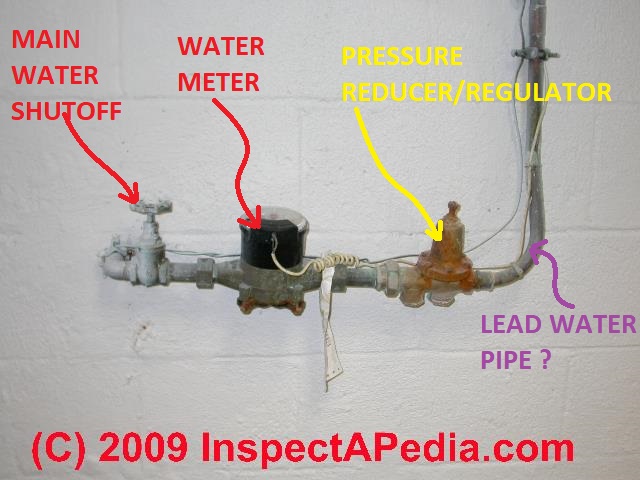
- Variation in supply pressure: There could be variation in water pressure supplied by the municipality - check with your neighbors and your water department. You can install a pressure valve at your water entry main and watch for variations in its reading when you're not even running water in your building. This is a likely cause but it's unlikely to continue for days or weeks.
- Clogged piping or multiple users: There could be a problem with poor water pressure due to clogged pipes combined with other people in the building using water at the same time.
This is a likely cause, it could continue for years, and it would correlate with the presence or absence of various building occupants and their water use.
See WATER PIPE CLOG DIAGNOSIS for a step by step diagnostic guide to this cause of bad water pressure. - Bad water pressure regulator: You could have a problem with your water regulator but it's unlikely that this would cause varying pressure. If you have this rare problem a plumber can change out the pressure regulator.
See WATER PRESSURE REDUCER / REGULATOR - No municipal water pressure at all: see NO WATER PRESSURE for a step by step diagnostic guide.
Readers whose water pressure recovers when the pump cycles on, but find water pressure dropping without explanation when the well pump stops should
See WATER PRESSURE FALLS SLOWLY, ERRATIC PUMP.
Also see WATER PRESSURE LOSS DIAGNOSIS & REPAIR and
also WATER PRESSURE STOPS, RETURNS - more details about intermittent water pressure and what to do about it.
WELL Water Pressure Diagnosis
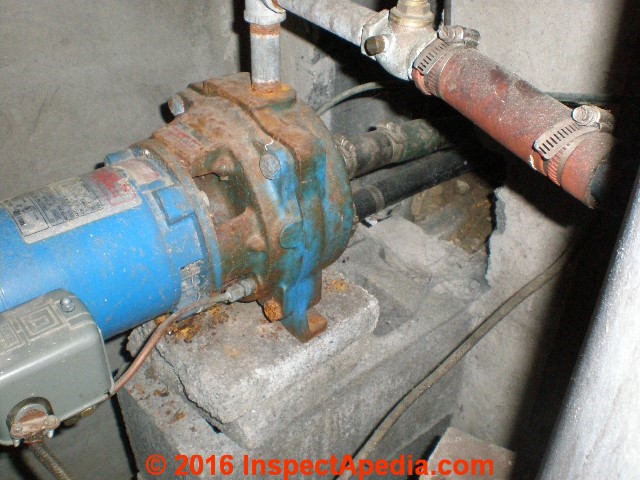
If your water is provided by a private well and the pressure or flow seem to vary or start and stop
When you lose water pressure or lose all water supply for some time period but water pressure later returns or improves, check the possible explanations outlined just below.
On the other hand, if you lose and do not recover water pressure in the building see this article for diagnosis of NO WATER PRESSURE
- First Check the Basics: Has someone partially shut off the main or some other water supply valve? Is there an obvious burst pipe? Is the water pump running at all? Is the electricity turned on for the well pump?
See our detailed diagnostic list at: WATER PRESSURE LOSS DIAGNOSIS & REPAIR - Is there water in the well? If so, how much water is in the well? Is the well being pumped "dry" and you're waiting for the well itself to recover water. With age however some wells deteriorate and deliver less and less water as their flow rate from the water table into the well diminishes.
This occurs as minerals clog the cracks or passages through which water is entering the well. You might need to find the well, open the well cap, and use a light and measuring tape, or possibly a combination of string and float to find the amount of water in the well when it is at rest.
See:- WELL FLOW RATE - how much water do we have available at the well? the start of this article series
- STATIC HEAD of Water in the Well - how much water is in the well casing when the well is at rest and recovered from last pump-put?
- WELL YIELD, SAFE LIMITS - so how much water can we get out of the well - static head plus flow rate or yield
- WELL FLOW TEST PROCEDURE - how to test well water total quantity (without opening the well casing)
- WATER PRESSURE STOPS, RETURNS - an explanation of slow recovery rate in a well and how it appears to the building occupants
- WELL LIFE EXPECTANCY - how long does a water well last?
- Are the well pump controls turning on the pump properly? A pressure switch senses pressure drop in the water tank and either turns on the well pump directly or it turns on a heavy duty relay that turns on the well pump. The detailed, step by step procedure for inspecting and adjusting the water pressure control switch is discussed in detail
at WATER PRESSURE CONTROL SWITCH ADJUSTMENTS - Is the well pump actually running? If the water pump is above ground, you will hear the pump motor running; if the pump is a submersible unit in the well, you won't hear the pump run, but your plumber or electrician can confirm that wiring to the pump is intact, that current is being delivered to the pump.
- Is the water pump is shutting down on thermal overload and you're waiting for it to cool down and automatically re-set it's overload switch. (Other electrical motors including on some pumps have a reset switch which must be re-set manually by pressing the "popped out" red button down. If the pump is visible in the building you can diagnose this condition:
- Water pump hesitates before starting at end of water tank draw-down cycle -
see FINE TUNE THE PUMP PRESSURE CONTROL SWITCH - If the pump runs, water pressure returns, but water pressure drops without explanation when the pump stops,
see WATER PRESSURE FALLS SLOWLY, ERRATIC PUMP - If the pump keeps running and you have no water (TURN OFF THE PUMP RIGHT AWAY in this case) there is
- a problem with the well pump itself, such as internal well pump damage, broken vane, mineral clogging, in which case the pup motor may run but pump does not deliver water (this will not normally give intermittent water flow, the problem will be static)
- a problem with the water well (no water or insufficient water)
- a problem with the foot valve in the well or some other check valve in the system - this could give an intermittent water loss if the valve is sticking open on occasion and the pump loses prime.
See WELL PIPING FOOT VALVES - a problem with the well piping between the bottom of the well, foot valve or submersible pump, and piping entering the water pressure tank, such as a burst or leaky pipe - (this will not normally give intermittent water flow, the problem will be static)
See WATER SUPPLY & DRAIN PIPING. - a problem with a plumbing valve that is closed in the piping system. If a water valve is closed between the well pump and the pressure tank, the water pump will cycle on and off very quickly - and can be damaged - turn off the pump. We've found this problem happening when someone used the built-in water shutoff valve on a cartridge type water filter.
The filter was replaced and the pump turned back on but the pump kept switching on and off rapidly - the owner had forgotten to turn the built-in water shutoff valve back to the "on" position. (this will not give intermittent water flow, the problem will be static)
See contrasting cases after this list. Turn off the water pump immediately so that you don't burn out the motor. Some water pumps depend on having water inside the pumping mechanism to avoid wear or overheating.
- If the pump shuts itself off and is hot, it's off on thermal reset. Feel the pump motor. Read the operating temperature range expected by the pump manufacturer - this data is usually on a label affixed to the pump motor.
- If the pump is in the well you can't see these conditions directly but an electrician or plumber can do some diagnosis from the building by noting the amperage draw on the pump circuit.
- Is water being delivered to the building when the pump runs? See the same questions as at step 8 above. If the pump runs but no water is delivered, look for no water in the well, a closed valve, a well piping leak, low voltage to the pump, or a damaged pump impeller.
- Is there a problem with the water pressure tank itself, such as loss of air in a bladderless steel water tank, or a tank bladder that is damaged or is sticking to itself, preventing water from entering the tank? Check these articles
Other Tricky Causes of Intermittent Water Pressure that Comes and Goes
 Pressure Regulating Valve at Water Heater Causes Odd Pressure Loss?
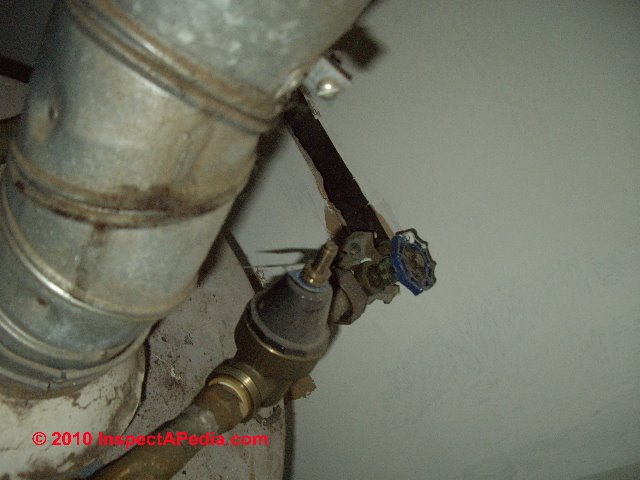
The following unusual water pressure case traced to a pressure regulating valve was described by Timothy Pearson, a senior plumbing designer in Charlotte, NC:
This poor hot water pressure problem had three senior level designers stumped as to a reasonable cause.
A young architect ... had a problem that we could only guess at: when he turned on the shower, lav, or kitchen sink hot water (both two handle and single handle arrangements) he got a steady stream of water from the spout/head. But after a brief interval water pressure slowed to a trickle.
When any other plumbing fixture valve, either hot or cold, was then opened, water pressure returned to a strong stream (pressure).
As this happened at every plumbing faucet this pretty much eliminated a clogged pipe possibility.
We wondered if there might be a large piece of debris in the water heater itself. This would explain that when any valve is turned on it equalizes the pressure and whatever debris (lighter than water) is moved thus allowing the pressure to increase? I have had a plumbing contractors’ license for 23 years and had my own firm for 10 years before I went back to college and graduated with a mechanical engineering degree (Thanks PM magazine and Julius Ballanco)
[We also speculated about another intermittent water flow blockage, a possible water tank bladder problem as we have seen odd water pressure behavior traced to that failure. - Ed.]
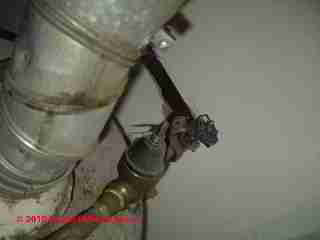
The young architect brought in pictures (see the photo above), what a difference when you actually see some of the system.
The previous owner had installed or had someone install a PRV [pressure regulating valve] in the cold water inlet to the water heater after the shut-off valve to the heater. We advised him to adjust the PRV to the point where it actually was not regulating the pressure through the valve at all. Problem solved.
I plan to go on a free Saturday at some point to verify that the inlet PRV is functioning correctly , and remove the PRV on the cold water inlet to the heater. I also intend to replace the gate valve with a ball valve and remove the 5 or 6 couplings on the hot water outlet piping.
Also its not being the smartest plumber, it is getting as much input to each problem or design issue from as many other people as possible that makes you a better designer, plumber, installer, etc. I am old enough to realize that anyone may make a suggestion that either will be better or different one from the one you had thought of regardless of the suggesting person’s experience.
Sometimes someone else’s input triggers your realization of another solution.
- - Thanks, Tim Pearson
Impact of Sediment & Debris on Intermittent Water Pressure
This sequence of reader questions, moderator replies, and reader follow-up illustrate how we tracked down an "intermittent water pressure problem" to a problem with sediment, debris, and clogging water filters.
Reader Question:
6/22/2014 Tom Evans said:
Okay, I have read everything I can find but am not seeing my exact scenario.
Water pressure starts off great and stays great for the first fifteen minutes of sprinkler time. Then it starts slowing down. It will get very slow. The pump cycles normally, kicks in at 40psi and out at 60psi. The pressure in the tank is not related to the pressure at the sprinkler.
The sprinkler has shown good flow through the whole range of pressure and had poor flow when the tank shows 60psi. Shutting off the water and waiting awhile will give another 10-15 minutes of good flow.
I should mention that flow is compromised in the entire system when it falls off
Reply:
Most likely you are exceeding the sustainable well flow rate. Less likely could be a motor overheat or low voltage problem.
Reader Follow-up:
I wondered about that. assumed that that is what it had to be until today. The preassure in the tank will build when the pump is working even while the sprinkler runs. The pump does not shut off until the cutout pressure is reached. If the tank pressure is building then there must be water right? - Tom Evans
Reply:
Sure
But if the flow rate in the well is reduced and if a well pump protection device is installed then the pump-delivery rate is also reduced until the well recovers.
Well flow rate is made up of a complex of flow numbers at different depths, differing rates, and for different sustainable intervals. When you draw a lot of water you may see water delivered at full pump capacity until the static head is exhausted, then a slower flow rate that may slow even further after local water close to the well bore has become exhausted - DF
Reader Follow-up:
I think I understand what you are saying. If I understand correctly, if the flow rate in the well is reduced then the flow into the pressure tank would be reduced and so the flow rate to the hose is reduced. What I seem to be observing is that the flow rate to the hose and the house is reduced but the pressure tank is refilling in good order. Even when the pressure tank is at 60psi the flow to the house and hose is compromised after the hose has been running for ~15 minutes.
New data from this evening:
There are 2 filters between the T where the well and the pressure tank join and the pipe to the house. The first is one of those sediment spin down filters, the next is one of those canister types with the drop in cartridge. I have flushed the first and replaced the cartridge in the second.
While my wife was noticing reduced flow in the hose I opened the stop cock on the spin down and there was enormous pressure there (pressure gadge between the well and tank said 60psi and I believe it). It seems like there must be something going on in the vicinity of the cartridge filter that is dropping the pressure but I can't see any obvious obstructions.
Reply:
Try removing the filter cartridges to flush the system, then install new filter cartridges and flush further. - DF
[Flushing from a point downstream from the water pump & filters & tank and onwads to outdoors avoids further clogging of filter screens at indoor sinks & showers, though those too may need to be cleaned. ]
Reader follow-up: flushing out filters seems to fix the water pressure problem
Can I flush to the nearest hose bib? I don't have to flush thru the house, right?
Okay, test is ongoing but seems ot be woking more as you would expect it to. For the first ten minutes or so well and pump were maintaining tank pressure but not recouping to 60psi.
The last 10 minutes pressure has been dropping while the pump runs. I think this is an indication that "the static head is exhausted"? I am tempted to run the water till the pump shuts off (heat protection shutoff- if that is what you call it) it has happened in the past when we were clueless. This would show for sure tha we are simply running out of water in the well- correct?
Ran water thru near hose bib for 1hr 25min w/o spin down filter or solid canister filter in place. Very little loss of flow. Installed a "bubbler" to diffuse water stream after 1hrl flow was approx. 7 gpm vs 10 gpm when we began (w/o bubbler).
Tank pressure had recouped to 55psi and was hanging there. As far as I can tell pump never shut off. When the pump was producing the least; the spin down filter (w/o filter installed) was still collecting alot of sediment. When the tank pressure increased the sediment was much less.
I have been using a solid filter that was supposed to be good for six months rather than a pleated filter that would need replacing every 3. I am wondering if this is a false economy and that the increased surface area of the pleated filter would address the flow slow down.
...
Put things back together and after 1/2 hr flow was back to its bad ol used to be. I shut off supply from the tank/pump and opened the spin down flush valve. Pressure restored. I am amazed that it could clog so quickly.
I guess I need more filtering options- seems like I need something for those bigger particles.
Any suggestions?
and thanks, I needed to prodding to take the filters out of the line.
Reply:
Tom
Indeed if the water supply system is picking up lots of sediment filters can clog quickly. For severe cases we need to install much larger-capacity filtration equipment, sometimes a settlement tank, or a cascade of filters handling particles of varying sizes (larger first).
Also check that the pick-up height of the foot valve in the well is not too close to the well bottom. This can happen if well casing damage permits soil to leak into the well, filling the bottom end of the well bore - something to discover by camera inspection of the well casing interior.
Finally, check and clean filter screens at indoor faucets and check for clogging at shower heads or other flow restrictors.
(Less common we've even seen debris clogging at stop valves in the piping system - moreso at some gate valve and globe valve designs than others.}
Daniel
(June 22, 2014) tomEvans said:
Put things back together and after 1/2 hr flow was back to its bad ol used to be. I shut off supply from the tank/pump and opened the spin down flush valve. Pressure restored. I am amazed that it could clog so quickly.
I guess I need more filtering options- seems like I need something for those bigger particles.
Any suggestions?
and thanks, I needed to prodding to take the filters out of the line.
(June 23, 2014) TomEvans said:
Daniel,
Thanks for your help. Glad to think our disscussion will be helpful to others.
With the 100 mesh screen removed from the spin down, the canister filter seems to be handling everything. We will see how soon it clogs. I am thinking a 60 or 40 mesh in the spin down may not clog so easily yet extend the life of the canister filter. Sort of a mini cascade. If that is not exceptible I will be looking at one of those higher end sediment filters. It was such a relief to be able to water for a couple of hours straight.
Thanks again,
Tom
Reply:
Tom we are in agreement. A cascade system will often do what's needed and given that we have to change just the front end filter most often, it may be more economical to operate than some alternatives. This will probably ONLY work well if the clogging sediment includes a lot of large particles.
If the clogging sediment is mostly very fine particulates you could still try a filter cascade but may find you need to go to a larger higher capacity filter to do the job.
...
Continue reading at WATER PRESSURE STOPS, THEN RETURNS "on its own" or select a topic from the closely-related articles below, or see the complete ARTICLE INDEX.
Or see WATER PRESSURE INTERMITTENT LOSS FAQs - Diagnostic Q&A posted originally on this page. More FAQs for this article on intermittent water pressrue loss are in the article link list below.
Or see these
Recommended Articles
- PLUMBING LEAK DETECTION METHODS
- WATER PRESSURE FALLS BRIEFLY THEN STOPS
- WATER PRESSURE FALLS SLOWLY, ERRATIC PUMP
- WATER PRESSURE GAUGE
- WATER PRESSURE INTERMITTENT LOSS
- WATER PRESSURE VARIATION CAUSES
- WATER PUMP CONTROLS & SWITCHES - home
- WATER PUMP REPAIR GUIDE - home
- WATER PUMP INTERMITTENT CYCLING
- WATER PUMP SHORT CYCLING
- WATER PUMP WON'T STOP RUNNING
- WATER QUANTITY TEST: WELL FLOW TEST
- WELL WATER PRESSURE DIAGNOSIS - home
Suggested citation for this web page
WATER PRESSURE INTERMITTENT LOSS at InspectApedia.com - online encyclopedia of building & environmental inspection, testing, diagnosis, repair, & problem prevention advice.
Or see this
INDEX to RELATED ARTICLES: ARTICLE INDEX to WATER SUPPLY, PUMPS TANKS WELLS
Or use the SEARCH BOX found below to Ask a Question or Search InspectApedia
Ask a Question or Search InspectApedia
Try the search box just below, or if you prefer, post a question or comment in the Comments box below and we will respond promptly.
Search the InspectApedia website
Note: appearance of your Comment below may be delayed: if your comment contains an image, photograph, web link, or text that looks to the software as if it might be a web link, your posting will appear after it has been approved by a moderator. Apologies for the delay.
Only one image can be added per comment but you can post as many comments, and therefore images, as you like.
You will not receive a notification when a response to your question has been posted.
Please bookmark this page to make it easy for you to check back for our response.
Our Comment Box is provided by Countable Web Productions countable.ca
Citations & References
In addition to any citations in the article above, a full list is available on request.
- Thanks to reader Vincent Madison 07/24/2010 for email questioning that suggested expansions in this discussion of variations in available water supply at buildings.
- Thanks to Timothy B. Pearson,
Senior Plumbing Designer, Clark Nexsen
Architecture & Engineering,
1523 Elizabeth Avenue Suite 300, Charlotte, NC 28204, 704.377.8800 Email: tpearson@clarknexsen.com for discussing unusual water pressure loss and return traced to a pressure regulating valve, March 2010
- Access Water Energy, PO Box 2061, Moorabbin, VIC 3189, Australia, Tel: 1300 797 758, email: sales@accesswater.com.au Website: http://www.accesswater.com.au/
Moorabbin Office: Kingston Trade Centre, 100 Cochranes Rd, Moorabbin, VIC 3189
Australian supplier of: Greywater systems, Solar power to grid packages, Edwards solar systems, Vulcan compact solar systems, water & solar system pumps & controls, and a wide rage of above ground & under ground water storage tanks: concrete, steel, plastic, modular, and bladder storage tanks. - Grove Electric, Typical Shallow Well One Line Jet Pump Installation [PDF], Grove Electric, G&G Electric & Plumbing, 1900 NE 78th St., Suite 101, Vancouver WA 98665 www.grovelectric.com - web search -7/15/2010 original source: http://www.groverelectric.com/howto/38_Typical%20Jet%20Pump%20Installation.pdf
- Grove Electric, Typical Deep Well Two Line Jet Pump Installation [PDF], Grove Electric, G&G Electric & Plumbing, 1900 NE 78th St., Suite 101, Vancouver WA 98665 www.grovelectric.com - web search -7/15/2010 original source: http://www.groverelectric.com/howto/38_Typical%20Jet%20Pump%20Installation.pdf
- Crystal Clear Supply provides portable ceramic water filter purifiers and portable reverse osmosis water treatment equipment - see http://www.crystalclearsupply.com/category_s/7.htm
- Handbook of Disinfectants and Antiseptics, Joseph M. Ascenzi (Editor), CRC, 1995, ISBN-10: 0824795245 ISBN-13: 978-0824795245 "The evaluation of chemical germicides predates the golden age of microbiology..." -
This well-focused, up-to-date reference details the current medical uses of antiseptics and disinfectants -- particularly in the control of hospital-acquired infections -- presenting methods for evaluating products to obtain regulatory approval and examining chemical, physical, and microbiological properties as well as the toxicology of the most widely used commercial chemicals. - Potable Aqua® emergency drinking water germicidal tablets are produced by the Wisconsin Pharmacal Co., Jackson WI 53037. 800-558-6614 pharmacalway.com
- Principles and Practice of Disinfection, Preservation and Sterilization (Hardcover)
by A. D. Russell (Editor), W. B. Hugo (Editor), G. A. J. Ayliffe (Editor), Blackwell Science, 2004. ISBN-10: 1405101997, ISBN-13: 978-1405101998.
"This superb book is the best of its kind available and one that will undoubtedly be useful, if not essential, to workers in a variety of industries. Thirty-one distinguished specialists deal comprehensively with the subject matter indicated by the title ... The book is produced with care, is very readable with useful selected references at the end of each chapter and an excellent index. It is an essential source book for everyone interested in this field. For pharmacy undergraduates, it will complement the excellent text on pharmaceutical microbiology by two of the present editors."
The Pharmaceutical Journal: "This is an excellent book. It deals comprehensively and authoritatively with its subject with contributions from 31 distinguished specialists. There is a great deal to interest all those involved in hospital infection ... This book is exceptionally well laid out. There are well chosen references for each chapter and an excellent index. It is highly recommended." The Journal of Hospital Infection.: "The editors and authors must be congratulated for this excellent treatise on nonantibiotic antimicrobial measures in hospitals and industry ... The publication is highly recommended to hospital and research personnel, especially to clinical microbiologists, infection-control and environmental-safety specialists, pharmacists, and dieticians."
New England Journal of Medicine: City Hospital, Birmingham, UK. Covers the many methods of the elimination or prevention of microbial growth. Provides an historical overview, descriptions of the types of antimicrobial agents, factors affecting efficacy, evaluation methods, and types of resistance. Features sterilization methods, and more. Previous edition: c1999. DNLM: Sterilization--methods. - U.S. Army Field Manual 21-10, Field Hygiene and Sanitation, 1988, web search 07/02/2010, original source: http://www.enlisted.info/field-manuals/fm-21-10-field-hygiene-and-sanitation.shtml
The purpose of this manual is to assist individual soldiers, unit commanders, leaders and field sanitation teams in preventing disease and environmental injuries. The manual provides information on preventive medicine measures (PMM) to the individual soldier as well as essential information for the unit commander, unit leaders, and the unit field sanitation team on applying unit level PMM. - When Technology Fails, Matthew Stein, Chelsea Green Publisher, 2008,493 pages. ISBN-10: 1933392452 ISBN-13: 978-1933392455, "... how to find and sterilize water in the face of utility failure, as well as practical information for dealing with water-quality issues even when the public tap water is still flowing". Mr. Stein's website is www.whentechfails.com/
- In addition to citations & references found in this article, see the research citations given at the end of the related articles found at our suggested
CONTINUE READING or RECOMMENDED ARTICLES.
- Carson, Dunlop & Associates Ltd., 120 Carlton Street Suite 407, Toronto ON M5A 4K2. Tel: (416) 964-9415 1-800-268-7070 Email: info@carsondunlop.com. Alan Carson is a past president of ASHI, the American Society of Home Inspectors.
Thanks to Alan Carson and Bob Dunlop, for permission for InspectAPedia to use text excerpts from The HOME REFERENCE BOOK - the Encyclopedia of Homes and to use illustrations from The ILLUSTRATED HOME .
Carson Dunlop Associates provides extensive home inspection education and report writing material. In gratitude we provide links to tsome Carson Dunlop Associates products and services.
 | HOME | ABOUT | ASK a QUESTION | CONTACT | CONTENT USE POLICY | DESCRIPTION | POLICIES | PRIVACY | |
| © 2024 - 1985 Publisher InspectApedia.com - Daniel Friedman | |||||||||