
InspectAPedia® FREE Encyclopedia of Building & Environmental Construction, Diagnosis, Maintenance & Repair |
Question? Just ask us! InspectAPedia
|
 Clean or Remove Toxic Mold in buildings
Owner/Occupant's Guide to Mold Remediation
- POST a QUESTION or COMMENT about the best procedures to get rid of mold and mold smells in buildings
This article describes how toxic or allergenic mold is removed from buildings - mold cleanup, or mold remediation.
We discuss how to physically remove problem mold (don't just spray over it), what cleaners can be used for mold removal, and use of bleach in mold cleanup and removal jobs.
We also list related mold cleanup or remediation articles that address special problems such as mold odors, mold removal from irregular surfaces, and stains or odors on roofs or in cars.
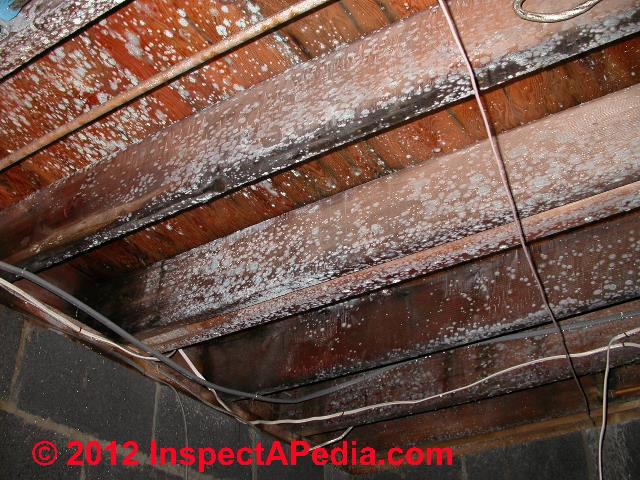
The steps in this document will be sufficient for many building owners who want to do their own mold investigation, mold testing, mold cleanup, and mold prevention in their home or office. The photos at the top of this page show the results of media blasting moldy wood surfaces.
InspectAPedia tolerates no conflicts of interest. We have no relationship with advertisers, products, or services discussed at this website.
How to Clean or Remove Mold, Moldy Debris, Other Indoor Environmental Contaminants - a Homeowner's Guide
 This article provides a succinct guide to mold cleanup for homeowners or tenants.
Protect the occupants and yourself:
from mold, demolition dust, debris, cleaning chemicals, etc.
Where a large area of cleanup is involved (more than 30 sq.ft.) a professional is usually called to establish negative air in the work area and to install containment barriers of plastic or other material to protect cleaner areas of the building from cross-contamination during the cleanup.
If you used a building environmental specialist to inspect and define the scope of work, you should have baseline mold test samples of both the work area and other building areas which will permit you to state definitively, at the end of the cleanup, whether or not the cleanup has caused cross-contamination of other building areas.
The spotless cleaning produced for the second photo above was obtained by using a professional who used
MEDIA BLASTING for MOLD REMOVAL to clean these surfaces. Such measures may be needed for large or complex surfaces, but quite often the necessary steps are less technical and less onerous, as we describe next.
Clean or remove mold and moldy debris:
The most succinct Mold Remediation or Mold Cleanup Guidelines one could
state would be this: the objective is not to sterilize your environment or "kill" mold, steps which are ineffective anyway - the operative words are "clean" or
"remove" problem mold and then to correct its cause.
If the total square feet of moldy material is less than 30 sq.ft.,
it is reasonable to handle the mold cleanup as an ordinary building cleaning or renovation procedure - hiring experts to establish negative air, dust containment, etc. is not required, but you should still take steps to minimize cross contamination in the building and to protect yourself and other occupants from moldy dust and debris.
If the total contiguous square feet of moldy material is large (more than 30 sq.ft.),
then you should consult a professional to inspect the building, find all of the problem mold areas, and to prepare a mold cleanup or mold remediation plan which will guide the mold remediation company (who should be a totally independent contractor in order to avoid conflicts of interest).
The mold consultant should also advise on the steps needed to prevent future mold growth - fix the causes of mold contamination.
If the mold cleanup is a costly project you should have the independent mold consultant perform a thorough visual and physical inspection of the building after the mold cleanup to assure that it was effective.
Note: some sources have amended the 30 square feet rule to 10 square feet as the size suitable for homeowner cleanup.
Remove and dispose of moldy items that cannot be effectively cleaned:
Moldy drywall, paneling, trim, carpets,
boxes, junk, are removed and disposed-of as construction debris or trash, either because the item cannot be effectively cleaned, or in some cases because the cost of cleaning exceeds the value of the object.
Be sure to remove building insulation that has been wet or smells moldy or has
been exposed to high levels of airborne mold.
See INSULATION MOLD CONTAMINATION TEST.
Usually moldy drywall and other debris can be disposed-of as ordinary construction debris or trash.
Scrubbing moldy surfaces - no sprays, no ozone, no sterilization:
We're talking about scrubbing here. It's the physical removal of moldy or allergenic debris that's important, not the surface sterilization.
The second we permit someone to "spray for mold" we can count on them to fail to do an adequate mold cleanup.
And if the moldy surface to be cleaned is "cleanable" so irregular or inaccessible as to make physical wiping or scrubbing impractical, you may want to
consider MEDIA BLASTING for MOLD REMOVAL.
What to Use to Clean Off Mold from Building Surfaces, Contents, Items
What to use to clean off mold from all of the exposed hard, cleanable surfaces: to clean off a moldy surface, you could use simple clean water, soapy water, spray cleaners, or if you prefer, a commercial biocide (follow their directions) or a dilute bleach cleaning solution.
But because so many readers have asked about specific mold "cleaning" or mold "killing" methods we list and comment on these approaches below.
At MOLD CLEANERS - WHAT TO USE we provide a detailed description of different methods people use to "clean off" or "kill" mold.
How to Use Bleach to Clean Up a Moldy Surface
Bleaching or "killing" mold is not the objective.
Bleach will not kill all of the mold anyway - we can tease viable spores out of lots of "bleached mold" samples we see in the lab.
The object of mold removal is to clean the surface, to remove loose moldy material, not to try to sterilize the surface.
Certain mold-contaminated materials that cannot be cleaned (drywall, carpeting, curtains) should be discarded. Clothing and bedding linens or towels can be washed or dry-cleaned.
Keep that in mind. If you want to use bleach as a cleaning agent instead of other cleaners (soap and water would work just fine) here are some mold cleanup suggestions for homeowners from the Canadian Mortgage and Housing Corporation CMHC.
See MOLD CLEANUP with BLEACH for details of how to mix and use bleach to clean a hard surface in a building as well as warnings about where bleaching mold is a cosmetic band-aid that just won't work. Here are the basics of using bleach to clean up a building surface:
- Dilute bleach with one part household bleach to four parts of clean water (do not add other cleaners to this solution as you may accidentally cause the release dangerous chlorine gas)
- Ventilate the work area
- Wear rubber gloves and eye protection
- Bleach exposure time: After physically cleaning and removing all loose mold, dirt, debris, from the surface being cleaned, let the solution stand on the surface for 10-15 minutes.
- Rinse the cleaned surface thoroughly
- Dry: Be sure that the cleaned surfaces are totally dry before restoring any building insulation, drywall, etc.
- Discard moldy fabrics or other similar materials that cannot be surface-cleaned.
Other Mold-Related Problems
CAR SMELL - Mold DEODORIZING - mold in cars, campers, trucks, RVs can be caused by water leaks and can make a moldy smell problem that's hard to cure.
Renters may also want to
see RENTERS & TENANTS GUIDE TO MOLD & INDOOR HAZARDS.
Home inspectors should
see MOLD TEST by HOME INSPECTORS?
Research & References
- Also see the citations at page endReferences or Citations
- ANSI Standard & Institute of Inspection Certification (2008). S520 Standard and Reference Guide for Professional Mold Remediation. Website: https://webstore.ansi.org/ Provided to ANSI by the Institute of Inspection, Cleaning and Restoration Certification [IICRC], cited below. Web: https://iicrc.org/
- HUD, REBUILD HEALTHY HOMES, GUIDE TO POST-DISASTER RESTORATION FOR A SAFE AND HEALTHY HOME [PDF] U.S. Department of Housing and Urban Development (HUD)
Check Credentials & Hire only licensed & insured contractors, see pp. 33-35
Cross-contamination protection, see pp.25-28 & pp. 39-40
Mold Removal Guidelines, see pp. 41 & 50-53
Remove previously or currently-wet or moldy insulation, foam padding, carpets, see pp. 48-49 - Johanning E1, Auger P, Morey PR, Yang CS, Olmsted E., "Review of health hazards and prevention measures for response and recovery workers and volunteers after natural disasters, flooding, and water damage: mold and dampness", Environ Health Prev Med. 2014 Mar;19(2):93-9. doi: 10.1007/s12199-013-0368-0. Epub 2013 Nov 20.
Abstract:
Health problems and illnesses encountered by unprotected workers, first-responders, home-owners, and volunteers in recovery and restoration of moldy indoor environments after hurricanes, typhoons, tropical storms, and flooding damage are a growing concern for healthcare providers and disaster medicine throughout the world.
Damp building materials, particularly cellulose-containing substrates, are prone to fungal (mold) and bacterial infestation. During remediation and demolition work, the airborne concentrations of such microbes and their by-products can rise significantly and result in an exposure risk. Symptoms reported by unprotected workers and volunteers may relate to reactions of the airways, skin, mucous membranes, or internal organs.
Dampness-related fungi are primarily associated with allergies, respiratory symptoms or diseases such as dermatitis, rhinosinusitis, bronchitis, and asthma, as well as changes of the immunological system. Also, cognitive, endocrine, or rheumatological changes have been reported.
Based on the consensus among experts at a recent scientific conference and a literature review, it is generally recommended to avoid and minimize unnecessary fungal exposure and use appropriate personal protective equipment (PPE) in disaster response and recovery work. Mycologists recommend addressing any moisture or water intrusion rapidly, since significant mold growth can occur within 48 h.
Systematic source removal, cleaning with "soap and water," and "bulk removal" followed by high-efficiency particulate air vacuuming is recommended in most cases; use of "biocides" should be avoided in occupied areas. Public health agencies recommend use of adequate respiratory, skin, and eye protection.
Workers can be protected against these diseases by use of dust control measures and appropriate personal protective equipment. At a minimum, a facial dust mask such as the National Institute for Occupational Safety and Health (NIOSH)-approved N95 respirator should be used for mold remediation jobs. For any large-scale projects, trained remediation workers who have medical clearance and use proper personal protection (PPE) should be employed. - Morey, Philip R. MICROBIAL REMEDIATION IN NON-INDUSTRIAL INDOOR ENVIRONMENTS [PDF] Chapter 12 in Sampling and analysis of indoor microorganisms, John Wiley & Sons, New York, NY, USA (2007): 231-242.
- Morey, Philip R. "Mold remediation in North American buildings." In Fundamentals of mold growth in indoor environments and strategies for healthy living, pp. 383-411. Wageningen Academic Publishers, 2011.
- Morey, P., Foarde, K., Klees, J., Streifel, A. "Microbiological Contaminants," IAQ '93 Operating and Maintaining buildings for Health, Comfort and Productivity, ASHRAE Conference, Philadelphia, Penn. Nov. 8-10,1993.
- Parrott, Kathleen R. MOLD REMEDIATION [PDF] (2009) Virginia Tech Cooperative Extension, Virginia State University, retrieved 2022/-6/-5 original source: https://vtechworks.lib.vt.edu/bitstream/handle/10919/50207/2901-7021.pdf?sequence=1
Excerpt:
Do I Need to Test for Mold?
If you can see mold or smell the distinctive musty odor of mold, you have mold. If you have water problems in your home that have caused building materials to become wet for extended periods of time, you probably have mold. Testing for mold will most likely not tell you anything you do not already know – you have mold, and it needs to be remediated. - Warscheid, Thomas. "Mold remediation in West-European buildings." In Fundamentals of mold growth in indoor environments and strategies for healthy living, pp. 413-433. Wageningen Academic Publishers, Wageningen, 2011.
Reader Comments, Questions & Answers About The Article Above
Below you will find questions and answers previously posted on this page at its page bottom reader comment box.
Reader Q&A - also see RECOMMENDED ARTICLES & FAQs
On 2022-10-19 by InspectApedia (Editor) - moldy drywall needs to be removed
@Natasha,
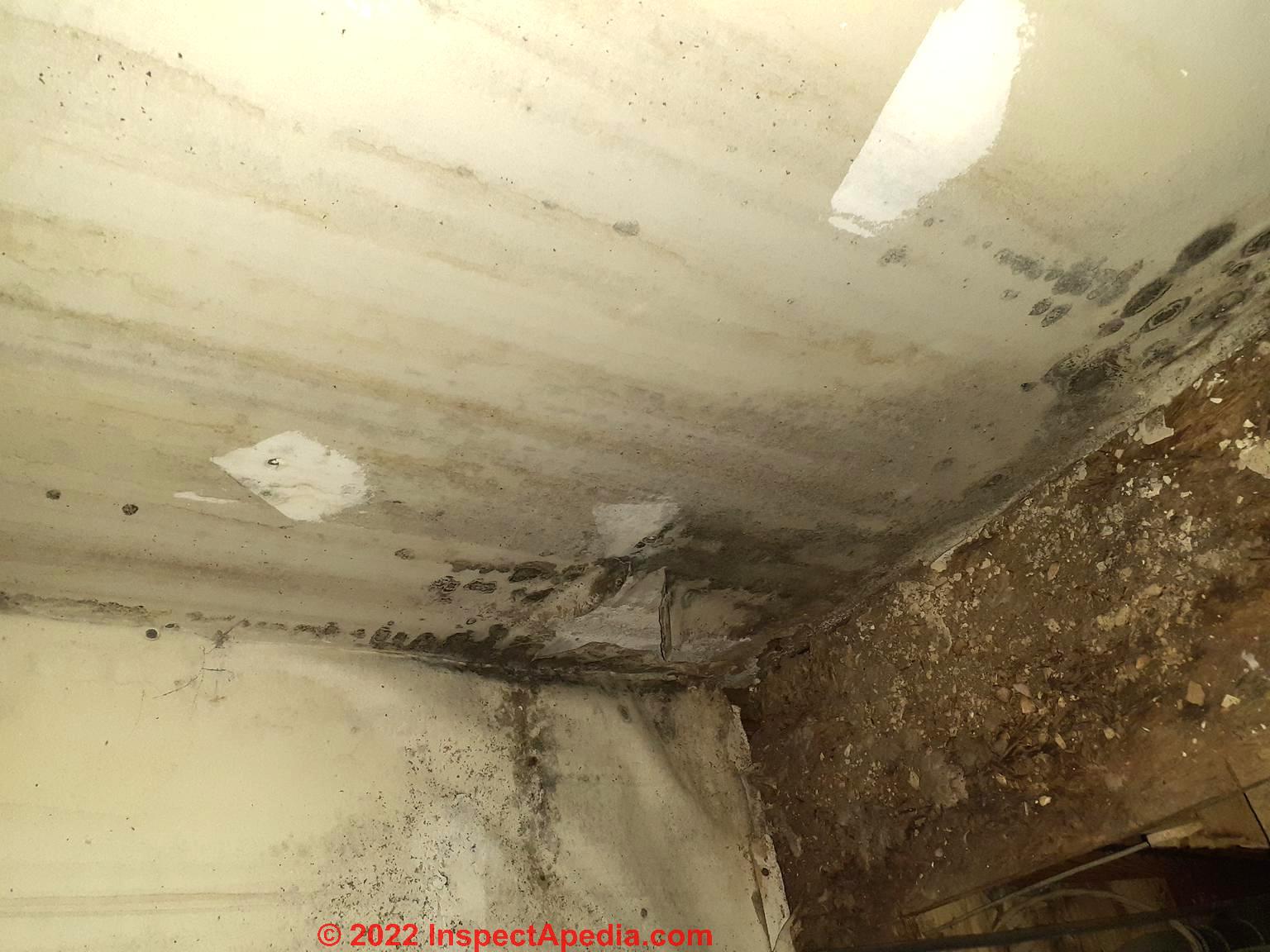
Sorry I really can't make out what's in your photo besides the white plastic piping. If there is gypsum board or drywall that is moldy then it needs to be completely removed.
In general, it's not necessary to identify the genera/species of mold in buildings before removing it: knowing the mold genera/species does not change what's needed one bit:
remove the mold
clean the exposed surfaces
fix its cause
If that's moldy drywall or gypsum board in your photo, it needs to be removed. Surface cleaning or spraying alone are not effective.
Also, that plastic drain looks improper and likely to leak - not to mention that it seems to be connected using plastic electrical tape.
On 2022-10-19 by Natasha
Is this and what kind of mould is this

On 2022-06-20 by InspectApedia-911 (mod) - multiple colors of mold indicate need for remediation
@Logan,
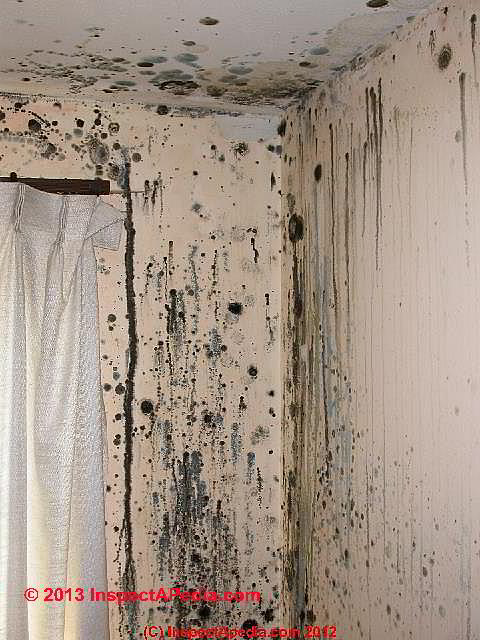
When you see that much mold growing on into a surfaces there's no doubt that there is harmful mold present.
It's a fundamental mistake to think that the only mold you care about is black in color. There are at least two hundred common mold genera / species that commonly grow in buildings, only a few of which are quite dark in color.
Fortunately knowing the mold genera and species doesn't change what's needed at all.
For the situation in your photo professional remediation is what's required.
That means remove the molding materials, clean the exposed surfaces, and find and fix leaks or moisture that caused the mold growth.
Take a look at the Mold Cleanup Guide above on this page.
On 2022-05-18 by Logan
What type of mold is this? Is it toxic black mold?
This Q&A were posted originally at
...
Continue reading at CARPET MOLD / ODOR TESTS or select a topic from the closely-related articles below, or see the complete ARTICLE INDEX.
Or see MOLD CLEANUP GUIDE - HOW TO GET RID OF MOLD FAQs - questions & answers posted originally at this page.
Or see these
Recommended Articles
- CHOOSE a FLOOD DAMAGE RESTORATION or MOLD REMEDIATOR
- MOLD ACTION GUIDE - WHAT TO DO ABOUT MOLD
- MOLD CLEANUP GUIDE- HOW TO GET RID OF MOLD - home
- CARPET MOLD / ODOR TESTS
- DISINFECTANTS, SANITIZERS, FUNGICIDAL-SEALANTS SOURCES
- FUNGICIDAL SEALANT USE GUIDE
- MOLD CLEANERS - WHAT TO USE
- MOLD CLEANUP with BLEACH
- MOLD CLEANUP, DRY THE MOLD-CLEANED SURFACE
- MOLD CLEANUP, LIMITATIONS
- MOLD CLEANUP - MISTAKES to AVOID
- MOLD CLEANUP, SAFETY WARNINGS
- MOLD CLEANUP - WOOD FRAMING & PLYWOOD
- MOLD CLEANUP - WOOD FLOORING
- MOLD & FUNGUS on WOOD SIDING: CLEAN & PREVENT
- MOLD REMOVAL, MEDIA BLASTING
- MOLD SANITIZER, SPRAY, BIOCIDE USE GUIDE
- OZONE MOLD KILL TREATMENT
- TRAPPED MOLD BETWEEN WOOD SURFACES
- MOLD CLEARANCE INSPECTIONS
Suggested citation for this web page
MOLD CLEANUP GUIDE- HOW TO GET RID OF MOLD at InspectApedia.com - online encyclopedia of building & environmental inspection, testing, diagnosis, repair, & problem prevention advice.
Or see this
INDEX to RELATED ARTICLES: ARTICLE INDEX to MOLD CONTAMINATION & REMEDIATION
Or use the SEARCH BOX found below to Ask a Question or Search InspectApedia
Ask a Question or Search InspectApedia
Questions & answers or comments about the best procedures to get rid of mold and mold smells in buildings
Try the search box just below, or if you prefer, post a question or comment in the Comments box below and we will respond promptly.
Search the InspectApedia website
Note: appearance of your Comment below may be delayed: if your comment contains an image, photograph, web link, or text that looks to the software as if it might be a web link, your posting will appear after it has been approved by a moderator. Apologies for the delay.
Only one image can be added per comment but you can post as many comments, and therefore images, as you like.
You will not receive a notification when a response to your question has been posted.
Please bookmark this page to make it easy for you to check back for our response.
Our Comment Box is provided by Countable Web Productions countable.ca
Citations & References
In addition to any citations in the article above, a full list is available on request.
- Canada Mortgage and Housing Corporation, CMHC, "Moisture and Air, problems and remedies, Householders Guide," NHA 5968, 1989, reprinted to 1995 cmhc-schl.gc.ca 800-668-2642. Cette publication est aussi disponible en francasi sus le tire: L'air et l'humidite - LNH 5969.
- A BRIEF GUIDE to MOLD, MOISTURE, and YOUR HOME, [PDF] U.S. Environmental Protection Agency US EPA - includes basic advice for building owners, occupants, and mold cleanup operations. See http://www.epa.gov/mold/moldguide.htm
- US EPA - MOLD REMEDIATION in SCHOOLS & COMMERCIAL BUILDINGS - - US EPA
- US EPA - UNA BREVA GUIA a MOHO / HONGO - en Espanol
- Mold Cleaning Procedures & Mold Remediation Standards Guidelines
- MN University of Minnesota - Fungal Abatement Safe Operating Procedure
- NY New York City Mold Remediation Guidelines - Assessment and Remediation of Fungi in Indoor Environments
- Our recommended books about building & mechanical systems design, inspection, problem diagnosis, and repair, and about indoor environment and IAQ testing, diagnosis, and cleanup are at the InspectAPedia Bookstore. Also see our Book Reviews - InspectAPedia.
- In addition to citations & references found in this article, see the research citations given at the end of the related articles found at our suggested
CONTINUE READING or RECOMMENDED ARTICLES.
- Adkins and Adkins Dictionary of Roman Religion discusses Robigus, the Roman god of crop protection and the legendary progenitor of wheat rust fungus.
- Kansas State University, department of plant pathology, extension plant pathology web page on wheat rust fungus: see http://www.oznet.ksu.edu/path-ext/factSheets/Wheat/Wheat%20Leaf%20Rust.asp
- A BRIEF GUIDE to MOLD, MOISTURE, and YOUR HOME, [PDF] U.S. Environmental Protection Agency US EPA - includes basic advice for building owners, occupants, and mold cleanup operations. See http://www.epa.gov/mold/moldguide.htm
- Allergens: Testing for the level of exposure to animal allergens is discussed at http://www.animalhealthchannel.com/animalallergy/diagnosis.shtml (lab animal exposure study is interesting because it involves a higher exposure level in some cases
- Allergens: WebMD discusses allergy tests for humans at webmd.com/allergies/allergy-tests
- Atlas of Clinical Fungi, 2nd Ed., GS deHoog, J Guarro, J Gene, & MJ Figueras, Centraalbureau voor Schimmelcultures, Universitat Rovira I Virgili, 2000, ISBN 90-70351-43-9
- A BRIEF GUIDE to MOLD, MOISTURE, and YOUR HOME, [PDF] U.S. Environmental Protection Agency US EPA - includes basic advice for building owners, occupants, and mold cleanup operations. See http://www.epa.gov/mold/moldguide.htm
- "Management of Powdery Mildew, Leveillula taurica, in Greenhouse Peppers," Ministry of Agriculture and Lands, British Columbia - Original source: www.agf.gov.bc.ca/cropprot/peppermildew.htm
- Fifth Kingdom, Bryce Kendrick, ISBN13: 9781585100224, - we recommend the CD-ROM version of this book. This 3rd/edition is a compact but comprehensive encyclopedia of all things mycological. Every aspect of the fungi, from aflatoxin to zppspores, with an accessible blend of verve and wit. The 24 chapters are filled with up-to-date information of classification, yeast, lichens, spore dispersal, allergies, ecology, genetics, plant pathology, predatory fungi, biological control, mutualistic symbioses with animals and plants, fungi as food, food spoilage and mycotoxins.
- Fungi, Identifying Filamentous, A Clinical Laboratory Handbook, Guy St-Germain, Richard Summerbell, Star Publishing, 1996, ISBN 0-89863-177-7 (English)
- US EPA: Mold Remediation in Schools and Commercial Building [Copy on file at /sickhouse/EPA_Mold_Remediation_in_Schools.pdf ] - US EPA
- US EPA: Una Breva Guia a Moho - Hongo [Copy on file as /sickhouse/EPA_Moho_Guia_sp.pdf - en Espanol
- In addition to citations & references found in this article, see the research citations given at the end of the related articles found at our suggested
CONTINUE READING or RECOMMENDED ARTICLES.
- Carson, Dunlop & Associates Ltd., 120 Carlton Street Suite 407, Toronto ON M5A 4K2. Tel: (416) 964-9415 1-800-268-7070 Email: info@carsondunlop.com. Alan Carson is a past president of ASHI, the American Society of Home Inspectors.
Thanks to Alan Carson and Bob Dunlop, for permission for InspectAPedia to use text excerpts from The HOME REFERENCE BOOK - the Encyclopedia of Homes and to use illustrations from The ILLUSTRATED HOME .
Carson Dunlop Associates provides extensive home inspection education and report writing material. In gratitude we provide links to tsome Carson Dunlop Associates products and services.
 | HOME | ABOUT | ASK a QUESTION | CONTACT | CONTENT USE POLICY | DESCRIPTION | POLICIES | PRIVACY | |
| © 2024 - 1985 Publisher InspectApedia.com - Daniel Friedman | |||||||||