
InspectAPedia® FREE Encyclopedia of Building & Environmental Construction, Diagnosis, Maintenance & Repair |
Question? Just ask us! InspectAPedia
|
 How to Reduce the Hazard of Asbestos Floor Tiles
or Sheet Flooring
How to Reduce the Hazard of Asbestos Floor Tiles
or Sheet Flooring
- POST a QUESTION or COMMENT On how to minimize the risk of asbestos contamination in a building due to the presence of asbestos-containing floor tiles or asbestos-suspect floor tile coverings
Asbestos floor tile or sheet flooring hazard reduction guide:
This document assists building buyers, owners or occupants in reducing the risk of asbestos exposure from flooring that contains or is suspected to contain asbestos.
Page top photo: asbestos-containing 9x9 floor tiles in a 1959 home, courtesy of Inspectapedia reader Steve. This floor is in good condition and should be left in place, covered-over.
InspectAPedia tolerates no conflicts of interest. We have no relationship with advertisers, products, or services discussed at this website.
Advice for Hazard Reduction for buildings with Vinyl Asbestos Floor Tiles
 Common sources of asbestos hazards in or on buildings include, among many other building materials, asbestos-containing flooring and flooring mastic adhesive.
Asbestos is safe and legal to remain in homes or public buildings as long as the asbestos materials are in good condition and the asbestos can not be released into the air.
Bottom line: Asbestos-suspect flooring, two cases, different options
- Asbestos-containing flooring or asbestos-suspect flooring in good condition
(like at the top of this page) can and should be left in place and covered over with new material like carpeting or new floor tiles or sheet flooring or even using a sealant or an epoxy paint. - Asbestos-containing flooring, or asbestos-suspect flooring that is damaged
(like our photo shown here) OR that must be damaged during renovations or removal needs more-careful handling.
Because extra costs will be involved in removing asbestos-containing materials from a building, if you don't know if your flooring contains asbestos your choices are
- Treat the floor as Presumed Asbestos-Containing Material (PACM)
- Have a representative sample of the flooring tested for asbestos
Foremost it is important to avoid creating an asbestos hazard by improper handling, and while it is usually reasonable to cover over asbestos floor tiles with a new layer of flooring, it is also important that you proceed properly, often with local expert advice.
Our reader's photo of a partly-demolished asphalt-asbestos floor tile installation shown above is an example of asbestos flooring dust and debris that might be created during demolition, including friable materials produced by chopping, sanding, sawing, or grinding old floor tiles or sheet flooring.
See details at
DOES THIS FLOOR CONTAIN ASBESTOS? - 5 easy questions to tell if your FLOOR probably contains asbestos -
If the floor contains asbestos or if you elect to treat it as PACM, broken flooring should be cleaned up using HEPA vacuuming and damp wiping, and further demolition should follow practices given at
ASBESTOS FLOORING REMOVAL GUIDE
Please note: In addition to asbestos-containing flooring, common sources of asbestos hazards in or on buildings include:
- asbestos-containing flooring mastic adhesive
- asbestos-containing roofing materials such as asbestos cement shingles or corrugated asbestos cement panels as well as asbestos used in some asphalt shingle products or in roof coatings and mastics
- asbestos-containing vermiculite used as building insulation
- asbestos used in paints
- asbestos in plaster and wall systems including drywall and joint compound
- asbestos-cement or "transite" siding, roofing, and piping
- asbestos containing window caulk, glazing compound, electrical wire insulation and other materials
Friable and non-friable asbestos are more thoroughly defined
at ASBESTOS DEFINITION & COMPOSITION
Friable Asbestos Particle Hazards from Asbestos-containing Floor Tiles or Sheet Flooring
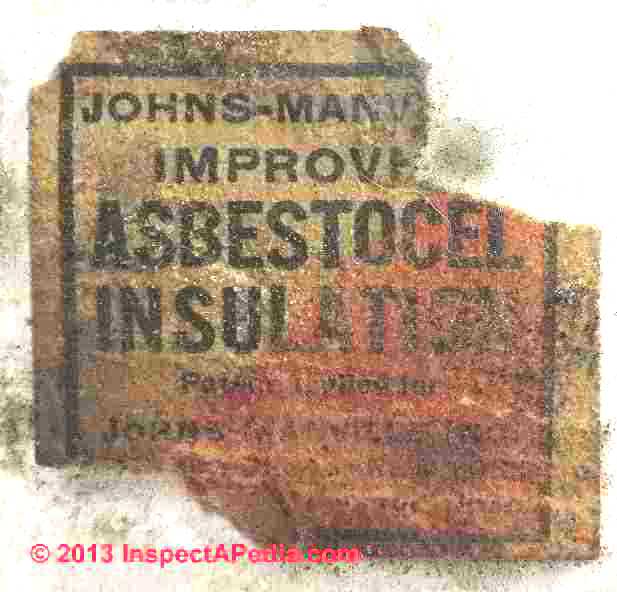
Friable asbestos material is any material containing more than 1 percent asbestos as determined using Polarized Light Microscopy (PLM), that, when dry, can be crumbled, pulverized, or reduced to powder by hand pressure. - (EPA p, 3)
Properly defined in plain english, "friable" asbestos means that one can easily produce powdered material, for example by rubbing asbestos pipe insulation between one's fingers to produce a crumbly dust
. In this regard your floor tiles are a mix of asbestos and vinyl or asphalt, and are not readily friable.
The definition of friable asbestos is important, because non-friable asbestos-containing material is less likely to be an asbestos hazard in buildings, unless it is mechanically ground or pulverized.
What produces measurable airborne asbestos-dust is either running equipment that mechanically grinds or sands the tile surface (including some industrial floor polishers) over the floor surface, or using aggressive means of demolition that produce lots of small fragments of broken tiles during renovations.
Because asbestos is a harmless material if not airborne and breathed-in or ingested (at sufficient quantity or volume), it's not as if the floor tiles are "radioactive" or harmful just sitting there, or better still, if covered the tiles will be protected from wear, damage, and future asbestos particle release.
U.S. EPA Definition of Nonfriable Asbestos Material
The US EPA in their "Asbestos NESHAP Adequately Wet Guidance" defines "nonfriable asbestos material" as
Nonfriable asbestos-containing material is any material containing more than 1 percent asbestos as determined by Polarized Light Microscopy (PLM) that, when dry, cannot be crumbled, pulverized, or reduced to powder by hand pressure. (Op Cit. p. 3)
By this definition, asphalt-asbestos and vinyl-abestos floor tiles are normally and virtually always non-friable materials.
Leaving Asbestos Floor Tiles in Place: Advice About Covering or Sealing Asbestos Floor Tiles

In this photo, courtesy of InspectApedia reader Grace, we see a 1958 vinyl-asbestos floor tile that is in good condition. Grace found this floor when she removed wall-to-wall carpeting, and you can still see the carpet tack strips at the left edge of the photo.
- The floor tiles are still well-adhered to the subfloor below.
- There are not broken nor missing floor tiles.
- If the carpet tack strips must be removed that will produce a small amount of broken flooring that should be cleaned-up using HEPA-vacuuming and damp-wiping.
- These floor tiles can and should be left in place.
- Because the flooring is to be left in place, testing to confirm that the floor contains asbestos (or doesn't) is not necessary.
- It would be appropriate to perform simple, non-abrasive surface cleaning to remove soil, grease, dust and dirt before covering this floor with new carpeting or by new floor tiles or sheet flooring.
Un-damaged asphalt-asbestos or vinyl-asbestos tiles or sheet-flooring materials are normally quite hard, not friable - not easily made into dust that can become airborne - and are best left in place and covered-over.
See details at ASBESTOS FLOORING LEFT IN PLACE - keep it and cover it.
Guidelines for Removing Asbestos-Containing Floor Tile (Vinyl-Asbestos Tile / Asphalt-Asbestos Tile)
Is Asbestos-Containing Floor Tile Removal Necessary?
We begin by suggesting that you should not remove asbestos-containing floor tile unless it is really necessary.
As with asbestos-containing products in general, the asbestos hazard at a building may be greater from disturbing asbestos-containing materials (ACM) than if they were left alone or covered up.
But in some cases, particularly during certain building renovations or when asbestos-containing flooring is in poor condition and cannot easily be left in place, removal may be necessary.
As we point out
at ASBESTOS FLOORING IDENTIFICATION, the US EPA points out
in ADEQUATELY WET ASBESTOS GUIDANCE, EPA340/1-90-019 that asbestos-containing floor tiles are considered non-friable materials but the materials can become friable with age or by grinding, sanding, demolition, etc.
Here is what the University of Minnesota has to say about the hazards of this type of asbestos-containing floor tiles:
Flooring that contains asbestos, when intact and in good condition, is generally considered nonfriable and is not hazardous.
Heat, water, weathering or aging can weaken flooring to the point where it is considered friable. Friable flooring includes any material containing more than 1 percent asbestos that can be crumbled, pulverized or reduced to powder with hand pressure.
This includes previously nonfriable flooring material which has been damaged to the extent that it may be crumbled, pulverized or reduced to powder by hand pressure.
Flooring can also be made friable during its removal.
Friable materials can release asbestos fibers into the air. Once in the air, asbestos fibers present a health hazard to people who inhale those fibers. - U. Minn atReferences or Citations
Watch out: if you must demolish or disturb asbestos-suspect flooring, because that process can create high levels of dust that might contain asbestos, it makes sense to have a sample of the flooring tested for asbestos before beginning work.
Short of testing, you would either treat the floor as PACM - Presumed Asbestos-Containing Material, which can add significantly to demolition and remodeling costs.
For making an educated guess before actual testing, there are five easy questions that can help tell you if an unknown floor covering contains asbestos, found at
DOES THIS FLOORING CONTAIN ASBESTOS?
Advice on Removing Asbestos-containing Asphalt or Vinyl Floor Tiles
Details for this topic are found at ASBESTOS FLOORING REMOVAL GUIDE. Excerpts are below.
First, here is the US EPA's general Asbestos Advice for Homeowners, quoting from ASBESTOS in YOUR HOME - U.S. EPA [PDF]
Asbestos Do's And Don'ts for the Homeowner
- Do keep activities to a minimum in any areas having damaged material that may contain asbestos.
- Do take every precaution to avoid damaging asbestos material.
- Do have removal and major repair done by people trained and qualified in handling asbestos. It is highly recommended that sampling and minor repair also be done by asbestos professionals.
- Don't dust, sweep, or vacuum debris that may contain asbestos.
- Don't saw, sand, scrape, or drill holes in asbestos materials.
- Don't use abrasive pads or brushes on power strippers to strip wax from asbestos flooring. Never use a power stripper on a dry floor.
- Don't sand or try to level asbestos flooring or its backing. When asbestos flooring needs replacing, install new floor covering over it, if possible.
- Don't track material that could contain asbestos through the house. If you cannot avoid walking through the area, have it cleaned with a wet mop. If the material is from a damaged area, or if a large area must be cleaned, call an asbestos professional.
Please see complete details at ASBESTOS FLOORING REMOVAL GUIDE
Asbestos Advice for Building & School Building Operators (may apply to other buildings)
A good introductory explanation to the possible risk of asbestos in schools and similar buildings is
at The ABCs of ASBESTOS in SCHOOLS [PDF] (August 2003), U.S. EPA, Web search 08/17/2010, original source: http://www.epa.gov/asbestos/pubs/abcsfinal.pdf - aqui se encuenta la misma documenta escrito en Espan~ol: El ABC del Asbestos en las Escuelas, (copy on file as /sickhouse/EPA_Asbestos_ABCs_Schools.pdf ) fuente original: http://www.epa.gov/asbestos/pubs/spanishabcs.pdf
Quoting from that document:
In general, as with cigarette smoking, the more asbestos fibers a person inhales, the greater the risk of developing an asbestos-related disease. The most severe health problems from asbestos exposure have been experienced by some workers who held jobs in industries such as shipbuilding, where they were exposed to very high levels of asbestos in the air.
These employees worked directly with asbestos materials on a regular basis as a part of their jobs. Much uncertainty surrounds the risk from exposure to low levels of asbestos fibers.
Nevertheless, the risk of school children being exposed to even low levels of asbestos is a concern. Acting on this concern, Congress passed the Asbestos Hazard Emergency Response Act (AHERA) in 1986 to protect school children and school employees from exposure to asbestos in school buildings. This pamphlet describes key parts of these federal asbestos requirements for schools.
Operators of schools and other public buildings should see the U.S. EPA's ASBESTOS REGULATIONS FOR SCHOOLS (the Asbestos Hazard Emergency Response Act, "AHERA") [PDF] (live link given just below); these guidelines require that an accredited inspector re inspect school buildings at least once every three years to reassess the condition of ACM.
Asbestos Hazard Control Guidelines
- ASBESTOS ENCAPSULANTS & SEALERS - Sealant Paints & Coatings for Asbestos, Asbestos Cement or Transite Surfaces
- ASBESTOS IN YOUR HOME [PDF] U.S. EPA, Exposure Evaluation Division, Office of Toxic Substances, Office of Pesticides and Toxic Substances, U.S. Environmental Protection Agency, Washington,D.C. 20460
- ASBESTOS NESHAP ADEQUATELY WET GUIDANCE [PDF] EPA340/1-90-019, [PDF] December 1990, U.S. ENVIRONMENTAL PROTECTION AGENCY, Office of Air Quality Planning and Standards, Stationary Source Compliance Division, Washington, DC 20460, original web source: http://www.epa.gov/region04/air/asbestos/awet.htm
- ASBESTOS REGULATIONS FOR SCHOOLS (the Asbestos Hazard Emergency Response Act, "AHERA") [PDF] (96 pp, 589k), U.S. Environmental Protection Agency (EPA) - web search 08/17/2010, original source: http://www.epa.gov/asbestos/pubs/2003pt763.pdf,
- DISINFECTANTS, SANITIZERS, FUNGICIDAL-SEALANTS SOURCES - includes floor sealers & primers
- HOW to MANAGE ASBESTOS in SCHOOL BUILDINGS, AHERA Designated Person Self Study Guide [PDF] U.S. EPA 910-B-96-001, January 1996, web search 08/17/2010, original source: http://www.epa.gov/region2/ahera/e23.pdf
- Asbestos in buildings: Guidance for Service and Maintenance Personnel ("Custodial Brochure") (July 1985) - available by telephone from the TCSA
- Guidance for Controlling Asbestos Containing Material in buildings ("Purple Book") (June 1985) - available by telephone from the TCSA
- Fact Sheet/Press Release--EPA Releases Asbestos-in-Public-buildings Study and Recommendations to Congress: Extent and condition of asbestos containing materials in public and commercial buildings (February 1988) - available by telephone from the TCSA
- HOW to REMOVE NONFRIABLE VINYL ASBESTOS FLOOR TILES (A Guide for Meeting DEQ Rules), [PDF] State of Oregon Department of Environmental Quality, Asbestos Program, retrieved 2016/12/02, original source: http://www.deq.state.or.us/aq/asbestos/docs/Asbflr.pdf
- MANAGING ASBESTOS in PLACE: A Building Owner's Guide to Operations and Maintenance Programs for Asbestos-Containing Materials [PDF] ("Green Book"), web search 08/11/2010, original source: http://www.epa.gov/asbestos/pubs/management_in_place.html
How to Develop and Maintain a Building Asbestos Operations and Maintenance (O&M) Program, This information is designed to assist building owners and managers in understanding how to develop and maintain an operations and maintenance program for asbestos-containing materials in their buildings.

Above: Except from EPA's Guide to Demolition Practices (for non-friable asbestos material categories and handling) cited just below.
[Click to enlarge any image]
- US EPA A GUIDE TO NORMAL DEMOLITION PRACTICES UNDER THE ASBESTOS NESHAP EPA 340-1-92-013 [PDF] retrieved 2019/08/30
- US EPA ASBESTOS / NESHAP REGULATED ASBESTOS CONTAINING MATERIALS GUIDANCE EPA 340-1-90-018 [PDF] retrieved 2019/08/30
- US EPA ASBESTOS MATERIALS BAN: CLARIFICATION 1999
- US EPA GUIDANCE FOR CATASTROPHIC EMERGENCY SITUATIONS INVOLVING ASBESTOS [PDF] (2009)
Excerpt:
Any building may contain asbestos. Inhalation exposure can occur when asbestos containing material (ACM) is disturbed and releases fibers.
Keeping material wet and contained minimizes emissions.
It is important to not burn or grind asbestos-containing material where doing so will result in the discharge of visible emissions to the air. In addition, units which burn asbestos may need permits under the Clean Air Act (CAA) and state solid waste requirements.
It is important to comply with regulatory requirements related to the renovation or demolition of buildings and the transport and disposal of asbestos-containing waste material.
EPA did not ban all commercial asbestos.
Inhalation of asbestos fibers is extremely hazardous. Health effects generally take 15 years or longer before they are identified by medical personnel. Health consequences can be severe and include asbestosis, lung cancer, and mesothelioma. - "Asbestos in your home or at work," Forsyth County Environmental Affairs Department, Winston-Salem NC 12/08
- "Asbestos Floor Tile Removal", the University of Minnesota's advice on removing VAT (vinyl asbestos or asphalt asbestos floor tile) can be read in detail at www.health.state.mn.us/divs/eh/asbestos/floor tile/index.html
Reader Comments, Questions & Answers About The Article Above
Below you will find questions and answers previously posted on this page at its page bottom reader comment box.
Reader Q&A - also see RECOMMENDED ARTICLES & FAQs
 ...
...
Question on reducing asbestos floor tile health risks in Spain
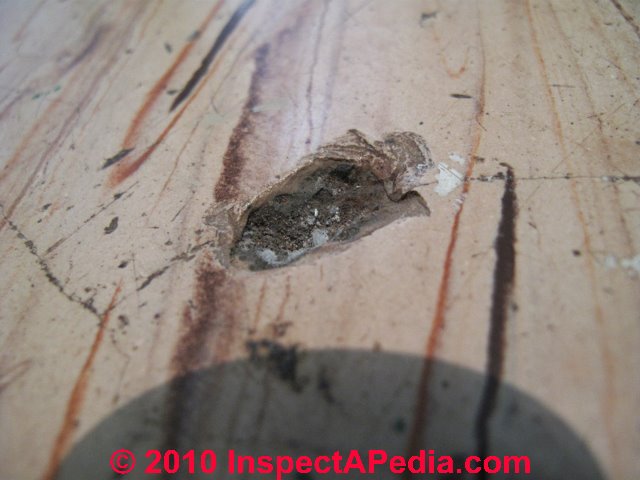
I live in Spain, in a house built in 1967, and I'm quite worried because I suspect that the floors of my house may contain asbestos. I have a baby is 9 month old crawling around the house.
[Click to enlarge any image]
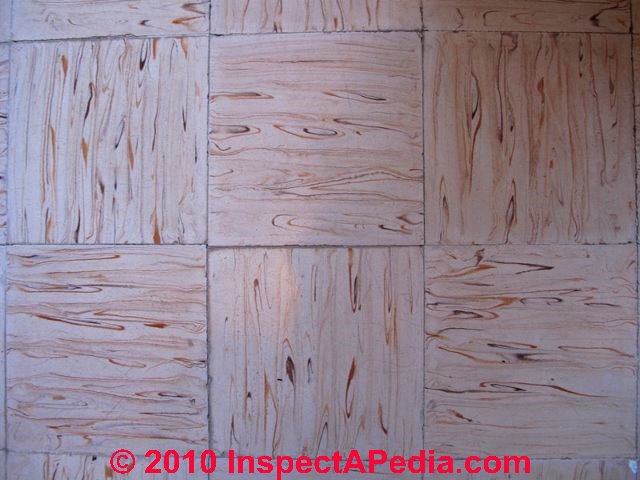
In several rooms I have a flaming ground, looking quite similar to many of the photos seen on your site. In some areas has deteriorated and has holes that emit or accumulate dust.
I'm not sure my flooring matches those shown on your site. I am sending photos (see image at left). if you are able to recognize or catalog. I really did not even know if this flooring vinyl or other material.
The floor tiles are quite thick (about 3 cm), with a thin layer of material seen (a few millimeters) and then a mortar or something similar. The asbestos-suspect floor tiles measure 25x25cm.
I hope you can advise me on the matter, think that contain asbestos? If so, what I can do at home? -- I.B., Spain
Answer:
Very small areas of damage like that shown in your photo are not a meaningful asbestos hazard but it would be good practice to clean the gouge and seal it using a at least a compatible clear sealant such as shellac or epoxy. Color-matched fillers are also available.
We have not seen this exact tile pattern before, but from our records it looks a bit like some of the Kentile flooring made in the U.S. (though yours is unlikely to be Kentile and your material is much thicker). Quite possibly your flooring was produced by a European manufacturer and is none of the brands for which we have data.
Our opinion includes the consideration that while foremost it is important to avoid creating an asbestos hazard by improper handling, and while it is usually reasonable to cover over asbestos floor tiles with a new layer of flooring, it is also important that you proceed properly, with local expert advice, so as to avoid creating inappropriate fear on the part of other users of the building.
Reader Question: How do I Determine if this 1930's Flooring Contains Asbestos & Can the Floor be Retained?
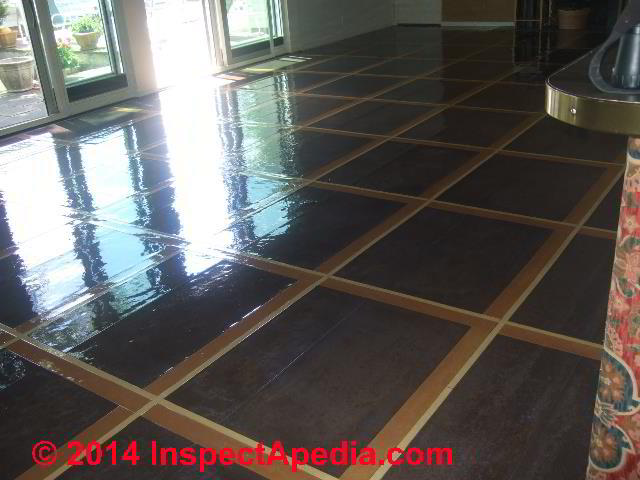 I am trying to find out what my floor is made of (photo at left). Also if it contains asbestos. It was installed in 1935
when the house was built. Thank you so much.
I am trying to find out what my floor is made of (photo at left). Also if it contains asbestos. It was installed in 1935
when the house was built. Thank you so much.
I have had a hard time keeping a protective finish on it. It hates water and will turn opaque where water gets on it as you can see from the picture in the foreground. - S.T. 2/17/2014
Moderator Reply:
I can't say for sure from just the photo but the colors make me think of a cork floor product; Can you send me some sharp photos giving a closer look at the floor surfaces?
Reader follow-up:
You bet!! The measured the depth of the floor is 3/16 of an inch.
The material is solid color throughout.
There is no backing, just solid material.
The chocolate brown is in 2 pieces for each square. The pieces are 18" by 36” and 10” by 36” for a total size of 28 X 36.

The copper color measures 3” by 36” and the blonde is 1” by 6 ft (largest piece I could find)
This is a large room about 20 X 40ft.
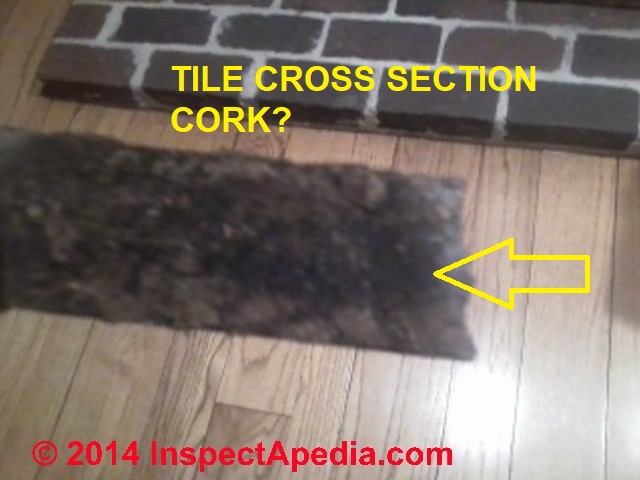
This house was built in 1935 by my great grandmother and has a lot of art deco elements. I have a lot of the original receipts but nothing I recognize as flooring.
I have a piece of the flooring and took pictures with my cell phone.
I have trolled online looking for information but it seems to be very hard to determine the material. I don’t believe it is cork.
I think it is solid vinyl.
The other floors in this house are 9” chocolate brown linoleum. I was unable to save those floors because they shattered when I tried to remove the carpet tack strips my parents used with wall to wall carpet in the 1970’s.
The linoleum was much less flexible than this floor. With this floor material I was able to carefully remove the tack strips.
It is actually flexible. It will break if bent too far but it will bend a little. This picture was taken right after finish was still drying. Shows the 2 pieces of the chocolate brown.
Moderator comments
About all I can guess from just photographs and without lab testing (which I'm not sure is justified) is:
Photo at above left looks like solid something - vinyl most likely from the color. See my comment below about rubber floor tiles;
Photo at above right, rather blurry, looks like cork floor tile held in cross section or "edge view", held up close to the camera, and for other readers, no this is not a bearskin rug on the floor.
Bottom Line:
If the floor is in good shape and you don't want to ruin its look by an epoxy paint, if you have not already completed applying a hard clear surface sealant (which I suspect you have) I'd look at liquid wax stripping and cleaning followed by coating with a clear sealant like the ones I discuss in this article series.
If the floor surface is sealed and un-damaged it's not going to be a particle source.
Rubber Floor Tiles?
There were also some rubber finish-flooring products in your other photos (not shown here).
The rubber-backed floor tiles I'm familiar with were red or black in cross section; Rubber flooring would be more flexible; usually older asphalt-asbestos or even vinyl asbestos (excluding the self-adhesive lines) are by now quite brittle and would break rather than bend unless heated.
Examples of rubber-backed flooring are
at ARMSTRONG RUBBER BACKED RUG PATTERNS
I would preserve what can be preserved, sealing the top surface with a clear coat; and for any cleanup of damaged flooring follow the safe procedures like wetting & HEPA vacuuming discussed
at ASBESTOS FLOORING REMOVAL GUIDE
Curiously some of my references assert that even rubber-based floor tiles up to the late 1970's or very early 80's contained asbestos filler.
...
Continue reading at ASBESTOS FLOORING LEFT IN PLACE for more detailed procedures & products suggested for keeping an intact asphalt asbestos floor or vinyl asbestos floor in place or select a topic from the closely-related articles below, or see the complete ARTICLE INDEX.
Or see ASBESTOS FLOORING HAZARD REDUCTION FAQs - questions & answers posted originally at this page
Or see these
Recommended Articles
- ASBESTOS FLOORING HAZARD LEVEL ASSESSMENT
- ASBESTOS FLOOR TILE COMPOSITION
- ASBESTOS FLOORING DAMAGE HAZARDS - what sorts of damage to an asbestos-containing floor covering are likely to require further action?
- ASBESTOS FLOORING HAZARD LEVEL ASSESSMENT - how dangerous is asbestos-containing flooring in a building?
- ASBESTOS FLOORING HAZARD REDUCTION - things you can do to minimize asbestos particle or fiber release from an existing asphalt asbestos or vinyl asbestos floor: tiles or sheet flooring
- ASBESTOS FLOORING LEFT IN PLACE - steps to avoid an asbestos hazard
- ASBESTOS FLOORING REMOVAL GUIDE - how to remove asbestos-containing flooring while minimizing the asbestos release or exposure hazard
- ASBESTOS REMOVAL, WETTING GUIDELINES
- ASBESTOS TESTING LAB LIST
- DOES THIS FLOOR CONTAIN ASBESTOS? - 5 easy questions to tell if your FLOOR probably contains asbestos -
- HAZARD vs RISK - what's the difference, why you should care
Suggested citation for this web page
ASBESTOS FLOORING HAZARD REDUCTION at InspectApedia.com - online encyclopedia of building & environmental inspection, testing, diagnosis, repair, & problem prevention advice.
Or see this
INDEX to RELATED ARTICLES: ARTICLE INDEX to ASBESTOS HAZARDS
Or use the SEARCH BOX found below to Ask a Question or Search InspectApedia
Ask a Question or Search InspectApedia
Questions & answers on how to minimize the risk of asbestos contamination in a building due to the presence of asbestos-containing floor tiles or asbestos-suspect floor tile coverings.
Try the search box just below, or if you prefer, post a question or comment in the Comments box below and we will respond promptly.
Search the InspectApedia website
Note: appearance of your Comment below may be delayed: if your comment contains an image, photograph, web link, or text that looks to the software as if it might be a web link, your posting will appear after it has been approved by a moderator. Apologies for the delay.
Only one image can be added per comment but you can post as many comments, and therefore images, as you like.
You will not receive a notification when a response to your question has been posted.
Please bookmark this page to make it easy for you to check back for our response.
Our Comment Box is provided by Countable Web Productions countable.ca
Citations & References
In addition to any citations in the article above, a full list is available on request.
- In addition to citations & references found in this article, see the research citations given at the end of the related articles found at our suggested
CONTINUE READING or RECOMMENDED ARTICLES.
- Carson, Dunlop & Associates Ltd., 120 Carlton Street Suite 407, Toronto ON M5A 4K2. Tel: (416) 964-9415 1-800-268-7070 Email: info@carsondunlop.com. Alan Carson is a past president of ASHI, the American Society of Home Inspectors.
Thanks to Alan Carson and Bob Dunlop, for permission for InspectAPedia to use text excerpts from The HOME REFERENCE BOOK - the Encyclopedia of Homes and to use illustrations from The ILLUSTRATED HOME .
Carson Dunlop Associates provides extensive home inspection education and report writing material. In gratitude we provide links to tsome Carson Dunlop Associates products and services.
 | HOME | ABOUT | ASK a QUESTION | CONTACT | CONTENT USE POLICY | DESCRIPTION | POLICIES | PRIVACY | |
| © 2024 - 1985 Publisher InspectApedia.com - Daniel Friedman | |||||||||