
InspectAPedia® FREE Encyclopedia of Building & Environmental Construction, Diagnosis, Maintenance & Repair |
Question? Just ask us! InspectAPedia
|
 Septic Tank Inspection
How to Inspect Septic Tank Condition
- POST a QUESTION or COMMENT about "how do you inspect or test a septic tank - what septic tank problems can be seen and what problems can be found before, during, or after pumping out the septic system.
How to inspect the condition of a septic tank: this document describes in detail how to inspect the condition of a septic tank - a key component in onsite wastewater disposal systems.
We describe what to look for at three distinct septic tank inspection points: before pumping, during pumping, & after the septic tank has been emptied.
After discussing a list of things to watch for before, during, and after pumping or cleaning out a septic tank, we discuss specific septic system inspection details and concerns for steel septic tanks, concrete septic tanks, home made septic tanks, fiberglass or plastic septic tanks, and the condition of septic tank baffles.
InspectAPedia tolerates no conflicts of interest. We have no relationship with advertisers, products, or services discussed at this website.
Inspecting Septic Tanks: How to Inspect the Condition of A Septic Tank
The purpose of the treatment tank or "septic tank" is to contain solid waste and to permit the beginning of bacterial action to process sewage into a combination of clarified effluent, settled sludge, or floating scum in the tank.
An intact, un-damaged septic tank is normally always filled with these materials.
However the inspector performing a "visual" check of the septic system needs to be alert for some important findings which we describe below.
Here we will discuss the following:
- How to inspect the septic tank for problems before and after the tank is pumped or cleaned
- Critical life-safety warnings for people inspecting septic tanks
- A septic tank inspection checklist
- Types of Septic Tanks: steel septic tanks, concrete septic tanks, fiberglass septic tanks, home made septic tanks - definitions and characteristics of various types of septic tanks
- Inspection specifics each different type of septic tank
- Inspection specifics for septic tank baffles, septic tank sludge and scum levels or thickness
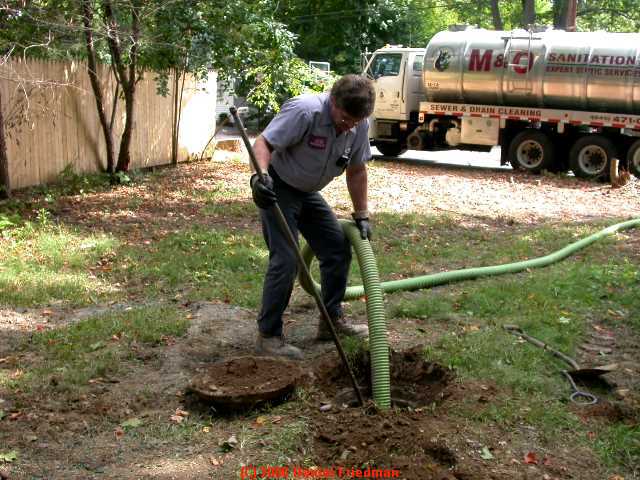
Our photograph above shows a septic tank that has been opened with pumping in progress. You can see the septic pumping truck in the background. The septic pumping contractor is using a long handled tool to stir the septic tank scum and sludge to break up these deposits to ease their removal from the septic tank.
[Click to enlarge any image]
How to Inspect the Septic Tank Before & After Pumping
 If you have not already reviewed SEPTIC TANK SAFETY please
do so before continuing in this section. There are serious risks of injury, explosion, and
death if safe procedures are not followed when working on septic systems.
If you have not already reviewed SEPTIC TANK SAFETY please
do so before continuing in this section. There are serious risks of injury, explosion, and
death if safe procedures are not followed when working on septic systems.
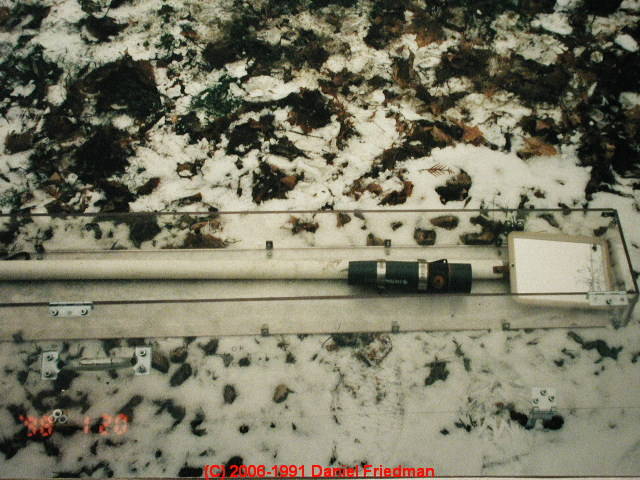
Our photograph illustrates a simple but effective septic tank inspection tool: an extension pole that sports an adjustable mirror and a bright flashlight.
The septic tank mirror, set to an appropriate angle, combined with light from the flaslight, permits inspection of the interior of the septic tank after it has been emptied.
The septic pumping contractor may check the condition of the septic tank baffles, the cleanliness of the septic tank, and she will look for cracks, breaks, or damage that might explain a septic tank leak.
Septic Tank Safety Warnings
Watch out: Read these life-safety warnings before attempting to open, inspect, or do anything to a septic tank.
- Don't work alone:
Falling into a septic tank or even leaning over a septic tank can be fatal. Do not work on or at septic tanks alone - workers can become suddenly overcome by methane gas. - Do not ever go into a septic tank to inspect or repair it
unless you are specially trained and are wearing the special equipment and gear for that purpose, including self-contained breathing apparatus. - Don't enter the septic tank to rescue someone:
Never go into a septic tank to retrieve someone who has fallen in and was overcome by toxic gases without a self-contained breathing apparatus (SCBA). if a SCBA is not available, call for emergency services and put a fan at the top of the tank to blow in fresh air. - Don't even lean over the septic tank openings:
Do not lean over or stick your head into the septic tank to examine its interior - you could fall in to the tank or become overcome by gases and fall into the tank, an event which is likely to be fatal. - Don't ignite flames near the septic tank:
Do not light a flame at or near the tank - methane gas is explosive.
At one tank pumpout my client described the explosion and burns received by the pumping contractor when he stood by the tank and lit a cigarette. Another exploded their septic tank by burning brush that was piled over the tank. - Work area around the septic tank must be ventilated:
Decomposing wastes in the septic tank produce toxic gases (such as methane) which can kill a human in a matter of minutes. When working on a tank be sure the area is well ventilated. - Rope off Dangerous Septic Tanks, Cesspools, Drywells, Work Sites:
If your inspection discover that there are dangerous conditions, such as an unsafe tank cover, tank collapse, or a home-made septic tank or cesspool (which are at increased risk of sudden collapse) such areas should be roped off and clearly marked as dangerous to prevent access until proper evaluation and repairs can be made. - If you have not already reviewed our complete SEPTIC TANK SAFETY article please do so before continuing in this section. There are serious risks of injury, explosion, and death if safe procedures are not followed when working on septic systems.
A Septic Tank Inspection Checklist
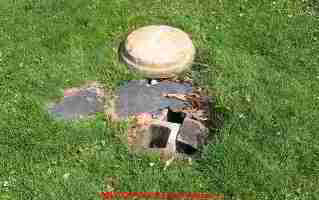 Inspecting the Septic Tank and Septic Tank Area Before Opening the Septic Tank
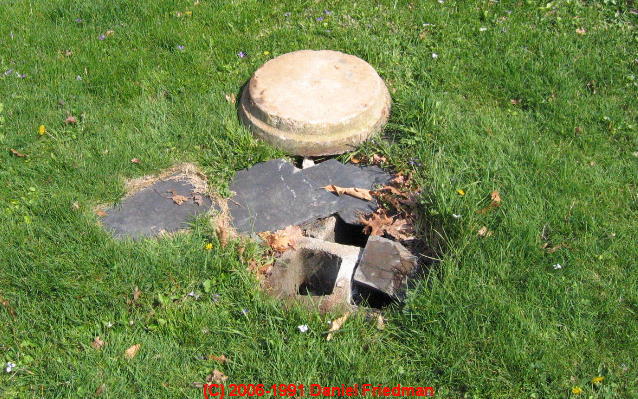
- Subsidence (depressions or low areas in the soil) at the septic tank location:
may risk dangerous, potentially fatal collapse - Recent work, excavation, modifications:
Evidence of recent work which may need to be investigated to understand the condition of the septic system - Evidence of backup or effluent breakout
at the surface in the septic tank area
also see SEPTIC TANK GRASS or SNOWMELT - Important Safety Check: Inspect the Condition of the Septic Tank Covers:
Condition and safety of the tank and access covers.
In the photo shown here a round concrete septic tank cover was placed over collapsing concrete blocks stacked to provide an access to a septic tank.
There was a septic tank collapse risk and a possible fatal hazard which at this property was an area only three meters from a children's playground.
The stacked concrete blocks were tumbling and the opening into the septic tank was larger than the cover.
We covered the area with plywood, roped it off, and informed the appropriate parties including the property owner.
A safe septic tank cover on a concrete tank is shown in a photo below where we discuss concrete septic tanks.
Probing in the area of a tank, without excavation, is not recommended as the probe may damage a steel or fiberglass tank.
Inspecting the Septic Tank After Opening the Septic Tank but Before Pumping
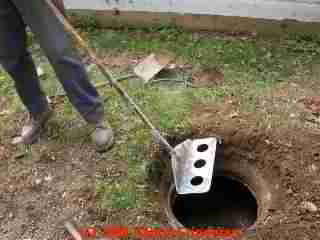 When a septic tank has been located and uncovered for pumping, additional critical details may be observed before the pumping operation begins.
After Opening But Before Pumping the Septic Tank:
When the septic tank is opened before it has been pumped out or cleaned, important information about the condition of
the septic system is available:
- Thickness of scum and sludge levels:
Septic tank maximum scum and sludge buildup prior to pump out, and instructions for measuring the floating scum layer thickness and settled sludge layer thickness in a septic tank are available in a separate chapter
at SEPTIC TANK PUMPING SCHEDULE.
At SEPTIC TANK LEVELS of SEWAGE we explain the meaning of thick or thin scum or sludge levels and high or low levels of sewage in the septic tank.
At TOOLS for MEASURING SCUM & SLUDGE we describe simple tools that are used to examine the condition of the septic tank before it is pumped. - Back-flow of effluent into the tank during pumpdown -
an indicator of flooded leach fields
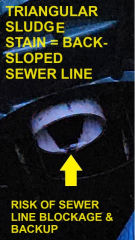
- Condition of the Septic Tank Inlet & Outlet PIping: back-sloped sewer line risks sewage backup
An experienced septic tank installation and service expert from a company in Two Harbors Minnesota pointed out to us the dark triangular stain at the mouth of this waste pipe that empties into the receiving end of a septic tank [shown above].
A stain in this location or accumulated sludge indicates that instead of flowing into the septic tank, wastewater sits in the pipe. That in turn tells us that the waste line between building and septic tank either has a sag or is back-sloped, not draining into the septic tank.
Properly a sewer line between building and septic tank slopes between 18/" and 1/4" a foot towards the septic tank, not away from it.
A back-sloped sewer line risks holding solid waste that can ultimately cause a blocked sewer line and a sewage backup into the building. The risk is increased if the building sits unoccupied for long periods as the blocked material also dries out and solidifies, growing over time as it blocks more waste from passing through.
This problem is made worse where low-flush toilets are installed because the lower volume of water increases the risk that solids are left behind in the sewer line between building and septic tank.
At this septic tank, by flushing toilets and running water during the septic inspection we were able to push solid waste, toilet paper and feces, out into the septic tank. The septic contractors suggestion, costing far less than digging up and replacing the sagged or improperly installed components was that building occupants flush toilets an extra time when used.
In an area where water is scarce occupants may balance the cost of wasting an extra gallon of water with the cost of an excavation to reinstall the sewer line or in the worst-case, reinstall the septic tank to put it at a lower depth.
In an area where water is plentiful the extra wastewater discharged into the septic is in fact ultimately returned to the environment and may be less of a worry. - Condition of the Septic Tank Baffles or Tees:
damage to the tank baffles. Evidence of a broken concrete septic tank baffle is shown below at our discussion of home made site built tanks, and a rusted-steel septic tank baffle is shown in other photographs on this page.
See SEPTIC TANK BAFFLES for an explanation of how to observe clues at the septic tank baffles or tees to look for signs of tank flooding when opening the septic tank for cleaning, pumping, or inspection.
- Liquid and waste level in the tank:
evidence of waste passing over the baffles - a flooded system, an indicator of septic system failure. Evidence of sewage flowing over the septic tank baffle is shown in a photo below where we describe septic tank baffles. - Unusually high levels of sewage in the septic tank -
suggesting a blocked outlet or drainfield. The drainfield may be failing due a damaged or clogged pipe, a clogged, failing drainfield, or due to groundwater leaks into the septic tank or groundwater that saturates the drainfield. - Unusually low levels of sewage in the septic tank -
suggesting that the septic tank has a leak, can have several causes depending on the tank age and the material from which it was built. - Low Sewage Levels in Concrete septic tanks:
If the tank is made of concrete it should be pumped and cleaned thoroughly so that your contractor can inspect the tank for cracks or other damage. - Low Sewage Levels in Plastic/Fiberglass septic tanks:
after pumping the tank, look for a lost drain plug in the tank bottom. Even pumping the tank can accidentally remove this plug - a condition you won't notice until the next time it's pumped. - Low Sewage Levels in Steel Septic Tanks:
Pump the tank completely, clean and inspect for rust holes - it's common for the bottom of such tanks to rust completely away. - Low Sewage Levels in Home Made or Site Built Septic Tanks:
Watch out: there is risk of tank collapse or leaks when septic tanks are site-built such as using concrete blocks or stone. Leaks are likely. Similarly, pumping out a site-built cesspool or drywall also risks fatal collapse hazards.
See SEPTIC TANK LEAKS - for an explanation of how and why septic tank leaks cause septic system failures.
See SEPTIC TANK LEVELS of SEWAGE for an a discussion of: What Do the Levels of Sewage in the Septic Tank Mean about Septic Tank Condition, Septic Tank Leaks, & the Timing of Septic Tank Pumping.
Septic tank leaks are also discussed
Septic Tank Solids: floating scum & settled sludge thickness, net free area, effluent retention time
Solids entering a septic tank are intended to remain there until pumped out during tank service. A large portion of solids settle to the bottom of the tank as sludge.
Grease and floating scum remain at the top of the sewage in the tank. Baffles (discussed above) help keep solids, scum, and grease in the tank. Bacterial action in the tank make a modest reduction in the solids volume and begin the processing of sewage pathogens, a step later completed by soil bacteria in the absorption fields.
A separate document, MEASURE SEPTIC TANK SCUM & SLUDGE, discusses how and why to measure septic tank scum and sludge
Net free area in the septic tank: If the sludge level becomes too high or the floating scum layer too thick, in addition to risking passage of solids out of the tank (damaging the absorption system), the remaining "net free area" of liquid in the tank is reduced. When the net free area becomes too small, there is insufficient time for waste entering the tank to settle out as bottom sludge or top floating scum.
The time allowed for sewage to separate and settle out as sludge or collect as floating scum is called septic tank retention time. Retention time is discussed further
"Septic Effluent Retention time and Effective Septic Tank Volume - Why pump a septic tank before it is "full" of solids and grease?".
For an in-use septic tank with a small net free area, and therefore a short septic effluent retention time, the frequent entry of solid and liquid waste will keep the tank debris agitated, thus forcing floating debris into the absorption system where the life of that component will be reduced (due to soil clogging).
The importance of keeping an adequate net free area in a septic tank is the reason that tanks need to be pumped at regular intervals. Building owners who never pump a tank until it is clogged have already damaged the absorption system and reduced its future life expectancy.
Septic Tank Inspection During Tank Pumping

During Septic Tank Pumping: if the pumper observes (or hears) septic effluent flowing back into the septic tank from the tank outlet pipe this is a sure indication that the drainfield or soil absorption system is waterlogged, and indicates a system failure needing further investigation.
The photo shows a concrete septic tank during pumping.
As the effluent level dropped below that of the bottom of the tank baffles, we stopped pumping briefly to listen for the sound of effluent flowing back into the tank from its outlet.
Septic tank pumping is best performed from an access cover at the center of the tank if one is provided (as in this photo).
This gives best access to the pumper to clean sludge and debris from all areas of the tank bottom.
Details about what to look for during the septic tank pumping operation are found at
INSPECT the SEPTIC TANK DURING PUMPING
Only by pumping and visual inspection can the septic tank capacity and condition be completely determined.
Septic Tank Inspection After the Septic Tank has Been Pumped Out
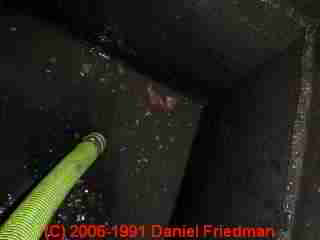 Details of what to look for when inspecting the septic tank's interior condition are
at INSPECT the SEPTIC TANK AFTER PUMPING.
Here is some basic advice:
Watch out: Do not enter or lean down over or into any septic tank unless you're wearing special breathing apparatus and have a second worker watching you for safety - methane gas in the tank can cause fatal asphyxiation.
It should never be necessary to enter a septic tank. Any work to replace the baffles or repair the tank should be done from the outside.
After the septic tank has been pumped out it may be useful to inspect its interior for evidence of cracks, settlement, or damage to its baffles, or perhaps to confirm the tank size if most of the tank has remained buried.
If a septic tank has been serviced by removing a cover over the entire tank all of these conditions can be seen easily. But more often the tank is pumped by access through a center cleanout port.
If there is no center cleanout port on a septic tank (some older concrete tanks) it is pumped preferably at the outlet end of the tank but possibly at the inlet end.
Septic pumpers may use a combination of a mirror at the end of a pole and a flashlight to look at the tank interior to look for evidence of damage to the tank itself such as cracks, leaks, or additional evidence of damaged tank baffles.
At MEASURE SEPTIC TANK SCUM & SLUDGE we include a detailed description of tools, procedures & guidelines that a trained septic contractor or inspector can use to examine the condition of a septic tank before, during, and after pumping, including the pole, flashlight and mirror we show below.
Septic Tank Inspection Research
- Cogger, Craig. "On-site septic systems: the risk of groundwater contamination." Journal of Environmental Health (1988): 12-16.
Abstract:
In recent years the potential for groundwater pollution from on-site septic systems has emerged as a serious concern in the United States. Outbreaks of disease have been traced to drinking groundwater contaminated by sewage from on-site systems. Nitrate from on-site systems also has leached into the groundwater and threatened water supplies in many parts of the country.
It is important that we evaluate the extent of ate groundwater threat posed by on-site systems and review the strategies that are available to limit further degradation of groundwater. On-site systems currently are the only economically viable wastewater treatment option in many rural and suburban areas, and special efforts must be made to ensure their environmental viability as well. - Vogel, Michael P. SEPTIC TANK INSPECTION AND TROUBLE-SHOOTING [PDF] (2001). Montana State University Extension Service, MT 199403 HR Revised 8/2005
Excerpt:
Conducting a septic system evaluation prior to sale or purchase of property protects both the buyer and the seller. Most importantly, an evaluation helps to protect the value of the buyer’s investment by ensuring that the system is functioning properly—and will continue to do so. It also protects the buyer from potentially tremendous costs of system repair or replacement soon after the sale.
For a seller (and realtor, too), a septic system evaluation will minimize the possibility of unknowingly selling a house with a defective or failing system, and could help avoid possible lawsuits that might arise as a result. A properly functioning system can also be a good selling point and enhance the value of the house.
Reader Comments, Questions & Answers About The Article Above
Below you will find questions and answers previously posted on this page at its page bottom reader comment box.
Reader Q&A - also see RECOMMENDED ARTICLES & FAQs
On 2021-05-24 - by (mod) -
@JoAnn,It seems to me possible but a d box cover might have been glued to the d-box using mastic in which case it might not be able to be removed without damaging it and then you would have to replace it.
But most distribution box covers can be removed and replaced as that's a necessary step in their inspection, maintenance, or adjustment.
We would need to know specifics about exactly what happened at your distribution box and what materials are involved to say more.
Can you post a photo?
On 2021-05-24 by JoAnn
Does a typical inspection require that the cement cover of the D Box be destroyed and then replaced? If so why?
On 2020-04-30 - by (mod) -
Yes, Cheryl, that's correct.On 2020-04-29 by cheryl
wanted to know when a septic tank is emptied, is it left empty to fill normally afterwards?
On 2018-05-23 - by (mod) -
glad to assist, BarryLet me know what you find - that will help other readers
On 2018-05-23 by Barry
Thanks. This is very helpful!!
On 2018-05-23 - by (mod) -
BarryAt INSPECT the SEPTIC TANK AFTER PUMPING - you will see several cameras and tools we recommend for inspecting the septic tank interior.
At least three of these, including a simple phone and selfie stick (properly secured) can obtain high resolution images of the septic tank interior.
When looking for a septic tank leak be sure to read SEPTIC TANK LEAKS
On 2018-05-23 by Barry Anderson
I have a tank that I suspect is leaking. Access for pumping is a 6” pvc pipe extending down into the 2000 gallon tank. I’m hoping to inspect he inside of the tank by using some type of endoscope camera. Anything that I can purchase does not seem to offer the resolution needed to see what’s happening to the tank. Any suggestions other than calling in some expensive outside help?
...
Continue reading at SEPTIC TANK LEVELS of SEWAGE or select a topic from the closely-related articles below, or see the complete ARTICLE INDEX.
Or see SEPTIC TANK INSPECTION FAQs - questions & answers posted originally on this page.
Or see these
Recommended Articles
- DISTANCE TO SEPTIC TANK
- INSPECT the SEPTIC TANK AFTER PUMPING septic tank inspection mirrors, cameras & other tools
- SEPTIC TANK BAFFLES
- SEPTIC TANK INSPECTION PROCEDURE
- SEPTIC TANK LEVELS of SEWAGE What Do the Levels of Sewage in the Septic Tank Mean
- SEPTIC TANK PUMPING PROCEDURE
- CLEANING SEPTIC TANKS
- WHEN to CLEAN THE SEPTIC TANK
- WHEN NOT TO PUMP A SEPTIC TANK
- FIND the SEPTIC TANK, HOW TO
- HOW TO OPEN a SEPTIC TANK
- INSPECT the SEPTIC TANK BEFORE PUMPING
- MEASURE SEPTIC TANK SCUM & SLUDGE
- INSPECT the SEPTIC TANK DURING PUMPING
- INSPECT the SEPTIC TANK AFTER PUMPING
- SEPTIC TANK INSPECTION PROCEDURE
- SEPTIC TANK LEVELS of SEWAGE
- PUMPER TRUCK OPERATION PROCEDURE
- PUMPING the SEPTIC TANK
- RECORD SEPTIC TANK LOCATION
- SEPTIC PUMPING CONCLUSIONS
- SEPTIC TANK SAFETY
Suggested citation for this web page
SEPTIC TANK INSPECTION PROCEDURE at InspectApedia.com - online encyclopedia of building & environmental inspection, testing, diagnosis, repair, & problem prevention advice.
Or see this
INDEX to RELATED ARTICLES: ARTICLE INDEX to SEPTIC SYSTEMS
Or use the SEARCH BOX found below to Ask a Question or Search InspectApedia
Ask a Question or Search InspectApedia
Questions & answers or comments about "how do you inspect or test a septic tank?", what septic tank problems can be seen and what problems can be found before, during, or after pumping out the septic system.
Try the search box just below, or if you prefer, post a question or comment in the Comments box below and we will respond promptly.
Search the InspectApedia website
Note: appearance of your Comment below may be delayed: if your comment contains an image, photograph, web link, or text that looks to the software as if it might be a web link, your posting will appear after it has been approved by a moderator. Apologies for the delay.
Only one image can be added per comment but you can post as many comments, and therefore images, as you like.
You will not receive a notification when a response to your question has been posted.
Please bookmark this page to make it easy for you to check back for our response.
Our Comment Box is provided by Countable Web Productions countable.ca
Citations & References
In addition to any citations in the article above, a full list is available on request.
- New York State Department of Health, APPENDIX 75-A WASTEWATER TREATMENT STANDARDS - INDIVIDUAL HOUSEHOLD SYSTEMS , [PDF] New York State Department of Health, 3 February 2010, retrieved 3/1/2010, original source: https://www.health.ny.gov/regulations/nycrr/title_10/part_75/appendix_75-a.htm
- US EPA ONSITE WASTEWATER TREATMENT SYSTEMS MANUAL [online copy, free] Top Reference: US EPA's Design Manual for Onsite Wastewater Treatment and Disposal, 1980, available from the US EPA, the US GPO Superintendent of Documents (Pueblo CO), and from the National Small Flows Clearinghouse. Original source http://www.epa.gov/ORD/NRMRL/Pubs/625R00008/625R00008.htm Onsite wastewater treatment and disposal systems, Richard J Otis, published by the US EPA. Although it's more than 20 years old, this book remains a useful reference for septic system designers. U.S. Environmental Protection Agency, Office of Water Program Operations; Office of Research and Development, Municipal Environmental Research Laboratory; (1980)
- Eco John® Innovative Toilet Solutions, Global Inventive Industries, Fountain Valley CA, PDF, product brochure
- "International Private Sewage Disposal Code," 1995, BOCA-708-799-2300, ICBO-310-699-0541, SBCCI 205-591-1853, available from those code associations.
- "Manual of Policy, Procedures, and Guidelines for Onsite Sewage Systems," Ontario Reg. 374/81, Part VII of the Environmental Protection Act (Canada), ISBN 0-7743-7303-2, Ministry of the Environment,135 St. Clair Ave. West, Toronto Ontario M4V 1P5 Canada $24. CDN.
- Manual of Septic Tank Practice, US Public Health Service's 1959.
- Advanced Onsite Wastewater Systems Technologies, Anish R. Jantrania, Mark A. Gross. Anish Jantrania, Ph.D., P.E., M.B.A., is a Consulting Engineer, in Mechanicsville VA, 804-550-0389 (2006). Outstanding technical reference especially on alternative septic system design alternatives. Written for designers and engineers, this book is not at all easy going for homeowners but is a text I recommend for professionals--DF.
- Septic Tank/Soil-Absorption Systems: How to Operate & Maintain, Equipment Tips, U.S. Department of Agriculture, 8271 1302, 7100 Engineering, 2300 Recreation, September 1982, web search 08/28/2010, original source: http://www.fs.fed.us/t-d/pubs/pdfimage/82711302.pdf
- Septic System Owner's Manual, Lloyd Kahn, Blair Allen, Julie Jones, Shelter Publications, 2000 $14.95 U.S. - easy to understand, well illustrated, one of the best practical references around on septic design basics including some advanced systems; a little short on safety and maintenance. Both new and used (low priced copies are available, and we think the authors are working on an updated edition--DF. Quoting from one of several Amazon reviews: The basics of septic systems, from underground systems and failures to what the owner can do to promote and maintain a healthy system, is revealed in an excellent guide essential for any who reside on a septic system. Rural residents receive a primer on not only the basics; but how to conduct period inspections and what to do when things go wrong. History also figures into the fine coverage.
- US EPA ONSITE WASTEWATER TREATMENT SYSTEMS MANUAL Top Reference: US EPA's Design Manual for Onsite Wastewater Treatment and Disposal, 1980, available from the US EPA, the US GPO Superintendent of Documents (Pueblo CO), and from the National Small Flows Clearinghouse. Original source http://www.epa.gov/ORD/NRMRL/Pubs/625R00008/625R00008.htm
- In addition to citations & references found in this article, see the research citations given at the end of the related articles found at our suggested
CONTINUE READING or RECOMMENDED ARTICLES.
- Carson, Dunlop & Associates Ltd., 120 Carlton Street Suite 407, Toronto ON M5A 4K2. Tel: (416) 964-9415 1-800-268-7070 Email: info@carsondunlop.com. Alan Carson is a past president of ASHI, the American Society of Home Inspectors.
Thanks to Alan Carson and Bob Dunlop, for permission for InspectAPedia to use text excerpts from The HOME REFERENCE BOOK - the Encyclopedia of Homes and to use illustrations from The ILLUSTRATED HOME .
Carson Dunlop Associates provides extensive home inspection education and report writing material. In gratitude we provide links to tsome Carson Dunlop Associates products and services.
 | HOME | ABOUT | ASK a QUESTION | CONTACT | CONTENT USE POLICY | DESCRIPTION | POLICIES | PRIVACY | |
| © 2024 - 1985 Publisher InspectApedia.com - Daniel Friedman | |||||||||