
InspectAPedia® FREE Encyclopedia of Building & Environmental Construction, Diagnosis, Maintenance & Repair |
Question? Just ask us! InspectAPedia
|
 Flooded Septic Systems
What to Do after a Flood, How to fix / prevent flooding septic tanks & fields
- POST a QUESTION or COMMENT about flooded septic tanks and flooded drainfields or soakaway beds - what to do to restore the septic system to safe functional operation
Flooded septic tanks and drainfields - advice:
If your septic system has been exposed to flooding, this document gives immediate safety and health advice and includes other advice from the U.S. EPA and other septic system experts. We set priorities: safety, health, maintenance, and repair for septic systems after flooding.
Yin et als (2011) point out that problems associated with flooded septic systems will increase significantly as sea levels and tide levels continue to rise around the world. In addition to describing steps to return a septic system to operation after flooding, this article includes recommendations and research on the construction of flood-damage-resistant decentralized or onsite septic systems.
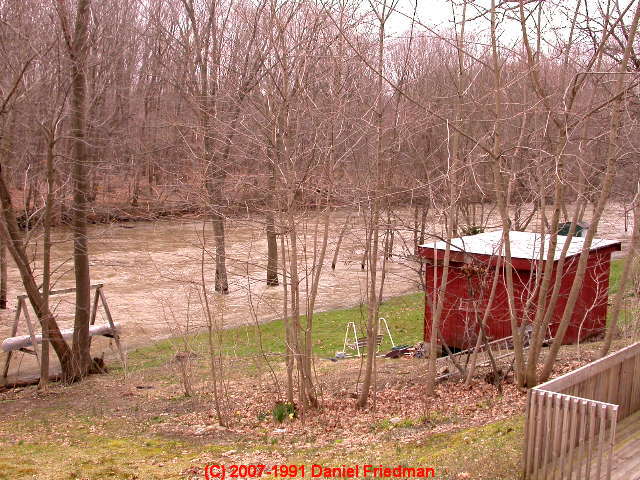
The photo at page top shows storm-flooding of Wappingers Creek in Dutchess County, New York. Homes built along this creek have septic soakbeds or drainfields located not only in a flood zone but too close to this waterway. Citation of this article by reference to this website and brief quotation for the sole purpose of review are permitted
InspectAPedia tolerates no conflicts of interest. We have no relationship with advertisers, products, or services discussed at this website.
Returning a Flooded Septic System to Service: Critical Post-Flood Septic System Advice
 Article Series Contents
- FLOODED SEPTIC SYSTEMS, REPAIR
- SEPTIC DESIGN for FLOOD DAMAGE RESISTANCE - separate article
- RESEARCH on SEPTIC SYSTEM FLOOD DAMAGE PREVENTION & REPAIR
The following text is not part of the original US EPA document but has been added by this website author.
Emergency Response: Septic System Safety in Flooded Areas
Watch out: there are immediate life safety hazards including falling into a septic tank, health hazards of open sewage, and electrocution hazards from septic pumps or controls that are under-water.
Immediate Serious Safety Hazards: Property owners whose septic system has been flooded should be concerned first for immediate safety hazards such as the increased risk of a dangerous collapse of a site-built septic tank, drywell, or cesspool. A site-built system, such as a cesspool made of dry-laid stone or concrete blocks, may have been weakened by floodwaters.
Rope off and prevent access to the area where such systems are installed until you have made certain that there is no danger of collapse. Someone walking over a weakened septic tank cover or cesspool or drywell could fall in - a possible fatal event. Never leave the cover off of a septic tank, cesspool, or manhole. Someone can fall-in.
Electrical Hazards: if your septic system includes electrical components such as pumps, be sure that electrical power has been turned off before attempting to examine the equipment.
Health Hazards: the EPA advice on this topic (below) refers to the high risk of sewage backup into homes during flooding. Sewage backup into a home leaves a variety of pathogens and creates a serious risk of hidden mold in buildings.
Both of these can create health hazards, particularly for people who are at extra risk: infants, the elderly, people who are immune-impaired, people with asthma, etc.
Further investigation, testing, and cleaning are likely to be in order. A simple "pumpout" of a flooded basement, for example, may leave wet building materials and insulation if the basement walls were finished with drywall or paneling. In these cases the wet materials should be removed promptly, the area dried, cleaned if needed, and inspected for evidence of contamination before rebuilding.
Major Structural or System Damage: do not enter a flooded structure if there is evidence that the building may be unstable or in danger of collapse. A building which has shifted off of its foundations, evidence of subsidence (depressions in the soil) over or near a septic system (or anywhere else), or buckled foundation walls are examples of dangerous conditions that merit professional inspection and advice.
Manholes and Tank Covers may have shifted or may even have been lost during flooding. Falling into an open septic tank or sewer is likely to be fatal. Watch for open, shifted, damaged, or otherwise unsafe covers or openings to these systems.
Property owners whose septic systems have been flooded should read the following articles as well as the advice offered from the U.S. Environmental Protection Agency and re-printed below.
- CESSPOOL SAFETY WARNINGS include dangers of cave-in and fatality
- SEWAGE CONTAMINATION TEST how to test buildings for bacterial contamination from Sewage and Septic backup, remediation, & references
- SEPTIC TANK SAFETY Septic System, Septic Tank, & Cesspool Safety Warnings for Septic Inspectors, Septic Pumpers, and Homeowners
The information below is provided by the U.S. EPA. Additional comments or suggestions, where provided by the web author, will be flagged as added text (such as the paragraphs preceding this section. I have re-ordered some of the original EPA text to put the obvious and most important information first. [DJF]
What do I do with my septic system after the flood?
Once floodwaters have receded, there are several things homeowners should remember:
- Be sure the septic tank's manhole cover is secure and that inspection ports have not been blocked or damaged. Otherwise someone could fall into the septic tank - a fatal hazard.
- Do not drink well water until it is tested. Contact your local health department.
See DRINKING WATER EMERGENCY SOURCES - Do not use the sewage system until the water level in the soil absorption field is lower than the water level around the house.
- Have your septic tank professionally inspected and serviced if you suspect damage. Signs of damage include settling or an inability to accept water.
Most septic tanks are not damaged by flooding since they are below ground and completely covered. However, septic tanks and pump chambers can fill with silt and debris, and must be professionally cleaned.
If the soil absorption field is clogged with silt, a new system may have to be installed. [DF: check the area of the drain field for piping which has become exposed (soil loss) or piping which has become clogged with mud and silt.] - Only trained specialists should clean or repair septic tanks because tanks may contain dangerous gases. Contact your health department for a list of septic system contractors who work in your area.
- If sewage has backed up into the basement, clean the area and disinfect the floor. Use a chlorine solution of a half cup of chlorine bleach to each gallon of water to disinfect the area thoroughly.
- Pump the septic system as soon as possible after the flood. Be sure to pump both the tank and lift station. This will remove silt and debris that may have washed into the system. Do not pump the tank during flooded or saturated drainfield conditions. At best, pumping the tank is only a temporary solution. Under worst conditions, pumping it out could cause the tank to try to float out of the ground and may damage the inlet and outlet pipes.
- Do not compact the soil over the soil absorption field by driving or operating equipment in the area. Saturated soil is especially susceptible to compaction, which can reduce the soil absorption field's ability to treat wastewater and lead to system failure.
- Examine all electrical connections for damage before restoring electricity. This includes electrical connections for pumps that may be used in your septic system: a septic grinder pump, effluent pump, or ejector pump.
- Check the vegetation over your septic tank and soil absorption field. Repair erosion damage and sod or reseed areas as necessary to provide turf grass cover.
- [DF: if your septic system uses special equipment such as a packaged aerobic treatment unit or other packaged wastewater treatment systems,
check with the system manufacturer. Some manufacturers will void the system warranty if sealed components are opened by the homeowner.]
See details at SEWAGE TREATMENT PLANTS, RESIDENTIAL
Remember: Whenever the water table is high or your sewage system is threatened by flooding there is a risk that sewage will back up into your home. The only way to prevent this backup is to relieve pressure on the system by using it less.
Where can I find information on my septic system?
Please contact your local health department for additional advice and assistance.
For more information on onsite/decentralized wastewater systems, call the National Environmental Services Center at (800) 624-8301 or visit their website at www.nesc.wvu.edu.Exit EPA Disclaimer
How to Find The Septic Tank - (added by web author)
- SEPTIC TANK, HOW TO FIND - How to Find the Septic Tank, how deep will the cover be, how to document its location
Do I pump my tank during flooded or saturated drainfield conditions?
No! At best, pumping the tank is only a temporary solution. Under worst conditions, pumping it out could cause the tank to try to float out of the ground and may damage the inlet and outlet pipes. The best solution is to plug all drains in the basement and drastically reduce water use in the house.
[DF NOTE: As the EPA says above, however, pump and inspect the septic system (including the piping) as soon as possible after the flood, just not so soon that there is risk of floating the septic tank.
If a septic system is not going to be used for months and wet weather or high ground water conditions are expected to continue, I would not pump a fiberglass or plastic septic tank as there is risk that the tank will float up out of the ground.
This is not much of a risk with concrete septic tanks. Be sure to pump both the tank and lift station. Further inspection for safety as well as the overall condition of the system is needed.]
When to Pump a Septic Tank - (added by web author)
- SEPTIC TANK PUMPING SCHEDULE: When, How, What to Watch For when pumping or cleaning septic tanks
What if my septic system has been used to dispose wastewater from my business (either a home-based or small business)?
In addition to raw sewage, small businesses may use their septic system to dispose of wastewater containing chemicals.
If your septic system that receives chemicals backs up into a basement or drain field take extra precautions to prevent skin, eye and inhalation contact.
The proper clean-up depends of what chemicals are found in the wastewater. Contact your State or EPA for specific clean-up information.
Suggestions for Homeowners with Flooded Septic Systems?
- Use common sense. If possible, don't use the system if the soil is saturated and flooded. The wastewater will not be treated and will become a source of pollution. Conserve water as much as possible while the system restores itself and the water table fails.
- Prevent silt from entering septic systems that have pump chambers. When the pump chambers are flooded, silt has a tendency to settle in the chambers and will clog the drainfield if it is not removed.
- Do not open the septic tank for pumping while the soil is still saturated. Mud and silt may enter the tank and end up in the drainfield. Furthermore, pumping out a tank that is in saturated soil may cause it to "pop out" of the ground. (Likewise, recently installed systems may "pop out" of the ground more readily than older systems because the soil has not had enough time to settle and compact.)
- Do not dig into the tank or drainfield area while the soil is still wet or flooded. Try to avoid any work on or around the disposal field with heavy machinery while the soil is still wet. These activities will ruin the soil conductivity.
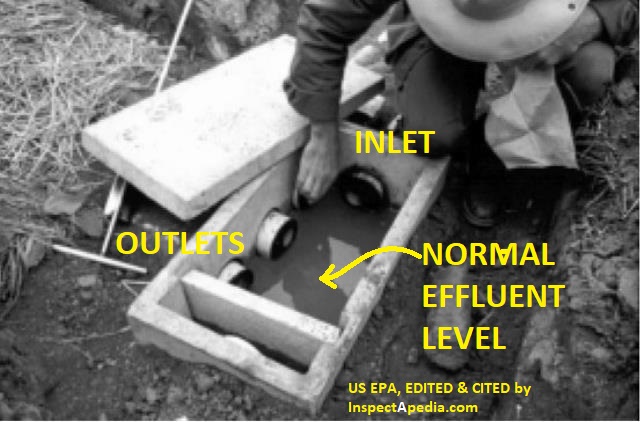
- Flooding of the septic tank will have lifted the floating crust of fats and grease in the septic tank. Some of this scum may have floated and/or partially plugged the outlet tee. If the septic system backs up into the house check the tank first for outlet blockage.
Clean up any floodwater in the house without dumping it into the sink or toilet and allow enough time for the water to recede. Floodwaters from the house that are passed through or pumped through the septic tank will cause higher flows through the system. This may cause solids to transfer from the septic tank to the drainfield and will cause clogging. - Locate any electrical or mechanical devices the system may have that could be flooded to avoid contact with them until they are dry and clean.
- AEROBIC Septic systems, septic plants, upflow filters, trickling filters, and other media filters have a tendency to clog due to mud and sediment. These systems will need to be washed and raked.
End of edited, supplemented US EPA text
- Design replacement septic tanks & absorption systems to resist flood damage:
see SEPTIC DESIGN for FLOOD DAMAGE RESISTANCE
Suggestions for Designing a Flood-zone Damage Resistant Septic System
This topic has been moved to SEPTIC DESIGN for FLOOD DAMAGE RESISTANCE
Flooded Septic System Repair or Prevention Research
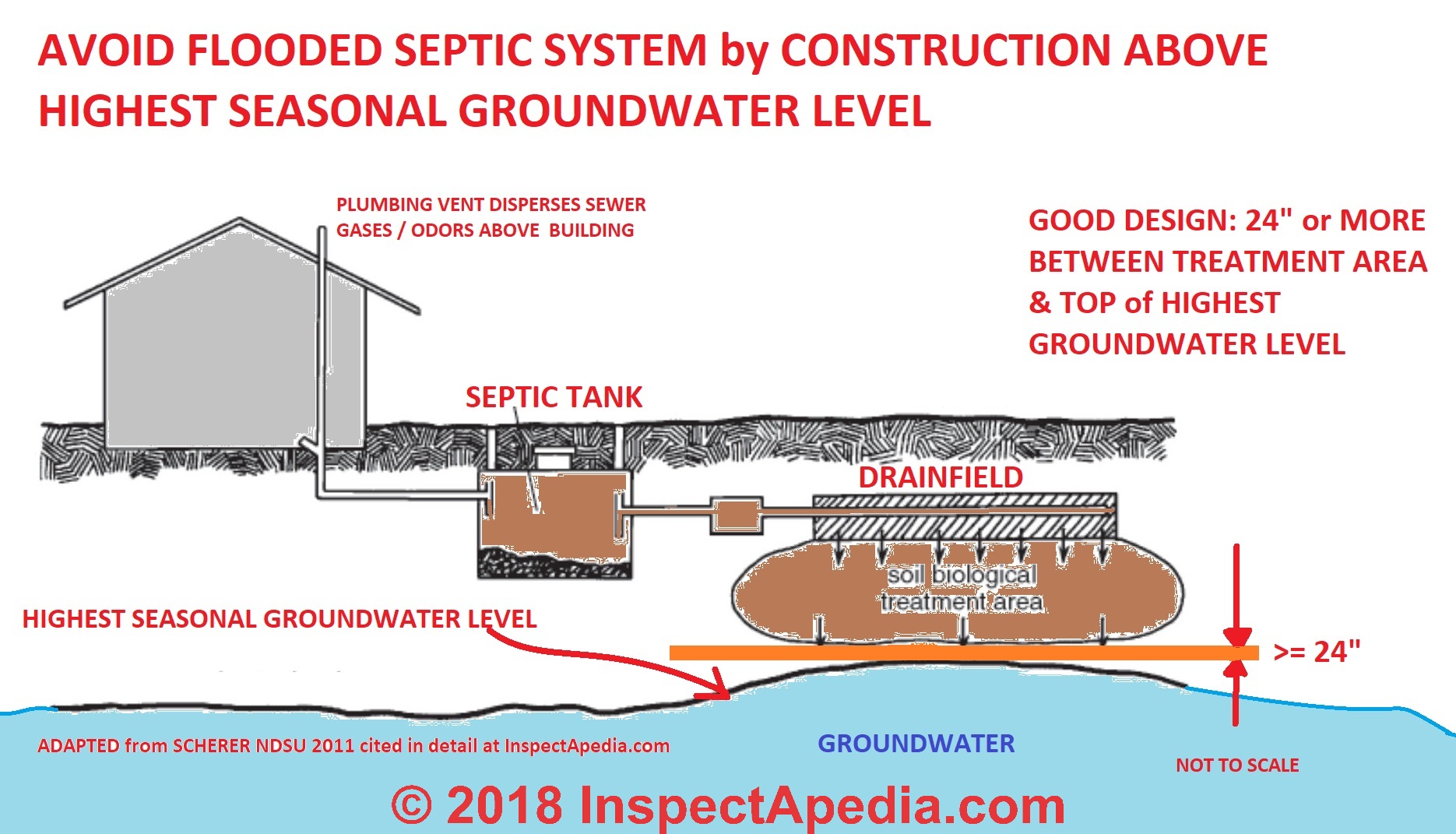
Ilustration of recommended 24" clearance between the bottom of the soil treatment area and seasonal high groundwater level, adapted from Scherer (2011) cited in detail below.
[Click to enlarge any image]
- Aftias, E. "Considerations for the first application of source control measures for stormwater runoff in the Athens metropolitan area." In Advances in Urban Stormwater and Agricultural Runoff Source Controls, pp. 141-146. Springer Netherlands, 2001.
- Aldwell, C. R., R. Thorn, and D. Daly. "Point source pollution in karst areas in Ireland." In Proc. 21st Congress, International Association Hydrogeologists,(Ed) Daoxian Y, Beijing, pp. 1046-52. 1988.
- Brown, Clive, Joe Burkhart, Nancy Burton, Jean Cox-Ganser, Scott Damon, Henry Falk, Scott Fridkin et al. Mold prevention strategies and possible health effects in the aftermath of hurricanes and major floods. US Department of Health and Human Services, Centers for Disease Control and Prevention, 2006.
- Burby, Raymond J., and Steven P. French. "Coping with floods: the land use management paradox." Journal of the American Planning Association 47, no. 3 (1981): 289-300.
- Burby, Raymond J., and Steven P. French. "The US experience in managing flood plain land use." Disasters 4, no. 4 (1980): 451-457.
- Environmental Protection Agency, U.S.A., Septic (Onsite / Decentralized) Systems information, Website: http://water.epa.gov/infrastructure/septic/
- Environment Agency, U.K., flood warnings, environmental data, incident reporting, Website: https://www.gov.uk/government/organisations/environment-agency
- Ferguson, Bruce K. Introduction to stormwater: concept, purpose, design. John Wiley & Sons, 1998.
- Few, Roger, G. T. Pham, and T. T. H. Bui. "Living with floods: health risks and coping strategies of the urban poor in Vietnam." Research project funded by British Academy (Committee for South East Asian studies), research report, May (2004).
- Kilduff, James E. "Design and construction of leaching systems in fill based on permeability." Journal of Environmental Engineering 115, no. 1 (1989): 239-256.
- Laak, Rein, Kent A. Healy, and Dan M. Hardisty. "Rational Basis for Septic Tank System Designa." Groundwater 12, no. 6 (1974): 348-351.
- Michigan DEQ, SEPTIC SYSTEMS & FLOODING EVENTS FAQs [PDF] includes safety advice, retrieved 2019/08/27 original source: https://www.michigan.gov/documents/deq/deq-eh-onsite-Septic_Systems_and_Flooding_626114_7.pdf
- Odemerho, Francis O. "Flood control failures in a third world city: Benin City, Nigeria—Some environmental factors and policy issues." GeoJournal 29, no. 4 (1993): 371-376.
- Pettry, D. E., and C. S. Coleman. "Two decades of urban soil interpretations in Fairfax County, Virginia." Developments in Soil Science 4 (1974): 27-34.
- Salati Jr, E., Eneida Salati, and E. Salati. "Wetland projects developed in Brazil." Water science and technology 40, no. 3 (1999): 19-25.
- Scherer, Thomas, WHAT TO DO WITH FLOODED SEPTIC SYSTEMS [PDF] (2011) North Dakota State University NDSU, Extension Service, retrieved 2019/01/21, original source: https://www.ag.ndsu.edu/flood/home/what-to-do-with-flooded-septic-systems-1
- Sharma, Vinod K., and Tanu Priya. "Development strategies for flood prone areas, case study: Patna, India." Disaster Prevention and Management 10, no. 2 (2001): 101-110.
- Spaling, Harry, and Bryan Vroom. "Environmental assessment after the 2004 tsunami: a case study, lessons and prospects." Impact Assessment and Project Appraisal 25, no. 1 (2007): 43-52.
- Swann, Chris. "The influence of septic systems at the watershed level." Watershed Protection Techniques 3, no. 4 (2001): 821-834.
- Tucker, David L., and Nestor D. Vivado. "Design of an overland flow system." Journal (Water Pollution Control Federation) (1980): 559-567.
- Waananen, Arvi O. Flood-prone areas and land-use planning: selected examples from the San Francisco Bay region, California. No. 942. US Govt. Print. Off., 1977.
- Webb, Maureen, "Sewage Treatment for Flood Risk Sites", WTE Ltd., Water Technology, Ltd., UK Tel: 01759 369915, Website: http://www.wte-ltd.co.uk/, - commented here 12/10/2014" "The UK Environment Agency asked us to develop a solution for flood risk sites in the UK and have approved this method. " - retrieved 10/12/2014 original source: www.wte-ltd.co.uk/sewage_treatment_flood_risk.html
This sewage treatment method combines a lift-pumping station, an above-grund Vortex sewage treatment plant, and a raised mound effluent absorpton system a mound soakaway bed. The company cites the following [paraphrased and adapted - Ed] - Webb, Tony, and Rodger B. Tomlinson. "Design procedures for effluent discharge to estuaries during ebb tide." Journal of environmental engineering 118, no. 3 (1992): 338-362.
- Yin, Jie, Zhan-E. Yin, Xiao-meng Hu, Shi-yuan Xu, Jun Wang, Zhi-hua Li, Hai-dong Zhong, and Fu-bin Gan. "Multiple scenario analyses forecasting the confounding impacts of sea level rise and tides from storm induced coastal flooding in the city of Shanghai, China." Environmental Earth Sciences 63, no. 2 (2011): 407-414.
...
Continue reading at SEPTIC DESIGN for FLOOD DAMAGE RESISTANCE or select a topic from the closely-related articles below, or see the complete ARTICLE INDEX.
Or see these
Recommended Articles
- FLOOD DAMAGE CLEANUP & REPAIR GUIDE - home
- FLOODED SEPTIC SYSTEMS, REPAIR
- SEPTIC D-BOX FLOODING
- SEPTIC DESIGN for FLOOD DAMAGE RESISTANCE
- SEPTIC SYSTEM BACK-PUMPING
- SEPTIC TANK BACK FLOODING
- SEWAGE BACKUP, WHAT TO DO - separate article with more advice for cleaning up after a sewage backup
Suggested citation for this web page
FLOODED SEPTIC SYSTEMS, REPAIR at InspectApedia.com - online encyclopedia of building & environmental inspection, testing, diagnosis, repair, & problem prevention advice.
Or see this
INDEX to RELATED ARTICLES: ARTICLE INDEX to SEPTIC SYSTEMS
Or use the SEARCH BOX found below to Ask a Question or Search InspectApedia
Ask a Question or Search InspectApedia
Questions & answers or comments about flooded septic tanks and flooded drainfields or soakaway beds - what to do to restore the septic system to safe functional operation
Try the search box just below, or if you prefer, post a question or comment in the Comments box below and we will respond promptly.
Search the InspectApedia website
Note: appearance of your Comment below may be delayed: if your comment contains an image, photograph, web link, or text that looks to the software as if it might be a web link, your posting will appear after it has been approved by a moderator. Apologies for the delay.
Only one image can be added per comment but you can post as many comments, and therefore images, as you like.
You will not receive a notification when a response to your question has been posted.
Please bookmark this page to make it easy for you to check back for our response.
Our Comment Box is provided by Countable Web Productions countable.ca
Citations & References
In addition to any citations in the article above, a full list is available on request.
- New York State Department of Health, APPENDIX 75-A WASTEWATER TREATMENT STANDARDS - INDIVIDUAL HOUSEHOLD SYSTEMS , [PDF] New York State Department of Health, 3 February 2010, retrieved 3/1/2010, original source: https://www.health.ny.gov/regulations/nycrr/title_10/part_75/appendix_75-a.htm
- In addition to citations & references found in this article, see the research citations given at the end of the related articles found at our suggested
CONTINUE READING or RECOMMENDED ARTICLES.
- Carson, Dunlop & Associates Ltd., 120 Carlton Street Suite 407, Toronto ON M5A 4K2. Tel: (416) 964-9415 1-800-268-7070 Email: info@carsondunlop.com. Alan Carson is a past president of ASHI, the American Society of Home Inspectors.
Thanks to Alan Carson and Bob Dunlop, for permission for InspectAPedia to use text excerpts from The HOME REFERENCE BOOK - the Encyclopedia of Homes and to use illustrations from The ILLUSTRATED HOME .
Carson Dunlop Associates provides extensive home inspection education and report writing material. In gratitude we provide links to tsome Carson Dunlop Associates products and services.
 | HOME | ABOUT | ASK a QUESTION | CONTACT | CONTENT USE POLICY | DESCRIPTION | POLICIES | PRIVACY | |
| © 2024 - 1985 Publisher InspectApedia.com - Daniel Friedman | |||||||||