
InspectAPedia® FREE Encyclopedia of Building & Environmental Construction, Diagnosis, Maintenance & Repair |
Question? Just ask us! InspectAPedia
|
 Perc Tests: Soil Percolation & Soil Depth Requirements for Septic Absorption Systems / Septic Drainfields
- POST a QUESTION or COMMENT about the procedures used for septic system test hole tests, deep hole tests, and percolation tests for drainfield qualification and soil testing
Septic soil percolation tests or soil absorption test procedures:
The ability of a drain field, also called leach field, or drain field, to absorb septic effluent determines the size, location, and type of effluent absorption system which can be installed at a property.
Septic drainfield percolation test procedures: this article describes the need for and process of "soil testing" or the preparation and use of soil test pits for septic system absorption system or drainfield design or repair.
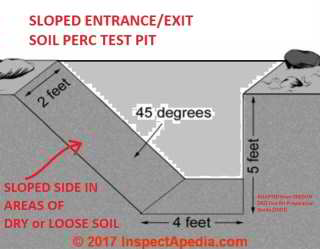
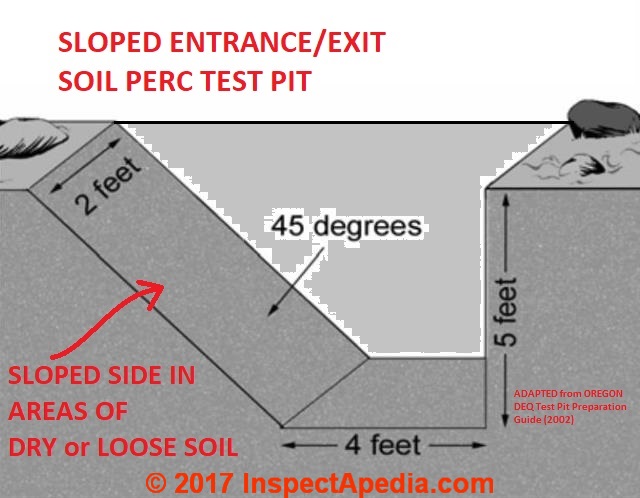
Page top sketch of a sloped-side soil perc test pit is adapted from Oregon DEQ cited in this article series.
InspectAPedia tolerates no conflicts of interest. We have no relationship with advertisers, products, or services discussed at this website.
What is a septic system soil percolation test? What is a "deep hole test"?
 Perc tests may also be performed in order to evaluate soils when a septic system is believed to have failed,
and when repair or septic field replacement are being considered.
Readers should also see our example of state-regulated soil percolation tests at the New York State Septic System Design Regulations 75-A.4 - Soil and site evaluation for septic system design page.
Perc tests may also be performed in order to evaluate soils when a septic system is believed to have failed,
and when repair or septic field replacement are being considered.
Readers should also see our example of state-regulated soil percolation tests at the New York State Septic System Design Regulations 75-A.4 - Soil and site evaluation for septic system design page.
[Click to enlarge any image]
- How do we perform a soil perc test when designing or testing a septic system?
- What is the difference between a soil percolation test or "perc test" and a "deep hole test" or test pit?
- When is a soil perc test usually performed?
- Why should soil perc tests be performed during wet weather?
- How much does it cost to have a soil perc test performed?
In specifying the size and type of absorption field (leach field, seepage pits, galleys, other) a septic engineer or health department official will require that a soil percolation test or "soil perc test" be performed. You may hear it described as a "deep hole test."
In brief, one or more holes are dug in the soil of the property where (or near where) a septic leach field is to be installed. Water is placed in the hole, and the engineer observes the amount of time it takes for the soil to absorb the water, or for the water to "percolate" through the soil. The engineer will also examine the exposed soil layers to obtain additional site design information. (Details follow).
What is a Soil Test Pit or Perc Test Pit or Deep Hole Test Pit?
Steps in a Perc Test / Soil Percolation Test
- A hole, 5-7 feet deep is dug in an area to be tested for future use
as a drain field, or near the drain-field area in representative soils.
See PERC HOLE SPECIFICATIONS for specifications of perc test hole excavations. - Water is poured into the hole
- The soils or septic engineer or contractor observes the rate at which soil absorbs the water by noting the
time that it takes for the level of water in the hole to drop one inch (for example). This observation is simple.
- To be reasonably accurate a board or stick is placed roughly-level on the ground, crossing over the top of the soil perc test hole
- The engineer measures the height from the stick under-side (or top - it doesn't matter as long as she's consistent) to the top of the water when water is first poured into the perc test hole
- The engineer measures the height from the stick to the bottom of the water in the hole at the same point in time - at the start of the test.
- If the soil is extremely porous so that water begins to disappear almost immediately the engineer watches the water level drop and times that event.
- If the water level drops more slowly, then the engineer waits a specified time, typically 30 minutes or an hour and at the end of that interval the engineer measures the distance from the stick to the top of the water again.
- The soil percolation rate is the number of inches that the water level dropped in the soil perc test hole over the specified interval, typically 30 minutes, or 60 minutes for a slow-draining soil.
- The septic engineer reports the number: EXAMPLE: the soil in test hole #1 showed a percolation rate of 3 inches in 30 minutes.
See PERC TEST STANDARDS for examples of how the soil percolation rate is calculated from the observed rate at which water passes into the ground.
More precise "perc tests" may involve using a specific quantity or volume of water or a perc test hole of specific dimensions to make these observations. Some perc tests may specify the inclusion of a couple of inches of gravel in the hole bottom - depending on the nature of the soil itself.
The first time I participated in a soil perc test procedure I found myself smiling with surprise at how low-tech the procedure actually was (in New York State.)
After identifying the most-likely location on the lot for placement of a septic drainfield, the excavator used a backhoe to dig a very rough hole about 5 ft. deep.
Happily no groundwater immediately filled in the hole (which would have been bad news). Perhaps this is why builders try to have this test done in July which is the period of most-dry weather and lowest groundwater table levels.
After digging this rough hole, the septic engineer poured a 5-gallon (joint compound) bucket of water into the hole. In some cases a few buckets might be dumped therein.
After that sophisticated move, the observers simply watched the rate at which the water disappeared. a one-inch drop in water level in this hole in three minutes was considered very good.
If the water was found still in the hole at no drop in level the next morning, this was considered seriously bad and probably requiring some soil exchange or other special design measures.
When is a Soil Perc Test Required vs Performed?
There are two different questions here:
- A soil perc test or percolation test is going to be required in most jurisdictions when a builder or property owner is going to install a new or replacement septic system that requires local health or building department approval.
This might be a perc test for a new building site or a perc test to permit approval of a septic design for a replacement soakbed or drainfield at an existing property whose existing septic fields must be replaced. - A soil perc test is usually performed during wet weather or during the wet season - a time that varies depending on where you live.
In North America that's typically April-June
In Australia the wet season is during Worrwopmi, the humid time - a period that depends on where in Australia you're located. In the Australian tropical region the wet or monsoon season extends over six months between November and March.
In northern and central New Zealand the wet season extends through winter while on the South Island winter is the season of least rainfall.
In the U.K. in my view most of the year is "wet season", though in Scotland May is probably the wettest month of all.
In western Europe in the Alps region the wet season is principally between March and December.
In western Europe along the Mediterranean Sea the wet season extends from October through March.
Heaviest rain coming from the Atlantic occurs during the European Monsoon during the European winter and again in June.
Why Soil Perc Testing during Wet Weather is Important
Why not do our perc tests during the dry season when a site is most-likely to "pass" local soil perc test requirements? I've absolutely seen builders use this trick to pass a marginal site for locating a septic soakbed.
Unfortunately designing a septic effluent disposal system based on "dry season" perc testing results means that the septic system design is likely to be inadequate: that is, during the wet season when soil water tables are higher and perc rates are slower, the septic system is going to discharge un-treated effluent into the environment: basically your are peeing and pooping into the water supply.
Septic Soil Perc Test Costs (soil percolation rate test cost)
Question: what's the cost to get a perc test performed?
2016/08/29 Anonymous said:
what s the cost to get a perc test
Reply:
Perc test costs vary depending on where you live and also on just what local regulation require. For example, a deep hole perc test in some jurisdictions will require the use of a backhoe - you'll be paying the hourly rate for the backhoe operator that might be $100. or more, plus the cost for the consulting engineer or septic designer to introduce water and watch and measure the percolation rate.
The number of perc test holes, hole depth, and ease of site access all affect the total cost for a soil perc test for septic system design and approval.
Actual costs range from a low of about $100. (presuming you're in the U.S.) for a shallow hand-dug perc test hole to $1000. for several perc test holes dug deeper (typically using a backhoe) plus the septic designer's measurements and report of soil percolation rates on the proposed septic field site. In some municipalities, the backhoe rate alone can be higher: $300. to $500./hour.
In VERY general terms, I'd figure $500. for the backhoe for 2-3 deep hole excavations and another $500. to pay the septic engineer.
We discuss perc tests in detail at inspectapedia.com beginning at SEPTIC SOIL & PERC TESTS but you'll also want to see the next articles SOIL PERC TEST HOLE SPECIFICTAIONS and SOIL PERC TEST STANDARDS in this series given at Continue Reading below, as the specifics of exactly what sort of soil perc test your local health or building department will require for septic system design approval will determine the amount of trouble, work, time and cost of your particular soil perc test
Our sister site the Building Advisor (Steve Bliss) also discusses SOIL AND PERC TESTING at https://buildingadvisor.com/buying-land/septic-systems/soil-and-perc-testing/
Septic Drainfield Percolation Test Research
- Test Pit Preparation for Onsite Sewage Evaluations, State of Oregon Department of Environmental Quality, Portland OR, 800 452-4011. PDF document. We recommend this excellent document that offers detail about soil perc tests, deep hole tests, safety, and septic design. Readers should also see SEPTIC SOIL & PERC TESTS and for testing an existing septic system, also see Dye Tests
- New York State Department of Health, APPENDIX 75-A WASTEWATER TREATMENT STANDARDS - INDIVIDUAL HOUSEHOLD SYSTEMS , [PDF] New York State Department of Health, 3 February 2010, retrieved 3/1/2010, original source: https://www.health.ny.gov/regulations/nycrr/title_10/part_75/appendix_75-a.htm
- SEPTIC SOIL & PERC TESTS soil perc testing guide and instructions
- Soil Test Pit Preparation, fact sheet, Oregon DEQ Department of Environmental Quality, original source www.deq.state.or.us/wq/pubs/factsheets/onsite/testpitprep.pdf The Oregon DEQ onsite water quality program can be contacted at 811 South Ave, Portland OR 97204, 800-452-4011 or see http://www.oregon.gov/DEQ/
- Percolation Testing Manual, CNMI Division of Environmental Quality, Gualo Rai, Saipan provides an excellent English Language manual guide for soil percolation testing. Original source: www.deq.gov.mp/artdoc/Sec6art108ID255.pdf CNMI Division of Environmental Quality, PO Box 501304, Saipan, MP 96950
- Septic System Owner's Manual, Lloyd Kahn, Blair Allen, Julie Jones, Shelter Publications, 2000 $14.95 U.S. - easy to understand, well illustrated, one of the best practical references around on septic design basics including some advanced systems; a little short on safety and maintenance. Both new and used (low priced copies are available, and we think the authors are working on an updated edition--DF. Quoting from one of several Amazon reviews: The basics of septic systems, from underground systems and failures to what the owner can do to promote and maintain a healthy system, is revealed in an excellent guide essential for any who reside on a septic system. Rural residents receive a primer on not only the basics; but how to conduct period inspections and what to do when things go wrong. History also figures into the fine coverage.
- SEPTIC TANK/SOIL-ABSORPTION SYSTEMS: HOW TO OPERATE & MAINTAIN [PDF] - , Equipment Tips, U.S. Department of Agriculture, 8271 1302, 7100 Engineering, 2300 Recreation, September 1982, web search 08/28/2010, original source: http://www.fs.fed.us/t-d/pubs/pdfimage/82711302.pdf.
Reader Comments, Questions & Answers About The Article Above
Below you will find questions and answers previously posted on this page at its page bottom reader comment box.
Reader Q&A - also see RECOMMENDED ARTICLES & FAQs
On 2023-12-06 by InspectApedia DF (mod) - perc inspection and cleanup
@David Kim,
I'm not quite sure what you need, but
a quick web search for "septic engineer" or "septic system installer in Westchester County NY" finds a plethora of companies offering septic services, but I'm afraid you'll have to call some of those to see who's willling to do a soil perc test.
If you have a sewage spill to cleanup indoors that's a different matter.
We don't have a specific referral and InspectApedia.com does not sell any service nor product - as a policy to protect reader trust.
On 2023-12-06 by David Kim
I am inquiring about the PERC inspection and clean-up service in Scarsdale, Westchester NY.
Please help me find an agency or business that does the service.
My contact as below
917 699 7800
davidkim1122@gmail.com
Question: do you think our 20 year old septic and leachfield will pass inspection? I'm selling the property.
(Nov 30, 2015) Charlotte said:
We have s septic and leachfield. It is 20 years old. We are careful not to put any kitchen grease, and NO paper is flushed. This system has never given any problem, and has never been pumped. It is a concrete tank. Do you think it will pass inspection after being pumped? Am selling the property.
Thanks.
wlorosie70@gmail.com.
Reply:
Charlotte:
"Pass inspection" depends on where you live, what local laws require of your system, and who performs the inspection (and what she knows). The level of usage, daily wastewater flow, soil conditions and other factors also affect septic system life - search InspectApedia.com for "SEPTIC SYSTEM LIFE" to see what factors are involved and how one can maximize the life of the system.
In my OPINION, however, there is no conventional septic tank and drainfield that should go 20 years without being pumped; even if you have not observed a problem that does not tell us the remaining life of the system nor the condition of the drainfield.
If I were inspecting the home for a buyer I would recommend a septic loading and dye test, then finding and pumping the septic tank to inspect the sludge and scum levels and the condition of the tank baffles.
If the tank is un-damaged and sludge/scum levels are so low that we have not been pushing solids into the leach field, I'd improve my guesstimate of remaining drainfield life from poor to unknown.
If I see that baffles have been lost then I know we've been sending solids into the fields and the remaining life is very poor.
Question: adding a studio apartment, can we increase the capacity of our existing septic syste
(May 22, 2016) Richard W said:
We are putting in a studio apt. over the garage. About 500 square feet, with a 3 piece bath ( toilet, sink, and shower) and a small kitchenette ( sink and dish washer). In addition a laundry room with a washing machine.
There is a existing septic system, generally can you add to the current system to increase capacity or is it likely we would need to start from scratch? As it is currently, the system serves a small 1000 SF manufactured home with 1 bath, a kitchen and laundry. Thank you
Reply: both septic tank size and soakbed size may need to be increased
You may be able to extend the drain fields but tank size is also a concern
Watch out: while it's often possible to extend leach field size and to dig up and install a bigger septic tank, running heavy equipment over the existing drainfield could damage or destroy it.
Question:
2016/08/29 Anonymous said:
what s the cost to get a perc test
Reply:
We include soil percolation test cost estimates at SEPTIC SOIL & PERC TESTS
Comments:
(June 12, 2015) Delores Lyon said:
Thanks for sharing this advice on buying and maintaining a septic system. It's nice to know what to do when you are first starting to have septic tank issues-- it makes sense to first try DIY options. However, when it isn't being fixed, diagnosing the issue is also an important party to getting it fixed. With this guide, I don't think it would be too hard to maintain a septic system at all!
(Sept 11, 2015) Carter Michaelson said:
Our neighbors recently had to deal with some issues with their septic tank and had to have some repairs done. It got me thinking about our septic tank and when the last time we got it looked at was. Getting your septic tank pumped and checked on every few years, if not once a year, is a great idea.
You never know when something might not be right and the next think you know, you are digging up your entire yard.
(Feb 19, 2016) Jackie Oliver said:
Wow, this was a huge help! My husband and I are building a cabin, and it has a septic tank. It's good to know that we will have to get on a schedule to have it pumped. I have never had a system like this before, so it's all totally new to me. I will be sure to monitor how much it's in use, and then get on a consistent schedule to have it pumped!
...
...
Continue reading at PERC HOLE SPECIFICATIONS - how should the soil perc test hole be constructed, or select a topic from the closely-related articles below, or see the complete ARTICLE INDEX.
Or see these
Recommended Articles
- U.S. SEPTIC AUTHORITIES & DESIGN SPECIFICATIONS
- SEPTIC & SEWAGE TREATMENT CODES & REFERENCES
- SEPTIC DRAINFIELD SIZE for wastewater application rate tables & septic trench design tables
- SEPTIC SOIL & PERC TESTS
- PERC HOLE SPECIFICATIONS
- PERC TEST STANDARDS
- SOAKBED SOIL CONDITIONS
- SOIL & SITE EVALUATION for SEPTIC SYSTEMS
- SEPTIC SYSTEM DESIGN ALTERNATIVES - home
- SEPTIC SYSTEM DESIGN BASICS - home
- SEPTIC SYSTEM DESIGN MANUAL - Online
- SEWAGE FLOW & DESIGN FLOW ESTIMATES
Suggested citation for this web page
SEPTIC SOIL & PERC TESTS at InspectApedia.com - online encyclopedia of building & environmental inspection, testing, diagnosis, repair, & problem prevention advice.
Or see this
INDEX to RELATED ARTICLES: ARTICLE INDEX to SEPTIC SYSTEMS
Or use the SEARCH BOX found below to Ask a Question or Search InspectApedia
Ask a Question or Search InspectApedia
Try the search box just below, or if you prefer, post a question or comment in the Comments box below and we will respond promptly.
Search the InspectApedia website
Note: appearance of your Comment below may be delayed: if your comment contains an image, photograph, web link, or text that looks to the software as if it might be a web link, your posting will appear after it has been approved by a moderator. Apologies for the delay.
Only one image can be added per comment but you can post as many comments, and therefore images, as you like.
You will not receive a notification when a response to your question has been posted.
Please bookmark this page to make it easy for you to check back for our response.
Our Comment Box is provided by Countable Web Productions countable.ca
Citations & References
In addition to any citations in the article above, a full list is available on request.
- In addition to citations & references found in this article, see the research citations given at the end of the related articles found at our suggested
CONTINUE READING or RECOMMENDED ARTICLES. - Our recommended books about building & mechanical systems design, inspection, problem diagnosis, and repair, and about indoor environment and IAQ testing, diagnosis, and cleanup are at the InspectAPedia Bookstore. Also see our Book Reviews - InspectAPedia.
- In addition to citations & references found in this article, see the research citations given at the end of the related articles found at our suggested
CONTINUE READING or RECOMMENDED ARTICLES.
- Carson, Dunlop & Associates Ltd., 120 Carlton Street Suite 407, Toronto ON M5A 4K2. Tel: (416) 964-9415 1-800-268-7070 Email: info@carsondunlop.com. Alan Carson is a past president of ASHI, the American Society of Home Inspectors.
Thanks to Alan Carson and Bob Dunlop, for permission for InspectAPedia to use text excerpts from The HOME REFERENCE BOOK - the Encyclopedia of Homes and to use illustrations from The ILLUSTRATED HOME .
Carson Dunlop Associates provides extensive home inspection education and report writing material. In gratitude we provide links to tsome Carson Dunlop Associates products and services.
 | HOME | ABOUT | ASK a QUESTION | CONTACT | CONTENT USE POLICY | DESCRIPTION | POLICIES | PRIVACY | |
| © 2024 - 1985 Publisher InspectApedia.com - Daniel Friedman | |||||||||