
InspectAPedia® FREE Encyclopedia of Building & Environmental Construction, Diagnosis, Maintenance & Repair |
Question? Just ask us! InspectAPedia
|
 How do Cesspools Fail?
Cesspool failure criteria, Inspection Methods, Rejuvenation Suggestions
- POST a QUESTION or COMMENT about the definition of state of "failure" of a cesspool or soakpit
This cesspool maintenance & repair article describes the criteria used to show that a cesspool has failed, or that a cesspool is at the end of its life and needs to be replaced.
If a cesspool shows the conditions described below, pumping it out, aerating it (dangerous) or other cesspool service or cesspool maintenance procedures may be simply a waste of money and in some cases can be dangerous too.
InspectAPedia tolerates no conflicts of interest. We have no relationship with advertisers, products, or services discussed at this website.
Cesspool Failure Criteria (MA)
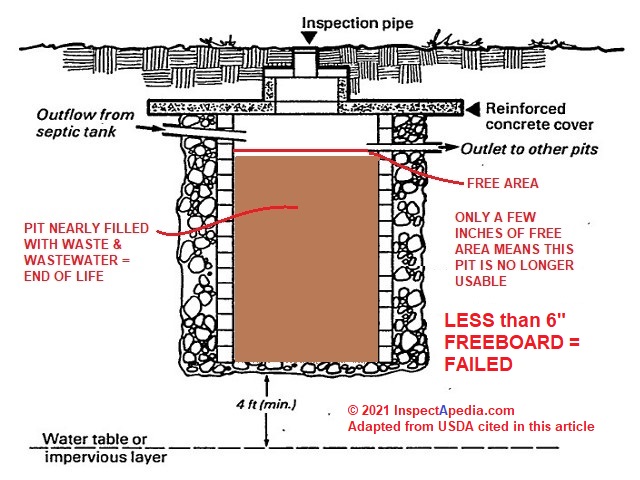 When inspecting a cesspool or soakpit, how do we know how much capacity it has to handle sewage at a property, and how do we know when it is
at or near the end of its useful life?
When inspecting a cesspool or soakpit, how do we know how much capacity it has to handle sewage at a property, and how do we know when it is
at or near the end of its useful life?
The cesspool failure indicators listed below can prevent a property owner from wasting money pumping or otherwise "servicing" a system that really needs to be replaced.
Failure Criteria for Cesspools [generally also applies as well to soakpits, drywells, and seepage pits]:
- If the waste level is within 12" of the inlet pipe near the top of a cesspool the system is at end of life and needs to be replaced.
Some municipalities and experts will state other distances. In Massachusetts according to the Massachusetts Title 5 Septic Law the following are considered a failed or unacceptable cesspool installation:
- a cesspool with less than 6 inches of freeboard - air space between the top of sewage in the cesspool and the bottom of the inlet pipe [ a variation on the 12-inch rule listed above]
- a cesspool with less less than 1/2 day's storage of waste and wastewater
- a cesspool with less within 100 ft. of a pond or dug well (surface water supply)
- a cesspool with less within 50 ft. of a private well (modern sanitary well, presumably with a drilled, sealed casing)
- a cesspool with less between 50 and 100 ft from a private well if well fails bacteria test
- a cesspool within Zone 1 of a public well - in Massachusetts, U.S.,
- Board of Health BOH evaluation is required if a cesspool is with less within 50ft of any surface water
A cesspool or soakpit needs replacement if it meets any of these failure criteria.
 While a septic company may offer to pump,
partially pump out, or agitate or aerate the bottom sludge in the cesspool in an effort to extend its life, these procedures
are potentially very dangerous and at best will give only temporary relief.
While a septic company may offer to pump,
partially pump out, or agitate or aerate the bottom sludge in the cesspool in an effort to extend its life, these procedures
are potentially very dangerous and at best will give only temporary relief.
If you insist on pumping out a septic system that is at the end of its life, the remaining period of use is likely to be quite short - the pumping cost might have been better spent towards replacing the system since an end-of-life cesspool is going to fill up again in just a few days of usage.
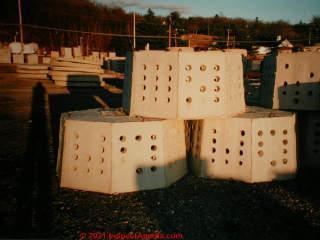
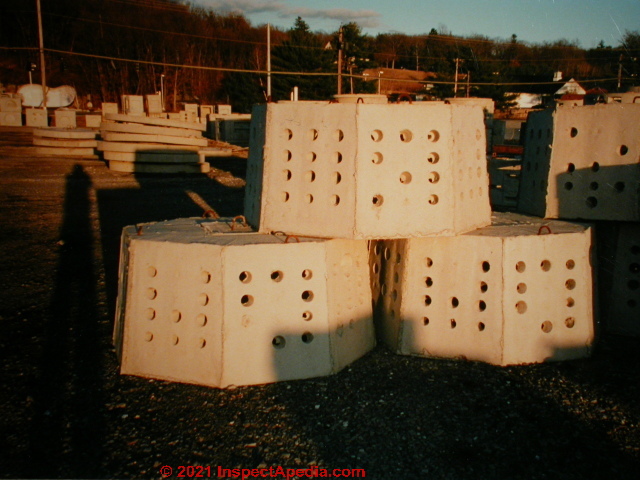
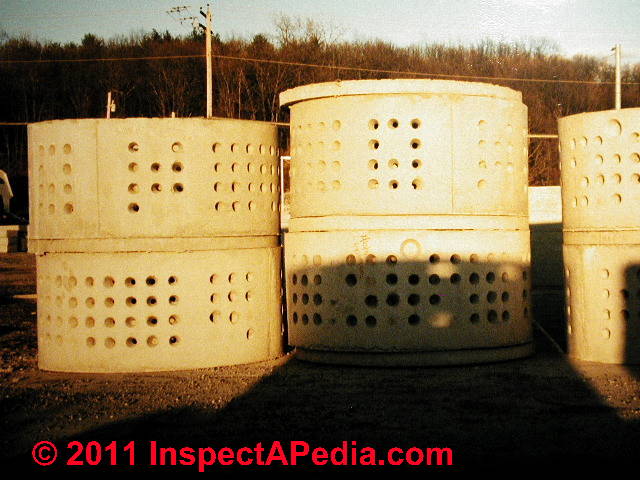
Where a new cesspool or soakpit of traditional sort is going to be installed you should at least use a concrete pre-cast model with a safe cover (see photos at left and above).
Pre-cast concrete soakpits or cesspools are a safer construction than a site-built stone or concrete block soakpit or cesspit, but
Watch out: even a pre-cast concrete soakpit or cesspool is very unsafe if it does not have a sound and secure cover that protects from someone falling into the system. Details are at CESSPOOL SAFETY WARNINGS.
Fortunately there are alternative onsite wastewater disposal alternative designs which can handle limited or even zero-space sites, so a simple cesspool as a destination for blackwater is no longer the only choice for limited-space sites.
Cesspool Inspection Guidance - Massachusetts
The following is excerpted from Massachusetts septic system inspection guidelines cited below.
Inspection Procedure for Single Cesspools
Inspection of a single cesspool must provide sufficient information to determine if any of the failure criteria are triggered. Minimum requirements are:
Determine dimensions and materials of construction.
Measure liquid level distance to invert and evaluate compared to failure criteria.
Determine the distance below the bottom of the cesspool to high ground water.
Note depth of sludge and scum, require pumping upon completion of initial inspection and observe infiltration of ground water, if any.
Inspection of Overflow Cesspool Systems
Overflow cesspool systems consist of an initial cesspool that overflows to some type of leaching facility, either pits, fields or trenches. Generally, these systems are found in older facilities and have been installed bit by bit over the years, usually to "repair" failed cesspools. These are hybrid systems and do not fall under the definition of "cesspool" as found in Title 5, nor are they conforming Title 5 systems. As a result, these systems have to be inspected using criteria for both cesspools and conventional systems.
When inspecting an overflow cesspool system, the inspector should recognize that the first cesspool is nominally functioning as a septic tank. This means that this unit is likely to be fitted with inlet and outlet pipes and will not have the requisite free space of six inches or half a day's storage volume that is required for a single cesspool.
Accordingly, in order to assess its suitability to function as a septic tank, the first cesspool should be evaluated based on septic tank criteria, except for water tightness. Thus the inspector must check for sludge and scum levels and depths, condition of inlet and outlet tees, and other septic tank criteria. The leaching system(s) or additional cesspool(s) should then be evaluated based on criteria for soil absorption systems.
Because the first cesspool is not watertight, it will leach some effluent and therefore must also be evaluated for setback distances for cesspools as defined in the failure criteria and held to these setbacks for determining failure. In addition, it must also be pumped after the evaluation of its function in order to determine if the bottom of the tank is above or below the maximum ground water elevation, as is required for single cesspool systems.
In some instances, there may be more than two cesspools in series.
Each cesspool that has an inlet and outlet pipe and overflows to another type of soil absorption system is to be evaluated as a septic tank as outlined above. Furthermore, they must be evaluated for cesspool setback criteria and pumped to determine if they are below the maximum ground water elevation. The terminal leaching facility, whether a pit, trench field or additional cesspool (i. e. no outlet and/ or connection to any other leaching facility or cesspool) would be subject to the soil absorption system criteria only.
- Source:
- Massachusetts SEPTIC & CESSPOOL INSPECTION GUIDELINES [PDF] Massachusetts, retrieved 2021/06/09 original source: https://www.mass.gov/guides/guidance-for-the-inspection-of-on-site-sewage-disposal-systems
- MASSACHUSETTS TITLE 5 SEPTIC LAW - web article & code citations
Reader Question: is this a cesspool? Has it failed? What are my repair options?
I came across your site while doing septic research. I recently had my septic tank pumped a few days ago. I noticed odors outside my home plus I heard gurgling when I flushed the toilet, as well. Last year, I had the tank pumped in October. I usually have it pumped every other year not every year.
I had a riser installed in 2003 to have easier access to the tank lid. This year, as well as last year, the water level was up into the riser and almost to the lid. My septic service said my leach bed quit working like it is suppose to and offered to have it repaired for around $6,000. Also, this person did not hose down the tank as it was being cleaned out. Is that something that should have been done?
With my best guess due to property size and location of everything, I would say I have a cesspool-type tank (my pipe comes out of the house and straight into the tank). I do not have room for a leach bed with pipelines that stretch out, plus, when I built my garage when I moved here, I would have came across pipes in the ground being that I had to dig 15 down into the ground about 30 feet away from the tank. I have lived in this house for 16 years. It was built in 1950. It looks like my tank is either 500 or 1000 gallons.
So, what are my options? Is it necessary for me to " shock" the septic system, being that I think I have a failed system? Should I add anything to the tank to aid in its effectiveness? - S.M., Pennsylvania, 10/12/2013
Reply: first figure out what is installed: differences between a cesspool & a septic system
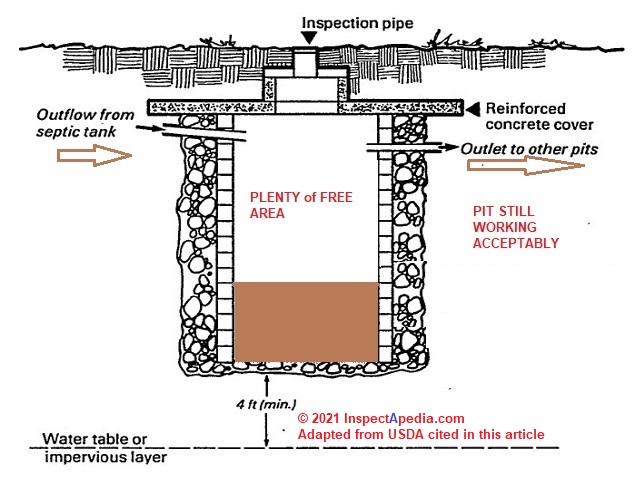 A competent onsite inspection by an expert usually finds additional clues that would permit a more accurate, complete, and authoritative answer than we can give by email alone. That said:
First we need to get clear on what type of wastewater treatment is installed, as you are mixing terms;
A cesspool is a perforated site built or precast hole in the ground that disposes of effluent through the cesspool bottom (which quickly clogs so is not counted in the effluent dispersal area) and cesspool sides into the soil. Solids along with sewage effluent remain mixed together in the cesspool (unlike a septic tank and drainfield system).
Watch out: A cesspool does not and cannot adequately treat the wastewater since at cesspool depths below the ground surface there is not enough oxygen for aerobic bacteria to live.
See details at BIOMAT FORMATION & SEPTIC LIFE
But a cesspool can "dispose" of effluent into the soil.
The risk of discharging inadequately-treated wastewater effluent is contamination of nearby waterways or local aquifers by chemicals, salts, pathogens. For this reason, in some jurisdictions new cesspool installations are not permitted.
As you understand, a septic tank - a water tight container - is quite different from a cesspool.
The septic tank accumulates solid waste while sending effluent out into a network of (hopefully) more shallowly buried pipes that distribute effluent into the soil for final treatment and disposal. About 40% of treatment occurs in the tank, the rest in the soil.
Double-Check Apparently-Failed Cesspool Before Abandoning / Replacing It
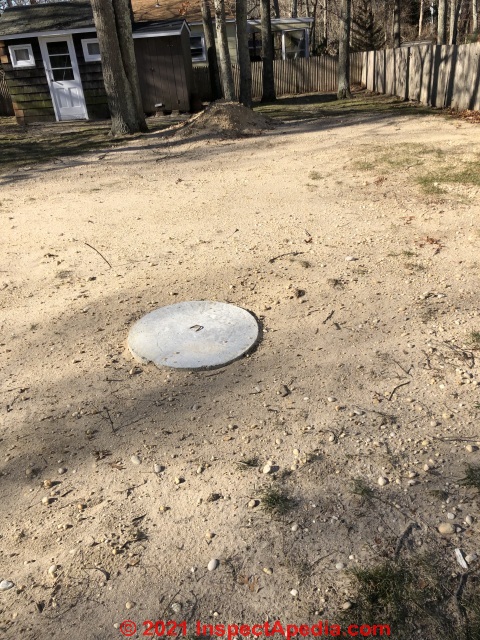
Photo: that round concrete cover gives access to a cesspool installed in an area of sandy soils, serving a small home, on a lot where there was no space for a conventional septic drainfield. Courtesy of an InspectApedia reader.
A more-careful inspection of the cesspool might disclose that it actually has a useful remaining life.
- Does the cesspool level vary seasonally? If the cesspool wastewater level is always near the cesspool top, independent of weather conditions, it may be at end of life, but
If the cesspool waste level drops considerably in dry weather it's possible that the cesspool is being flooded by surface-runoff or ground-water - Is the cesspool actually filled (end of life) or is it flooded?
Check the actual contents of the cesspool - your septic contractor can do this using a couple of inspection tools that we describe
at MEASURE SEPTIC TANK SCUM & SLUDGE - Check for sources of cesspool flooding:
If the cesspool is only seasonally flooded, or if step 2 finds that most of the waste in the cesspool is liquid, not solids, look for a surface runoff problem or a broken or cracked cesspool cover or even a break in the sewer line between building and cesspool that admits roof spillage or surface runoff into the cesspool. - Should you have a filled-cesspool pumped out?
OPINION: Generally not, as doing so can be dangerous (collapse, falling in is fatal), and because any relief or additional use you get out of the emptied pit is likely to be very brief; If the soil around the cesspool has stopped accepting effluent, pumping the cesspool does very little - Should you try cesspool restoration or rejuvenation?
OPINION: Usually cesspool washing or hydrojetting to try to open soils around the system are not useful, does not give a much longer life to the cesspool, and for site-built cesspools this can be very dangerous.
While it's not a scientific study, over nearly fifty years of working with homeowners we have had no one who reported any long-term benefit from cesspool jetting nor from septic drainfield restoration.
See Cesspool Cleanout & Rejuvenation discussed below.
Cesspool Cleanout & Rejuvenation
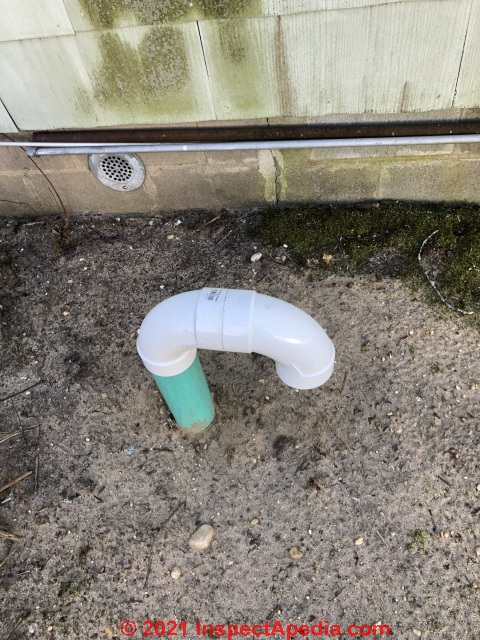 Small solids leaving the cesspool mixed with wastewater clog soils around the system, first at the system bottom, then lower sides, then over time clogging progresses up the sides until the cesspool no longer leaches into the soil.
At this point the cesspool has failed and needs replacement.
Photo: PVC vent serving the drain between house and cesspool, courtesy of an InspectApedia reader.
- Hosing down the sides of a cesspool after pumping would be pointless;
- Pumping the cesspool is close to pointless too.
- Jetting or hydro-jetting are offered a cesspool rejuvenation procedure, claiming that those processes open up the soil around the clogged cesspool.
Watch out: Cesspool rejuvenators try aerating the cesspool bottom and sides - using hydrojetting, not chemicals (chemicals also contaminate the soils and are illegal in most jurisdictions)
This dangerous step can cause a site built cesspool to collapse - even causing fatalities, as our articles on this topic have documented
at SEPTIC TANK ACCIDENT REPORTS. For this reason most cesspool pumpers know better than fully pump out an old site built cesspool system. At most the service company might pump half the tank, giving a few days of extra usage.
Also see CESSPOOL SAFETY WARNINGS
At best, cesspool pumping or jetting or other rejuvenation treatments are a temporary band-aid giving a bit longer use of what is basically a failed system. Cesspool failures are defined in the article above.
What Can I Do When the Cesspool has Failed?
When a cesspool has failed, if there is room the property owner usually adds another cesspool daisy-chained downstream from the first one;
If there is not even room for a second cesspool then the first unit may be excavated, soil removed as needed, and a new system constructed; but I suspect that on a very small site an owner may run into legal issues with the local building or health department as the site may not comply with local building and health codes.
CLEARANCE DISTANCES, SEPTIC SYSTEM
There are alternative small-footprint wastewater treatment system designs such as those specified by Dr. Jantrania (Advanced Onsite Wastewater Systems Technologies, Anish R. Jantrania, Mark A. Gross.). But before considering an alternative septic design one would need to employ a local septic design engineer who knows local soils, local laws, and who knows what local officials will accept.
Extending the Cesspool Life
If you install a new cesspool, and particularly if your household does a lot of lint-producing laundry, it may be worthwhile to install a filter at the laundry graywater discharge to keep that material out of the cesspool; minimizing flushing unnecessary grease down drains also helps.
and FILTERS SEPTIC & GREYWATER
This material is a chapter of our Septic Systems Online Book: That document explains septic system inspection procedures,defects in onsite waste disposal systems, septic tank problems, septic drainfield problems, checklists of system components and things to ask. Septic system maintenance and pumping schedules.
Citation of this article by reference to this website and brief quotation for the sole purpose of review are permitted. Use of this information in books or pamphlets for sale is reserved to the author. Technical review by industry experts has been completed; reviewers are listed below. Further review comments and content suggestions are welcome. Home buyers who want less technical advice should see the
HOME BUYERS GUIDE to SEPTIC SYSTEMS
This article is part of our series: CESSPOOLS which explains what a cesspool (or in the U.K. and in Australia & New Zealand, a soakpit) is, gives important safety and maintenance advice for cesspool systems, and defines the criteria for cesspool failure. We also provide critical safety warnings concerning cesspool systems as with some older and especially site-built cesspools there is a risk of dangerous collapse or cave-ins.
...
Continue reading at CESSPOOL AGE ESTIMATES or select a topic from the closely-related articles below, or see the complete ARTICLE INDEX.
Or see these
Recommended Articles
- CESSPOOLS
- CESSPOOL FAILURE CRITERIA
- CESSPOOL AGE ESTIMATES
- CESSPOOL SAFETY WARNINGS
- CISTERNS, WATER STORAGE
- DRYWELL DESIGN & USES
- GREYWATER SYSTEMS
- SEEPAGE PITS
- SEPTIC TANK ABANDONMENT GUIDE
- SEPTIC TREATMENTS & CHEMICALS
- SEWER GAS ODORS - home
- SEWER GAS ODORS in COLD / WET WEATHER
Suggested citation for this web page
CESSPOOL FAILURE CRITERIA at InspectApedia.com - online encyclopedia of building & environmental inspection, testing, diagnosis, repair, & problem prevention advice.
Or see this
INDEX to RELATED ARTICLES: ARTICLE INDEX to SEPTIC SYSTEMS
Or use the SEARCH BOX found below to Ask a Question or Search InspectApedia
Ask a Question or Search InspectApedia
Try the search box just below, or if you prefer, post a question or comment in the Comments box below and we will respond promptly.
Search the InspectApedia website
Note: appearance of your Comment below may be delayed: if your comment contains an image, photograph, web link, or text that looks to the software as if it might be a web link, your posting will appear after it has been approved by a moderator. Apologies for the delay.
Only one image can be added per comment but you can post as many comments, and therefore images, as you like.
You will not receive a notification when a response to your question has been posted.
Please bookmark this page to make it easy for you to check back for our response.
Our Comment Box is provided by Countable Web Productions countable.ca
Citations & References
In addition to any citations in the article above, a full list is available on request.
- Our recommended books about building & mechanical systems design, inspection, problem diagnosis, and repair, and about indoor environment and IAQ testing, diagnosis, and cleanup are at the InspectAPedia Bookstore. Also see our Book Reviews - InspectAPedia.
- The NSFC Products List has an excellent list of design manuals/modules National Small Flows Clearinghouse (NSFC) now (2019/12/13) hosted at http://www.nesc.wvu.edu/ Tel: 304-293-4191 e-mail info@mail.nesc.wvu.edu.
he National Small Flows Clearinghouse (NSFC) was funded by the U.S. Environmental Protection Agency (EPA) to help America's small communities and individuals solve their wastewater problems through objective information about onsite wastewater collection and treatment systems. NSFC products and information are the only national resource of its type, dealing with small community wastewater infrastructure. or by telephone 800-624-8301 - In addition to citations & references found in this article, see the research citations given at the end of the related articles found at our suggested
CONTINUE READING or RECOMMENDED ARTICLES.
- Carson, Dunlop & Associates Ltd., 120 Carlton Street Suite 407, Toronto ON M5A 4K2. Tel: (416) 964-9415 1-800-268-7070 Email: info@carsondunlop.com. Alan Carson is a past president of ASHI, the American Society of Home Inspectors.
Thanks to Alan Carson and Bob Dunlop, for permission for InspectAPedia to use text excerpts from The HOME REFERENCE BOOK - the Encyclopedia of Homes and to use illustrations from The ILLUSTRATED HOME .
Carson Dunlop Associates provides extensive home inspection education and report writing material. In gratitude we provide links to tsome Carson Dunlop Associates products and services.
 | HOME | ABOUT | ASK a QUESTION | CONTACT | CONTENT USE POLICY | DESCRIPTION | POLICIES | PRIVACY | |
| © 2024 - 1985 Publisher InspectApedia.com - Daniel Friedman | |||||||||