
InspectAPedia® FREE Encyclopedia of Building & Environmental Construction, Diagnosis, Maintenance & Repair |
Question? Just ask us! InspectAPedia
|
 Perc Test Standards
Soil Percolation Soil Percolation Rate Standards for Septic Drainfields
- POST a QUESTION or COMMENT about the standards for septic system test hole tests, deep hole tests, and percolation tests for drainfield qualification and soil testing
This article discusses soil percolation rate specifications - what are the required soil perc rates when testing for septic system absorption system or drainfield design or repair.
How do we perform a soil perc test when designing or testing a septic system? Specifications and guidelines for soil percolation testing.
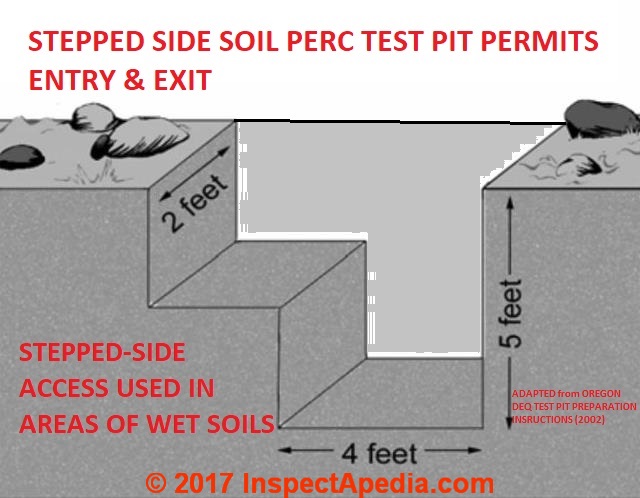
The page top soil perc test hole sketch is adapated from Oregon DEQ cited in this article.
InspectAPedia tolerates no conflicts of interest. We have no relationship with advertisers, products, or services discussed at this website.
PERC TEST STANDARDS - What are the soil percolation rate standards and other soil requirements for septic systems?
 The Massachusetts Title 5 Septic Inspection criteria does a great job of defining a (at least possibly) what is required to assure a functional septic drainfield.
The text explains the role of the biomass below the absorption bed, sets soil depth requirements, and recognizes the importance of keeping the bottom of the working biomass area in well drained soil sufficiently above the seasonal high water table.
Example of soil requirements for a functional drainfield.
This version is particularly clearly written and is for residents of Ohio but the principles apply anywhere. Readers should also see our example of state-regulated soil percolation tests at
the NEW YORK STATE SEPTIC SYSTEM DESIGN REGULATIONS 75-A.4 - Soil and site evaluation for septic system design page.
In Ohio, soil absorption systems can be used in areas where the percolation rate of the soil is between 3 and 60 minutes per inch (soil permeability between 1 and 20 inches per hour).
At least 4 feet of suitable soil is required under the soil absorption system to provide adequate treatment of the septic tank effluent. To accommodate the construction of the system and provide adequate soil cover to grade, a minimum of 5 1/2 to 6 1/2 feet of suitable soil is needed above the limiting layer.
A limiting layer may be bedrock, an impervious soil layer (hardpan, fragipan) or a seasonally high water table (gray soil or mottles). The soil absorption system must be at least 8 feet from any drain line on the lot, 50 feet from a water supply, and 10 feet from the property line, right-of-ways and the house.
Septic systems cannot be placed on the flood plain and are limited to areas with less than a 15 percent slope. Reference: ohioline.osu.edu/aex-fact/0743.html Ohio State University Fact Sheet Septic Tank - Soil Absorption Systems
Our separate article by Lockwood includes a description of the calculations to answer the question: How Big Should the Leach Field Be? our
article SEPTIC DRAINFIELD SIZE
includes a practical example using sample calculations as well as a table of soil percolation rate vs. the necessary leach field size.
Question: California MPI soil perc rates vs. "Codes"
2016/11/24 Puzzled said:
Perc Rates for leach fields are commonly expressed in Minutes per Inch. The inspector said my perc rate of 2 MPI requires advanced treatment in California.
When I check the Plumbing Code it says perc rates should be between 0.83 gallons per sq.ft. per day and 5.0 gallons per sq. ft. per day.
How does this relate to MPI?
This question was posted originally at SEPTIC DRAINFIELD SIZE
Reply:
Puzzled
We cannot directly relate soil percolation rate numbers to gallons per square foot per day without knowing the dimensions of the test hole that was dug.
I'm assuming your MPI number means "minutes per inch" of soaking of water out of a test hole into the ground.
1 U.S. gallon = 231 cubic inches.
So if I had a 231 square-inch FLAT bottomed perc test hole and I filled it with FIVE INCHES of water, I'd have 5 gallons in my soil percolation rate test hole.
Then according to the (presumably California) plumbing code you're citing, if all five inches soaked away into the soil over a day (24 hours) that'd meet the uppe end of the soil percolation rate test specification.
Just as a sanity check, if your local building inspector allowed a gallon per square foot per day perc rate septic field, then you would need something like 2000 square feet for a functional field + recovery field area in a new septic design. (Average daily wastewater production for the number of occupants or number of bedrooms x 2)
Theoretical Soil Perc Test Hole Dimensions, Soakaway Rate, & Percolation Rate in MPI or Minutes per Inch |
||||
| Percolation Hole Water Area Dimensions in Inches |
Water Test Volume in Gallons |
Water Absorption Time | Percolation Rate in MPI (Minutes Per Inch of water) |
Comments |
| 1 x 1 x 231 inches | 1 | 1.2 days | 1732 minutes | This is a 0.83 gallon per square foot per day Perc Test result |
| 1 x 1 x 231 inches | 1 | 1 day | 1440 minutes | This is a 1-gallon per square foot per day Perc Test result |
| 5 x 1 x 231 inches | 5 gallons | 1 day | 288 minutes | This is a 5 gallon pe square foot per day Perc Test Result |
| 1 x 1 x 231 inches | 1 gallon | 2 minutes | 2 minutes | This is a 2 MPI perc test result IF the soil perc test hole specification is as described in this table and its notes. |
Notes to the Table Above
This data has not been reviewed by a septic design engineer. I may have missed something. - Ed.
The column on perc hole water dimensions emphasizes that we're only discussing the shape of the water volume in the test hole in order to permit calculation of a soil percolation rate that is standardized. Without specifying the dimensions of a soil perc test hole, simply pouring water into an arbitrarily sized hole at an arbitrary depth gives only a very crude guess at the soil's ability to absorb effluent.
In the real world, digging a soil pecolation test hole with a backhoe does not produce a perfectly rectangular opening with a perfecly-flat bottom of un-disturbed soil.
The actual depth of the soil perc test hole (typically set at 5 feet but varying significantly by local code and procedure) has to reflect the anticipated depth of the soil soakbed trenches and must consider the soil properties below that point as well as the seasonal high water table level.
Useful constants for soil absorption rate calculations
- 144 square inches = 1 square foot
- 231 square inches = 1.6 square feet
- 231 cubic inches = 1 U.S. Gallon
- 1440 minutes = 1 day or 24 hours
A 231 square inch flat bottomed (theoretical) perc test hole that absorbs one gallon of water in 24 hours
Here is a typical standard percolation test hole specification when soil testing for leachlines:
Test holes shall be augered or excavated to within 13 inches of the actual test depth which corresponds to the anticipated depth of the leachline or the bed trench bottom. Vary depths to include testing of side wall if the disposal system will be more than three feet below the ground surface.
In addition, perform one test in the least permeable soil stratum found during the deep excavation if the soil type changes within 5 feet of the proposed trench bottom. - San Bernadino soil perc test specifications, cited below.
- PERC HOLE SPECIFICATIONS standard soil percolation rate test hole excavation dimensions & procedures
- Bicki, T. J., and R. B. Brown. "ON-SITE SEWAGE DISPOSAL: THE IMPORTANCE OF THE WET SEASON WATER TABLE." [PDF] Journal of Environmental Health 52, no. 5 (1990): 277-279.
Abstract:
Effluent entering a soil absorption system may contain varying combinations and amounts of potential contaminants.
A vertical separation distance of 24 inches between the bottom of a soil absorption system and the seasonally high water table has been suggested as a minimum soil depth fdor proper treatment of effluent and protection of groundwater.
Depth to the wet season water table can be monitored with observation wells or can be estimated from soil morphological characteristics.
Caution is advised when evaluating artificial drainage as a method to improve performacne of on-site sewage disposal systems. - New York State APPENDIX 75-A WASTEWATER TREATMENT STANDARDS - RESIDENTIAL ONSITE SYSTEMS, [PDF] (2016) retrieved 2017/12/09, original source: https://www.health.ny.gov/environmental/water/drinking/docs/appendix_75a.pdf
- New York State Department of Health, APPENDIX 75-A WASTEWATER TREATMENT STANDARDS - INDIVIDUAL HOUSEHOLD SYSTEMS , [PDF] (2010) New York State Department of Health, 3 February 2010, retrieved 3/1/2010, original source: https://www.health.ny.gov/regulations/nycrr/title_10/part_75/appendix_75-a.htm
- Koch, Bobbi, SOIL TEST PIT PREPARATION for ONSITE SEWAGE EVALUATIONS, [PDF] State of Oregon Department of Environmental Quality, Portland OR, 800 452-4011. PDF document (2002).
We recommend this excellent document that offers detail about soil perc tests, deep hole tests, safety, and septic design. The Oregon DEQ onsite water quality program can be contacted at 811 South Ave, Portland OR 97204, 800-452-4011 or Oregon DEQ website: http://www.oregon.gov/DEQ/ - SOIL PERCOLATION TESTING MANUAL [PDF] from Saipan in the Mariana Islands.
Oregon's State DEQ has some nice sketches of a soil test pit from which we excerpt in the article above. These notes paraphrase and expand on the Oregon DEQ's text. - SOIL PERCOLATION TESTING MANUAL, [PDF] CNMI Division of Environmental Quality, Gualo Rai, Saipan provides an excellent English Language manual guide for soil percolation testing. Original source: www.deq.gov.mp/artdoc/Sec6art108ID255.pdf CNMI Division of Environmental Quality, PO Box 501304, Saipan, MP 96950
- "SOIL PERCOLATION (PERC) TEST REPORT STANDARDS" Suitability Of Lots And Soils For
Use Of Leachlines Or Seepage Pits", [PDF], San Bernardino County
Division Of Environmental Health Services
385 North Arrowhead Avenue
San Bernardino, Ca 92415-0160
Telephone: (909) 387-4666
Fax Number: (909) 387-4323
Http://www.sbcounty.gov/dehs
retrieved 2016/11/24, original source: http://www.sbcounty.gov/uploads/dph/dehs/Depts/ EnvironmentalHealth/FormsPublications/ 550034_on_site_waste_water_disposal_system.pdf - Ohio Septic Code 3701-29-20 SEPTAGE & SEWAGE MANAGEMENT, retrieved 2017/10/20 original source: http://www.odh.ohio.gov/ -/media/ODH/ASSETS/ Files/rules/final/3701 -20-TO--29/3701-29/ 2015-0101/3701-29-20-N.pdf?la=en
...
Continue reading at SOIL CONDITIONS or select a topic from the closely-related articles below, or see the complete ARTICLE INDEX.
Or see these
Recommended Articles
- U.S. SEPTIC AUTHORITIES & DESIGN SPECIFICATIONS
- SEPTIC DRAINFIELD SIZE for wastewater application rate tables & septic trench design tables
- SEPTIC & SEWAGE TREATMENT CODES & REFERENCES
- SEPTIC SOIL & PERC TESTS
- PERC HOLE SPECIFICATIONS
- PERC TEST STANDARDS
- SOAKBED SOIL CONDITIONS
- SOIL & SITE EVALUATION for SEPTIC SYSTEMS
- SEPTIC SYSTEM DESIGN ALTERNATIVES - home
- SEPTIC SYSTEM DESIGN BASICS - home
- SEPTIC SYSTEM DESIGN MANUAL - Online
- SEWAGE FLOW & DESIGN FLOW ESTIMATES
- SOIL & SITE EVALUATION for SEPTIC SYSTEMS for other wastewater system soil tests or design standards besides perc tests
Suggested citation for this web page
PERC TEST STANDARDS at InspectApedia.com - online encyclopedia of building & environmental inspection, testing, diagnosis, repair, & problem prevention advice.
Or see this
INDEX to RELATED ARTICLES: ARTICLE INDEX to SEPTIC SYSTEMS
Or use the SEARCH BOX found below to Ask a Question or Search InspectApedia
Ask a Question or Search InspectApedia
Try the search box just below, or if you prefer, post a question or comment in the Comments box below and we will respond promptly.
Search the InspectApedia website
Note: appearance of your Comment below may be delayed: if your comment contains an image, photograph, web link, or text that looks to the software as if it might be a web link, your posting will appear after it has been approved by a moderator. Apologies for the delay.
Only one image can be added per comment but you can post as many comments, and therefore images, as you like.
You will not receive a notification when a response to your question has been posted.
Please bookmark this page to make it easy for you to check back for our response.
Our Comment Box is provided by Countable Web Productions countable.ca
Citations & References
In addition to any citations in the article above, a full list is available on request.
- Soil Test Pit Preparation, [PDF] fact sheet, Oregon DEQ Department of Environmental Quality, original source www.deq.state.or.us/wq/pubs/factsheets/onsite/testpitprep.pdf The Oregon DEQ onsite water quality program can be contacted at 811 South Ave, Portland OR 97204, 800-452-4011 or see http://www.oregon.gov/DEQ/
- Percolation Testing Manual, [PDF] CNMI Division of Environmental Quality, Gualo Rai, Saipan provides an excellent English Language manual guide for soil percolation testing. Original source: www.deq.gov.mp/artdoc/Sec6art108ID255.pdf CNMI Division of Environmental Quality, PO Box 501304, Saipan, MP 96950
- Test Pit Preparation for Onsite Sewage Evaluations, [PDF] State of Oregon Department of Environmental Quality, Portland OR, 800 452-4011. PDF document. We recommend this excellent document that offers detail about soil perc tests, deep hole tests, safety, and septic design.
CONTINUE READING or RECOMMENDED ARTICLES.
- Carson, Dunlop & Associates Ltd., 120 Carlton Street Suite 407, Toronto ON M5A 4K2. Tel: (416) 964-9415 1-800-268-7070 Email: info@carsondunlop.com. Alan Carson is a past president of ASHI, the American Society of Home Inspectors.
Thanks to Alan Carson and Bob Dunlop, for permission for InspectAPedia to use text excerpts from The HOME REFERENCE BOOK - the Encyclopedia of Homes and to use illustrations from The ILLUSTRATED HOME .
Carson Dunlop Associates provides extensive home inspection education and report writing material. In gratitude we provide links to tsome Carson Dunlop Associates products and services.
 | HOME | ABOUT | ASK a QUESTION | CONTACT | CONTENT USE POLICY | DESCRIPTION | POLICIES | PRIVACY | |
| © 2024 - 1985 Publisher InspectApedia.com - Daniel Friedman | |||||||||