
InspectAPedia® FREE Encyclopedia of Building & Environmental Construction, Diagnosis, Maintenance & Repair |
Question? Just ask us! InspectAPedia
|
 Perc Test Hole Specifications for Soil Percolation Tests for Septic Field Design
- POST a QUESTION or COMMENT about the specifications for septic system test hole tests, deep hole tests, and percolation tests for drainfield qualification and soil testing
Soil absorption test or percolation rate test hole specifications:
What are "perc tests" or soil percolation tests? How do we perform a soil perc test when designing or testing a septic system?
This septic system design chapter provides specifications for soil percolation holes used for testing for septic system absorption system or drainfield design.
We explain how to dig a hole for soil percolation tests, deep hole tests, and perc testing where there is rocky soil. We provide perc test safety recommendations.
Soil perc tests may also be performed in order to evaluate soils when a septic system is believed to have failed, and when repair or septic field replacement are being considered.
InspectAPedia tolerates no conflicts of interest. We have no relationship with advertisers, products, or services discussed at this website.
Specifications for Digging Holes for Soil Percolation Tests for Septic System Design and Approval
 How to Dig a Soil Test Pit
- Soil Perc Test Hole Depth: A typical soil perc test hole like the one shown at the top of this page or pit is dug at least 4 1/2 ft. deep and usually five feet (5') deep.
On occasions a 6' hole is used if the approving health or building department septic inspector or engineer so requires.
The dept of the test hole for a seepage pit (as opposed to an absorption bed or drainfield trench) must extend to at least mid-depth and to full depth of the proposed bottom depth of the seepage pit, and must include at leats one test hole dug to three feet below the proposed bottom of the seepage pit. - Soil Perc Test Hole Width: a typical soil test pit is two feet wide. It may be larger depending on the excavator's skill and on local soil conditions.
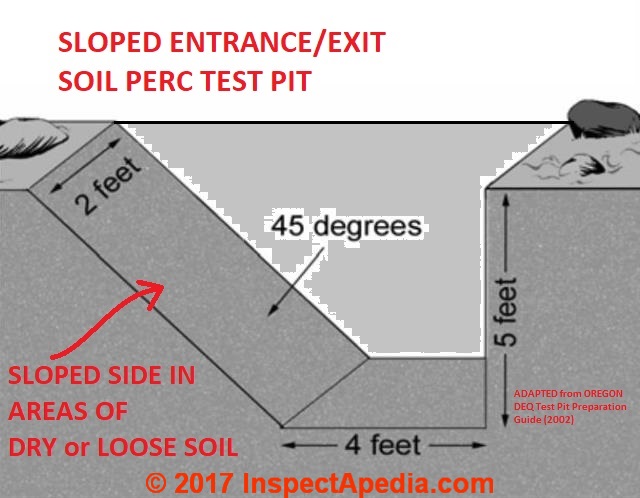
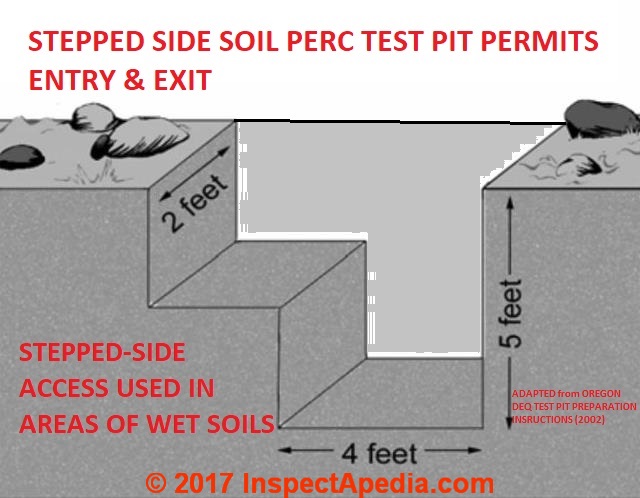
- Perc Test Shape: The bottom of the pit should be level and about 2 ft. x 4 ft. in size. This is important to permit accurate measurement of the soil pecolation rate.
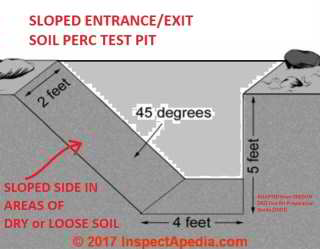
At least one side of the soil test pit should be sloped so that if someone falls into the pit they can easily exit.
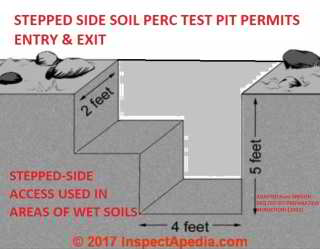
Some soil test pit specifications describe a stair-stepped side to the test pit to permit a person to climb out should they fall into the hole
In ouir opinion, except in areas of very stable soils, a backhoe operator digging the "perc test hole" is usually going to dig a sloped side (to permit inspection or escape) not a stairwell. And no test pit I [DF] have ever seen is anywhere as precisely excavated as those in our sketches, adapted from Oregon's DEQ recommendations.
But the bottom of the test hole should be at the required depth and should be as flat as possible in order to permit measurement of the rate at which water poured into the space percolates into the ground below. - Soil Perc Test Excavated Dirt Placement: soil that has been excavated to dig a test pit must be kept back at least two feet from the edge of the test pit.
- Perc Test and Water or Rock: If the excavator encounters water or bedrock before reaching the five or six foot test pit depth, the excavation will normally stop at that depth regardless.
- Soil Perc Test SAFETY:
- In dry soils, for safety and ease of access (to be able to climb in and out of the hole, one side of the hole must be sloped to permit someone to easily enter and leave the pit. The other side(s) of the hole are roughly vertical.
- In wet soils, for safety and ease of access in and out of the hole, one side of the pit must be dug stair-stepped with each step no greater than 2 ft. in height.
- Soil Percolation Test SAFETY: Earth which has been removed to create the hole must be piled at least 2' away from the hole edges, again for safety.
- [DF opinion]: SAFETY: engineers or workers should not enter a soil test pit (nor any other excavation) while working alone.
- Re-fill the test holes after testing has been completed.
Where to Dig the Soil Test Pit for Septic Systems
 Usually two percolation-rate test holes are dug, 50' to 100' apart in order to evaluate the proposed septic leachfield area.
Evidence of the seasonal high water table is noted (possibly based on changes in soil color at various depths).
Usually two percolation-rate test holes are dug, 50' to 100' apart in order to evaluate the proposed septic leachfield area.
Evidence of the seasonal high water table is noted (possibly based on changes in soil color at various depths).
For safety, septic soil drainfield perc test holes must be re-filled after the test is complete. If the hole must be left open and unattended during the test it should be barricaded to prevent anyone from falling in. Here are some hints from Callum County, Washington:
- Dig the perc test hole downhill from the house site if possible.
- Stay away from swales and drainage ways, and areas that are seasonally wet.
- Keep 100 feet away from all wells and surface water, including irrigation ditches.
- Septic systems cannot be located on slopes in excess of 45% (24 degrees).
- It is helpful if property boundaries and the proposed house site are marked ahead of time.
Number of Soil Test Pits Required
The number of soil test pits required to obtain an approved septic system installation may be as few as one, and depends on
- Local health or building department rules, including possibly other types of soil tests in place of percolatin tests when the actual test is observed by a health department offical who is on-site.
- Local soil conditions
- What variations in soil profiling are discovered when the first test hole is dug, spaced to prove that the whole area planned for the septic soakaway field is actually suitable.
- The depth at which seasonal high ground water is found and the type of water table (perched, apparent, or artesian).
- Size, shape, and type of septic absorption bed or leachfield being installed
- The use of seepage pits (as opposed to drainfield trenches) that require additional test holes at full depth, half-depth and three feet below full depth of the pit bottom. (NYS A-75 cited below).
Often where I have visited building sites and have observed multiple test pit excavations that's because the excavator moved the test pit location until she found one that gave acceptable results. That's where the absorption bed should be located.
Here is a typical specification, from New York State's Appendix 75-A:
(2) If a subsurface treatment unit such as an absorption field is planned, at least four feet of usable soil shall be available over impermeable deposits (i.e., clay or bedrock). Highest groundwater level shall be at least two feet below the proposed trench bottom.
Where systems are to be installed above drinking water aquifers, a greater separation distance to bedrock may be required by the local health department having jurisdiction. At least one test hole at least six feet deep shall be dug within or immediately adjacent to the proposed leaching area to insure that uniform soil and site conditions prevail.
If observations reveal differing soil profiles, additional holes shall be dug and tested. These additional holes shall be spaced to indicate whether there is a sufficient area of usable soil to install the system. Treatment systems shall be designed to reflect the most severe conditions encountered.
If the percolation tests results are inconsistent with field determined soil conditions, additional percolation tests must be conducted and the more restrictive tests must be the factor used for the system design.
What is the Soil Test Pit Showing and How Does the Percolation Test Impact Septic System Design?
How much water is needed to perform a soil perc test?
Enough clean water, typically several 5 gallon pails, is poured into the soil percolatoin test pit hole to provide 1-2 feet of depth of water in the actual test pit (a 2' x 4' flat bottomed hole).
1 cubic foot = 7.5 U.S. gallons
Since the standard test pit hole is 2' deep x 2' wide x 2' across, that's 8 cubic feet.
8 cu.ft. x 7.5 U.S. gallons = 60 gallons of water to fill the hole.
I have never seen a soil test performed in which the test engineer poured 12 5-gallon joint compound buckets of water into the hole. But certainly you need enough water in the hole to permit a reliable measurement of the percolation rate.
In many jurisdictions and where there is less supervision, a smaller test pit is what's usually dug, perhaps half the bottom area as the standard given above. And typically a single 5-gallon bucket of water is poured into the hole.
How is the Soil Percolation Rate Measured?
Water is poured into the standard test pit.
The depth of water in the pit is measured using a tape measure or a calibrated rod or stick and that depth is recorded.
Depending on the rate at which water is absorbed into the soil, subsequent measurements of water depth are made at intervals ranging from a few minutes (very sandy, fast-absorbing soil) to several hours (slow perc rate soils) to overnight (terrible perc-rate soils).
At each subsequent perc test water level measurement the tester notes the elapsed time and the number of inches of water remaining in the pit.
Using a standard percolation test pit hole size of 2' x 2' bottom area, we have (24 x 24) 576 square inches of area to absorb water - allowing a somewhat standardized report of the soil's percolation rate.
A minimum usable perc test hole area accepted by some authorities (PERC TEST STANDARDS) is about 230 square inches (a bit less than half of the area given above).
Soil perc test procedures: pouring water, making observations, reporting results, are described in detail at SEPTIC SOIL & PERC TESTS - topic home.
Percolation rate examples:
Percolation rates are given in minutes per inch of water in the test pit.
Watch out: The stated or observed "soil percolation rate" only makes sense if the test pit bottom is flat, the sides of the test pit hole are relatively vertical, and if both the area of the test pit bottom in inches and the volume of water poured into the hole are known.
If 1 gallon of water is poured into this smaller tet pit hole (1" x 1" x 231") and if the water is absorbed in 2 minutes, the soil percolation rate, given in minutes per inch of water, is 2 minutes.
If 5 gallons of water (one full joint compound bucket) is poured into this smaller test pit and if it takes a full day (24 hours) for the water to absorb into the ground, that's a soil percolation rate of 288 minutes.
Soil percolation or perc tests are used to determine the ability of a soil to transmit wastewater effluent through the soil profile.
The soil percolation rate is the amount of time water takes to move through soil, measured in minutes per inch. Finer textured soils have slower percolation rates; it takes longer for water to drain from a test hole. These soil types need larger drainfields than soils with faster percolation rates, such as sandy soils, to handle a given amount of wastewater.
Soils with very slow percolation rates may not be suitable for drainfields. In Nebraska [and other jurisdictions], if soils perc at a rate slower than 60 minutes per inch, consider installing a lagoon system if the lot is at least 3 acres.
Otherwise, an engineer must design a specialized [alternative design] septic system.
Soils with very fast percolation rates, less than 5 minutes per inch, must be modified by adding a loamy sand liner to the drainfield, so that proper treatment can occur. [adapted from Univ. of Nebraska, Lincoln Extension, Institute of Agricultural & Natural Resources, "Residential Onsite Wastewater Treatment: Site Evaluation]
Soil Percolation Test Pit Design Specification Guidelines
- PERC TEST STANDARDS - gives both calculation methods and typical required percolation rates for acceptible areas for septic system installations
- Koch, Bobbi, SOIL TEST PIT PREPARATION for ONSITE SEWAGE EVALUATIONS, [PDF] State of Oregon Department of Environmental Quality, Portland OR, 800 452-4011. PDF document (2002).
We recommend this excellent document that offers detail about soil perc tests, deep hole tests, safety, and septic design. The Oregon DEQ onsite water quality program can be contacted at 811 South Ave, Portland OR 97204, 800-452-4011 or Oregon DEQ website: http://www.oregon.gov/DEQ/ - SOIL PERCOLATION TESTING MANUAL [PDF] from Saipan in the Mariana Islands.
Oregon's State DEQ has some nice sketches of a soil test pit from which we excerpt in the article above. These notes paraphrase and expand on the Oregon DEQ's text. - SOIL PERCOLATION TESTING MANUAL, [PDF] CNMI Division of Environmental Quality, Gualo Rai, Saipan provides an excellent English Language manual guide for soil percolation testing. Original source: www.deq.gov.mp/artdoc/Sec6art108ID255.pdf CNMI Division of Environmental Quality, PO Box 501304, Saipan, MP 96950
- "SOIL PERCOLATION (PERC) TEST REPORT STANDARDS" Suitability Of Lots And Soils For
Use Of Leachlines Or Seepage Pits", [PDF], San Bernardino County
Division Of Environmental Health Services
385 North Arrowhead Avenue
San Bernardino, Ca 92415-0160
Telephone: (909) 387-4666
Fax Number: (909) 387-4323
Http://www.sbcounty.gov/dehs
retrieved 2016/11/24, original source: http://www.sbcounty.gov/uploads/dph/dehs/Depts/ EnvironmentalHealth/FormsPublications/ 550034_on_site_waste_water_disposal_system.pdf - Ohio Septic Code 3701-29-20 SEPTAGE & SEWAGE MANAGEMENT, retrieved 2017/10/20 original source: http://www.odh.ohio.gov/ -/media/ODH/ASSETS/ Files/rules/final/3701 -20-TO--29/3701-29/ 2015-0101/3701-29-20-N.pdf?la=en
- New York State APPENDIX 75-A WASTEWATER TREATMENT STANDARDS - RESIDENTIAL ONSITE SYSTEMS, [PDF] (2016) retrieved 2017/12/09, original source: https://www.health.ny.gov/environmental/water/drinking/docs/appendix_75a.pdf
- New York State Department of Health, APPENDIX 75-A WASTEWATER TREATMENT STANDARDS - INDIVIDUAL HOUSEHOLD SYSTEMS , [PDF] (2010) ew York State Department of Health, 3 February 2010, retrieved 3/1/2010, original source: https://www.health.ny.gov/regulations/nycrr/title_10/part_75/appendix_75-a.htm
Citation of this article by reference to this website and brief quotation for the sole purpose of review are permitted. Use of this information at other websites, in books or pamphlets for sale is reserved to the author. Technical review by industry experts has been performed and is ongoing - reviewers welcomed and are listed atReferences or Citations .
This article is part of our series: SEPTIC SYSTEM INSPECTION & MAINTENANCE COURSE an online book on septic systems.
Question: requirement to fill in a "perk hole"
(Apr 24, 2014) S justiss said:
if the perk hole is not filled in, can a neighboring occupant demand the developer do that?
Reply:
S you are asking a legal question that I can't answer - it's one to take to an attorney. But gee whiz - seems to me that the attorney's consult fee will be more than the cost to fill in a perc test hole.
I agree that remaining holes in a property can be a safety hazard and might also interfere with proper drainage. Fill it in.
Question: Perc test hole specifications for Maine
8 June 2015 Anonymous said:
What are the standards for a Percolation test in Biddeford Maine?
Reply:
The State of Maine abandoned the traditional percolation test in 1974 and replaced it with a system of site evaluation to determine suitability for subsurface wastewater disposal. These evaluations are performed by individuals licensed by the Department of Human Services.
Because of the diminishing number of sites with “suitable soils” and the belief that other site characteristics should be taken into consideration the Department developed the New System Variance procedure. This procedure assigns points to various site and system design characteristics and sets a minimum passing score of 50 points, with 65 points required for properties in Shoreland Zoning areas, and 75 points for lots in proposed subdivisions. Properties not meeting the requirement of original soil over limiting factor are judged by this system.
A detailed answer to this question is at NUMERICAL CLASSIFICATION SYSTEMS for septic system soil testing and "Percolation Testing"
Or see Numerical Classification System To Determine Overall Site Suitability For Subsurface Wastewater Disposal, October, 1987
found at www.maine.gov/dhhs/mecdc/environmental-health/plumb/documents/numerical-classification.rtf - 2011-11-10
...
Continue reading at PERC TEST STANDARDS - how to calculate and find acceptable percolatin rates for septic system soils, or select a topic from the closely-related articles below, or see the complete ARTICLE INDEX.
Or see these
Recommended Articles
- U.S. SEPTIC AUTHORITIES & DESIGN SPECIFICATIONS
- SEPTIC DRAINFIELD SIZE for wastewater application rate tables & septic trench design tables
- SEPTIC & SEWAGE TREATMENT CODES & REFERENCES
- SEPTIC SOIL & PERC TESTS
- PERC HOLE SPECIFICATIONS
- PERC TEST STANDARDS
- SOAKBED SOIL CONDITIONS
- SOIL & SITE EVALUATION for SEPTIC SYSTEMS
- SEPTIC SYSTEM DESIGN ALTERNATIVES - home
- SEPTIC SYSTEM DESIGN BASICS - home
- SEPTIC SYSTEM DESIGN MANUAL - Online
- SEWAGE FLOW & DESIGN FLOW ESTIMATES
- SOIL & SITE EVALUATION for SEPTIC SYSTEMS for other wastewater system soil tests or design standards besides perc tests
Suggested citation for this web page
PERC HOLE SPECIFICATIONS at InspectApedia.com - online encyclopedia of building & environmental inspection, testing, diagnosis, repair, & problem prevention advice.
Or see this
INDEX to RELATED ARTICLES: ARTICLE INDEX to SEPTIC SYSTEMS
Or use the SEARCH BOX found below to Ask a Question or Search InspectApedia
Ask a Question or Search InspectApedia
Try the search box just below, or if you prefer, post a question or comment in the Comments box below and we will respond promptly.
Search the InspectApedia website
Note: appearance of your Comment below may be delayed: if your comment contains an image, photograph, web link, or text that looks to the software as if it might be a web link, your posting will appear after it has been approved by a moderator. Apologies for the delay.
Only one image can be added per comment but you can post as many comments, and therefore images, as you like.
You will not receive a notification when a response to your question has been posted.
Please bookmark this page to make it easy for you to check back for our response.
Our Comment Box is provided by Countable Web Productions countable.ca
Citations & References
In addition to any citations in the article above, a full list is available on request.
- New York State Department of Health, APPENDIX 75-A WASTEWATER TREATMENT STANDARDS - INDIVIDUAL HOUSEHOLD SYSTEMS , [PDF] New York State Department of Health, 3 February 2010, retrieved 3/1/2010, original source: https://www.health.ny.gov/regulations/nycrr/title_10/part_75/appendix_75-a.htm
- Thanks to reader Michael Roth for technical link editing 6/29/09.
- SEPTIC SOIL & PERC TESTS soil perc testing guide and instructions
- Soil Test Pit Preparation, fact sheet, Oregon DEQ Department of Environmental Quality, original source www.deq.state.or.us/wq/pubs/factsheets/onsite/testpitprep.pdf The Oregon DEQ onsite water quality program can be contacted at 811 South Ave, Portland OR 97204, 800-452-4011 or see http://www.oregon.gov/DEQ/
- Percolation Testing Manual, CNMI Division of Environmental Quality, Gualo Rai, Saipan provides an excellent English Language manual guide for soil percolation testing. Original source: www.deq.gov.mp/artdoc/Sec6art108ID255.pdf CNMI Division of Environmental Quality, PO Box 501304, Saipan, MP 96950
- Septic System Owner's Manual, Lloyd Kahn, Blair Allen, Julie Jones, Shelter Publications, 2000 $14.95 U.S. - easy to understand, well illustrated, one of the best practical references around on septic design basics including some advanced systems; a little short on safety and maintenance. Both new and used (low priced copies are available, and we think the authors are working on an updated edition--DF. Quoting from one of several Amazon reviews: The basics of septic systems, from underground systems and failures to what the owner can do to promote and maintain a healthy system, is revealed in an excellent guide essential for any who reside on a septic system. Rural residents receive a primer on not only the basics; but how to conduct period inspections and what to do when things go wrong. History also figures into the fine coverage.
- In addition to citations & references found in this article, see the research citations given at the end of the related articles found at our suggested
CONTINUE READING or RECOMMENDED ARTICLES.
- Carson, Dunlop & Associates Ltd., 120 Carlton Street Suite 407, Toronto ON M5A 4K2. Tel: (416) 964-9415 1-800-268-7070 Email: info@carsondunlop.com. Alan Carson is a past president of ASHI, the American Society of Home Inspectors.
Thanks to Alan Carson and Bob Dunlop, for permission for InspectAPedia to use text excerpts from The HOME REFERENCE BOOK - the Encyclopedia of Homes and to use illustrations from The ILLUSTRATED HOME .
Carson Dunlop Associates provides extensive home inspection education and report writing material. In gratitude we provide links to tsome Carson Dunlop Associates products and services.
 | HOME | ABOUT | ASK a QUESTION | CONTACT | CONTENT USE POLICY | DESCRIPTION | POLICIES | PRIVACY | |
| © 2024 - 1985 Publisher InspectApedia.com - Daniel Friedman | |||||||||