
InspectAPedia® FREE Encyclopedia of Building & Environmental Construction, Diagnosis, Maintenance & Repair |
Question? Just ask us! InspectAPedia
|
 Recommended Distance Between Septic System & Swimming Pool
- POST a QUESTION or COMMENT about septic system component clearance distances and swimming pools or other constructions
Septic tank or field clearance distances to swim pools:
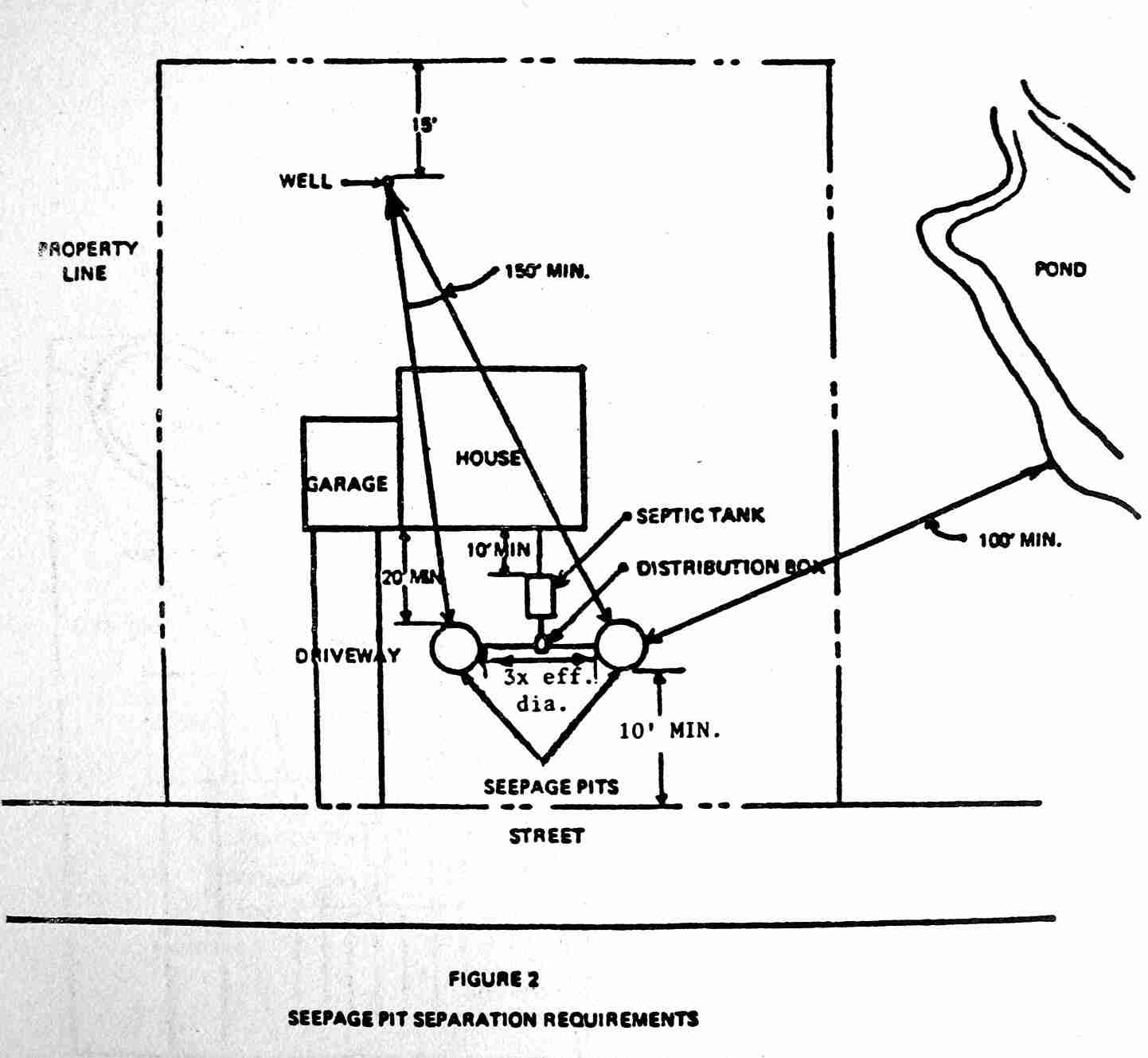
This document, which discusses distances that should be observed between a swimming pool installation and septic fields or septic tanks is a supplement to our chapter SEPTIC CLEARANCES which provides typical septic tank and field clearances. In this file a detailed septic distances table describes distance requirements between septic components (septic tank, leach field, cesspools, drywells) and other site features such as wells, water supply piping, streams, trees, property boundaries, lakes, etc.
In general, septic effluent must be disposed of on the property from which it originates. However more strict clearances and distances than this are required between various onsite wastewater treatment system components and buildings, property boundaries, lakes, streams, wells, and so on, as detailed in the table below. Contact us with corrections or additions to this data.
InspectAPedia tolerates no conflicts of interest. We have no relationship with advertisers, products, or services discussed at this website.
Advice on Locating a Swimming Pool Near Septic System Components
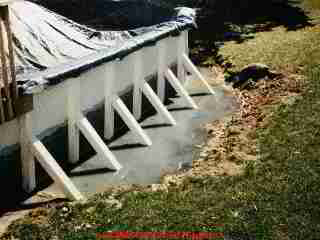
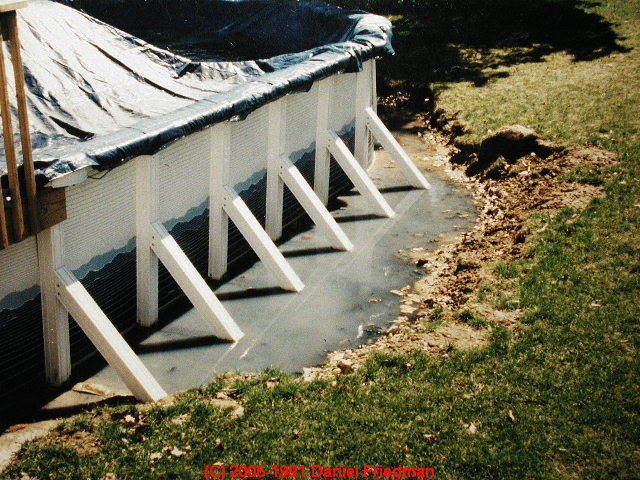
 Few septic authorities or codes specifically address the distance that should be maintained between a swimming pool and septic system
components like septic tanks, drainfields, or septic mound systems. But we have observed some serious problems when swimming pools
were installed near or on top of septic system components.
Few septic authorities or codes specifically address the distance that should be maintained between a swimming pool and septic system
components like septic tanks, drainfields, or septic mound systems. But we have observed some serious problems when swimming pools
were installed near or on top of septic system components.
Problems caused by a swimming pool on top of or too close to a septic field include damage to the drainfield, reduced ability of the drainfield to absorb effluent, redirecting water onto and thus flooding the drainfield, and even causing drainfield effluent to leak out to the ground surface around the swimming pool.
This article discusses some of things you should consider when installing a swimming pool near a septic system.
Other than a fifteen foot clearance specified between a swimming pool and septic components for the state of Missouri, and a 100 ft. clearance specified between a swimming pool and a septic lagoon (an entirely different situation), we don't have much guidance in locating swimming pools near septic components.
I don-t know an official answer to this question, but here are some considerations when planning to add a swimming pool to a property with a septic system:
- Avoid septic damage from pool construction process: The distance from mound to pool must be great enough to assure that any equipment used to build the pool, say excavating machines or trucks delivering materials, do not pass on the mound or other septic components - vehicle traffic may cause costly damage if it occurs.
- Avoid a pool excavation which redirects ground water or septic effluent: If the pool is a below-ground installation, it needs to be far enough away that the hole created by the pool does not interfere with mound operation, say by creating a path for effluent to pass improperly from the mound to the pool excavation.
- Avoid an above ground pool which directs surface runoff onto a septic field: If the pool is above ground, it needs to be constructed so as to not direct surface or subsurface runoff towards the mound where it could cause flooding of the septic field, and located so that it will not trap surface runoff or pool discharge against the mound. If an above ground pool is "up hill" from the mound it probably should be more distant from the mound than if it were downhill. An In-ground pool should probably be more distant from the mound than an above-ground system regardless of location.
- Do not empty swimming pools or backwash pool filters onto a septic drainfield: The pool drainage and/or filter backwash also need to be directed away from the septic system.
- Never put a pool on top of a drainfield, soakbed, raised bed septic or septic mound: Never locate a swimming pool on top of a drainfield or mound: the work of installation is likely to damage the drainfield, and even a
simple, lightweight plastic swimming pool liner and above ground frame, built by tiptoeing onto the drainfield, is still a problem: the impervious area
created atop the ground where such a pool were placed prevents transpiration/evaporation of septic effluent, and is likely to also reduce the oxygen
level in the soil.
Oxygen is needed by some of the bacteria we expect to help break down pathogens in septic effluent.
After also addressing the above considerations, locate a pool 25- or more from the nearest portion of the mound. That should give good working distance for installation and if surface drainage corrections are needed between pool and mound there should be ample room to install such.
Reader Comments, Questions & Answers About The Article Above
Below you will find questions and answers previously posted on this page at its page bottom reader comment box.
Reader Q&A - also see RECOMMENDED ARTICLES & FAQs
On 2020-07-23 by (mod) -
Anon
I don't recommend that, Anon or you risk losing future use of the septic expansion field.
On 2020-07-23 by Anonymous
I have a septic system with a leach field and an expansion field was added to field map. If I wanted to install inground pool, can I encroach on expansion field safely while remaining 25 feet from actual leach field?
On 2020-07-22 by (mod) - How far should you dig 5 ft deep in ground from a field line
Anon
OPINION not authoritative fact
I would keep not just the 5 ft deep pool excavation 25 ft or more from the septic drainfield but also keep equipment off of the drainfield during pool construction.
On 2020-07-21 by Anonymous
How far should you dig 5 ft deep in ground from a field line
On 2020-07-12 - by (mod) -
That sounds reasonable to me.
On 2020-07-12 by Kelly
We had an old septic system that hasn't been used in five years since we have been converted to city water. Could we have a concrete pool installed where the old drain field was located?
On 2020-07-08 - by (mod) - need to know where our septic pipes are
Sure, Mark.
Most precisely you will probably hire a plumber who has buried drain locating equipment.
There are several methods including the insertion of a snake into the drain and an above ground sensor.
In the index to related articles found above you will find articles on septic tank location and septic drain field location that give details about methods for finding buried pipes and other equipment.
See SEPTIC DRAINFIELD LOCATION giving the procedures that work best, and in that article series are septic tank, septic pipes, and septic D-box location instructions.
Thank you for asking don't hesitate to let me know if either of those articles leaves you with further questions
On 2020-07-08 by Mark Pesl
We are building a pool and need to know where our septic pipes are. Can you help
Thank you
On 2020-06-27 - by (mod) - Long island septic to pool distance
I don't think you'll find a building code on That explicit
drywell clearance distance to a swimming pool.
I'm guessing that you're talking about an inground pool and in my opinion if your mason thinks it's too close. you should take that information very seriously.
It's really likely that if you were 10 feet or less away and someone's digging around with a backhoe that they may well collapse a dry well there's also a problem or concern of disposed waste water from a dry well impacting the excavation for the pool.
I don't know exactly where you are on Long Island but in some areas the soil shares a common aquifer and is rather sandy, in which case you probably need more than the minimum distance
On 2020-06-27 by Joanne
I am in NY, Long Island, regarding an inground pool and dry well, is there a minimum distance these should be from each other?
My mason guy thinks they put them way too close to each other & says it could hinder the CO process & construction of pool from the dry well settlements. Would love your feedback!
On 2018-02-24 - by (mod) - Clark County in Las Vegas, Nevada regarding distance from septic tank and swimming pool
We have not found a specific code Citation for Nevada for septic distances to swimming pools although I will research it further.
The 15 foot minimum quoted in the article above is a guideline.
You should also check with your local Building Department.
Be sure to review the issues against which we won since even if there's no explicit distance cited in your code you still could have a wish to avoid the problems that we describe.
On 2018-02-22 by via gonzales
What is the code for Clark County in Las Vegas, Nevada regarding distance from septic tank and swimming pool
On 2017-09-19 3 - by (mod) - okay to put the pool water lines, electric over a septic tank or leach lines.
John
at SEPTIC CLEARANCE DISTANCES
you'll find some distances such as from potable water lines to septic components - 10 to 25 ft or more depending.
Watch out: I'd also be worried about someone digging up or driving equipment over leach lines, crushing them, compacting soil, damaging the fields.
Since a building permit and approval are required almost everywhere that you might be installing a swimming pool, start by asking your local building department or plumbing inspector what she will accept - that's the final legal authority.
On 2017-09-18 by John
Is it okay to put the pool water lines, electric over a septic tank or leach lines.
On 2017-06-12 - by (mod) - How far does a pool need to be away from a septic drain field?
Thanks for asking, Kathy; we have a separate article on clearance distances from septic to various site features - a live link is given above at the
Continue Reading at CLEARANCE DISTANCES, SEPTIC SYSTEM
- there you'll find clearance distances for pools (typically 50 ft); note that depending on where you live the codes and rules may differ, or there may be no explicit rule at all. If you need help finding your local code specs on this you can give me your country, city, state or province and I'll try to help out; or you can call your local health or building department.
Keep in mind that if you're thinking of building a pool, it's not just clearance distance that's a concern: you don't want people driving equipment over the septic system.
On 2017-06-11 by Kathy
How far does a pool need to be away from a septic drain field?
On 2017-05-13 - by (mod) - septic location plan or drawings on file may not match the actual "as built" septic system
Thanks for the suggestion Jimbo, we'll be sure to keep your comment with this article series.
Watch out: However very often there is no local record and certainly no state or provincial record of where septic components are located on private property, particularly for older homes.
Worse, or at least more-confusing, even when there is a septic *plan* on file, it's not a surprise to find that the actual installation differs.
For example, the backhoe operator encounters ledge, or a giant boulder where the plans put a drainfield trench so he just moves over a few feet.
If we are lucky there is an "as built" plan as well as site photos during septic system installation.
But when those are not available there are both visual methods for finding septic components - that we describe in the articles below, and also more technical methods involving
- use of a snake and radio transmitter/receiver to map buried pipes by inserting the finder into the pipe
- use of other ground and below-ground survey equipment (magnetic, radar, etc) that are usually not cost-justified for private septic systems
- and finally in the worst case excavation using a cross-trench or to follow known pipes.
Watch out: I advise against turning a backhoe operator loose on the property if the septic system is working as it may be ruined simply by driving heavy equipment over it.
See
VISUAL CLUES LOCATE the DRAINFIELD shows how to find the drainfield by inspection
SEPTIC DRAINFIELD LOCATION includes a video of walking a site to figure where the septic components can be and probably are
Also see SEPTIC COMPONENT LOCATIONS for a discussion of finding these buried components
On 2017-05-13 by Jimbo
@Anonymous,
Contact your state Department of Environmental Quality they have your info on file. They will send you the mapping of it.
On 2017-02-25 - by (mod) - How do I find my field lines from my septic tank?
Use the search box just above to search
for SEPTIC DRAINFIELD LOCATION and you'll see articles giving the procedures that work best
On 2017-02-23 by Anonymous
How do I find my field lines from my septic tank?
On 2014-06-28 - by (mod) -
Please see the septic-to-pool distances cited above, Jeff, and then do not hesitate to post a follow-up question or criticism if any of that is incomplete or unclear. Thanks.
On 2014-06-27 by jeffsherer@optonline.net
pool and septic tank how close can they be inground southampton ny 11968
how close to an inground pool can a septic tank and or dry well be from an inground pool in the town of southampton New york 11698
On 2012-09-03 by Kathy
I live in nj n have cesspool. How far away should inground pool be
On 2012-07-12 by tony
Can a swimming pool on top of the septic system cause the toilet to bubble and stop up and the shower to stop up and smell like sewer
On 2011-08-25 - by (mod) -
Bob, on this page I've added a link to
PLANTS & TREES OVER SEPTIC SYSTEMS (links also in the ARTICLE INDEX ) - PLEASE take a look and let me know if there are further questions about planting distances and septic systems.
Thanks
Dan
On 2011-08-22 by Bob Gair
How close to an above ground septic field can I landscape - TREES & such?
On 2011-08-05 - by (mod) -
T JB my OPINION is that the answer is probably yes - the footprint of the pool will stop transpiration/evaporation from the drainfield where it rests, there is risk of pool supports damaging buried components, and there is risk of drainfield flooding from the pool - probably the latter is the easiest to avoid.
Sure you could raise the pool off of the ground - just be sure your support system is adequate and that the posts and piers for the deck do not cut into drainfield trenches or pipes and you'll be much better off. Send along some photos if you can.
On 2011-08-05 by T JB
If the pool is only left up for the short summer season 3 months would this still cause damage to the septic field? My entire yard is the septic field. butwho you ever owned house before built a deck and had poles insertd between the field lines. couldint I just put a deck up and put a 4 ft X 15 pool on it>
...
Continue reading at CLEARANCE DISTANCES, SEPTIC SYSTEM or select a topic from the closely-related articles below, or see the complete ARTICLE INDEX.
Or see these
Recommended Articles
- CLEARANCE DISTANCES, SEPTIC SYSTEM
- PLANTS & TREES OVER SEPTIC SYSTEMS
- REASONS to FIND THE DRAINFIELD
- SEPTIC to POOL DISTANCE
- SEPTIC TANK, HOW TO FIND
- SPA / HOT TUB / POOL MANUALS, PARTS, REPAIR, SUPPLIES
Suggested citation for this web page
SEPTIC to POOL DISTANCE at InspectApedia.com - online encyclopedia of building & environmental inspection, testing, diagnosis, repair, & problem prevention advice.
Or see this
INDEX to RELATED ARTICLES: ARTICLE INDEX to SEPTIC SYSTEMS
Or use the SEARCH BOX found below to Ask a Question or Search InspectApedia
Ask a Question or Search InspectApedia
Try the search box just below, or if you prefer, post a question or comment in the Comments box below and we will respond promptly.
Search the InspectApedia website
Note: appearance of your Comment below may be delayed: if your comment contains an image, photograph, web link, or text that looks to the software as if it might be a web link, your posting will appear after it has been approved by a moderator. Apologies for the delay.
Only one image can be added per comment but you can post as many comments, and therefore images, as you like.
You will not receive a notification when a response to your question has been posted.
Please bookmark this page to make it easy for you to check back for our response.
Our Comment Box is provided by Countable Web Productions countable.ca
Citations & References
In addition to any citations in the article above, a full list is available on request.
- New York State Department of Health, APPENDIX 75-A WASTEWATER TREATMENT STANDARDS - INDIVIDUAL HOUSEHOLD SYSTEMS , [PDF] New York State Department of Health, 3 February 2010, retrieved 3/1/2010, original source: https://www.health.ny.gov/regulations/nycrr/title_10/part_75/appendix_75-a.htm
- Advanced Onsite Wastewater Systems Technologies, Anish R. Jantrania, Mark A. Gross. Anish Jantrania, Ph.D., P.E., M.B.A., is a Consulting Engineer, in Mechanicsville VA, 804-550-0389 (2006). Outstanding technical reference especially on alternative septic system design alternatives. Written for designers and engineers, this book is not at all easy going for homeowners but is a text I recommend for professionals--DF.
Design Manuals for Septic Systems
- US EPA ONSITE WASTEWATER TREATMENT SYSTEMS MANUAL [online copy, free] Top Reference: US EPA's Design Manual for Onsite Wastewater Treatment and Disposal, 1980, available from the US EPA, the US GPO Superintendent of Documents (Pueblo CO), and from the National Small Flows Clearinghouse. Original source http://www.epa.gov/ORD/NRMRL/Pubs/625R00008/625R00008.htm Onsite wastewater treatment and disposal systems, Richard J Otis, published by the US EPA. Although it's more than 20 years old, this book remains a useful reference for septic system designers. U.S. Environmental Protection Agency, Office of Water Program Operations; Office of Research and Development, Municipal Environmental Research Laboratory; (1980)
- Eco John® Innovative Toilet Solutions, Global Inventive Industries, Fountain Valley CA, PDF, product brochure
- "International Private Sewage Disposal Code," 1995, BOCA-708-799-2300, ICBO-310-699-0541, SBCCI 205-591-1853, available from those code associations.
- "Manual of Policy, Procedures, and Guidelines for Onsite Sewage Systems," Ontario Reg. 374/81, Part VII of the Environmental Protection Act (Canada), ISBN 0-7743-7303-2, Ministry of the Environment,135 St. Clair Ave. West, Toronto Ontario M4V 1P5 Canada $24. CDN.
- Manual of Septic Tank Practice, US Public Health Service's 1959.
- In addition to citations & references found in this article, see the research citations given at the end of the related articles found at our suggested
CONTINUE READING or RECOMMENDED ARTICLES.
- Carson, Dunlop & Associates Ltd., 120 Carlton Street Suite 407, Toronto ON M5A 4K2. Tel: (416) 964-9415 1-800-268-7070 Email: info@carsondunlop.com. Alan Carson is a past president of ASHI, the American Society of Home Inspectors.
Thanks to Alan Carson and Bob Dunlop, for permission for InspectAPedia to use text excerpts from The HOME REFERENCE BOOK - the Encyclopedia of Homes and to use illustrations from The ILLUSTRATED HOME .
Carson Dunlop Associates provides extensive home inspection education and report writing material. In gratitude we provide links to tsome Carson Dunlop Associates products and services.
 | HOME | ABOUT | ASK a QUESTION | CONTACT | CONTENT USE POLICY | DESCRIPTION | POLICIES | PRIVACY | |
| © 2024 - 1985 Publisher InspectApedia.com - Daniel Friedman | |||||||||