
InspectAPedia® FREE Encyclopedia of Building & Environmental Construction, Diagnosis, Maintenance & Repair |
Question? Just ask us! InspectAPedia
|
 What to do if No One Knows if a Building is Connected to a Septic Tank or to a Sewer System
- POST a QUESTION or COMMENT about how to determine if a building is connected to a municipal sewer or a private septic system
Nobody knows if the building is connected to sewer or septic?
This article explains what to do if you are buying a home or other building and no one seems to know if it is connected to a private septic tank and drainfield (or similar onsite waste disposal system) or connected to a public sewer line.
A reader asked, "How do I know if the house I am purchasing has a septic tank?"
Often the answer to this question is well known, documented, and everyone is confident of the facts. But in older communities, especially if the age of a building is greater than the age of the community sewer system, even if a sewer is installed right in the street in front of a building, that building may never have been connected to the sewer line.
InspectAPedia tolerates no conflicts of interest. We have no relationship with advertisers, products, or services discussed at this website.
What To Do If No One Knows Whether a Building Is Connected to the Public Sewer Line or Not
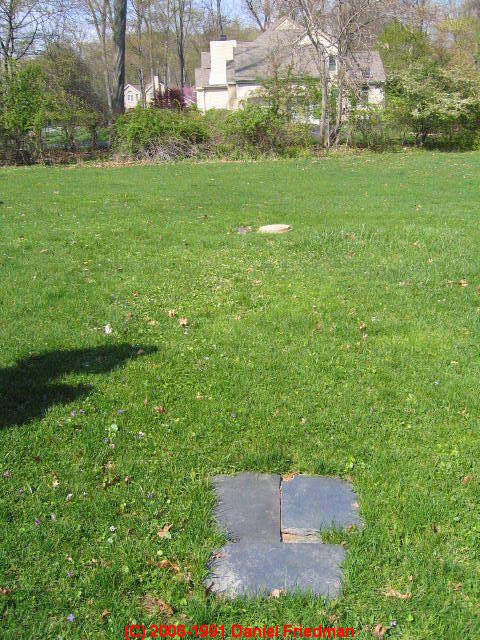
Watch out: At the top of this page we see a flat stone that might mark the location of an old septic tank or drywell or cesspool at a property. If such features are present, even if they have been unused for many years, there could be fatal safety hazards such as someone falling into a collapsing cesspool. So don't ignore such site features. Keep people away until the questions about buried tanks have been answered.
Watch out: if you see evidence that a public sewer is installed near your building that alone does not assure that your building has been connected to the sewer system. If an owner or realtor tells you that a sewer system is installed but the house is older than the sewer and no one knows for sure if the house was ever connected to the sewer, some investigation is needed.
Even if we see that there is a sewer line in the street on which the house is located, how do we know if the home is connected to it?
We can do several things to find out whether a home or other building is connected to a public sewer system or to a private septic tank system:
- Find out if a public sewer line is even available for the property or building in which you're interested. there are lots of ways to find out if a sewer main is present.
We outline them in the next chapter of this article at
CLUES INDICATING A SEWER LINE is PRESENT
Obviously if no public sewer is available you'll need to begin a septic tank and drainfield investigation.
But it's also worth asking local building authorities if there is a plan to add a public sewer in the neighborhood. Knowing that a public sewer line is coming, and when, can inform your plans for septic system maintenance, repair, and replacement options. - If a local sewer main is right at the property you'll still need to find out if the building is connected to it.
See SEWER / SEPTIC PIPE CAMERAS for using a video camera to trace the main building drain to its destination.
See CLUES INDICATING CONNECTED to SEWER and don't assume that just because a sewer main is nearby that your building has been connected to it. - Ask local plumbers or septic contractors if they’ve done work on the house or on a septic system there, or if they have worked on sewer main or septic tank connections for other nearby buildings
- Ask the town building department if a sewer main is present, and if so, ask if they have records of the property being connected to the sewer;
- Look for visual evidence that a septic tank was or remains at the property such as depressions in the ground, stones marking tank or cleanout locations, even wet areas and odors (unfortunately indicating a problem) can indicate that a septic tank or cesspool is present. For older properties you should do this even if the building is presently connected to a public sewer.
- Finally, as a last resort you can trace the piping underground to find if it heads to a sewer main passing near the property or conversely, to an onsite septic tank or cesspool. Tracing house waste piping to its destination, whether that destination is a septic tank or a sewer line, is a similar process.
See SEPTIC TANK, HOW TO FIND– since these methods can also help you find and follow the course of a buried main drain that connects to a sewer. There are various methods of pipe tracing including simple plumbing snakes and probes and more sophisticated electronic pipe sensing systems
...
Continue reading at FIND the SEPTIC TANK, HOW TO or select a topic from the closely-related articles below, or see the complete ARTICLE INDEX.
Or see these
Recommended Articles
- CLOGGED DRAIN DIAGNOSIS
- FIND the SEPTIC TANK, HOW TO
- SEPTIC or SEWER CONNECTION? - topic home
- WHAT TO ASK ABOUT SEWERS or SEPTICS
- CLUES INDICATING A SEWER LINE is PRESENT
- CLUES INDICATING CONNECTED to SEWER
- GUIDE for BUILDINGS CONNECTED to PUBLIC SEWER
- GUIDE for BUILDINGS PRE-DATING SEWER INSTALLATION
- GUIDE for BUILDINGS CONNECTED to PRIVATE SEPTIC
- WHAT TO DO IF NO ONE KNOWS - if the connection is to sewer or septic
- SEPTIC VIDEOS show how to walk the site for possible septic tank & drainfield locations
- SEWER / SEPTIC PIPE CAMERAS
Suggested citation for this web page
WHAT TO DO IF NO ONE KNOWS at InspectApedia.com - online encyclopedia of building & environmental inspection, testing, diagnosis, repair, & problem prevention advice.
Or see this
INDEX to RELATED ARTICLES: ARTICLE INDEX to SEPTIC SYSTEMS
Or use the SEARCH BOX found below to Ask a Question or Search InspectApedia
Ask a Question or Search InspectApedia
Try the search box just below, or if you prefer, post a question or comment in the Comments box below and we will respond promptly.
Search the InspectApedia website
Note: appearance of your Comment below may be delayed: if your comment contains an image, photograph, web link, or text that looks to the software as if it might be a web link, your posting will appear after it has been approved by a moderator. Apologies for the delay.
Only one image can be added per comment but you can post as many comments, and therefore images, as you like.
You will not receive a notification when a response to your question has been posted.
Please bookmark this page to make it easy for you to check back for our response.
Our Comment Box is provided by Countable Web Productions countable.ca
Citations & References
In addition to any citations in the article above, a full list is available on request.
- New York State Department of Health, APPENDIX 75-A WASTEWATER TREATMENT STANDARDS - INDIVIDUAL HOUSEHOLD SYSTEMS , [PDF] New York State Department of Health, 3 February 2010, retrieved 3/1/2010, original source: https://www.health.ny.gov/regulations/nycrr/title_10/part_75/appendix_75-a.htm
- Septic Tank/Soil-Absorption Systems: How to Operate & Maintain [ copy on file as /septic/Septic_Operation_USDA.pdf ] - , Equipment Tips, U.S. Department of Agriculture, 8271 1302, 7100 Engineering, 2300 Recreation, September 1982, web search 08/28/2010, original source: http://www.fs.fed.us/t-d/pubs/pdfimage/82711302.pdf.
- Pennsylvania State Wastewater Treatment Fact Sheet SW-161, Septic System Failure: Diagnosis and Treatment
- Pennsylvania State Wastewater Treatment Fact Sheet SW-162, The Soil Media and the Percolation Test
- Pennsylvania State Wastewater Treatment Fact Sheet SW-l64, Mound Systems for Wastewater Treatment
- Pennsylvania State Wastewater Treatment Fact Sheet SW-165, Septic Tank-Soil Absorption Systems
- Document Sources used for this web page include but are not limited to: Agricultural Fact Sheet #SW-161 "Septic Tank Pumping," by Paul D. Robillard and Kelli S. Martin. Penn State College of Agriculture - Cooperative Extension, edited and annotated by Dan Friedman (Thanks: to Bob Mackey for proofreading the original source material.)
- Advanced Onsite Wastewater Systems Technologies, Anish R. Jantrania, Mark A. Gross. Anish Jantrania, Ph.D., P.E., M.B.A., is a Consulting Engineer, in Mechanicsville VA, 804-550-0389 (2006). Outstanding technical reference especially on alternative septic system design alternatives. Written for designers and engineers, this book is not at all easy going for homeowners but is a text I recommend for professionals--DF.
- In addition to citations & references found in this article, see the research citations given at the end of the related articles found at our suggested
CONTINUE READING or RECOMMENDED ARTICLES.
- Carson, Dunlop & Associates Ltd., 120 Carlton Street Suite 407, Toronto ON M5A 4K2. Tel: (416) 964-9415 1-800-268-7070 Email: info@carsondunlop.com. Alan Carson is a past president of ASHI, the American Society of Home Inspectors.
Thanks to Alan Carson and Bob Dunlop, for permission for InspectAPedia to use text excerpts from The HOME REFERENCE BOOK - the Encyclopedia of Homes and to use illustrations from The ILLUSTRATED HOME .
Carson Dunlop Associates provides extensive home inspection education and report writing material. In gratitude we provide links to tsome Carson Dunlop Associates products and services.
 | HOME | ABOUT | ASK a QUESTION | CONTACT | CONTENT USE POLICY | DESCRIPTION | POLICIES | PRIVACY | |
| © 2024 - 1985 Publisher InspectApedia.com - Daniel Friedman | |||||||||