
InspectAPedia® FREE Encyclopedia of Building & Environmental Construction, Diagnosis, Maintenance & Repair |
Question? Just ask us! InspectAPedia
|
 Septic Loading & Dye Test Step 1
Do This Before Starting the Test
Septic system testing procedure
- POST a QUESTION or COMMENT about preparing for a septic loading & dye test
Septic loading & dye testing, step 1:
This article provides details the first step of the Septic Loading and Dye Test procedure for testing the function of septic systems, focused on condition of the effluent disposal section, also known as a leach field, seepage pits, drainfield or drainage field.
InspectAPedia tolerates no conflicts of interest. We have no relationship with advertisers, products, or services discussed at this website.
WHAT TO DO BEFORE - the Septic Inspection and Test
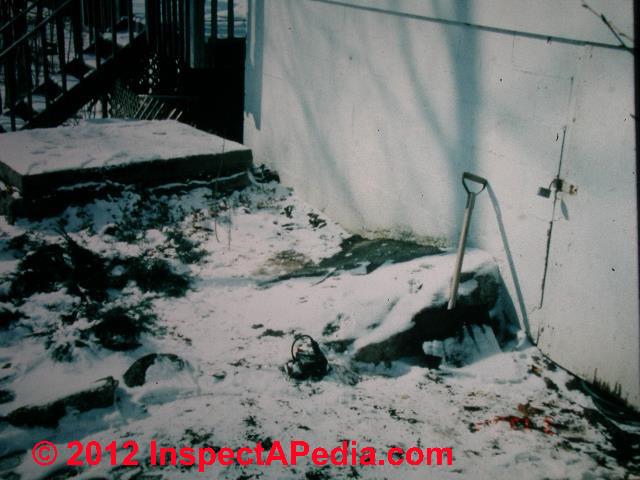
Here we describe key steps to take before actually beginning the onsite septic system inspection and test procedure.
Our photo shows a home-made septic tank abutting the building wall (upper left in the photo). We saw a septic effluent pump on the ground, above ground piping, and concluded that the entire system was home-made and very doubtful.
[Click to enlarge any image]
On flushing a toilet in the home, the effluent pump sprayed sewage through the air and on bystanders - needless to say this was an unsanitary event and not much of a septic system.
- Septic Inspection Safety: Review Safety Warnings to Septic System Inspectors in our main text: "Inspecting, Testing, & Maintaining Residential Septic Systems.
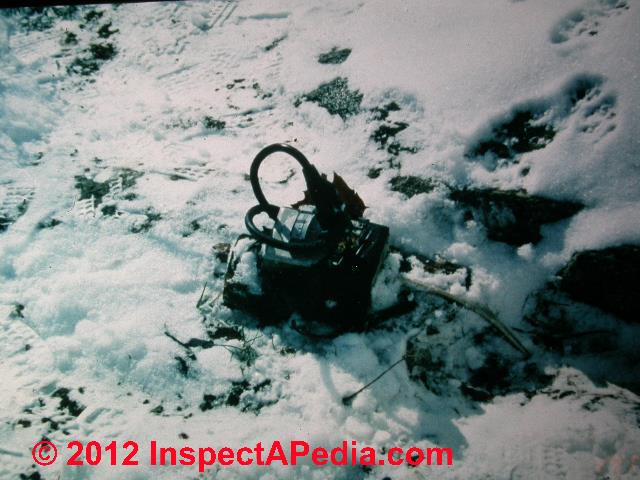
Our photo ( shows the septic effluent pump in its makeshift installation.
It was evident that the system was not functional, not sanitary, and really unsafe for bystanders. A system like this should not be tested nor operated without taking steps to protect the inspector and others.
- Obtain owner permission.
If a buyer has indicated that a septic test is to be performed one might
expect the owner to have given permission for a loading and dye test but
it's not the case that an owner understands ahead of time what is going to
be done.
If an owner objects to running water or performing a dye test the inspector should not proceed with the test and should inform the client, including the implications of the situation.
A realtor present at the inspection should, by virtue of the realtor agency for the seller, be able to confirm that the septic test is to be performed. - Do not perform loading tests on certain septic systems: dosing systems and recirculating sand bed systems may require that flows into them be limited in volume and time; some systems can be damaged by excessive flooding.
- Do not permit septic tank or system pumpout right before testing: an empty tank may be 1000 gallons or more; it will not be filled by a typical loading and dye test, therefore the SAS will not have been loaded at all, and false conclusions may be drawn about the condition of the system.
- If pumping and tank inspection are to be performed in conjunction
with a dye test: the optimum
procedure would be to open and inspect the tank at its normal operating
condition. The static level liquid in the tank (high, normal, low) may give
evidence of a problem that will be masked when the system is flooded.
Tank pumping may then be delayed until after the loading test has had opportunity to test the SAS. If there is obvious tank damage (missing baffles, collapsing tank, abnormal liquid levels) the dye test should not proceed. - Document: when and where water was run, at what fixtures, for what length of time, at what measured or estimated average flow rate, and at what total volume.
- Confirm water flow into main waste line: from the fixtures where it is being run. Note piping that may suggest presence of separate drywells and do not use fixtures draining thereto for septic system testing. Document that drywells were not tested if you're not performing additional tests thereon.
- Monitor water supply equipment during test: if flow declines or stops, be sure to stop the test to avoid possible damage to a well pump.
- Watch for leaks and backup at plumbing fixtures: check each fixture before walking away leaving water running. Ask Douglas Hansen what happens if you don't do this.
- Inspect: suspected SAS area as well as all property areas for evidence of dye or effluent breakout before and after the test.
- Check nearby streams, storm drains: for presence of dyed effluent. Dye often appears in 10-20 minutes if there is a gross system failure; however it may not appear for 5 days in some cases.
- Questions To Ask the Property Owner About the Septic System
- Where are the septic tank and other system components located? (For help locating septic tanks see Tank Location - How to Find the Septic Tank)
- What is installed? (Steel tank, concrete tank, drain field, seepage pits, drywells, galleys, etc.)?
- What is the maintenance and repair history of the system? (Last pumped, what repairs have been done, pumping history and frequency, backups, etc.)
Helpful information is provided by answers to septic system questions, even if the answer is "I don't know"
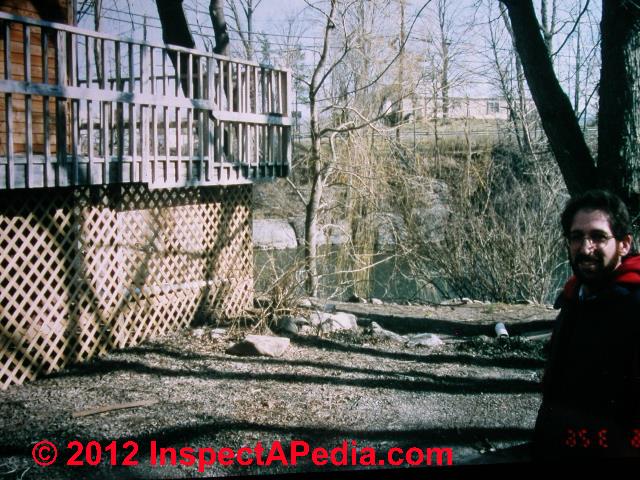
The septic information questions about the history of a septic system we list above are deliberately a bit vague and open ended to permit a property owner to volunteer what information they may have about the condition of the septic system.
Our photo (left) shows a home with a septic system very close to a river - you can see the river in the center of the photo. The property owner had no idea where the septic tank nor drainfield were, and we couldn't see much space for these components on the small lot that was mostly driveway and parking area.
We inserted septic dye into the system and began running water, running down to the river to watch for our dye appearing in that body.
Our septic dye never made it to the river, and we were quickly called back up the bank by our clent who pointed out the red dyed sewage effluent that came flowing out of the driveway and towads the basement entry door.
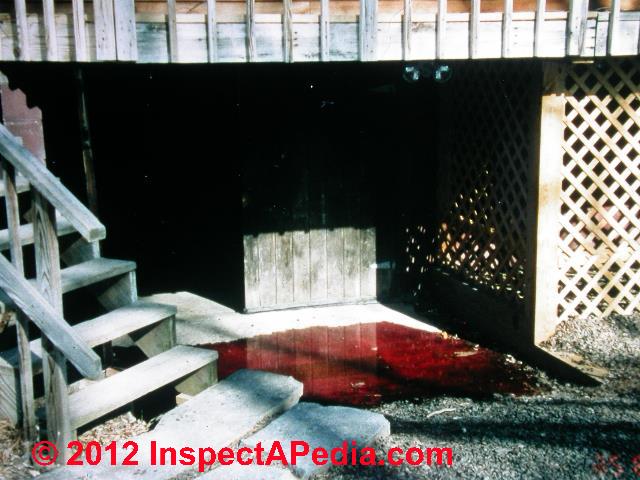
The septic system consisted of a tank and leachfield located under the driveway - too close to the river, too compacted and destroyed by vehicle traffic, and really, too awful.
Because an owner may not recall the septic system maintenance history or may not be familiar with onsite waste disposal terminology, the inspector and client should obtain and consider but should not blindly rely on simple oral statements about the type of equipment installed.
These questions can be given to the inspector's client well before the site inspection, to permit the client or real estate agent to present them to the property owner, particularly if the owner is not going to be at the site at the time of the inspection.
- Obtain Permission: by informing the real estate agent and through agent an owner, or if owner is present, ask the owner's permission before performing this test.
- Do Not Pump the Septic Tank Before the Test - an owner who offers to provide this service for a prospective
buyer may be (inadvertently) preventing a valid septic loading and dye test.
We want the system to be in-use or at least the septic tank to be at its normal level of liquid and waste (its normal condition) at the time of testing. More details about the problem of septic tank pumpouts as a cover-up of a septic problem or failure are at WHEN NOT TO PUMP A SEPTIC TANK: warnings for home buyers about septic tank pumping. - Confirm that the septic tank has not just been pumped before starting a loading and dye test, by visual inspection and by asking
the septic system maintenance history. If the inspector sees fresh excavation in a likely septic
tank location it is possible that the tank was pumped recently.
If the system has not been used sufficiently since pumping the septic loading and dye test should be postponed until the tank has first been filled. Otherwise the "loading test" is simply filling the tank rather than pushing any liquid test volume into the drain field. - Septic system records: Are there written records of septic system installation, repair, or maintenance? Home inspectors performing a septic loading and dye test are not required to review written records nor to perform offsite research at a health or building department facility. Some inspectors may elect to offer that service for an additional fee.
These pages are part of our SEPTIC DYE TEST PROCEDURE for testing septic system function. Technical review by industry experts has been performed and is ongoing - reviewers are listed atReferences or Citations . Comments and suggestions for content are welcome.
Recommended Articles
- SEPTIC LOADING & DYE TEST PROCEDURE - home
...
Continue reading at OUTSIDE SEPTIC PRE-TEST INSPECTION or select a topic from the closely-related articles below, or see the complete ARTICLE INDEX.
Suggested citation for this web page
SEPTIC TEST PRE-CHECKS at InspectApedia.com - online encyclopedia of building & environmental inspection, testing, diagnosis, repair, & problem prevention advice.
Or see this
INDEX to RELATED ARTICLES: ARTICLE INDEX to SEPTIC SYSTEMS
Or use the SEARCH BOX found below to Ask a Question or Search InspectApedia
Ask a Question or Search InspectApedia
Try the search box just below, or if you prefer, post a question or comment in the Comments box below and we will respond promptly.
Search the InspectApedia website
Note: appearance of your Comment below may be delayed: if your comment contains an image, photograph, web link, or text that looks to the software as if it might be a web link, your posting will appear after it has been approved by a moderator. Apologies for the delay.
Only one image can be added per comment but you can post as many comments, and therefore images, as you like.
You will not receive a notification when a response to your question has been posted.
Please bookmark this page to make it easy for you to check back for our response.
Our Comment Box is provided by Countable Web Productions countable.ca
Citations & References
In addition to any citations in the article above, a full list is available on request.
- New York State Department of Health, APPENDIX 75-A WASTEWATER TREATMENT STANDARDS - INDIVIDUAL HOUSEHOLD SYSTEMS , [PDF] New York State Department of Health, 3 February 2010, retrieved 3/1/2010, original source: https://www.health.ny.gov/regulations/nycrr/title_10/part_75/appendix_75-a.htm
- Inspecting Septic Systems: Online Book, Inspection, Test, Diagnosis, Repair, & Maintenance: our Online Septic Book: Septic Testing, Loading & Dye Tests, Septic Tank Pumping, Clearances, details of onsite waste disposal system inspection, testing, repair procedures.
- Mark Cramer Inspection Services Mark Cramer, Tampa Florida, Mr. Cramer is a past president of ASHI, the American Society of Home Inspectors and is a Florida home inspector and home inspection educator. Mr. Cramer serves on the ASHI Home Inspection Standards. Contact Mark Cramer at: 727-595-4211 mark@BestTampaInspector.com
- John Cranor [Website: /www.house-whisperer.com ] is an ASHI member and a home inspector (The House Whisperer) is located in Glen Allen, VA 23060. He is also a contributor to InspectApedia.com in several technical areas such as plumbing and appliances (dryer vents). Contact Mr. Cranor at 804-873-8534 or by Email: johncranor@verizon.net
- Pennsylvania State Wastewater Treatment Fact Sheet SW-161, Septic System Failure: Diagnosis and Treatment
- Pennsylvania State Wastewater Treatment Fact Sheet SW-162, The Soil Media and the Percolation Test
- Pennsylvania State Wastewater Treatment Fact Sheet SW-l64, Mound Systems for Wastewater Treatment
- Pennsylvania State Wastewater Treatment Fact Sheet SW-165, Septic Tank-Soil Absorption Systems
- Document Sources used for this web page include but are not limited to: Agricultural Fact Sheet #SW-161 "Septic Tank Pumping," by Paul D. Robillard and Kelli S. Martin. Penn State College of Agriculture - Cooperative Extension, edited and annotated by Dan Friedman (Thanks: to Bob Mackey for proofreading the original source material.)
- Advanced Onsite Wastewater Systems Technologies, Anish R. Jantrania, Mark A. Gross. Anish Jantrania, Ph.D., P.E., M.B.A., is a Consulting Engineer, in Mechanicsville VA, 804-550-0389 (2006). Outstanding technical reference especially on alternative septic system design alternatives. Written for designers and engineers, this book is not at all easy going for homeowners but is a text I recommend for professionals--DF.
- In addition to citations & references found in this article, see the research citations given at the end of the related articles found at our suggested
CONTINUE READING or RECOMMENDED ARTICLES.
- Carson, Dunlop & Associates Ltd., 120 Carlton Street Suite 407, Toronto ON M5A 4K2. Tel: (416) 964-9415 1-800-268-7070 Email: info@carsondunlop.com. Alan Carson is a past president of ASHI, the American Society of Home Inspectors.
Thanks to Alan Carson and Bob Dunlop, for permission for InspectAPedia to use text excerpts from The HOME REFERENCE BOOK - the Encyclopedia of Homes and to use illustrations from The ILLUSTRATED HOME .
Carson Dunlop Associates provides extensive home inspection education and report writing material. In gratitude we provide links to tsome Carson Dunlop Associates products and services.
 | HOME | ABOUT | ASK a QUESTION | CONTACT | CONTENT USE POLICY | DESCRIPTION | POLICIES | PRIVACY | |
| © 2024 - 1985 Publisher InspectApedia.com - Daniel Friedman | |||||||||