
InspectAPedia® FREE Encyclopedia of Building & Environmental Construction, Diagnosis, Maintenance & Repair |
Question? Just ask us! InspectAPedia
|
 How to Cure Sewer Gas Smells from Septic Tanks & Septic Systems
- POST a QUESTION or COMMENT about recommended cures for sewer odors
Sewer & septic gas & odor cures & prevention:
This sewer gas smell article describes how to get rid of or cure odors in buildings including septic or sewage or sewer gas smells or "gas odors" in buildings with a focus on homes with a private onsite septic tank but including tips for owners whose home is connected to a sewer system as well.
Citation of this article by reference to this website and brief quotation for the sole purpose of review are permitted. Use of this information at other websites, in books or pamphlets for sale is reserved to the author.
InspectAPedia tolerates no conflicts of interest. We have no relationship with advertisers, products, or services discussed at this website.
How to Diagnose, Prevent, or Cure Odors and Hazards from Gases in Septic Systems
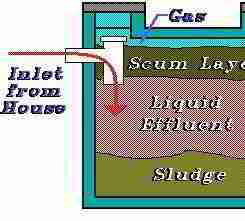
In a properly constructed drain-waste-vent system and septic tank installation, sewer gases produced in the septic tank find their easiest escape path back up through the scum layer and into the septic tank inlet tee
and from there up the drain waste vent (DWV) system to the building plumbing vent stack system where gases are vented above the building roof.
More septic or sewer gases may escape and make their way through the tank's outlet tee top into the soil absorption system where the gases are distributed over a larger (leachfield) area and further filtered and deodorized by the soil.
Where a building is connected to a municipal sewer, the building drain-waste-vent system (DWV) includes traps and vents to be sure that any sewer gases passing back up waste lines are vented safely above the building roof.
Watch out: as we warn in all of our sewer gas articles, because sewer gas contains methane gas (CH4) there is a risk of an explosion hazard or even fatal asphyxiation. Sewer gases also probably contain hydrogen sulfide gas (H2S) In addition some writers opine that there are possible health hazards from sewer gas exposure, such as a bacterial infection of the sinuses (which can occur due to any sinus irritation).
Depending on the sewer gas source and other factors such as humidity and building and weather conditions, mold spores may also be present in sewer gases.
Also see WET WEATHER or COLD WEATHER SEPTIC / SEWAGE ODOR Diagnosis & Repair Guide for additional odor tracing and cure advice for odors occurring during wet or cold weather.
A variety of mistakes or just plain bad luck about site terrain shape and prevailing wind, or something more serious like a failing septic system can, however, produce sewer odors at a property.
Here are some steps to diagnose and correct gas odors at properties served by septic systems. Some of these steps also apply to homes connected to a municipal sewer as well.
What Gases Form in the Septic Tank
At SEPTIC & CESSPOOL SAFETY we've already explained that gases produced in a septic tank are dangerous, as a potential source of explosion and as a cause of death by asphyxiation if someone falls into or deliberately enters a septic tank.
The gases that form in septic tanks are primarily two, methane, CH4, and hydrogen sulfide H2S. It's the H2S (a "rotten egg" smell) that people mostly notice if gases from a sewage system are not properly vented at a building. Other gases produced by the decaying organic matter in the tank are also mixed into this brew as well.
Septic Tank Gas Leak Points Outside
Experts [Burks/Minnis, Kahn et als, Jantrania] will tell readers that septic tanks and their covers and access covers and piping fittings should all be sealed air-tight with proper rubber gaskets.
In nearly 50 years of looking at septic tanks and systems, I've rarely seen a conventional concrete tank which was sealed with gaskets.
Some steel and certainly some of the newer fiberglass septic tanks may be in fact more precisely designed and built, but concrete septic tanks and covers are a bit rough and will be leaky in most installations.
Septic Tank Acidity can Cause Odors
Acidic Septic Tank Problems can also cause odors:
See Acidic septic tanks
at SEPTIC or SEWER PIPING LEAKS for the diagnosis and cure of this source of sewage smells.
Septic System Maintenance vs Septic Odors: sewer gas, sulphur odors, rotten egg smells
A review of septic system maintenance advice, particularly from aerobic treatment unit or ATU septic designs makes clear that a system that is not properly maintained may be a source of troubling smells, while a properly operating and maintainted system is not normally a source of complaints.
Some examples of septic system maintenance snafus that can result in sewer gas odors at the site or backing up into the building include at least these:
- Aerobic treatment unit septic system parts failure:
an aerator pump or control valve failure can cause the ATU to emit septic smells and risks system damage or even failure - by the discharge of inadequately treated wastewater into the effluent disposal bed.
See AEROBIC SEPTIC ODORS & SMELLS - Drain backups & sewage odors:
blocked drain lines or vent pipes resulting in trap siphonage or sewer gas backups into the building can have as a component or even primary cause a failed septic system drainfield. A drainfield or soakaway bed failure in turn may be due to inadequate maintenance such as failure to pump or clean out the septic tank on schedule.
For an example, see FLOOR DRAIN / TRAP ODORS - Septic tank or sewer line leaks
at any point in the system can discharge effluent or, depending on the leak location, may be a source of sewer gas leaks & odors. Sewer lines within a building may corrode at the top of the piping or may be cracked or damaged at a position hard to see but one that can be located by careful inspection and odor tracking.
An example is at CAST IRON DRAIN LEAK, ODOR, REPAIR.
Also see HYDROGEN SULFIDE CORROSION: CONSEQUENCES, DETECTION & CONTROL [PDF], U.S. Environmental Protection Agency, retrieved 02/20/2023, ttps://nepis.epa.gov/Exe/ZyPDF.cgi/200048ZZ.PDF?Dockey=200048ZZ.PDF - Treatment chemicals misapplied
or not used where required in some aerobic septic system designs or similar designs that require use of a disinfectant can result in system odors.
Watch out: don't just go pouring bleach into a septic system and for disinfectant type septic designs be sure you are using the proper disinfectant.
See AEROBIC ATU SEPTIC MAINTENANCE PROCEDURES
and AEROBIC SEPTIC DISINFECTANTS - Calcium Hypochlorite
Septic Tank Gases Back Up Into Building
Sewer gases formed in the septic tank can return to a building interior by backing up from the septic tank inlet baffle and pipe to the building drain-waste-vent piping. Inside the building sewer gas (rotten egg or methane) smells may be observed:
- A blockage at the septic tank can cause sewer gases to back up into the building.
Blockages at the tank range from very costly (a failing drainfield) to less costly (a blocked or damaged sewer line between the septic tank and the distribution box or drainfield), to least costly and repaired by normal maintenance (pumping the septic tank). How can pumping the septic tank cure a sewer gas odor?
If the septic tank outlet baffle has become blocked by a too-thick floating scum layer or "pillow" then sewer gases may be backing up into the building through the incoming sewer line to the tank.
Still, if the building vent system and traps are in good condition, this odor should not appear indoors so look for additional problems we list next: - At loose toilets that are not properly sealed to waste lines,
often appearing at lowest floor toilets first but possibly appearing at any toilet that is not well sealed.
Even a toilet that does not "rock" on the floor may have a crushed leaky wax ring sealing the toilet base to the waste pipe. If smells are worst around a particular toilet we suggest having your plumber remove and re-seal the toilet. - At leaky or defective plumbing traps or plumbing vent lines -
links to Recommended Articles at the end of this page point to details on these topics. - Odors at leaky sewage grinder pumps -
see SEWAGE PUMP ODORS
Reader Comments, Questions & Answers About The Article Above
Below you will find questions and answers previously posted on this page at its page bottom reader comment box.
Reader Q&A - also see RECOMMENDED ARTICLES & FAQs
On 2022-01-31 by Inspectapedia Com Moderator - capping off a shower leads to odors
@Anita R,
We need some clarification on just what was done to "cap off the shower".
When any plumbing drain is left un-used, its water trap eventually dries out and sewer gases can emerge. (We pour mineral oil into such traps to help keep them sealed against odor release.)
If the shower drain is sealed then sewer gas odors ought not find their way into the bathroom from that source.
So perhaps the "Cap off" operation was incomplete.
Another possibility is that the remaining vent piping itself is leaking somewhere such as under a floor or in a wall.
The most-reliable test is a pressure test of the vent piping system, but a sewer line inspection camera might also show up a problem without having to tear open walls or ceilings to visually inspect the vent and drain piping - that'd be a last resort.
See more at
PLUMBING VENT DEFECTS
Please let us know if you have additional questions and do let us know what you find out as that will help other readers.
On 2022-01-30 by Anita R
I have read through the questions and your answers but haven't seen one that matches my situation. We live in a house built in 1960 with iron pipes.
One bathroom went unused for a decade, we had someone replace the toilet and sink and cap off the shower so that couldn't be used, but septic smell comes up the shower drain and after several months of use and another new toilet and several plumbers later a camera determined the pipes are corroded.
It's too expensive to replace, so we've closed up that bathroom again. BUT the smell lingers - is there anything I can pour down the toilet/shower as well as the drain in the utility room that will minimize the septic gases from coming back into the house? Or some kind of filter to place over them?
On 2022-01-03 by Inspectapedia Com Moderator - baking soda won't fix anything in a septic system
@Bob Radlinski,
I will do some additional research on the baking soda question but in general it seems absurd to me if you consider the liquid waste water volumes involved in there for the amount of baking soda you would need to make any meaningful effect on the pH of the entire system. You're also treating the symptom not the cause.
In general it's common to have some septic odor close to manholes and clean outs and vents but if the whole area stinks, then in my OPINION there's something wrong either with the system design, maintenance, or the processing of the sewage.
On 2022-01-03 by Bob Radlinski
@Inspectapedia Com Moderator, Thank you very much for the quick and informative response. The current charcoal filters were added before I got involved and the charcoal is overdue for replacement anyway. The two filter vendors I contacted said that freezing is not a problem, including for filters sold to Canadian customers.
The baking soda treatment was recommended by a septic system consultant and several online sources claim no odor at all once the pH is adjusted (one of course is Arm and Hammer!).
Considering our system that is fed by pumps with discharge check valves preventing any venting back through the house stacks. it is reasonable to expect that an oder free system is possible, or do we have to expect some odor, no matter what we do? We are getting some odor around the access covers and from the unfiltered leach field downstream vents.
Thanks
On 2021-12-30 by Inspectapedia Com Moderator - why an outdoor septic odor vent filter might freeze
@Bob Radlinski,
We can both understand the reasons for thinking an outdoor septic vent using charcoal might freeze (moisture) and then stop working- but I suspect the requirement to remove the vent in cold weather is product dependent.
Let's ID the specific brand and product that you're using there in NH.
For example the
PAGODA CHARCOAL SEPTIC ODOR VENT [PDF] brochure
makes no mention of freezing issues.
I am not a fan of trying to adjust the pH of sewage with baking soda or anything else - the volumes and dosages involved don't seem practical to me, and worse if you're emptying effluent into a drainfield I'm unclear what that "treatment" would do to the necessary soil bacteria.
On 2021-12-29 by Bob Radlinski
Live in a new housing development in New Hampshire with multiple houses feeding a common septic system through E/One grinder pumps. We are getting strong odors outdoors.
Because of the pumps, all septic system vents are at grade. Tall vents at inlet to field, short vents at outlet. Tall vents have charcoal - have read that charcoal must be removed in winter due to freezing - is this true? Filter suppliers say not a problem.
Major source of odor is an unfiltered dosing pump chamber vent. Have read that adjusting pH using baking soda can eliminate odor, but local septic pumping company has not heard of this.
Question - should we pursue the baking soda solution or just add a charcoal filter with heat tracing to the pump chamber vent? Thanks.
On 2021-05-26 by danjoefriedman (mod) - septic odor since I had the tank pumped
@J Morrow,
Since the septic tank cleanout would not involve anyone tracking sewage into the home, when this odor complaint comes up I'd look for
- a damaged septic tank inlet baffle
- damaged plumbing vent system
- sewage spills outside that are entering the building
On 2021-05-26 by J Morrow
I had my septic tank drained and the pipes cleared out a few weeks ago. Since then I’ve had the septic smell in my house, specifically in the bathroom, especially after a shower.
On 2021-05-02 by danjoefriedman (mod) - time to hire a septic inspector
@B Dukes,
It's worth giving yourself some peace of mind about having an accurate diagnosis by paying a plumber or other septic inspector to use a sewer line camera to explore your drain field lines to see if they are flooded versus broken or damaged but certainly on a 30 year old septic you wouldn't be surprised at the conclusion that you already suspect
On 2021-05-02 by B Dukes - septic odor in my yard
I have septic odors around my whole yard. If it is drain fields wouldn’t the odor be at that drain field. The system is 30 years old. Septic professionals will automatically tell you to replace your drain fields. Any advice?
On 2021-04-05 by danjoefriedman (mod) - house in Phillipines smells like feces
@Heinrich,
What you describe sounds like a serious health hazard. Can you get advice from a local doctor? Do you have an option of moving?
If not, and if the landlord won't correct your situation, you'll need to have it fixed yourself.
That means:
A plumber to inspect and find the source of sewage leaks or sewer gas leaks and repair those
A cleaning company who can find and clean up any sewage spills and disinfect those surfaaces
And frankly living in a home with no windows and no fresh air sounds like a terrible environment. At least get some screening and leave your doors open but screened when you can, and get some box fans to blow fresh air in at one door and stale air out at another. (Be sure the interior is cleaned up first as we don't want to just stir up unhealthy or unsafe dust).
If you cannot make these health corrections and if your doctor agrees that the home is unsafe and if with photo documentation and help from your plumber or doctor to communicate the trouble to your landlord, if no repairs are being made quickly then you'll need to move.
I know it's easier for me to say than than for you to do it, and I'm sorry for that, but it's very troubling to consider simply staying in an environment that you have already said is making you and your family sick.
On 2021-04-05 by Heinrich
Hi. I'm a foreigner in the Philippines. Landlords do not help tenants. And I do not speak their language. Our house smells like feces very bad. I have 8 kids. And we are all sick. Houses here also do not have windows. So ventilation is not good. What can we do? Thank you kindly.
On 2021-03-20 by (mod) - signs that a building drain is clogged but the clog is distant from the fixture
@louisemmm,
All of the symptoms you report point to a remote drain clog or blockage.
SEPTIC SYSTEM ODOR CURES https://inspectapedia.com/septic/Septic_Odor_Cures.php contains our complete list of diagnostic procedures - please take a look there and don't hesitate to ask if any of that is unclear or seems to be missing something.
On 2021-03-19 by louisemmm
I do hope you will provide some guidance. I live in a condominium. It is a 10-floor building and I am on the 3rd. I have a few issues - all with plumbing - and the building manager won't help. The first problem is one toilet that periodically makes a loud bubbling sound which can last for 20 minutes or go on and off all day.
The toilet has no blockage and everything flushes well. The second issue is in the kitchen sink. Periodically, food and other items will pour into my sink through the drain and will start to fill it up. The third is that periodically, there is an awful sewer smell in the master bathroom. I checked and replaced the toilet wax ring.
There were no problems and the toilet was re-caulked or sealed. It is really a horrible situation and I worry that the manager is just refusing any responsibility. I would love to hear your thoughts and what I should do next. I thought to find an expert who could write up an assessment of the situation that I can pass on to the manager. Thank you very much.
On 2021-02-02 by danjoefriedman (mod) - find the source of a bad odor in my home
Adam
In the ARTICLE INDEX you will find a whole family of articles, tips, data logging sheets, and other ideas for tracking down a sewer gas or plumbing system odor; please take a look; Going through those helps give some order and sequence to tracking down odors and fixing them, and so will perhaps be more successful than if, with close to zero information about your building and how it is constructed and its condition, I were simply to make wild guesses of what to do next.
Or start at SEWAGE ODOR SOURCE LOCATION
On 2021-02-01 by adam
Hi there. I have had an issue with a bad odor in my home for a few yrs now.
During that period of time, I have had the tub and plumbing replaced (broken trap under the tub), on the first floor. Removed insulation in part of the attic (the insulation was destroyed by vemin), thinking it may alleviate the smell.
I had a plumber video inspect my main drain to see if there are any breaks, which he did not find any break and the trap was intact. I have municipal water, no septic.
The smell shows up in spring and summer, but once the temp drops, it goes away. I have had several people try to give me any more ideas to check, but so far I am at a loss what to check next. I need to figure this out. Any suggestions? Thank you.
I also want to add the smell is located on the first floor. Near the first floor bathroom and the boiler closet.
On 2020-01-13 by (mod) - smells after septic tank pumped
Was there any spillage?
I ask because I don't think they're pumping attack would have any obvious immediate effect on me building plumbing system itself unless you have enough combination of against such as missing or dryer Plumbing trucks and sewer gas backing up from the now empty septic tank through the building drain waste vent system
On 2020-01-13 by Sharon Howard
I just had my septic tank cleaned out I never had a smell before now I do the smell is in the room behind the bathroom what would cause this...
On 2019-12-28 0 by (mod) - septic odors since new plastic septic tank installed
Kirk
It's normal for sewer gas to be vented out of the vent pipes above the roof-line; that's why they are located above the roof and not lower;
However sometimes a site feature: trees, wind direction, roof slope, etc. can cause downdrafts that send sewer gas smells down where we don't want them. A possible cure is a wind-activated hood that faces vents away from the oncoming wind, or extending vent heights.
An odor when running a washer can be from inadequate venting at the washer drain stand pipe.
A sewage ejector pump ought always to have a check valve in its outlet piping.
Let me know if your septic inspection finds signs of trouble such as abnormally high levels in the tank, damaged or missing baffles, etc.
Watch out: DO NOT work alone, and hire a professional; leaning over a septic tank can by itself be fatal.
On 2019-12-26 by Kirk Dupas
We had a new Septic tank (Plastic type) installed in2016 We have had a septic gas smell since then.
We did have an old 1960s not up to code drain from the tub and kitchen that was blocked. A plumber came in and installed new PVC pipe. First the Vent pipes on the roof were spuing gas. It was sickning out in our back yard.
The installer wouldn't help us as he never smelled it. I installed two carbon filters That fixed it outside but not inside. We are getting gas smell big time when I wash my hands in the laundry room sink and the pump turns on.
When we use the washing machine we get some smell while it is running and if you open it to empty you can smell it. I was desperate so I installed a sump pump backflow preventer. It helps but it is not the cure.
Should I have another Septic installer look at how it was installed or call a plumber. I am going to check the baffle but right now the ground is frozen.
On 2019-09-05 by (mod) - more clues to source of a septic system smell
If there were no odor problems before the new septic was installed then it'd make sense to review what was done during that installation:
new tank?
new fields?
New D-box?
New piping between house and tank?
What changed?
Did someone drive over a pipe and crush it?
Do drains flow freely?
Are there any drain noises?
Has anyone checked for flow into the septic tank and into the D-box when toilets are flushed?
On 2019-09-05 by Leighann
It’s an old farmhouse. Some plumbing new. In US, eau claire wi. So you’re thinking start with plumbing? Why would this suddenly happen when new septic installed?
On 2019-09-05 by (mod) - to track down the source of a septic odor try to find where the odor is strongest
Leighann
We need an onsite expert, perhaps an experienced plumber, to take a look at your system.
Is this a new house or old one? What are the country and city of location?
Start where the odor is worst and look for a problem with plumbing venting first. Is there a loose toilet? Is the house plumbing new or recently modified?
On 2019-09-05 by Leighann
Just had a new conventional septic put in and within a few days the house smells like an outhouse. The main level bathroom being the worst but radiates thru entire house upstairs as well. Smells vary in how bad it gets.
On 2019-03-12 by judy
septic tank smell underneath bathroom sink when you open door and coming through air and heat duct vents when unit is running,HELP!!!
On 2018-11-18 by (mod) - To eliminate an odor we need to find its source.
To eliminate an odor we need to find its source.
Try ODOR DIAGNOSIS SIX STEPS and try the odor log sheet that we suggest as that can help narrow down the odor cause.
On 2018-11-18 by Leslie
considering the dryer runs simultaneously I am thinking it is not methane. Any ideas on how I might remedy the problem? The septic was cleaned out about 3 months ago and all sewage pipes inside my home were replaced 3 years ago.
On 2018-11-18 by (mod) - safety of an odor from the septic system?
Anon
I can't make a safe, reliable guess about the safety of an odor by e-text.
Watch out: However IF the odor you smell is sewer gas entering the home, that's potentially dangerous as it contains explosive methane (actual hazard depends on the amount and concentration and building ventilation) and possibly pathogens.
On 2018-11-18 by Anonymous
The smell I am experiencing has an odor similar to when a woman gets a hair permanent. It is produced when I do laundry. I am on a septic which is located on the side of the house and the laundry is nearest to the septic.
My home is 60-70 feet in length, has the laundry at the end nearest the septic, a bathroom in the middle and a bathroom at the end furthest from the septic.
There is only one vent at the middle of the house.
Is this gas dangerous? Any suggestions?
...
Continue reading at SEPTIC / SEWER ODOR SOURCE TABLE or select a topic from the closely-related articles below, or see the complete ARTICLE INDEX.
Or see SEPTIC ODOR FAQs - diagnostic questions & answers
Or see these
Recommended Articles
- AEROBIC SEPTIC ODORS & SMELLS - causes & cures for odors from aerobic septic treatment systems
- SEWER GAS ODORS - home
- ODOR CONTROL for SEPTIC TANKS
- ODORS GASES SMELLS, DIAGNOSIS & CURE - home
Suggested citation for this web page
SEPTIC SYSTEM ODOR CURES at InspectApedia.com - online encyclopedia of building & environmental inspection, testing, diagnosis, repair, & problem prevention advice.
Or see this
INDEX to RELATED ARTICLES: ARTICLE INDEX to BUILDING ODOR DIAGNOSIS & CURE
Or use the SEARCH BOX found below to Ask a Question or Search InspectApedia
Ask a Question or Search InspectApedia
Try the search box just below, or if you prefer, post a question or comment in the Comments box below and we will respond promptly.
Search the InspectApedia website
Note: appearance of your Comment below may be delayed: if your comment contains an image, photograph, web link, or text that looks to the software as if it might be a web link, your posting will appear after it has been approved by a moderator. Apologies for the delay.
Only one image can be added per comment but you can post as many comments, and therefore images, as you like.
You will not receive a notification when a response to your question has been posted.
Please bookmark this page to make it easy for you to check back for our response.
Our Comment Box is provided by Countable Web Productions countable.ca
Citations & References
In addition to any citations in the article above, a full list is available on request.
- New York State Department of Health, APPENDIX 75-A WASTEWATER TREATMENT STANDARDS - INDIVIDUAL HOUSEHOLD SYSTEMS , [PDF] New York State Department of Health, 3 February 2010, retrieved 3/1/2010, original source: https://www.health.ny.gov/regulations/nycrr/title_10/part_75/appendix_75-a.htm
- Thanks to Slade Franklin for the reminder that a leaky wax ring at a toilet can lead to septic odors in bathrooms. 11/2007
- Thanks to J.V. (privacy protected) for the reminder to make a detailed inspection of the plumbing vent system when sewer gas odors are present. 07/2008
- Thanks to Roger Hankey & Cheryll Brown, www.hankeyandbrown.com, ASHI home inspectors in Minnesota, for the deteriorated transite pipe gas flue vent photograph and comments. Mr. Hankey is a past chairman of the ASHI Technical Committee, serves as co-chairman of ASHI legislative committee, and has served in other ASHI professional and leadership roles. 7/2007
- PLUMBING DRAIN NOISE DIAGNOSIS: may indicate defective or clogged plumbing: how to diagnose and cure drain soundscalculating septic tank volume from size measurements
- SEPTIC TANK/SOIL-ABSORPTION SYSTEMS: HOW TO OPERATE & MAINTAIN [PDF] - , Equipment Tips, U.S. Department of Agriculture, 8271 1302, 7100 Engineering, 2300 Recreation, September 1982, web search 08/28/2010, original source: http://www.fs.fed.us/t-d/pubs/pdfimage/82711302.pdf.
CONTINUE READING or RECOMMENDED ARTICLES.
- Carson, Dunlop & Associates Ltd., 120 Carlton Street Suite 407, Toronto ON M5A 4K2. Tel: (416) 964-9415 1-800-268-7070 Email: info@carsondunlop.com. Alan Carson is a past president of ASHI, the American Society of Home Inspectors.
Thanks to Alan Carson and Bob Dunlop, for permission for InspectAPedia to use text excerpts from The HOME REFERENCE BOOK - the Encyclopedia of Homes and to use illustrations from The ILLUSTRATED HOME .
Carson Dunlop Associates provides extensive home inspection education and report writing material. In gratitude we provide links to tsome Carson Dunlop Associates products and services.
 | HOME | ABOUT | ASK a QUESTION | CONTACT | CONTENT USE POLICY | DESCRIPTION | POLICIES | PRIVACY | |
| © 2024 - 1985 Publisher InspectApedia.com - Daniel Friedman | |||||||||