
InspectAPedia® FREE Encyclopedia of Building & Environmental Construction, Diagnosis, Maintenance & Repair |
Question? Just ask us! InspectAPedia
|
 Nitrogen Contaminants From Septic Systems

- POST a QUESTION or COMMENT about the level of nitrogen contamination in soils, groundwater, and wells traced to septic systems
This document discusses nitrogen contamination (excess nitrogen or nitrate/nitrite levels) found in soils due to onsite septic systems.
We discusses further the principal nitrogen contaminants produced by septic systems or on-site waste disposal systems. This article discusses nitrogen and nitrate contaminants and links to sister documents discussing septic tank pathogens and other contaminants as well as to discussions of what to do about sewage backups in buildings and how to inspect and repair a septic system after flooding. We include discussion of health or other concerns with soil and groundwater contamination and with measures adopted to address these problems.
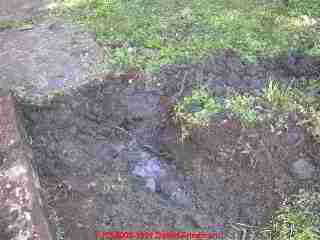
The photo above shows what dirt and sewage effluent may look like in a yard where the sewer line between the house and septic tank is damaged and leaking. Nitrates, nitrites, and sewage pathogens leaking from a septic system to the soil surface and subsoil waters are potential health hazards.
InspectAPedia tolerates no conflicts of interest. We have no relationship with advertisers, products, or services discussed at this website.
NITROGEN CONTAMINATION: nitrogen discharge from sewage treatment plants
Generally the discharge of nitrogen into arid land soil is very beneficial, as nitrogen (N) is beneficial to plants. Limits on the nitrogen level in soil may be a limit on the plant's successful growth. The discharge of nitrogen into tropical and temperate soil is also beneficial, but there remains a concern that the leachage of excess nitrogen into the water supply or into ground water is not desirable.
[Click to enlarge any image]
The discharge of nitrogen into the ocean is probably ok. While nitrogen is harmful and forms the limiting nutirient for algae growth, the dilution of the large volume of ocean water makes it unlikely that there is a measurable effect.
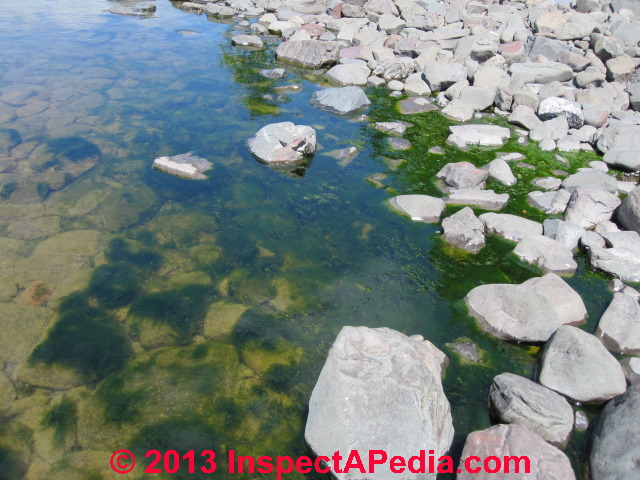
Watch out: Conversely the discharge of nitrogen (for example in wastewater or in farmland runoff) into fresh water lakes, streams or similar bodies is highly undesirable. In this environment the nitrogen level is algae's second most limiting nutrient. We see this effect in the excessive growth of algae along the shores of a freshwater lake where sewage effluent (containing high levels of nitrogen and other nutrients) leaks into the lake water.
Details are at WASTEWATER BIOCOMPATIBILITY.
Photo at above left, algae growth along a freshwater lake shore close to a septic system drainfield. While not water tests nor soil tests were performed at this location, and while there were no septic odors, further along the same shore but more distant from this concentration we did not find the same algae growth even though other conditions were the same.
New York -- January 11, 2006. New York City will spend more than $700 million on advanced water treatment systems to help restore Long Island Sound's water quality by upgrading municipal sewage treatment plants over the coming decade in order to reduce the discharge of nitrogen.
Nitrogen in treated sewage effluent causes a number of problems including excessive algae growth, reduced oxygen in water, and the death of fish, shellfish, and plants. The project will address Jamaica Bay and other water systems in the area. -- New York Times, page B4, 1/11/2006.
NITROGEN REFERENCES - Nitrogen Contaminants in Sewage - Reference List & Excerpts
That nitrogen release is a worldwide concern is evident from these example reports on nitrogen and sewage treatment.
Israel: Evaluation of Pollution in the Gulf of Eilat - Report For the Ministries of Infrastructure, Environment and Agriculture.
"There is consensus that the water clarity and coral reefs of Eilat are deteriorating. The widely suggested explanation for the degradation is that Eilat waters are suffering from sustained inputs of organic carbon and nutrients.
The International Expert Team (IET) was tasked to identify existing and potential sources of pollution; assess the carrying capacity of the Gulf for fish-farming; and formulate recommendations for minimization of pollution and environmental pressures. The IET considered 10 factors contributing to pollution in the Gulf: phosphate dust, sewage, fish-farms, groundwater inputs, siltation, marina activities, oil, tourist diving activities, water temperature, and port-ballast water.
The IET recognizes that there have been multiple stressors on the coral reefs of Eilat over the past 25 years, and these are discussed and ranked in the report. Presently, environmental pressures include: 1) continued inputs of nutrients from Aqaba phosphate dust, Aqaba sewage, and fish farms; 2) siltation from construction; 3) diving activities and, perhaps, 4) increased water temperature."
" In the past 25 years, total nitrogen in the water of the northern Gulf appears to have doubled, but varies seasonally. The large seasonal fluctuations are approximately equivalent to all the nitrogen input from fish-farms over the last 10 years and one-fourth of all the nitrogen input from sewage over the last 30 years;..."
China: The Problems and Countermeasures on Agricultural Sewage Irrigation in China - Yang Jifu (Irrigation and Drainage Department,IWHR)
"Abstract Due to the lack of agricultural water resources and the continuously increasing volume of sewage discharging all over the country, sewage has already become an important water resources for agriculture irrigation in the suburbs near many big cities in the North.In 1991 sewage irrigation area has reached 3 million hectares about 6%of the total irrigation area.
On the one hand, sewage irrigation alleviates agricultural water shortage, and on the other hand, it reduces the harmful impact on water environment by discharging sewage. However,three big problems on sewage irrigation have been existing for many years. They are the low water quality, the blind development on irrigation area and the backward research and management.
Thus, the sewage irrigation has become one of the three sources of water environment worsening in the village.It has been jeopardizing not only the quality of food and drinking water in the irrigation area, but also the food safety of 1.6 billion populations until the 21 st century.The following suggestions and countermeasures are provided in the Paper."
PATHOGENS in SEWAGE
At our continued reading links just below we point to an article on the pathogens or toxins found in sewage.
...
Continue reading at SEWAGE PATHOGENS in SEPTIC SLUDGE or select a topic from the closely-related articles below, or see the complete ARTICLE INDEX.
Or see these
Recommended Articles
- ENDOCRINE DISRUPTERS at BUILDINGS
- SEPTIC SYSTEM INSPECT DIAGNOSE REPAIR - home
- SEPTIC & CESSPOOL SAFETY
- SEPTIC DRAINFIELD LIFE
- SEWAGE & SEPTIC CONTAMINANTS
- SEWAGE BACKUP, WHAT TO DO/li>
- SEWAGE & SEPTIC CONTAMINANTS
- SEWAGE CONTAMINATION in BUILDINGS
- SEWAGE NITROGEN CONTAMINANTS
- SEWAGE PATHOGENS in SEPTIC SLUDGE
- WASTEWATER BIOCOMPATIBILITY
Suggested citation for this web page
SEWAGE NITROGEN CONTAMINANTS at InspectApedia.com - online encyclopedia of building & environmental inspection, testing, diagnosis, repair, & problem prevention advice.
Or see this
INDEX to RELATED ARTICLES: ARTICLE INDEX to SEPTIC SYSTEMS
Or use the SEARCH BOX found below to Ask a Question or Search InspectApedia
Ask a Question or Search InspectApedia
Try the search box just below, or if you prefer, post a question or comment in the Comments box below and we will respond promptly.
Search the InspectApedia website
Note: appearance of your Comment below may be delayed: if your comment contains an image, photograph, web link, or text that looks to the software as if it might be a web link, your posting will appear after it has been approved by a moderator. Apologies for the delay.
Only one image can be added per comment but you can post as many comments, and therefore images, as you like.
You will not receive a notification when a response to your question has been posted.
Please bookmark this page to make it easy for you to check back for our response.
Our Comment Box is provided by Countable Web Productions countable.ca
Citations & References
In addition to any citations in the article above, a full list is available on request.
- New York State Department of Health, APPENDIX 75-A WASTEWATER TREATMENT STANDARDS - INDIVIDUAL HOUSEHOLD SYSTEMS , [PDF] New York State Department of Health, 3 February 2010, retrieved 3/1/2010, original source: https://www.health.ny.gov/regulations/nycrr/title_10/part_75/appendix_75-a.htm
- "Bacterial Pathogens Recovered from Vegetables Irrigated by Wastewater in Morocco", Y. Karamoko, K. Ibenyassine, M. M. Ennaji, B. Anajjar, R. Ait Mhand, M. Chouibani, Journal of Environmental Health, June 2007.
Abstract:
The authors obtained 50 vegetable samples from various regions in Morocco and examined them to determine the micro biological quality of these products. Aerobic count, coliform, enterococci, and Staphylococcus areus were evaluated. This analysis revealed high levels of enterococci, fecal coliforms, and total coliforms. No coagulase-positive Staphylococcus aureas was detected in any of the samples analyzed. Biochemical identification of Enterobacteriaceae showed the presence of Citrobacter freundii (28 percent), Enterobacter cloacae (27 percent), Escherichia coli (16 percent), Enterobacter sakazakii (12 percent), Klebsiella pneamoniae (17 percent), Serratia liquefaciens (11 percent), and Salmonella arizonae (0.7 percent). The results clearly demonstrate that vegetables irrigated with untreated wastewater have a high level of microbiological contamination. Consequently, these vegetables may be a threat for the Moroccan consumer and may be considered a serious risk to Moroccan public health. ABSTRACT FROM AUTHOR Copyright of Journal of Environmental Health is the property of National Environmental Health Association and its content may not be copied or emailed to multiple sites or posted to a listserv without the copyright holder's express written permission. However, users may print, download, or email articles for individual use. This abstract may be abridged. No warranty is given about the accuracy of the copy. Users should refer to the original published version of the material for the full abstract.
Contact Us to request a copy of this article stored as BacterialPathogens.pdf if you have difficulty obtaining a copy of this full article for private use. - Beuchat, L.R. (1996). Pathogenic microorganisms associated with fresh produce. Journal of Food Protection, 59(2), 204-216.
- Breuer, T, Benkel, D.H., Shapiro, R.L., Hall. W.N., Winnett. M.M., Linn, M.J., Timothy, J.N., Barrett. J., Dietrich, S., Downes, EP, Toney, D-M., Pearson, J.L., Rolka. H., Slutsker. L, & Griffin, PM. (2001). A multi-state outbreak of Escherichia coli O157:H7 infections linked to alfalfa sprouts grown from contaminated seeds, Emerging Infectious Diseases, 7(6), 977-982.
- Evans, M.R., Ribiero, CD., & Salmon, R.L. (2003). Hazards of healthy Living: Boiled water and salad vegetables as risk Factors For Campylobacter infection. Emerging Infectious Disease, 9(10), 1219-1225.
- Guo, X., Chen, j . , Brackett, R.E., & Beuchat. LR. (2001). Survival of Saimonellae on and in tomato plants From the time of inoculation at flowering and early stages of fruit development through fruit ripening. Applied and Environmental Microbiology, 67(10), 4760-4764
- Madden, J.M. (1992). Microbial pathogens in fresh produce—The regulatory perspective. Journal of Food Protection, 55, 821-823.
- Shearer, A.E., Strapp, CM., & Joerger, R.D. (2001). Evaluation of polymerase chain reaction-based system for detection of Salmonella enteritidis, Escherichia coli O157:H7, Listeria spp., and Listeria monocytogenes on Fresh Fruit and vegetables. Journal of Food Protection, 64(6), 788-795.
- "Septic Tank/Drainfield System Fact Sheet", Utah Department of Environmental Quality, Division of Drinking Water, Source Protection Program - (801) 536-4200 Division of Water Quality - (801) 538-6146 Sonja Wallace, Pollution Prevention Coordinator - (801) 536-4477 Environmental Hotline - 1-800-458-0145 - Original source: http://www.drinkingwater.utah.gov/documents/spec_services/pollution_prevention_septic_tanks.pdf
- New York State Wastewater Treatment Standards - Individual Household Systems, Appendix 75-A (1990), Public Health Law 201(1)(1).
- New York State Alternative Septic System Design Regulations, Wastewater Treatment Standards - Individual Household Systems, Appendix 75-A, of Public Health Law 201(1)(1) 1990.
- Advanced Onsite Wastewater Systems Technologies, Anish R. Jantrania, Mark A. Gross, CRC Taylor & Francis, 2006 ISBN 0-8493-3029-7
- Anish Jantrania, Ph.D., P.E., M.B.A., Consulting Engineer, Mechanicsville VA, 804-550-0389
- The Septic System Owners's Manual, Lloyd Kahn, Blair Allen, Julie Jones, Shelter Publications, 2000. ISBN 0-936070-20-X
- Onsite wastewater treatment systems, Bennette D. Burks & Mary Margaret Minnis. Textbook and reference manual on all aspects of onsite treatment. This is one of the best books we've reviewed on the subject, with an excellent balance of clear simple explanation and solid engineering. Topics: Soil & Site Selection, Hydraulics, System Selection & Design, Wastewater Biology, History & Mythology of Onsite Wastewater Treatment. $49.95, Hogarth House, Ltd., 800-993-2665 x327 or order by telephone 800 -993-2665 x327 (Univ. Wisc. Bookstore)
Septic & Sewage Pathogens and Contaminants, References & Research Articles
- Amahmid, O., Asmama, S., & Bouhoum, K. (1999). The effect of waste water reuse in irrigation on the contamination level of food crops by Giardia cysts and Ascaris eggs. International Journal of Food Microbiology, 49(1-2), 19-26.
- Barak, J.D., Whitehand, L.C., & Charkowski, A.O. (2002). Differences in attachment of Salmonella enterica serovars and Escherichia coli O157:H7 to alfalfa sprouts. Applied and Environmental Microbiology, 68(10), 4758-4763.
- Beuchat, L.R. (1996). Pathogenic microorganisms associated with fresh produce. Journal of Food Protection, 59(2), 204-216.
- Breuer, T., Benkel, D.H., Shapiro, R.L., Hall, W.N., Winnett, M.M., Linn, M.J., Timothy, J.N., Barrett, J., Dietrich, S., Downes, F.P., Toney, D.M., Pearson, J.L., Rolka, H., Slutsker. L., & Griffin, P.M. (2001). A multi-state outbreak of Escherichia coli O157:H7 infections linked to alfalfa sprouts grown from contaminated seeds. Emerging Infectious Diseases, 7(6), 977-982.
- Castro-Rosas, J., & Escartin, E.F. (2000). Survival and growth of Vibrio cholerae O1, Salmonella typhi, and Escherichia coli O157:H7 in alfalfa sprouts. Journal of Food Science, 65(1), 162-165.
- Charkowski, A.O., Barak, J.D., Sarreal, C.Z., & Mandrell, R.E. (2002). Growth and colonization patterns of Salmonella enterica and Escherichia coli O157:H7 on alfalfa sprouts and the effects of sprouting temperature, /in·oc·u·lum/ material used in inoculation.
- Evans, M.R., Ribeiro, C.D., & Salmon, R.L. (2003). Hazards of healthy living: Bottled water and salad vegetables as risk factors for Campylobacter infection. Emerging Infectious Disease, 9(10), 1219-1225.
- Frost, J.A., McEvoy, M.B., Bentley, C.A., Andersson, Y., & Rowe, B. (1995). An outbreak of Shigella sonnei infection associated with consumption of iceberg. Emerging Infectious Disease, 1(1), 26-28.
- Guo, X., Chen, J., Brackett, R.E., & Beuchat, L.R. (2001). Survival of Salmonellae on and in tomato plants from the time of inoculation at flowering and early stages of fruit development through fruit ripening, said of meat. See curing. . Applied and Environmental Microbiology, 67(10), 4760-4764.
- Guo, X., Chen, J., Brackett, R.E., & Beuchat, L.R. (2002). Survival of Salmonellae on tomatoes stored at high relative humidity, in soil, and on tomatoes in contact with soil. Journal of Food Protection, 65(2), 274-279.
- Guo, X., Iersel, M.W.V., Chen, J., Brackett, R.E., & Beuchat, L.R. (2002). Evidence of association of salmonellae with tomato plants grown hydroponically in inoculated nutrient solution. Applied and Environmental Microbiology, 68(7), 3639-3643.
- Itoh, Y., Sugita-Konishi, Y., Kasuga, E, Iwaki, M., Hara-Kudo, Y., Saito, N., Noguchi, Y, Konuma, H., & Kumagai, S. (1998) Enterohemorrhagic Escherichia coli enterohemorrhagic Escherichia EHEC Any of the E coli serotypes–eg O29, O39, O145 that produces shiga-like toxins, causing bloody inflammatory diarrhea, evoking a HUS. See Escherichia coli O157:H7, Hemolytic uremic syndrome. O157:H7 present in radish sprouts. Applied and Environmental Microbiology, 64(4), 1532-1535.
- Madden, J.M. (1992). Microbial pathogens in fresh produce--The regulatory perspective. Journal of Food Protection, 55, 821-823.
McMahon, M.A.S., & Wilson, I.G. (2001). The occurrence of enteric pathogens and Aeromonas species in organic vegetables. International Journal of Food Microbiology, 70(1-2),155-162. - Puohiniemi, R., Heiskanen, T., & Siitonen, A. (1997). Molecular epidemiology of two international sprout-borne Salmonella outbreaks. Journal of Clinical Microbiology . 35(10), 2487-2491.
- Shearer, A.E., Strapp, C.M., & Joerger, R.D. (2001). Evaluation of polymerase chain reaction-based system for detection of Salmonella enteritidis, Escherichia coli O157:H7, Listeria spp., and Listeria monocytogenes on fresh fruit and vegetables. Journal of Food Protection, 64(6), 788-795.
- Takeuchi, K., Hassan, A.N., & Frank, J.F. (2001). Penetration of Escherichia coli O157:H7 into lettuce as influenced by modified atmosphere and temperature. Journal of Food Protection, 64(11), 1820-1823.
- Wright, C., Kominos, S.D., & Yee, R.B. (1976). Enterobacteriaceae and Pseudomonas aeruginosa recovered from vegetable salads. Applied and Environmental Microbiology, 31(3), 453-454.
- In addition to citations & references found in this article, see the research citations given at the end of the related articles found at our suggested
CONTINUE READING or RECOMMENDED ARTICLES.
- Carson, Dunlop & Associates Ltd., 120 Carlton Street Suite 407, Toronto ON M5A 4K2. Tel: (416) 964-9415 1-800-268-7070 Email: info@carsondunlop.com. Alan Carson is a past president of ASHI, the American Society of Home Inspectors.
Thanks to Alan Carson and Bob Dunlop, for permission for InspectAPedia to use text excerpts from The HOME REFERENCE BOOK - the Encyclopedia of Homes and to use illustrations from The ILLUSTRATED HOME .
Carson Dunlop Associates provides extensive home inspection education and report writing material. In gratitude we provide links to tsome Carson Dunlop Associates products and services.
 | HOME | ABOUT | ASK a QUESTION | CONTACT | CONTENT USE POLICY | DESCRIPTION | POLICIES | PRIVACY | |
| © 2024 - 1985 Publisher InspectApedia.com - Daniel Friedman | |||||||||