
InspectAPedia® FREE Encyclopedia of Building & Environmental Construction, Diagnosis, Maintenance & Repair |
Question? Just ask us! InspectAPedia
|
 Outdoor Steps in the Septic Inspection & Dye Test Procedure
- POST a QUESTION or COMMENT about how to perform a septic loading and dye test: what to do outdoors
How to perform the outdoor steps of a septic system loading & dye test:
This septic dye test procedure article provides the outdoor checks to be made during a Septic Loading and Dye Test of the function of a septic system, focused on condition of the effluent disposal section, also known as a leach field, seepage pits, drainfield or drainage field.
InspectAPedia tolerates no conflicts of interest. We have no relationship with advertisers, products, or services discussed at this website.
Septic Test Procedures: what to do outside the building
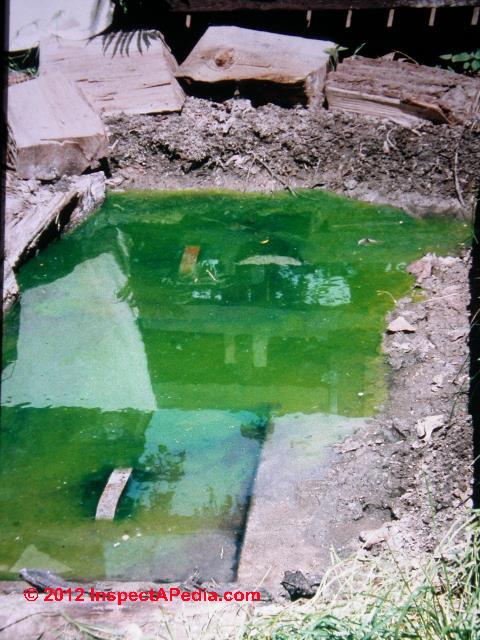
[Click to enlarge any image]
What should we look for, do, & report about outdoor conditions during and after a septic inspection, loading & dye test?
- Record weather conditions (heavy rain, snow cover, frozen snow, flooding, drought, etc.).
- Trace the sewer pipe, if possible, from the point of apparent exit from building to locations of apparent or plausible septic tank and absorption system. Clues such as depressions, rectangular or circular tank outlines, mature trees crowded together and larger open areas may indicate where components could possibly have been installed. (Excavating equipment may not fit among large old trees; very rocky areas may not hold septic components.)
- Examine the absorption area for signs of trenches, such as sunken parallel
lines. Do this before starting the test, during the test, after the test,
and up to five days after the site inspection (an added service or an admonition to
the client) since it is possible in odd cases for effluent to appear on a property
days after the initial test. Fortunately, in cases of a failed or marginal system
this procedure often shows breakout in 20-30 minutes.
Dyed effluent usually appears in 20-30 minutes on a failed system but can take up to five days to show up.
If at a building inspection suspect wet areas are observed I recommend a dye test even if one was not previously requested. When wet areas are not found (or created by running water into the septic system) on the property being inspected, dye tests may still be performed to meet requirements of some lenders. - Note the locations of and distance to well, trees, pools, additions to the building, driveways, etc. that might infringe on the tank or absorption area.
- Examine all site areas including property boundaries that could reasonably be reached by drainfield extensions, nearby streams, ponds, storm drains, edges of mound systems, edges of banks, rocky areas, steep slopes near the septic fields
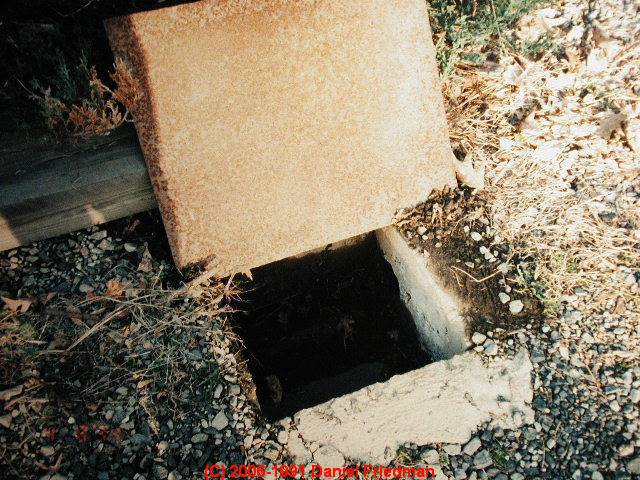
- Check storm drains and site drains at the property - sometimes septic effluent is leaking into or has even been directed into these improper septic effluent disposal destinations, such as we found in this driveway drain
- Do not probe the soil over suspected septic tank locations by using methods that could damage the equipment. Heavy wrecking bars, for example, can puncture a steel or fiberglass tank cover or break a plastic drainfield line.
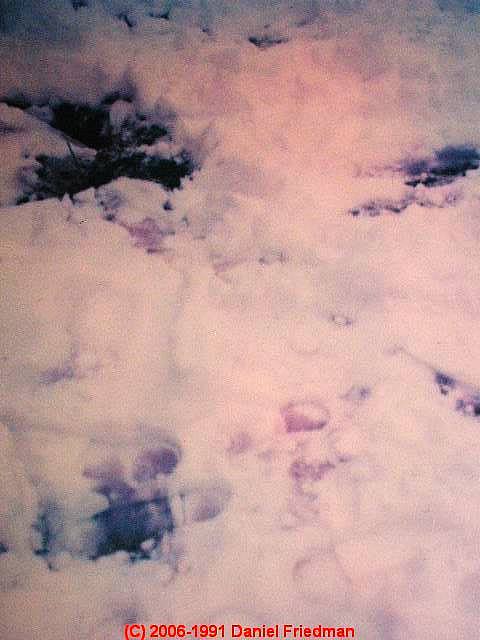
When the ground is snow-covered, walk a grid pattern across the drainfield area to watch for septic dye appearing just at the bottom layer of the snow cover.
Here you can see our red septic dye appearing in the snow where we scuffed the surface of the snow-covered area.
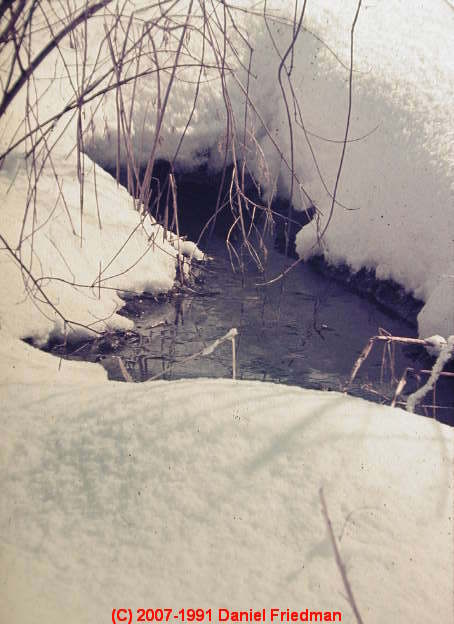
When the ground is snow covered and near a wet or swampy area, check the wet area for the appearance of septic dye - actually check here in all weather conditions, but snow cover can actually make it easier to find septic dye breakout provided the ground is not frozen solid.
These pages are part of our SEPTIC DYE TEST PROCEDURE for testing septic system function. Technical review by industry experts has been performed and is ongoing - reviewers are listed atReferences or Citations . Comments and suggestions for content are welcome.
Septic System Testing Articles
- SEPTIC & CESSPOOL SAFETY
- SEPTIC COMPONENT LOCATIONS
- SEPTIC INSPECTION & TEST LAWS & PROCEDURES
- SEPTIC LOADING & DYE TEST PROCEDURE - home
- SEPTIC SYSTEM BASICS
- SEPTIC SYSTEM INSPECTION CLASS
- SEPTIC SYSTEM INSPECTION & TEST GUIDE - home
...
Continue reading at SEPTIC DRAINFIELD INSPECTION & TEST or select a topic from the closely-related articles below, or see the complete ARTICLE INDEX.
Suggested citation for this web page
OUTSIDE SEPTIC DYE TEST STEPS at InspectApedia.com - online encyclopedia of building & environmental inspection, testing, diagnosis, repair, & problem prevention advice.
Or see this
INDEX to RELATED ARTICLES: ARTICLE INDEX to SEPTIC SYSTEMS
Or use the SEARCH BOX found below to Ask a Question or Search InspectApedia
Ask a Question or Search InspectApedia
Questions & answers or comments about how to perform a septic loading and dye test: what to do outdoors
Try the search box just below, or if you prefer, post a question or comment in the Comments box below and we will respond promptly.
Search the InspectApedia website
Note: appearance of your Comment below may be delayed: if your comment contains an image, photograph, web link, or text that looks to the software as if it might be a web link, your posting will appear after it has been approved by a moderator. Apologies for the delay.
Only one image can be added per comment but you can post as many comments, and therefore images, as you like.
You will not receive a notification when a response to your question has been posted.
Please bookmark this page to make it easy for you to check back for our response.
Our Comment Box is provided by Countable Web Productions countable.ca
Citations & References
In addition to any citations in the article above, a full list is available on request.
- New York State Department of Health, APPENDIX 75-A WASTEWATER TREATMENT STANDARDS - INDIVIDUAL HOUSEHOLD SYSTEMS , [PDF] New York State Department of Health, 3 February 2010, retrieved 3/1/2010, original source: https://www.health.ny.gov/regulations/nycrr/title_10/part_75/appendix_75-a.htm
- Septic Tank/Soil-Absorption Systems: How to Operate & Maintain, Equipment Tips, U.S. Department of Agriculture, 8271 1302, 7100 Engineering, 2300 Recreation, September 1982, web search 08/28/2010, original source: http://www.fs.fed.us/t-d/pubs/pdfimage/82711302.pdf
- "Manual of Policy, Procedures, and Guidelines for Onsite Sewage Systems," Ontario Reg. 374/81, Part VII of the Environmental Protection Act (Canada), ISBN 0-7743-7303-2, Ministry of the Environment,135 St. Clair Ave. West, Toronto Ontario M4V 1P5 Canada $24. CDN.
- Manual of Septic Tank Practice, US Public Health Service's 1959.
- Mark Cramer Inspection Services Mark Cramer, Tampa Florida, Mr. Cramer is a past president of ASHI, the American Society of Home Inspectors and is a Florida home inspector and home inspection educator. Mr. Cramer serves on the ASHI Home Inspection Standards. Contact Mark Cramer at: 727-595-4211 mark@BestTampaInspector.com
- John Cranor [Website: /www.house-whisperer.com ] is an ASHI member and a home inspector (The House Whisperer) is located in Glen Allen, VA 23060. He is also a contributor to InspectApedia.com in several technical areas such as plumbing and appliances (dryer vents). Contact Mr. Cranor at 804-873-8534 or by Email: johncranor@verizon.net
- SEPTIC TANK/SOIL-ABSORPTION SYSTEMS: HOW TO OPERATE & MAINTAIN [PDF] - , Equipment Tips, U.S. Department of Agriculture, 8271 1302, 7100 Engineering, 2300 Recreation, September 1982, web search 08/28/2010, original source: http://www.fs.fed.us/t-d/pubs/pdfimage/82711302.pdf.
- Advanced Onsite Wastewater Systems Technologies, Anish R. Jantrania, Mark A. Gross. Anish Jantrania, Ph.D., P.E., M.B.A., is a Consulting Engineer, in Mechanicsville VA, 804-550-0389 (2006). Outstanding technical reference especially on alternative septic system design alternatives. Written for designers and engineers, this book is not at all easy going for homeowners but is a text I recommend for professionals--DF.
- Onsite Wastewater Treatment Systems, Bennette D. Burks, Mary Margaret Minnis, Hogarth House 1994 - one of the best septic system books around, suffering a bit from small fonts and a weak index. While it contains some material more technical than needed by homeowners, Burks/Minnis book on onsite wastewater treatment systems a very useful reference for both property owners and septic system designers.
- In addition to citations & references found in this article, see the research citations given at the end of the related articles found at our suggested
CONTINUE READING or RECOMMENDED ARTICLES.
- Carson, Dunlop & Associates Ltd., 120 Carlton Street Suite 407, Toronto ON M5A 4K2. Tel: (416) 964-9415 1-800-268-7070 Email: info@carsondunlop.com. Alan Carson is a past president of ASHI, the American Society of Home Inspectors.
Thanks to Alan Carson and Bob Dunlop, for permission for InspectAPedia to use text excerpts from The HOME REFERENCE BOOK - the Encyclopedia of Homes and to use illustrations from The ILLUSTRATED HOME .
Carson Dunlop Associates provides extensive home inspection education and report writing material. In gratitude we provide links to tsome Carson Dunlop Associates products and services.
 | HOME | ABOUT | ASK a QUESTION | CONTACT | CONTENT USE POLICY | DESCRIPTION | POLICIES | PRIVACY | |
| © 2024 - 1985 Publisher InspectApedia.com - Daniel Friedman | |||||||||