
InspectAPedia® FREE Encyclopedia of Building & Environmental Construction, Diagnosis, Maintenance & Repair |
Question? Just ask us! InspectAPedia
|
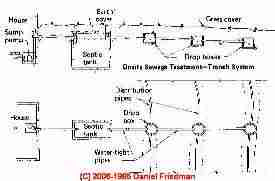 How to Find the Precise Location of Septic Drainfield Piping

- POST a QUESTION or COMMENT about accurately locating the septic system drdainfield pipes and trenches
Accurate septic drainfield or soakaway bed location:
How to probe pipes, make measurements & use electronic or other buried pipe locating tools to make a precise location of septic drainfield components. This article series and our accompanying septic system location videos explains how to find the precise leach field or drainfield portion of a septic system.
We include sketches and photos that help you learn what to look for, and we describe several methods useful for finding buried drainfield components. (Septic drain fields are also called soil absorption systems or seepage beds.)
InspectAPedia tolerates no conflicts of interest. We have no relationship with advertisers, products, or services discussed at this website.
How to Use Special Equipment to Locate Unknown Drainfield Piping Location Precisely
 Guide to Finding Septic Drainfield Componentss - Part 6
At the end of the day, if you must locate an exact leach field trench and if there are absolutely no visual clues (such as visible parallel settlement lines marking a sewer pipe or drainfield trenches) then proceed to find the buried drainfield trenches & piping as follows:
- Start at the septic tank: find the tank outlet use a plumbing snake either to:
- Measure distance to the next obstruction (likely to be the D-Box - see our Distribution Box article) which places it along a known arc of distance from the point where the snake was inserted
- Use an electronic snake system (call a plumber) which puts an electronic signal in the plumbing snake
and which permits an above ground tracing of the precise path the snake has taken underground.
For details see Buried-Utility Locating Equipment below in this article. - After locating the D-box (if there is one), open it to see how many individual leach lines leave the box, and uses the same process as above to find them.
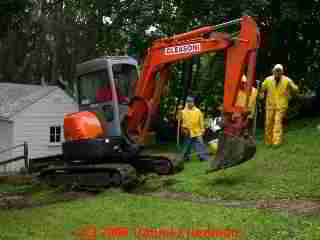
Using a backhoe for excavation to find drainfield components
This is the most heavy-handed "tool" to locate septic components, but is often what's really needed. [Photo above]
But often some careful digging by hand can locate key drainfield components without causing damage to the ground surface and components buried below it.
So when do we use a backhoe to dig up septic or drainfield components?
- When more extensive exploratory excavation is needed to find components - more than is reasonable to dig by hand. For example an excavator may cut a test trench across a property section to find buried piping that was not located using pipe locating equipment.
- When we already have determined that extensive replacement of drainfield or septic piping is required.
Test holes to confirm exact drainfield line locations and drainfield line condition are discussed at EXCAVATE to LOCATE DRAINFIELD
Buried Utility Locating Equipment Finds Pipes, Wires, Cables
How do electronic utility locating devices work?
Some pipe locating tools work entirely above ground and rely on magnetic field sensing or radio frequency and density measurements. But the most popular and precise buried utility component locating equipment that is used for nonmetallic piping (such as plastic drainfield lines) may combine a signal wire inserted into the buried piping from an access point and an above-ground sensor.
In between these two and used for locating buried gas lines, water lines, and cables, a transmitter may be clipped to an exposed setion of the buried line and an above ground receiver then scans the property surface to locate and allow marking of the precise location of the utility.
Where to Buy or Rent Buried Pipe or Utility Locating Equipment
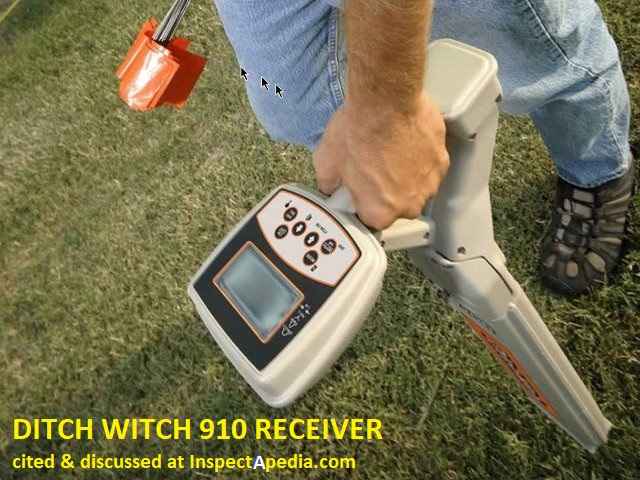 In most communities, local plumbers, some well drillers, some septic system excavators, and (if present) local gas or electric or water companies all have and make regular use of buried-utility locating equipment & systems.
It is also possible to rent this equipment from local construction equipment rental companies, or to buy it from the manufacturer's outlets.
Some examples of utility locating tools & equipment include:
- DitchWitch® utility locators include pipe and cable locating equipment and plastic pipe or conduit locating devices. Quoting from the company's literature:
[For locating buried pipes & cables] Our extensive selection of electronic pipe & cable locators ranges from the lightweight, handheld 150R/T to the sophisticated, multi-channel 970T transmitter.
The DitchWitch150 pipe locator shown at left is a single frequency device. The 150T permits choice among multiple frequencies for varying material & site condition. The company produces a number of transmitting & receiving devices for locating various types of buried pipes, cables, wires & utilities. [Image permission requested 11/19/12]
[For locating plastic pipe such as sewer piping & perforated drainfield piping or foundation drains] Find any type of utility conduit or piping, metallic or non-metallic, with the 2450GR ground penetrating radar, and use the versatile 150 beacon to trace water, sewer, and drain lines.
DitchWitch Corporation, 1959 W. Fir St., Perry, OK 73077-5803
Toll free: 800-654-6481 Fax: 580-336-3458
Website: http://www.ditchwitch.com/utility-locators/ - (use the company's website to find a nearby DitchWitch dealer) - Pipehorn Locating Technology produces "pipe and cable locators and ferromagnetic detectors. In addition to damage prevention equipment, we offer devices for maintaining underground utilities, including water leak detectors. "
Pipehorn Locating Technolgy
Utility Tool Company Inc.
2900 Commerce Blvd., P.O. Box 100519 Birmingham, AL 35210
Tel: 800-952-3710
Website: http://www.pipehorn.com/ - Remco underground utility locating equipment distributes various products including
Aervoe, Sensit, & Vivax Microtech Locating Products
... locators, detectors, measuring wheels, marking flags, Spy Holiday Detectors (Jeepers), probe bars, beveling machines ...
Remco Supply Inc., P.O. Box 580996, Tulsa, Oklahoma 74158-0996
Tel: 1-800-888-5656
Email: sales@remcotulsa.com
Shipping Address: 6730 East 13th Street, Tulsa OK 74112-5612
Website: http://www.remcotulsa.com/ - Accurate Locators, Inc., cable, pipe & utility locators,
Metal Detectors, Ground Penetrating Radar, Underground Surveyor Apparatus Geophysical 3D Imaging & Cable & Pipe Locators for Utilities
Accurate Locators Inc. 1383 2nd Ave. Gold Hill, Oregon 97525 Toll Free (877) 808-6200 (US & CAN) or (541) 855-1590 International Sales: 01-541-855-1590 Fax: (541) 855-1023 Las Vegas area: (775) 751-6931 E-mail: accurate@accuratelocators.com
Website: http://www.accuratelocators.com/pipe_cable_locators.html- Schonstedt Instrument Company
- Fisher Research Laboratory (e.g. FIsher TW6)
- Rycom Instruments, Inc.
- Subsurface Instruments, Inc.
Other pipe finder products & brands
- Radio Detection Brand
- Mytana Brand PT20
- Maverick Tile Finder
Inductive Bleed-Over Errors When Locating Buried Pipes & Utilities
Watch out: for bleed-over problems when using buried pipe or cable locating equipment. Making a mistake can be catastrophic if you hit a gas line or high pressure water line. In Fishkill N.Y. we watched a backhoe opertor hit a high pressure gas line. A white plume of natural gas shot into the air as we and everyone else ran like mad. Luckily an explosion was avoided.
At another occasion we needed to locate a buried well pipe at a New York Property. Working in freezing conditions we rented a jackhammer to open solid frozen ground adjacent to a building where a prior owner told us the well was located.
First, because we knew there were nearby buried gas pipes, we called Central Hudson Gas & Electric to locate and mark the gas lines. The technician clipped his transmitter to an exposed gas line in the building and, using his pipe locator, he sprayed red paint on the "exact" location of the buried gas line.
- "How accurate are that equipment and your marks?" - we asked.
- "Oh, to an inch, I'd say" he replied.
Banging away two feet distant from the red gas line markings we worked carefully - luckily, as we found (and did not damage) the yellow gas pipe was exactly where we were excavating - a bit over 24 inches away from the "precise" red paint stripe placed by the tech.
Why did this happen? Later excavation found that at this home, built in the 1920's, there were two other old steel water lines buried in parallel and close to the gas pipe. The combination of multiple metal pipes close to one another can confuse pipe locating equipment.
Pipehorn [5] and other buried utility locating experts have suggestions for avoiding inductive bleedover, including
- Work short distances - Adjacent conductors will carry some signal and many times become return paths from the target conductor. At first, the signal strength from the target conductor will be stronger.
As you walk down the line the signal will weaken to the point that it becomes equal in strength with an adjacent conductor. The solution is to mark the last known confident spot of the target conductor and move the transmitter to that position, in the direction of the conductor. This will strengthen the signal on the target conductor and let you continue with a confident locate. - Relocate the transmitter away from interfering conductors
- Offset the Transmittter
- Null out the conductor that is the source of confusion by positioning your transmitter properly along the conductor you are trying to trace.
- Contact the manufacturer of your pipe locating equipment as their technical staff can give precise advice for your situation.
...
Continue reading at EXCAVATE to LOCATE DRAINFIELD or select a topic from the closely-related articles below, or see the complete ARTICLE INDEX.
Or see these
Recommended Articles
- CLEARANCE DISTANCES, SEPTIC SYSTEM
- ODORS, SEPTIC or SEWER
- SEPTIC COMPONENT LOCATIONS
- SEPTIC D-BOX INSTALL, LOCATE, REPAIR
- SEPTIC DRAINFIELD INSPECTION & TEST - home
- SEPTIC DRAINFIELD LOCATION - home
- DRAINFIELD PIPE LOCATION, PRECISE
- EXCAVATE to LOCATE DRAINFIELD
- REASONS to FIND THE DRAINFIELD
- RECORDS to LOCATE the DRAINFIELD
- SURPRISING DRAINFIELD LOCATIONS
- UNLIKELY DRAINFIELD LOCATIONS
- VISUAL CLUES LOCATE the DRAINFIELD
- VISUAL CLUES LOCATE the SEPTIC TANK
- SEPTIC DRAINFIELD SIZE
- SEPTIC DRAINFIELD SHAPE
- SEPTIC TANK, HOW TO FIND
- SEPTIC VIDEOS - where the tank, D-box, and fields could or could not be found at a site
Suggested citation for this web page
DRAINFIELD PIPE LOCATION, PRECISE at InspectApedia.com - online encyclopedia of building & environmental inspection, testing, diagnosis, repair, & problem prevention advice.
Or see this
INDEX to RELATED ARTICLES: ARTICLE INDEX to SEPTIC SYSTEMS
Or use the SEARCH BOX found below to Ask a Question or Search InspectApedia
Ask a Question or Search InspectApedia
Try the search box just below, or if you prefer, post a question or comment in the Comments box below and we will respond promptly.
Search the InspectApedia website
Note: appearance of your Comment below may be delayed: if your comment contains an image, photograph, web link, or text that looks to the software as if it might be a web link, your posting will appear after it has been approved by a moderator. Apologies for the delay.
Only one image can be added per comment but you can post as many comments, and therefore images, as you like.
You will not receive a notification when a response to your question has been posted.
Please bookmark this page to make it easy for you to check back for our response.
Our Comment Box is provided by Countable Web Productions countable.ca
Citations & References
In addition to any citations in the article above, a full list is available on request.
- New York State Department of Health, APPENDIX 75-A WASTEWATER TREATMENT STANDARDS - INDIVIDUAL HOUSEHOLD SYSTEMS , [PDF] New York State Department of Health, 3 February 2010, retrieved 3/1/2010, original source: https://www.health.ny.gov/regulations/nycrr/title_10/part_75/appendix_75-a.htm
- Percolation Testing Manual, CNMI Division of Environmental Quality, Gualo Rai, Saipan provides an excellent English Language manual guide for soil percolation testing. Original source: www.deq.gov.mp/artdoc/Sec6art108ID255.pdf
- Soil Test Pit Preparation, fact sheet, Oregon DEQ Department of Environmental Quality, original source www.deq.state.or.us/wq/pubs/factsheets/onsite/testpitprep.pdf The Oregon DEQ onsite water quality program can be contacted at 811 South Ave, Portland OR 97204, 800-452-4011 or see http://www.oregon.gov/DEQ/
- [3] Thanks to reader Michael Roth for technical link editing 6/29/09.
- [4] Septic Tank/Soil-Absorption Systems: How to Operate & Maintain [ copy on file as /septic/Septic_Operation_USDA.pdf ] - , Equipment Tips, U.S. Department of Agriculture, 8271 1302, 7100 Engineering, 2300 Recreation, September 1982, web search 08/28/2010, original source: http://www.fs.fed.us/t-d/pubs/pdfimage/82711302.pdf.
- [5] Pipehorn Locating Technolgy, "Using the Transmitter to avoid "Bleedover" (Inductive), Utility Tool Company Inc., 2900 Commerce Blvd., P.O. Box 100519 Birmingham, AL 35210, Tel: 800-952-3710, retrieved 11/19/2012, original source http://www.pipehorn.com/pages/Utility%20Locating%20Tips/bleedover.htm [copy on file as Bleedover.pdf]
- Pennsylvania State Fact Sheets relating to domestic wastewater treatment systems include
- Pennsylvania State Wastewater Treatment Fact Sheet SW-161, Septic System Failure: Diagnosis and Treatment
- Pennsylvania State Wastewater Treatment Fact Sheet SW-162, The Soil Media and the Percolation Test
- Pennsylvania State Wastewater Treatment Fact Sheet SW-l64, Mound Systems for Wastewater Treatment
- Pennsylvania State Wastewater Treatment Fact Sheet SW-165, Septic Tank-Soil Absorption Systems
- Document Sources used for this web page include but are not limited to: Agricultural Fact Sheet #SW-161 "Septic Tank Pumping," by Paul D. Robillard and Kelli S. Martin. Penn State College of Agriculture - Cooperative Extension, edited and annotated by Dan Friedman (Thanks: to Bob Mackey for proofreading the original source material.
- Advanced Onsite Wastewater Systems Technologies, Anish R. Jantrania, Mark A. Gross. Anish Jantrania, Ph.D., P.E., M.B.A., is a Consulting Engineer, in Mechanicsville VA, 804-550-0389 (2006). Outstanding technical reference especially on alternative septic system design alternatives. Written for designers and engineers, this book is not at all easy going for homeowners but is a text I recommend for professionals--DF.
- Our recommended books about building & mechanical systems design, inspection, problem diagnosis, and repair, and about indoor environment and IAQ testing, diagnosis, and cleanup are at the InspectAPedia Bookstore. Also see our Book Reviews - InspectAPedia.
- In addition to citations & references found in this article, see the research citations given at the end of the related articles found at our suggested
CONTINUE READING or RECOMMENDED ARTICLES.
- Carson, Dunlop & Associates Ltd., 120 Carlton Street Suite 407, Toronto ON M5A 4K2. Tel: (416) 964-9415 1-800-268-7070 Email: info@carsondunlop.com. Alan Carson is a past president of ASHI, the American Society of Home Inspectors.
Thanks to Alan Carson and Bob Dunlop, for permission for InspectAPedia to use text excerpts from The HOME REFERENCE BOOK - the Encyclopedia of Homes and to use illustrations from The ILLUSTRATED HOME .
Carson Dunlop Associates provides extensive home inspection education and report writing material. In gratitude we provide links to tsome Carson Dunlop Associates products and services.
 | HOME | ABOUT | ASK a QUESTION | CONTACT | CONTENT USE POLICY | DESCRIPTION | POLICIES | PRIVACY | |
| © 2024 - 1985 Publisher InspectApedia.com - Daniel Friedman | |||||||||