
InspectAPedia® FREE Encyclopedia of Building & Environmental Construction, Diagnosis, Maintenance & Repair |
Question? Just ask us! InspectAPedia
|
 Septic System Design Basics
Choosing Septic Tank Size, Drain Field Size, Basic Septic Design
- POST a QUESTION or COMMENT about how to choose septic tank and drainfield size - septic design basics
The ABCs of septic tank and drainfield design:
This septic system design article outlines basic septic system design parameters such as finding the recommended septic tank volume and conventional recommended onsite wastewater soil absorption system (leach field or drainfield) size, along with some notes on how to calculate these from simple water usage and site conditions.
InspectAPedia tolerates no conflicts of interest. We have no relationship with advertisers, products, or services discussed at this website.
Basic Septic System Design: Choose Septic Tank Size, Absorption System Size, Basic Design Notes
 How to Use this Septic Design Guide
This document and the articles it recommends describe the planning and design of a basic or conventional septic system which uses a septic tank and soil absorption system.
Septic system design parameters such as finding the recommended septic tank volume and conventional recommended leach field or drainfield size, along with some notes on how to calculate these from simple water usage and site conditions are discussed here and in our basic design articles.
For more in-depth information about septic system design see our list of detailed septic design articles
Also see the EPA design manual
at SEPTIC SYSTEM DESIGN MANUAL, ONLINE.
Also take a look at the septic publications listed at Technical Reviewers & References at the end of this article to see septic codes, septic design manuals, and onsite waste disposal standards links and articles.
The Basics of Septic System Design:
SEPTIC SYSTEM DESIGN BASICS will allow you to answer basic septic system design questions.
If you have no idea what the basic parts of a septic system are, you should take a look at the take a look
at HOME BUYERS GUIDE to SEPTIC SYSTEMS.
The key articles are shown in the at RECOMMENDED ARTICLES at end of this page.
The Details of Septic Designs: A more extensive list of detailed septic planning and design articles available online is provided after the "Basic Advice for Conventional Septic System Design" just below.
Difficult septic system installation sites which are rocky, steep, wet, having high groundwater or shallow bedrock, or sites limited in size are likely to require an alternative septic design using special methods and products.
For those conditions see SEPTIC SYSTEM DESIGN ALTERNATIVES - home
Basic Specifications & Advice for Conventional Septic Tank & Drainfield System Design
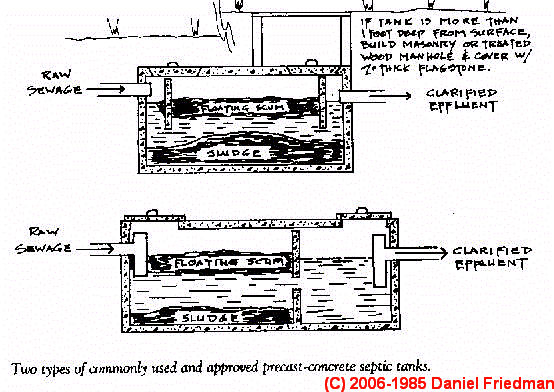
Septic Tank Sizing: Most jurisdictions currently want to see a minimum of 1000 gallons.
Septic tanks may be approved constructed of concrete, fiberglass, or polyethylene. Site-built septic tanks may still be permitted in some jurisdictions.
Any of these materials can work fine for a septic tank provided the tank is properly installed. (Lightweight tanks may need to be anchored to prevent floating up out of the ground when empty.)
But the right septic tank size depends on the anticipated usage not an arbitrary number.
To determine the required septic tank size you would need to look at
the SEPTIC TANK SIZE to see the required tank size based on daily water volume usage
and the WATER QUANTITY USAGE TABLES article which discusses water usage requirements to confirm that you're estimating the water volume reasonably.
Septic Tank Location: Articles
titled SEPTIC CLEARANCE DISTANCES
and WELL CLEARANCES tell you where you can put the tank relative to other site features.
Usually the septic tank is located close to the building for shorter waste line runs and because that's where there is often plenty of backfill to bury a septic tank during construction. Special tank designs are available for problem sites.
Septic Tank Retention Time if you just wanted to know our opinion about tank size as a function of effluent retention time,
Septic leach field or drainfield size and layout planning: see our
article SEPTIC DRAINFIELD SIZE which sizes the field based on its percolation rate
and our article SEPTIC SOIL & PERC TESTS which describes performing a perc test,
with perhaps a look at SEPTIC BIOMATS to understand biomats that form below a drainfield and why a leach field in a wet area won't treat the effluent.
Standard Leach Field Trench Specifications: conventional "two foot" gravel and perforated pipe absorption trench leach field trench specifications are given here. The typical numbers you'll see for trench design in typical soils with acceptable percolation rate and excluding special and problem sites will look something like this:
- Leach line 4" perforated PVC pipe will slope at 1/4" per ten feet of length
- A good trench is 18" to 36" wide and 18 " to 30" deep (no deeper), and the pipe is put with holes down, and runs in a 12" fill (in the trench) of clean gravel 1 1/2-3" diameter stones. Most septic design authorities refer to a standard or generic two-foot wide trench.
- In the gravel in the trench, the perforated leach line pipe is placed on top of 6" of gravel and then is covered with additional gravel until the gravel is 2" over the pipe. With a 4" pvc pipe this is how I got the 12" fill of gravel.
- Remember to direct surface or subsurface runoff away from the septic system components. Otherwise you may flood the system in wet weather.
- How Big Should the Leach Field Be? has notes on calculating the number of linear feet of leach line trench for a conventional septic system leach field.
- SEPTIC DRAINFIELD SIZE includes a "Table of Septic Drainfield Trench Lengths Determined by Soil Percolation Rate and Daily Wastewater Input Flow" that gives assumptions for number of building occupants, average daily gallons of septic wastewater input flow volume in gallons per day, and for conventional gravel trench drainfields, the required trench length in feet for various soil percolation rates.
- SEPTIC SOIL & PERC TESTS explains soil percolation tests that are used to determine the ability of soil at a site to absorb septic effluent and process it to an adequate level of treatment.
Example Septic Leaching Trench Specification Code
DRAINFIELD LEACHING TRENCH SPECIFICATIONS [PDF] retrieved 2017/10/20, original source: http://www.odh.ohio.gov/
Design Manuals for Septic Systems
- US EPA ONSITE WASTEWATER TREATMENT SYSTEMS MANUAL [online copy, free] Top Reference: US EPA's Design Manual for Onsite Wastewater Treatment and Disposal, 1980, available from the US EPA, the US GPO Superintendent of Documents (Pueblo CO), and from the National Small Flows Clearinghouse.
Original source http://www.epa.gov/ORD/NRMRL/Pubs/625R00008/625R00008.htm Onsite wastewater treatment and disposal systems, Richard J Otis, published by the US EPA. Although it's more than 20 years old, this book remains a useful reference for septic system designers. U.S. Environmental Protection Agency, Office of Water Program Operations; Office of Research and Development, Municipal Environmental Research Laboratory; (1980) - "International Private Sewage Disposal Code," 1995, BOCA-708-799-2300, ICBO-310-699-0541, SBCCI 205-591-1853, available from those code associations.
- "Manual of Policy, Procedures, and Guidelines for Onsite Sewage Systems," Ontario Reg. 374/81, Part VII of the Environmental Protection Act (Canada), ISBN 0-7743-7303-2, Ministry of the Environment,135 St. Clair Ave. West, Toronto Ontario M4V 1P5 Canada $24. CDN.
- Manual of Septic Tank Practice, US Public Health Service's 1959.
- NY RESIDENTIAL ONSITE WASTEWATER TREATMENT SYSTEMS DESIGN HANDBOOK (2012), New York State Department of Health, Health Education Services, POB 7126, Albany NY 12224 Tel: 518-439-7286 - retrieved 2022/06/22 original source: https://www.health.ny.gov/environmental/water/drinking/wastewater_treatment_systems/docs/design_handbook.pdf
- New York State Department of Health, APPENDIX 75-A WASTEWATER TREATMENT STANDARDS - INDIVIDUAL HOUSEHOLD SYSTEMS , [PDF] New York State Department of Health, 3 February 2010, retrieved 3/1/2010, original source: https://www.health.ny.gov/regulations/nycrr/title_10/part_75/appendix_75-a.htm
- Environment Agency, U.K., "Polution Prevention Guidelines", [PDF] Environment and Heritage Service, Scottish Environment Protection Agency (SEPA), Enviornment Agency, U.K., PPG4 (2006), retrieved 2 September 2015,
Environment Agency www.environment-agency.gov.uk HEAD OFFICE Rio House Waterside Drive Aztec West Almondsbury Bristol BS32 4UD Tel: 01454 624 400 Fax: 01454 624 409,
Scottish Environment Protection Agency www.sepa.org.uk CORPORATE OFFICE Erskine Court The Castle Business Park Stirling FK9 4TR Tel: 01786 457 700 Fax: 01786 446 885,
Environment and Heritage Service www.ehsni.gov.uk HEAD OFFICE 17 Antrim Road Lisburn County Antrim BT28 3AL Tel: 028 9262 3100 Fax: 028 9267 6054, original source: https://www.gov.uk/government/uploads/system/uploads/attachment_data/file/290141/pmho0706bjgl-e-e.pdf - Environment Agency, U.K., "Disposal of Sewage Where No Mains Drainage is Available", - retrieved 2 Sept 2015, original source: http://www.doeni.gov.uk/niea/ppg04.pdf
These notes are for guidance only. They are produced by the Environment Agency for England and Wales, the Scottish Environment Protection Agency and the Environment and Heritage Service in Northern Ireland, jointly referred to as the Agency or Agencies. Each site will be considered according to local circumstances, and early consultation with your local Agency Office is advisable. Contact details will be found at the end of these guidelines. - U.K. Code of Practice for the Design of Small Sewage Treatment Works and Cesspools. BS6297:1983: British
Standards Institute: Telephone 0181 996 7000 - U.K.. Septic Tanks and Small Sewage Treatment Works, A Guide to Current Practice and Common Problems:
1993: CIRIA Technical Note 146: Construction Industry Research and Information Association:
Telephone 0171 222 8891 - Advanced Onsite Wastewater Systems Technologies, Anish R. Jantrania, Mark A. Gross. Anish Jantrania, Ph.D., P.E., M.B.A., is a Consulting Engineer, in Mechanicsville VA, 804-550-0389 (2006). Outstanding technical reference especially on alternative septic system design alternatives. Written for designers and engineers, this book is not at all easy going for homeowners but is a text I recommend for professionals--DF.
- Builder's Guide to Wells and Septic Systems, Woodson, R. Dodge: $ 24.95; MCGRAW HILL B; TP;
Quoting from Amazon's description:
For the homebuilder, one mistake in estimating or installing wells and septic systems can cost thousands of dollars. This comprehensive guide filled with case studies can prevent that. Master plumber R. Dodge Woodson packs this reader-friendly guide with guidance and information, including details on new techniques and materials that can economize and expedite jobs and advice on how to avoid mistakes in both estimating and construction.
Chapters cover virtually every aspect of wells and septic systems, including on-site evaluations; site limitations; bidding; soil studies, septic designs, and code-related issues; drilled and dug wells, gravel and pipe, chamber-type, and gravity septic systems; pump stations; common problems with well installation; and remedies for poor septic situations. Woodson also discusses ways to increase profits by avoiding cost overruns. - Onsite Wastewater Disposal, R. J. Perkins; Quoting from Amazon: This practical book, co-published with the National Environmental Health Association, describes the step-by-step procedures needed to avoid common pitfalls in septic system technology.
Valuable in matching the septic system to the site-specific conditions, this useful book will help you install a reliable system in both suitable and difficult environments. Septic tank installers, planners, state and local regulators, civil and sanitary engineers, consulting engineers, architects, homeowners, academics, and land developers will find this publication valuable. - Onsite Wastewater Treatment Systems, Bennette D. Burks , Mary Margaret Minnis, Hogarth House 1994 - one of the best septic system books around, suffering a bit from small fonts and a weak index. (DF volunteers to serve as indexer if Burks/Minnis re-publish this very useful volume.)While it contains some material more technical than needed by homeowners, Burks/Minnis book on onsite wastewater treatment systems a very useful reference for both property owners and septic system designers. We refer to it often.
- Septic Tank/Soil-Absorption Systems: How to Operate & Maintain, Equipment Tips, U.S. Department of Agriculture, 8271 1302, 7100 Engineering, 2300 Recreation, September 1982, web search 08/28/2010, original source: http://www.fs.fed.us/t-d/pubs/pdfimage/82711302.pdf
- Wells and Septic System, Alth, Max and Charlet, Rev. by S. Blackwell Duncan, $ 18.95; Tab Books 1992. We have found this text very useful for conventional well and septic systems design and maintenance --DF.
Quoting an Amazon description:
Here's all the information you need to build a well or septic system yourself - and save a lot of time, money, and frustration. S. Blackwell Duncan has thoroughly revised and updated this second edition of Wells and Septic Systems to conform to current codes and requirements.
He also has expanded this national bestseller to include new material on well and septic installation, water storage and distribution, water treatment, ecological considerations, and septic systems for problem building sites. - The NSFC Products List has an excellent list of design manuals/modules National Small Flows Clearinghouse (NSFC) now (2019/12/13) hosted at http://www.nesc.wvu.edu/ Tel: 304-293-4191 e-mail info@mail.nesc.wvu.edu.
The National Small Flows Clearinghouse (NSFC) was funded by the U.S. Environmental Protection Agency (EPA) to help America's small communities and individuals solve their wastewater problems through objective information about onsite wastewater collection and treatment systems. NSFC products and information are the only national resource of its type, dealing with small community wastewater infrastructure. or by telephone 800-624-8301 - US EPA ONSITE WASTEWATER TREATMENT SYSTEMS MANUAL Top Reference: US EPA's Design Manual for Onsite Wastewater Treatment and Disposal, 1980, available from the US EPA, the US GPO Superintendent of Documents (Pueblo CO), and from the National Small Flows Clearinghouse. Original source http://www.epa.gov/ORD/NRMRL/Pubs/625R00008/625R00008.htm
- Water Wells and Septic Systems Handbook, R. Dodge Woodson. This book is in the upper price range, but is worth the cost for serious septic installers and designers. Quoting Amazon: Each year, thousands upon thousands of Americans install water wells and septic systems on their properties. But with a maze of codes governing their use along with a host of design requirements that ensure their functionality where can someone turn for comprehensive, one-stop guidance? Enter the Water Wells and Septic Systems Handbook from McGraw-Hill.
Written in language any property owner can understand yet detailed enough for professionals and technical students this easy-to-use volume delivers the latest techniques and code requirements for designing, building, rehabilitating, and maintaining private water wells and septic systems. Bolstered by a wealth of informative charts, tables, and illustrations, this book delivers:
* Current construction, maintenance, and repair methods
* New International Private Sewage Disposal Code
* Up-to-date standards from the American Water Works Association
- PERCOLATION TESTING MANUAL [PDF] CNMI Division of Environmental Quality, PO Box 501304, Saipan, MP 96950
Reader Comments, Questions & Answers About The Article Above
Below you will find questions and answers previously posted on this page at its page bottom reader comment box.
Reader Q&A - also see RECOMMENDED ARTICLES & FAQs
On 2021-02-08 - by (mod) -
 Damian
At GRAVELESS SEPTIC DESIGN CRITERIA
we discuss Infilrator septic systems as well as other gravelless or "no-rock" septic designs like yours.
There you'll also find free PDF-forms of downloadable installation instructions and design manuals if you don't already have those for your specific Infiltrator septic product.
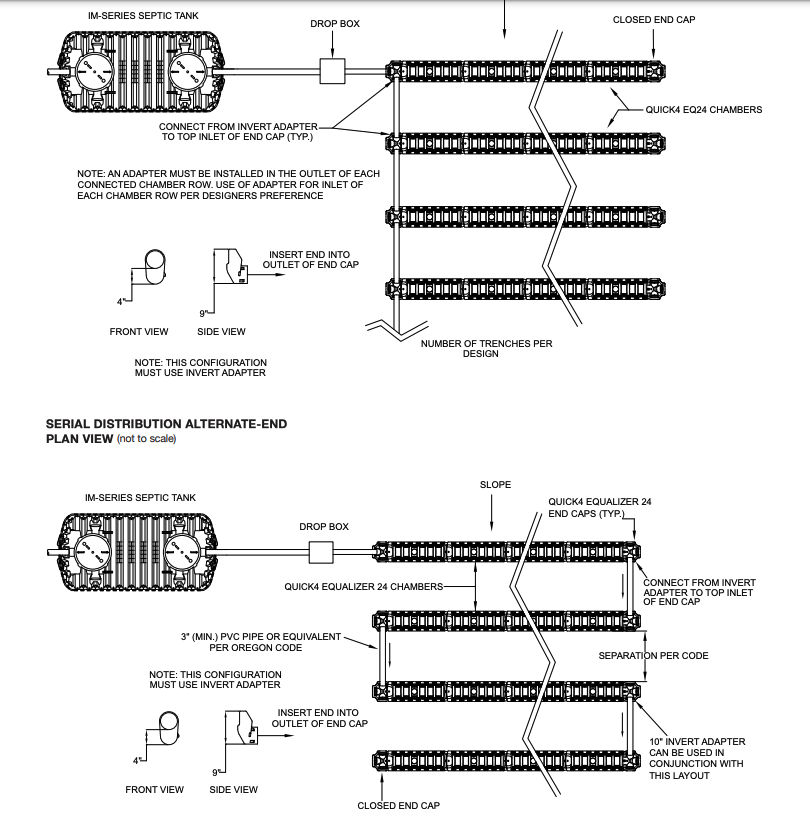
In general, septic trenches do not have to all be on the same level as one another, but in the effluent distribution box or D-box you will want to take care not to overdose or over-load the lower trenches and to be sure effluent is distributed properly among all of the septic effluent absorption trenches you build.
When installing trenches at a sloped site the trenches generally run parallel to one another and along the fall line of the slope, as I'll illustrate below with an excerpt from the Infiltrator installation manual cited also herein;
Infiltrator provides a Contour Swivel Connection™ that is helpful on sloped sites.
On 2021-02-08 by Damian crumpton
We are in the process of digging out our Leach fields did I know the trench itself has to be level from front to back and was wondering if each parallel trench needs to be level with each other I am using a distribution box for speed levelers so it would seem that it wouldn’t have to beThe problem that I’m running into
The whole property is on a hill and if I make each trench level with each other I will be above the 18 inch mark at the top and below the 30 inch mark at the bottom I live in Texas am useing infiltrator panels and have around 6 ft of usable soil any help would be appreciated
On 2013-01-10 by steven buhl
Why is it so hard to find the minimum distance that the drain FIELD must be from the house?
On 2012-06-03 by Dave
Hello
Is a soil test that failed conclusive evidence that requires a new mound system? I have some clay in my drainfield. Good soil was found up to a 22 inch depth in a couple of areas. The requirement is for a 36 inch depth of good soil.
My septic system is working perfectly with no back up or odor issues. I cannot afford a new system. Are there options that I could utilize to possibly improve the drainfield? i.e. piping, more top soil, filling in low areas, etc. Need some help here. I live in Florence, Wisconsin. Thank you.
On 2012-04-16 - by (mod) -
Yes Dave, I've quoted an excellent table of septic system design flows titled "Table of Septic Drainfield Trench Lengths Determined by Soil Percolation Rate and Daily Wastewater Input Flow" - you could search InspectApedia for that phrase to see the article titled "Septic Drainfield Design: Septic Size Requirements Guide".
I put the table there because incoming wastewater flow + soil perc rate determines standard drainfield size. For the ClearStream and other alternative systems, you can use as input specifications the wastewater flow input assumptions from the same table.
For example: a 2 bedroom house assumes 260 to 300 gpd (a number I think is too small based on other sources who have opinions about water usage). A 5 bedroom house assumes 650 to 750 gallons per day.
In short the ClearStream should handle a 4 bedroom house.
These assumptions are very rough given that one 4 bedroom house may have say 5 occupants (2 parents and 3 kids) while another may jam in 10 or more occupants at 2 per room in North America. But code agencies in various U.S. states and provinces tend to specify by bedrooms in many cases because the number of occupants is less fixed.
I'll add some cross-reference links to soil percolation testing and drainfield sizing in the article above to help readers find that information - thanks for asking.
On 2012-04-16 by Dave
In the new Septic Systems is there a FLOW RATE for the sewage Liquid. Eg. ClearStream 600N will handle 600 gallons of sewage per day. Does that mean 600/24hr = 25 gallons per hour. Or does it mean 600 gallons per day 200= 2 hr, 100 = next 4 hr. What systems does this apply to = ClearStream,EchoFlow, etc....
On 2011-11-06 by Gabe
can the leech field be replaced?and how to do it
On 2011-09-07 - by (mod) -
M Fleck I sure do agree; we used schedule 40 in a perforated drain line that had to run under a drive and even that had to be protected against crushing when the oil truck makes a delivery; Schedule 80 would have been better still.
On 2011-09-07 by m fleck
it is best to use a white perforated pvc. Typically a astm 30 or so. One that is not easily crushable if a vehicle, etc were to drive on it.
On 2011-06-25 by D Smith
Which is better to use for the septic drainfield/leachfield: The corrugated pipe that is PVC or the black flexible stuff that has the holes in it or the black flexible stuff with the slits cut around the entire circumference because they have all three types at my local lowes?
On 2020-09-06 - by (mod) -
1/8 - 1/4 inches per foot
On 2020-09-06 by Rob
What is the minimum slope required from dwelling outlet to septic tank inlet? Also, provided slope requirement can be met, is there a maximum overall distance allowed from dwelling to septic tank?
On 2020-07-21 - by (mod) -
Mark
22 and 45 are ok,
To make a 90 or a tee you use a sanitary or DWV fitting that makes a more gradual sweep rather than a sharp 90
On 2020-07-20 by MArk
What angles are acceptable for waste lines? 22 degree? 45 degree? Is a 90% too much ? What are the basic guidelines?
On 2020-01-08 - by (mod) -
Bill
Give the Town of Essex City building department a call directly to get the best answer:
Town of Essex, New York
2313 Main Street, Essex, New York 12936
P.O. Box 355
Email: townhall@essexnewyork.com
Website: www.essexnewyork.com
Phone: (518) 963-4287
On 2020-01-08 by Bill kelley
Engineered septic design plans are good for how long in Essex city ny
On 2019-12-05 - by (mod) -
jack said:
I love that you mentioned that the size of a septic tank should be determined by the expected usage of it. I hadn't thought of that before, but it would make a lot of sense.
We are looking to get a septic tank for our new home, and it will be important for us to know that we could get the right one. I will be sure to consider how much we will use it, so we could get the right size.
Moderator reply:
Jack, sizing the septic tank based on the anticipated daily wastewater flow, and sizing the drainfield capacity similarly, are the most-fundamental concepts of septic system design. If a tank is too small you end up pushing solids into the drainfield, ruining it.
In the ARTICLE INDEX you'll find articles on septic tank size guidelines.
Thanks for the comment.
On 2019-12-05 by jack
I love that you mentioned that the size of a septic tank should be determined by the expected usage of it. I hadn't thought of that before, but it would make a lot of sense. We are looking to get a septic tank for our new home, and it will be important for us to know that we could get the right one. I will be sure to consider how much we will use it, so we could get the right size. http://www.sizerwell.com/septic-systems
On 2019-06-18 - by (mod) -
Septic engineer would probably estimate the number of people likely to use the bathrooms in a given day and also the water usage per fixture to calculate the maximum daily in flow rate. If you have enough volume to give a 24-hour settling time you may be okay.
On 2019-06-18 - by (mod) -
The final legal Authority is of course your local building or plumbing inspector. Even though you don't have people living at the property 7 days a week the septic system needs to be able to handle surges in you.
If you have a septic tank that is too small the effect is there's not adequate settling time in the septic tank and solid waste ends up getting pushed into the drain field where it clogs and destroys the field. So I suspect 500 gallons is too small.
In the ARTICLE INDEX above you will find articles on septic tank size that should be helpful.
On 2019-06-17 by Lowell Jenson
I am trying to confirm if 500 gallon septic tank and leach field are large enough for small addition to 2350 SF church. Max. occupancy is 179 and 3 water closes, 3 sinks and 1 floor sink. Activity P15CP0485 in Vail, AZ.
On 2017-02-19 - by (mod) -
Ajayi
Watch out:
I'm not sure a "mini" septic tank will be acceptable in most jurisdictions - it has to be big enough to properly process sewage and to allow clarified effluent to flow out into the soakaway bed or drainfield.
But if you search InspectApedia.com for SEPTIC TANK DEPTH you can read common depths - varying by site conditions and climate.
Putting the soakaway too deep into soil guarantees that it won't work: it will lack enough oxygen for necessary bacterial action.
On 2017-02-19 by ajayi joel
For a mini septic tank of 10" x 10" what depth is suitable for it and the Soakaway?
On 2017-01-25 by randy
in what order is lift station and septic tank installed is it sewage line from residence to lift station then to septic tank or is it sewage line to septic tank and then to lift station
On 2016-03-28 - by (mod) -
You need to both find the location of the soakbed or septic field - see inspectapedia.com/septic/Septic_Drainfield_Location.php
and look for filed plans or drawings too. Often we can spot the trench lines in the field area as long parallel depressions. Or you might have to make some test digs.
If you can find the septic tank you can find the Distribution box, from there it's usually possible to send a snake into lines, communicating with buried pipe mapping equipment.
On 2016-03-28 by Maggie allard
How do I find out the lay out of my septic field?
On 2015-09-08 - by (mod) -
Frank,
Looking at frost depth for northern WI via the U.S. National Weather Service finds:
Below is information about wisconsin soil temperatures at various depths as reported by weather observers with national weather service soil thermometers. Eqp means equipment problem.
- Depth Of Temp. Sensor Time/date
2 4 8 20 40 60 Of Last
Id County Location In. In. In. In. In. In. Report
Mfdw3 Wood Marshfield-uw 68 70 68 66 64 60 07 Am 09/08
Nelw3 Clark Neillsville 68 68 67 63 61 58 07 Am 09/08
Arx La Crosse La Crosse-nws 67 68 69 68 63 56 07 Am 09/08
Arlw3 Columbia Arlington-uw M 70 70 68 65 58 08 Am 09/04
Mkx Jefferson Sullivan-nws 71 70 70 68 65 64 07 Am 09/08
Ugrw3 Racine Union Grove M M 67 64 64 60 07 Am 09/08
Below Is Soil Temperature Information From Other Sources
- Depth Of Temp. Sensor Time/date
2 4 8 20 40 60 Of Last
Id County Location In. In. In. In. In. In. Report
Plow3 Portage Plover-south 71 73 71 65 65 67 07 Am 09/02
Mwow3 Waukesha Eagleville 72 71 71 70 66 63 07 Am 09/08
In Jefferson, Portage and Waukesha counties you're looking at 6 feet for the frost line depth.
Unless your design includes a drain-back system not just the pump but any liquid-filled piping such as a force-main pumping effluent up hill will be at risk of freezing.
On 2015-09-08 by Frank Norris
We live in northwestern Wisconsin. For a septic system with a large in-ground septic tank w/ filter plus a large in-ground affluent tank with pump to supply a large effluent field, how far below ground should a field supply pump pipe be placed underground to minimize freeze-up?
Do these pipes allow for back-flow of affluent to the affluent tank in between pumping cycles?
On 2015-07-27 - by (mod) -
Sure Terry, in the ARTICLE INDEX under SEPTIC TANKS see the article link titled
SEPTIC TANK SIZE: septic tank size and capacity vs. usage determine the required septic tank size, calculate size of an existing septic tank
On 2015-07-2 by terry
can you tell me how you figure out what size tank you need and how much drain line needed
...
Continue reading at SEPTIC TANK SIZE or select a topic from the closely-related articles below, or see the complete ARTICLE INDEX.
See SEPTIC SYSTEM DESIGN BASICS FAQs - questions & answers posted originally at this page
Or see these
Recommended Articles
- SEPTIC CONSULTANTS, DESIGNERS, ENGINEERS
- COMMERCIAL SEPTIC DESIGN
- DESIGN APPROVAL for NEW or INTERIM SEPTIC PRODUCTS
- DRYWELL DESIGN & USES
- EFFLUENT DISTRIBUTION DESIGN
- SEPTIC & DESIGN CODES & SPECIFICATIONS U.S.A.
- SANDY SOIL SEPTIC DESIGNS
- SEPTIC DESIGN for FLOOD DAMAGE RESISTANCE
- SEPTIC SYSTEM DESIGN ALTERNATIVES - home
- SEPTIC SYSTEM DESIGN BASICS - home
- SEPTIC SYSTEM DESIGN REGULATIONS
- SEPTIC SYSTEM TYPES - home
- SEPTIC TRENCH DEPTH SPECIFICATIONS
- SEPTIC DRAINFIELD SIZE
- SEPTIC TANK DESIGN DEPTH
- SEPTIC TANK DESIGN STRENGTH SPECS
- SEPTIC TANK SIZE
Suggested citation for this web page
SEPTIC SYSTEM DESIGN BASICS at InspectApedia.com - online encyclopedia of building & environmental inspection, testing, diagnosis, repair, & problem prevention advice.
Or see this
INDEX to RELATED ARTICLES: ARTICLE INDEX to SEPTIC SYSTEMS
Or use the SEARCH BOX found below to Ask a Question or Search InspectApedia
Ask a Question or Search InspectApedia
Try the search box just below, or if you prefer, post a question or comment in the Comments box below and we will respond promptly.
Search the InspectApedia website
Note: appearance of your Comment below may be delayed: if your comment contains an image, photograph, web link, or text that looks to the software as if it might be a web link, your posting will appear after it has been approved by a moderator. Apologies for the delay.
Only one image can be added per comment but you can post as many comments, and therefore images, as you like.
You will not receive a notification when a response to your question has been posted.
Please bookmark this page to make it easy for you to check back for our response.
Our Comment Box is provided by Countable Web Productions countable.ca
Citations & References
In addition to any citations in the article above, a full list is available on request.
- Septic System Owner's Manual, Lloyd Kahn, Blair Allen, Julie Jones, Shelter Publications, 2000 $14.95 U.S. - easy to understand, well illustrated, one of the best practical references around on septic design basics including some advanced systems; a little short on safety and maintenance. Both new and used (low priced copies are available, and we think the authors are working on an updated edition--DF. Quoting from one of several Amazon reviews: The basics of septic systems, from underground systems and failures to what the owner can do to promote and maintain a healthy system, is revealed in an excellent guide essential for any who reside on a septic system. Rural residents receive a primer on not only the basics; but how to conduct period inspections and what to do when things go wrong. History also figures into the fine coverage.
- Septic System Owner's Manual, Lloyd Kahn, Blair Allen, Julie Jones, Shelter Publications, 2000 $14.95 U.S. - easy to understand, well illustrated, one of the best practical references around on septic design basics including some advanced systems; a little short on safety and maintenance. Both new and used (low priced copies are available, and we think the authors are working on an updated edition--DF. Quoting from one of several Amazon reviews: The basics of septic systems, from underground systems and failures to what the owner can do to promote and maintain a healthy system, is revealed in an excellent guide essential for any who reside on a septic system. Rural residents receive a primer on not only the basics; but how to conduct period inspections and what to do when things go wrong. History also figures into the fine coverage.
- Grass is Always Greener Over the Septic Tank, Bombeck, Erma: $ 5.99; FAWCETT; MM; This septic system classic whose title helps avoid intimidating readers new to septic systems, is available new or used at very low prices. It's more entertainment than a serious "how to" book on septic systems design, maintenance, or repair. Not recommended -- DF.
- In addition to citations & references found in this article, see the research citations given at the end of the related articles found at our suggested
CONTINUE READING or RECOMMENDED ARTICLES.
- Carson, Dunlop & Associates Ltd., 120 Carlton Street Suite 407, Toronto ON M5A 4K2. Tel: (416) 964-9415 1-800-268-7070 Email: info@carsondunlop.com. Alan Carson is a past president of ASHI, the American Society of Home Inspectors.
Thanks to Alan Carson and Bob Dunlop, for permission for InspectAPedia to use text excerpts from The HOME REFERENCE BOOK - the Encyclopedia of Homes and to use illustrations from The ILLUSTRATED HOME .
Carson Dunlop Associates provides extensive home inspection education and report writing material. In gratitude we provide links to tsome Carson Dunlop Associates products and services.
 | HOME | ABOUT | ASK a QUESTION | CONTACT | CONTENT USE POLICY | DESCRIPTION | POLICIES | PRIVACY | |
| © 2024 - 1985 Publisher InspectApedia.com - Daniel Friedman | |||||||||