
InspectAPedia® FREE Encyclopedia of Building & Environmental Construction, Diagnosis, Maintenance & Repair |
Question? Just ask us! InspectAPedia
|
 How to Detect Hard Water - by visual inspection - Water Softener Guide
- POST a QUESTION or COMMENT about visual clues indicating that a building water supply is high in mineral content - has "hard water"
Hard water or high mineral content water supply: how to recognize that you need a water softener by simple visual inspection of fixtures in the building . Here is a description of what to look for and where to find it in diagnosing hard water conditions.
InspectAPedia tolerates no conflicts of interest. We have no relationship with advertisers, products, or services discussed at this website.
Easy Ways for a Homeowner, Tenant, or Inspector to Detect Hard Water
 Hard water is not just an aesthetic concern in the shower. Very hard water can clog pipes [photo of scale build-up in a water pipe] and water heating equipment (especially tankless coils such as the ones we show here) leading to
costly repairs.
Hard water is not just an aesthetic concern in the shower. Very hard water can clog pipes [photo of scale build-up in a water pipe] and water heating equipment (especially tankless coils such as the ones we show here) leading to
costly repairs.
![[photo of scale build-up in a water pipe]](https://inspectapedia.com/water/hardnesspipe.jpg)
Hard water is not normally health concern people although the treatment of hard water using a conventional ion-exchange (salt) water softener can, especially if improperly adjusted, place salt (NaCl) into the water supply at a level which people on low-salt or no-salt diets may wish to avoid.
We discuss this point further
at HOW WATER SOFTENERS / CONDITIONERS WORK.
Separately at WATER TESTING GUIDE we describe easy tests you can make to actually measure the hardness of the building water supply.
Here are some visual clues that the water supply at a building is hard
There is a water softener installed
- look for the water softener treatment tank and salt tank, usually installed close to where water enters the building or close to the water pressure tank and pump controls if a private well is in use.
Hot water pressure is noticeably less than cold water pressure
in the building.
Since minerals precipitate out of hard water faster when the water is heated, we expect hot water piping to clog with minerals faster than cold water piping.
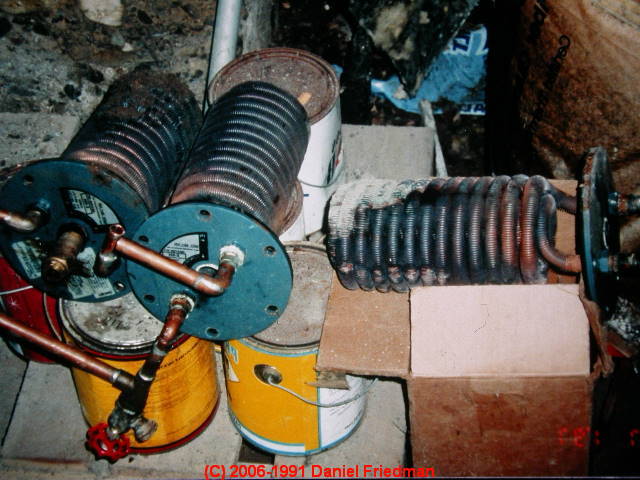
Signs of tankless coil clogging
from hard water: When a tankless coil is installed, since that's where our water is the hottest, often the tankless coil clogs before other plumbing materials.
A pile of tankless coils found in a home, such as we show in the photo in this section, is a likely sign that they have been replaced repeatedly - the water in this home is probably quite hard.
Look for evidence of previous acid-cleanout of the tankless coil. If the coil has been cleaned before, you'll see extra drain valves and shutoff valves installed on the hot and cold water lines close to the tankless coil.
The plumber uses these valves and drains to first isolate the tankless coil from the rest of the building water supply piping, and second, to pump an acid through the coil to try an dissolve the mineral clogging therein.
Once a tankless coil (or "hot water coil") has been acid-cleaned it may re-clog faster than before, since the surface of the copper tubing has been etched by the copper and may be more receptive to mineral deposition.

Mineral deposits on faucets and faucet strainers are an easy-to-spot sign of hard water at a building.
Often faucets and fixtures can be cleaned successfully using special cleaners to dissolve mineral deposits, or sometimes simply by soaking the parts in a vinegar solution.
Our photo at left looks up into the mouth of a bathroom faucet spout, showing minerals deposited by three years of exposure to hard well water.
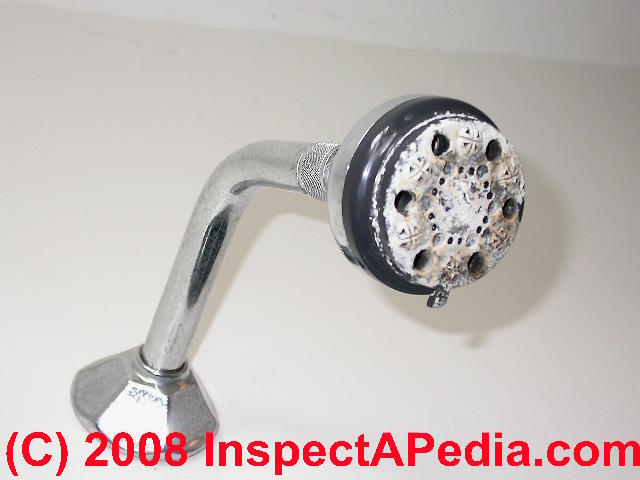
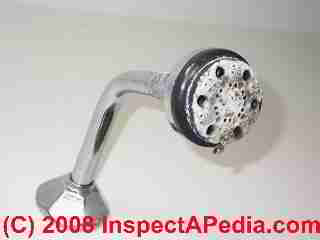
Mineral deposits also appear on shower heads and are unmistakable.
Our photo of a shower head shown just left shows white and tan minerals deposited by three years of exposure to hard well water.
Stained plumbing fixtures
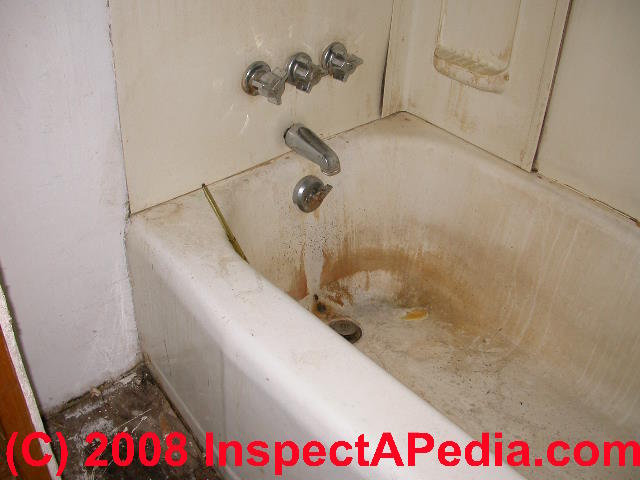
such as the bath tub shown in this photo often tell a lot about the history of a building as well as the condition of its water supply.
When hard water is supplied to a building the deposition of thin mineral deposits on bath tub and shower surfaces forms a rough coating that in turn increases the rate at which soap scum and dirt adhere.
Hard Water Lime Deposits in Other Problem Locations
White lime deposits have been reported on roofs where leaky swamp coolers were installed - WHITE STAINS on ROOFS or select a topic from the closely-related articles below, or see the complete ARTICLE INDEX.
...
Continue reading at WATER HARDNESS: HOW TO MEASURE or select a topic from the closely-related articles below, or see the complete ARTICLE INDEX.
Or see these
Recommended Articles
Suggested citation for this web page
WATER HARDNESS: HOW TO DETECT at InspectApedia.com - online encyclopedia of building & environmental inspection, testing, diagnosis, repair, & problem prevention advice.
Or see this
INDEX to RELATED ARTICLES: ARTICLE INDEX to WATER TREATMENT SYSTEMS
Or use the SEARCH BOX found below to Ask a Question or Search InspectApedia
Ask a Question or Search InspectApedia
Try the search box just below, or if you prefer, post a question or comment in the Comments box below and we will respond promptly.
Search the InspectApedia website
Note: appearance of your Comment below may be delayed: if your comment contains an image, photograph, web link, or text that looks to the software as if it might be a web link, your posting will appear after it has been approved by a moderator. Apologies for the delay.
Only one image can be added per comment but you can post as many comments, and therefore images, as you like.
You will not receive a notification when a response to your question has been posted.
Please bookmark this page to make it easy for you to check back for our response.
Our Comment Box is provided by Countable Web Productions countable.ca
Citations & References
In addition to any citations in the article above, a full list is available on request.
- North Dakota Standards for Water Softeners, North Dakota General Authority Law, Chapter 62-04-08, Water Softener Units http://www.legis.nd.gov/information/acdata/pdf/62-04-08.pdf. "The objective of this chapter is to provide a standard of quality, capacity, and performance for water softener units. Water softener performance is to be based upon referee tests procedures described in section 62-04-08-09."
- Culligan Mark 10 Water Softener 1994-1998 Installation and Operating Instructions (covering models manufactured after 1995) (1-96) 01881948.pdf available from www.culligan.com
- Water Softeners, CMHC, Canadian Mortgage and Housing Corporation, cmhc-schl.gc.ca/en/co/maho/wawa/wawa_005.cfm - October 2008. Canada Mortgage and Housing Corporation acknowledges the contribution of Health Canada to the development of this document. For further questions regarding water treatment and water quality, contact Health Canada at watereau@hc-sc.gc.ca or call 613-957-2991 or 1-866-225-0709.
- "Commercial Water Softener Installation and Operating Instructions", IBC Filtration & Water Treatment Products (Australia) for commercial, industrial and residential application www.ibcwater.com.au (07) 3219 2233
- "Non electric water softener, Installation and Operating Instructions", IBC Filtration & Water Treatment Products (Australia), op.cit.
- "Water Softener Twin Tank Installation and Operating Instructions", IBC Filtration & Water Treatment Products (Australia), op.cit.
- Our Water Hardness Table used at originated with but was edited and added to from http://www.bestfish.com/tips/110598.html and also from http://www.water-research.net/hardness.htm
- In addition to citations & references found in this article, see the research citations given at the end of the related articles found at our suggested
CONTINUE READING or RECOMMENDED ARTICLES.
- Carson, Dunlop & Associates Ltd., 120 Carlton Street Suite 407, Toronto ON M5A 4K2. Tel: (416) 964-9415 1-800-268-7070 Email: info@carsondunlop.com. Alan Carson is a past president of ASHI, the American Society of Home Inspectors.
Thanks to Alan Carson and Bob Dunlop, for permission for InspectAPedia to use text excerpts from The HOME REFERENCE BOOK - the Encyclopedia of Homes and to use illustrations from The ILLUSTRATED HOME .
Carson Dunlop Associates provides extensive home inspection education and report writing material. In gratitude we provide links to tsome Carson Dunlop Associates products and services.
 | HOME | ABOUT | ASK a QUESTION | CONTACT | CONTENT USE POLICY | DESCRIPTION | POLICIES | PRIVACY | |
| © 2024 - 1985 Publisher InspectApedia.com - Daniel Friedman | |||||||||