
InspectAPedia® FREE Encyclopedia of Building & Environmental Construction, Diagnosis, Maintenance & Repair |
Question? Just ask us! InspectAPedia
|
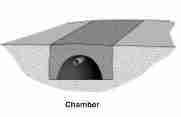 Chamber type Gravelless Septic System Designs
- POST a QUESTION or COMMENT about the design, installation, maintenance & repair of chamber type septic effluent absorption systems
Chamber type no-rock septic drainfield design:
What does a chamber system septic design look-like? What are its properties?
This article discusses the properties & installation of a chamber type gravelless or "no gravel" or "no rock" septic drainfield systems, offering installation specifications. Drainfields, also called leach fields, absorption beds, soil absorption systems, and leaching beds, perform the functions of septic effluent treatment and disposal in onsite wastewater treatment systems, conventionally called "septic systems"
InspectAPedia tolerates no conflicts of interest. We have no relationship with advertisers, products, or services discussed at this website.
Design & Installation of No-Gravel Chamber Systems for Wastewater Treatment and Disposal
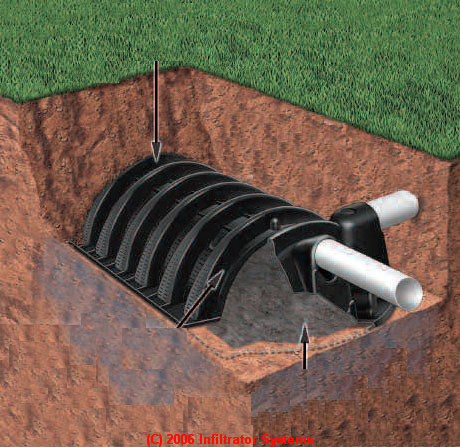
Gravelless septic systems or "no gravel" septic system trenches use plastic or other prefabricated wastewater distribution systems which are buried in soil without the use of surrounding gravel.
Gravelless Systems - Gravelless Septic Absorption Systems
There are three typical gravel-less effluent disposal systems in current use and shown in the US EPA sketches below (originally from NSFC) and I describe a fourth variation which is provided by some manufacturers:
This article describes the third type, chamber septic systems for effluent disposal.
Typical gravelless septic systems use a plastic chamber, a geotextile-wrapped pipe, or a polystyrene-wrapped pipe to distribute effluent into the soil.
The necessary soil absorption area is provided by the perforated surface of the gravelless septic system components (or by soil at the bottom of a chamber) themselves rather than by the gravel and trench walls of a conventional septic drainfield.
Gravelless or "no rock" septic systems can provide an acceptable effluent disposal system for sites with limited space for a drainfield or where gravel is not available or is quite expensive.
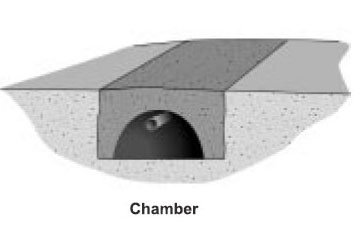
3. Chamber septic systems, using pre-formed plastic chambers (shown just above) buried in an earthen trench. Wastewater is delivered to the top of the chamber by a solid plastic pipe. Effluent seeps into soil across the bottom of the chamber.
The empty chamber also provides effluent storage volume to handle peak wastewater flow loads.
Chambers are available in widths varying from 16" across (at the bottom) to 34" wide and are placed in trenches ranging in width from 18" to 36".
Synonyms for this design include "leaching chambers", "galleys", and "flow diffusers". Illustration courtesy of Infiltrator Systems, Inc., used with permission. (Infiltrator Systems Inc. contact information is listed below).
Use of Vertical Thin Wall Chambers for Wastewater Treatment and Disposal
4. Vertical thin wall chambers: A fourth variation on gravelless effluent disposal systems is similar to the chamber system (#3 above), but uses pre-formed but thin plastic "chambers" which are inserted into a narrow slot cut into the soil; these systems diffuse effluent primarily through their sides into the soil.
Consultants or supplies in this field can be listed at our alternative septic designers page at no charge by contacting me.
Reader Comments, Questions & Answers About The Article Above
Below you will find questions and answers previously posted on this page at its page bottom reader comment box.
Reader Q&A - also see RECOMMENDED ARTICLES & FAQs
Question: explain "stub out" and “ 34 Arc 24’s 510ft^2. Drainfield" on my septic plans
2021/03/17 Jon said:
On my engineered plans it says “ stub out no lower then 99.96’ What does that mean because I’m sure doesn’t mean 99.96 feet underground.
On my engineered plans it says
34 Arc 24’s 510ft^2. Drainfield.
What is this?
Moderator reply:
@Jon, your septic engineer is calling for installation of a "no-rock" or "gravelless" septic drainfield installation - the drainfield is the part of your septic system that disposes of clarified septic effluent by allowing it to leach into the soil where bacterial action processes its pathogens.
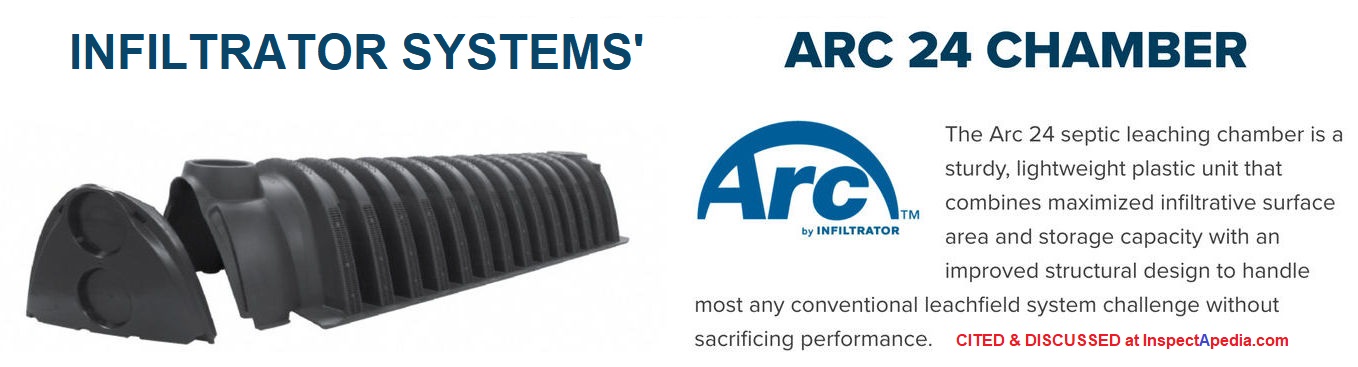
The Arc 24 Chamber is a "no-rock" septic product (no rocks or gravel are required in the drainfield trenches) produced by Infiltrator Systems, as we illustrate below. Infiltrator Systems, Inc.provides chamber products
The 510ft^2 is perhaps telling us that the total square feet of drainfield area [or length?] is to be 510 square feet. (though I could not add up the data to amount to either square feet nor total trench length).
And I am guessing that the "34" is the number of 24s sections that will be needed - each Infiltrator Arc 24 section is 22"W x 63"L x 12"H and gives you 7.96 sq ft of leaching area. (Unless your engineer knows of a larger variant of this product.)
But frankly I can't make the numbers add-up. If 34 is the quantity, and as the Arc 24 gives you just under 8 sq.ft. then that would give us 8 x 34 = 272 square feet of area, not 510 sq.ft.
So it makes sense to ask your septic engineer to translate her septic design specifications into lay-person English. Please let me know what you're told as we'll both learn something useful.
---
The statement
stub out no lower then 99.96’
is greek to me, too. I wonder if there was a typo in the plan.
In general "stub out" would probably mean that the builder or plumber installs an initial sewage effluent line or sewer line to the tank and thence to the drainfield area. When the gravelless trenches are installed and connected (via a D-box) they'd be connected to a stub that was instaleld previously.
You can read more about no-rock septics that use a chamber like yours at GRAVELLESS SEPTIC CHAMBER SYSTEMS inspectapedia.com/septic/Gravelless_Septic_Chamber_Systems.php
And you'll find a "cutsheet" giving the specifications for your Infiltrator Arc-24 chambers under our listing for Infiltrator Systems
at
GRAVELLESS NO-ROCK SEPTIC SUPPLIERS
Including these references:
- Infiltrator Systems ARC 24 CHAMBER SPECIFICATIONS [PDF] Infiltrator Systems, Inc. provides chamber products TEl: 800-718-2754 Old Saybrook CT USA. Website: http://www.infiltratorsystems.com/ or 4 Business Park Road P.O. Box 768 Old Saybrook, CT 06475 860-577-7000 - 1-800-221-4436
- Infiltrator Systems ARC 18, ARC 24 GRAVELLESS CHAMBER SYSTEM INSTALLATION GUIDE [PDF] Op. Cit.
- Infiltrator Systems ARC 36, ARC 36LP, ARC 36 GRAVELLESS CHAMBER SEPTIC SYSTEM INSTALLATION GUIDE [PDF] Op. Cit.
Separately
at GRAVELESS SEPTIC DESIGN CRITERIA you will find the actual design specifications and installation guides for Infiltrator Systems' Arc 24 and other similar products.
Question: Chamber Septic Feet to Equivalent Conventional Septic Drainfield Trench?
2019/02/11 Steve Haldeman said:
How many feet of sewer pipe does 1 24x48 chamber equal. Like 1 chamber or 10/20/30feet of sewer pipe? do you use a big chamber for a septic tank?
Reply:
Take a look at GRAVELESS SEPTIC DESIGN CRITERIA
There you'll see that the equivalent feet of perforated rain line (conventional leach field drain trench) for a chamber system varies by manufacturer's specific product and its specifications.
For each specific septic chamber system product and plastic pipe or chamber diameter, the manufacturer will indicate the disposal area provided by the product (per linear foot, for example).
But your engineer and installer need to evaluate your soils and daily wastewater usage to determine the amount of leaching area needed for your site.
Also the equivalent area of conventional field (or length) will depend on the gravel-less pipe size.
Here is an example of equivalent drainfield size to gravelless size from Crumpler Plastic Pipe
The 8” size pipe will equal to 2-foot wide conventional trench; and the 10” size will equal a 2.5-foot wide trench. To determine the required linear footage of either pipe size, first determine the square footage by dividing the design sewage flow by the appropriate soil’s long term application rate. Then divide this total square footage area figure by either 2 feet (for 8”) or 2.5 feet (for 10”) to establish the linear footage amount.
- Source: CPP’S No-Rock ™ Fabric Wrapped Septic Pipe [PDF] (2019) Crumpler Plastic Pipe, .O. Box 2068, Highway 24 West, Roseboro, NC 28382 USA, Tel: 1-800-334-5071
Email: cppsales@cpp-pipe.com retrieved 2019/02/11 original source: www.cpp-pipe.com/no_rock.html
...
Continue reading at GRAVELESS SEPTIC DESIGN CRITERIA or select a topic from the closely-related articles below, or see the complete ARTICLE INDEX.
Or see these
Recommended Articles
- SEPTIC CONSULTANTS, DESIGNERS, ENGINEERS
- GRAVELLESS SEPTIC SYSTEMS
- SEPTIC EFFLUENT DISTRIBUTION Products Directory List
- SEPTIC FILTER / GRAYWATER FILTER SOURCES & Wastewater Treatment Systems Using Filtration Methods Products Directory
- SEPTIC SYSTEM DESIGN ALTERNATIVES
- SEPTIC SYSTEM DESIGN BASICS - home
- TYPES OF SEPTIC SYSTEMS - master list
Suggested citation for this web page
GRAVELLESS SEPTIC CHAMBER SYSTEMS at InspectApedia.com - online encyclopedia of building & environmental inspection, testing, diagnosis, repair, & problem prevention advice.
Or see this
INDEX to RELATED ARTICLES: ARTICLE INDEX to SEPTIC SYSTEMS
Or use the SEARCH BOX found below to Ask a Question or Search InspectApedia
Ask a Question or Search InspectApedia
Questions & answers or comments about the design, installation, maintenance & repair of chamber type septic effluent absorption systems.
Try the search box just below, or if you prefer, post a question or comment in the Comments box below and we will respond promptly.
Search the InspectApedia website
Note: appearance of your Comment below may be delayed: if your comment contains an image, photograph, web link, or text that looks to the software as if it might be a web link, your posting will appear after it has been approved by a moderator. Apologies for the delay.
Only one image can be added per comment but you can post as many comments, and therefore images, as you like.
You will not receive a notification when a response to your question has been posted.
Please bookmark this page to make it easy for you to check back for our response.
Our Comment Box is provided by Countable Web Productions countable.ca
Citations & References
In addition to any citations in the article above, a full list is available on request.
- New York State Department of Health, APPENDIX 75-A WASTEWATER TREATMENT STANDARDS - INDIVIDUAL HOUSEHOLD SYSTEMS , [PDF] New York State Department of Health, 3 February 2010, retrieved 3/1/2010, original source: https://www.health.ny.gov/regulations/nycrr/title_10/part_75/appendix_75-a.htm
- Crumpler Plastic Pipe, Inc. Crumpler provides fabric-wrapped drainage piping 800-334-5071 Roseboro NC USA - "No-Rock TM Septic-Leachate drainpipe systems" are available in 8" and 10" systems.
- Jeff Pildis, Technical Service & Support, Infiltrator Systems, Inc. 800-718-2754
- Pennsylvania State Wastewater Treatment Fact Sheet SW-161, Septic System Failure: Diagnosis and Treatment
- Pennsylvania State Wastewater Treatment Fact Sheet SW-162, The Soil Media and the Percolation Test
- Pennsylvania State Wastewater Treatment Fact Sheet SW-l64, Mound Systems for Wastewater Treatment
- Pennsylvania State Wastewater Treatment Fact Sheet SW-165, Septic Tank-Soil Absorption Systems
- Our recommended books about building & mechanical systems design, inspection, problem diagnosis, and repair, and about indoor environment and IAQ testing, diagnosis, and cleanup are at the InspectAPedia Bookstore. Also see our Book Reviews - InspectAPedia.
- In addition to citations & references found in this article, see the research citations given at the end of the related articles found at our suggested
CONTINUE READING or RECOMMENDED ARTICLES.
- Carson, Dunlop & Associates Ltd., 120 Carlton Street Suite 407, Toronto ON M5A 4K2. Tel: (416) 964-9415 1-800-268-7070 Email: info@carsondunlop.com. Alan Carson is a past president of ASHI, the American Society of Home Inspectors.
Thanks to Alan Carson and Bob Dunlop, for permission for InspectAPedia to use text excerpts from The HOME REFERENCE BOOK - the Encyclopedia of Homes and to use illustrations from The ILLUSTRATED HOME .
Carson Dunlop Associates provides extensive home inspection education and report writing material. In gratitude we provide links to tsome Carson Dunlop Associates products and services.
 | HOME | ABOUT | ASK a QUESTION | CONTACT | CONTENT USE POLICY | DESCRIPTION | POLICIES | PRIVACY | |
| © 2024 - 1985 Publisher InspectApedia.com - Daniel Friedman | |||||||||