
InspectAPedia® FREE Encyclopedia of Building & Environmental Construction, Diagnosis, Maintenance & Repair |
Question? Just ask us! InspectAPedia
|
 Maintenance Guide for Free Standing Septic Pumps and Sump Pumps
- POST a QUESTION or COMMENT about sewage ejector pumps and sewage grinder pumps
Free standing sewage grinder pumps or septic pumps:
This article explains the differences between Sump Pumps, Sewage Ejector Pumps, Septic Grinder Pumps, Sewage Pumping Stations, & Septic Pump Alarms.
We discuss the vertical lift required for different types of sewage or septic pumps and the importance of matching pump capacity to the design requirements of the system.
Citation of this article by reference to this website and brief quotation for the sole purpose of review are permitted.Citation of this article by reference to this website and brief quotation for the sole purpose of review are permitted. Use of this information at other websites, in books or pamphlets for sale is reserved to the author. Technical review by industry experts has been performed and comments from readers are welcomed. Contributors are listed at the end of each article.
InspectAPedia tolerates no conflicts of interest. We have no relationship with advertisers, products, or services discussed at this website.
What is a Free-Standing Sewage Grinder Pump
 A sewage grinder pump is about the same as the packaged on in-can sewage ejector pump discussed above, except that the grinder pump
is a heavy-duty pump which, instead of being in a prepackaged container such as for use to install a single basement bathroom
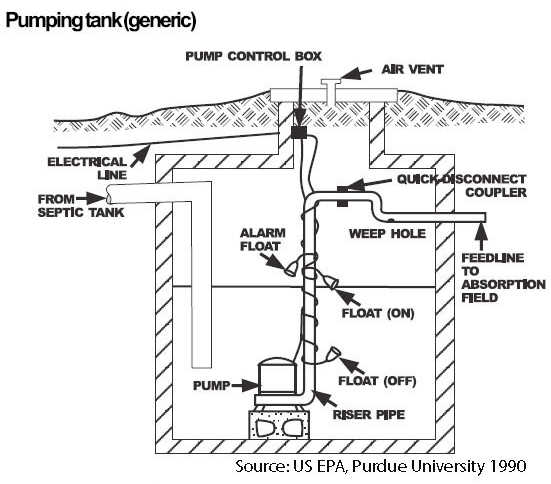
at a level below the building sewer outlet height, the grinder pump is installed right in a septic tank.
A sewage grinder pump is about the same as the packaged on in-can sewage ejector pump discussed above, except that the grinder pump
is a heavy-duty pump which, instead of being in a prepackaged container such as for use to install a single basement bathroom
at a level below the building sewer outlet height, the grinder pump is installed right in a septic tank.
The free standing sewage grinder pump macerates sewage so that it can be pumped through a (usually smaller-diameter, perhaps 2") force main to an uphill septic tank or sewage pumping station or to a municipal sewer line, all of which are in this case located higher than the pumping location. Thus the need for the pump.
A non-clogging sewage pump used in the same application is designed to move larger solids, up to perhaps 4" in diameter, to a gravity drain.
The "septic pump in a can" or packaged septic grinder pump systems described
at SEWAGE EJECTOR / GRINDER PUMPS have varying lift capacity depending on the pump horsepower, but these are generally less powerful than a submersible sewage pump.
Where a lot of vertical lift is needed (where there is a large "head" pressure), a submersible sewage grinder or effluent pump will be used and will be installed at or near the bottom of the holding tank.
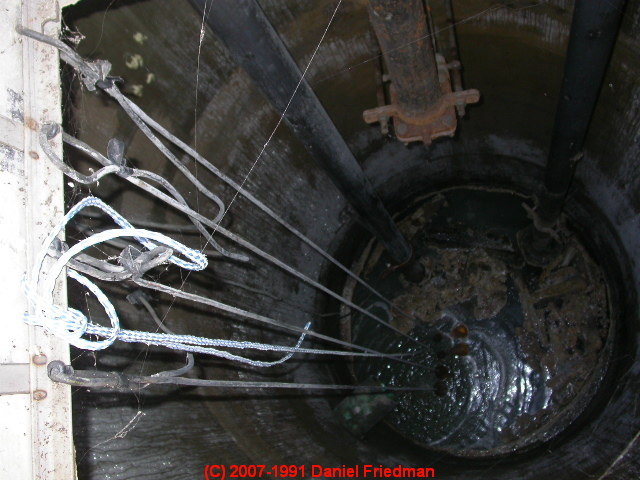
Though we can't see the pumps in this photo - they are below the sewage level in this pumping chamber - that's what we'd expect to find installed in this municipal sewage lift station (which we discuss in more detail
If someone installs an ordinary dewatering sump pump to pump sewage they're opting for an inexpensive pump that is not going to last long at all because it's being misused and it's going to clog up.
Using an ordinary dewatering sump pump to move septic effluent is making a similar, if not as completely egregious mistake.
If you are pumping only clarified septic system effluent out of a septic pumping chamber which itself is downstream from and separated from a septic tank which contains solids and floating scum, then your pump does not need to be a grinder pump.
However even in this case I would avoid the common $100.00 (ballpark) common sump pump because it's unlikely that the pump will have the duty cycle and durability to give you a long term, reliable septic system operation.
The best design for any pumping system, solids to a tank or effluent to an elevated drainfield, is a duplex pump system so that you have a chance to keep a working house drain system even when a pump fails.
Research
- More about force mains and sewage pumping stations is at SEPTIC PUMPING STATIONS https://inspectapedia.com/septic/Sewage_Pumping_Stations.php
- Also see our CONTINUE READING and our Recommended Articles below
- Also see additionalReferences or Citations at the end of this article
...
Continue reading at SEPTIC PUMP ALARM SYSTEMS or select a topic from the closely-related articles below, or see the complete ARTICLE INDEX.
Or see these
Recommened Articles
- ODORS, SEPTIC or SEWER
- SEWAGE EJECTOR / GRINDER PUMPS - home
- DISPOSABLE WET WIPE CLOGS
- FREE-STANDING GRINDER PUMPS
- SEWAGE TREATMENT PLANTS, RESIDENTIAL
- SEPTIC SYSTEM PUMPS
- SEPTIC PUMP ALARM SYSTEMS
- SEPTIC PUMP BUYERS GUIDE & MANUALS
- SEPTIC PUMP DUPLEX DESIGNS
- SEPTIC PUMP INSPECTION & MAINTENANCE
- SEPTIC PUMP INSTALLATION
- SEWAGE ODOR SOURCE LOCATION
- SEWAGE PUMP BUYERS GUIDE & MANUALS
- SEWAGE PUMP DAMAGE & REPAIR
- SEWAGE PUMP INTERMITTENT CYCLING
- SEWAGE PUMP ODORS
- SEWAGE PUMPING STATIONS
- SEWAGE ODOR SOURCE LOCATION
- SEWAGE PUMPING STATIONS
- WAXY BIOFILM SLIME CLOGS in DRAINS & PUMPS
- SEPTIC SYSTEM PUMPS
- SUMP PUMPS
Suggested citation for this web page
FREE-STANDING GRINDER PUMPS at InspectApedia.com - online encyclopedia of building & environmental inspection, testing, diagnosis, repair, & problem prevention advice.
Or see this
INDEX to RELATED ARTICLES: ARTICLE INDEX to SEPTIC SYSTEMS
Or use the SEARCH BOX found below to Ask a Question or Search InspectApedia
Ask a Question or Search InspectApedia
Try the search box just below, or if you prefer, post a question or comment in the Comments box below and we will respond promptly.
Search the InspectApedia website
Note: appearance of your Comment below may be delayed: if your comment contains an image, photograph, web link, or text that looks to the software as if it might be a web link, your posting will appear after it has been approved by a moderator. Apologies for the delay.
Only one image can be added per comment but you can post as many comments, and therefore images, as you like.
You will not receive a notification when a response to your question has been posted.
Please bookmark this page to make it easy for you to check back for our response.
Our Comment Box is provided by Countable Web Productions countable.ca
Citations & References
In addition to any citations in the article above, a full list is available on request.
- New York State Department of Health, APPENDIX 75-A WASTEWATER TREATMENT STANDARDS - INDIVIDUAL HOUSEHOLD SYSTEMS , [PDF] New York State Department of Health, 3 February 2010, retrieved 3/1/2010, original source: https://www.health.ny.gov/regulations/nycrr/title_10/part_75/appendix_75-a.htm
- SEPTIC TANK/SOIL-ABSORPTION SYSTEMS: HOW TO OPERATE & MAINTAIN [PDF] - , Equipment Tips, U.S. Department of Agriculture, 8271 1302, 7100 Engineering, 2300 Recreation, September 1982, web search 08/28/2010, original source: http://www.fs.fed.us/t-d/pubs/pdfimage/82711302.pdf.
- "International Private Sewage Disposal Code," 1995, BOCA-708-799-2300, ICBO-310-699-0541, SBCCI 205-591-1853, available from those code associations.
- "Manual of Policy, Procedures, and Guidelines for Onsite Sewage Systems," Ontario Reg. 374/81, Part VII of the Environmental Protection Act (Canada), ISBN 0-7743-7303-2, Ministry of the Environment,135 St. Clair Ave. West, Toronto Ontario M4V 1P5 Canada $24. CDN.
- Manual of Septic Tank Practice, US Public Health Service's 1959.
- Septic Tank/Soil-Absorption Systems: How to Operate & Maintain, Equipment Tips, U.S. Department of Agriculture, 8271 1302, 7100 Engineering, 2300 Recreation, September 1982, web search 08/28/2010, original source: http://www.fs.fed.us/t-d/pubs/pdfimage/82711302.pdf
- Septic System Owner's Manual, Lloyd Kahn, Blair Allen, Julie Jones, Shelter Publications, 2000 $14.95 U.S. - easy to understand, well illustrated, one of the best practical references around on septic design basics including some advanced systems; a little short on safety and maintenance. Both new and used (low priced copies are available, and we think the authors are working on an updated edition--DF. Quoting from one of several Amazon reviews: The basics of septic systems, from underground systems and failures to what the owner can do to promote and maintain a healthy system, is revealed in an excellent guide essential for any who reside on a septic system. Rural residents receive a primer on not only the basics; but how to conduct period inspections and what to do when things go wrong. History also figures into the fine coverage.
- In addition to citations & references found in this article, see the research citations given at the end of the related articles found at our suggested
CONTINUE READING or RECOMMENDED ARTICLES.
- Carson, Dunlop & Associates Ltd., 120 Carlton Street Suite 407, Toronto ON M5A 4K2. Tel: (416) 964-9415 1-800-268-7070 Email: info@carsondunlop.com. Alan Carson is a past president of ASHI, the American Society of Home Inspectors.
Thanks to Alan Carson and Bob Dunlop, for permission for InspectAPedia to use text excerpts from The HOME REFERENCE BOOK - the Encyclopedia of Homes and to use illustrations from The ILLUSTRATED HOME .
Carson Dunlop Associates provides extensive home inspection education and report writing material. In gratitude we provide links to tsome Carson Dunlop Associates products and services.
 | HOME | ABOUT | ASK a QUESTION | CONTACT | CONTENT USE POLICY | DESCRIPTION | POLICIES | PRIVACY | |
| © 2024 - 1985 Publisher InspectApedia.com - Daniel Friedman | |||||||||