
InspectAPedia® FREE Encyclopedia of Building & Environmental Construction, Diagnosis, Maintenance & Repair |
Question? Just ask us! InspectAPedia
|
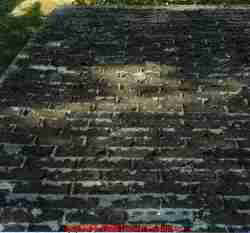 Loss of Roof Shingle Mineral Granules - Roof Wear
8 Causes of Asphalt Shingle Granule Loss on Roofs
- POST a QUESTION or COMMENT about the cause and significance of lost mineral granules from asphalt shingle & roll roofing surfaces
Loss of mineral granules from asphalt shingle or roll roofing roofs:
This roof leak article explains the causes & effects of loss of protective mineral granules from roof shingles.
Shingle granule loss defects occur on organic-mat or fiberglass-mat asphalt roof shingles and, depending on the cause and extent of mineral granule loss, the loosening of this protective coating can spell the end of life of an asphalt shingle roof or the demise of a mineral-granule-coated roll roofing roof.
InspectAPedia tolerates no conflicts of interest. We have no relationship with advertisers, products, or services discussed at this website.
Mineral granule loss from asphalt roof shingles

Causes & effects of loss of protective mineral granules from roof shingles. Description of different causes of roof shingle granule loss: normal, defective product, storm damage, foot traffic, etc. How to Inspect a Roof for Loss of its Protective Coating of Mineral Granules. When does granule loss mean that a new roof is needed?
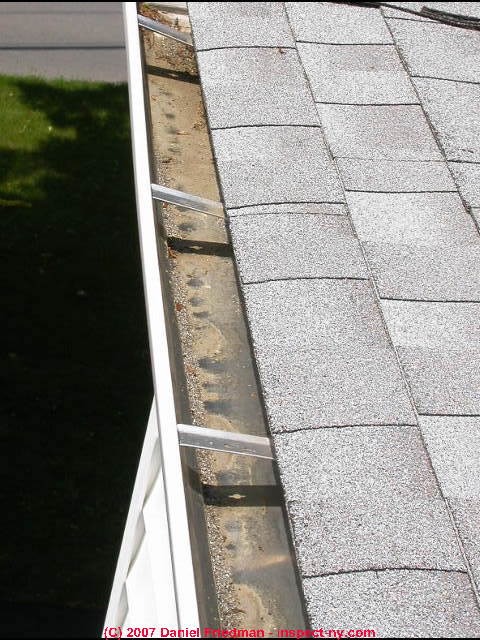
This roof gutter sports about an inch of mineral granules that have washed off of the asphalt-shingle roof. Is that a problem? We'll see.
Roof shingle granule loss may be normal shingle wear, hail damage wear, or defective roofing product, as we explain here. The page-top photograph shows severe loss of mineral granules from an asphalt shingle roof.
This "bald" asphalt shingle roof is way past needing replacement and is almost certainly leaking. Even a roof with less dramatic granule loss is showing signs of wear and reduced future life.
Readers are also invited contribute roof failure information to the web author for research purposes. web author for research purposes.
[Click to enlarge any image]
The job of these mineral granules which are adhered to the roof shingle surface as part of the shingle manufacturing process, is to protect the shingle from sunlight, from UV light, and from the weather in general.
The selection of roof shingle color is also determined by the choice of its coating of mineral granule; lighter colored shingles may remain a bit cooler and at least in some applications (hot sunny climates) may have a longer life than dark-colored shingles.
Eight Types of Mineral Granule Loss on Asphalt Roofing Shingles
While in our page top photo the roof is "worn out", there are quite a few other conditions that can produce mineral loss on asphalt shingle roofs. Diagnosing the correct cause of granule loss is useful in helping to assess the probable remaining roof life and it may play a role in roof shingle warranty claims or insurance claims related to storm or hail damage.
In this article we define, contrast, and illustrate all types of mineral granule losses that occur on asphalt roofing:
- ROOF GRANULE LOSS, NEW - Asphalt shingle mineral granule loss on a new asphalt shingle roof
- ROOF GRANULE LOSS, BLISTER RASH - Asphalt shingle mineral granule loss due to roof shingle blistering
- ROOF GRANULE LOSS, OLD ROOF - Asphalt shingle mineral granule loss on old, worn-out asphalt shingle roofs
- ROOF GRANULE LOSS, WALKING-ON - Asphalt shingle mineral granule loss from being walked-on or mechanical damage
- ROOF GRANULE LOSS, HAIL DAMAGE - Asphalt shingle mineral granule loss due to hail or other storms
- ROOF GRANULE LOSS, NORMAL - Asphalt shingle mineral granule loss on an asphalt shingle roof due to normal aging
- ROOF GRANULE LOSS, DEFECTIVE PRODUCT - Asphalt shingle mineral granule loss due to defective roofing product
- ROOF GRANULE LOSS, IMPROPER STORAGE - Asphalt shingle mineral granule loss due to damage shingles from improper storage
This article also describes:
ROOF GRANULE LOSS INSPECTION PROCEDURES
and we also discuss
ROOF GRANULE LOSS & RE-ROOF DECISION
Normal Mineral Granule Loss on a New Asphalt Shingle Roof
Granule loss on a new asphalt roof,
loose mineral granules wash down the roof and will appear in gutters and at the ends of downspouts. You can begin this roof condition assessment at the ground, before even looking at the roof itself.

If the roof is reported to be new, the granules shown in our photo are normal and not a worry. [Or they could be there having washed off of an older worn out roof that was just replaced.]
Especially right after an asphalt roof has been installed, granules that were loosened on it surface from walking by the installers will wash down and off of the roof surface.
Provided the roofers were careful not to dance the Twist while roofing on a hot day, the roof should be fine.
See GAF's handy diagnostic article on granule loss from new roof shingles where the company helps a homeowner decide "is this a problem or not?"
- GAF GRANULE LOSS on NEW SHINGLES [PDF] GAF, Technical Advisory Bulletin TAB-R-112, GAF 1 Campus Drive, Parsippany NJ 07054, Web: gaf.com - retrieved 2023/03/09, original source: gaf.com/en-us/document-library/documents/documents/ technicalbulletinsdocuments /residentialenglishdocuments /R__112_Granule_Loss_on_New_Shingles.pdf
But if the granules appear after a hail storm, or if the roof is quite old, they are more likely to indicate roof wear and/or damage.
Just take a close look at the shingles themselves for granule loss. And if you clean out the gutters you'll find it easy to see if this granule loss is continuing. Look in the roof gutters for shingle granules too.

Roof granule loss due to normal aging occurs over the life of an asphalt shingle roof as weather and sun exposure cause the roof shingle to lose its flexibility, as the roof is exposed to changing temperatures, etc.
Normal shingle granule loss means that there has been no single event that has damaged the roof, that the quantity of granules lost from or remaining on the shingles is typical for the chronological age of the roof, and that thus the "wear age" of the roof (it's remaining life compared with its original warranty or projected roof life) is about the same as the roof's chronological age, after we factor
in ASPHALT SHINGLE LIFE / WEAR FACTORS.
Details and photos of normal roof granule loss are at Roof Granule Loss Due to NORMAL AGING in this article (below).
Roof Shingle Granule Loss from Damaged Shingle Blisters
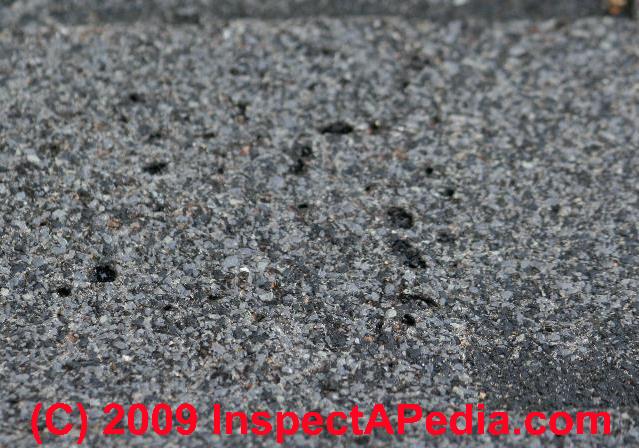
Granule loss due to blistering: blisters or "pimple-like" protrusions from a shingle surface may be a "cosmetic" manufacturing defect (at least in the opinion of the manufacturers).
On at least some roofs we find that these blisters ultimately become the first wear points on the shingle when their upper surface wears away (perhaps from foot traffic or weather) exposing small round dots of missing granules on the shingle.
Watch out: walking on a badly-blistered roof may cause damage visible as granule loss or pits.
See ROOF INSPECTION SAFETY & LIMITS
We discuss this defect and how to distinguish between defective shingle product and storm damage
Roof Shingle Granule Loss on Old, End-of-Life Roofs
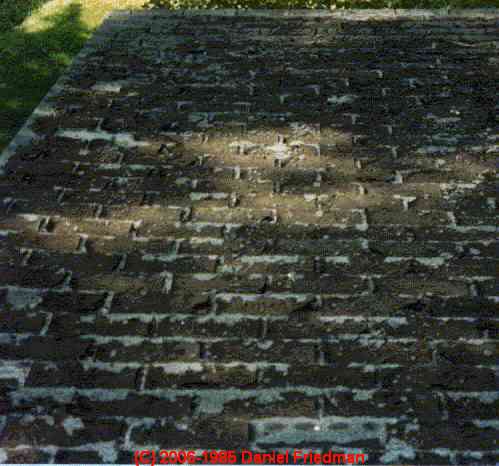
Granule loss on old asphalt shingle roofs: when an asphalt shingle roof is nearing the end of its life we may see that granules have begun to wash off of the shingles so as to leave large "bald" or nearly bald areas showing black shingle substrate.
These shingles have more porosity than those where their mineral granules remain in place and may already be leaking even if leaks are not quite visible in the building interior. Such a roof is ready for replacement.
Roof Shingle Damage from Mechanical Forces: Walking-on, Chopping
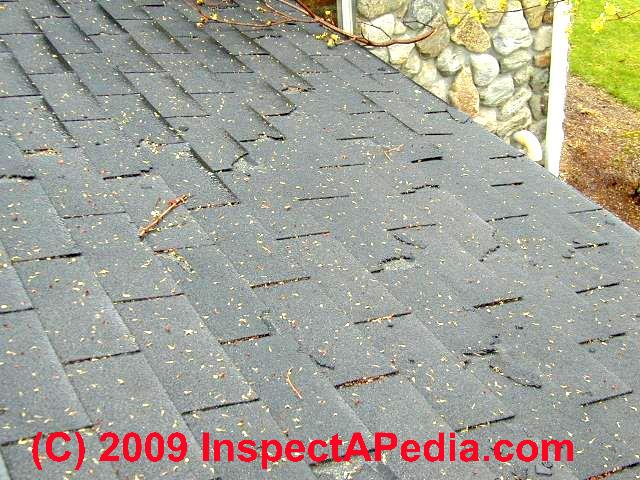
Granule loss on a roof being walked-on: walking on any asphalt shingle roof loosens some of the mineral granules from their attachment embedded in the asphalt used to impregnate and coat the shingle. If there is a lot of roof traffic, such as when work is being done on a chimney, you may see "bald" areas of shingles with lost granules where people have been walking.
The (older, more brittle) roof at left suffered both granule loss and cracked shingle corners after it was walked-on.
See ROOF INSPECTION SAFETY & LIMITS
This is damage caused by workers and is not a product defect. Some examples and photos of shingle damage that occurred at least in part due to foot traffic on a roof, and that produced lots of granule loss from the surface can be seen
at MECHANICAL DAMAGE of SHINGLES.
At an arbitration hearing involving a roof dispute we could actually track the footprints (and damage) across an older roof that had been walked-on (and damaged) by the very contractor who told the owner she needed a new roof. (Don't walk on fragile roof surfaces).
Roof Shingle Granule Loss from Hail Damage
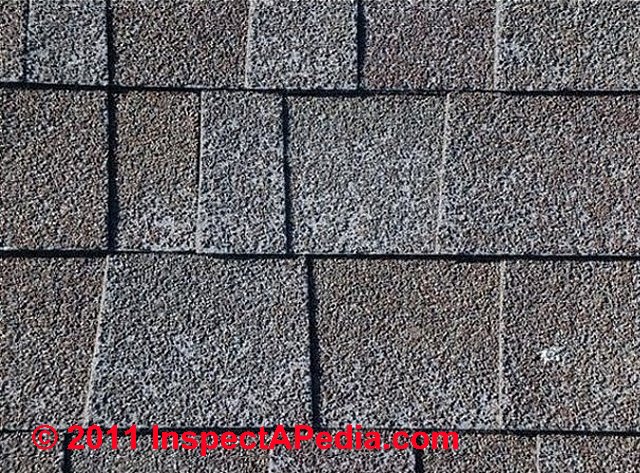
Granule loss on asphalt shingles due to storms, especially hail: it is possible that severe weather, such as hailstorms, may damage shingles producing pitting and granule loss.
Such roofs have a reduced remaining life, depending on the severity of damage.
See HAIL DAMAGED SHINGLES & OTHER ROOF COVERINGS for more detail on this source of asphalt shingle roof damage and for more photographs of asphalt shingles that have been deprived of their protective coating of mineral granules.
Roof Granule Loss Due to Normal Aging
Granule loss due to normal wear and shingle aging
The organic felt-based asphalt shingles shown at below left has lost some granules into the roof gutter but an inspection of the shingles themselves showed no significant bald areas. We had to look closely at those shingles in the upper right of the photo and we decided the wear was probably due to foot traffic as well.
The organic-mat asphalt roof shingle shown at right, also showing normal wear, is completely worn out, showing shingle substrate, sun and heat damage, and basically, that the roof needs to be replaced. A shingle like the one shown is usually so fragile that stepping on it breaks it into many small fragments.
These shingles (above right) may already be leaking into the roof substrate, placing water between the shingle and its felt underlayment, between the underlayment and the roof sheathing, or leaks may be entering the roof structure.
Even if there is no visible evidence of leaks in the living area (such as stains on top floor ceilings or visible water in the attic) this roof is at the end of its life.
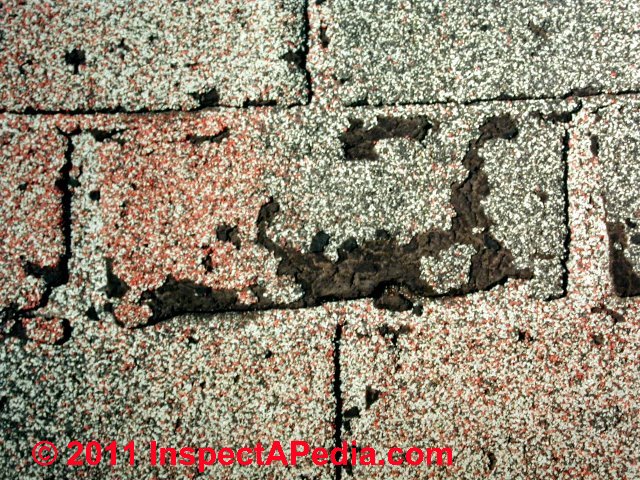
Wherever and whenever a roof shingle has lost the protection of its mineral granules that shingle has a reduced life expectancy. In all climates the loss of granules means that area of the roof shingle has lost its protection from sunlight. In freezing climates, shingle wear may accelerate in the area of lost granules as the roof ages and is exposed to freeze thaw cycles.
Mineral Granule Loss Due to Defective Roofing Product
Roof shingle granule loss due to defective roofing product usually exposes the shingle substrate in "premature bald" patches and is identified by bald spots or exposed shingle substrate on roofs early in their chronological life, often distributed uniformly over the roof or in areas of the roof where shingles from a particular pallet of roof shingles were installed.
Below (left), the picture of bald areas in this laminated asphalt shingle or "architectural shingle" roof show white fiberglass roof shingle substrate. Our OPINION was that this was a defective roof product.
This same roof also suffered thermal splitting or tearing damage (below right). Photos of roof damage below were provided by ASHI Home inspector Steve Mauer and photographed in 2009.
Our OPINION is that the asphalt roof shingle granule loss shown at below left is due to a defective product.
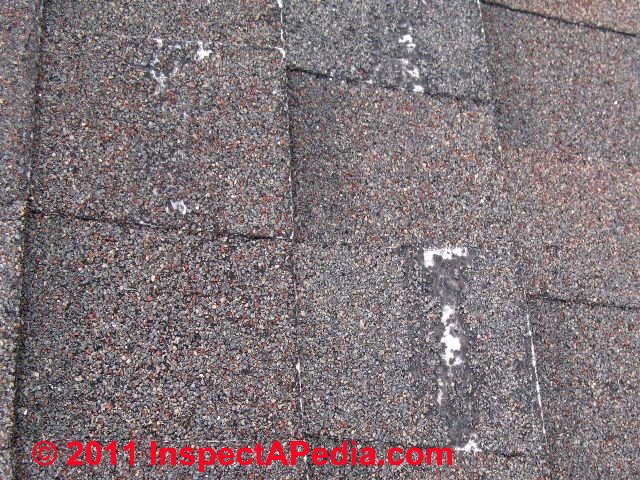
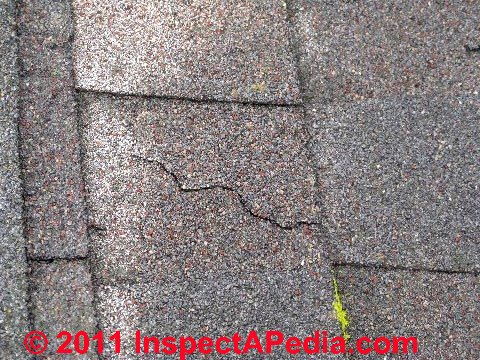
The shingle tearing and splitting shown below on the same roof is also often a product defect referred to as thermal splitting.
See CRACKS & THERMAL SPLITTING in FIBERGLASS SHINGLES for an explanation of splits or cracks in asphalt shingles.
Asphalt Shingle Mineral Granule Loss due to Improper Shingle Storage

The roof shown above was observed on a home in Haddonfield, New Jersey in the U.S. That the shingles were installed in a ladder pattern has become obvious as sections of these roof shingles have lost more granules than their neighbors. The loss of the tan colored mineral granules is leaving the black asphalt shingle substrate exposed.
Laddering or stair-step installation of shingles is not the best roofing practice and it, too, can contribute to other roof wear or leak problems that we don't see on this roof, but laddering is permitted by roofing installation practice guides.
See LADDERING vs STAIR STEPPING SHINGLES.
However because shingles installed in a ladder pattern tend to be grouped in batches of shingles were set on the roof for installation from individual shingle bundles, often the loss of mineral granules not only tell us the shingle installation pattern but also they tell us something about variation in shingle durability or variation in shingle granule loss in individual bundles of shingles that otherwise were (probably) manufactured in the same production run.
This distinction is significant. If all of the shingles on a roof were produced in the same manufacturing run but if we then see that groups of shingles wear differently even though installed on the same roof slope, exposed thus to the same sun and weather conditions, we can infer that there were variations in condition among the individual bundles of shingles.
Typically three bundles of shingles make up one square (100 sq .ft.) of roof covering.
A common explanation of this variation in shingle durability by bundle is improper shingle storage such as leaving a pallet of roof shingles exposed to weather for some time before they are used. Shingles on the top of the pallet become rain-soaked and may suffer damage.
See ROOF SHINGLE STORAGE.
How to Inspect a Roof for Loss of its Protective Coating of Mineral Granules
Check the shingle surface for mineral granule loss
The critical place to evaluate the condition of roof shingles is at the edge of or (if safe and the roof is not fragile), on the roof itself.
Look closely at those shingles - get down on your hands and knees and look closely for early wear signs such as tiny bald spots, pits, cracks, or other damage. If you can't see obvious bald areas from which the protective granules have been lost from the shingle, it's unlikely that granule loss is a current problem.
Look in the gutters for lost mineral granules from the roof
The photograph at above left shows a modest amount of mineral granule wash-off into the gutter of this home.
If the roof is a new one, this may be a normal amount of granule loss.
When the gutter is cleaned out completely, you should not see this same level of mineral granules again soon. If you do, there may be a rapid wear problem going on with the roof, or someone may be dancing on it.
The photograph above shows a significant loss of mineral granules into the gutter on this roof.
A look at the scoured surface of the roof shingles and a report by the owner of a recent and significant hail storm suggest that this granule loss may have been due to hail damage. we discuss evaluating hail damage to roofs and how to distinguish hail damage from other sources of shingle granule loss
at HAIL DAMAGED SHINGLES & OTHER ROOF COVERINGS.
Look on the ground for lost mineral granules from the roof
Check the ground surface at the end of the downspouts or roof leaders. If you see lots of mineral granules there the roof is either brand new or badly worn. A check of the roof surface easily distinguishes between these two conditions.
Translating Asphalt Shingle Damage or Wear into the Decision to Re-Roof
Extensive shingle granule loss alone, sufficient to expose the roof shingle substrate, means that the wear rate on the roof will accelerate.
That's because the shingle body is exposed to direct sun and in freezing climates because the exposed shingle substrate begins to absorb water, suffering from the freeze-thaw cycle. In other words, once the shingle substrate is exposed by mineral granule loss, that area of the shingle will absorb more water than its neighbors.
When shingle granule loss is extensive or when it is combined with other roof defects (such as tears, cracks, brittle shingles that can't be walked-on for patching, or more than just a very few readily-accessible (patchable) defects, those will usually form a sound basis for asserting that the roof is already leaking (at those cracks) even if water has not appeared on finished ceilings inside the home, and they both argue that this roof has no predictable useful remaining life.
Roof Shingle Granule Health Hazards
Question: is breathing roof shingle granules dangerous?
2017/04/03 Sara jane said:
Is it dangerous to have wind blowing this around if we breath it in the air when outside our home.
Reply:
Sara Jane
Roof shingle mineral granules are pretty heavy and ought not be airborne except in really extreme weather - they are not normally "respirable" (able to be breathed-in) - though dust from ground roof debris along with anything else on the ground may be airborne at lower wind velocities.
High levels of airborne dust are a respiratory irritant for almost anyone and will contain unknown materials from soils and just about anything else in the wind path, some of which could be hazardous.
Shingle granules produced by 3M (which covers most shingle and roll roofing products used in North America) contain mixtures of natural ingredients such as feldspars, along with quartz, and additions of ceramic material, inorganic pigments, oil, titanium dioxide, chromium oxide, and carbon black.
A good place to look for potential hazards of these substances as with any material is in the product's MSDS (Material Safety Data Sheet).
As 3M supplies mineral granules used in the roofing industry, you'll want to take a look at their MSDS for this product
Excerpts from the 3M Roofing Granules MSDS:
Immediate health, physical, and environmental hazards:
Granules are not respirable. Dust generated during handling may contain
respirable material. Contains a chemical or chemicals which can cause cancer.
Inhalation:
Respiratory Tract Irritation:
Signs/symptoms may include cough, sneezing, nasal discharge, headache, hoarseness, and nose and throat pain.
Prolonged or repeated exposure may cause:
Silicosis:
- 3M Material Safety Data Sheet: 3M BRAND ROOFING GRANULES- 7100W, 7600W & 7700W (Wasau WI) 09/23/13 [PDF] - retrieved 2017/04/03, original source: multimedia.3m.com/mws/mediawebserver?mwsId=SSSSSuUn_zu8l00xMxtUoxt1ov70k17zHvu9lxtD7SSSSSS--
Signs/symptoms may include breathlessness, weakness, chest pain, persistent cough, increased amounts of sputum, and heart disease
Reader Comments, Questions & Answers About The Article Above
Below you will find questions and answers previously posted on this page at its page bottom reader comment box.
Reader Q&A - also see RECOMMENDED ARTICLES & FAQs
On 2023-02-22 by InspectApedia Editor
@Mary,
Thank you for sharing these photos and for the follow up on your roof damage. Good news that insurance will cover repair.
On 2023-02-22 by Mary
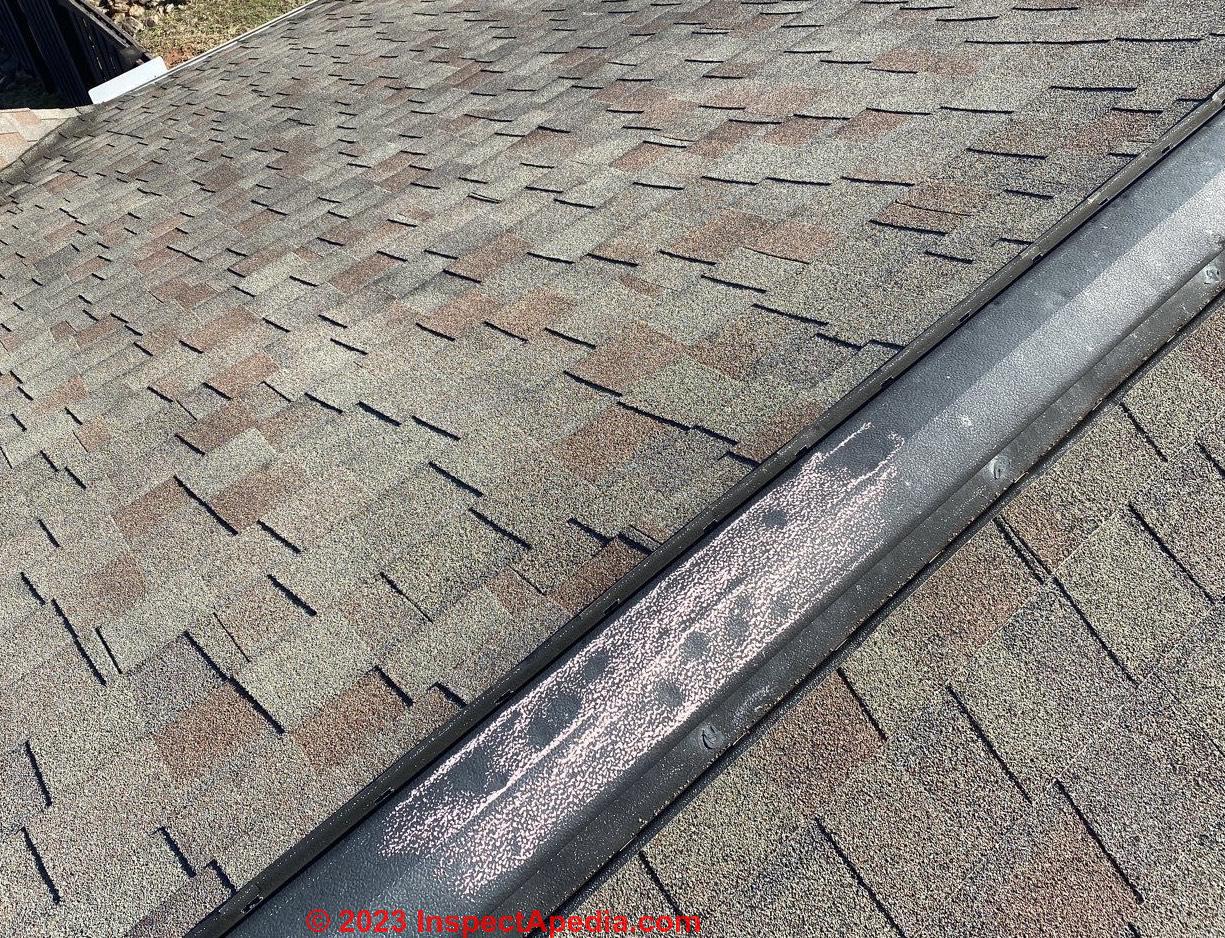
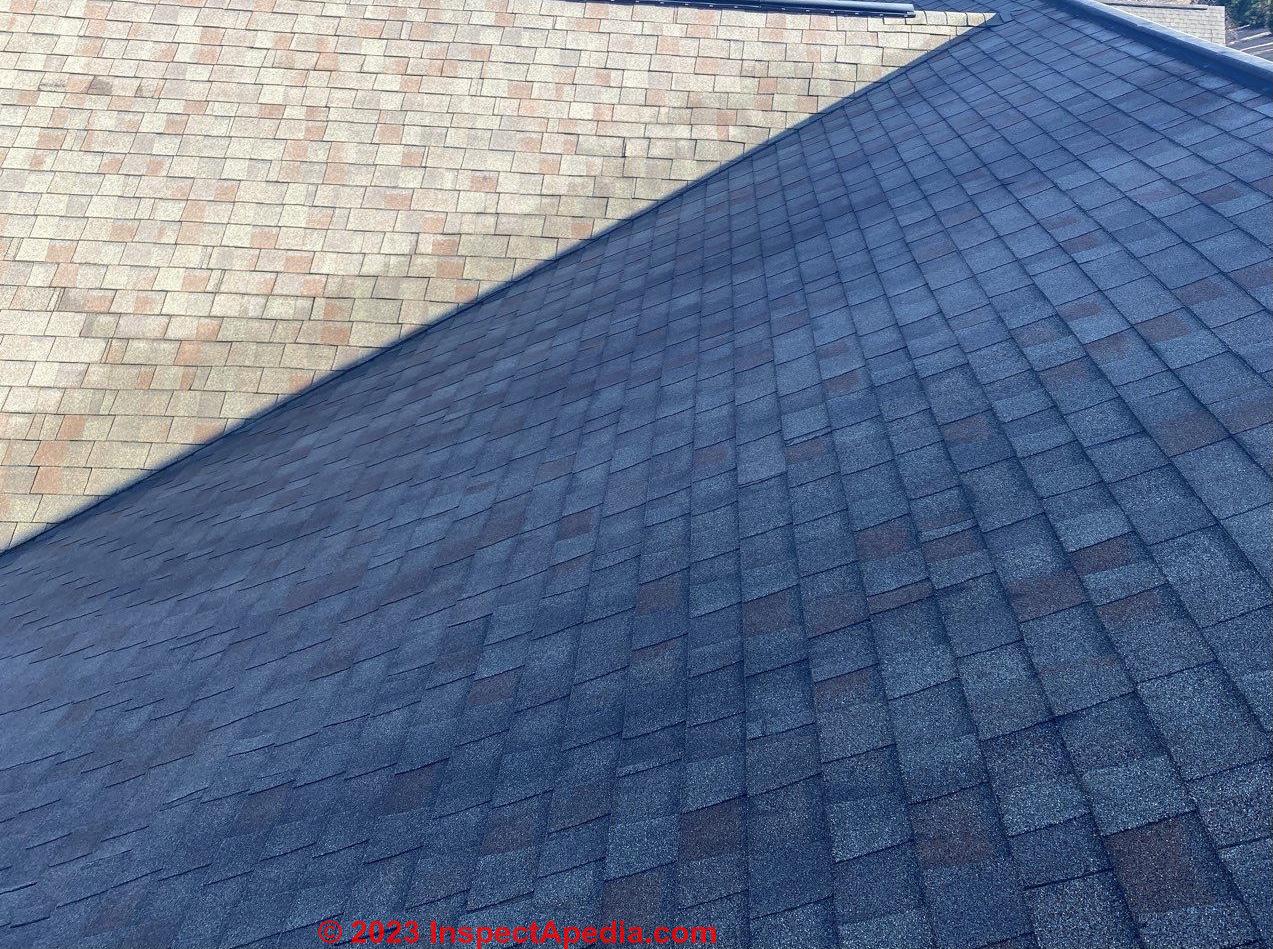
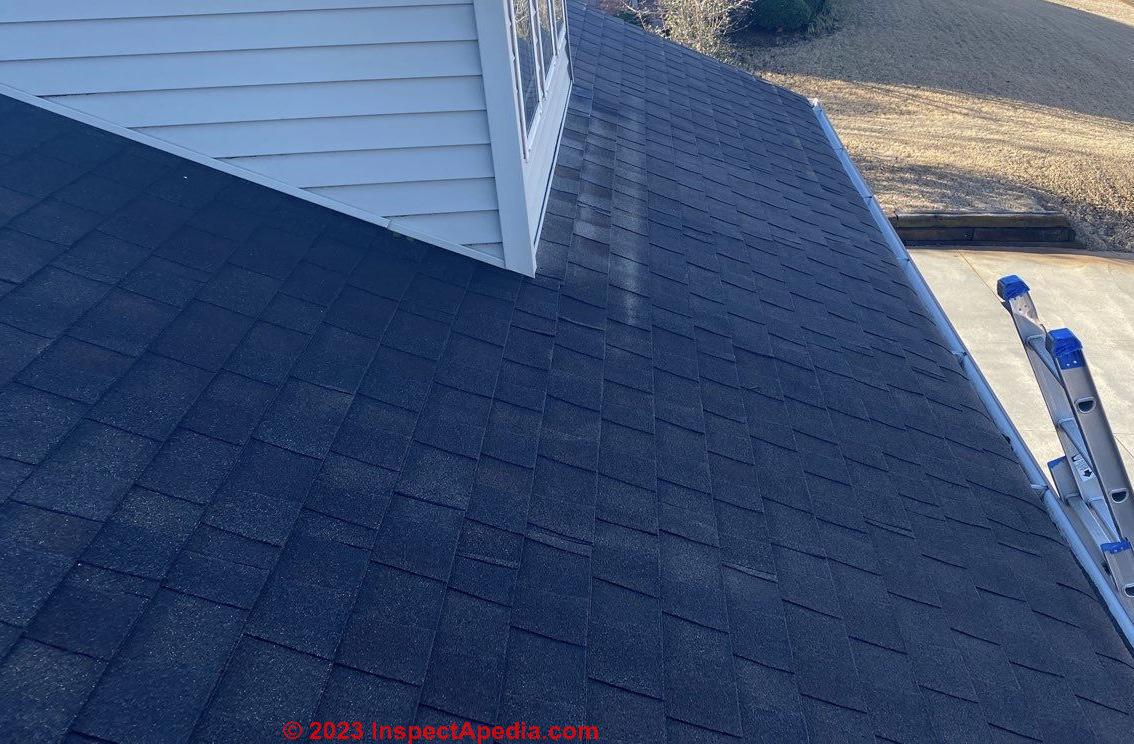
@InspectApedia Publisher, Sorry it’s taken so long to post pics of my 13 yr old roof, but thought I’d post them anyway. I tried to upload 5 photos but unsure if all of them posted. My insurance co determined there’s significant hail damage and approved a new, praise the Lord! Hope this was helpful, and have a blessed day!
 ...
... 
...
On 2023-01-14 by Mary
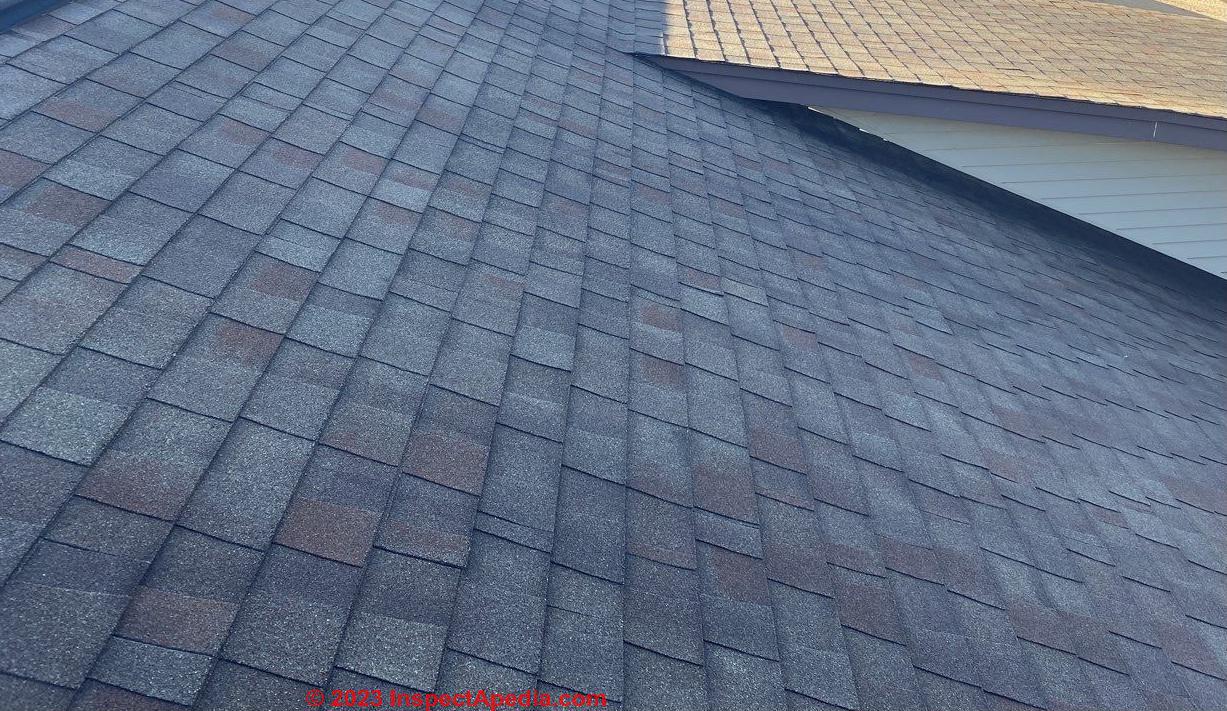 @InspectApedia Publisher, thanks for the info. I don’t have any leakage. What prompted me to get the inspection was due to the arctic blast that came through a few weeks ago causing some siding to pop out on a dormer so I thought the whole roof should be inspected too since the winds were very high & gusty.
Many of my neighbors have had their roofs replaced in the past 2 yrs so thought that might be an indication mine might need replacement too.
I’m waiting on the roofer to send the roof pics so after I get them I’ll upload one and the report from the reinspection, hopefully next week. Thanks!
On 2023-01-13 by InspectApedia Publisher (mod) - Is it unusual for a roof to wear unevenly for 6 yrs?
@Mary,
With the apology that we can't see your roof and an onsite expert will always see more than you and I can notice and discuss, I comment that
1. we do not normally have to caulk at a ridge vent. Properly selected and installed the plastic or metal components of the ridge vent itself should prevent un-wanted leaks. It's worth a very careful inspection on-roof and from the attic to be sure that we understand why you're seeing leaking.
Take a look at RIDGE VENT, ATTIC INSTALL & INSPECT
for some things you can see from the attic - without having to go on the roof itself.
2. Similarly, on a sloped roof plumbing vent flashing, properly installed, would not leak. The upper end and sides of the plumbing vent "boot" flashing to UNDER the roof shingles and the bottom edge goes ATOP them. So again we need a careful look at where and why you're seeing leaks.
Take a look at PLUMBING VENT FLASHING INSTALLATION
3. Mineral granule loss is normal over the life of a roof. If, however you're seeing bald spots where the shingle substrate is exposed to the weather, the roof is nearing end of life.
Please read GRANULE LOSS from SHINGLES (you are on that page)
After you've reviewed that material you will be in better shape to discuss your roof condition with your roofer, and we'll welcome your further comments, report, questions, and photos (one photo per comment and as many comments+photos as you like).
On 2023-01-13 by Mary
My 13 yr old roof was inspected today, and the findings were that the vent ridges need recaulking again, & around the outlet pipes, and the nails in front of a dormer. Also, some granules have worn off considerably in patches across the roof, but the other areas were ok.
When my roof was inspected in 2017 it was in great condition, but since then there’s been all kinds of bad weather. The roofer is unsure why it’s wearing out unevenly so he plans to reinspect it with someone else higher up in his company after it’s sunnier and dried out from the rain we just had yesterday.
I know at least the caulking needs redoing, but I think the granules wearing off is just the weather & normal aging because if the materials were defective the granules issue wouldn’t just start up in it’s 7th year.
What’s your opinion? Is it unusual for a roof to wear unevenly for 6 yrs starting at the 7th yr or is it the norm if the materials were defective? Thanks!
On 2022-02-23 by Inspectapedia Com Moderator - Can wind strip granules from a shingle during a hurricane?
@Tim,
In my OPINION wind alone would not be likely to remove the granules from asphalt shingles except for granules that are already loose on the shingle surface, such as when a roof is brand new.
But wind-driven rain, hail, or debris would certainly impact a roof surface and the damage might well include loss of mineral granules. A look on-the-roof at the pattern of granule loss may also be diagnostic.
On 2022-02-23 by Tim
Can wind strip granules from a shingle during a hurricane?
On 2021-08-10 by inspectapedia.com.moderator - roof debris is killing my plants
@J,
What is the roof covering material? (Asphalt shingles, tar and gravel, slate, tile, what?)
Please post a sharp photo showing me the roof above the area in your photo.
Also tell me the country and city of location and the age of the building and I'll be glad to comment further.
On 2021-08-09 by J
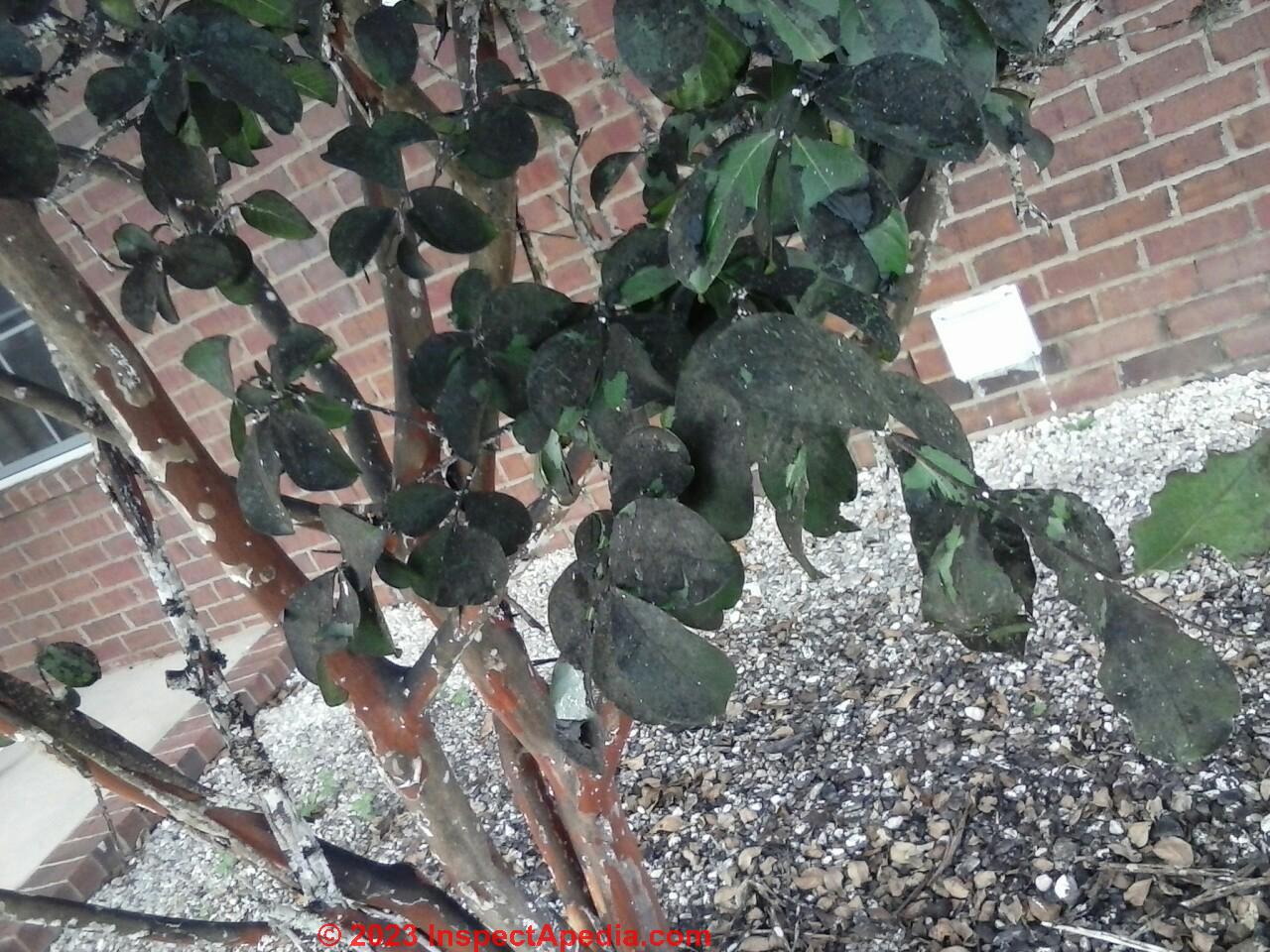
New roof as of 11/2020. Contractor since has gone to court, can't contact. Asphalt is still coming off the roof, was minor, but now the white rocks in flower bed are black, my crepe myrtle is covered with black gunk and dying, my azaleas are covered with it.
I don't know what to use to clean it off or is there anything I can do to keep my plants and tree from dying. Thank you for any help you can give me. I could only upload 1 photo.
On 2021-05-12 by danjoefriedman (mod) - granules have been completely removed in small spots on a newly installed roof
@Chris,
From text alone I don't think anyone can make a authoritative or reliable guess at your remaining roof life or the extent to which it has been damaged. I can say in general that the mineral granules are there to protect the shingle from sunlight, UV, and of course the weather.
Anywhere that the granules are lost the shingle can wear more rapidly and does its life could be reduced. Just how significant that is depends on the amount of shingle granule loss.
My opinion in general is that if the shingle is bear and you can see the substrate of fiberglass or asphalt impregnated paper than that shingle is damaged and its life remaining has been reduced.
On 2021-05-10 by Chris
I have a few areas on a newly installed roof (8 months ago) where granules have been completely removed in small spots (maybe 1/2 in by 1/2 in).
From what i can see It is not consistent throughout the roof and seems to be within the path that the installers traveled most frequently (due to the configuration of our roof there are not many spots that make it easy to get to the 2nd level) so i assume it is foot traffic damage.
The areas where damage is evident is generally along the bottom edge of the shingle and appears to expose asphalt but not shingle substrate. Since at this location there will be the head of the underlying shingle underneath is it safe to assume that this will not harm the lifespan of the roof significantly?
On 2020-12-15 by (mod) - extensive granule loss on 4 year old asphalt shingle roof
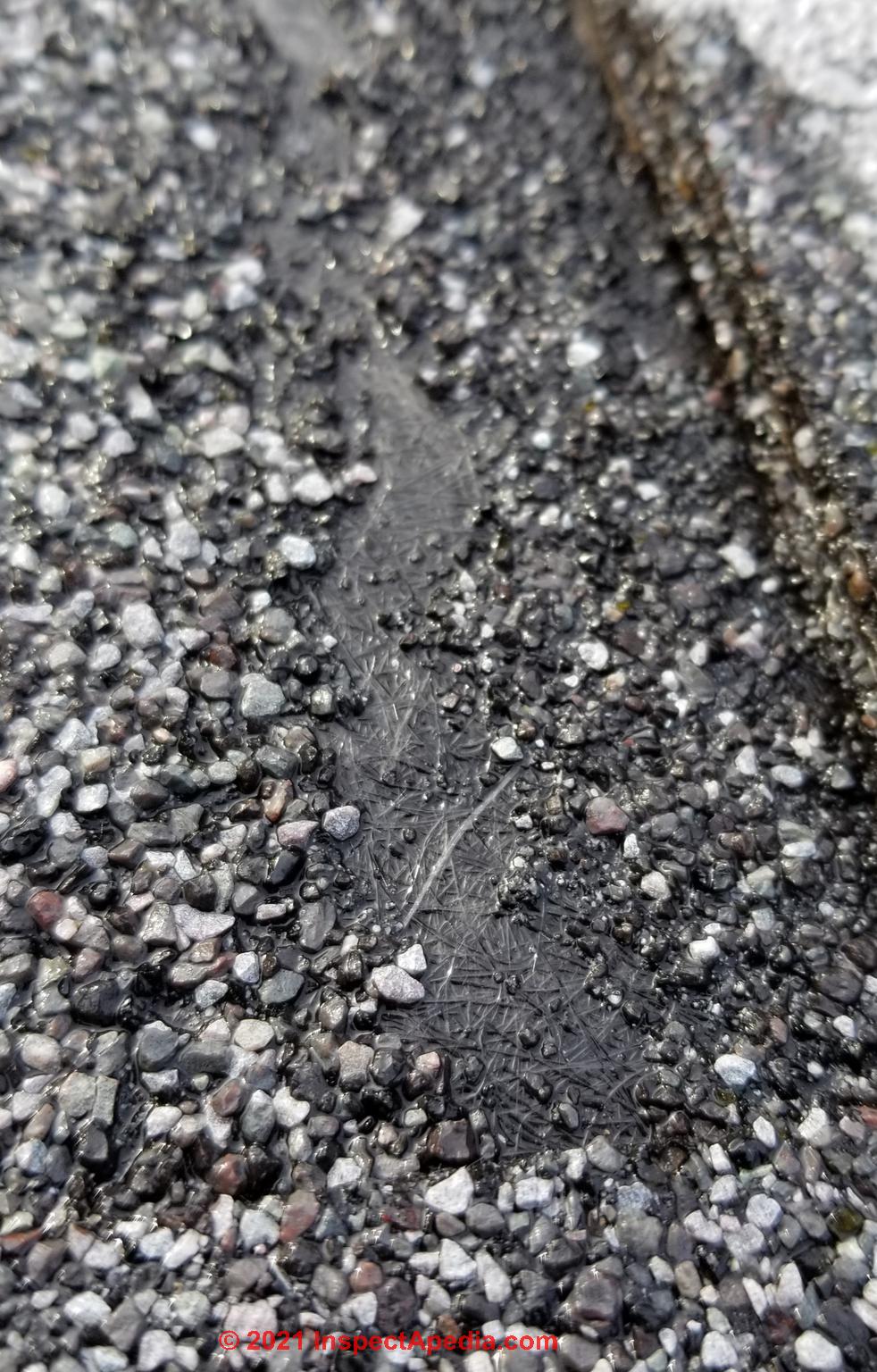 Well that's certainly disappointing, Greg.
It looks as if either many architectural shingle tabs blew off the roof or some dope pulled them off during installation, leaving many areas of the roof where the fiberglass substrate is installed.
IF those bald spots are high enough in the shingles that they are over roofing felt rather than over the head of an underlying shingle, THEN
In my OPINION, if this was a 20-year rated life roof, it's been reduced to 8-12 years as those damaged areas are throughout the field of the roof and are bare right down to the fiberglass.
On 2020-12-15 by Greg
Sorry, morning frost and minimal daylight has slowed me on getting pics of this. I took a couple one with some water removing the frost and another with the frost, seems to show the fiber lines well. The spot I put the ladder at had less damage than others but it's all the same type. Thanks again!
On 2020-12-12 - by (mod) -
That sounds (and from your photos looks) to me as if glued-on tabs were lost;
The result isn't an immediate catastrophe but it means a reduced roof life wherever we've exposed the shingle substrate.
I'd like to see some sharp close-up photos.
On 2020-12-11 by Greg
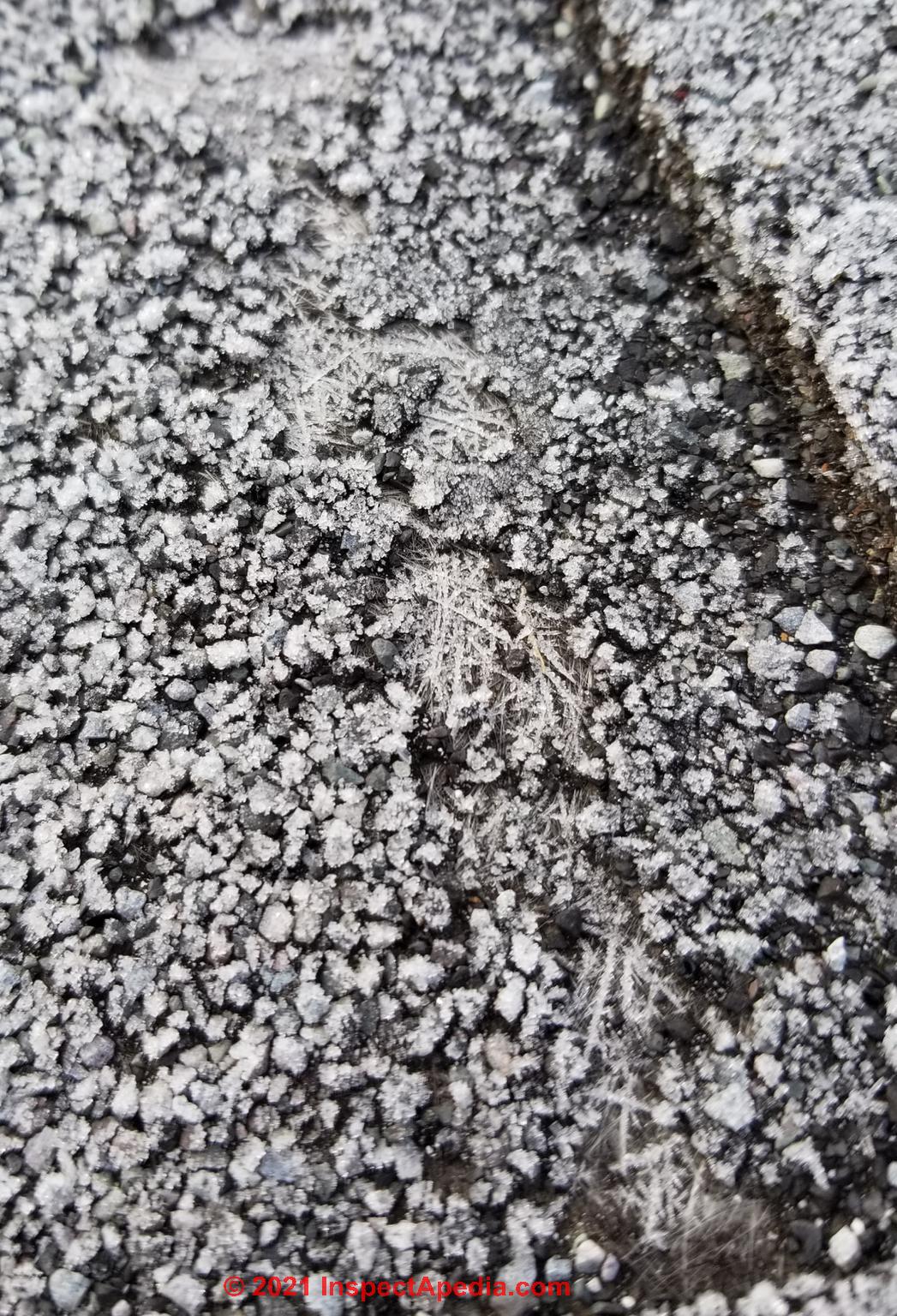 Thanks! I am talking about the lighter areas within the darker spots. Unfortunately it's raining pretty good for the rest of the day here so I can't take more pics yet. Apologies for not noticing the lack of detail in the pic I uploaded. I'll try a little more description in the meantime.
The lighter areas have a fibrous woven quality when you look at them. You can see individual fibers in those spots. To me it looks like a woven core layer within the shingle showing through. Reminds me of a worn down bike tire, but finer threads.
The lighter spots are across the entire roof, but are not in any consistent pattern. I hope that info helps. Thanks again!
On 2020-12-11 - by (mod) -
Greg
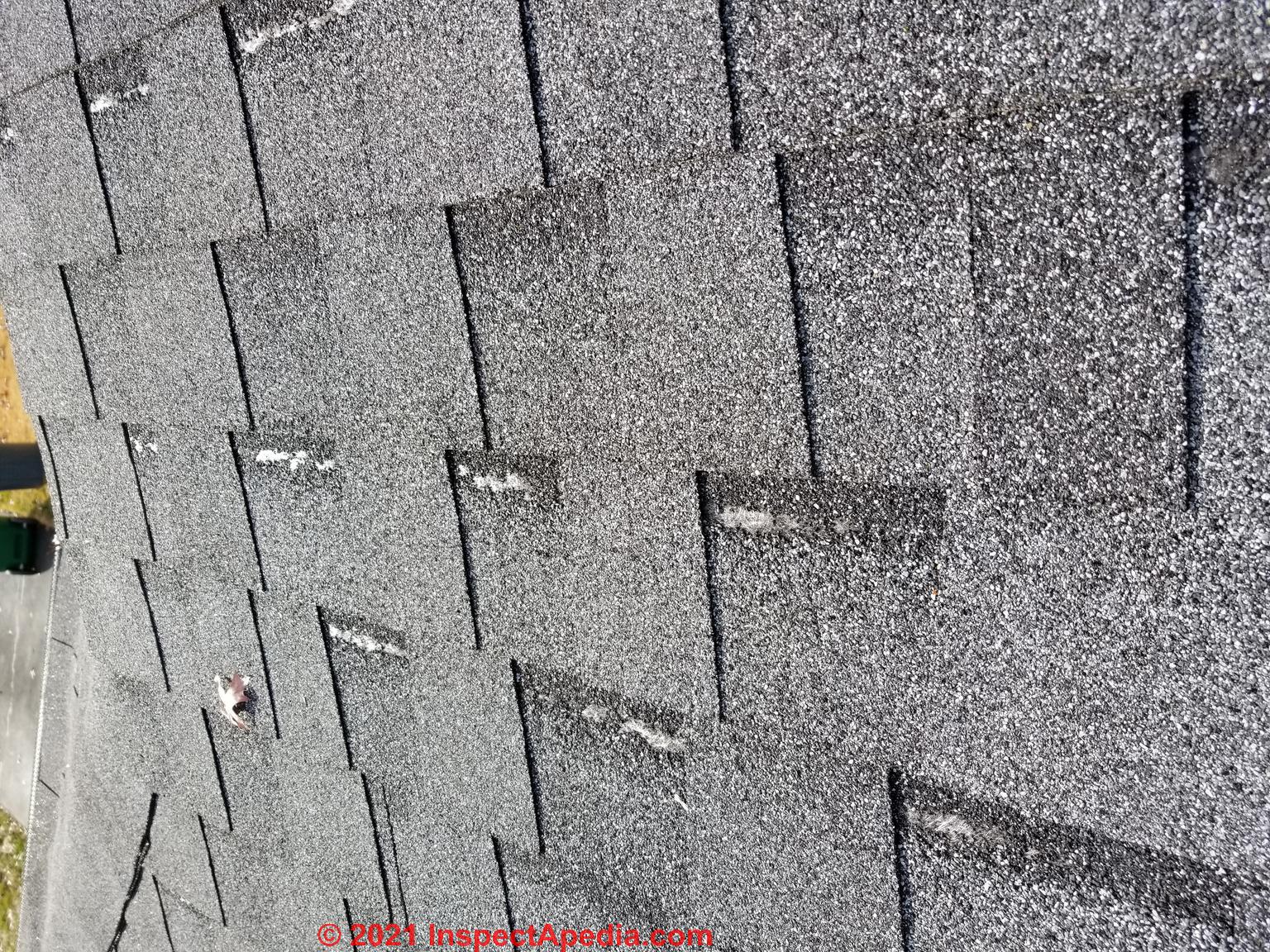
The dark areas may be perfectly normal and are a cosmetic detail intended to give "depth" to the appearance of the shingles.
But let's double check by looking a bit more-carefully at the roof:
If you are referring to those darker areas with a white line through them, compare those with the dark areas that do NOT have a light colored line through them.
If the areas where an adhesive is showing are what's represented by those "white" lines in your photo, then it's possible that a glued-on shingle tab has been lost.
Can we see a photo of a larger area of the roof?
On 2020-12-11 by Greg
My four year old roof has a lot of patches like this on it? Is it defective? Need to be replaced already? The roof was installed the year before I bought my home. These patches have been there as long as I can remember. Probably just getting a little worse. Thanks
On 2013-04-04 by Dana
We had our shingles replaced 2 years and I am still seeing black granules all over my patio, is this normal after such a long time?
On 2012-10-05 - by (mod) -
Richard,
I'm performing forensic work out of the U.S. until year end but would be glad to take a look at your photos pro-bono; For chemical or physical property testing of your faux-slate samples, while I'd like to examine them next year, that's not my lab's specialty - you'd be better contacting a lab with specific experience with the specific materials of your slates.
In any event, I'd want to know more about your concern, what you observed on site, and I will doubtless have questions after seeing what photos you've taken; In all events, do keep us posted on your findings.
On 2012-10-05 by Richard
I have both, photos and samples of both, new and failed faux slates.I expect to pay for this service.
On 2012-06-18 - by (mod) -
Glenn, your roof may actually have failed within its promised product life - depending on the particular material used on the roof. But foot traffic, improper installation, sun and heat are also factors in early wear-out. I'd need to see some photos (use the CONTACT US link) to say much more.
The nearby asphalt shingles are a different product, and almost certainly are installed on a steeper slope - which are two reasons they have a better life.
On 2012-06-15 by Glenn B
What would cause the complete failure of rolled roofing five years old. Ice and water Sheild underneath protected the house. The adjacent architectural shingles are pristine. I could send a picture if that would help but, there is no way to attach it here.
Thank you
On 2012-04-11 by Pam
The mineral granules have been falling off for over 6 months, including a very mild winter. Is this normal?
On 2012-03-11 - by (mod) -
Je vous remercie de vos gentils commentaires. Nous serons heureux de recevoir vos questions sur les articles que vous lisez à InspectAPedia et sera heureux de la recherche encore si dans l'avenir vous trouvez notre information imprécise ou incomplète.
On 2012-03-07 by Anonymous
Merci vos information me donne une clarification concernant l,usure prématuré de mon toit en bardeau d,asphalte
suzanne Richard
On 2019-01-19 by MikeB
Great article. Thanks.
On 2018-09-09 by (mod) -
That doesn't sound like it makes any sense at all to me. First of all shingles don't produce dust. Secondly that dust from the surface of a shingle would have a hard time passing through the roof sheathing and through the insulation and through the drywall to show up on the interior surface of a ceiling.
On 2018-09-04 by Tim
I have black stains on my ceiling—right at the apex of the roof—my roofer said it was shingle dust from a branch falling on my roof—is this possible??
On 2018-08-19 by Warren Robison
I just read on your web site that states that shingles have carcinogens in them which can cause respiratory illness if exposed to (not the granules themselves due to their weight, but-) their dust during deterioration of the granules from the shingles for whatever cause. I have been diagnosed many years ago with asthma and related issues.
Eighteen years ago, our heavy gauge metal roof was replaced with a combo shingle/rubber matting roof. We live in a highly rural area that has NO city/county water lines to supply the all the residents here.
All of us here have shallow drinking water wells, and rainwater cisterns for household use. We do put disinfectant in our cisterns as we have been directed by a county inspector when we first moved here. We relayed this information to the first company that replaced our roof due to damage beyond repair. We have relayed this same information to the current company that will be replacing our last roof because it just died!
My question is: Now that we see your info at this website, we have periodically cleaned out our gutters/cisterns like we are supposed to in order to keep any type of debris from going into them.
Can these carcinogens leach into the water in our cisterns which supply ALL household use including hand washing the dishes, showering & bathing, toilet flushing, doing laundry, and/or using the water for cleaning the house? We have actually lived here for 20 years and water conservation is a MUST!
Since the original metal roof was replaced with the above mentioned materials, is there a possibility that we have been exposed to possible carcinogens leaching into our water. There have been times when our shallow well was too low to use for drinking water and we have used the cistern water for drinking after using a purification process on it.
For the last 5-10 years my wife and I have been experiencing skin problems from head to toe. We haven't really been to a doctor for it - just been doctoring ourselves and figured it was due to aging because we are seniors now. Can you shed any helpful information about this? Is there anything we can do or is there some kind of a sealant that can be applied over the shingles to help deter deterioration of them?
On 2018-03-27 by Edna
Our roof was replaced om March 10, 2018. We bought the 30 years warranty shingles. Last week we had one day of rain and I noticed, a lot of shingles particles, on my driveway. Is it normal to happen after 10 days of installation?
On 2018-03-13 by (mod) -
RD
Yes,
We discuss a variety of roof coatings and sealants at
https://inspectapedia.com/roof/Roof_Sealant_Application.php
However you need to evaluate the condition of your roof before considering simply adding a coating. For example if the shingles are quite worn, curling, and fragile, it may not be economically sensible to spend on coating when it's a new roof that is needed.
On 2018-03-13 by R. D. Lyle
can I put a coating on roof to help stop loss of granuals
On 2015-11-14 by (mod) -
I estimate most shedding is over after a good hard rain , perhaps 2 more if the slope is low.
On 2015-11-13 by Mary Cawley
Just had a new roof put on and it has been shedding granules. How long will it continue to do so?
On 2015-09-08 by (mod) -
Some granule wash down is normal on new roofs but what you describe is not. More likely all of that gutter debris is from a prior roof tear off or wear and damage. Have the gutters cleaned out and check their slope.
On 2015-09-08 by Paul
We have a new asphalt roof. Notice the gutters were not drainging so I check gutters. I found 2 inches of roof granules, roofing nails and pieces of roof tiles in gutter. Is this normal?
On 2015-05-13 by (mod) -
Lynne,
If you see areas of shingle that are bald - i.e. you can see the black shingle substrate, then the shingles are defective or damaged and further evaluation is needfed.
If the shingle surfaces are intact it may be that the loose granules are simply slow to wash down your roof.
On 2015-05-11 by lynne
We had a new roof put on 3 years ago. I understand that granules come off in the first, but why are they still coming off. Is the produce defective. They did not do a good job on it in the first place, but charged top dollar.
On 2015-04-21 by (mod) -
Liz
I can't predict what will happen on your specific roof as I know nothing about it.
Usually the loose granules on the surface of a roof wash down into the gutter in the first year after installation. Power washing the roof is a bad idea, risking loosening more granules and shortening roof life. And of course if the shingles are themselves defective they could continue to shed granules.
Take a close look at the shingle surfaces for tiny bald spots, craters, pits, blisters. Use our email found at our page bottom CONTACT link to send me some sharp photos along with the brand and model of shingle, roof pitch, where the home is located, and we can comment further.
On 2015-04-20 by Liz
Help! I bought my house a year ago. Rather large home. Brand new Asphalt roof was put on about 1 1/2 years ago. Inspector said was all good.
But the constant granules everywhere are driving me crazy! My gutters need an overhaul admittedly which is a project I am working on so in the meantime, in many areas, rain water flows down where it pleases off the roof and the black granules seem to be never-ending and get into everything (including the pool).
I had power washers come to do the house and asked them to lightly dowse the roof as well hoping to get and loose granules off once and for all (would've thought the heavy FL rains we have would've accomplished this naturally for me but obviously not). While the guy was up there, he stomped his foot slightly and said "listen to this" and sounded like an avalanche.
To date, the shingles do not seem to be showing any wear and tear. So....Can you tell me when I can expect the new roof granules to give up the landslide??
On 2014-11-08 by (mod) -
William
it sounds as if an insurance company roof inspector thinks your roof is in such poor condition that costly leaks are imminent. It's less costly to replace the roof before serious leak damage than later. If you think the roof has good remaining life, get a roofing expert to give you an opinion, in writing, that you can share with your insurance company.
On 2014-11-05 by william sellers
what to do when my home insurance is canceled because granular loss that shows up more because it,s white it does not leak, should i just replace it ,its on the north side , it had miner leak which i fixed by raising tabs and taring with white product and it shows between the tabs i did not know this stuff would affect my insurance at the time,.
On 2014-10-23 by Nickolas
can I reduce granule loss from asphalt signles by applying things like Davlin butylseal 572 ?
Thanks
On 2016-09-08 by (mod) - shingle warranty news for Home Inspectors
Thanks for the important roof shingle warranty question, Spencer. Now it's time for a dose of painful reality. What follows is my OPINION.
Roof shingle warranties vary, and you don't mention the brand and model of your roof shingles so we don't know what your warranty promised. Usually shingle warranties, even "lifetime" ones, are actually quite limited.
IF the manufacturer agrees at all that the product is defective, you'd expect recover a portion of the shingle material cost, pro-rated based on the percent of roof life promised vs. delivered.When the roof has lost granules such that its remaining life is likely to be reduced and when we are now at 1/2 of the roof's rated life, but the roof is not yet leaking, the manufacturer is going to argue that the roof has not yet "failed" - it's not leaking.
So they are re-adjusting the 50% of shingle material cost to a smaller sum which is the manufacturer's own opinion of the amount of reduction from the 25-year life that has been caused by the roof's deterioration. They may not enjoy explaining that to you but that's probably the rationale behind the pathetic warranty offering.
The manufacturer will also adjust the warranty coverage for a roof based on their own observation of installation defects including virtually anything that did not completely follow the manufacturer's installation instructions regarding product selection, underlayment, nailing schedule, condition of the roof deck, flashing details, roof ventilation details and perhaps other conditions (such as mechanical damage from ice dams).
The cost of a roof leak in damaged building insulation, wiring, finish materials, drywall, and potentially mold clean-up can also be a significant cost that won't be covered by roof warranty even if the roof is actually leaking.
The labor to install roof shingles is normally a much greater cost than the materials, a third fact that makes roof shingle warranties of only very limited value.
What we learn from this is that product warranties are more of a marketing feature than something intended to actually protect the consumer. Roof shingle warranties may tell us something about the comparable expected life of different roof products but they're not particularly valuable as insurance against early roof leaks.
See WARRANTIES for ROOF SHINGLES for a series of articles about roof warranties and collecting on them.
In corresponding with readers about this topic for decades now I've seen that just what the roof manufacturer or roof installer offer in settlement varies considerably depending in part on how much trouble the consumer is making and how persistent is the consumer in pressing a claim as well as on the difference between large commercial jobs and residential roof jobs.
Asphalt shingle test labs offer product testing services that can explain why a shingle product is failing or appears defective, such as loss of volatiles, over-heating during manufacture, or other manufacturing or service life defects.
You could try asking one of these labs to test representative samples of your roof; you'd need to photo-document the whole roof, document the product, its installation details, and other information, then cut samples, patch the cut area, and send your samples to a test lab.
I would of course be interested in what the lab tells you - we'd all benefit from that if your case were adequately documented. But I warn that YOU are not an important customer to the roof shingle test lab. The roofing manufacturers may use independent asphalt shingle test labs to monitor and assess their own manufacturing process.
They, the manufacturers, are far more important customers to the lab than you. Therefore you might find some reluctance on the part of test labs to help you prepare material that will in turn be used to annoy their main client.
We discuss asphalt shingle test lab services at ROOFING MATERIALS TEST LABS https://inspectapedia.com/roof/Roof_Shingle_Test_Labs.php
So that other readers of interest or expertise can comment, I'll post your question and this reply over at
https://inspectapedia.com/roof/Roof_Warranties.php
Do keep me posted, and do use the page top or bottom CONTACT link to send me sharp photos of the whole roof, varying conditions by roof slope, and close-ups of granule loss on shingle surfaces as well as of the lost -granules that you probably see in your gutters or on the ground.
Daniel
On 2016-09-08 by Spencer Rafferty
I have a roof of 12yrs with 25yr shingles on it, I noticed significant granule loss on 90% of whole roof on the single layer part of arc. shingles. I contacted manufacturer and they only offered 384.00, then I contacted local representative and he's only offering about 1,700.
Now I am a Home Inspector and know from experience this is a manufacturers defect because its on 90% of roof and certain parts of each shingle. Problem is I feel they should honor their warranty of full replacement, so how do I go about getting independent testing of shingles to determine if it was manufacturers defect to go after company ?? Any help would be appreciated !!
Question: what about the effects of roof color?
Feb 22, 2016)selesao5000 said:
thanx, but very little about roof shingle colors, check here [Advertising link deleted]
Reply:
Thank you Selesa. We provide considerable information on roof color options, best roof colors for various climates, etc.
See ROOF COLOR RECOMMENDATIONS at inspectapedia.com/Energy/Roof_Color_Recommended.php
Question: roofer says 9 year old roof needs to be replaced
(Aug 23, 2016) juneballard123abc@aol.com said:
I have a 30 year roof that is 8 or 9 years old. I had a roofing company look at the roof, and they stated we needed a roof. (90 percent of my neighbors have gotten a new roof, due to a major hail storm). My insurance company sent an independent company to look at the roof, and stated we did not need a roof.
However, we are seeing lots of granule loss running from the gutters when it rains. How much of the life of the shingles is lost when the granules come off during a storm? I would assume that a 30 year roof would be in adequate condition, if it did not have a major hail storm effect it.
Thank you,
juneballard123abc@aol.com
Reply:
June:
In GENERAL a 30-year rated asphalt shingle roof that's less than 10 years old ought to be less than half way through its anticipated life; A specific roof might be in worse shape due to a variety of factors: installation, foot traffic, mechanical damage, inadequate ventilation, or as you pose, storm damage.
Search InspectApedia.com for HAIL DAMAGED SHINGLES to get details about how to recognize that situation; do keep me posted; use the page bottom CONTACT link to send long photos of your roof condition if you like.
Details about this issue are in GRANULE LOSS from SHINGLES
...
Continue reading at HAIL DAMAGED SHINGLES & OTHER ROOF COVERINGS or select a topic from the closely-related articles below, or see the complete ARTICLE INDEX.
Or see these
Recommended Articles
- ASPHALT SHINGLE FAILURE TYPES
- ASPHALT SHINGLE LIFE / WEAR FACTORS
- ASPHALT ROOF SHINGLES - topic home, for all articles about asphalt roof shingles
- HAIL DAMAGED SHINGLES & OTHER ROOF COVERINGS
- ROOFING MATERIALS TEST LABS
- SHINGLE HAIL DAMAGE vs SHINGLE BLISTER RASH
- WARRANTIES for ROOF SHINGLES
Suggested citation for this web page
GRANULE LOSS from SHINGLES at InspectApedia.com - online encyclopedia of building & environmental inspection, testing, diagnosis, repair, & problem prevention advice.
Or see this
INDEX to RELATED ARTICLES: ARTICLE INDEX to BUILDING ROOFING
Or use the SEARCH BOX found below to Ask a Question or Search InspectApedia
Ask a Question or Search InspectApedia
Try the search box just below, or if you prefer, post a question or comment in the Comments box below and we will respond promptly.
Search the InspectApedia website
Note: appearance of your Comment below may be delayed: if your comment contains an image, photograph, web link, or text that looks to the software as if it might be a web link, your posting will appear after it has been approved by a moderator. Apologies for the delay.
Only one image can be added per comment but you can post as many comments, and therefore images, as you like.
You will not receive a notification when a response to your question has been posted.
Please bookmark this page to make it easy for you to check back for our response.
Our Comment Box is provided by Countable Web Productions countable.ca
Citations & References
In addition to any citations in the article above, a full list is available on request.
- In addition to citations & references found in this article, see the research citations given at the end of the related articles found at our suggested
CONTINUE READING or RECOMMENDED ARTICLES. - Arlene Puentes [Website: www.octoberhome.com ] , a licensed home inspector, educator, and building failures researcher in Kingston, NY
- Steve Mauer is an ASHI certified home inspector in Doylestown, PA. Mr. Mauer can be reached by email to steve@maurerinspections.com or by telephone at 287-884-4047.
- Our recommended books about building & mechanical systems design, inspection, problem diagnosis, and repair, and about indoor environment and IAQ testing, diagnosis, and cleanup are at the InspectAPedia Bookstore. Also see our Book Reviews - InspectAPedia.
- Asphalt Roofing Residential Manual from ARMA the Asphalt Roofing Manufacturers Association Website https://www.asphaltroofing.org/product/residential-asphalt-roofing-manual/ ,
- Building Pathology, Deterioration, Diagnostics, and Intervention, Samuel Y. Harris, P.E., AIA, Esq., ISBN 0-471-33172-4, John Wiley & Sons, 2001 [General building science-DF] ISBN-10: 0471331724 ISBN-13: 978-0471331728
- Building Pathology: Principles and Practice, David Watt, Wiley-Blackwell; 2 edition (March 7, 2008) ISBN-10: 1405161035 ISBN-13: 978-1405161039
- Problems in Roofing Design, B. Harrison McCampbell, Butterworth Heineman, 1991 ISBN 0-7506-9162-X (available used)
- Roofing The Right Way, Steven Bolt, McGraw-Hill Professional; 3rd Ed (1996), ISBN-10: 0070066507, ISBN-13: 978-0070066502
- Smart Guide: Roofing: Step-by-Step Projects, Creative Homeowner (Ed), 2004, ISBN-10: 1580111491, ISBN-13: 978-1580111492
- In addition to citations & references found in this article, see the research citations given at the end of the related articles found at our suggested
CONTINUE READING or RECOMMENDED ARTICLES.
- Carson, Dunlop & Associates Ltd., 120 Carlton Street Suite 407, Toronto ON M5A 4K2. Tel: (416) 964-9415 1-800-268-7070 Email: info@carsondunlop.com. Alan Carson is a past president of ASHI, the American Society of Home Inspectors.
Thanks to Alan Carson and Bob Dunlop, for permission for InspectAPedia to use text excerpts from The HOME REFERENCE BOOK - the Encyclopedia of Homes and to use illustrations from The ILLUSTRATED HOME .
Carson Dunlop Associates provides extensive home inspection education and report writing material. In gratitude we provide links to tsome Carson Dunlop Associates products and services.
 | HOME | ABOUT | ASK a QUESTION | CONTACT | CONTENT USE POLICY | DESCRIPTION | POLICIES | PRIVACY | |
| © 2024 - 1985 Publisher InspectApedia.com - Daniel Friedman | |||||||||