
InspectAPedia® FREE Encyclopedia of Building & Environmental Construction, Diagnosis, Maintenance & Repair |
Question? Just ask us! InspectAPedia
|
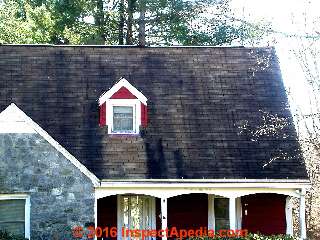 Catalog of Black Stains on Building Roof Surfaces
- POST a QUESTION or COMMENT about the various causes of black staining on roof shingles, slates, roof tiles, etc.
Black stains on roofs: here is our catalog listing the types of black stains that are found on roofs, using asphalt shingle roofs as the prime example. This article series tells readers how to identify & explain the most-common causes of black, brown, red, gray, green, or white stains appearing on roof shingles and on other building surfaces.
Roof shingle stains are often caused by black algae, bleed-through or extractive bleeding of asphalt, dirt, soot, or organic debris.
InspectAPedia tolerates no conflicts of interest. We have no relationship with advertisers, products, or services discussed at this website.
Catalog of Causes of Black Stains on Roofs

Aesthetic or Cosmetic Roofing Issues - Black Stains on Asphalt Shingles
Some consumers have concerns with how their shingles look on the roof as much as with how long the roof will last. Roofing manufacturers offer a wide variety of products which give different "looks" and shadings.
It's possible that in addition to site and installation conditions, variations in manufacturing process (granule adhesion, bleed-through) can affect how the roof looks from the ground.
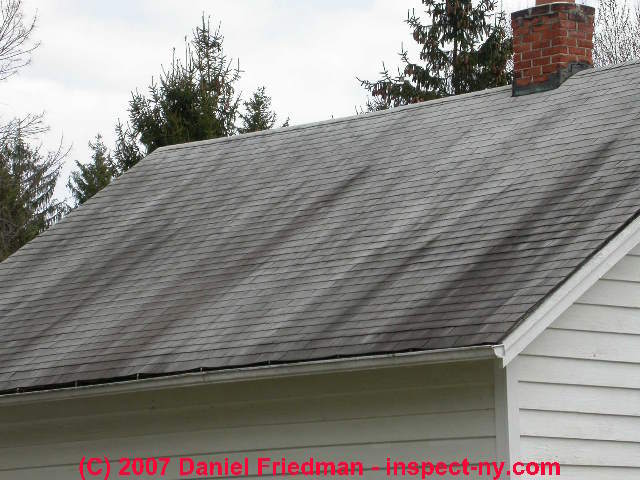
We've also investigated client concerns with shadows appearing in early morning or late afternoon which show variations in the roof surface.
Some shadows which are only of cosmetic nature may be caused by slight buckling or unevenness in the roof decking and may not indicate a structural or durability concern.
If you have particular concerns about roof appearance ask your roofer if s/he can direct you to a house where the product which interests you is already installed.
Remember that site differences (orientation to sun, shade trees, height above ground, roof pitch, and probably other factors) may make shingles look a bit different on your house.
Bleed-Through Shingle Stains
Black Bleed-Through or Extractive Bleeding Black Stains on Asphalt Shingles
Extractive bleeding - bleed-through asphalt shingle stains may be mistaken for but are not black algae or black "fungus", nor are they soot. Extractive bleeding stains on asphalt shingles are caused by loss of black pigment in the asphalt mix intended to impregnate the shingle mat itself.
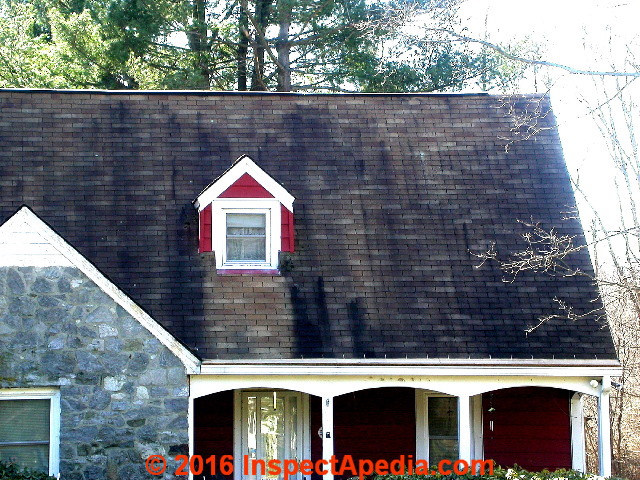
Extractive bleeding or "bleed through" stains leaving black streaks running down an asphalt shingle roof is an indication of a defective roofing product.
Typically bleed-through on asphalt shingles appears as black streaks running down shingles.
You'll see black streaks of varying length and width (photo at left).
Really? Some experts claim that extractive bleeding of roof shingles is a fantasy - that it never occurs, and that all black roof stains are due to algae growth or other causes. Having found some expert citations describing extractive bleeding of asphalt roof shingles as a product defect, while we agree that it's not common, we don't agree that it's a fantasly.
See EXTRACTIVE BLEEDING on SHINGLES for our full discussion of extractive bleeding stains on asphalt shingles.
Black Algae Roof Staining
Black Algae Stains on Asphalt Shingles, Roll Roofing & Many Other Kinds of Roof Surfaces
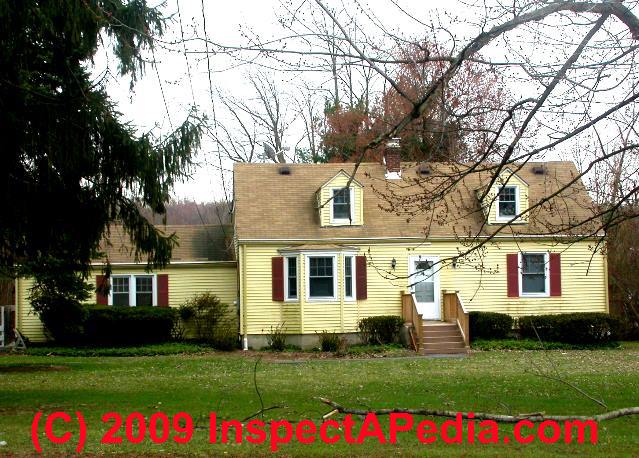
Black algae stains on roofs is in many areas the most common explanation for black blotches, streaks, or discoloration on asphalt roofing products as well as on some other roofing materials.
Misnamed as "mildew" or "fungus" by some writers, algae staining on asphalt shingles usually in shaded areas or on the more-shaded roof slopes (photo at left) characterized by black staining fairly uniform over shingles, but appearing specifically in areas of the roof shaded by nearby trees.
See BLACK or GREEN ALGAE on ROOFS for our full discussion of this topic.
The black stains on the roof at above left are probably an algal growth.
Debris-Staining on Roofs
Black Debris Can Cause Stains on Asphalt Shingle Roofs & Other Roof Materials Too
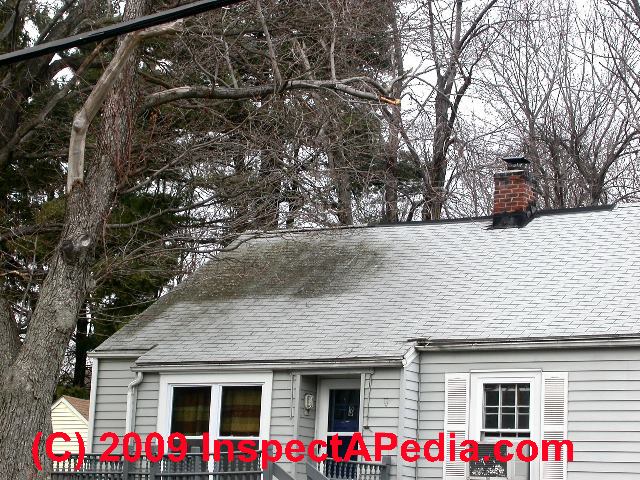
Debris staining on roofs produces fairly uniform black or brown staining in areas where due to low-slope or presence of overhanging trees, organic debris collects on the roof slope.
Decaying debris may encourage fungal or algal growth (cited above). Debris staining often incorporates fungal or algal growth in the shaded, longer-wet areas of a roof as well as staining caused by the actual roof debris itself.
Please see DEBRIS STAINING for our full article on this topic.
Soot Staining on Roofs
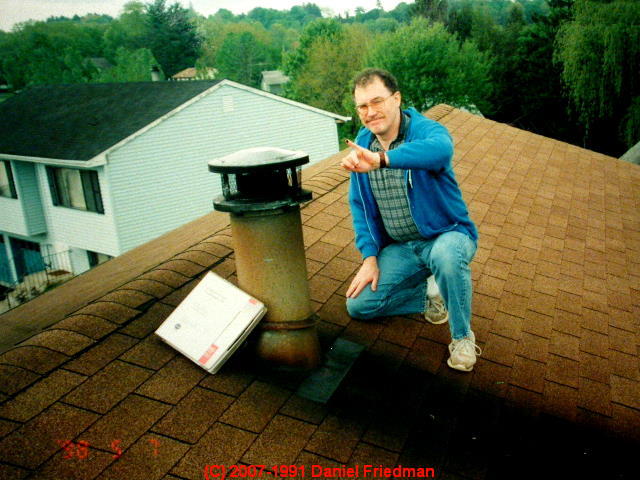
Black Soot Stains on Roof Surfaces Around & Below Chimneys
Soot from fireplace flues washing down onto the roof - characterized by staining appearing below and in line with the chimney, as Roger Hankey is demonstrating above.
See CHMNEY-CAUSED ROOF STAINS for the full article on this topic as well as some important fire and flue gas safety warnings.
The photograph of a soot-stained roof top was provided courtesy of Roger Hankey a Minnesota home inspector. Thanks again Roger.
...
Continue reading at BLACK or GREEN ALGAE STAINS on ROOFS or select a topic from the closely-related articles below, or see the complete ARTICLE INDEX.
Or see these
Roof Stain Diagnosis, Repair, Prevention Articles
- STAIN DIAGNOSIS on ROOFS - home
- ALGAE, FUNGUS, LICHENS, MOSS on ROOFS
- BLACK ROOF STAIN CAUSES
- BLACK or GREEN ALGAE STAINS on ROOFS
- BLACK or GREEN ALGAE STAIN REMOVE / PREVENT
- CHIMNEYS, STAINS on / near
- DEBRIS STAINS on ROOFS
- EXTRACTIVE BLEEDING on SHINGLES
- LICHENS on ROOFS
- MOSS on ROOFS
- POWER WASHING ROOFS
- RUST STAINS on ROOFS
- SOOT STAINS on ROOFS
- TARRY BLEED on ROOFS
- TOBACCO JUICING SHINGLE STAINS
- WHITE STAINS on ROOFS
- TEST LABS - ROOF SHINGLE
Suggested citation for this web page
BLACK ROOF STAIN CAUSES at InspectApedia.com - online encyclopedia of building & environmental inspection, testing, diagnosis, repair, & problem prevention advice.
Or see this
INDEX to RELATED ARTICLES: ARTICLE INDEX to BUILDING ROOFING
Or use the SEARCH BOX found below to Ask a Question or Search InspectApedia
Ask a Question or Search InspectApedia
Try the search box just below, or if you prefer, post a question or comment in the Comments box below and we will respond promptly.
Search the InspectApedia website
Note: appearance of your Comment below may be delayed: if your comment contains an image, photograph, web link, or text that looks to the software as if it might be a web link, your posting will appear after it has been approved by a moderator. Apologies for the delay.
Only one image can be added per comment but you can post as many comments, and therefore images, as you like.
You will not receive a notification when a response to your question has been posted.
Please bookmark this page to make it easy for you to check back for our response.
Our Comment Box is provided by Countable Web Productions countable.ca
Citations & References
In addition to any citations in the article above, a full list is available on request.
- Roger Hankey is principal of Hankey and Brown Inspections, Winter Park, CO. Mr. Hankey is a past chairman of the ASHI Standards Committee and served in other ASHI chapter and national leadership roles. Mr. Hankey is a National Radon Proficiency Program certified measurement professional and a Level II infrared thermographer. Contact Roger Hankey at: 970-393-6604 - rogerhankey47@gmail.com . Website: www.HankeyandBrown.com Mr. Hankey is a frequent contributor to InspectAPedia.com.
- Our recommended books about building & mechanical systems design, inspection, problem diagnosis, and repair, and about indoor environment and IAQ testing, diagnosis, and cleanup are at the InspectAPedia Bookstore. Also see our Book Reviews - InspectAPedia.
- Building Pathology, Deterioration, Diagnostics, and Intervention, Samuel Y. Harris, P.E., AIA, Esq., ISBN 0-471-33172-4, John Wiley & Sons, 2001 [General building science-DF] ISBN-10: 0471331724 ISBN-13: 978-0471331728
- Building Pathology: Principles and Practice, David Watt, Wiley-Blackwell; 2 edition (March 7, 2008) ISBN-10: 1405161035 ISBN-13: 978-1405161039
- In addition to citations & references found in this article, see the research citations given at the end of the related articles found at our suggested
CONTINUE READING or RECOMMENDED ARTICLES.
- Carson, Dunlop & Associates Ltd., 120 Carlton Street Suite 407, Toronto ON M5A 4K2. Tel: (416) 964-9415 1-800-268-7070 Email: info@carsondunlop.com. Alan Carson is a past president of ASHI, the American Society of Home Inspectors.
Thanks to Alan Carson and Bob Dunlop, for permission for InspectAPedia to use text excerpts from The HOME REFERENCE BOOK - the Encyclopedia of Homes and to use illustrations from The ILLUSTRATED HOME .
Carson Dunlop Associates provides extensive home inspection education and report writing material. In gratitude we provide links to tsome Carson Dunlop Associates products and services.
 | HOME | ABOUT | ASK a QUESTION | CONTACT | CONTENT USE POLICY | DESCRIPTION | POLICIES | PRIVACY | |
| © 2024 - 1985 Publisher InspectApedia.com - Daniel Friedman | |||||||||