
InspectAPedia® FREE Encyclopedia of Building & Environmental Construction, Diagnosis, Maintenance & Repair |
Question? Just ask us! InspectAPedia
|
 Oil Tank Test Methods
How Oil Tanks are Tested for Evidence Leaks, of Current or Previous Oil Spills
- POST a QUESTION or COMMENT about choosing among oil tank leak testing methods
Guide to types of oil storage tank leak tests available:
This article discusses the types of oil storage tank tests that may be performed on buried oil tanks and above ground oil storage tanks to check for leaks or imminent leaks. Not all storage tank tests are equal in accuracy nor cost, and some are more appropriate than others, depending on other factors.
InspectAPedia tolerates no conflicts of interest. We have no relationship with advertisers, products, or services discussed at this website.
Guide to Oil Storage Tank Testing: Oil Tank Inspection and Oil Leak Testing Choices
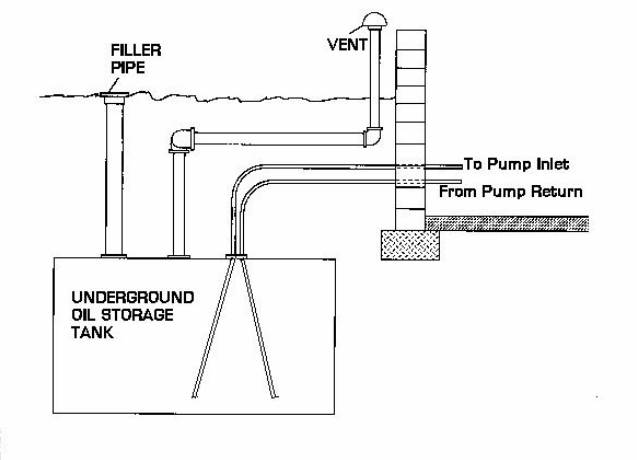 Oil tank leak testing guide: this document describes the common methods used to test oil storage tanks for evidence of
leakage, either by soil testing, pressure testing of the tank, or by other tank screening measurements.
Oil tank leak testing guide: this document describes the common methods used to test oil storage tanks for evidence of
leakage, either by soil testing, pressure testing of the tank, or by other tank screening measurements.
[Click to enlarge any image]
We discuss the following topics here:
What are the pros and cons of alterative methods of testing for oil tank leaks? Oil tank testing method choices: pressure testing, oil tank sonogram testing, oil tank leak soil tests.
Soil testing for oil tank leaks & Oil tank pressure testing for oil tank leaks, Oil tank fill pressures - to what pressure is an oil tank subjected during an oil delivery?
Simple tests for water in oil tanks, & Electronic oil tank leak scanning & ground scanning radar for hidden oil tank location.
Article Contents
Other steps to locate and test heating oil storage tanks at properties, both buried tanks and above ground tanks are discussed at other documents at this website.
Leaking oil tanks are not only a concern as contaminants of the water supply, but have become an increasing general environmental concern addressed by the DEC. Leaking commercial oil storage equipment and even simply-suspect oil storage equipment have been extremely costly to address.
 Such
burdens were never anticipated when the equipment was installed. While similar
regulations pertaining to residential installations are scarce, this topic is
of growing concern to home owners and home
buyers.
Such
burdens were never anticipated when the equipment was installed. While similar
regulations pertaining to residential installations are scarce, this topic is
of growing concern to home owners and home
buyers.
Look for yourself: Before deciding to hire a tank testing company for professional inspection and testing, some basic information such as the age (property and tank), tank location, and type of oil tank, and for above-ground tanks, a simple visual inspection of the tank and its piping, can give you and idea of the risks involved.
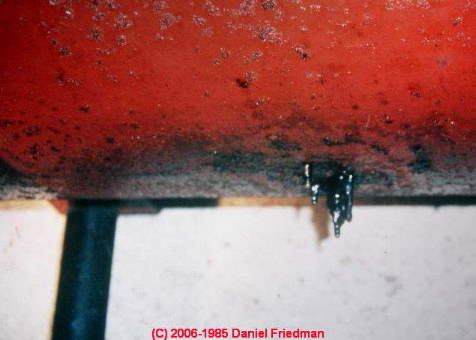
Look for obvious leaks such as oil stains on the ground or floor under or around the tank and around the oil fired equipment. Remember to look under the oil tank at its bottom, as most leaks occur in the lower portion of the tank.
The leaky oil storage tank shown at left is discussed
at OIL TANK LEAK or FAILURE MECHANISMS where we explain the various causes of leaks in oil tanks.
Hire an expert: Specialty companies and some oil companies have equipment to test buried tanks for leaks. Soil testing, simple low-psi pressure-testing and sophisticated electronic testing are commonly used.
I advise home buyers to have a soil test performed rather than a pressure
test of an existing oil tank, since even if the tank is not currently leaking we would prefer an assurance
that it didn't leak before, say from a plumbing connection that was repaired.
advise home buyers to have a soil test performed rather than a pressure
test of an existing oil tank, since even if the tank is not currently leaking we would prefer an assurance
that it didn't leak before, say from a plumbing connection that was repaired.
Separately
we include a listing of oil and fuel storage tank testing companies and services, and invite (no-fee) listings from other companies providing that service.
Many storage tank testing companies also offer storage tank removal and site cleanup services as well.
From a previous use, a buried oil tank may be present or may have been present at a property now served by an indoor, above ground oil tank or even by LP or natural gas.
So don't assume that because you don't see a tank that none was ever used or present at a property.
How Oil Tanks are Tested for Evidence of Leakage
Testing for water in an oil tank (above ground or buried) is simple and can be done by any service person. Tank testing methods for oil leaks or for the risk of oil leakage vary in risk to the tank, cost, invasiveness, length of time to complete, and more.
 In addition to oil tank inspection, oil piping inspection, and oil tank testing to "pass" or "fail" an
oil storage tank, more sophisticated tests are available to assess the chances that an existing
heating oil storage tank has leaked or is likely to have a serious leak soon.
In addition to oil tank inspection, oil piping inspection, and oil tank testing to "pass" or "fail" an
oil storage tank, more sophisticated tests are available to assess the chances that an existing
heating oil storage tank has leaked or is likely to have a serious leak soon.
These include a oil tank corrosion analysis which adds to the basic tank inspection and tests an assessment of the level of corrosion of the tank walls and thus the chances of its leaking or failure, and soil corrosion or soil corrosivity evaluation which includes an evaluation of soil samples collected from around the tank in order to assess the degree to which the soil in which the oil tank has been buried will contribute to the process of corrosion of the (presumably steel) buried oil tank.
Specialists and some oil companies have equipment to test buried tanks for leaks. Both simple pressure-testing and sophisticated electronic testing are used, mostly on commercial equipment, and more recently on residential tanks.
Testing for water in the tank is simple and can be done by any service person
using a simple chemical paste on a probe. A lot of water in the tank is a reason
to be pessimistic about its condition.
There are a number of tank testing methods currently in use, varying in risk to
the tank, cost, invasiveness, length of time to complete, and some, requiring
shutting down of the heating system during test period. See "How do you
choose the right tank testing method?" Cynthia Johnson, Fuel Oil & Oil
Heat Magazine, November 1995.
- Low-psi oil tank pressure-testing for leaks is used to test a tank for existing leaks. To conduct an oil tank pressure test, the oil tank and its piping system are sealed off (and taken out of use), pressurized to a low value, typically just a few psi, and monitored over 24 hours for a pressure drop.
An advantage of this simple test is that it can detect leaks not just in the oil storage tank but also in piping systems connected to the tank - an important feature for buried oil tanks whose underground fill and vent pipes or supply pipes are not visible. For a discussion of the normal operating pressures to which an oil storage tank is subjected
see OIL TANK PRESSURE . - Soil testing for oil tank leaks looks for evidence of actual oil contamination in the soil. A proper soil test is based on having located the buried tank or the site where a tank was buried, and taking borings to a depth approximately just below the tank bottom.
- Electronic testing of oil tanks to check for leak scan also screen tanks for evidence of damage - usually this was used only on commercial jobs. Also
see Mesa 2-D TEST for OIL TANK LEAKS. - Oil tank ultrasound oil tank leak risk screening program (photo above) is offered by some oil companies who scan the bottom section of above ground oil tanks to measure the thickness of the tank steel. Tanks that pass an ultrasound screening test may be insured against future leakage.
We discuss ultrasound screening of oil tanks
at ULTRASOUND TEST for AST OIL TANKS - Water testing in oil tanks can indicate the risk of in-tank corrosion and thus leakage - an easy first-pass which
can be used at both above ground tanks and buried oil tanks.
See WATER in OIL TANKS, TEST FOR. - Ground scanning radar or magnetic sensing is also used to locate buried steel tanks.
Mesa 2-D Digital Non Volumetric Oil Tank Tightness Test for Oil Tank Leak Risk
This test for oil tank tightness developed by Mesa Engineering, uses a digital probe and using ultrasound, examines frequency changes to detect a leak in the oil tank or its piping.
The Mesa 2-D Digital test includes a "U-L" frequency leak test that detects leaks in the oil tank or its piping. The Mesa 2-D test also detects vapor bubbling ("P-L" frequency leak) indicating that the oil storage tank or its piping contains a leak in the oil piping or oil filler piping portion of the system.
This is a low "negative pressure" or vacuum test using a vacuum of 60 inches of water or –2.16 psig. The manufacturer requires that test operators be certified at least every two years.
According to the developer, Mesa Engineering, a U-L frequency leak typically occurs in the oil vent pipe or fill pipe, and can often be repaired, while a P-L frequency leak usually indicates a critical system failure that means the tank will probably be taken out of service and abandoned.
Watch out: In reader correspondence we have a report of an owner's concern about an apparent "coincidence" that within two weeks following a Mesa 2-D oil tank test a catastrophic oil tank leak was found and a costly cleanup followed. Not only is the Mesa 2-D oil tank test considered "safe" (it does not expose the oil tank to high pressure or high vacuum), but a review of the Mesa 2-D tank test report for this case disclosed that the test itself detected a tank failure.
Our OPINION was that provided the test was conducted properly, the most likely explanation of the apparent coincidence was that the test had correctly detected an oil tank leak that was not previously recognized, and that had existed for a considerable time.
Mesa 2-D Oil Tank Test Report Example #1 - see this example of a Mesa 2-D oil tank leak test that found significant evidence of an oil tank leak. The owners reported that within two weeks a major oil leak was confirmed and a cost underground oil tank replacement and oil spill cleanup was required.
The company who conducted this test, ATS Environmental Services Co., includes in their Mesa 2-D test description
MESA 2-D test results are 100% digital & computer analyzed which eliminates the chances of human error affecting test results. Many other tank test systems are analog and not computer controlled. These inferior test methods rely heavily on the testing technician listening for leaks or bubbles in the tank bottom.
The MESA 2-D uses computer and digital acoustic profiling technology to evaluate the integrity of underground tank systems. The MESA 2-D test system will not damage the tank or heating system. This is not an air pressure test! MESA 2-D test system can test tanks with any level of fuel including tank that are empty.
Mesa Oil Tank Test Report Example #2 - this example of a MESA oil tank test also found that the tank was leaking. As we pointed out to the reader who contributed this oil tank test report, the test found a tank leak, called for appropriate repair action, and did not (indeed could not) indicate the extent of soil contamination that may be present.
Interpreting a MESA 2-D oil tank test report
In the example MESA 2-D oil tank leak test Mesa Oil Tank Test Report Example #2 the test company recommended that possibly leaking oil piping be inspected and repaired if found faulty (though it appears that the technician didn't think that was the problem. The company continues to indicate that if piping repairs do not stop the leak, the tank will need to be abandoned according to proper procedures.
OPINION-DF: even if the oil piping is repaired and the repairperson believes that a leak was fixed, there is a potential for significant increases in the later cost to abandon the oil tank if in fact it continues to leak, and because there can be multiple leak defects in any tank and piping system (so that fixing one may not fix them all). For that reason, a follow-up test might be appropriate.
Mesa 2-D Method with ACT v1 Water Level Sensor - test description and specifications from Mesa Engineering - web search 6/22/2010. Mesa Engineering, 5801 Dierker, Houston TX 77041 713-895-7000, [company website link in this literature is not functional]
Oil Tank Pressure Testing Advice: using pressure to test an oil tank for leaks
 Using this tank testing method the oil tank is sealed and pressurized to a low psi level, then
carefully monitored for a pressure drop, perhaps for 24 hours. This method is comparatively
quick to execute but I don't care for it.
Using this tank testing method the oil tank is sealed and pressurized to a low psi level, then
carefully monitored for a pressure drop, perhaps for 24 hours. This method is comparatively
quick to execute but I don't care for it.
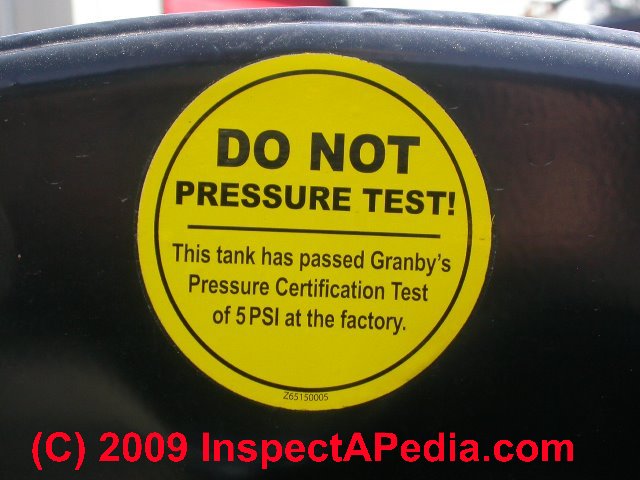
Notice (in our photo at left) that some oil tank manufacturers do not want their oil tanks pressure-tested after the tank has been installed.
Details are at OIL TANK PRESSURE.
- First, if there is a pressure drop, additional testing
will be required to determine if there has been actual oil seepage into the soil. (A leak could have been
a minor one at the tank top, for example.)
The additional testing is pretty-much the same as my second method described below, so the consumer ends up paying for testing twice in this case. - Second, even if there is not a pressure drop, I'm not sure that there hasn't been a tank leak in the past, perhaps fixed by a plumbing repair or other method.
Some home owners balk at this test, fearing that the pressure of the test procedure will "burst" an oil tank that is about to fail. I am doubtful that this is a legitimate concern. The pressure at which the tank is being tested is almost certainly a much lower psi than the pressure to which the tank is subjected while it is being filled by the oil delivery truck and driver.
Soil Tests for Oil Tank Leaks: Soil tests for evidence of tank leakage
We prefer this method for testing for evidence of leaks at buried oil tanks if there is a question of whether or not an oil tank has already leaked. The cost for soil testing is about the same as the first method where buried tanks are installed.
Multiple soil borings are collected around the tank, at a depth just past the level of the tank bottom. The soil samples are tested for petroleum product contamination.
This is considered the definitive test for oil tank leakage, and if the tank has not leaked, it provides more reliable documentation of that fact. More time is needed to complete the test as there is a delay for the lab work.
Consider that if you opted for the tank pressure test described earlier, and if the test showed that the tank has leaked oil into its surrounding soil, some additional testing is going to be needed to confirm the extent of soil contamination. It seems to me it's better to test the soil in the first place, thus also covering not only current but past conditions.
Finally, if we are told that an oil tank has been "remove" or "abandoned" at a property, we expect to be given the documentation that outlines who did what when, and importantly, what steps were taken to assure that there was no oil leak that was simply left for the next owner to discover and clean-up.
If adequate documentation is not provided, a soil test is certainly appropriate. One of my clients took this advice and discovered, and avoided having to pay for, a $60,000. site cleanup at the property he was buying.
Water Test for Oil Tank Leak Risk - Test oil tanks for presence of water
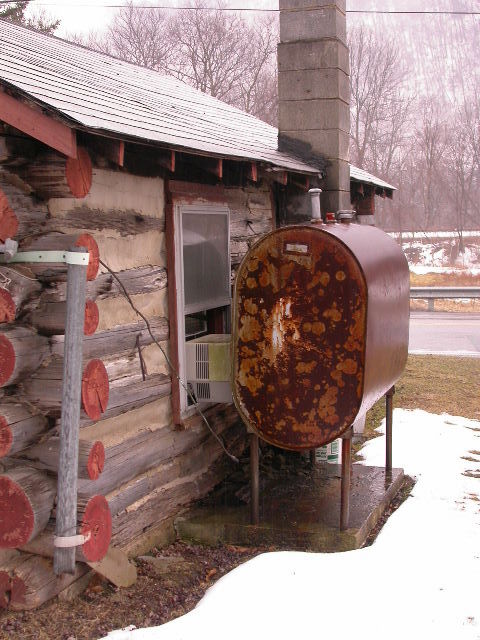 See OIL TANK WATER CONTAMINATION for detailed advice on how to remove water from oil storage tanks. Excerpts are below.
Buried tanks, such as heating oil tanks, should be tested for amount of water present in tank bottom, and water should be pumped out. Even above-ground tanks can take on large amounts of water from roof spillage, condensation, or a bad oil delivery. (Photo at left).
In fact, water can accumulate in indoor or outdoor above ground oil storage tanks too, either from exposure to varying temperatures (in-tank condensation) or from the occasional delivery of bad oil which contains excessive water content.
A neat way to look for a history of water in the heating oil storage tank is to check the oil filter canister itself. Many oil burners are protected by a heating oil filter installed either at the tank or at the oil burner. (Every heating boiler burning oil should have one of these filters installed to protect the equipment.)
If the oil tank has a high level of water, especially if the oil lines run to the oil burner from the bottom of the oil tank, some of that water will have been making its way to the oil burner where, en route, it is (usually) trapped in the oil filter. If you open an oil filter container and see that its metal parts are rusted, or that there is a lot of rusty sludge in the bottom of the filter holding canister, the oil tank needs to be checked further for water
The oil service technician can check the level of water in an oil tank by putting some "oil finder paste" on the bottom of a stick or probe which is inserted into the tank and to its bottom. The paste changes color in the presence of water, showing, by the length of color change on the probe, the depth of water in the bottom of the tank. Obviously this trick is much easier if the tank is outside than indoors where a basement ceiling can make probing the oil tank difficult.
Ask your oil service company to perform this test.
Alternatively, if an underground oil storage tank also needs an oil tank tightness test or oil tank leak test,
the Mesa 2-D TEST for OIL TANK LEAKS can also detect water leakage into the tank.
While we've found them lasting longer, a common life expectancy of buried oil tanks is 10-15 years. We do not have the same data for gas tanks. Life may be similar.
If the tank is to remain in use, ask your fuel supplier about using an additive or other methods to help remove water. Warning: on some older oil tanks which had a lot of sludge in the tank, as the de-watering additive (such as "4-in-1-HOT (TM)") was added to the tank we found an increase in the debris making its way to the heating oil filter.
You should inspect the filter cartridge for water and debris and have it changed more frequently until this question is closed. It's more trouble but the end result is a more reliable oil storage tank and heating system.
See OIL TANK WATER CONTAMINATION for detailed advice on how to remove water from oil storage tanks.
Ultrasound Oil Tank Tests of above ground tanks for leak risk
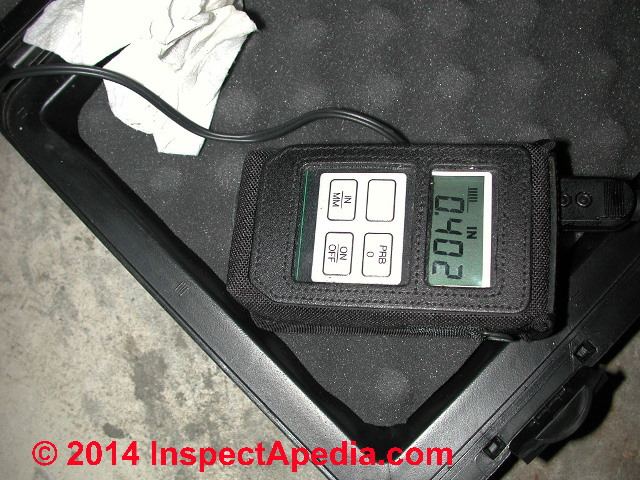
Oil tank ultrasound screening program (photo above) is offered by some oil companies who scan the bottom section of above ground oil tanks to measure the thickness of the tank steel. Tanks that pass an ultrasound screening test may be insured against future leakage.
The oil company technician uses an ultrasound scanner to make twelve thickness measurements on the lower portion of the oil tank and records the thickness at each location.
How does Ultrasonic Testing (UT) work on metal tanks or pipes?
The test instrument includes an unltrasonic wave generator and a test sensor or probe. The sensor probe is touched to the metal surface of the oil tank or metal pipe. The wave generator sends a UHF (Ultra High Frequency) sound wave into the exterior of the metal surface.
A reflecting sound wave echoes back from the interior surface of the metal. The UT instrument measures the time between the impulse and the echo, divides that time by the known speed of sound through that type of metal surface (e.g. oil tank steel), and with that calculation can produce a measurement of the thickness of the metal that is said to be as accurate as a dial-gauge caliper.
For readers who might be concerned, it should be noted that ultra-sound testing is entirely safe: there are no emission hazards, no radiation, nor other worries with this method. However to obtain accurate results when measuring oil tank or pipe wall thickness using UT, the task must be performed using a proper test instrument employed by a technician who is herself/himself trained in both use of the instrument and in the metal systems and components being tested.
For example, testing an oil tank metal thickness at the top of the oil tank would have little to do with assessing the risk that the oil tank is corroded or at risk of leaking because that corrosion normally occurs on the bottom or near the bottom of the tank (at the oil-water interface line) - as explained in this article series.
Oil Tank Thickness Readings using UT
Typical oil tank thickness readings on an older above-ground indoor oil tank may range from 0.105 to 0.185 inches in thickness.
If all 12 sample point thicknesses exceed 0.100" the oil tank "passes" and the dealer offers $1000. insurance for a year as part of the fee. Our photo (above) shows an oil tank sonogram in process for the author, conducted by Nash Brothers Oil Company, Hyde Park, NY
Watch out: observing some above ground oil tank tests using the ultrasound screening program makes us nervous.
It is inconvenient for the technician to both observe the instrument readings and then climb out of the position shown in our photo (above) to write down the data.
 As a result we have seen tank test technicians "memorize" ten or 20 readings and then write them down by recollection of the "ballpark" figures.
This is reasonable in that the technician is really just looking for any readings that cross the threshold of unacceptable tank steel thickness.
But it remains inaccurate and risks oil tank test data errors or skewing by operator error.
Further, if the test finds steel thickness readings close to the threshold of acceptability, we recommend that additional "spot checks" be taken of the tank's thickness in that area, rather than simply screening the tank bottom at larger spatial intervals.
See OIL TANK TREATMENTS, ADDITIVES for an oil treatment manufacturer's cautions about spot tests of oil tank thickness.
See WATER in OIL TANKS for added suggestions for finding and removing water from oil storage tanks.
What is the Most Reliable Approach to Evaluating an Oil Storage Tank for Risk of Near Term Leaks & Spills?
Watch out: critics argue that spot testing the oil tank bottom and lower sides for thin metal will not detect find all possible oil tank problems and may itself miss an existing pinhole oil leak. While I agree with that caveat there is more to be said.
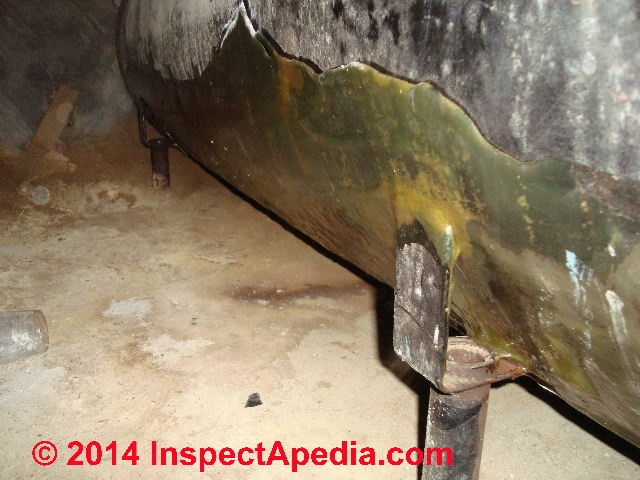 Our tank photo at left shows an oil storage tank whose bottom area has been coated with an epoxy sealant in an attempt to cope with leaks. We already know the condition of this tank, without testing. It leaks.
- Tests alone are never complete:
Any oil tank evaluation method that relies only on a test, that is with the omission of informed visual inspection of the site, piping, equipment, and site and equipment history, is by definition of limited scope and in my view incomplete.
And as experts such as the New York DEC point out,
no oil tank test can predict what will happen next year, next month, or even the next day. - Tests of oil tank metal condition and thickness are useful
A test that measures the thickness of the oil tank steel remaining is a useful indicator of the extent of corrosion going on inside the oil tank.
What we gain by testing the thickness of an oil storage tank where there is no visible leakage is an idea of the remaining metal material, its strength and thus the risk of an upcoming oil leak or spill. - Oil Storage Tank Corrosion Zone or Band:
Oil tank corrosion occurs at the oil-water interface line inside the oil storage tank.
The area described by this high-risk zone is hardly a pinpoint. It extends along the entire tank wall, all around the sides and ends of the oil tank, in a band of varying width and height depending on the history of level of water in the tank.
Just as in bird watching we find the birds by looking at areas where they are expected to be found, in my opinion, tests such as an ultrasonic thickness test of the tank wall ought to test the tank areas most likely to be corroded: not just the tank bottom, but the tank's lower sides.
And such a test would be ridiculous if the test technician did not also look at the tank by eye for obvious, existing evidence of leaks, seepage, or pinholes. - Using visual inspection plus technical tests
is the more reliable approach to spotting an oil tank at higher risk of a leak or spill than either approach alone.
Indeed when a corrosion-caused tank leak in an oil or water tank finally begins to actually leak, excepting the exciting cases of someone punching a hole in a tank, the leak usually begins as a pinhole, seepage, and small oil release. How rapidly that leak grows to a catastrophe depends on the nature and extent of the corrosion or other cause of tank deterioration or damage.
Oil Tank Testing Standards
U.S. & Canadian Standards groups and authorities pertaining to oil or other fuel storage tanks and tank testing include
- ASTM
- ASTM #-1739 - 95 (2002) Standard Guide for Risk-Based Corrective Action Applied at Petroleum Release Sites, quoting from ASTM:
1.1 This is a guide to risk-based corrective action (RBCA), which is a consistent decision-making process for the assessment and response to a petroleum release, based on the protection of human health and the environment. Sites with petroleum release vary greatly in terms of complexity, physical and chemical characteristics, and in the risk that they may pose to human health and the environment.
The RBCA process recognizes this diversity, and uses a tiered approach where corrective action activities are tailored to site-specific conditions and risks. While the RBCA process is not limited to a particular class of compounds, this guide emphasizes the application of RBCA to petroleum product releases through the use of the examples.
Ecological risk assessment, as discussed in this guide, is a qualitative evaluation of the actual or potential impacts to environmental (nonhuman) receptors. There may be circumstances under which a more detailed ecological risk assessment is necessary (see Ref (1).1.2 The decision process described in this guide integrates risk and exposure assessment practices, as suggested by the United States Environmental Protection Agency (USEPA), with site assessment activities and remedial measure selection to ensure that the chosen action is protective of human health and the environment.
The following general sequence of events is prescribed in RBCA, once the process is triggered by the suspicion or confirmation of petroleum release: ...- ASTM - www.astm.org
- ASTM #-1739 - 95 (2002) Standard Guide for Risk-Based Corrective Action Applied at Petroleum Release Sites, quoting from ASTM:
- CSA Standards - Canada
- NFPA
- NFPA 30: Flammable and Combustible Liquids COde (2008)
- NFPA 31: Standard for the Installation of Oil-Burning Equipment (2006)
- NFPA 54: National Fuel Gas Code (2009)
- NFPA 58: Liquefied Petroleum Gas Code (2008)
- NFPA 101: Life Safety Code (2009)
- NFPA 225: Model Manufactured Home Installation Standard
- NFPA 329: Handling Underground Releases of Flammable and Combustible Liquid
- UL & UL-Canada
- Aboveground Tanks, ULC-S601, -S630, ULC/ORD-C142.18, ULC-S653
- Protective Coating for Underground Steel Tanks, ULC-S616, CAN/ULC-S603.1
- Storage Cabinets for Flammable Liquid Containers, ULC/ORD-C1275
- Bulk Containers, Nonmetallic, for Combustible and Non-combustible Liquids {containers-Tanks}, ULC/ORD-C142.14
- Tanks for Used Oil, ULC-S652
- Tanks for Heating and / or Generator Fuels, Aboveground, CAN/ULC-S602
- Underground Tanks, ULC-S615, 603, CAN/ULC-S603.1
- Anode Assemblies, Underground Tank Protection, ULC-S618
- Shop Fabricated Steel Aboveground Tanks For Flammable and Combustible Liquids, CAN/ULC-S601
- Aboveground Steel Tanks for Fuel Oil and Lubricating Oil, CAN/ULC-S602
- Underground Tanks, ULC-S615, Steel Underground Tanks for Flammable and Combustible Liquids, ULC-S615
- External corrosion Protection Systems for Steel Underground Tanks for Flammable and Combustible Liquids, CAN/ULC-S603.1
- Aboveground Steel contained Tank Assemblies for Flammable and Combustible Liquids, CAN/ULC-S653
- Tank Assemblies for the Collection, Storage and Removal of Used Oil, CAN/ULC-S652
- Hose and Hose assemblies for Flammable and Combustible Liquids, CAN/ULC-S612
- Hose Nozzle Valves for Flammable and Combustible Liquids, CAN/ULC-S620
- Non-metallic Underground Piping for Flammable and Combustible Liquids, CAN/ULC-S660
- Double Containment Fibre Reinforced Plastic Linings for Flammable and Combustible Liquid Storage Tanks, ULC/ORD-C58.4
- US EPA
- STANDARD TEST PROCEDURES FOR EVALUATING LEAK DETECTION METHODS: NONVOLUMETRIC TANK TIGHTNESS TESTING METHODS [PDF], U.S. EPA, March 1990 - this document addresses the ability of various storage tank testing methods to meet the U.S. EPA's Performance Standards - i.e. how to test the oil storage tank test methods. [Blank pages deleted from this PDF]
- GUIDE to EPA MATERIALS on UNDERGROUND STORAGE TANKS [PDF] U.S. EPA helps sort through the plethora of documents on oil storage tanks and tank testing, tank abandonment, tank use, etc.
Home buyers should be sure to also review
- OIL TANK LEGAL ISSUES - home Buyers and Home Owners Guide to Leaky Heating Oil Tanks - What to Do About & When to Report Oil Tank Leaks.
Home owners who have old oil tanks above ground or any age oil tank below ground should also be sure to review
- OIL TANK ABANDONING PROCEDURE - Abandoning Commercial vs. Residential Underground Oil Storage Tanks (UST) - Procedures & Regulations
- Regulations governing tank leak reporting and tank abandonment as well as the registration
of oil tanks at properties is
at OIL TANK LEAK & ABANDONMENT REGULATIONS
Oil Tank Leak Research
- See additional page bottom CITATIONS
- Heck, Dian H., A CASE STUDY OF A LARGE SCALE PRECISION [OIL OR FUEL] TANK TESTING PROGRAM [PDF] Diane H. Heck, Tetra Tech Richardson, Newark, Delaware, web search 4/27/12, original source: info.ngwa.org/GWOL/pdf/870143411
- Sandberg, C., The application of a continuous leak detection system to pipelines and associated equipment", C.
Raychem Corp., Menlo Park, CA, Holmes, J. ; McCoy, K. ; Koppitsch, H, Industry Applications, IEEE Transactions on, Sep/Oct 1989, Vol. 25 No. 5, pp. 906-909, ISSN : 0093-9994 INSPEC Accession Number: 3582593 Digital Object Identifier : 10.1109/28.41257,
Abstract:
An overview of classical leak detection systems is given and the engineering basis of a novel type of detector is examined.
This system is a flexible hydrocarbon-sensing cable that can be installed along pipelines, in double-containment tanks and piping, or in trenches to detect and locate leaks of common industrial hydrocarbon solvents or fuels while ignoring the presence of water. The simple electrical circuit that locates and detects a leak anywhere along the length of the sensor is also described. - Sheng, Ooi Ching, Wai Keng Ngui, Hui Kar Hoou, Lim Meng Hee, and Mohd Salman Leong. REVIEW OF UNDERGROUND STORAGE TANK CONDITION MONITORING TECHNIQUES [PDF] In MATEC Web of Conferences, vol. 255, p. 02009. EDP Sciences, 2019.
Abstract.
This article aims to provide a comprehensive review on the condition monitoring techniques of underground storage tanks (UST). Generally, the UST has long been a favourite toxic substance reservation apparatus, thanks to its large capacity and minimum floor space requirement. Recently, attention has been drawn to the safety risks of the complex cylindrical-shaped system and its surrounding environment due to contamination resulting from unwanted subsurface leakage. S
tudies on related countermeasures shows that numerous efforts have been focused on the damage remediation process and fault detection practice; however, it has also been observed that there are uncertainties in present technical complications involving the effectiveness of corrective actions and the robustness of condition monitoring techniques.
As an alternative means to deliver spatial information on structural integrity, the feasibility of integrating nondestructive evaluation (NDE) techniques with machine learning algorithms, on observing the degradation process of UST, so as to enhance condition monitoring competency, is discussed. - US EPA Straight Talk on OIL TANK LEAK DETECTION METHODS For Petroleum Underground Storage Tanks And Piping [PDF] (2005) US EPA, retrieved 2023/09/25, original source: acgov.org/forms/aceh/LeakDetectionMethods09-05.pdf
Vehicle tank or tank truck tank leak testing methodologies & research
Reader Question: Sirs: [Regarding your description of ultrasonic testing of oil storage tanks found at OIL TANK LEAK TEST METHODS]
We are an ISO/IEC 17020:2012 accredited inspection body and among our accredited activities is the inspection of tanks used for the transportation of dangerous goods, in accordance with the Unece ADR Agreement.
In order to conclude about the acceptability of the tank concerning its thickness, we must have a sampling plan including the places of measurements on the whole surface of the tank as well as the total number of measurements to be performed.
In your text above, you perform 12 measurements in the bottom of the oil tank and you give also the corresponding acceptability criteria.
So, I would strongly appreciate if you could inform me about an analogous statistical sampling plan as well as its reference, in order to perform my thickness measurements.
Reply:
Thanks for your interesting note and question. I am not an expert on testing tanks of transport vehicles.
Our article discusses only stationary above ground heating oil storage tanks for which I do have some experience and for which I've done some research. What we've learned there might be of some help to you, but in my opinion the tanks on transport vehicles are subject to very different stresses and conditions so are likely to need a different sampling procedure than what we describe for home heating oil tanks.
The sampling plan used by the oil tank test technician was most likely never derived from statistical analysis but rather is based on decades of opinion and field observation about where leaks occur on heating oil storage tanks - particularly along the bottom (water resides there in an oil tank thus rusts the steel) and also at the typical line along the tank side that would represent the average oil-water interface line (bacteria operating at that oil-water interface can increase corrosive action in the tank).
I think the leak testing approach for oil storage tanks would also be informed by the usual size of detectable leaks or leak-risk corroded spots on the tank (observed on cutting open of abandoned tanks or perhaps by other means) and thus would define the minimum spacing of the test points.
In other words, the number of samples must consider the total area that is at particular risk - something that will of course be different on larger tanks, tanks carrying different types of liquids and gases, tanks of different structures.
In my opinion, for transport vehicle type tanks, where mechanical stresses are involved, and where the tanks might be custom-assembled on or for particular vehicles, you must surely also want to check the condition of welds, joints, plumbing connections, and mounting points all subject to vibrational or other stresses, even vehicular collisions or other accidents.
Therefore also in my opinion, reliance only on a statistical sampling approach to choosing the type of vehicle tank test to be performed and the locus of the test sites, if it simply came up with a number of tank thickness tests, uninformed by tank type, uses, construction and mounting details, would be dangerous.
One might also want to look at some of the highest-risk applications of tank-like structures, such as underwater exploratory vehicles and submarines or space vehicles. Rakheja has published some interesting research that may particularly interest you.
Here are a few interesting research citations:
Vehicle Tank or Transport Tank Truck Leak Testing & Standards Research
- Aceves, S. M., J. Martinez-Frias, and F. Espinosa-Loza. "Performance evaluation tests of insulated pressure vessels for vehicular hydrogen storage." In Proceedings of the world hydrogen energy conference, Montreal, Canada. 2002.
- Bergoglio, M., and D. Mari. "Leak rate metrology for the society and industry." Measurement 45, no. 10 (2012): 2434-2440.
Goheen, K. R. "Modeling methods for underwater robotic vehicle dynamics." Journal of Robotic Systems 8, no. 3 (1991): 295-317. - Griebenow, G., and M. Mears. "Leak detection implementation: modeling and tuning methods." Journal of Energy Resources Technology 111, no. 2 (1989): 66-71.
- Keown, Matthew, Jim Kot, Nicholas Shewchenko, and Ed Fournier. "GM C/K Pickup Truck Fuel Tank Retrofit Evaluation, Phase 1." Biokinetics and Associates Ltd., Ottawa, Canada, Biokinetics Report R99-13 (1999).
Liou, Jim CP, and Jun Tian. "Leak detection—transient flow simulation approaches." Journal of energy resources technology 117, no. 3 (1995): 243-248. - Pisciolaro, Orlando, and Fernando Henrique Comparini. Development of a High Capacity Plastic Fuel Tank for Trucks. No. 921513. SAE Technical Paper, 1992.
- Miller, William R., John T. Klein, Raimund Mueller, Winfried Doelling, and Juergen Zuerbig. The development of urea-SCR technology for US heavy duty trucks. No. 2000-01-0190. SAE Technical Paper, 2000.
Mix, Paul E. Introduction to nondestructive testing: a training guide. John Wiley & Sons, 2005. - Rakheja, S., R. Ranganathan, and S. Sankar. "Field testing and validation of directional dynamics model of a tank truck." International Journal of Vehicle Design 13, no. 3 (1992).
- Rakheja, Subhash, S. Sankar, R. Ranganathan, J. R. Billing, and W. Mercer. Field Testing of a Tank Truck and Study of Fluid Slosh. No. 912679. SAE Technical Paper, 1991.
- Wegrzyn, James, and Michael Gurevich. Liquefied natural gas for trucks and buses. No. 2000-01-2210. SAE Technical Paper, 2000.
Zhanqi, Wang, S. Rakheja, and Sun Cunzhen. Influence of partition location on the braking performance of a partially-filled tank truck. No. 952639. SAE Technical Paper, 1995.
For other readers we identify the ISO/IEC standard to which you refer.
ISO/IEC 17020:2012 Conformity assessment - Requirements for the operation of various types of bodies performing inspection
Abstract:
This International Standard has been drawn up with the objective of promoting confidence in bodies performing inspection.
Inspection bodies carry out assessments on behalf of private clients, their parent organizations, or authorities, with the objective of providing information about the conformity of inspected items with regulations, standards, specifications, inspection schemes or contracts. Inspection parameters include matters of quantity, quality, safety, fitness for purpose, and continued safety compliance of installations or systems in operation.
The general requirements with which these bodies are required to comply in order that their services are accepted by clients and by supervisory authorities are harmonized in this International Standard.
This International Standard covers the activities of inspection bodies whose work can include the examination of materials, products, installations, plants, processes, work procedures or services, and the determination of their conformity with requirements and the subsequent reporting of results of these activities to clients and, when required, to authorities.
Inspection can concern all stages during the lifetime of these items, including the design stage. Such work normally requires the exercise of professional judgement in performing inspection, in particular when assessing conformity with general requirements.
This International Standard can be used as a requirements document for accreditation or peer assessment or other assessments.
This set of requirements can be interpreted when applied to particular sectors.
Inspection activities can overlap with testing and certification activities where these activities have common characteristics. However, an important difference is that many types of inspection involve professional judgement to determine acceptability against general requirements, for which reason the inspection body needs the necessary competence to perform the task.
Inspection can be an activity embedded in a larger process. For example, inspection can be used as a surveillance activity in a product certification scheme. Inspection can be an activity that precedes maintenance or simply provides information about the inspected item with no determination of conformity with requirements. In such cases, further interpretation might be needed.
The categorization of inspection bodies as type A, B or C is essentially a measure of their independence. Demonstrable independence of an inspection body can strengthen the confidence of the inspection body's clients with respect to the body's ability to carry out inspection work with impartiality.
ISO/IEC 17020:2012 specifies requirements for the competence of bodies performing inspection and for the impartiality and consistency of their inspection activities.
It applies to inspection bodies of type A, B or C, as defined in ISO/IEC 17020:2012, and it applies to any stage of inspection. - retrieved 8/29/2014, original source: http://www.iso.org/iso/catalogue_detail?csnumber=52994
Reader Comments, Questions & Answers About The Article Above
Below you will find questions and answers previously posted on this page at its page bottom reader comment box.
Reader Q&A - also see RECOMMENDED ARTICLES & FAQs
On 2020-01-30 by Jeremiah Tyler said:
Jeremiah Tyler said:
Great and informative article! is not just about how big or sturdy a tank is, but it also gives you so much more standards that benefit people and make the tank so much more efficient. Thanks for the in-depth guide and keep up the good work!
On 2019-02-04 by danjoefriedman (mod) - We are fabricating the oil tank and we used co2 welding.
I'm not sure what a positive response would be but what's needed is a careful on-site inspection to identify the location of the leak. Since this is a newly fabricated oil tank it's more likely that the failure was either a plumbing connection or welded seam or joint than in the general field of the steel fabricated oil tank body.
On 2019-02-03 by Pravin Sable
We are fabricating the oil tank and we used co2 welding. After fabrication we tested the tank for 24 hours for leakage. After dispatching the tank and our customers assembled the tank with engine and after 10 hours of tank used. The oil leakage is observed.
Please suggest the possible reasons for oil leakage.
I am waiting for your positive response
On 2017-01-16 by Tank Storage
Petroleum Products Storage Tanks ( tank farm) And Vessel available for lease and rent in Rotterdam. Interested persons can contact for further details and arrangements, Email: tankfarmleaseagent@gmail.com
On 2016-12-03 y Sunil Gadade
We are Manufacturing of oil tank for tippers ab
And we are tested this oil tank closing all opening and pour inside 0.3bar air then dip this tank inside water
If any airbubble come from welding joint then tank rejected
If no airbubble come in 5minuate then we can pass this tank
But one another nonconformity observed at customer end two oil tank seepage obsevered near welding joint
We take back this material and retest by same process but no leakage obseverd
So need your support please guide how we can arrest this situation at our end
Thanks for your support
Sunil Gadade
Contact no 9920152405
On 2016-03-21 - by (mod) -
Thanks Erroll. at the page top link for EXPERTS DIRECTORIES you may find a suitable oil tank testing company.
On 2016-03-20 by Erroll pearson
your articles are great I need an oil tank testing Philadelphia area
On 2015-09-06 - by (mod) -
A pressure test, properly conducted, is a useful test of the oil tank and, depending on how and where it's conducted, it may include oil piping, Brian. But no "test" is a substitute for an expert visual inspection, site history taking etc.
For an older home you need a thorough inspection of the home to identify all of the (at least visibly-apparent) costly and dangerous conditions and repairs needed; such an inspection may find evidence of a history of oil tanks - sometimes more than one - or of spills, leaks, or other hazards.
A pressure tank can tell you that the tank being tested is not leaking but it won't tell you if there are other buried tanks or above ground tanks or if there were such nor if such leaked previously.
On 2015-09-05 by Brian
We are interested in purchasing a home that has an underground oil tank beside the garage. This tank has not been used in many years. The home is in very rough shape and would be purchased as is, but we don't want to get into a mess where there would be extensive clean up if there is a leak. Is a pressure test sufficient?
Question:
(Oct 22, 2014) Anonymous said:
we are dealing with an underground aband. yrs ago mom switched to gas .I suspect the resident oil tank is less than 1100 more like less than 1000gallons . I do not know if I have to anything other than fill it toprevent collapse.
it is very old at least 25 yrs to 40yrs old
my father passed away 3 yrs ago and this project has fallen in my lap.
do we have to do anything if it is less than 11oo gallons
he dec is listed for queens ny do u know anyone to talk to there. thxs
Reply:
Tom Bradshaw said:
Testing has come quite a ways over the past few years. Great resource with a clear outline of the testing processes... nice work. This should be a must read for homeowners with oil tanks.
...
Continue reading at OIL TANK LIFE, ABOVEGROUND or select a topic from the closely-related articles below, or see the complete ARTICLE INDEX.
Or see these
Recommended Articles
- BURIED / UNDERGROUND OIL TANK (UST), LOCATION METHODS
- OIL TANK FILL / VENT PIPE LEAK REPAIRS
- OIL TANK LEAKS & SMELLS - home
- OIL TANK LEAK / FAILURE CAUSES
- OIL TANK PRESSURE
- OIL TANK REPLACEMENT PROCEDURE
- OIL TANK TESTING & REMOVAL COs
- OIL TANK WATER CONTAMINATION
- OIL TANKS - home
Suggested citation for this web page
OIL TANK TESTING METHODS at InspectApedia.com - online encyclopedia of building & environmental inspection, testing, diagnosis, repair, & problem prevention advice.
Or see this
INDEX to RELATED ARTICLES: ARTICLE INDEX to HEATING OIL, OIL BURNERS, OIL FIRED HEATERS, OIL TANKS
Or use the SEARCH BOX found below to Ask a Question or Search InspectApedia
Ask a Question or Search InspectApedia
Try the search box just below, or if you prefer, post a question or comment in the Comments box below and we will respond promptly.
Search the InspectApedia website
Note: appearance of your Comment below may be delayed: if your comment contains an image, photograph, web link, or text that looks to the software as if it might be a web link, your posting will appear after it has been approved by a moderator. Apologies for the delay.
Only one image can be added per comment but you can post as many comments, and therefore images, as you like.
You will not receive a notification when a response to your question has been posted.
Please bookmark this page to make it easy for you to check back for our response.
Our Comment Box is provided by Countable Web Productions countable.ca
Citations & References
In addition to any citations in the article above, a full list is available on request.
- ATS Environmental Engineering, Advanced Tank Services Co., 800-440-TANK / 800-440-8265 - http://www.atsenvironmental.com/Mesa.htm - web search 07/24/2010
- Yamada Pumps, 800 990-7867, is a leading producer of industrial equipment since 1905, and of fluid handling products for over 60 years. Yamada America supports pump requirements for North, Central, and South America and has an assembly facility in the U.S. in Arlington Heights, IL. Special thanks to David Hollen, Applications & Technical Support, 847 631-9200 ext. 218, for technical consulting regarding pump selection and capacity.
- BOYLE's LAW: this simple gas law explains the relation between pressure and volume when either of those changes - P1 • V1 = P2 • V2 A nice online calculator for Boyles Law simple pressure and volume change operations is provided by 1728 Software Systems and can be found online at www.1728.com/boyle.htm
- "Chapter 2, Operating Your Heating Oil Tank", Main Department of Environmental Protection, maine.gov/dep/rwm/ust/pdf/hotdoc2.pdf and see maine.gov/dep/rwm/ust/ for Maine's basic guide to oil storage tanks and maine.gov/dep/rwm/ust/statutesrules.htm for Maine's UST stautes and rules.
- "Roles of Passivation and Galvanic Effects in Localized CO2 Corrosion of Mild Steel," Jiabin Han, Yang Yang, Srdjan Nesic and Bruce N Brown
Institute for Corrosion and Multiphase Technology, Department of Chemical and Biomolecular Engineering,
Ohio University 342 West State Street,
Athens, Ohio 45701,
A galvanic mechanism of localized CO2 corrosion was explored to explain a “mesa” type of localized CO2 corrosion. Localized corrosion of mild steel in a deaerated environment dominated by CO2 can be caused by local defects in the corrosion product film/scale covered surface. After the film is locally damaged, the bare surface, usually small in relation to the film covered surrounding area, corrodes one or more orders of magnitude faster than the film protected area. It was found that the open circuit potential (OCP) of the two surfaces is different, a higher OCP at the film covered surface (cathode) and a lower OCP at the bared surface (anode). The OCP difference between the anode and cathode drives the localized corrosion. The causes for this OCP difference between these surfaces were investigated. Studies using potentiodynamic sweeps have shown the passivation of the carbon steel surface, which was developed at higher pH under the FeCO3 film. Cyclic polarization experiments reconfirmed the passivation phenomenon. The nature of the passivation was further explored by a depassivation experiment. The passive film dissolution or depassivation may help detach FeCO3 film from substrate steel bulk and cause it to be removed more easily. These results have been combined into a 2-D galvanic mechanism, which can be used to explain the “mesa” localized CO2 corrosion for mild steel. Key Words: Localized CO2 corrosion, galvanic mechanism, mesa attack, potentiodynamic, cyclic polarization, self-passivation, depassivation, passivation - Mesa Engineering, 5801 Dierker, Houston, TX 77041, Tel: (713) 895-7000 E-mail: charlie@atsenvironmental.com, URL: www.mesatest.com [NOT a functional URL - autoforwards to atsenvironmental.com - Tel: (816) 443-2494
- Nash Brothers Oil Company, located in Hyde Park, NY, (845) 229-8695, Web: nashbrosoil.com offers oil delivery and oil heating services in the New York Hudson Valley area.
- "Development Of A Tank Test Method For A National Survey Of Underground Storage Tanks" U.S. EPA - text file at http://nepis.epa.gov/Exe/ZyPURL.cgi?Dockey=2000ZF9E.txt
- "Review of Effectiveness of Static Tank Testing (UST#50A)", U.S. EPA, Waste oils; Storage tanks; Leak detection; Static tests; Estimating; Leakage; Statistical analysis; Standard error; Standard deviation; Error analysis; Confidence limits; Underground storage;, http://nepis.epa.gov/Exe/ZyPURL.cgi?Dockey=100006YB.txt
- "Evaluation Of Volumetric Leak Detection Methods For Underground Fuel Storage Tanks Volume 1 {ust #34}", U.S. EPA, http://nepis.epa.gov/Exe/ZyPURL.cgi?Dockey=2000954I.txt
- "Standard Test Procedures for Evaluating Leak Detection Methods: Nonvolumetric Tank Tightness Testing Methods", U.S. EPA, http://nepis.epa.gov/Exe/ZyPURL.cgi?Dockey=10001BVL.txt - web search 07/24/2010
- "[Fuel Storage] Tank Corrosion Study", U.S. EPA report on gasoline and oil tank corrosion, James H. Pim, P.E., John M. Searing, Suffolk County DOHS, 15 Horseblock Place, Farmingville Long Island, NY 11728, November 1988, for the Office of Underground Storage Tanks, U.S. EPA. ATTN: David O'Brien. The report presents a study of 500 underground storage tanks spanning 24 February 1987 and September 1 1988 and summarizes earlier reports on this same study. Tank sizes ranged from 175 gallons to 50,000 gallons, and oil tank ages ranged from two years to 70 years old. All 500 oil storage tanks were constructed of welded steel, and 12 other tanks that were other than plain steel were also examined.
- Thanks to reader R.I. for discussing an underground oil tank failure and related tank tests that had been performed - June 2010
- In addition to citations & references found in this article, see the research citations given at the end of the related articles found at our suggested
CONTINUE READING or RECOMMENDED ARTICLES.
- Carson, Dunlop & Associates Ltd., 120 Carlton Street Suite 407, Toronto ON M5A 4K2. Tel: (416) 964-9415 1-800-268-7070 Email: info@carsondunlop.com. Alan Carson is a past president of ASHI, the American Society of Home Inspectors.
Thanks to Alan Carson and Bob Dunlop, for permission for InspectAPedia to use text excerpts from The HOME REFERENCE BOOK - the Encyclopedia of Homes and to use illustrations from The ILLUSTRATED HOME .
Carson Dunlop Associates provides extensive home inspection education and report writing material. In gratitude we provide links to tsome Carson Dunlop Associates products and services.
 | HOME | ABOUT | ASK a QUESTION | CONTACT | CONTENT USE POLICY | DESCRIPTION | POLICIES | PRIVACY | |
| © 2024 - 1985 Publisher InspectApedia.com - Daniel Friedman | |||||||||