
InspectAPedia® FREE Encyclopedia of Building & Environmental Construction, Diagnosis, Maintenance & Repair |
Question? Just ask us! InspectAPedia
|
 Abandoning Commercial & Residential Underground or Above Ground Oil Storage Tanks (UST)
Oil Tank Abandonment
Procedures & Regulations
- POST a QUESTION or COMMENT about abandoning oil storage tanks, converting to gas fuel, etc.
How to abandon use of an oil storage tank, either a buried tank or an above-ground oil storage tank.
This document explains how to properly "abandon" or close an underground petroleum storage tank (UST) in place, that is, without having to excavate and remove it.
This procedure is permitted if tests show that the tank has not leaked, and it can save a significant amount of the cost of oil tank removal and site repair to fill in the hole left behind.
We also discuss how to cease using an above ground oil storage tank (AST). And we explain how to use-up or remove heating oil from an oil tank before abandoning it.
InspectAPedia tolerates no conflicts of interest. We have no relationship with advertisers, products, or services discussed at this website.
Oil Tank Abandonment Regulations: for Underground or Aboveground Tanks
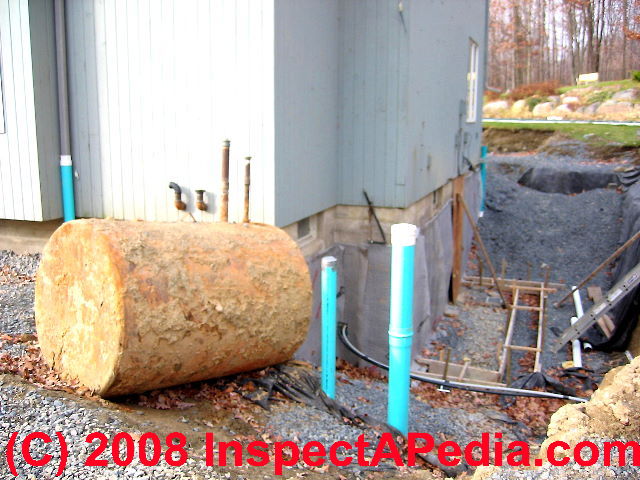
 Proper oil storage tank abandonment requires the use of good
engineering practices, including consideration of the future condition of the tank.
While the original of this article focused on commercial oil storage tanks, the concerns and steps should be examined by those
abandoning residential oil tanks as well.
Proper oil storage tank abandonment requires the use of good
engineering practices, including consideration of the future condition of the tank.
While the original of this article focused on commercial oil storage tanks, the concerns and steps should be examined by those
abandoning residential oil tanks as well.
[Click to enlarge any image]
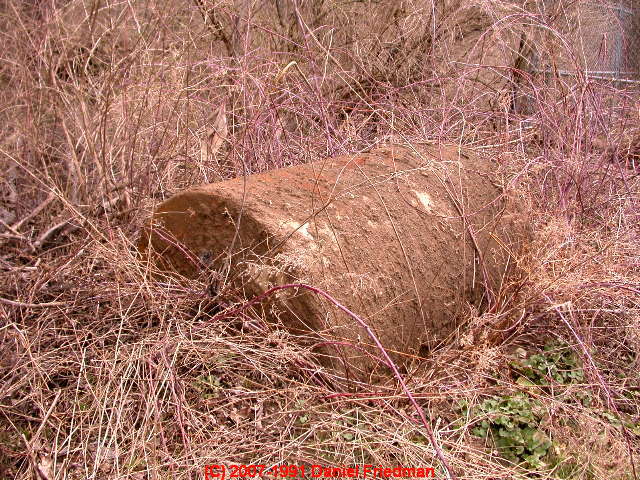
Our photo (left) shows an oil storage tank that was improperly "abandoned" along a stream in Dutchess County New York. The tank, empty, floated up out of the ground when the stream flooded.
In Brief: oil storage tanks which have not leaked can be abandoned by removal or by filling in-place. Oil tank leaks must be reported to the proper authorities.
The US EPA has this succinct advice about abandoning oil tanks:
- Notify the regulatory authority
at least 30 days before you close your UST. - Determine if contamination
from your UST (underground storage tank) is present in the surrounding environment. If there is contamination, you may have to take corrective action.
For at least 3 years, keep a record of the actions you take to determine if contamination is present at the site (or you can mail this record to your regulatory authority). - Either remove the UST from the ground or leave it in the ground.
In both cases, the tank must be emptied and cleaned by removing all liquids, dangerous vapor levels, and accumulated sludge.
These potentially very hazardous actions need to be carried out carefully by trained professionals who follow standard safety practices. If you leave the UST in the ground, have it filled with a harmless, chemically inactive solid, like sand.
The US EPA also provides more detailed oil storage tank abandonment guidelines for both temporary and permanent abandonment of oil tanks as you will see
at MORE READING
 Abandoning a leaky oil tank?
In New York abandoning an oil storage tank includes contacting the NYS DEC within two hours of leak discovery. Oil leaks require special cleaning and testing.
Significant costs can be involved. Buyers of buildings with buried tanks should either obtain good documentation regarding tank abandonment (and any leak tests performed) or if no documentation is available, testing for leaks is very strongly advised.
In other U.S. states and Canadian provinces similar regulations apply in almost all jurisdictions.
Due to the corrosive properties of the soil environment, any steel tank left in the ground will eventually corrode and collapse.
See OIL TANK LEAK / FAILURE RATES and
also see OIL TANK LEAK / FAILURE CAUSES. For this reason, storage tanks which are no longer to be used must be properly "abandoned" or "discontinued."
Abandon an oil tank without removal
Abandonment of an oil tank does not itself require that a tank be removed. If a tank has not leaked, thus is there is not a soil contamination issued, it can be opened, cleaned, inspected, and filled in-place. Actual removal of a buried tank involves the additional expense of excavation to remove the tank and then having to fill-in the hole.
Home inspectors in states or provinces where oil-fired heating equipment is used may often find indications that an old tank has been "abandoned" at the property either because of a switch to an alternative fuel or because an old leaking tank was supplanted by a new one. Safety and environmental concerns mean that an improperly abandoned tank may become a significant future cost to the homeowner.
Portions of this article are from the first half of a New York DEC article printed in the NYSBOC Building Log newsletter in 1992. While most of the present tank regulations exclude the mere presence of residential heating oil storage tanks under 1100 gallons from having to be reported, inspectors should watch for changes: increasing public concern is leading to increased regulation of residential tanks. Original author - Russ Brauksieck. Extensive edits & additions: D J Friedman.
Many localities across the country are allowing underground petroleum tanks to be filled with water if the tank is to be closed in-place. This is not a good engineering practice because the water will accelerate the ultimate corrosion of the tank. Subsequently, the water, now contaminated by the residues in the tank, will escape to the soil and eventually contaminate the ground water.
Note: Long Island NY requires that residential heating oil tanks be registered with the State Department of Environmental Conservation. (C)Trap DJ Friedman
In addition, the tank, now empty, is likely to cave-in along with the ground around it. The need to require that good engineering practices be used in underground storage tanks has prompted the development of much legislation across the country. Abandoned buried storage tank cave-in prevention is discussed in the next section of this article.
Note: Regulations for proper closure of underground petroleum storage tanks in New York State [and almost certainly in other oil-using states as well] have been promulgated by the NYS Uniform Fire Prevention and Building Code (UFPBC), the U.S. EPA, the NYS Department of Environmental Conservation (DEC).
When the Oil Tank must be emptied:
Also see NFPA 31, (2011) Sections 7.12 and 7.13 having the identical text as NFPA 31 Section 2-8 in older editions in older editions, with a possible exception, and with an affidavit required in 7.13. which provides
"If a tank and its related piping is abandoned for whatever reason, the tank and all piping connected to it, including the outside fill and vent piping and any piping connected to the appliance, shall be emptied of all contents, cleaned, removed from the premises or property, and disposed of in accordance with all applicable local, state, and federal rules and regulations."
Thanks to NHFireBear, a frequent InspectApedia contributor, for updates to these standards. 5/11/2015 - Ed.
Other Oil storage tank regulations regarding Oil Tank Abandonent
- New York State Fire Code: 3404.2.13.1 (old NY CRR 1164.5) requires that an oil tank which is no longer going to be used (a discontinued oil storage tank) shall be opened, cleaned, and abandoned (filled in-place or removed) within ninety days of the day on which it is no longer used. Piping is also removed (Avoid accidental filling of empty abandoned tanks or leaks from pipes no longer connected to tanks!).
- 1164.5 of the UFPBC, in section 40
- CFR part 280.7 of the federal Underground Storage Tank (UST) regulations
- subdivision 6 NYCRR Part 613.9 (b) of the DEC's Petroleum Bulk Storage (PBS) regulations.
- Also see this NY State DOH advice on avoiding spills and leaks from abandoned heating oil pipes:
ABANDONED OIL TANK FILL PIPE LEAK HAZARD [PDF] NYS DOH, New York State Department of Heatlth, retrieved 2021/12/12 original source: https://www.health.ny.gov/environmental/oil_spills/oil_spill_abandoned_fill_pipes.htm
- Other states using significant amounts of oil for residential heating may have similar regulations. See TANK REGULATIONS.
Regulations addressing reporting of oil tank leaks and oil tank abandonment of oil tanks written
various state and federal authorities are discussed in more detail
at OIL TANK LEAK & ABANDONMENT REGULATIONS - "Buried Tank and Above Ground Oil Tank Leak Reporting & Tank Abandonment Regulations"
Avoid Oil Storage Tank CAVE-INs When Abandoning Oil Tanks
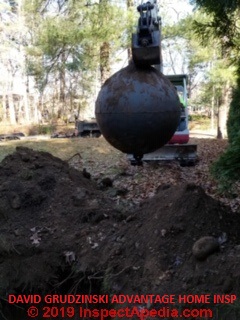 There are proper methods of "abandoning" old unused buried
tanks without actually excavating and removing them (provided there is
not evidence of leakage).
There are proper methods of "abandoning" old unused buried
tanks without actually excavating and removing them (provided there is
not evidence of leakage).
Photo: an unusual spherical buried oil tank being removed from a homesite, courtesy of professional home inspector David Grudzinski.
David Grudzinski, Advantage Home Inspections,
ASHI cert # 249089, HUD cert# H-145, is a professional home inspector who contributes on various topics including structural matters.
David Grudzinski, Cranston RI serving both Rhode Island and Eastern Connecticut can be reached at 401-935-6547 fax- 401-490-0607 or by email to Davidgrudzinski@aol.com
In order to avoid cave-ins, all of these regulations require that tanks either be removed or filled in-place with a solid, inert material, using good engineering practices.
Such fill material is also required to prevent the tank from surfacing after closure, should the ground water table rise, and to completely seal the tank and associated piping from future use as a tank system.
Acceptable solid, inert materials for closing a tank include sand, concrete slurry, and even some foams. When the tank eventually corrodes and collapses, this solid material inside the tank will keep the ground from caving in.
Reader Question: retaining wall damaged by nearby buried oil tank
21 January 2015 mike rose said:
my neighbor has a abandon oil tank that has a certificate saying it was done right i question this.The big problem is the tank sets behind a retaining wall that is 6 inchs from my property line and is collapsing and has been failed by a engineer. my lawyer says they have been notified with the report and we really can't do anything.
i am going to check for soil contamination the tank is from 1964 and the tank was abandon in 1992.and is still in the ground and has a sink hole developing above it.can i do anything.
- This question appeared originally at RETAINING WALL DAMAGE and is shown in the FAQs section of that article. - Ed.
Reply:
Mike
Watch out: If an "abandoned" buried oil storage tank is collapsing that is certainly a potential hazard in several regards and it has not been properly abandoned. I have myself seen collapses, damage to nearby building foundation walls from water collecting at the buried oil tank (UST) location, and even heating oil leaks through the foundation wall off an adjacent building.
Details about proper oil storage tank abandonment, regulations, and safety or environmental concerns are found in this article series - see MORE READING at the end of this article.
I suspect that what your neighbor might have is a document stating that there was no evidence of leakage - which would have permitted the tank to be abandoned in place. But that abandonment, properly conducted, would have included cleaning the tank and filling it with sand or another suitable material.
To check for soil contamination one would need to collect soil samples close to the tank and to a depth of the tank's bottom.
Watch out: If there is a sink hole risk the area should be roped-off and protected until proper investigation and repairs can be made:
If those steps have not been taken already, notify the owner and building authorities of a small but potentially dangerous local sink hole condition as a child or possibly even an adult falling into such an opening could be very serious, even fatal.
Watch out also for further damage to your foundation wall by movement of heavy equipment on the higher level near the wall itself, or by excavation in that area (for example should detection of an oil spill require tank and soil excavation).
Removing old fuel from underground oil tanks
The UFPBC also requires that underground petroleum tanks to be closed in-place shall be made safe by removing flammable or combustible liquids from the tank and connecting lines; disconnecting the suction inlet, gauge and vent lines; and capping the remaining piping.
All storage tanks removed from their location must also have flammable or combustible liquids removed, have the same lines disconnected; have sections of connecting lines not to be used further removed, and have inlets, outlets, and any leaks capped or plugged. The basic procedures for meeting these requirements are defined in the State and federal regulatory programs.
In addition to requiring the same basic procedures as the State regulations, the federal UST regulations require that a site assessment be performed by the owner/operator when a tank is closed. (Heating oil tanks, and farm and residential tanks storing less than 1,100 gallons of motor fuel are exempt from these regulations.)
See INDOOR OIL TANK ABANDONMENT for some suggestions for using up heating oil or removing it from an oil tank to be abandoned.
For a detailed description of the steps required for proper tank abandonment or for more information on site assessments and permanent tank closure, contact your state department of environmental conservation. In New York inspectors can contact the author or the Bulk-Storage help-line 800-242-3451.
How to Use Up Heating Oil Before Removing or Replacing an Oil Tank
Oil to Gas Heat Conversion Advice - using up heating oil fuel
If you are going to convert to gas or another heating source but you first want to use up the heating oil in your oil storage tank,
and provided that your oil fired heating equipment (oil fired boiler, furnace, or water heater) is good operating condition, you can choose to simply let the old, to-be-abandoned oil fired equipment keep running until you run out of oil ... almost. There are a few problems to watch out for:
If your oil tank piping lines come off of the top of the oil tank
and are properly installed the lines won't pick up the sludge, water, and last few inches of oil in the tank, so you'll probably be fine just running your oil fired equipment until you run out of oil.
If your oil tank piping lines come off of the bottom of the oil tank
and you run it out there is the risk of pulling sludge and crud into the oil filter, oil burner, and losing heat if those components clog. If the oil burner shuts off in that manner, it'll indeed be shut off firmly until it's repaired, so don't try this if you're still depending on the oil heat to keep working (say to avoid freezing).
Your gas heat or other new source of heating should be hooked up and ready
to run. Thus you can run the oil heat until it runs out or fails on clogging without risking leaving the building with no heat source - risking frozen pipes, water damage, mold contamination, etc.
The heating service technicians will not want to remove old oil-fired heating equipment until it is completely cold. That's because they don't want to deal with hot water, burns, etc.
The old oil tank may still need to be pumped out
if there's oil remaining in it - lest you get a messy leak and spill later.
Chimney safety warning on heating fuel conversion from oil to gas
If you are converting fuel from oil to gas and intend to continue to use the same chimney that vented your oil fired heating equipment be sure to have the chimney cleaned and inspected for safety. The draft characteristics of these fuels differ, so chimney repairs or changes could be needed for safety.
Be SURE that the tank filler and vent are totally removed lest you get an un-wanted oil delivery. Don't laugh, it happens.
Question: who removes the old oil fill and vent piping on an oil-to-gas conversion?
When switching from oil heat to gas heat, who is responsible for removing the tank filler and vent? The oil company or the gas company? Or do I have to hire a additional contractor? I've heard stories about unwanted oil deliveries. They are heart breaking. - Laura
Reply: nobody wants to do the whole job - the "Peanut Butter theory of construction: just skim the cream of profit"
Laura just removing the oil tank filler and vent are simple plumbing disconnections that can be performed by a plumber or general contractor. I agree that removing the abandoned filler is critical.
It is too common that some (not all) contractors in all building trades "just do their job" and leave parts of it incomplete, pointing to you or other contractors to finish the job. I call this the "peanut butter" approach to business. "Just buy some stuff and smear it on the house and get paid" - you don't care if the actual problem is really solved or the need fulfilled, or the job is complete and functional.
At a recent building project in Dutchess County NY we hired the top, most expert, and most expensive chimney company in the Hudson Valley to install a new metal chimney for an oil fired heating boiler. For years I had recommended that company to our clients.
In my case their work was very disappointing: During installation we had to do our own framing and our own sealing of the new chimney base at the roof line. And the new chimney installation work was of poor quality: dented metal chimney sections, floppy inadequate support brackets that left the chimney wobbling side to side, a crushed leaky chimney cap, damaged roof drip edge, even a small puncture in the rubber roof where the workers dropped something.
And the chimney installation job was incomplete: the contractor left all of the old chimney and parts for us to remove separately at our own expense.The company "skimmed the cream" of profit from the job , got in and out fast, and didn't care about the success of the whole project. When I complained, my long time but disappointing friend Bill, the owner said "Dan we've always done it that way, in thousands of jobs. That's just the way we do it."
It appeared that the company felt we were just being picky. And indeed their contract spelled out quite clearly that they would not remove old components nor perform any framing. But what is often not made clear to the customer is that those tasks are absolutely necessary and that additional trouble and expense will be involved in their completion.
It's up to you the homeowner to ask about, and then discuss these details with the contractors ahead of time and be sure that all the needed tasks are done. Now after the fact you can try asking them to come back and do more work, but once paid, the contractor may be reluctant to return - for free. Don't pay for work that is unsatisfactory or incomplete. Or to have added out-of-contract-scope work performed, pay the contractor to return and do it. Or hire someone else.
I discussed the abandoned oil fill pipe question recently with a New York heating oil delivery truck driver as we recounted horror stories of oil deliveries into building basements.
The driver said if he finds a filler that has been duct-taped over he would not remove it to deliver oil. I said that I know of cases of less experienced drivers doing stunning things like removing plywood nailed over the filler pipe, turning an upside down filler right side up and pumping oil into the open basement of a home.
I claim the old oil fill and vent pipes should be removed promptly and that there is no major cost involved except in very odd cases. The risk is not worth wasting time arguing over.
You should also notify your oil company both by telephone and in writing that the oil tank has been removed and that they should remove you from automatic oil delivery immediately.
How to Document a Buried Oil Tank Abandoned Long Ago
Question: oil tank abandoned long ago, missing paperwork: how do I obtain documentation & supporting testing
I have someone interested in buying my home. The oil tank on the property was abandoned properly years ago and signed off by the EPA…but this was done before records were kept on computers…the buyers just want verification that the tank was abandoned, not a soil test. I’m wondering how much this will cost me? And how this is done?
Reply:
- First choice:
contact the company who performed the original oil tank abandonment and any supporting inspections and testing and ask for a copy of their documentation.
By the way, I'd be careful to be very accurate in speaking to your buyer, in order to avoid any possible misunderstanding. Contrary to what you wrote, the U.S. EPA does not "sign off" on residential oil storage tank abandonments or removals nor on oil tank leak testing. Nor does your state DEP (Department of Environmental Protection) or DEC (Department of Environmental Conservation) "sign off" on oil tank abandonments.
In fact in many states residential oil tanks of smaller size, such as under 1100 gallons, are not registered with the state.
Generally, when an oil storage tank is removed or abandoned, the service company performing the work (and the property owner) are required in most U.S. states to notify their DEP or DEC if there is evidence that there has been an oil leak or spill. And the state will typically have guidelines on how an oil tank should be abandoned, such as a requirement to fill the tank. - For a heating oil tank that was abandoned (emptied, filled, left in place),
it should be easy to locate the tank and perform a soil test at a depth chosen by the expert - usually at the depth of the tank bottom.
If necessary, the top of the tank (that won't be deep) can be excavated and fittings opened to confirm that the tank was properly filled - avoiding a potentially dangerous future collapse at the site. - If the oil tank was actually removed
years ago, once a buried oil tank is long gone, and if there is no documentation about its removal, a responsible home buyer might ask to perform a site inspection and soil testing.
If evidence or concern justified further inspection for actual buried tanks, there are ground scanning radar and other methods that can be used to scan a property - a costly step that one would not ordinarily perform in the case you describe. DEP or DEC if there is evidence that there has been an oil leak or spill. - To contact a company
who can perform a site inspection and soil testing you can use this link:
OIL TANK TESTING COs where we list companies offering soil and tank leak testing services - or just ask your heating oil company for a referral or check your local telephone directory.
Typically the oil tank testing company will inspect and perform one or more soil tests in the area and at the depth where the oil tank was previously located. And an astute inspector would notice the presence or absence of piping or tubing associated with buried oil tanks and that would not be expected to be present if a tank was removed, vs. abandoned in place. - Really? But in my OPINION you should NOT have these tests performed yourself, since doing so puts you in a position of potential liability. Rather, if you agree to do so, just give the buyer an allowance and have them order and pay for the test directly - to avoid any appearance of conflict of interest.
Reader Comments, Questions & Answers About The Article Above
Below you will find questions and answers previously posted on this page at its page bottom reader comment box.
Reader Q&A - also see RECOMMENDED ARTICLES & FAQs
On 2021-04-16 - by (mod) -
@Anon, glad to assist; let me know (and see) what you find as that will surely help other readers too.
On 2021-04-16 by Anon
thanks very much for the detailed response. It really helps us to understand how to proceed with more confidence!
On 2021-04-16 - by (mod) -
@Anon,
I don't know what laws pertaining to you because I don't know where you're located, country, city, but frequently it's the case the testing is not required unless there's evidence of a leak. Example of evidence of a leak would be discovering that an oil tank is visibly damaged or perforated or of course that there is visible obvious heating oil spillage.
So if loyalty ink removal company comes to a site to remove an existing tag and they could not find obvious evidence that it has already leaked there may be no soil testing performed.
It's a hold are you describe is actually underneath an existing oil tank
It would be pretty unusual for the hole to have been made after the tank was installed since access to that area would be quite difficult. I suppose it's possible, as I haven't seen any photos of your situation.
It also should be quite easy to see whether the hole is one that was left during the original pour of the floor versus one that was cut into the floor later simply by careful examination of the surrounding concrete. It's quite obvious to see marks of an impact hammer or drill for example.
It's perfectly plausible if the garage was added or the slab was added to the concrete was poured around the tank. If that's the case you will be able to recognize the edges of a pour as quite different in appearance than edges of a chopped or drilled hole in concrete.
On 2021-04-16 by Anon
thank you very much.
Are Tank Removal services required to test the soil when removing the tank? Is that routine and required by the state in every instance, or just where there is visual evidence of a potential issue - such as a leaking tank (our tank isn't leaking) or signs that a previous tank, perhaps decades old, may have leaked (which may be the case for us.) As you said, it's hard to know until a soil test is performed... appreciate any headlights you can provide.
On 2021-04-16 - by (mod) - gravel had been covering what appears to be a hole in the slab under the oil tank
@Anon, I can appreciate wanting to avoid a nightmare but in fact nevertheless it's better for you to resolve this question now rather than later, for example if you were trying to sell your house and discovered you couldn't before resolving it then.
In most states and provinces is required by law that age where leak is reported to the department of environmental protection or conservation and of course it be cleaned up. That doesn't mean that it's a five figure nightmare.
At the very least she would have a professional test the soil in that hole to see whether it needs to be removed.
You can raise or lower your own level of concern by looking carefully at the oil tank itself to see if there is evidence that it has leaked such as what oil spots on the concrete around the pool or the concrete is missing or gummy oily residue on the tank bottom.
On 2021-04-15 by Anon
We moved into an old house 2 years ago and converted our heat source. We are removing an empty above-ground oil tank in the basement. It's empty except for some sludge. I was vacuuming under it recently and cleaned out some small gravel under the tank
The gravel had been covering what appears to be a hole in the slab under the tank. Maybe the original slab was poured around the old tank and they never got to fixing it when they put the new tank in? Anyway, using the shop vac, and dug down into the hole a little and sucked up what seems to be oil-soaked dirt. I'm worried that this could turn into a 5 figure nightmare. Should I just leave the tank were it is and not touch it or call a contractor to take a look at it?
On 2020-03-08 - by (mod) - is an oil tank wipe-tested when it's abandoned?
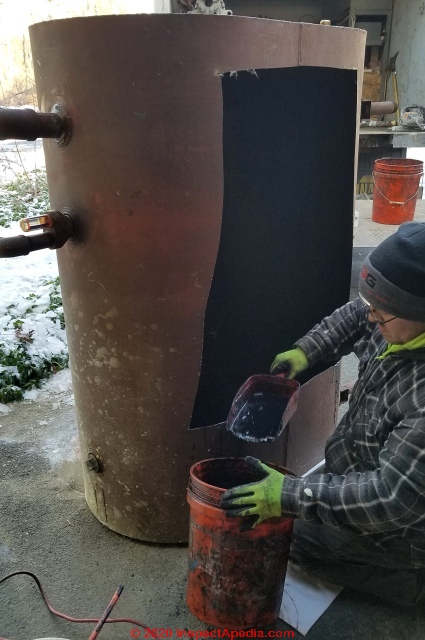 Not wipe tests, that I've seen, Bob; the cleaning is intended to remove oil that is likely to be sufficient in quantity as to possibly leak into the environment. A slight oil film on the steel in the tank wouldn't be an issue.
But what WOULD be an issue is an incompletely-cleaned oil tank.
In a companion article OIL TANK REPLACEMENT PROCEDURE
you'll see photos of how our oil tank replacement company cut open the oil tank to permit removal of decades of oil sludge that cannot be removed simply by pumping.
Depending on the country and state or province where you live, your department of environmental protection will have their own specific rules for what's required.
On 2020-03-06 by bob
Is it common for oil/fuel storage tanks to have a wipe sample applied post cleaning? Or some kind of sampling to prove the inside of the tank is clean?
On 2020-02-19 - by (mod) - oil tank was abandoned 20 years ago, now what?
Anon
There is no amnesty unless you're Michael Milken or another big time white collar criminal.
The bottom line is that
IF your oil tank was properly-abandoned then at the time some qualified expert tested and inspected and documented that
1. the tank had not leaked into the surrounding soil
2. the tank has been properly-abandoned: emptied, cleaned, and filled with sand or similar material
If those steps were never done, then the risk is a very very expensive oil tank leak that could need to be cleaned-up.
If such a leak has occurred, in New York the leak must be reported to the NYS DEC within 24 hours.
So if you have no documentation that the work was done properly twenty years ago you need to have that done now.
On 2020-02-19 by Anonymous
my tank was abandoned twenty years ago, I am now being asked to file for a conversion permit with a tank inspection.I was issued a new c of o in 2007 and have applied and received a boiler permits each year since.
It seems to me that this is just clerical formality and that after twenty years it shouldn't require this procedure. the property is located in yonkers new york, is there such thing as amnesty or otherwise after twenty years of not being used?
On 2019-10-28 - by (mod) - environmental site assessment if the tank passed a tank tightness test for abandoned oil tank?
MHuber
Typically the tank is emptie, cleaned, and filled with sand. It's not tightness tested, but, ...
It depends ... on the country and city where you live and their UST abandonment regulations AND on just how old your tank tightness test is.
If the tank was tested sufficiently-recently you're probably fine.
On 2019-10-24 1 by MHuber2066@aol.com
When you abandon a UST are you required to do a environmental site assessment if the tank passed a tank tightness test?
On 2013-03-02 by (mod)
Clean sand, Marty
On 2013-03-02 by marty
what is a acceptable fill for a oil tank left in the ground
On 2013-01-27 by Wayne
As for removing the piping, it is with out a doubt the job of the tank removal company, if not removed at least drained cut below surface and filled with cement.If not it would pass an inpsection from your local building department (if required) I recommend removing all oil tanks unless there is a mitigating circumstance that impeads removal.
Any Home Buyer should have the seller remove the tank whether it was properly abandoned or not. I DO AGREE about taking soil samples from 4 spots surrounding the tank. Keep in mind proper drilling and sampling may be 1/2- 3/4 of the price to remove the tank. FYI I am an environmental consultant and owner of a tank removal/installation company in Tarrytown NY.
When Selling your home "codes" may not be as important as pleasing potential buyers. If you were buying a house would you want to buy the one with an oil tank (underground or above) or the one without?
On 2012-12-07 - by (mod) -
Jack
Start with your local oil company and get a price on having the tank emptied. There are lots of oil storage tank removal companies to choose among.
Be sure to obtain & keep documentation on the removal and on oil leak or spill evidence absent or present.
On 2012-12-06 by jack schnur
I recently switched to gas a few weeks ago and still have an oilt tank 1/2 filled with oil.
How do I dispose of the oil and the tank
On 2012-10-23 by John
In selling my house, there is an abandoned 275 gal oil tank in basement that the new buyer is concerned about and has addressed that I take care of it, before closing. The home inspector noted that it was there and should be removed. What are the regulations, or where do i find any code requirements that I am responsible for this? Is it even something that has to be addressed...again code-wise or is it merely a negotiation in the sale like say a broken window?
On 2011-08-11 - by (mod) -
Laura this is such an annoying as well as heart breaking problem that I have responded at length above where I discuss the "peanut butter theory of construction" and give my own example of snafu - it happens even to professionals like me.
At this point, if neither contractor will remove the old piping and patch the wall holes, hire anyone, a plumber or handyman, to remove the old oil tank fill and vent pipe and in the interim, securely duct-tape the filler cap to the filler pipe.
On 2011-08-11 by Laura
When switching from oil heat to gas heat, who is responsible for removing the tank filler and vent? The oil company or the gas company? Or do I have to hire a additonal contractor? I've heard stories about unwanted oil deliveries. They are heart breaking.
...
Continue reading at INDOOR OIL TANK ABANDONMENT or select a topic from the closely-related articles below, or see the complete ARTICLE INDEX.
Or see OIL TANK ABANDONING PROCEDURE FAQs - questions & answers posted originally at the end of this page.
Or see these
Recommended Articles
Suggested citation for this web page
OIL TANK ABANDONING PROCEDURE at InspectApedia.com - online encyclopedia of building & environmental inspection, testing, diagnosis, repair, & problem prevention advice.
Or see this
INDEX to RELATED ARTICLES: ARTICLE INDEX to HEATING OIL, OIL BURNERS, OIL FIRED HEATERS, OIL TANKS
Or use the SEARCH BOX found below to Ask a Question or Search InspectApedia
Ask a Question or Search InspectApedia
Try the search box just below, or if you prefer, post a question or comment in the Comments box below and we will respond promptly.
Search the InspectApedia website
Note: appearance of your Comment below may be delayed: if your comment contains an image, photograph, web link, or text that looks to the software as if it might be a web link, your posting will appear after it has been approved by a moderator. Apologies for the delay.
Only one image can be added per comment but you can post as many comments, and therefore images, as you like.
You will not receive a notification when a response to your question has been posted.
Please bookmark this page to make it easy for you to check back for our response.
Our Comment Box is provided by Countable Web Productions countable.ca
Citations & References
In addition to any citations in the article above, a full list is available on request.
- Technical & Peer Reviewers for the original publication in the ASHI Technical Journal
- Stephen Gladstone, Stonehollow Inspections, CT.,
- Paul Ciminello, Ecosystems Strategies, Poughkeepsie, NY
- Daniel Friedman, ASHI Technical Journal Editor/Publisher, Poughkeepsie, NY
- Russ Brauksieck is an Environmental Engineer with the New York State Department of Environmental Conservation.
- US EPA "How do you Properly Close a UST?" is summarized at epa.gov/OUST/fsprevnt.htm These details for temporary and permanent closing of underground oil storage tanks are provided by the US EPA as well.
- "How do you choose the right tank testing method?", Cynthia Johnson, Fuel Oil & Oil Heat Magazine, November 1995
- National Association of Oil Heat Service Managers, PO Box 380, Elmwood Park, NJ 07407
- In addition to citations & references found in this article, see the research citations given at the end of the related articles found at our suggested
CONTINUE READING or RECOMMENDED ARTICLES.
- Carson, Dunlop & Associates Ltd., 120 Carlton Street Suite 407, Toronto ON M5A 4K2. Tel: (416) 964-9415 1-800-268-7070 Email: info@carsondunlop.com. Alan Carson is a past president of ASHI, the American Society of Home Inspectors.
Thanks to Alan Carson and Bob Dunlop, for permission for InspectAPedia to use text excerpts from The HOME REFERENCE BOOK - the Encyclopedia of Homes and to use illustrations from The ILLUSTRATED HOME .
Carson Dunlop Associates provides extensive home inspection education and report writing material. In gratitude we provide links to tsome Carson Dunlop Associates products and services.
 | HOME | ABOUT | ASK a QUESTION | CONTACT | CONTENT USE POLICY | DESCRIPTION | POLICIES | PRIVACY | |
| © 2024 - 1985 Publisher InspectApedia.com - Daniel Friedman | |||||||||