
InspectAPedia® FREE Encyclopedia of Building & Environmental Construction, Diagnosis, Maintenance & Repair |
Question? Just ask us! InspectAPedia
|
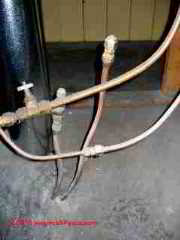 Indoor clues point to a buried oil tank
How to Find Underground Oil Tanks - Visual Evidence of Buried Oil Tanks, Part 2

- POST a QUESTION or COMMENT about visual methods & indoor clues that detect abandoned or buried oil storage tanks at residential properties
Photo guide to clues of buried or abandoned oil tanks:
This is a photo guide to visual clues spotted indoors or outdoors which can assist in the location of abandoned or buried oil tanks or the detection of evidence that an underground (or even an above ground) oil tank is or was in use at a property.
The article and photographs used to show the reader ways to find buried oil tanks include examples of clues leading to the discovery of "nearly hidden" buried or underground oil tanks which were found at residential properties and which avoided very costly surprises later for the new owner.
Underground oil storage tanks, or UST's, whether still present or previously removed, involve a risk of costly oil leaks and soil contamination which may need to be addressed. Here are some investigation methods that any home buyer, owner, or home inspector can apply to reduce these risks by looking for evidence that a buried oil tank is or was at a property.
InspectAPedia tolerates no conflicts of interest. We have no relationship with advertisers, products, or services discussed at this website.
SIGNS OF BURIED OIL TANKS- A Photo Guide to Visual Clues for Finding Buried Oil Storage Tanks - Part 2, Indoor Clues
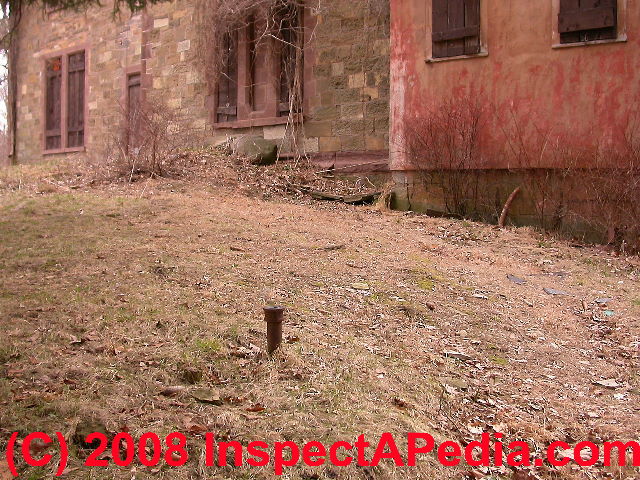
How to find buried oil tanks: Evidence that a buried fuel storage tank exists at a property may be direct and visually obvious, or the evidence may be subtle.
Often a series of small observations, individually not apparently very important, can add up to an increased probability that a buried fuel storage tank is or was at a property.
While environmental investigators and oil tank test companies may use magnetic scanners or even ground scanning radar to locate buried steel tanks, an astute visual inspection can often discover the presence or probable presence of a buried fuel storage tank at a property, thus suggesting that further testing is definitely in order. Here are some clues to the possible current or past presence of a buried tank at a property.
Photographs of Indoor Clues for Detecting Buried Oil Tanks
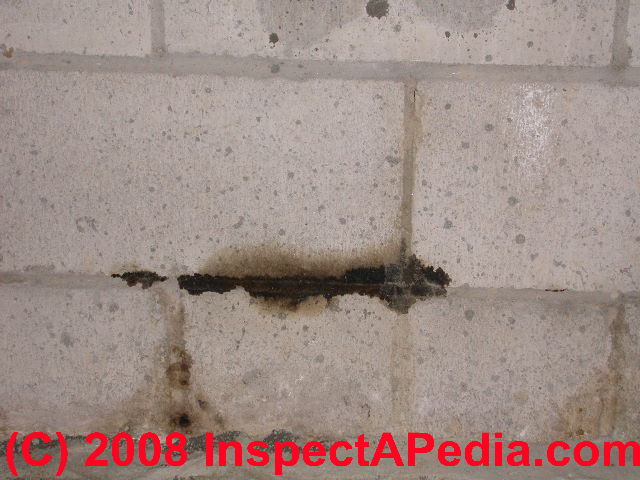
Unexplained oil stains on building foundation walls at any location might indicate that a leaky oil tank is or was outside the building near that location.
At the home where we saw this oil stain on the foundation wall of a crawl space, further investigation found that an oil tank had been leaking and had been abandoned just outside this wall.
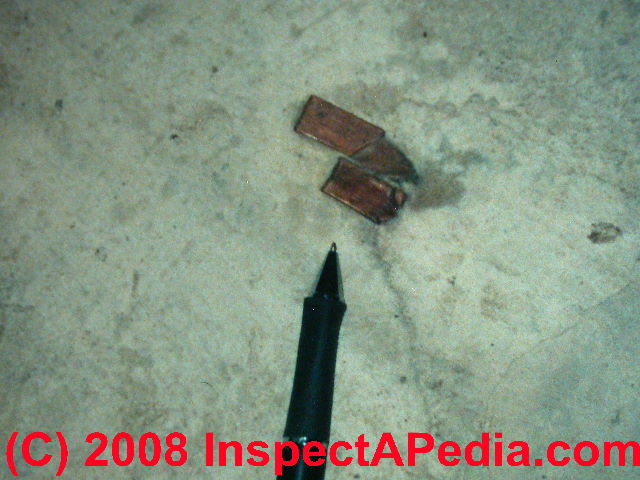
Abandoned heating oil lines in floors in a building may be present at or near existing oil-fired equipment, or may be at or near the previous location of such equipment.
Look for a pair of flexible copper fuel lines protruding into the basement or crawl space wall, perhaps cut off, bent-over, and crimped. The oil pipes shown in our photo at left were smashed flat and left in place on a basement floor.
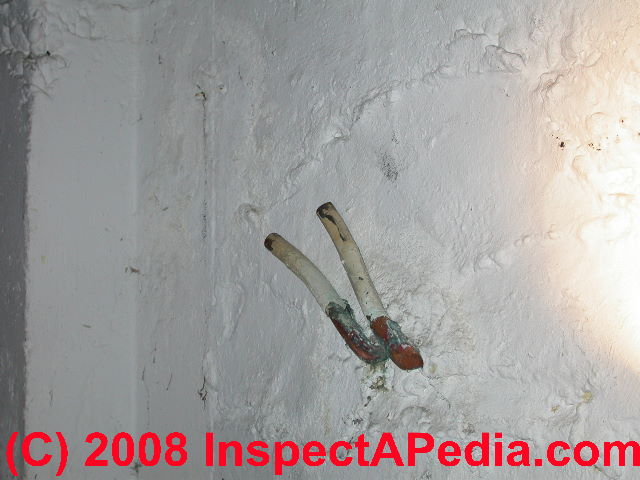
Abandoned heating oil lines at foundation walls Here is an easy to spot pair of oil lines abandoned at a basement wall. Sometimes they're not nearly so obvious.
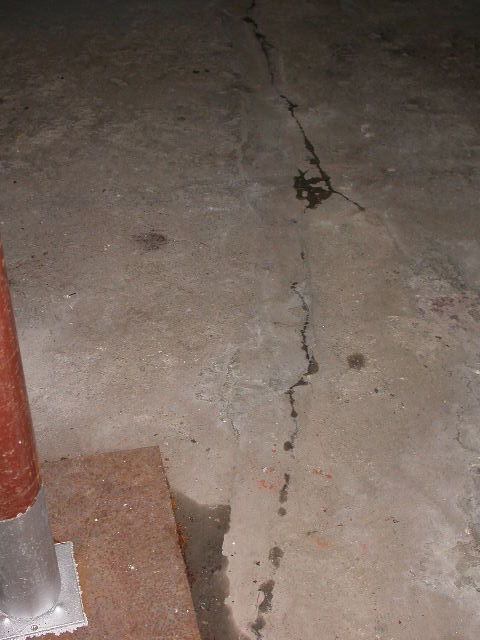
Evidence of under-slab oil piping now abandoned: Even where no oil pipes themselves are visible, look patches or cuts in a basement or crawl space floor slab where oil lines may have been routed under the slab, or look for a small patch in the upper or even lower portion of a basement or crawl space wall in a location where logically one might have expected to see fuel lines entering the building.
Our photo above shows a basement slab cut in an older home in Portland Maine. The slab was poured, then later opened to route lines from an oil tank under the floor over to a heating boiler. At the time of our inspection the old boiler had been removed and a new boiler and oil tank were found in the basement. New oil lines from the oil tank to boiler passed nowhere near this floor cut.
But further exploration found remains of ABANDONED OIL SUPPLY PIPING. [Photo]
Question: sealing damage from leaky oil tanks
(Apr 23, 2014) Kim said:
Considering a purchase. Abandoned tank found under the driveway of 1928 house. The basement wall closest to tank has painted, peeling paint. Other walls do not. Concerned the tank leaked, penetrated the foundation walls. Tank will be removed. Can the walls be cleaned and sealed?
Reply:
Kim,
FIrst, it sounds as if the buried oil tank close to the home may also have created a cavity that directed surface runoff or roof spillage against the foundation - those conditions need to be addressed.
Second, before painting the foundation walls you need to understand the properties of the stain thereon. If it's actually a stain from a heating oil leak, and if it's large in area then the leak was substantial and any painting needs to wait until the tank and contaminated soils have been removed.
It may be possible to select and oil-compatible primer and paint that will adhere to concrete block after some preliminary cleaning with a detergent and thorough drying.
Send along photos or reports or other details (see our CONTACT link) and I can comment further.
Daniel
Question: do I need a soil test for a tank that was properly abandoned in place?
(July 1, 2014) Tom said:
Is there a problem if the oil tank was abandoned properly, with a licensed company that cleaned it out, filled it with foam and filed the paper work with the county? In my town, they don't require soil testing if the tank is abandoned. When I called the County, they said there shouldn't be a concern if it was properly abandoned. What should the homeowner do if a tank was abandoned 30 years ago but may still be buried?
Reply:
Tom:
Advice on this topic is at
Basically if the tank was properly abandoned AND you have credible paperwork documenting that effort then the bank and other parties should be satisfied. If there is a buried oil storage tank that is out of use but that was never properly abandoned then some testing and abandonment are in order.
Question: could an old house have had more than one oil storage tank installed?
(July 24, 2014) Anonymous said:
Recently purchased a 1920s house with an abandoned tank under driveway. We have state certification of proper abandonment although the vent pipe and fill pipe (at some distance from each other indicating outside UST) are still visible. Those were not removed but also filled with inert material.
My question - in our basement, there are two additional pipes (both sealed) sticking out from the cement floor about two feet from the current furnace. Could these be the oil gauge, oil filter or shut off valves for the old outside tank? There was no mention of an indoor UST and the inspector seemed satisfied with the paperwork. Could an old house like mine have had TWO tanks? It was not a big house originally.
Reply:
Small diameter copper lines in pairs would have been supply and return oil lines for a buried oil tank. Yes an older building could have had more than one tank.
Question:
(June 16, 2015) Cait said:
I have a photo taken during the inspection and is said to be evidence of a possible buried oil tank. The owners say they have no knowledge of a buried tank (they've owned the house since 2009) and the town has no records of a tank.
We know neither of these necessarily prove there is no tank, the house was built in 1966 so it is very possible. We would like to avoid paying $1000-$1500 especially since no one knows if there even is a tank! any pictures I've seen of lines coming through the foundation show two lines. this looks like a hose to me? here is link to the photo
Reply:
Cait your link was insecure.
You can use our email found at page bottom CONTACT to send us photos for comment.
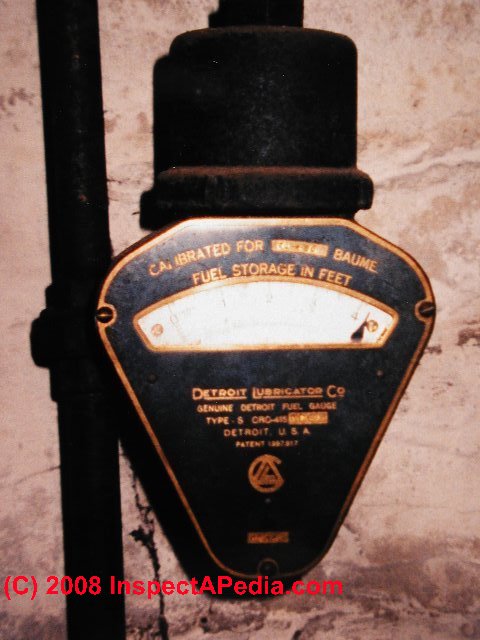
- Presence of antiquated oil storage tank fuel-level gauges
such as we show at above-left can also indicate that oil tanks have been in use at a property for a long time. An old fuel level gauge mounted on a basement wall is a sure indicator that an oil storage tank has been buried outside of the building.
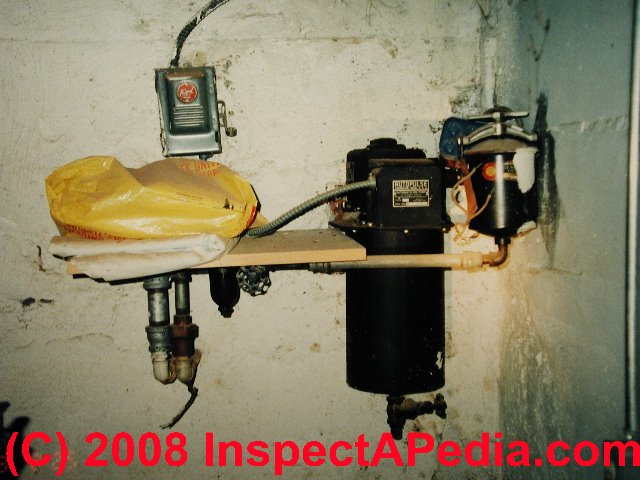
You may also find abandoned heating oil filters and less commonly you may find that an indoor lift pump (above right) was added to bring oil from an outdoor buried tank into the building's oil-fired heating equipment. The right hand photo shows a Teesdale automatic oil pump which was used for this purpose. - Footprints of old heating equipment and even oil stains on a basement or crawl space floor may indicate that previously oil-fired equipment was present even if it is no longer at the site.
- Records at local oil delivery companies who serve the neighborhood may indicate a history of deliveries to the site. Records of previous building inspections may also indicate this possibility.
Question:
(Nov 11, 2011) HELP! WE HAVE A PIPE JUST LIKE said: Please help me. We have a pipe just like the one in the pictures in our cellar / basement of our century home - 110 years old. A cap on the pipe sticking out of the later-poured concrete with exactly the same nut on top to open whatever it is...NOW WHAT??
Reply:
Help:
Take a look at the buried oil tank location articles in the series given just above. If your home has a buried tank that is no longer in use but that has not been properly abandoned, then you will want to do so.
...
Continue reading at BURIED OIL TANKS, OUTDOOR CLUES or select a topic from the closely-related articles below, or see the complete ARTICLE INDEX.
Or see
Buried Oil Tank Location Articles
Suggested citation for this web page
BURIED OIL TANKS, INDOOR CLUES at InspectApedia.com - online encyclopedia of building & environmental inspection, testing, diagnosis, repair, & problem prevention advice.
Or see this
INDEX to RELATED ARTICLES: ARTICLE INDEX to HEATING OIL, OIL BURNERS, OIL FIRED HEATERS, OIL TANKS
Or use the SEARCH BOX found below to Ask a Question or Search InspectApedia
Ask a Question or Search InspectApedia
Try the search box just below, or if you prefer, post a question or comment in the Comments box below and we will respond promptly.
Search the InspectApedia website
Note: appearance of your Comment below may be delayed: if your comment contains an image, photograph, web link, or text that looks to the software as if it might be a web link, your posting will appear after it has been approved by a moderator. Apologies for the delay.
Only one image can be added per comment but you can post as many comments, and therefore images, as you like.
You will not receive a notification when a response to your question has been posted.
Please bookmark this page to make it easy for you to check back for our response.
Our Comment Box is provided by Countable Web Productions countable.ca
Citations & References
In addition to any citations in the article above, a full list is available on request.
- [4] Fuel Oil and Oil Heat Magazine, August 1985 p.18. Fuel Oil & Oil Heating Magazine, 3621 Hill Rd., Parsippany, NJ 07054, 973-331-9545
- [5] Standards of the National Board of Fire Underwriters, as referenced by "Domestic and Commercial Oil Burners,", Charles H. Burkhardt, 1961, 3rd Ed., McGraw Hill Book Company, p. 172
- [6] NFPA - the National Fire Protection Association can be found online at www.nfpa.org
- [7] "The Interim Prohibition Guidance for Design and Installation of Underground Oil Storage Tanks", U.S. EPA, EPA/530-SW-85203, Office of Underground Storage Tanks, Washington D.C.
- [9] US EPA "How do you Properly Close a UST?" is summarized at epa.gov/OUST/fsprevnt.htm These details for temporary and permanent closing of underground oil storage tanks are provided by the US EPA as well.
- [10] "How do you choose the right tank testing method?", Cynthia Johnson, Fuel Oil & Oil Heat Magazine, November 1995
- In addition to citations & references found in this article, see the research citations given at the end of the related articles found at our suggested
CONTINUE READING or RECOMMENDED ARTICLES.
- Carson, Dunlop & Associates Ltd., 120 Carlton Street Suite 407, Toronto ON M5A 4K2. Tel: (416) 964-9415 1-800-268-7070 Email: info@carsondunlop.com. Alan Carson is a past president of ASHI, the American Society of Home Inspectors.
Thanks to Alan Carson and Bob Dunlop, for permission for InspectAPedia to use text excerpts from The HOME REFERENCE BOOK - the Encyclopedia of Homes and to use illustrations from The ILLUSTRATED HOME .
Carson Dunlop Associates provides extensive home inspection education and report writing material. In gratitude we provide links to tsome Carson Dunlop Associates products and services.
 | HOME | ABOUT | ASK a QUESTION | CONTACT | CONTENT USE POLICY | DESCRIPTION | POLICIES | PRIVACY | |
| © 2024 - 1985 Publisher InspectApedia.com - Daniel Friedman | |||||||||