
InspectAPedia® FREE Encyclopedia of Building & Environmental Construction, Diagnosis, Maintenance & Repair |
Question? Just ask us! InspectAPedia
|
 Guide to Use of Mold Disinfectants, Mold Sprays, Biocides, Fungicides
- POST a QUESTION or COMMENT about how best to use biocides, sanitizers & sprays in buildings as part of a mold contamination remediation job
Guide to Using Biocides, Fungal Sprays, Mold Sprays, Sanitizer for Indoor Mold, Particle, or Other Biological Contaminants
This article discusses the use of sprays to address bacterial and mold hazards in buildings. We illustrate when the use of disinfectant or biocidal sprays, fungicides, bleach, and discuss when they are are useful, and when they are a mistake.
This article emphasizes that cleaning or removing problem mold and correcting the reasons why it grew are key steps, adding that consumers should beware of use of sprays of any kind if they substitute for those steps.
InspectAPedia tolerates no conflicts of interest. We have no relationship with advertisers, products, or services discussed at this website.
When Is it Good Practice to Use Biocides, Disinfectants, or Fungal sprays in a Building to Address Bacteria or Mold?
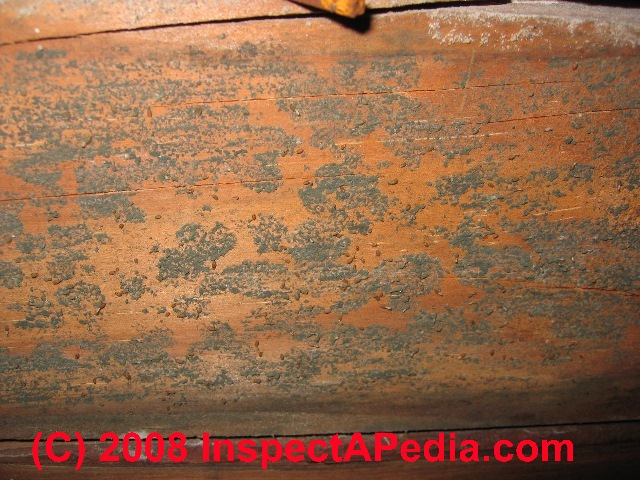
Green mold (lab confirmed it was Trichoderma) on wood joists in a basement. Simply spraying an encapsulant or paint over this mold would be poor practice.
[Click to enlarge any image]
Article Contents
- DIFFERENCE BETWEEN SANITIZER / BIOCIDE & SURFACE SEALANTS / COATINGS
- DEFINITIONS of BIOCIDE DISINFECTANT SANITIZER STERILIZER
- STEPS in USING a SANITIZER / BIOCIDE
- BIOCIDE SANITIZER USE WARNING
- RECOMMENDATION AGAINST USE of SANITIZERS
- WHEN is BIOCIDE / SANITIZER or ENCAPSULANT USE GOOD PRACTICE
Difference Between a Sanitizer/Biocide & a Sealant Coating
In this article series we distingish between and discuss separately sanitizers, disinfectants, and sealants. However there is some overlap and confusion among these products.
The essential distinction is that sprays that are described only as a sanitizer (or stronger disinfectant) are used as part of a cleaning procedure while sprays or other coatings that may (or may not) also include biocides or fungicides are used after a remediation or clean-up job and are intended to provide a moisture-resistant coating on the surface to which they're applied.
In addition to the use of biocides or sanitizers directly in or on buildingm surfaces, some building coatings may contain a biocide or a sanitizer product as well.
- SANITIZER, SPRAY, BIOCIDE USE GUIDE - you are on this page - using a sanitizer or disinfectant on building surfaces as part of a mold-cleanup or other building cleaning and sanitizing or disinfecting procedure.
- FUNGICIDAL SEALANT USE GUIDE - sealing cleaned surfaces to improve resistance against future mold or other contaminants.
These products work chiefly by sealing wood or other surfaces against future moisture uptake, combined in many but not all products, with a chemical that is intended to resist future mold growth.
Keep in mind that while the sealant coating itself, and its moisture-resistant benefit may be quite durable, the effectiveness of biocides or disinfectants to the coating will almost always have a much more limited lifetime.
Other coating products sold as other coatings such
as ASBESTOS ENCAPSULANTS & SEALERS or even simply various types of paints and surface sealants may work equally-well following a mold or sewage cleanup job.
Biocide - Sanitizer Definitions & Confusion Among Biocide, Disinfectant, Sanitizer, Sterilizer
It appears that many consumers and perhaps some mold remediators are unclear about the distinction among definitions of biocide, disinfectant, sanitizer, and sterilizer. [Given just below.]
While the producers of various cleaning products are careful to distinguish among these terms when describing their individual products, a search for official definitions shows why confusion might be expected among the general public.
At DISINFECTANTS, SANITIZERS, FUNGICIDAL-SEALANTS SOURCES we list both sanitizers (and some disinfectants) as well as sealants in the same article.
We understand that it's easy to confuse sanitizing sprays with fungicidal sealant sprays, because both products may contain chemicals intended to reduce the level of biological contaminants and to retard their growth.
Even U.S. EPA mixes and merges these terms and often discusses them together.
"The cleanup process involves thorough washing and disinfecting of the walls, floors, closets, shelves, and contents of the house. In most cases, common household cleaning products and disinfectants are used for this task. ... It is important to remember that disinfectants and sanitizers contain toxic substances.
The ability of chemicals in cleaning products to cause health effects varies greatly, from those with no known health effects to those that are highly toxic."
"... sanitizer products, as defined in section 455.10, are "pesticide products that are intended to disinfect or sanitize, reducing or mitigating growth or development of microbiological organisms including bacteria, fungi, or viruses on inanimate surfaces in the household, institutional, and/or commercial environment and whose labeled directions for use result in the product being discharged to ... [potable water supplies]" -- U.S. EPA
New York State's health department describes bleach as a sanitizer.
Definitions of Biocide, Disinfect, Sterilize, Sanitize, Sanitizer
- A biocide:
this is a broad term referring to any substance, especially a bactericide or fungicide, that kills or retards the growth of microorganisms -"a substance (as DDT) that is destructive to many different organisms" - Merriam Webster with similar definitions at www.yourdictionary.com/, Merriam Webster and the US EPA.
An example of a biocide product is Bio-Cide International's Pro-Oxine. - Disinfect
refers to inanimate objects and the destruction of all vegetative cells (not spores). "to free from infection, especially by destroying harmful microorganisms; broadly, cleanse. - Merriam Webster
This is an old term, dating from 1598. New York State DOH defines "disinfect" as "To eliminate virtually all germs from inanimate surfaces through the use of chemicals, or through the use of heat."
See also MOLD KILLING GUIDE - Sanitize
refers to the reduction of microorganisms to levels considered safe from a public health viewpoint. "to make sanitary (as by cleaning or sterilizing); to make more acceptable by removing unpleasant or undesired features." - Merriam Webster This term dates from 1836. - A sanitizer
is a product used to disinfect or sanitize, reducing microbiological growth on inanimate surfaces [i.e. not on living animals or plants] .
Some manufactures are careful to avoid using the term "disinfectant" for a product sold as a sanitizer. The distinction is that a sanitizer reduces microbological grouth (such as mold) but it does not claim to leave a sterile surface.
Our research found that a main distinction between a sanitizer and a disinfectant is that at the "specified use" dilution, the disinfectant will have a higher kill rate of bacterial pathogens than a sanitizer.
As Burge points out at RECOMMENDATION AGAINST USE of SANITIZERS some microorganisms are quite resistant to disinfectants / biocides.
Industry and product definitions of sanitizers emphasize what the producers state are less-toxic or even non-toxic (to humans and other animals) chemicals used in those products. - Sterilize
refers to the statistical destruction and removal of all living organisms. "to make free from living microorganisms" - Merriam Webster This is an old term, dating at least from 1695.
A narrow distinction between sterilize and disinfect is to distinguish between removing all living microorganisms (sterilize) and removing virtually all microorganisms (disinfect
Steps in Using a Biocide, Sanitizer, Mold "disinfecting" Spray
- First properly inspect the building
to confirm that a mold problem is the source of occupant complaints, accurately locate the mold or other contaminant reservoir, and accurately identify and correct its cause before launching any costly mold remediation job.
See PREMATURE or INACCURATE MOLD SPRAY APPLICATION below - Second it is important to physically remove contaminated or moldy materials
and debris or materials and debris that have been contaminated with sewage or flood water sludge and mud. - Third it is important to physically clean the contaminated surfaces in a crawl space such as moldy joists or subflooring.
- Fourth, use of a biocide, sanitizer, disinfectant, or surface encapsulating spray as a final step
makes people feel more confident about the mold or sewage cleanup, but although this is a widespread practice, the use of biocides is questioned by experts.
See RECOMMENDATIONS AGAINST BIOCIDES [Opinion - for mold remediation] below.
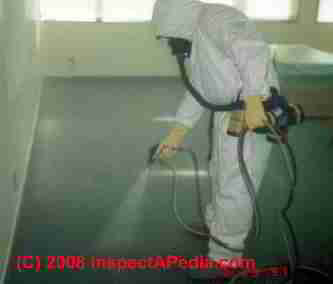
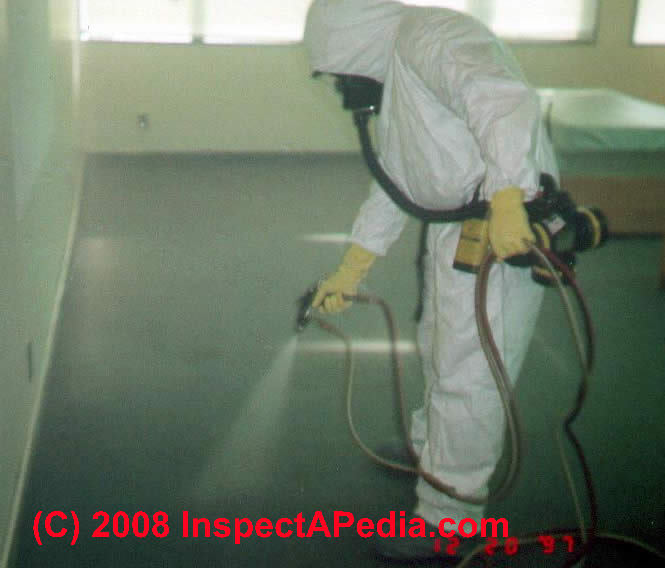
One could certainly question the usefulness, effectiveness, and wisdom of spraying carpeting such as shown in our page top photo. If the carpeting is so infected as to "need" spraying with a disinfectant, it and its padding should be removed, discarded, and the surfaces cleaned instead.
Be Careful to Avoid Premature or Inaccurate Mold Spray Application
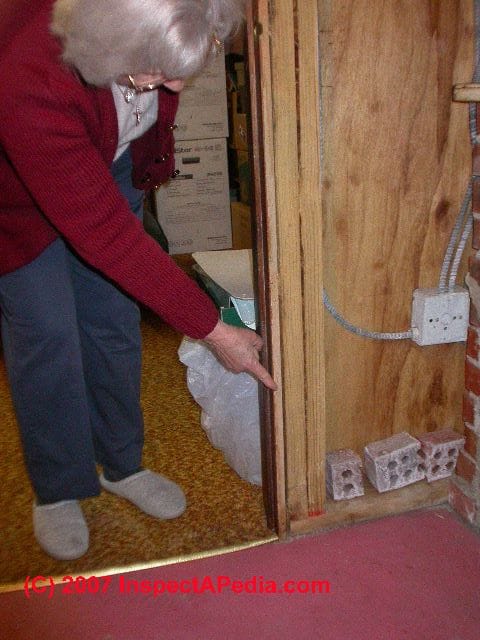
At a follow-up investigation requested by homeowners (client Z., 2007) we learned that a local mold remediator had applied a spray product into wall cavities and on interior wall surfaces.The clients reported that a "biocidal spray" was used in their basement and in upper floor wall cavities. (See Biocide Sanitizer Confusion below).
Because the problem mold reservoir had not been properly located, moldy odors and mold complaints persisted in the home.
The client is shown (photo at left) indicating one of the basement spray application locations. Based on client-perceived odor sources, the remediator used an thermography - an infra-red camera to identify cool areas around a window, areas that he then identified to the client as the problem mold reservoir. A mold spray product was applied through small openings into wall cavities around the window and on exposed surfaces in other building locations. (Photo, left).
THERMOGRAPHY IR Infra Red & Thermal Scanners - discusses use of infrared and thermography images and temperature scanning equipment.
The source of odors in a building can be tricky to pinpoint, as we discuss
at ODORS GASES SMELLS, DIAGNOSIS & CURE.
When the client continued to complain of mold odors in the home, a subsequent inspection including test cuts by the author were made into the previously-sprayed wall cavity where we found evidence that no water or air leaks (an expected cause of mold in a building cavity) nor mold had previously been present where the spray was applied.
That inspection and subsequent laboratory testing indicated that the spray procedure had been ineffective, almost certainly because it was applied based on poor mold-locating methodology, and because it had not been applied where mold was in fact present in a problem mold reservoir that we located (by inspection) elsewhere in the building.
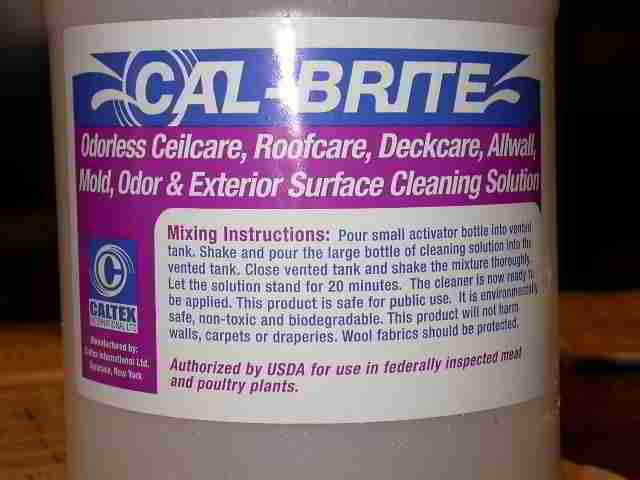
The client's leftover product's PACKAGE LABEL [Photo] described the coating as intended for ceilings, roofs, decks, walls, mold, odor, and exterior surface cleaning, and USDA authorized for use in federally inspected meat and poultry plants. The "left over material" was labeled as CalBrite™.
The company's attorneys have indicated that:
"CalBrite is not held out to be a biocide. To the contrary, CalBrite is a sanitizer, and when used it will kill as much mold as a more chemically potent or harmful biocide."
At its core however, the ultimate success of this mold odor removal case turned not on choice of mold spray chemical, but on accurately finding the problem mold reservoir. It illustrates the importance of determining that a problem mold reservoir is present in a building, using valid investigation and testing methods, and accurately locating the problem(s) in the building before any costly cleaning, sprays or other steps are applied.
See MOLD CLEANUP - MISTAKES to AVOID for a master list of the principal ways that people foul up mold cleanup projects.
Recommendations Against Use of Biocides in Buildings?
Really? Some experts also warn that at least some biocides may be irritating or harmful to building occupants, may leave harmful particles, are only temporarily and only partly effective, and may add moisture that adds problems to the building to the question “When should I use biocides during fungal remediation in buildings?” the short answer is that use of biocides should be avoided if you can.
We agree with the following opinion expressed by Dr. Harriet Burge, our favorite teacher and a respected expert in the field of public health:
Biocides, as the word indicates, are designed to kill living organisms. The simplest answer to the question, is to use biocides when you want to kill something. Answers are never so simplistic, however. Before using a biocide, you should consider the following questions:
- Is killing the organism going to make a difference in the remediation outcome?
The answer to the first question, at least with respect to fungal growth in buildings, is usually “no”. Most illnesses and symptoms related to fungal exposure will occur whether or not the fungus is alive or dead.
Also, the use of biocides will only marginally change the speed with which re-growth occurs if suitable moisture conditions recur. Cases where biocides may affect outcomes are in hospitals where infection of immunocompromised patients is of concern, in cleaning up bird droppings infested with Cryptococcus neoformans, or as a delay tactic in areas prone to repeated wetting.
Fixing the water problem, or using materials that do not support fungal growth, are better long-term solutions.
See MOLD KILLING GUIDE for more about "killing" mold. - Is the biocide effective against the organisms of concern in this case?
The second question is equally important, especially for fungi. Most biocides were designed to kill infectious bacteria in hospitals and other high-risk environments. Many biocides that work well against bacteria are essentially useless for the control of fungi.
Thus, fungi are highly resistant to ozone, ultraviolet radiation, quarternary ammonium compounds, and many other commonly used biocides. Some of these biocides (e.g., ozone) will inactivate some spores in a population and enhance germination for those remaining. For this reason, reliance on biocides is not recommended for the control of most fungi.
Examples of biocides that are effective against fungi are: ethylene oxide (useful as a fumigant for wet, moldy books), formaldehyde in high concentrations, and glutaraldehyde in high concentrations. None of these are recommended for use except under exceptional circumstances due to their potential toxicity. - Is exposure to the biocide more or less dangerous than exposure to the living agent(s) of concern?
For any biocide, it is important to weigh the risks of human exposure to the biocide against the potential benefit of reducing human exposure to the fungal species targeted.
For many infectious disease agents for which most biocides were designed, the disease is far worse than exposure to the biocide. So the answer is, for nonspecific building-related symptoms, the risk tradeoff is not so clear-cut.
If possible, biocide use should be avoided. If there is a logical reason to use biocides in a specific case, then care must be taken to insure that the biocide will be effective and that human exposure to the biocide will be minimized. -- Dr. Harriet Burge EM Lab by email 8/30/04
Also see MOLD CLEANUP - MISTAKES to AVOID for a master list of the principal ways that people foul up mold cleanup projects.
When is it Good Practice to use Disinfectants, Biocides, Mold Paints, Fungicidal Sealants and Encapsulant Sprays in a Crawl Space or in Other Building Areas?
Use a disinfectant when it is necessary to - as Burge said - kill something.
For example when cleaning up a building sewage spill it is necessary to first wash, then disinfect surfaces and contents. Details about these procedures are at

Surface encapsulant sprays
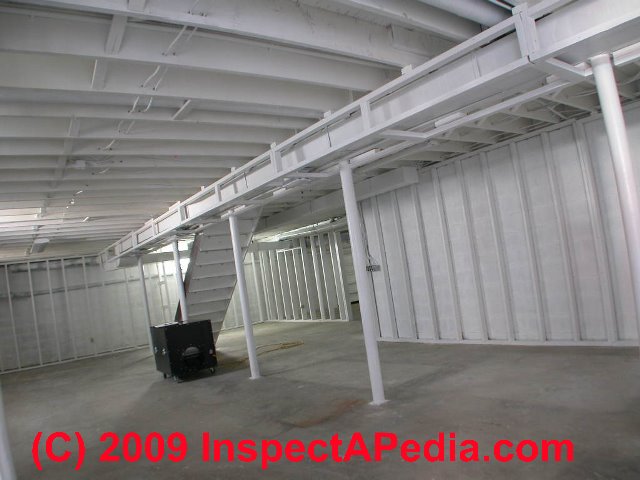
are used by mold and flood damage remediators to knock down remaining airborne particles in the work area and to immobilize (the hopefully very few) particles that remain on surfaces and in crevices of a building area after professional cleaning.

We sometimes see encapsulant sprays applied right on top of thick heavy debris or on building insulation. This is an ineffective shortcut that should be avoided. (Photo at above left).
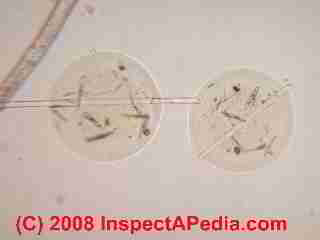
Our laboratory photo shows how a clear encapsulant spray (Fosters 4051™) produced individual "over spray" dried droplets which captured both small particles and some large fiberglass insulation fragments that were airborne at the time the encapsulant was being sprayed in the remediation area.
Clean, don't just spray:
Do not, however, permit the use of biocides, disinfectants, sprays, or encapsulants as a substitute for the physical cleaning that must come first.
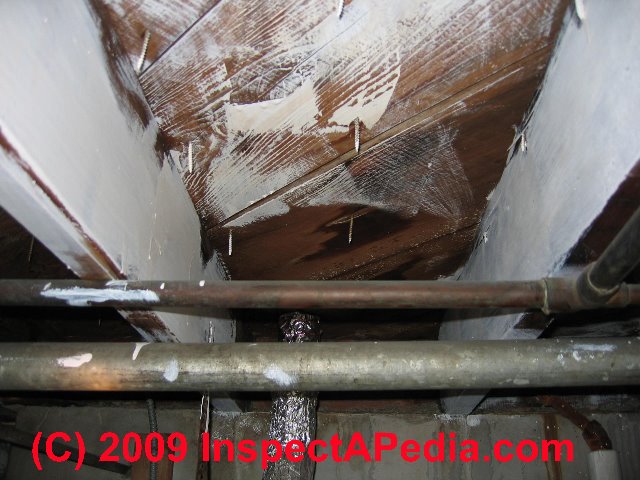
Otherwise there is risk that you will leave harmful contaminants and particles in the building, and it is likely that cleanup will be inadequate. Look at the thick debris sprayed-over in this building. Simply stirring the debris shows that this approach was ineffective.
If you are going to apply a mold paint or sealant in a building, be neat and thorough. Don't accept an incomplete, amateur job like the one shown in our photo at left.
Fiberlok IAQ 6000 HD™, Anabec X70™ waterborne sealant, and Fosters 4051™ (clear coating shown at above right) produce sealants frequently used by mold and flood damage remediation companies.
Also see Protex™ 63, a sealant and coating t formulated for exterior use. Or see our complete list
at DISINFECTANTS, SANITIZERS, FUNGICIDAL-SEALANTS SOURCES.
Once the building has been cleaned of debris and moldy materials, and building leaks, moisture traps, or crawl space water has removed, and after we've eliminated the sources of building water entry, we are ready to take the next steps to keep the building clean and dry.
See details at MOLD PREVENTION GUIDE
Also see TRAPPED MOLD BETWEEN WOOD SURFACES for a discussion of the question of need to remove mold from mated and inaccessible building surfaces.
Reader Comments, Questions & Answers About The Article Above
Below you will find questions and answers previously posted on this page at its page bottom reader comment box.
Reader Q&A - also see RECOMMENDED ARTICLES & FAQs
On 2018-09-24 by (mod) - Should a crawl space be dried out first?
That's probably okay. After all even if a crawl space has not flooded we will often see condensation or water under the plastic Vapor Barrier that has been put down. It is important however to be sure that the plastic is properly installed and not leaking humidity into the crawl area.
You may also need to continue to dehumidifier the crawl space to be sure that the wood or other materials are dried out. And if insulation was wet it needs to be removed.
On 2018-09-23 by hollis
I had a water pipe leak under the house shoot water on the ground about 100000 gallons. There was an inch of water.
It was dehuidified and had air blowers for 3 days then an inch of gravel put down thenb new plastic barrier. But it is wet under the plastoic barrier, Should a crawl space be dried out first? I=s it ok to put plastic over still wet ground?
Question: SMTS mold remediation?
(July 22, 2012) etcrandall@yahoo.com said:
Do you have any advice on the product SMTS mold remediation?
Reply:
Sure ETC Randall:
Taking a look at the SMTS product literature available from various users including some pest control operators, the product is a two part "mold spray" system:
Part 1 is a multi purpose antimicrobial based in quaternary ammonium salts. The chemical is a bactericide, virucide, disinfectant, fungicide, cleaner, mildew stat and deodorizer.
Part 2 of the system is a surface sealant that is sprayed onto the treated area. Usually sealants are used after surface cleaning in order to knock down remaining airborne dust and debris and more significantly in my opinion, to seal the surface to reduce the ease with which it takes up moisture in the future. Sealants, properly applied can also help control remaining odors that were emanating from the treated surfaces.
You should review the discussion in the article above about the importance of
physically cleaning or removing problem mold: removal is more important than "killing" since killing rarely kills 100% of pathogens in buildings (petri dishes look better than the uneven and various surfaces in a crawl space), and because some mold spores, even if "dead" - meaning they won't grow in a culture media - still are toxic or harmful to people or animals.
Basically, you are spraying a disinfectant and following up with a sealant.
Be sure to read the product's MSDS and you might want to look at the possible health effects of quaternary ammonium salts. Sometimes product manufacturer's promises are more than can be delivered, or do not fit the application (mold remediation) as perfectly as you may imagine.
Finally, no mold cleanup process is complete without finding and fixing the cause of mold growth in the first place.
Question: Benefect Botanical Disinfectant & mold bomb fogger from Biocide Labs?
(Dec 18, 2012) tjlm09@gmail.com said:
The "Benefect Botanical Disinfectant" product is described as less toxic than vinegar yet able to kill 99.99 percent of molds. Have you reviewed this product?
Mar 26, 2015) madeskv@yahoo.com said:
Have you heard of or had any experience with mold bomb fogger from Biocide Labs?
Reply:
Mad
you'll read that "killing" or "bombing" or "Fogging" to "kill" mold is not a proper substitute mold cleanup procedure. You need to remove the mold and fix the reason it grew in th building.
...
Continue reading at DISINFECTANTS, SANITIZERS, FUNGICIDAL-SEALANTS SOURCES or select a topic from the closely-related articles below, or see the complete ARTICLE INDEX.
Or see these
Mold Cleanup Articles
- ASBESTOS ENCAPSULANTS & SEALERS - coatings, encapsulants, fiber release control for asbestos containing materials
- MOLD CLEANUP GUIDE- HOW TO GET RID OF MOLD
- CARPET MOLD / ODOR TESTS
- DISINFECTANTS, SANITIZERS, FUNGICIDAL-SEALANTS SOURCES
- FUNGICIDAL SEALANT USE GUIDE - how & when to use a sealant or sanitizer
- MOLD CLEANERS - WHAT TO USE - how to clean off moldy building surfaces and what simple products to use
- MOLD CLEANUP with BLEACH
- MOLD CLEANUP, DRY THE MOLD-CLEANED SURFACE
- MOLD CLEANUP, LIMITATIONS
- MOLD CLEANUP - MISTAKES to AVOID
- MOLD CLEANUP, SAFETY WARNINGS
- MOLD CLEANUP - WOOD FRAMING & PLYWOOD
- MOLD CLEANUP - WOOD FLOORING
- MOLD & FUNGUS on WOOD SIDING: CLEAN & PREVENT
- MOLD REMOVAL, MEDIA BLASTING
- MOLD SANITIZER, SPRAY, BIOCIDE USE GUIDE
- OZONE MOLD KILL TREATMENT
- TRAPPED MOLD BETWEEN WOOD SURFACES
- MOLD CLEARANCE INSPECTIONS
- SEWAGE CLEANUP PROCEDURES & STANDARDS - how to use bleach, disinfectants & sanitizers in buildings
Suggested citation for this web page
MOLD SANITIZER, SPRAY, BIOCIDE USE GUIDE at InspectApedia.com - online encyclopedia of building & environmental inspection, testing, diagnosis, repair, & problem prevention advice.
Or see this
INDEX to RELATED ARTICLES: ARTICLE INDEX to MOLD CONTAMINATION & REMEDIATION
Or use the SEARCH BOX found below to Ask a Question or Search InspectApedia
Ask a Question or Search InspectApedia
Try the search box just below, or if you prefer, post a question or comment in the Comments box below and we will respond promptly.
Search the InspectApedia website
Note: appearance of your Comment below may be delayed: if your comment contains an image, photograph, web link, or text that looks to the software as if it might be a web link, your posting will appear after it has been approved by a moderator. Apologies for the delay.
Only one image can be added per comment but you can post as many comments, and therefore images, as you like.
You will not receive a notification when a response to your question has been posted.
Please bookmark this page to make it easy for you to check back for our response.
Our Comment Box is provided by Countable Web Productions countable.ca
Citations & References
In addition to any citations in the article above, a full list is available on request.
- Harriet Burge, Harvard School of Public Health, and EM Laboratory, a private mold and environmental testing lab - email to D.F. August, 2004. Dr. Burge is an educator, writer, and consultant in the field of indoor air quality and mold contamination.
- In addition to citations & references found in this article, see the research citations given at the end of the related articles found at our suggested
CONTINUE READING or RECOMMENDED ARTICLES.
- Carson, Dunlop & Associates Ltd., 120 Carlton Street Suite 407, Toronto ON M5A 4K2. Tel: (416) 964-9415 1-800-268-7070 Email: info@carsondunlop.com. Alan Carson is a past president of ASHI, the American Society of Home Inspectors.
Thanks to Alan Carson and Bob Dunlop, for permission for InspectAPedia to use text excerpts from The HOME REFERENCE BOOK - the Encyclopedia of Homes and to use illustrations from The ILLUSTRATED HOME .
Carson Dunlop Associates provides extensive home inspection education and report writing material. In gratitude we provide links to tsome Carson Dunlop Associates products and services.
 | HOME | ABOUT | ASK a QUESTION | CONTACT | CONTENT USE POLICY | DESCRIPTION | POLICIES | PRIVACY | |
| © 2024 - 1985 Publisher InspectApedia.com - Daniel Friedman | |||||||||