
InspectAPedia® FREE Encyclopedia of Building & Environmental Construction, Diagnosis, Maintenance & Repair |
Question? Just ask us! InspectAPedia
|
 Inspecting & Evaluating Damaged, Unsafe Lightning Protection Systems
- POST a QUESTION or COMMENT about visual inspection to detect unsafe lightning arrestor or protection systems
Basic inspection tips for lightning protection systems:
Examples & photos of damaged lightning protection system components & suggestions for how to inspect lightning protection systems are outlined here. This article series describes common lightning protection systems, certification, installation, and lightning protection system inspection.
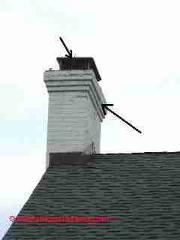
We provide information about lightning strikes, lightning hazards, related equipment, sources of lightning protection system installers, and lightning strike risk assessment. Our page top photo is of the remains of a lightning protection system found on a Poughkeepsie NY home built ca 1935.
InspectAPedia tolerates no conflicts of interest. We have no relationship with advertisers, products, or services discussed at this website.
Example of a Damaged Lightning Protection System
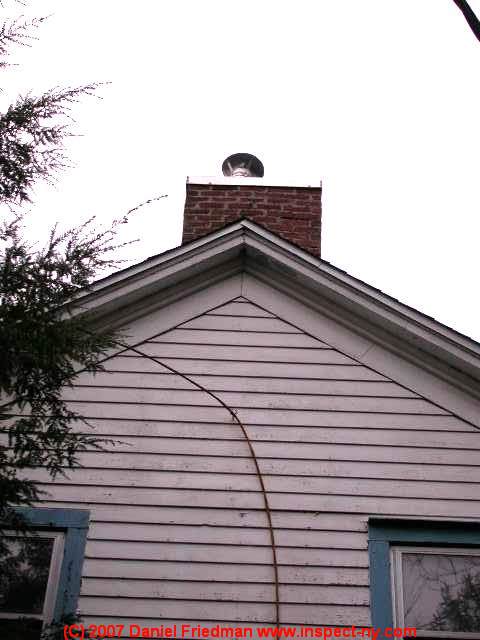
We took these photographs of a damaged lightning protection system on an 1865 house in Orange County, New York. (Newburgh NY).
[Click to enlarge any image]
The air terminal and conductor were bent down away from the top of the home leaving the chimney and roof (a metal one in an area of frequent lightning strikes) unprotected.
This is an example of what can happen when someone who is not qualified works on the system.
The lightning protection system for this home was dangerously compromised when the maintenance crew simply bent components down out of their way.
[The photographs of details of an old lightning protection system shown here were NOT the work of any of the companies or sources described at this website.]
Example of an Improperly Abandoned Lightning Protection System
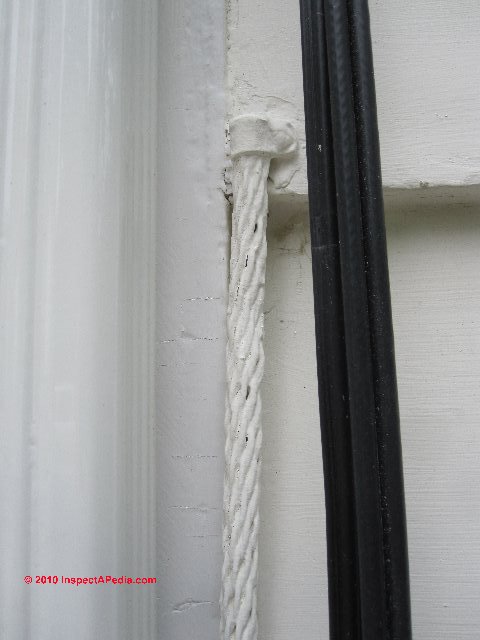
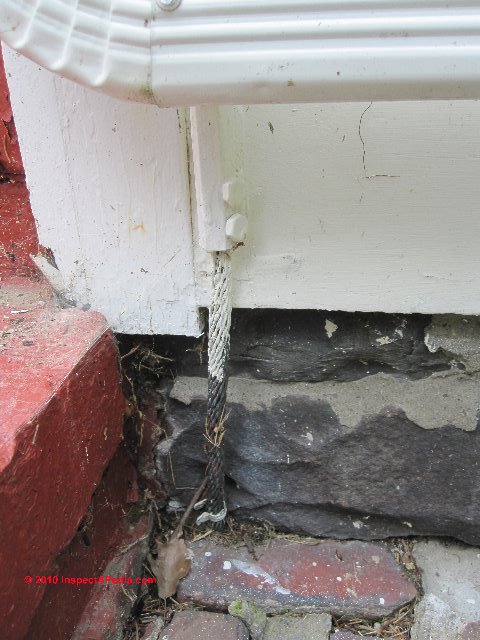
The two photographs just below show the remains of the grounding connections for a lightning arrestor system that was installed on a Poughkeepsie New York Home.
 ...
...
But our third photograph (below) also shows trouble at each of the home's chimneys.

Leaving an incomplete lightning protection system on a building may actually be worse than having nothing at all, as especially combined with a masonry chimney (wet, conductive in a storm), a copper chimney cap, and a remaining lightning rod that is no longer connected to ground, this system may be saying to nature "go ahead, hit me!".
In the photo above, the arrow at upper left points to the lightning protection air terminal electrode, and the arrow at lower right in our photo points to the conductor cable that was cut off, perhaps by the roofers or by the house painters when they found that the lightning protection system wiring was "in the way".
We recommend removing rooftop electrodes and conductors that are no longer connected to ground, or if you believe that the original owner and installer felt that there was a reason for installing this system, it should be repaired by an expert.
Below: an example of secure bonding between the lightning rod and the current conductor between the lightning rod and earth. This lightning protection system detail is observed atop the Saxon Tower in Oxford in the U.K.
 \
\
Below we see the grounding conductor at its connection to the earthing rod at the Saxon Tower in Oxford.
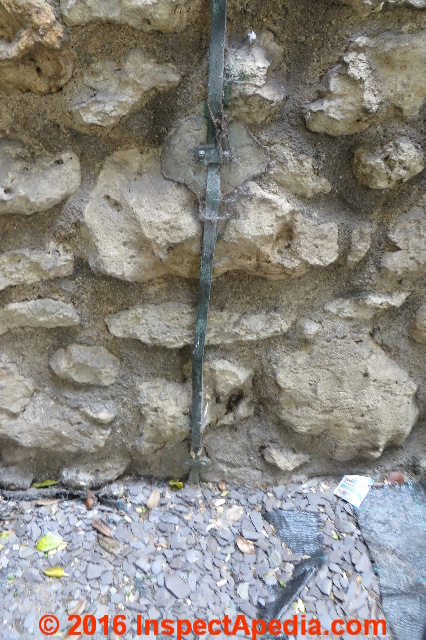
You can see the lightning rod itself atop the Saxon Tower
at LIGHTNING PROTECTION, HOW IT WORKS.
Inspection tips for Lightning Protection Systems
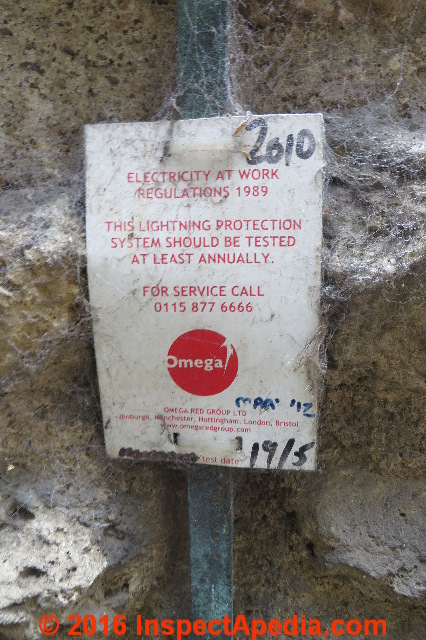
- In the U.S. look for the UL certification label for the lightning protection system. Often this tag is screwed to the building wall
outside near where a main cable approaches ground level for connection to the ground rod.
At left is the inspection tag for U.K. lightning protection systems at the Saxon Tower in Oxford in the U.K. in compliance with UK regulations from 1989. - Look for documentation describing who installed the system and when it was last inspected
- Look for evidence of burned, damaged components that may have taken a lightning strike and need to be replaced or repaired
- Look for missing or loose components such as sections of cabling, air terminals, or connectors which may have been removed. In the
photographs above, a contractor working on the chimney simply removed and bent components of the lightning protection system to
get it out of his way.
In photos shown earlier in this article, the house had a metal roof, a chimney now employing a metal cap and metal liner, and the property had a history of recurrent lightning strikes on and near the building! - If a "hidden" lightning protection system is installed you will not be able to find all of its components as some sections of cabling may run inside walls or even inside chimney masonry. But look in the attic for grounding conductors, connections, etc.
- Look for a UL tag affixed to the building confirming that the lightning protection system components are UL-listed for that purpose.
- The Lightning Protection Institute (LPI) tests and certifies Professional Design/Inspectors for lightning protection systems.
- Fisher, Charles E., LIGHTNING PROTECTION for HISTORIC STRUCTURES [PDF] COMPLETE VERSION (2017) Preservation Brief No. 50, US NPS, US DOE, retrieved 2022/10/09, original source: https://www.nps.gov/tps/how-to-preserve/preservedocs/preservation-briefs/50Preserve-Brief-Lightning-Protection.pdf
- This list is incomplete - contributions and critique are invited. CONTACT US
...
Continue reading at LIGHTNING PROTECTION SYSTEM CERTIFICATION or select a topic from the closely-related articles below, or see the complete ARTICLE INDEX.
Or see these
Recommended Articles
- GAS PIPING, FLEXIBLE CSST - lightning protection needed for flexible stainless steel tubing used as gas piping
- LIGHTNING PROTECTION SYSTEMS - home
- LIGHTNING PROTECTION SYSTEMS, DEFINITIONS
- LIGHTNING PROTECTION, HOW IT WORKS
- LIGHTNING PROTECTION SYSTEM DAMAGED, UNSAFE
- LIGHTNING PROTECTION SYSTEM CERTIFICATION
- LIGHTNING PROTECTION SYSTEM DESIGN
- LIGHTNING PROTECTION for TREES
- LIGHTNING PROTECTION, HIDDEN
- LIGHTNING STRIKE RISK ASSESSMENT
- LIGHTNING, AVOID BEING STRUCK BY
- LIGHTNING STRIKES SMALL BOAT
Suggested citation for this web page
LIGHTNING PROTECTION SYSTEM DAMAGED, UNSAFE at InspectApedia.com - online encyclopedia of building & environmental inspection, testing, diagnosis, repair, & problem prevention advice.
Or see this
INDEX to RELATED ARTICLES: ARTICLE INDEX to LIGHTNING PROTECTION SYSTEMS
Or use the SEARCH BOX found below to Ask a Question or Search InspectApedia
Ask a Question or Search InspectApedia
Try the search box just below, or if you prefer, post a question or comment in the Comments box below and we will respond promptly.
Search the InspectApedia website
Note: appearance of your Comment below may be delayed: if your comment contains an image, photograph, web link, or text that looks to the software as if it might be a web link, your posting will appear after it has been approved by a moderator. Apologies for the delay.
Only one image can be added per comment but you can post as many comments, and therefore images, as you like.
You will not receive a notification when a response to your question has been posted.
Please bookmark this page to make it easy for you to check back for our response.
Our Comment Box is provided by Countable Web Productions countable.ca
Citations & References
In addition to any citations in the article above, a full list is available on request.
- Portions of this information are based on UL publication 200-81 11/87 and other local service company information about lightning protection systems and lightning strike hazards.
- Special thanks to Associated Lightning Rod Company, Cooper Road Box 329A, Millerton NY who has been contributing technical content in presentations to NY ASHI home inspectors since 1996. Some of that information [on lightning system material and installation details] was edited for clarity. ALRCi can be reached at 518-789-4603, 845-373-8309, 860-364-1498 and will inspect your lightning protection system at no charge. [We have no financial nor any other business relationship with any company or product discussed at this website--DF]
- For more details on how lightning protection systems work, see Lightning Protection from Pacific Electric and Gas Company, and Electrical System Grounding and Lightning Protection, Engineering Technical Letter 90-6, Department of the Air Force, HQ USAF.
- Lightning strike risk assessment: for the full body of this excellent article which summarizes recent opinions about lightning strike risk assessment and safe practices for individuals or groups needing to avoid being struck by lightning, see Updated Recommendations for Lightning Safety - 1998 Ronald L. Holle and Raul E. Lopez from National Severe Storms Laboratory, NOAA and Norman, Oklahoma, Christoph Zimmermann Global Atmospherics, Inc. Tucson, Arizona
- As we indicated in an original version of this article, a lightning strike risk assessment guide can be found in Appendix I of the National Fire Protection Association's Lightning Protection Code, NFPA #780. The guide considers type of structure, type of construction, structure location, topography, occupancy, contents and lightning frequency. Contact NFPA, Batterymarch Park, Quincy, MA 02269 617-770-3000.
- Lightning Protection Institute, 3365 N. Arlington Heights Rd., Suite J., Arlington Heights IL 60004
- Underwriters Laboratory Standard UL96A. These requirements cover the installation of lightning protection systems on all types of structures other than structures used for the production, handling, or storage of ammunition, explosives, flammable liquids or gases, and other explosive ingredients including dust. These requirements apply to lightning protection systems that are complete and cover all parts of a structure. Partial systems are not covered by this standard. These requirements do not cover the installation of lightning protection systems for electrical generating, distribution, or transmission systems. These requirements do not cover lightning protection components, which are covered by the Standard for Lightning Protection Components, UL 96.
- Underwriters Laboratory Standard UL96: These requirements cover lightning protection components for use in the installation of complete systems of lightning protection on buildings and structures. These requirements do not cover the installation of lightning protection components. Products of this type are covered by the Standard for Installation Requirements for Lightning Protection Systems, UL 96A.
- "Lightning Awareness," Gerry Schulte, BMW ON magazine, June 2007 pp. 58-60, provided some technical details about lightning, and refers readers to www.lightningsafety.noaa.gov/outdoors.htm
- Our recommended books about building & mechanical systems design, inspection, problem diagnosis, and repair, and about indoor environment and IAQ testing, diagnosis, and cleanup are at the InspectAPedia Bookstore. Also see our Book Reviews - InspectAPedia.
- Armor Lightning Protection Inc Manchester Center, VT, 802-375-0266 state-of-the-art lightning protection and surge protection for residential and commercial buildings in Vermont, New England, and throughout the Northeast
- Associated Lightning Rod Company, Inc., Box 329A, Cooper Road, Millerton, NY 12546 914/373-8309 518/789-4603
- A-C Lightning Security, Inc., 2100 East First St., PO Box 329, Maryville MO 64468 816-582-8115 800-821-5575 816-562-2932. In New York, Hudson Valley, contact Christensen Electrical Power Systems, Richard G. Christensen, 518-537-4128.
- Lightning Eliminators & Consultants6687 Arapahoe Road Boulder, CO 80303 (303) 447-2828. "Engineering Solutions For Lightning, Grounding and Surge Protection Worldwide Since 1971"
- Electrical EINET
- Lightning Protection for Facilities, Dr. Bruce Gabrielson, Robert B. Marcus, Published and presented: EMCEXPO92, Washington D.C.
- MIT's Electrical Safety Files
- Lightning Protection for Workers What to Do if You're Outside in a Lightning Storm - Center to Protect Workers' Rights (PDF)
- 1998 and Current Lightning Protection Conferences & Exhibitions
- Lightning Risk and Hazard Analysis Measurement from the National Lightning Safety Institute (NLSI).
- "Lightning Fatalities, Injuries, and Damage Reports in the United States from 1959-1994", E. Brian Curran, Ronald L. Holle, Raul E. Lopez, NOAA Technical Memorandum NWS SR-193 October 1997
- UL - Underwriters Labs Lightning equipment certification program. "Underwriters Laboratories Inc. (UL) has been testing and certifying lightning protection equipment since 1908. UL issues certificates of conformance for systems, inspecting system components and checking completed installations. Installations are required to comply with UL's internationally recognized Standards for lightning protection systems. Manufacturers, suppliers and installers demonstrate their commitment to safety by building, selling and installing only those lightning protection products that pass UL's rigorous testing." -- (Op.Cit.)
- * Safety Hazards and Safe Inspection Procedures for Electrical and Home Inspectors at Residential Electric Panels
- In addition to citations & references found in this article, see the research citations given at the end of the related articles found at our suggested
CONTINUE READING or RECOMMENDED ARTICLES.
- Carson, Dunlop & Associates Ltd., 120 Carlton Street Suite 407, Toronto ON M5A 4K2. Tel: (416) 964-9415 1-800-268-7070 Email: info@carsondunlop.com. Alan Carson is a past president of ASHI, the American Society of Home Inspectors.
Thanks to Alan Carson and Bob Dunlop, for permission for InspectAPedia to use text excerpts from The HOME REFERENCE BOOK - the Encyclopedia of Homes and to use illustrations from The ILLUSTRATED HOME .
Carson Dunlop Associates provides extensive home inspection education and report writing material. In gratitude we provide links to tsome Carson Dunlop Associates products and services.
 | HOME | ABOUT | ASK a QUESTION | CONTACT | CONTENT USE POLICY | DESCRIPTION | POLICIES | PRIVACY | |
| © 2024 - 1985 Publisher InspectApedia.com - Daniel Friedman | |||||||||