
InspectAPedia® FREE Encyclopedia of Building & Environmental Construction, Diagnosis, Maintenance & Repair |
Question? Just ask us! InspectAPedia
|
 Home Energy Audit to Evaluate Building Heat Loss or Heat Gain & Choose Heating or Cooling Improvements
- POST a QUESTION or COMMENT about home energy audits
Using a home energy audit to best advantage:
This article explains how to make best use of a home energy audit to reduce home heating or cooling costs.
We provide related insulation and heat loss or heat gain analysis procedures including how to measure or calculate heat loss in a building, defines thermal terms like BTU and calorie, provides measures of heat transmission in materials, gives desired building insulation design data, and shows how to calculate the heat loss in a building with R values or U values.
InspectAPedia tolerates no conflicts of interest. We have no relationship with advertisers, products, or services discussed at this website.
How to Get the Most Benefit from a Free Home Energy Audit
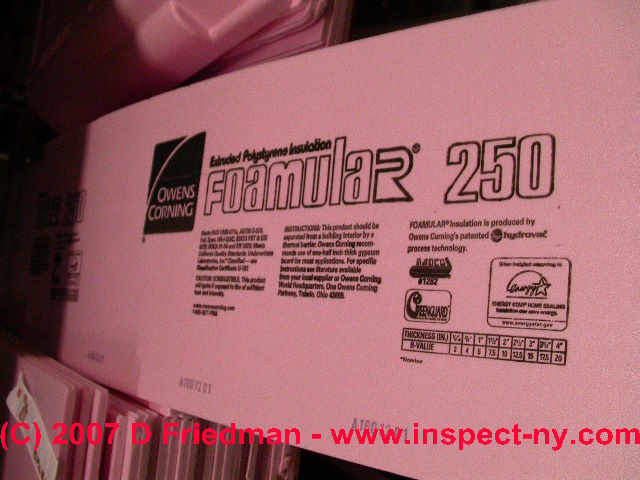
Formula-R™ and Owens Corning™ which may be visible in our page top photograph of pink Styrofoam™ insulation boards are registered trademarks of Owens Corning® and were photographed at a Home Depot® building supply center.
Many people have heard of using "R" values to describe "how good" a building's insulation is. This article explains three measures of the flow of heat out of or into a building: R-values, K-values, and U-values. Each of these is defined below. But before moving on to these basic concepts of building heat loss (or gain) theory, it is essential that this still more basic point be considered:
It doesn't matter much how wonderful the building insulation is, how thick it is, or what the insulating material's "R" value is (see R defined below) if the building is leaky.
If, for example, we're considering an older home with leaky windows or doors, or if we're considering a tall building with poorly controlled heat in winter, such that occupants of the upper floors are leaving windows open in winter then the heat flow out of these openings will be so terrific that the amount of insulation won't matter much.
See also HEAT LOSS R U & K VALUE CALCULATION
How to make use of a home energy audit or free home energy use survey
A less precise and less computerized method for calculating building heat loss (or gain) is used by people who perform an "energy survey" or energy audit for a building. Home energy audit services may be free from your local utility company.
The energy survey technician uses a pre-printed form whereon s/he records the areas of the building's walls, top floor ceilings, foundation walls, floors, and the number and type of windows and doors.
An "R" value is assigned to these and the sheet is used to manually calculate the building's rate of heat loss. We had one of these "free" surveys performed on a home built in 1900 when we were renovating it years ago. Regrettably the surveyor was either poorly trained or simply not very observant.
The free energy audit surveyor rated our building walls at a very high rate of heat loss by assuming that they were not insulated whatsoever (and then proceeded to try to sell us an insulation service).
What that particular home energy audit surveyor failed to notice was that the building walls had been insulated (with blown-in foam) - a condition that was quite easy to see since we had removed the building's exterior siding and wall sheathing. He just didn't look.
So while home energy audits are a great idea, make sure your auditor is awake before you believe the results of the home energy survey.
And remember that some "home energy auditors" are really trying to sell you replacement windows (very long payback time) or building insulation. (Remember the urban legend about the home energy auditor who was using a camera light meter as an "energy loss" indicator to convince home owners that they needed new windows?)
Question: who do I call to get advice on saving on my heating costs?
2017/11/05
In 1985/86 local electric utility company's weatherization program did the following for my house:
1. blow insulation put between roof & ceiling, under home crawl space & some other don't know where all at places between exterior wood cedar shingles & exterior walls
2. former wood & rope frame windows replaced with new aluminium slide frame windows
In 2015 licensed, ETC roof business, now out of business, workers removed former roof tar paper & asphalt shingles, added some extra what i call beams, looked like maybe 2 by 4
replaced former roof tar paper & asphalt shingles with new roof tar paper & lifetime asphalt shingles
all nailed to beams
There is no crawl space area between roof & ceiling
Each of my rooms has its own individual base board heaters with on heater controls. Some heaters, not all, were replaced once from 1900 - 2005. Not all of the electric heaters are working right, so I leave them turned off at circuit panel.
I need to know what type/kind of business, ETC i need to do what additional work re: current roof, insulation, ETC situation to help make my home less cold Sept through May every year
- Anonymous by private email
Reply: where to get energy program help from your state, warnings about for-pay or even "free" energy audits
If I understand your question is
"Who can tell me what energy-savings or heat-cost reduction steps I should take for my home?"
You live in Parkland Washington
This website: https://www.energycodes.gov/adoption/states/washington
provides information about your state's energy codes and gives links to its various energy programs.
Also you can use your web browser to search for
Parkland Washington energy audit
and you will see a list of companies offering that service.
You need to know:
Where are the most-important points of un-wanted energy-costs
Watch out: Beware that some energy auditors are better or more-comprehensive than others, and that many of them want to sell you a specific product, like insulation or weatherizing. Still their services are useful and often are offered at no charge.
Too many "home energy auditors" offer services like "blower door testing" that are not sufficiently diagnostic. Such tests, like any incomplete building inspection service, might tell you that your home is leaky and could save money by a weatherizing program, but the test alone will not tell you exactly what steps are needed.
Your energy audit needs to identify:
- Cold air leaks into the building
- Heat losses out of the building
- Areas of missing insulation
- Causes of excessive stack-effect air movement upwards drawing cold air into the building during the heating season
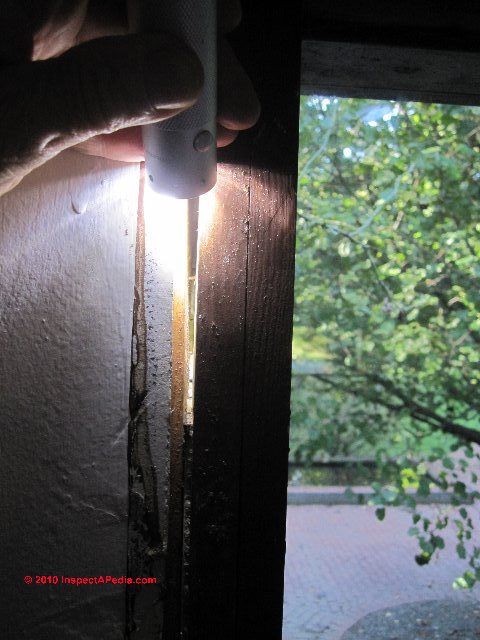 A casual energy audit by an experienced weatherization or insulation company might spot common points of heat loss and may walk around your home commenting on common problem spots like recessed ceiling lights, gaps in trim caulk, or roof ventilation.
But without a more careful, better-informed analysis, perhaps using thermography or other measurements during the heating season, often such generic advice is plain wrong.
Examples of Some Energy Auditors & Their Advice
Case 1: wrong assumptions about building insulation
In the 1980's a New York State energy auditor examined a home built in 1900, that had blown-in foam insulation in the 1970's, and that I [DF] had renovated, weather stripped, caulked, and sealed in the 1980's.
He noted the age of the home and said "well your walls are uninsulated, you need to have us insulate them". A rather careless conclusion that was not helpful.
It's not entirely sensible to assume that by 2015 a home built in 1900 has never had insulation added to its walls and attic, and a careful inspection can usually spot signs that insulation has indeed been added.
This home sported round drill marks where insulation had been blown into walls, and in both attic and basement oozing foam insulation was readily visible had anyone bothered to look.
An experienced auditor might have known that during the 1970's Arab Oil Embargo energy crisis many people blew UFFI into their older home's uninsulated walls.
Mixed-wrong UFFI could cause temporary but un-wanted high levels of formaldehyde off-gassing, and later owners might have discovered that their UFFI shrunk,leaving gaps around the insulation in walls.
UFFI SHRINKAGE, THERMAL BYPASS LEAKS has details.
To be fair, no inspector can discover every important construction detail, defect, or condition at a property. But where there is clear visual evidence, it'd be helpful if she'd take a look at it.
Case 2: missing the energy savings target by shooting (your caulk gun) in the dark
 Recently an experienced energy auditor examined another home with me. That house, built in 1970, has undergone extensive energy savings improvements that focused on finding and fixing air leaks.
Details of that project are at WINDOW / DOOR AIR LEAK SEALING HOW TO.
Our energy auditor
- Did not ask if we had already taken any steps to save on energy costs - that might have enabled him to see mistakes in what we had done, or to focus on what remaining steps would be most-beneficial
- Did not use any instruments to examine for points of heat loss or air leaks
- Did make a casual (and free) walk-around the outside and some of the inside of the home, suggesting that we would benefit from better caulking and sealing of exterior trim and interior pot lights or ceiling lights. He also suggested providing outdoor air supply to a heating boiler (located in a garage into which outdoor air leaks around the garage door).
We were left with a couple of nice suggestions but no idea whether or not those suggestions were accurately drawn rather than drawn just from general experience. There was not mention of where we had actually found the major air leaks previously, discussed at the window and door air leak sealing project cited above.
To be fair, nobody can, in a casual walk-through, know the detailed history of a building, nor can they have a complete picture with objective data showing the priorities of attention to stop un-wanted energy costs.
But an energy auditor could ask about building history or spot evidence of renovations and discuss what has been done in deciding what remains to be done.
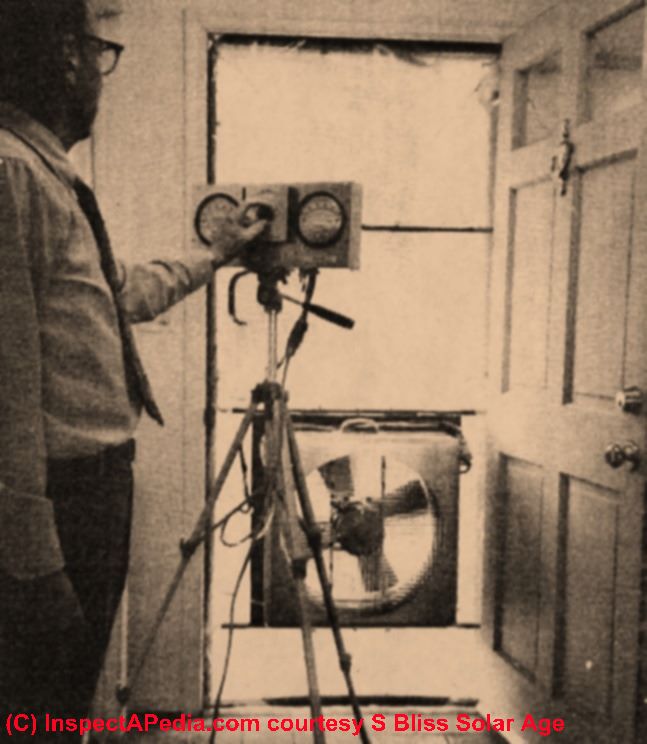
The auditor offered a for-fee blower door test that would tell how much air leakage the building was still suffering.
While blower door tests are useful diagnostic tools, they're not prescriptive. We'd have still needed to guess at where the air leaks were and thus would be shooting our caulk guns in the dark.
See BLOWER DOORS & AIR INFILTRATION
Using infra-red or thermography to screen buildings for un-wanted heat loss, leaks, or heat gain points
Home energy loss surveys using thermography or simple infra-red thermometers are a great way to pinpoint individual points of heat loss (or unwanted heat gain) in a building.
In the hands of a properly-trained expert (not a window salesman) this equipment can help find unexpected building air leaks or heat loss points even when you think that the building has already been insulated.
Having a "high-R" insulated wall or ceiling is not going to be enough to make a building energy efficient if there are many unidentified air leaks or insulation voids in the building's walls, ceilings, or floors.
See THERMAL IMAGING, THERMOGRAPHY for an series of articles explaining what thermography is, how it works, how it is best-used to save energy in buildings, and where to buy thermography scanning cameras and equipment.
What is the Typical Design Temperature for buildings and Building Insulation?
The "indoor design temperature" for a building refers to the assumed target indoor temperature that the building owner or occupants want. Typically 70 deg. F. is used unless the owner specifies something different.
The "outdoor design temperature" for a building is (for heating purposes) assumed to be the average lowest recorded temperature for each month between October and March (the heating season in most climates).
If we are specifying a "design temperature" for cooling climates we'd use the average outdoor highest recorded temperature during the heating season, perhaps April through September.
Building Energy Codes & Standards for Energy Ratings
These codes include detailed specifications for testing and reporting on HVAC system air leakage
- CALIFORNIA HERS REGULATIONS, Home Energy Rating System [PDF], U.S. California Energy Commission (2009) CEC-400-2008-011-CMF, CALIFORNIA CODE OF REGULATIONS
TITLE 20
Chapter 4, Article 8, Sections 1670 – 1675
California Home Energy Rating System Program
Abstract:
Public Resources Code (PRC) Section 25942 directs the Energy Commission to adopt a statewide California Home Energy Rating System (HERS) Program for residential dwellings.
Phase I of the California HERS Program, which was adopted in 1999, established the basic operating framework of the program, including training and certification procedures for raters, quality assurance procedures, and data collecting and reporting requirements for raters who are performing field verification and diagnostic testing services for demonstrating compliance with Title 24 Building Energy Efficiency Standards. - CALIFORNIA HERS REGULATIONS / STANDARDS APPENDIX [PDF] , U.S. California Energy Commission (2009), effective 2010, for residential & non-residential buildings, CEC-400-2008-004-CMF
- CALIFORNIA HERS REGULATIONS TECHNICAL MANUAL [PDF], U.S. California Energy Commission (2008) cite as: California Energy Commission, HERS Technical Manual, California Energy Commission, High
Performance Buildings and Standards Development Office. 2012.
Abstract:
(HERS) Program, including requirements for HERS Providers, modeling procedures and assumptions for HERS software, and procedures for California Wholeâ€ÂÂÂÂÂÂÂÂÂÂHouse Home Energy Raters. HERS rating software is used to calculate the California HERS Index, generate recommendations on how to improve the energy performance of the rated home, and analyze customers utility bills.
The Technical Manual also explains the roles, requirements, and procedures for persons certified to perform specific functions related to HERS ratings. The Technical Manual explains the requirements for completion of California Home Energy Audits that are provided for people who do not wish to have a formal rating but want recommendations for cost-effective energy efficiency improvements. The Technical Manual also explains the HERS reports, data collection procedures, and certification and quality assurance procedures. - ENERGY CODE, U.S. Department of Energy, Website: https://www.energycodes.gov/
Website Excerpt:
The Building Energy Codes Program (BECP) mission is to support building energy code development, adoption, implementation and enforcement processes to achieve the maximum practicable, cost-effective improvements in energy efficiency while providing safe, healthy buildings for occupants.
The U.S. Department of Energy (DOE) is directed to participate in industry processes to develop model building energy codes, issue determinations as to whether updated codes result in energy savings, and provide technical assistance to states to implement and comply with the codes. - ENERGY DESIGN GUIDE for Medium Box Retail, Technical Report NREL/TP-550-42828 (2008) [PDF]
- ENERGY DESIGN GUIDE for Grocery Stores, Technical Report NREL/TP-550-42829 (2008) [PDF]
- International Energy Conservation Code (IECC) - see PDF copies of the 2012 IECC versions adopted by Washington State below
- Iowa: RESIDENTIAL BUILDINGS ENERGY CODE SUMMARY - US State of Iowa [PDF] retrieved 2017/07/14, original source: http://www.dps.state.ia.us/fm/building/energy/PDF/Iowa_Residential_Energy_Code_Summary_2012.pdf
- NY CES Clean Energy Standard,[PDF] retrieved 2017 07 26 New York State Energy Research and Development Authority
17 Columbia Circle
Albany, NY 12203-6399 Email: info@nyserda.ny.gov Tel: 518-862-1090 Contacts: https://www.nyserda.ny.gov/Contacts
original source: https://www.nyserda.ny.gov/All-Programs/Programs/Clean-Energy-Standard
Website excerpt:
The CES is designed to fight climate change, reduce harmful air pollution, and ensure a diverse and reliable low carbon energy supply. To help achieve these goals, the CES requires that 50 percent of New York's electricity come from renewable energy sources such as solar and wind by 2030, with a progressive phase-in schedule starting in 2017.
NYSERDA Code Overview & Library: New York State Energy Research and Development Authority Email: info@nyserda.ny.gov Tel: 518-862-1090 866-NYSERDA (Toll free) Website: https://nyserdacodetraining.com/overview.php - NYSERDA FIELD INSPECTION GUIDELINES - SOLAR HEATING SYSTEMS [PDF]
- NYSERDA, New York State Energy Research and Development Authority, Website: https://www.nyserda.ny.gov/About
Website excerpt:
Clean energy can power New York while protecting the environment. The New York State Energy Research and Development Authority, known as NYSERDA, promotes energy efficiency and the use of renewable energy sources.
These efforts are key to developing a less polluting and more reliable and affordable energy system for all New Yorkers. Collectively, NYSERDA's efforts aim to reduce greenhouse gas emissions, accelerate economic growth, and reduce customer energy bills. - NYSERDA Plan Review & Inspection Services, assistance with building plan review and on-site inspection services Website: https://nyserdacodetraining.com/services.php
- Pennsylvania: SMALL WIND ELECTRICL SYSTEMS Consumer's Guide US Pennsylvania [PDF] U.S. Department of Energy, Energy Efficiency and Renewable Energy
- WASHINGTON STATE COMMERCIAL ENERGY CODE [PDF] (2015) Washington state has adopted (and amended its version of) the 2012 edition of the International Energy Conservation Code Commercial Provisions, the 2012 IECC model code. Retrieved 2017/11/05, original source: https://fortress.wa.gov/ga/apps/SBCC/File.ashx?cid=6195
- WASHINGTON STATE RESIDENTIAL ENERGY CODE [PDF] (2015) Washington state has adopted (and amended its version of) the 2012 edition of the International Energy Conservation Code Residential Provisions, the 2012 IECC model code. Retrieved 2017/11/05, original source: https://fortress.wa.gov/ga/apps/SBCC/File.ashx?cid=6303
...
Continue reading at ENERGY SAVINGS MAXIMIZE RETURNS ON or select a topic from the closely-related articles below, or see the complete ARTICLE INDEX.
Or see these
Recommended Articles
- AIR LEAK SEALING STRATEGIES - home
- ENERGY SAVINGS in BUILDINGS - home
- AIR CHANGE RATE ACH HEAT SAVINGS
- AIR LEAK SEALING PROCEDURE
- AIR LEAKS in DUCT CONNECTIONS
- AIR LEAKS in RETURN DUCTS
- AIR LEAKs in SUPPLY DUCTS
- ENERGY AUDIT, HOW TO USE
- ENERGY AUDIT STANDARDS for ENERGY RATINGS
- ENERGY RETROFIT BOTTOM LINE
- ENERGY SAVINGS MAXIMIZE RETURNS ON
- ENERGY SAVINGS PRIORITIES
- ENERGY SAVINGS RETROFIT CASE STUDY
- ENERGY SAVINGS RETROFIT LEAK SEALING GUIDE
- ENERGY SAVINGS RETROFIT OPTIONS
- ENERGY STAR PROGRAM
- ENERGY USE MONITORING
- ENERGY USE MONITORING, SOLAR
- HEATING COST SAVINGS METHODS
- HEAT LOSS INDICATORS
- HEAT LOSS R U & K VALUE CALCULATION
- HIGH MASS TRADEOFFS, HEATING vs COOLING
- HOUSE DOCTOR, HOW to BE
- TIMERS for ELECTRIC WATER HEATERS
- VENTILATION, BALANCED HEAT COST SAVINGS
- HEAT LOSS R U & K VALUE CALCULATION
- INSULATION INSPECTION & IMPROVEMENT - home
- INSULATION R-VALUES & PROPERTIES - R-values & U Values of various materials
- PERM RATINGS of BUILDING MATERIALS
Suggested citation for this web page
ENERGY AUDIT, HOW TO USE at InspectApedia.com - online encyclopedia of building & environmental inspection, testing, diagnosis, repair, & problem prevention advice.
Or see this
INDEX to RELATED ARTICLES: ARTICLE INDEX to BUILDING ENERGY SAVINGS
Or use the SEARCH BOX found below to Ask a Question or Search InspectApedia
Ask a Question or Search InspectApedia
Try the search box just below, or if you prefer, post a question or comment in the Comments box below and we will respond promptly.
Search the InspectApedia website
Note: appearance of your Comment below may be delayed: if your comment contains an image, photograph, web link, or text that looks to the software as if it might be a web link, your posting will appear after it has been approved by a moderator. Apologies for the delay.
Only one image can be added per comment but you can post as many comments, and therefore images, as you like.
You will not receive a notification when a response to your question has been posted.
Please bookmark this page to make it easy for you to check back for our response.
Our Comment Box is provided by Countable Web Productions countable.ca
Citations & References
In addition to any citations in the article above, a full list is available on request.
- American Plywood Association, APA, "Portland Manufacturing Company, No. 1, a series of monographs on the history of plywood manufacturing",Plywood Pioneers Association, 31 March, 1967, www.apawood.org
- "An Example of Colonial Paneling", Norman Morrison Isham, The Metropolitan Museum of Art Bulletin, Vol. 6, No. 5 (May, 1911), pp. 112-116, available by JSTOR.
- "Energy Savers: Whole-House Supply Ventilation Systems [copy on file as /interiors/Energy_Savers_Whole-House_Supply_Vent.pdf ] - ", U.S. Department of Energy energysavers.gov/your_home/insulation_airsealing/index.cfm/mytopic=11880?print
- "Energy Savers: Whole-House Exhaust Ventilation Systems [copy on file as /interiors/Energy_Savers_Whole-House_Exhaust.pdf ] - ", U.S. Department of Energy energysavers.gov/your_home/insulation_airsealing/index.cfm/mytopic=11870
- "Energy Savers: Ventilation [copy on file as /interiors/Energy_Savers_Ventilation.pdf ] - ", U.S. Department of Energy
- "Energy Savers: Natural Ventilation [copy on file as /interiors/Energy_Savers_Natural_Ventilation.pdf ] - ", U.S. Department of Energy
- "Energy Savers: Energy Recovery Ventilation Systems [copy on file as /interiors/Energy_Savers_Energy_Recovery_Venting.pdf ] - ", U.S. Department of Energy energysavers.gov/your_home/insulation_airsealing/index.cfm/mytopic=11900
- "Energy Savers: Detecting Air Leaks [copy on file as /interiors/Energy_Savers_Detect_Air_Leaks.pdf ] - ", U.S. Department of Energy
- "Energy Savers: Air Sealing [copy on file as /interiors/Energy_Savers_Air_Sealing_1.pdf ] - ", U.S. Department of Energy
- In addition to citations & references found in this article, see the research citations given at the end of the related articles found at our suggested
CONTINUE READING or RECOMMENDED ARTICLES.
- Carson, Dunlop & Associates Ltd., 120 Carlton Street Suite 407, Toronto ON M5A 4K2. Tel: (416) 964-9415 1-800-268-7070 Email: info@carsondunlop.com. Alan Carson is a past president of ASHI, the American Society of Home Inspectors.
Thanks to Alan Carson and Bob Dunlop, for permission for InspectAPedia to use text excerpts from The HOME REFERENCE BOOK - the Encyclopedia of Homes and to use illustrations from The ILLUSTRATED HOME .
Carson Dunlop Associates provides extensive home inspection education and report writing material. In gratitude we provide links to tsome Carson Dunlop Associates products and services.
 | HOME | ABOUT | ASK a QUESTION | CONTACT | CONTENT USE POLICY | DESCRIPTION | POLICIES | PRIVACY | |
| © 2024 - 1985 Publisher InspectApedia.com - Daniel Friedman | |||||||||