
InspectAPedia® FREE Encyclopedia of Building & Environmental Construction, Diagnosis, Maintenance & Repair |
Question? Just ask us! InspectAPedia
|
 Cellulose Building Insulation Fire Resistance Informal Test Report
- POST a QUESTION or COMMENT about the fire resistance of cellulose building insulation
Fire resistance of cellulose insulation:
This article illustrates and describes the fire resistant properties of cellulose building insulation materials. This document assists building buyers, owners or inspectors who need to identify building insulation materials and also people who need to recognize both asbestos materials (or probable-asbestos) in buildings as well as materials unlikely to contain asbestos - all by simple visual inspection.
In these articles we provide photographs and descriptive text various kinds of building insulation along with description of the characteristics of each material.
InspectAPedia tolerates no conflicts of interest. We have no relationship with advertisers, products, or services discussed at this website.
What is the Fire Resistance of Fire-Retardant Treated Cellulose Building Insulation?
 If your building was insulated with cellulose like the loose fill or sprayed or wet-packed cellulose insulation shown in this article series, and if it was built in the U.S. after the fall of 1978, and if the insulation used in the building was manufactured after September 7, 1978, then that insulation was required to meet a mandatorey cellulose insulation safety standard that addressed flame resistance and corrosiveness.
The packaging for that insulation was required to carry this notice:
ATTENTION: This material meets the applicable minimum Federal flammability standard. This standard is based on lab tests onl, which do not represent actual conditions which may occur in the home.
The US CPSC added that
A homeower can specify that a contractor only use insulation that is labeled with this statement or certify that it meets the standard. - U.S. CPSC Alert Sheet: Cellulose Insulation, August 1978, given in detail as a PDF download below on this page.
Keep in mind that some, but not all, cellulose insulation produced before September 8, 1978, also met these safety standards.
Cellulose Fire Test No. - Home Depot sample
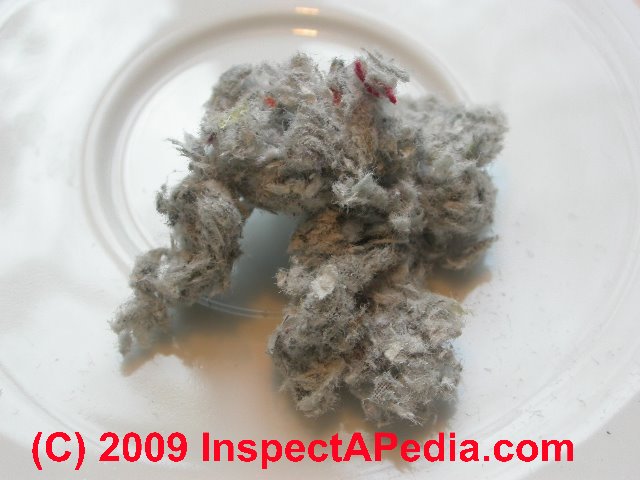
Anyone looking closely at cellulose insulation can often see recognizable bits of newsprint in this chopped fibrous gray insulating material. Walking through a major home improvement center recently we picked up some loose fill cellulose insulation that fell out of a package of new cellulose insulation being purchased by a client.

Our photos (above) show what it looked like when we put a little of this insulation on a ceramic dish in the sink in our forensic lab.
We were curious to know how fire resistant this random sample of new cellulose insulation would be in response to a very simple test.
Watch out: DO NOT TRY THIS IN YOUR HOME - you could start a fire.
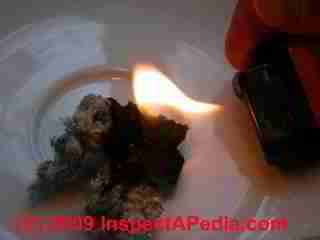
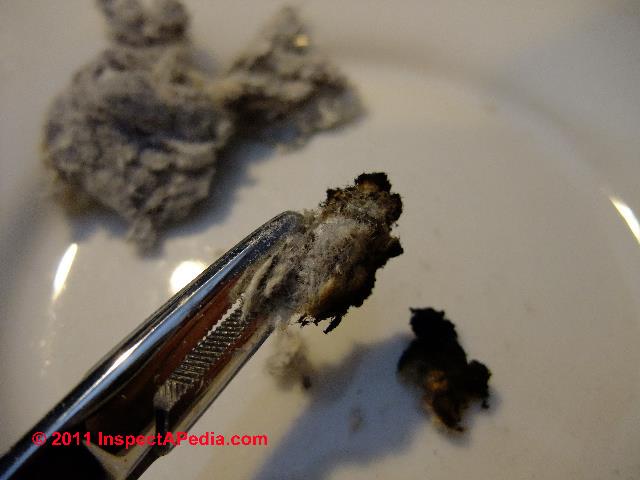
Using an ordinary butane cigarette lighter and in safe lab conditions over a sink with water and fire extinguishers at ready (Photo above left) we heated the cellulose insulation for 60 seconds in direct flame.
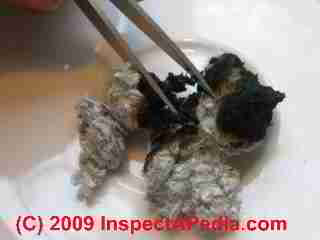
The temperature to which we exposed our cellulose insulation sample was perhaps hotter than the insulation might experience if it were in contact with a light bulb, but possibly no hotter than if it were in contact with shorting electrical wiring or an overheating aluminum branch wiring circuit connection.
There was a very brief tiny flame as a piece of plastic-coated newsprint in the insulation caught fire. The plastic on this newsprint probably resisted treatment by the fire retardant chemical and that fragment burned easily - and momentarily.
Other than that small fragment, the insulation charred, smoked, but would not support combustion.
Cellulose building insulation manufacturers should avoid accepting plastic or water-resistant coated papers into their insulation manufacturing process, or at least be sure that water resistant paper is present only at such trivial quantities (as indeed it was in our test sample) that the cellulose insulation will not support combustion after treatment.
Cellulose Insulation Fire Test No. 2, National Fiber Corp. (Cel-Pak & Nu-Wool)
Deborah Falkow, owner of MetroNY Insulation, provided us with a sample of cellulose insulation produced by National Fiber Corp. (Cel-Pak & Nu-Wool) for further testing in 2010.
According Ms. Falkow, Cel-Pak and Nu-Wool have an 83% recycled content, primarily over-issue newsprint and other ground wood paper sources.
The paper is fully fiberized (reduced to cellulose fiber) and infused with borate, a naturally occurring mineral. Borate gives cellulose [insulation] a Class A fire rating."
Watch out: DO NOT TRY THIS IN YOUR HOME - you could start a fire.
In our test lab we observed:
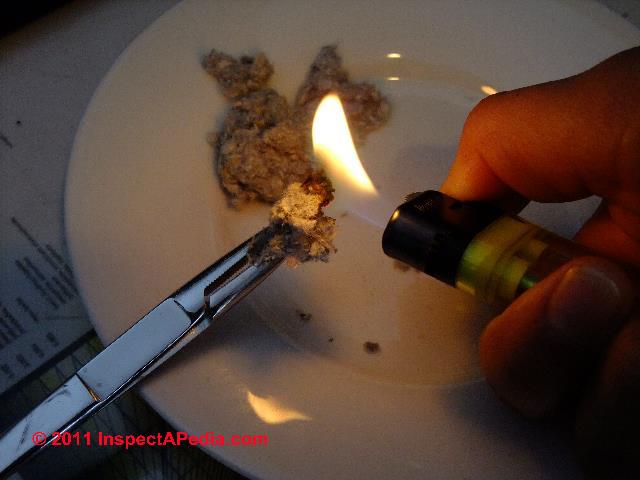
- The National Fiber Corp cellulose insulation would not support combustion.
- While the flame was applied the insulation fibers glowed, but when the flame was removed, immediately the combustion process stopped. Only traces of smoke were visible during the test.
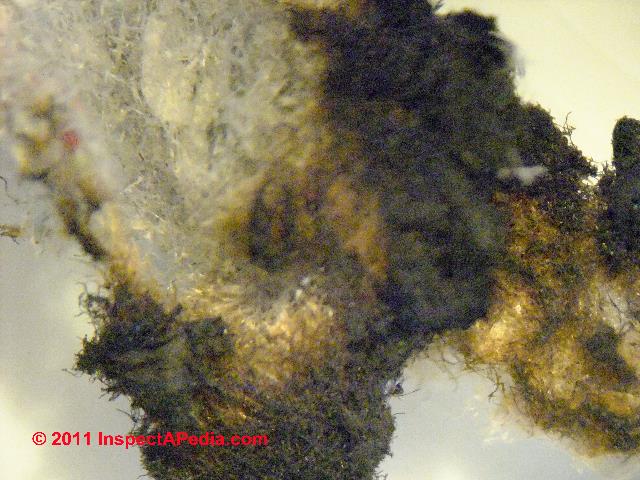
- Here is a closeup PHOTO of BURNED CELLULOSE INSULATION
Microscopic Comparison of Typical vs. "Fully Fiberized" Cellulose Building Insulation
Our photos compare sample of cellulose insulation collected from a Home Depot brand (below left) and National Fiber's "fully fiberized" cellulose insulation (below right). As you can see, fragments of newsprint remain recognizable in both samples (notice the "Y" and other letters at left and the "e" character at right.
But in our photos above and below, both taken at similar levels of magnification in the stereo microscope, the National Fiber Corp. cellulose was visibly much more fragmented into individual cellulose fibers. The number of discernable paper fragments per cubic centimeter was notably fewer than in the Home Depot sample.

Notice: although our lab and the author (DF) are trained in forensic microscopy, our forensic lab has no certification for fire testing or fire rating of materials. Judgment of degree of fiberization and remaining paper fragments, while obvious on direct physical examination, was nonetheless subjective because no quantitative fiber count nor count of particles by size was attempted.
In sum, our amateur "fire tests" demonstrated in two cases with two different cellulose insulation products (1. Home Depot brand, 2. National Fiber Corp. (Cel-Pak & Nu-Wool)) that our samples of new cellulose insulation would not support combustion. But take a look at NAIMA's findings just below.
NAIMA's Fire Resistance Testing of Cellulose Insulation
According to the North American Insulation Manufacturers' Association, the chemical treatment of cellulose insulation does not make cellulose insulation "non-combustible" nor does it prevent smoldering type ignition of the material. Cellulose insulation is tested for fire resistance using ASTM C-739.
It has also long been our opinion that the chemical retardant treatment, however effective it may be, may deteriorate over time or especially if the insulation is exposed to water - say from a roof or wall leak. NAIMA has a similar view.
In sum according to NAIMA "fire retardant treated cellulose insulation" is not necessarily completely fireproof see this article
on FIRE CHARACTERISTICS of INSULATION [PDF]
But then, a chief competitor of cellulose insulation, fiberglass insulation products are also not exactly fireproof - the kraft paper to which lots of fiberglass insulation is affixed to ease installation (and provide somewhat of a vapor retarder), for example can be set afire and it is possible that some of the binder resins may support combustion.
ASTM C-665 is the test standard for fire resistance of mineral fiber batts and rolls, and ASTM C-764 is the fire test standard for loose fill mineral insulation.
In industry speak, fiberglass is considered a mineral fiber along with rock wool or mineral wool insulations.
Fire Resistance of Cellulose Building Insulation Research & Laws
- Day, M., T. Suprunchuk, and D. M. Wiles. "The fire properties of cellulose insulation." Journal of Thermal Insulation 4, no. 3 (1981): 157-170.
Abstract:
The fire properties of cellulose as they relate to the potential fire hazard of cellulose insulation are examined and methods of reducing these hazards are reviewed. The suitability of various smoulder and flame resistance tests for evaluating the fire properties is also considered.
The effect of water and temperature cycling upon combustion retardant chemical migration and resultant fire properties of the material are discussed. - Day, M., T. Suprunchuk, and D. M. Wiles. "A combustibility study of cellulose insulation." Journal of Thermal Insulation 3, no. 4 (1980): 260-271.
Excerpts:
Cellulose insulation has certainly received a large amount of publicity with respect to its fire safety, and although many people will claim that there has been an over-reaction on the part of government regulating authorities and the press, those familiar with combustion characteristics of cellulose recognize the wood, cotton, as well as ground up newspaper will burn unless treated with appropriate chemicals.
With cellulose insulation, the concern is that the material, when installed in an attic, may result in a fire should come into contact with an overheated electrical device, or heat source such as a recessed lighting fixture, trouble lamp, furnace flue or chimney, or even an open flame such as a match or plumbers torch.
It is therefore essential to ensure that the chemicals applied to the material that only retard the flaming combustion, but also the smoldering combustion of the material.
Borax and boric acid have long been recognized as flame retardant chemicals for cellulosic textiles. Consequently, it is not too surprising to find that their widespread use with cellulosic insulation.
Work at the US Department of Agriculture is Southern Regional Research Center has already shown that boric acid is the effective chemical of choice to retard the smoldering combustion of cotton batting used in mattresses.
In addition it has also demonstrated the deleterious role of sodium ions associated with borax in retarding smoldering combustion.
However the case of cellulose insulation it is desirable determine the optimum concentration of borax and boric acid to achieve both smolder resistance and flame resistance. - Gnanachelvam, Sayilacksha, Anthony Ariyanayagam, and Mahen Mahendran. "Effects of insulation materials and their location on the fire resistance of LSF walls." Journal of Building Engineering 44 (2021): 103323.
Abstract:
Lightweight walls incorporate insulation materials to compensate for their low thermal mass and to improve thermal performance. This helps in increasing the energy performance of the buildings.
Since insulation materials are sensible heat storage materials, there is an increment in the room temperature. Phase Change Materials (PCMs) are used in lightweight walls due to their high thermal storage capacity and the resulting enhanced thermal comfort levels. However, the performance of the PCM incorporated building products/insulations in fire has not been investigated yet.
This research has investigated the fire resistance of Light gauge steel framed (LSF) walls with PCM incorporated cellulose insulation through small-scale fire tests. It has also investigated the effects of using different insulation materials and their location on the fire resistance of LSF walls.
Important results of this research are presented in this paper in the form of time-temperature profiles for cavity and externally insulated LSF wall configurations with and without PCM incorporated cellulose insulation.
Findings reveal that externally insulated LSF walls have higher fire resistance levels than cavity insulated LSF walls based on insulation failure criterion.
Importantly, adding PCM to cellulose insulation improves the fire resistance of both cavity and externally insulated LSF walls. PCM incorporated cellulose insulation can be used externally in LSF walls to enhance their fire and energy performance. However, the fire behaviour of Vacuum Insulation Panel (VIP) incorporated LSF wall is completely different to other wall systems.
- Hurtado, Pablo Lopez, Antoine Rouilly, Virginie Vandenbossche, and Christine Raynaud. A REVIEW ON THE PROPERTIES OF CELLULOSE FIBRE INSULATION [PDF] Building and environment 96 (2016): 170-177.
Abstract:
The building sector is constantly innovating in its use of materials with regards to sustainability. There is a need to use cost effective, environmentally friendly materials and technologies which lessen the impact of a construction in terms of its use of non-renewable resources and energy consumption.
Cellulose fibre insulation is an eco-friendly thermal insulation material made from recycled paper fibres. It offers good thermal properties and has a low embodied energy. However due to lack of expertise in its application and properties, cellulose insulation is not widely used in comparison to more traditional insulation materials.
The present paper reviews the available research on cellulose fibre insulation, its manufacture, installation, and performance. The paper focuses the physical properties of cellulose insulation, the environmental factors that affect these properties, and possible means of future innovation. - Kodur, V. R., and M. A. Sultan. FACTORS GOVERNING FIRE RESISTANCE OF LOAD-BEARING STEEL STUD WALLS [PDF] In Proc. of the 5th AOSFST International Conference, pp. 1-2. 2001.
Excerpt:
The uninsulated wall Assembly, F37, provided the highest fire resistance of 77 minutes. The failure of the glass fiber insulated wall assembly (F27) occurred at 56 minutes, while the failure of the rock fiber (F38) and cellulose (F31) insulated wall assemblies occurred at 59 and 71 minutes, respectively.
These results suggest that maximum fire resistance can be obtained in a steel stud wall assembly with no insulation in the cavity.
Further, the use of rock fiber insulation provides a higher fire resistance compared to glass fiber insulation, but a lower fire resistance compared to cellulose fiber insulation. - Kurama, Haldun. "Fire Reterdant Effıcency of Waste Magnesia Powder in Cellulose Insulation." Journal of the Australian Ceramic Society 52, no. 2 (2016): 143-149.
Abstract:
The aim of the study is to determine the usability of waste magnesia powders in the production of paper based cellulose material as a fire retardant additive. In experiments, the waste sample, supplied from the electrostatic bag house of magnesia production plant, was used in the paper based cellules formulations as received or calcined forms.
In ignition tests, the Bunsen burner was used as a flame source and the times for the samples to be ignited were recorded for each formulation. According to the test results, it was found that the addition of magnesia powder has a beneficial effect on the ignition time of products.
Therefore, it can be suggested that the magnesia waste could be use as a low cost and environmental friendly material as a fire retardant additive within the formulation of cellulosic materials. - Lea, Daniel. CELLULOSE: BUILDING INSULATION WITH HIGH RECOVERED CONTENT, LOW EMBODIED ENERGY [PDF] In Green Building Materials 96 Conference, vol. 1, no. 4. 1996.
Excerpt:
... the fire retardants, which are about 20 percent of cellulose insulation by weight, ... - Meier, A. "Cellulose insulation: Not like paper and fire." Home Energy;(United States) 8, no. 1 (1991).
Abstract
Cellulose is an inexpensive and effective insulation material, easily blown into wall cavities and attics. It is simple to manufacture (from shredded or ground newspaper) and meets the Environmental Protection Agency's criteria for federal agencies to use recycled materials in insulation.
Cellulose on its own is very flammable and so must be treated with various chemicals to reduce its flammability before it is used as insulation.
By far the most popular fire retardant is boric acid, which numerous tests have demonstrated is an extremely effective fire retardant. Boric acid has become the standard retardant since 1978, when Congress mandated minimum flammability standards for cellulose insulation.
Nevertheless, persistent rumors claim that house fires either have been caused or aided by cellulose insulation. Most of the cases were settled out of court, so the facts have never been well-documented or publicized.
Still, it became worth investigating whether properly prepared insulation could somehow lose its fire resistance.
Recent research at Tennessee Technological University by Nan Chiou and David Yarbrough suggests that cellulose insulation treated with boric acid is very stable, and that its fire resistance will not significantly diminish over long time periods, perhaps hundreds of years. - Mo, Yang, Lijun Yang, Wei Hou, Tiantian Zou, Youyu Huang, Xiaoling Zheng, and Ruijin Liao. "Preparation of cellulose insulating paper of low dielectric constant by OAPS grafting." Cellulose 26 (2019): 7451-7468.
- Moreno, Paalo, Nicole Villamizar, Jefferson Perez, Angelica Bayona, Jesús Roman, Nicolás Moreno, and Nilo Sergio Medeiros Cardozo. "Fire-resistant cellulose boards from waste newspaper, boric acid salts, and protein binders." Clean Technologies and Environmental Policy 23 (2021): 1537-1546.
- Mróz, Katarzyna, Izabela Hager, and Kinga Korniejenko. "Material solutions for passive fire protection of buildings and structures and their performances testing." Procedia Engineering 151 (2016): 284-291.
- Rantuch, Peter, and T. O. M. Á. Š. Chrebet. THERMAL DECOMPOSITION OF CELLULOSE INSULATION [PDF] Cellul. Chem. Technol 48 (2014): 461-467. - retrieved 2023/09/16, original source: cellulosechemtechnol.ro/pdf/CCT5-6(2014)/p.461-467.pdf
Abstract:
The article focuses on the behaviour of cellulose insulation during thermal load. The tested samples were stressed by heating rate of 5 °C.min-1, as well as isothermally at temperatures of 210 °C, 250 °C, 295 °C, 300 °C, 400 °C and 500 °C. The mass loss of the samples was observed.
It is obvious from the measured values that the decomposition of cellulose insulation begins at the temperature of 250-260 °C. The values of the peaks of mass loss rate, as well as the temperatures of reaching 95% and 30% of the mass of the samples, confirm that the decomposition rate of cellulose insulation is affected by its own density in the first phase.
A similar dependence was also determined for the mass loss of carbonaceous residue. Based on the measured data, linear equations, which describe the dependence of temperatures of reaching the above mentioned states on the density of the samples, were determined. - US Code Title 15 Chapter 47 § 2082 - INTERIM CELLULOSE SAFETY STANDARD [PDF] , retrieved 2016/08/19, original source: law.cornell.edu/uscode/text/15/2082 - (Pub. L. 92–573, § 35, as added Pub. L. 95–319, § 3(a), July 11, 1978, 92 Stat. 386; amended Pub. L. 103–437, § 5(c)(2), Nov. 2, 1994, 108 Stat. 4582; Pub. L. 110–314, title II, § 235(c)(3), (5), Aug. 14, 2008, 122 Stat. 3074, 3075.)
Excerpt:
(1)Subject to the provisions of paragraph (2), on and after the last day of the 60-day period beginning on July 11, 1978, the requirements for flame resistance and corrosiveness set forth in the General Services Administration’s specification for cellulose insulation, HH–I–515C (as such specification was in effect on February 1, 1978), shall be deemed to be an interim consumer product safety standard which shall have all the authority and effect of any other consumer product safety standard promulgated by the Commission under this chapter.
During the 45-day period beginning on July 11, 1978, the Commission may make, and shall publish in the Federal Register, such technical, nonsubstantive changes in such requirements as it deems appropriate to make such requirements suitable for promulgation as a consumer product safety standard.
At the end of the 60-day period specified in the first sentence of this paragraph, the Commission shall publish in the Federal Register such interim consumer product safety standard, as altered by the Commission under this paragraph.
(2)The interim consumer product safety standard established in paragraph (1) shall provide that any cellulose insulation which is produced or distributed for sale or use as a consumer product shall have a flame spread rating of 0 to 25, as such rating is set forth in the General Services Administration’s specification for cellulose insulation, HH–I–515C. - US Consumer Product Safety Commission. CELLULOSE INSULATION [Consumer Safety Alert] [PDF] US Consumer Product Safety Commission, 1978.
Excerpt:
Increased use of home insulation to help reduce heating and cooling costs has also focused attention on its safety aspect. The hazards of cellulose insulation and how to buy and install safety are the subject of this consumer alert.
Usually made from ground up or shredded paper, cellulose insulation is normally treated with chemicals to make it resistant to fire and vermin.
Properly manufactured, treated, and installed, cellulose can have a high insulating value and meet the federal flammability standard for cellulose insulation.
Cellulose insulation manufactured with improper amounts and cons of fire retardant however many percent of flammability hazard or cause corrosion problems.
Some cellulose insulation is treated with chemicals which can combine with moisture in the air and corrode some metal parts that are in contact with the insulation.
Acting on these possible hazards, Congress has an act of the laws that amends with the consumer product safety act to require of the US Consumer Product Safety Commission Perez CPSC paren to publish a mandatory safety standard for cellulose insulation.
The standard adopt certain aspects of the GSA general services administration federal specifications HH–1–5-15C dealing with flame resistance and corrosiveness.
Cellulose insulation manufactured after September 7, 1978 must be the requirements of the new standard. - Yang, H-B., Z-X. Liu, H. Chen, X. Yue, Z-C. Ling, Z-M. Han, C-H. Yin et al. "An all-natural fire-resistant bioinspired cellulose-based structural material by external force-induced assembly." Materials Today Nano 23 (2023): 100342.
Reader Comments, Questions & Answers About The Article Above
Below you will find questions and answers previously posted on this page at its page bottom reader comment box.
Reader Q&A - also see RECOMMENDED ARTICLES & FAQs
On 2017-09-18 by mod - fear of cellulose insulation - will cellulose building insulation burn?
Charles
Cellulose, a paper based insulating product, is treated with fire-retardant chemicals and, provided you buy a reputable, certified cellulose insulation product, ought to be fine to install.
Please see details at CELLULOSE INSULATION FIRE RESISTANCE - above on this page - Ed.
Watch out: however, some caution is justified according to the opinion of writers in at least some sources. Example:
When cellulose insulation burns in an attic space or within a wall, it typically burns from the bottom up, and it burns at such low temperatures that even the best thermal imaging camera (TIC) may not pick up the traces of heat. ... The tell-tale sign of a fire burning within cellulose is the smell of burning paper.
...
Cellulose is a very tricky material when it comes to firefighting. Its low combustibility is extremely beneficial to homeowners, but creates multiple challenges for firefighters.
Understanding how this material works and knowing what to look for when fighting fire in a structure that contains cellulose insulation will ensure your safety as well as the continued safety of the homeowner.
Firefighternation.com https://www.firefighternation.com/2011/11/28/fire-cellulose-insulation/#gref - Nov 28, 2011
On 2017-09-18 by Charles
I am looking to install a bathroom fan/light in the ceiling.
My ceiling is 2x4 construction with a layer of AVB and blown cellulose above it (which is in my attic). Is it ok to install? Is this a fire hazard? I was thinking of installing addition framing above the 2x4's for clearance and also looking for the smallest depth for a fan.
Cellulose just scares me with it being so flammable. Is it ok for it to be in contact with
This Q&A were posted originally at BATHROOM VENT DUCT TERMINATION
...
Continue reading at CELLULOSE INSULATION UNDER the MICROSCOPE or select a topic from the closely-related articles below, or see the complete ARTICLE INDEX.
Or see these
Recommended Articles
- ARTICLE INDEX to BUILDING FIRE SAFETY
- ASBESTOS FIREPROOFING SPRAY-On Coatings
- BLOWN-IN INSULATION
- CELLULOSE LOOSE FILL INSULATION - home
- CELLULOSE INSULATION PROS & CONS
- CELLULOSE INSULATION FIRE RESISTANCE
- CELLULOSE INSULATION UNDER the MICROSCOPE
- INSULATION & FIRE SAFETY [PDF] from NAIMA
- INSULATION IDENTIFICATION GUIDE
- INSULATION R-VALUES & PROPERTIES - properties of different insulating materials used in buildings.
- INSULATION LOCATION - WHERE TO PUT IT
Suggested citation for this web page
CELLULOSE INSULATION FIRE RESISTANCE at InspectApedia.com - online encyclopedia of building & environmental inspection, testing, diagnosis, repair, & problem prevention advice.
Or see this
INDEX to RELATED ARTICLES: ARTICLE INDEX to BUILDING INSULATION
Or use the SEARCH BOX found below to Ask a Question or Search InspectApedia
Ask a Question or Search InspectApedia
Try the search box just below, or if you prefer, post a question or comment in the Comments box below and we will respond promptly.
Search the InspectApedia website
Note: appearance of your Comment below may be delayed: if your comment contains an image, photograph, web link, or text that looks to the software as if it might be a web link, your posting will appear after it has been approved by a moderator. Apologies for the delay.
Only one image can be added per comment but you can post as many comments, and therefore images, as you like.
You will not receive a notification when a response to your question has been posted.
Please bookmark this page to make it easy for you to check back for our response.
Our Comment Box is provided by Countable Web Productions countable.ca
Citations & References
In addition to any citations in the article above, a full list is available on request.
- Deborah K. Falkow MetroNY Insulation, LLC., an New York insulation contractor. MetroNY Insulation, 60 Commerce St., Suite M, Spring Valley NY 10977, Tel: 845-445-8255, Email: info@metronyinsulation.com Web: metronyinsulation.com
- In addition to citations & references found in this article, see the research citations given at the end of the related articles found at our suggested
CONTINUE READING or RECOMMENDED ARTICLES.
- Carson, Dunlop & Associates Ltd., 120 Carlton Street Suite 407, Toronto ON M5A 4K2. Tel: (416) 964-9415 1-800-268-7070 Email: info@carsondunlop.com. Alan Carson is a past president of ASHI, the American Society of Home Inspectors.
Thanks to Alan Carson and Bob Dunlop, for permission for InspectAPedia to use text excerpts from The HOME REFERENCE BOOK - the Encyclopedia of Homes and to use illustrations from The ILLUSTRATED HOME .
Carson Dunlop Associates provides extensive home inspection education and report writing material. In gratitude we provide links to tsome Carson Dunlop Associates products and services.
 | HOME | ABOUT | ASK a QUESTION | CONTACT | CONTENT USE POLICY | DESCRIPTION | POLICIES | PRIVACY | |
| © 2024 - 1985 Publisher InspectApedia.com - Daniel Friedman | |||||||||