
InspectAPedia® FREE Encyclopedia of Building & Environmental Construction, Diagnosis, Maintenance & Repair |
Question? Just ask us! InspectAPedia
|
 Balsam Wool & Wood Product Building Insulation
Wood Fiber Insulation Brown Wood Fibre
Balsam Wool & Wood Product Building Insulation
Wood Fiber Insulation Brown Wood Fibre
- POST a QUESTION or COMMENT about the properties & identification of balsam wool & other wood product insulation materials
Balsam wool insulation guide:
This article illustrates and describes balsam wool and wood product insulation materials. We discuss the properties of balsam wool, what it is made from, its fire resistance, insect resistance, insulation properties (R-value).
We address the frequent question: does balsam wool insulation contain asbestos and we give the history of use and manufacture of balsam wool. We added these examples because of frequent questions about these materials.
This document assists building buyers, owners or inspectors who need to identify various insulation materials in buildings by simple visual inspection. We provide photographs and descriptive text of balsam wool insulation and other wood insulating products to permit identification of these materials in buildings.
InspectAPedia tolerates no conflicts of interest. We have no relationship with advertisers, products, or services discussed at this website.
Balsam Wool Insulation Properties, Composition, History, Photos, Tests
Article Contents
History of the Development & Production of Balsam Wool Insulation
"Balsam Wool" is a wood fiber product or "cellulose" insulation that was widely used in homes and in a variety of other applications in the U.S. from at least the 1930's. Synonyms for balsam wool insulation include wood fiber insulation, wood insulation, wood-wool insulation, and blackweld or blackwell insulation.
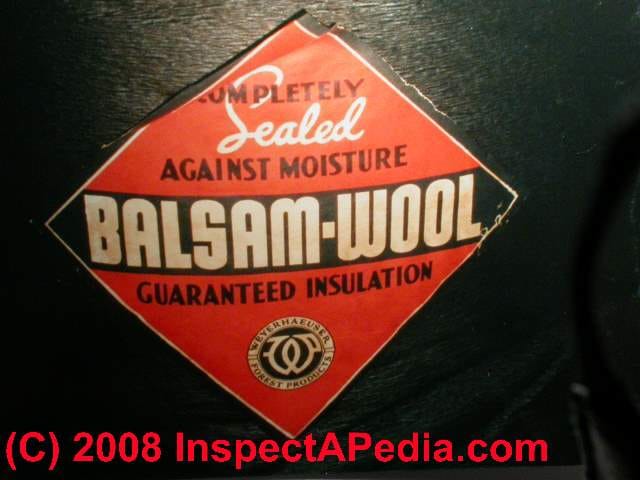
Our Balsam-Wool insulation photo (above left) includes a Weyerhaeuser Forest Products logo in the bottom of the red diamond.
[Click to enlarge any image]
We learn from the Minnesota Historical Society [5] as well as from reviewing patents describing the history of production of balsam wool fiber insulation [4] that the Wood Conversion Company of Cloquet, Minnesota, incorporated in 1922 in Delaware.
The Wood Conversion Company of Cloquet was a Weyerhaeuser By-Products Division, and was a key participant in the development & production of Balsam Wool Insulation. Wood Conversion was the assignee of a variety of patents describing the production of balsam wool and other wood fiber (and even animal hair) insulation products.
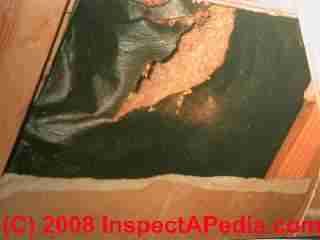
The wood product insulating batts shown in these photos was produced by Weyerhaeuser corporation.
In the right hand (and page top) photo of this insulation (basically chopped wood fibers, probably treated with a fire retardant), you can see the brown/tan fibers of insulating material.
Properties of Balsam Wool Building Insulation
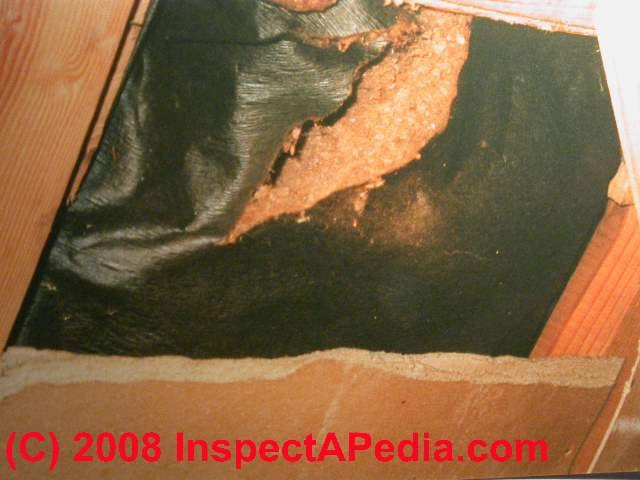
Balsam wool insulating blankets, also referred to as "wood cotton" in some patent literature, are shown in our photographs here. These insulating batts of "balsam wool" were produced using wood fibers from tree bark, wood pulp, or other lumber byproducts.
A review of some of the key patents, (described below in the references section of this article) a variety of tree species were described including tree bark and wood byproducts from redwood, [balsam] fir, and others. [4]
Various sprays were used to give desired properties including for adhesion, fiber control, sizing, and possibly insect and rodent resistance.
When inspecting balsam wool insulation we advise against cutting the kraft paper covering these insulation batts as if the paper is cut a large amount of the insulating material is likely to simply fall out.
If you must make a cut to test or confirm the material or its condition, the cut should be just an inch or so, and you should tape the cut closed after your inspection.
Reader question: Is this Balsam Wool? what is this dark brown fibrous insulation?
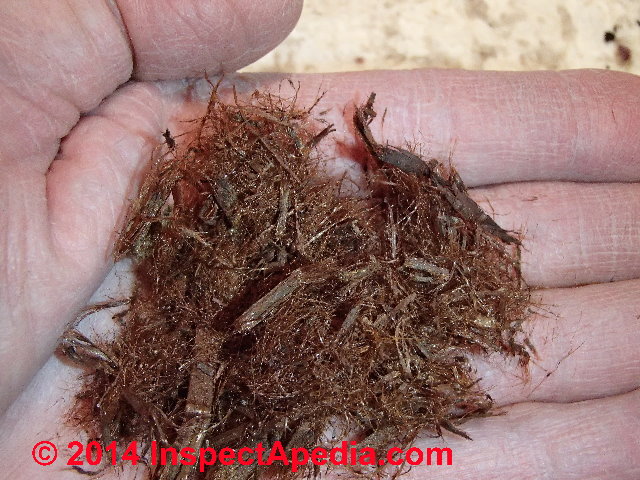
I Wonder if you recognize the loose fill insulation in attached photo?
This insulation was found in an attic in 1944 house. Reddish brown, strands.
Would ignite and smolder but not really burn. Same house has some Kimsul insulation but this is quite different. Friends upstate say its been a bad winter, its been poor here in Raleigh but nowhere near what you guys suffer through. - S.S., Raleigh N.C. 3/10/2014
Reply:
What you have in hand looks like wet Balsam Wool - a wood fiber insulating product I describe in the article above, though your insulation sample is more coarse and has larger chunks than I've seen.
- Was the insulation wet?
- Was it wrapped in black or tan Kraft paper?
I'll post the photo here to invite other reader comment. Most likely this
is SILVAWOOL INSULATION or a similar product. - DF
Reader Question: Is this balsam wool insulation or vermiculite?
30 June 2015 Joshie said:
Hey. Is this balsam wool insulation or vermiculite?

link to YouTube youtube [dot] com/watch?v=nVq6NWfGcCk
Reply:
Joshie
The insulation in the video you cite (and these three photographs) is not balsam wool and it is not vermiculite.
The insulation in the video shown by the link you provided (and excerpted here in stills) is most likely fiberglass batts or perhaps a mix of fiberglass batts and chopped (or damaged) fiberglass, or possibly fiberglass batts along with some older mineral wool or rock wool.

See MINERAL WOOL - ROCK WOOL INSULATION to learn what mineral wool insulation looks-like.

See VERMICULITE INSULATION to learn what vermiculite looks like.
INSULATION IDENTIFICATION GUIDE - for a guide to identifying all types of building insulation.
It's not apparent why the vacuum removal of this attic insulation was undertaken. Just why was not given. But it would perhaps be reasonable to remove old fiberglass or mineral wool insulation if it were badly damaged, ineffective, or if the insulation were contaminated by rodents, insects, or if the insulation had become wet and was a mold hazard.
Does Balsam Wool Insulation Contain Asbestos?
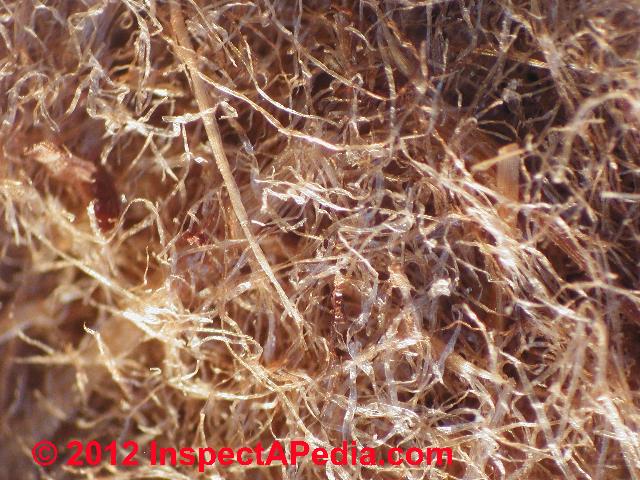
Balsam wool insulating blanket used wood fibers from tree bark, wood pulp, or other lumber byproducts. As such it is a wood or cellulose product and not an asbestos-containing material.
Watch out: however, from 1958 through 1974 asbestos was used in the production of other products at the Conwed Corporation (Wood Conversion Company) plant in Cloquet, Minnesota, including the production of ceiling tiles and other products.
Our photo at left illustrates a stereo-microscopic view of balsam wool fibers.
You can see that the manufacturing process separated individual long wood fibers and that there was little extraneous material in this insulation product.
12/5/2014 Ron said:
I have Balsam Wool Batt insulation in my house. It is labeled with the same Weyerhaeuser label that you have pictured. I want to replace the insulation but need to know if the black paper backing contains asbestos. thanks, Ron.
Reply:
Ron, while there are some curious manufacturing site overlaps between producers of asbestos-containing products and manufacturers of wood-fiber based products that *might* have produced some asbestos cross-contamination among products (Robins 1988), we have not yet been able to find credible research asserting that problem is a real one.
Balsam wool is a chemically treated wood fiber used as insulation material.
Other than that, wood fiber insulation products are not asbestos-products nor was their paper covering. If you want an absolutely reliable answer however, you'd want to spend about $50. to send a sample of your material to a certified asbestos testing lab.
Keep us posted if you take that step. I'd be surprised if asbestos were detected in any balsam wool product. Here are some interesting research citations Take note of Baird (1946) in re your question as he cites "boards containing wool and asbestos" suggesting that mineral wool or balsam wool might have appeared with asbestos in some products.
- Allcut, E. A. "Heat Insulation as Applied to Buildings and Structures." Proceedings of the Institution of Mechanical Engineers 128, no. 1 (1934): 195-251.
- Baird, Parker K., Robert J. Seidl, and Donald J. Fahey. "PAPER-BASE PLASTICS 423 Wool Goldsmid, P. Analysis of fabrics, papers, and boards containing wool and asbestos. Papeterie 68, no. 2: 34-35, 37-39 (Feb., 1946); BIPC 17: 223. Zinc." Pulp and Paper Manufacture; Bibliography (1946): 423.
- Blondeel, Arlette, Jacques Oleffe, and Georges Achten. "Contact allergy in 330 dermatological patients." Contact dermatitis 4, no. 5 (1978): 270-276. - Includes citations of balsam wool contact.
- Cayuga lumber company. Building material catalog. Webber Lumber & Supply Co., 1941. - includes Balsam Wool insulation.
- Cummings, J. M. "Possibilities for the Manufacture of Mineral Wool in British Columbia" [PDF], British Columbia Department of Mines, (1937)- includes tables comparing properties of various insulation and other materials to mineral wool and balsam wool, retrieved 12/6/2014, original source: http://142.32.76.167/Mining/Geoscience/
PublicationsCatalogue/MiscellaneousPublications/
Documents/PossibilitiesManufactureMineralWool1937.pdf - Hahn, David W., and M. Necati Özişik. "Appendix I: Physical Properties." Heat Conduction, Third Edition: 679-684. includes physical properties of balsam wool
- Robins, Thomas G., and Margaret A. Green. "Respiratory morbidity in workers exposed to asbestos in the primary manufacture of building materials." American journal of industrial medicine 14, no. 4 (1988): 433-448.
- Hooper, William James. "The Deposition of Dust on Walls." Journal of Applied Physics 1, no. 1 (1931): 61-68.
Reader Question: can I get my insulation tested to see if this (apparently Balsam Wool) insulation contains asbestos?
(Jan 7, 2013) Matt said:
Hello. I think I may have found something like Balsam wool in my attic. Would love to get it tested (to make sure it's not asbestos.) Any recommendations? I'm in Nashville, TN.
Reply:
Matt most forensic labs can identify different types of insulation; but there is little or no physical resemblance between balsam wool and asbestos, nor was asbestos used as a brown fiber enclosed in batts, nor does asbestos resemble long woody fibers.
Take a look at the insulation; Balsm wool is usually pretty easy to identify by eye.
We perform limited forensic lab testing on a pro-bono basis for people of limited means. Please do NOT send us any samples or materials for testing without prior arrangement.
Fire Resistance of Balsam-Wool Insulation - lab test results
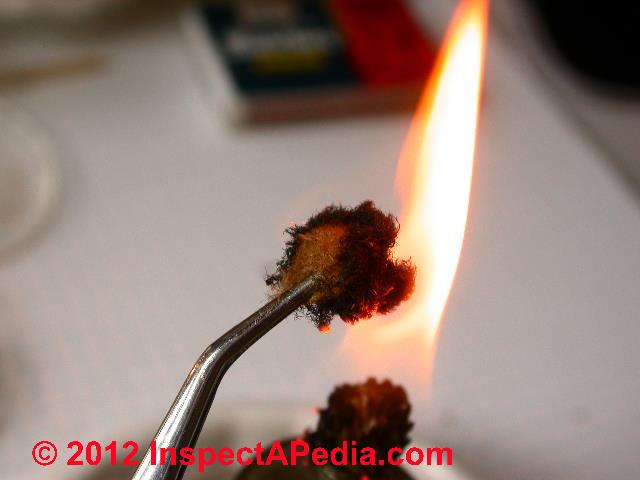
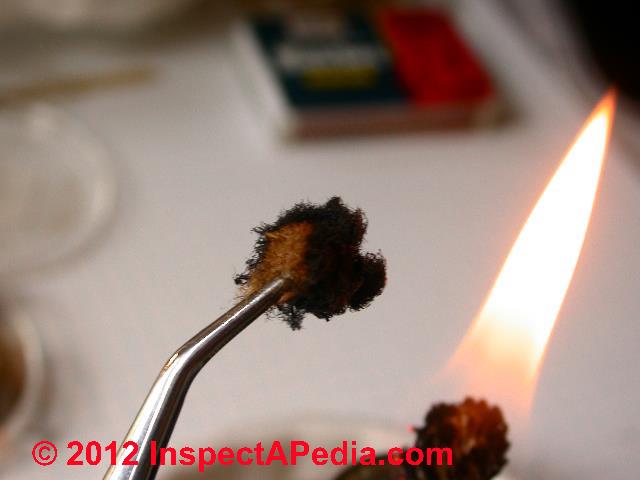
In 2012 we performed a simple combustion test of a sample of Balsam-Wool insulation from an older home. Our photo below illustrates the result.
Using an alcohol lamp as a flame source in our lab, and holding a sample of balsam-wool insulation in the flame until its edges glowed, we found on removal from the flame that the insulation would not support combustion.
...
Insect Resistance of Balsam Wool Insulation
Balsam wool, depending on the wood species used to produce it, may be naturally insect resistant (Balsam) as are cedar, cypress, and some other wood products. It might have been treated with a fire retardant, I don't yet know (am researching the question).
Some fire retardants (borate salts used in cellulose insulation) also seem to be mold resistant and may also be insect resistant.
Reader Question: is balsam fiber insulation treated to prevent attracting insects?
(Mar 25, 2012) Anonymous said:
Is the balsam fiber treated to prevent attracting wood destroying insects. Have a crawlspace that has allot of balsam batt insulation that's deteriorated and falling on ground.
Reply:
Balsam wool, depending on the wood species used to produce it, may be naturally insect resistant (Balsam) as are cedar, cypress, and some other wood products. It might have been treated with a fire retardant, I don't yet know (am researching the question).
Some fire retardants (borate salts used in cellulose insulation) also seem to be mold resistant and may also be insect resistant.
Reader question: is balsam wool insulation mold resistant?
(Sept 16, 2012) Geoff In Oregon said:
Question: Any anti-fungal/mold properties to balsam ?
Reply:
Good question. I haven't come across moldy balsam wool insulation. Although there are plenty of molds that like to grow on cellulose - wood fibers - the number that grow happily on dry or even damp balsam fir may be much smaller.
If you have some that is suspect, mail me a few cubic inches in a labeled new clean Ziploc bag and I'll test it pro bono next January when our lab returns to the US.
R-Values of Balsam Wool & Silvawool Insulation
We estimate that balsam wool has an R value of about 2 to 3.5 in loose fill and about 2 to 3.25 in batts.
We have seen some estimates of an R value of 3.4 per inch for versions of insulation that contain a mixture of wood fibers and chopped paper.
To compare insulating material R-values see our extensive tables
of INSULATION R-VALUES & PROPERTIES
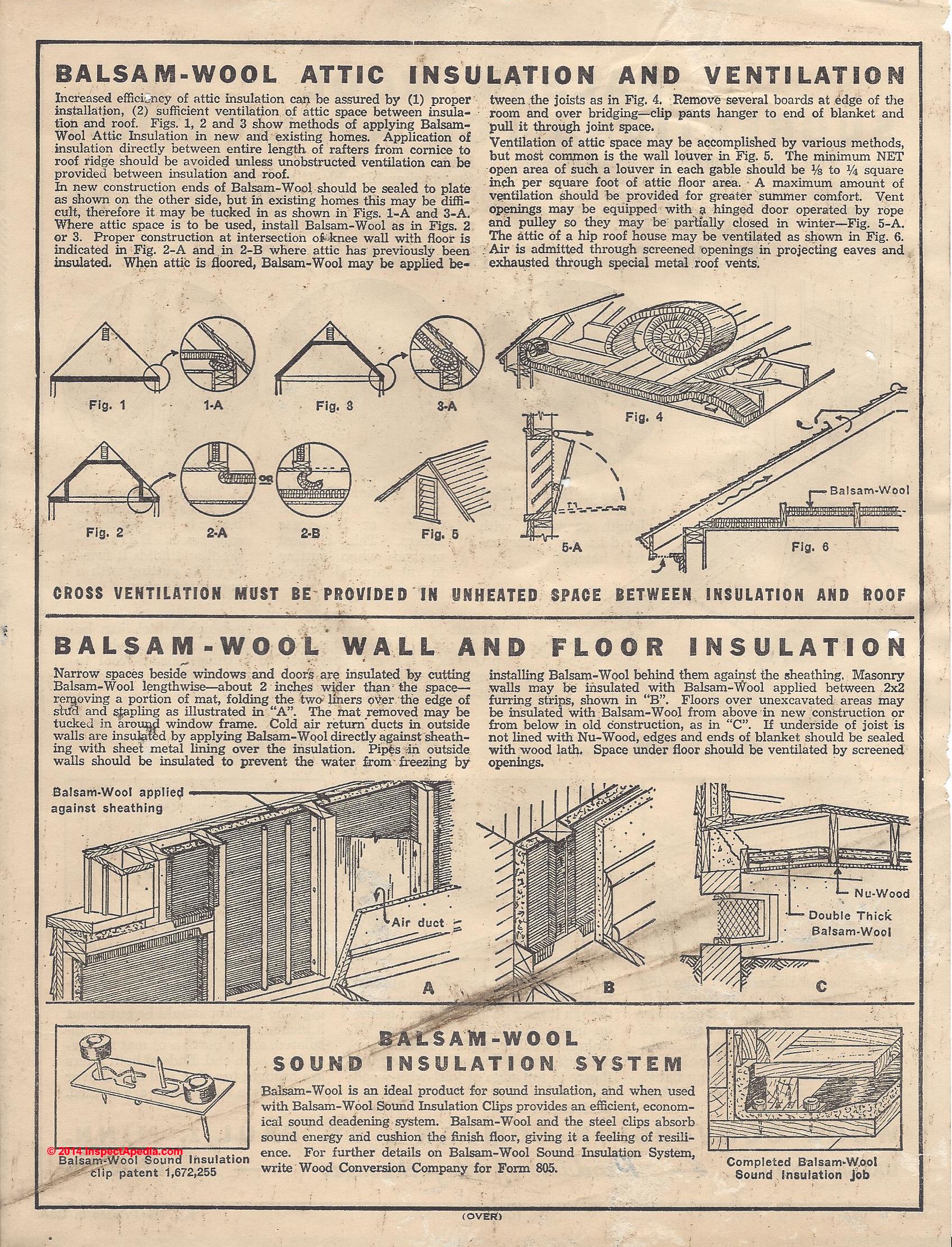
Balsam Wool Historical Documents & Installation Instructions
Thought you'd appreciate these instructions for Balsam Wool. We've been removing it because we have limited space for fiberglass, and the packaging is displacing too much space. The balsam inside has disintegrated and packed, thus not too useful. - D.G. 3/10/2014
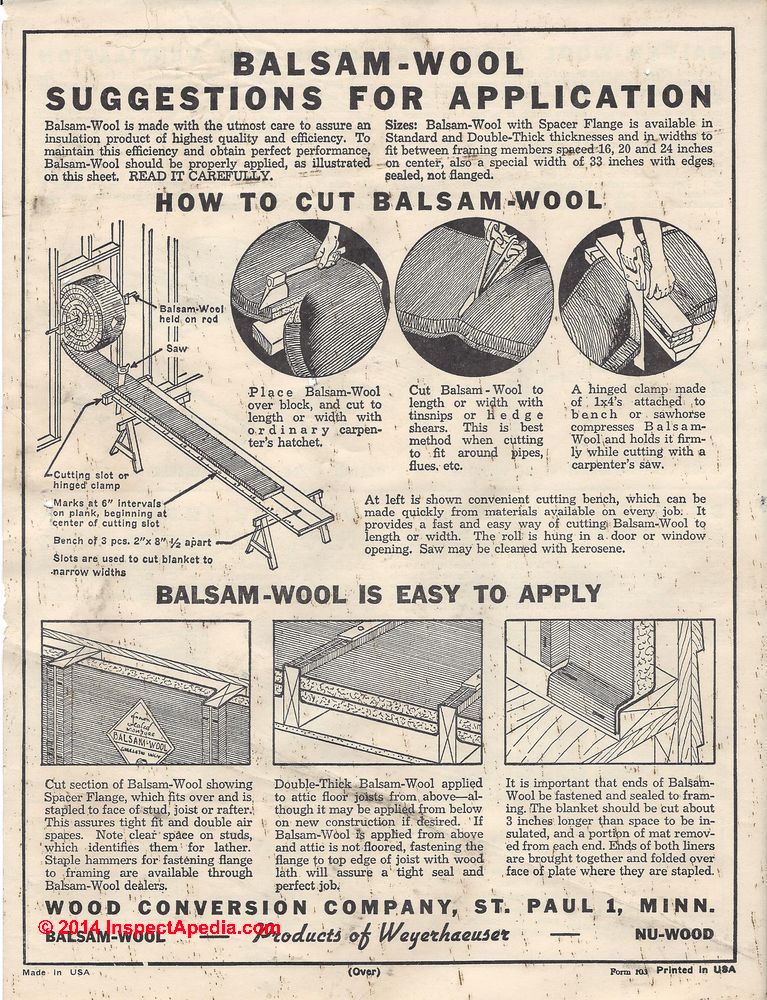
[Click to enlarge any image]
Blackweld Wood Fiber / Cellulose Insulation?
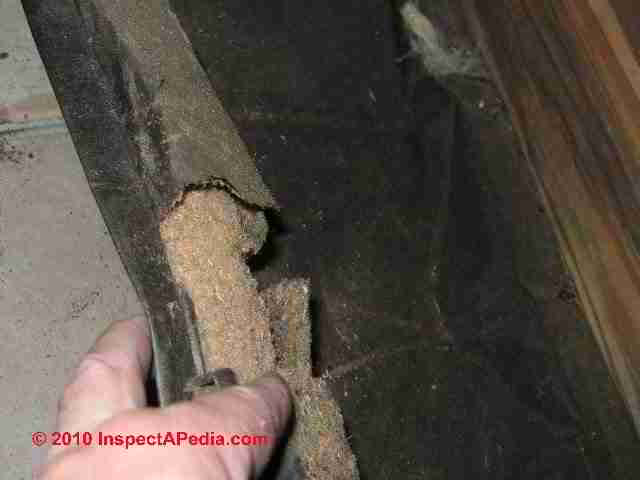
Professional home inspector Stephen P. Shockley sent along this excellent photo of 1940's vintage insulation found in a home below a more recent layer of fiberglass insulation.
We think this is "Blackweld Insulation", another wood-fiber insulation product similar to the Balsam Wool product described above, and we are looking for a positive ID, product label photos, or a sample to examine in our forensic lab. CONTACT us with feedback.
Had Mr. Shockley been able to send a small sample (a cubic inch or less would be sufficient) to our forensic lab we would have examined the material to identify its constituents.
Some readers refer to this insulating material as "Blackwell Insulation" but that's probably an error. Google Scholar searches for BlackWeld Insulation and for blackwell insulation made in 2009 and again in 2017 have not found patents nor specific uses of the terms blackweld insulation nor blackwell insulation.
- CHATTOPADHYAY, PARIMAL, ARABINDO NATH BOSE, and B. C. Raychaudhuri. "Computation of insulation efficiencies of fish transport containers." Journal of Food Science 39, no. 5 (1974): 1006-1010. - refers to "wood-wool insulation" used between the sides of a corrugated container for fish transport
- Hecker, John C., "Horizontal sublimation apparatus." U.S. Patent 2,743,169, issued April 24, 1956. - electric furnace insulation
- Popp, V., The Popp Compressed air and Electric Power Company, 1890. Victor popp. U.S. Patent 438,767. Electrical circuit insulation.
- WILSON, AE. "Apparatus for growing plants under controlled environmental conditions." Annals of Applied Biology 24, no. 4 (1937): 911-931. - refers to wood-wool insulating layers of material.
Silvawool & Kimsul Wood Fiber Insulation

SilvaWool was a Weyerhaeuser Timber Company, described as produced by Weyerhaeuser's Special Product Division in Tacoma Washington, as you'll note in the product labeling provided by reader Mike Giacalone.
Mike's photo was of SilvaWool found in a 1954-built home in Phoenix AZ.
Question: is this wood fiber insulation Silvawool?

I ran across you site while doing some research on insulation inside a vintage refrigerator. I'm refurbing (Admiral Refrigerator 1949 - 1950) when I removed the interior I came across what looked similar to Silva Wool or some type of shredded wood insulation but much more fine that what was pictured on your site.
It's reddish brown, mixed sized pieces some look like wood, while others almost hair. It burns for a short second than goes out much like your tests.
It wasn't held together with any paper backing but looks like it may have been glued in sheets but now is very loose and falls apart very easily.
Have you come across anything like this in your research? From what I found and reaching out to some antique appliance folks also, it sounds like refrigerators in that era typically used compressed sawdust which hopefully means something similar or Silva Wool (I've read horse hair too).
I have attached an image (with penny for scale) if you'd be willing to take a look - and possibly help identify, if anything for peace of mind - I would greatly appreciate it! - J.R. 2015/12/28 by private email
Reply: Silvawool® & Weyerhaeuser wood fiber insulation history & dates
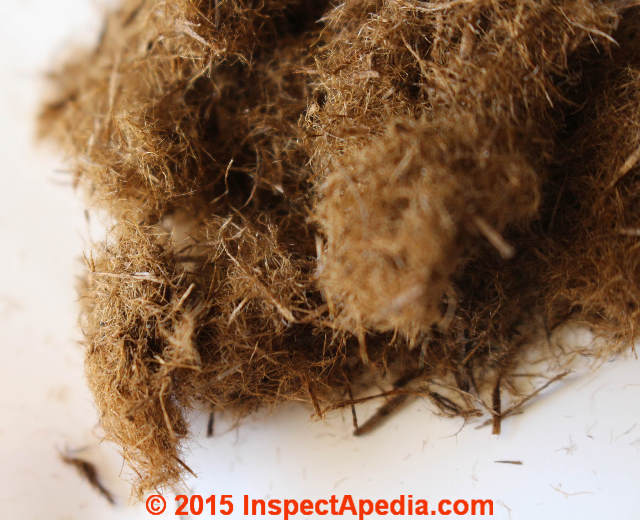
Thanks for the excellent photos. Your insulating material may be Silvawool or Kimsul or a similar chemically treated wood fiber insulating material: at least to me this looks very much like a treated wood fiber insulating product.
Indeed the fibers in your photos are longer than in some balsam wool insulation products, but if we consider that a wide variety of cellulose fibers were used for insulating materials that is not a surprise.
Even sugar cane was used.
Silvawool® was indeed a shredded wood fiber insulation product, one of many popular in North America beginning in the 1950's. There is no doubt that wood fiber insulation was used not just in buildings but within refrigerators, freezers and in other special applications.
SilvaWool was a Weyerhaeuser product - the trademarked brand name was first used in 1949 and was filed in a trademark application by Weyerhaeuser (Tacoma Washington) on 5 August 1950 as # 0562777.
The Silvawool trademark was fully registered in 1952. The company's literature (found by trademark search) described Silvawool as "... Silvawool is a product related to chemically impregnated wood fiber for use as insulation material. " Silvawool insulation is no longer in production.
The material is likely to have been treated with a fire retardant, perhaps the same borate salt as was later used in cellulose (chopped newsprint) insulation.
As with other wood and cellulose insulations, this is not an asbestos-suspect material though we have read reports of possible cross-contamination when some companies processed non-asbestos insulation products at the same plant where asbestos products were handled. Generally testing for asbestos is not performed unless we find some particular reason to do so such as facing a high-cost dusty demolition project.
Kimsul Crepe-paper-like Insulation

Kimsul™, produced by Kimberly Clark, in Neenah Wisconsin in the U.S., is an older insulating material used from about 1930 into at least the 1950's and that has been described by some building history sources as a creped paper insulating material that was impregnated by asphalt.
Although Kimsul was described by its manufacturer as a wood-fiber product, It won't look like the wood fiber insulation described
at BALSAM WOOL INSULATION PROPERTIES though I've seen Silvawool and "Kimsul" described together in some sources.
Kimsul, according to Bill Kibbel at historicbuildings.com, was used in refrigerators, car dashboards, in trains, and as an insulation in Quonset huts during WWII. - retrieved 2015/12/29, original source http://historicbldgs.com/asbestos.htm
Kimsul, a Kimberly-Clark insulation brand copyrighted in 1949, was sold in round rolls or in stitched batts, was still in distribution in 1956 when Kimberly-Clark advertised Kimsul for use as building insulation in the April 1956 issue of Popular Science - ad excerpt shown here.
Kimsul was produced in reflective-faced batts which, if spread apart, showed what look like soft, brown, accordion-pleated crepe paper.
The company described Kimsul insulation with its reflective "vaporseal" as resisting radiant heat loss as well as providing insulation value in ceilings and walls.

The Kimsul manufacturer provided charts of percent of loss in a Kimsul-insulated wall as ranging from 0 to 90% but did not provide the R-values used today.
Typical heat loss savings estimated by the company for homes using Kimsul in walls and roofs ranged from about 25% to 38%. A K-factor of 0.27 Btu/sq.ft. was quoted in the company's Kimsul catalog.
Kimsul's ASTM tested fire resistance was quoted in the same catalog as resisting flame temperatures as high as 1700 degF.

You may see Kimsul Insulation printed on the Kimsul insulating batts in an attic or wall of a home built in the 1940's and 1950's. Each roll of Kimsul contained 200 sq. ft. of insulating material.
The photo above, posted by InspectApedia.com reader Frank W., shows characteristic black crepe paper facing on Kimsul® insulation.
The use of stitched crepe paper facing allowed balsam wool batts of insulation to be installed easily under roofs as well as in walls and attic floors.
The Kimsul insulation shown below uses a foil facing and was observed by inspector Lawrence Transue in a Pennsylvania home built in 1940. At a tear in one of the batts you can see the balsam-wool interior.
 ...
... 
Kimsul was also used as acoustic insulation for sound control, in theaters and in some audio speakers as an acoustic curtain, and in airplanes.
- Cook, Richard K. "Behavior of acoustic materials." Journal of the Society of Motion Picture Engineers 51, no. 2 (1948): 192-202.
- Karpodines, Marco. "Controlled ambience speaker system." U.S. Patent 4,349,084, issued September 14, 1982.
Excerpt: The acoustic curtain 58 may be made of any suitable sound-absorbing material and may, for example, be made of a layer of packed fibrous cotton material approximately one inch thick similar to that used for the acoustic cover 28. In one embodiment, both the acoustic cover 28 and the acoustic curtain 58 may be made of material sold under the brand name KIMSUL™.
...
The sound projected from the speaker system can be varied by altering the type of material used for the acoustic curtain and acoustic cover, although the preferred material is sold under the brand name KIMSUL™. - Lawrence Transue is a Pennsylvania building scientist and consultant, a certified ASHI home inspector, a Licensed Pesticide Applicator, a BPI Building Analyst & Envelope Professional, with 18 Years of Home Inspection Experience. He can be reached by Telephone: 610.417.0763, by Email: lawrence@lawrencetransue.com as well as at his WEBSITE and at FACEBOOK.
Balsam Wool Insulation History, Patents & References

Photo: reflective-liner (foil faced) Balsam Wool from reader Glenn, found in a home built in 1960.
- [4] Patents describing the Production & Use of Balsam Wool, and assigned to the Wood Conversion Company of Cloquet, Minnesota
- SPAFFORD'S PATENT [PDF] for an insulation pad described using Balsam Wool (US Patent 2,028,253, 15 September 1930. He improved the production to permit thicker blankets of insulation.
- Balsam wool is described in the US WEISS PATENTS NOS. 1,336,402, [PDF]US Pat. 1,336,403, and 1,336,404. Related patents derive from the 1930's-40's.
- In the 2nd WEISS PATENT, US PAT. 1,336,403, [PDF] Weiss described preferring wood fibers, using tree bark, from spruce, balsam, fir and redwood and any bark having long fibers (also he considered Japanese swamp moss) including ground wood pulp that was then shredded into fibrous form.
The problem of how to keep the fibers in place between two sheets of paper without having to sew and quilt the entire assembly was solved by spraying fibers with an adhesive, or in later versions, using an adhesive bonded to the paper inner faces, such as asphalt, pitch, or tar. Fibers were also treated with a water resistant sizing. - In the third WEISS BALSAM WOOL INSULATION PRODUCTION PATENT 1,336,404 [PDF] the inventor referred to the insulating material as "wood cotton" - a "cellulosic product derived from wood pulp" Various sprays were used to give the material desired properties and for fiber control, including casein, lime, sodium silicate.
- [5] Forest History Society, Comp., "Interviews with pioneer lumbermen, 1953-1957", Minnesota Historical Society, web search 6/19/2012, original source: http://www.mnhs.org/library/findaids/P2385.xml . Abstract: Transcripts (typewritten carbon copies) of interviews between pioneer lumbermen and relatives of lumbermen of the Upper Midwest and members of the Forest History Society staff.
The interviewees are: Paul Caplazi, Leonard Costley, Walter Ernest Dexter, Maud Mullen Calgren, George W. Dulany, Herman Heitman, Julius Joel, James Arthur Mathieu, Hope Garlick Mineau, Wirt Mineau, George Neils, Walter Neils, L. J. Olson, Margaret Orr O'Neill, Hugo Schlenk, Orrin W. Sinclair, and James Stevens. and
"Origins of the Lumber Industry at Cloquet," by Hugo Schlenk. 3 leaves. Information is given on the Charles N. Nelson's Lumber Company's Cloquet mill which was built in 1880; on the operations of the Knife Falls Lumber Company (1883); the absorption of this firm by the George Shaw company of Davenport and by Frederick Weyerhaeuser (1883).
This firm was then called Renwick, Shaw and Crossett Company, and later the Cloquet Lumber Company. Other companies organized were: Cloquet Water Power Company (1882); Johnson-Wentworth Company (1894); Northwest Paper Company (1898);
Wood Conversion Company (1922); and the Northern Lumber Company (1911), the latter three being Weyerhaeuser interests. The paper ends with a description of the organization and early leaders of the Knife Falls Boom Corporation, which was incorporated in 1871. - Asbestos products and their history and use in various building materials such as asphalt and vinyl flooring includes discussion which draws on ASBESTOS, ITS INDUSTRIAL APPLICATIONS, ROSATO 1959 [published as web pages], D.V. Rosato, engineering consultant, Newton, MA, Reinhold Publishing, 1959 Library of Congress Catalog Card No.: 59-12535 (out of print).
- Building Research Council, BRC, nee Small Homes Council, SHC, School of Architecture, University of Illinois at Urbana-Champaign, brc.arch.uiuc.edu. "The Small Homes Council (our original name) was organized in 1944 during the war at the request of the
President of the University of Illinois to consider the role of the university in meeting the demand for housing in the United States. Soldiers would be coming home after the war and would be needing good low-cost housing. ... In 1993, the Council became part of the School of Architecture, and since then has been known as the School of Architecture-Building Research Council. ...
The Council's researchers answered many critical questions that would affect the quality of the nation's housing stock.- How could homes be designed and built more efficiently?
- What kinds of construction and production techniques worked well and which did not?
- How did people use different kinds of spaces in their homes?
- What roles did community planning, zoning, and interior design play in how neighborhoods worked
- INSULATION: ADDING INSULATION TO AN EXISTING HOME [PDF] U.S. Department of Energy - tips on how to do your own check for the presence of absence of insulation in a home
- INSULATION: SELECTING INSULATION FOR NEW HOME CONSTRUCTION, [PDF] U.S. Department of Energy - "Your state and local building codes probably include minimum insulation requirements, but to build an energy-efficient home, you may need or want to exceed them.
For maximum energy efficiency, you should also consider the interaction between the insulation and other building components.
This is called the WHOLE-HOUSE systems design approach. [PDF] - Teesdale, Laurence Victor. THERMAL INSULATION MADE OF WOOD-BASE MATERIALS: ITS APPLICATION AND USE IN HOUSES [PDF] (1958) Report No. 1740, US Forest Products Laboratory, U.S. Department of Agriculture, Madison 5, Wisconsin, in cooperation with the University of Wisconsin.
Reader Comments, Questions & Answers About The Article Above
Below you will find questions and answers previously posted on this page at its page bottom reader comment box.
Reader Q&A - also see RECOMMENDED ARTICLES & FAQs
On 2021-10-22 by inspectapedia.com.moderator (mod) - why we slash insulation facing when adding more batts: avoid a moisture trap
@JC,
Your insulation installers are quite correct; you should follow their instructions.
Kraft paper is more permeable than foil but it is nevertheless a vapor barrier.
On 2021-10-22 by JC
I have what appears to be balsam wool blankets insulating my attic floor. Then 4 inches of fiberglass batts over that.
The MassSave people (I live in Massachusetts) want to blow in another 12" of cellulose over that, - but: they say that the balsam wood blankets are creating two layers of vapor barrier, since by their nature they are wrapped in kraft paper all around.
They are telling me to cut the top layer of the blanket and remove the kraft facing on the top, leaving only the bottom layer as vapor barrier. -- Is this really necessary. No sign of mold. Just aging kraft paper.
On 2021-07-27 by (mod)
@gregg,
No. Please take a look at the article above for a description of what's in balsam wool insulation. Let me know if that leaves you with any questions or suggestions.
Thanks.
On 2021-07-27 by (mod) - hemp insulation
@Emily,
Thank you for an excellent photo and a helpful question.
That is Jute building insulation, described at
HEMP / JUTE INSULATION
which is also included in our insulation identification page at
INSULATION IDENTIFICATION GUIDE
I'll add your photo there as it's even better than our other Jute building insulation images.
On 2021-07-27 by Emily
Hi, please see the image for what's insulating most of my 1923 brick house. I was told by the realtor that this is balsam wool, but it's not really looking like a match to me as I research. Your thoughts? Thank you!

On 2021-06-25 by mak.church (mod)
@gregg,
You are on the right page and I would direct you to the above section titled:
Does Balsam Wool Insulation Contain Asbestos?
Let us know if you have additional questions.
On 2021-06-25 by gregg
does balsam wool insulation have asbestos in it//
On 2020-12-28 by (mod)
Lynn,
Possibly.
Use the Add Image button to post a photo of the insulation itself and of any writing on the facing
1 image per comment
On 2020-12-27 by Lynn
While remodeling an old house, The walls have insulation with black paper on both sides is this balsom wool?
On 2020-11-09 by (mod)
That might be jute packing or insulation, or the edge of fiberboard.
and
On 2020-11-09 by Jeff
What is this brown woody/fibrous stuff? Balsam wool? Wood-fiber board? Asbestos?

On 2020-08-31 by (mod) - clean up falling balsam wool or other attic insulation
 The photo isn't quite clear, Caitlin but that does look like Balsam wool;
If so that's naturally mold resistant but not absolutely mold proof; mold might grow first on any paper facing.
Wear proper respirator and other protection, bag the falling insulation, and best to user a HEPA vac for cleanup.
On 2020-08-24 by Caitlin
Hello, I live in a house in Western NY that was built in 1923. Our attic is a crawlspace (accessed through hole in the ceiling) and we haven't been up there, but when we stuck our heads in the hole we found this mess (pictured).
I'm assuming this is Balsam Wool insulation, falling apart perhaps as a result of the previous owner's roof replacement in 2013. I have two questions.
1. Is it possible for Balsam wool to grow mold? In the picture you can see black spots in the falling down batts.
No large black patches, and nothing obvious in the insulation on the floor. I haven't yet gotten close enough to inspect. It's possible that I'm just seeing the black paper wrap through gaps in the insulation...
2. Any tips on how to go about removing all of this? A shop vac maybe?
Thanks very much; your website has been extremely helpful!
...
...
Continue reading at BALSAM WOOL vs CELLULOSE INSULATION or select a topic from closely-related articles below, or select a topic from the closely-related articles below, or see the complete ARTICLE INDEX.
Or see BALSAM WOOL BATT INSULATION FAQs - questions and answers about balsam wool insulation posted originally on this page.
Or see these
Recommended Articles
- ASBESTOS INSULATION - to distinguish from wood or fiberglass
- BALSAM WOOL BATT INSULATION
- BALSAM WOOL vs CELLULOSE INSULATION
- BLOWN-IN INSULATION
- CELLULOSE LOOSE FILL INSULATION
- FIBER & HAIR IDENTIFICATION
- FIBERBOARD SHEATHING - another wood fibre insulating product in board or panel form
- INSULATION IDENTIFICATION GUIDE - topic home
- INSULATION LOCATION - WHERE TO PUT IT
- INSULATION R-VALUES & PROPERTIES
- WOOD FIBRE INSULATING PANELS
Suggested citation for this web page
BALSAM WOOL BATT INSULATION at InspectApedia.com - online encyclopedia of building & environmental inspection, testing, diagnosis, repair, & problem prevention advice.
Or see this
INDEX to RELATED ARTICLES: ARTICLE INDEX to BUILDING INSULATION
Or use the SEARCH BOX found below to Ask a Question or Search InspectApedia
Ask a Question or Search InspectApedia
Try the search box just below, or if you prefer, post a question or comment in the Comments box below and we will respond promptly.
Search the InspectApedia website
Note: appearance of your Comment below may be delayed: if your comment contains an image, photograph, web link, or text that looks to the software as if it might be a web link, your posting will appear after it has been approved by a moderator. Apologies for the delay.
Only one image can be added per comment but you can post as many comments, and therefore images, as you like.
You will not receive a notification when a response to your question has been posted.
Please bookmark this page to make it easy for you to check back for our response.
Our Comment Box is provided by Countable Web Productions countable.ca
Citations & References
In addition to any citations in the article above, a full list is available on request.
- [1] 3/07: thanks to Gary Randolph, Ounce of Prevention Home Inspection, LLC Buffalo, NY, for attentive reading and editing suggestions. Mr. Randolph can be reached in Buffalo, NY, at (716) 636-3865 gary@ouncehome.com
- [2] 06/07: thanks for photographs of transite asbestos heating ducts, courtesy of Thomas Hauswirth, Managing Member of Beacon Fine Home Inspections, LLC and (in 2007) Vice President, Connecticut Association of Home Inspectors Ph. 860-526-3355 Fax 860-526-2942 beaconinspections@sbcglobal.net
- [3] Thanks to home inspector Stephen P. Shockley, Shore-Footed Property Services, for discussing "blackweld" cellulose-based (probably) insulation, August 2010
- In addition to citations & references found in this article, see the research citations given at the end of the related articles found at our suggested
CONTINUE READING or RECOMMENDED ARTICLES.
- Carson, Dunlop & Associates Ltd., 120 Carlton Street Suite 407, Toronto ON M5A 4K2. Tel: (416) 964-9415 1-800-268-7070 Email: info@carsondunlop.com. Alan Carson is a past president of ASHI, the American Society of Home Inspectors.
Thanks to Alan Carson and Bob Dunlop, for permission for InspectAPedia to use text excerpts from The HOME REFERENCE BOOK - the Encyclopedia of Homes and to use illustrations from The ILLUSTRATED HOME .
Carson Dunlop Associates provides extensive home inspection education and report writing material. In gratitude we provide links to tsome Carson Dunlop Associates products and services.
 | HOME | ABOUT | ASK a QUESTION | CONTACT | CONTENT USE POLICY | DESCRIPTION | POLICIES | PRIVACY | |
| © 2024 - 1985 Publisher InspectApedia.com - Daniel Friedman | |||||||||